

What is there today
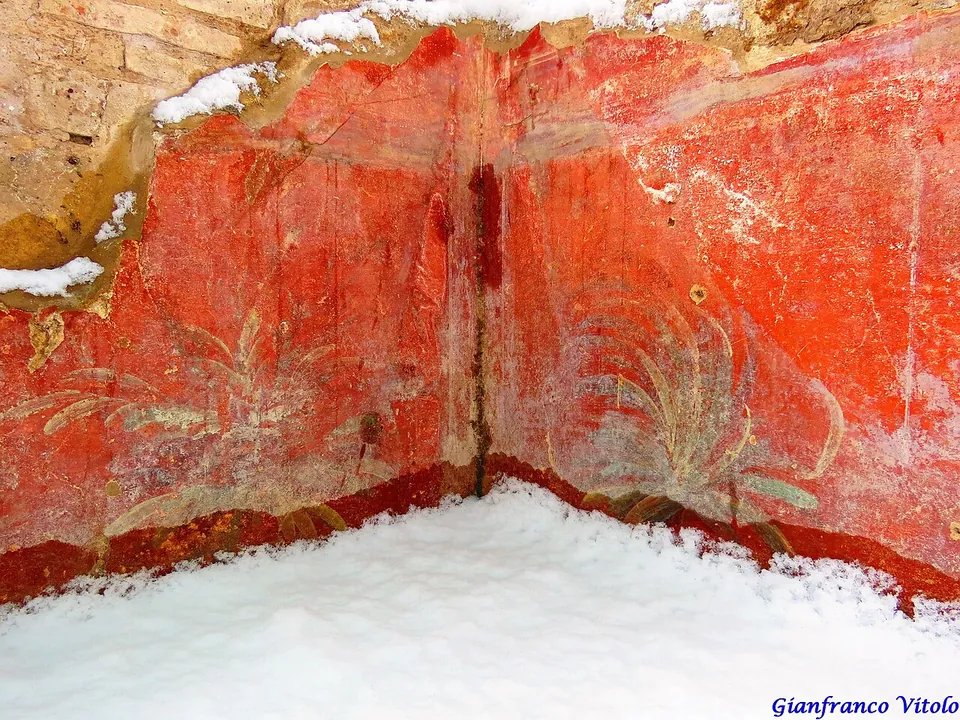
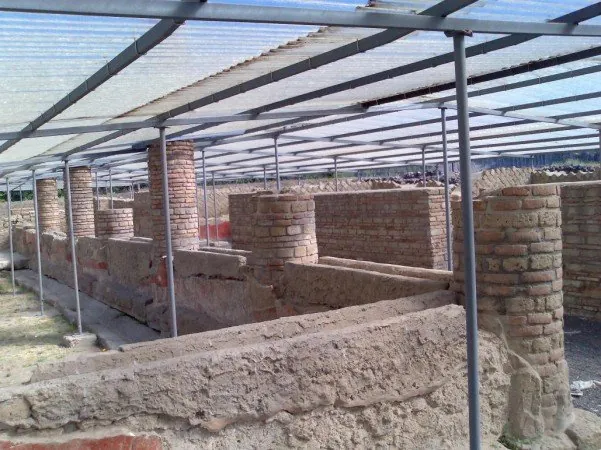
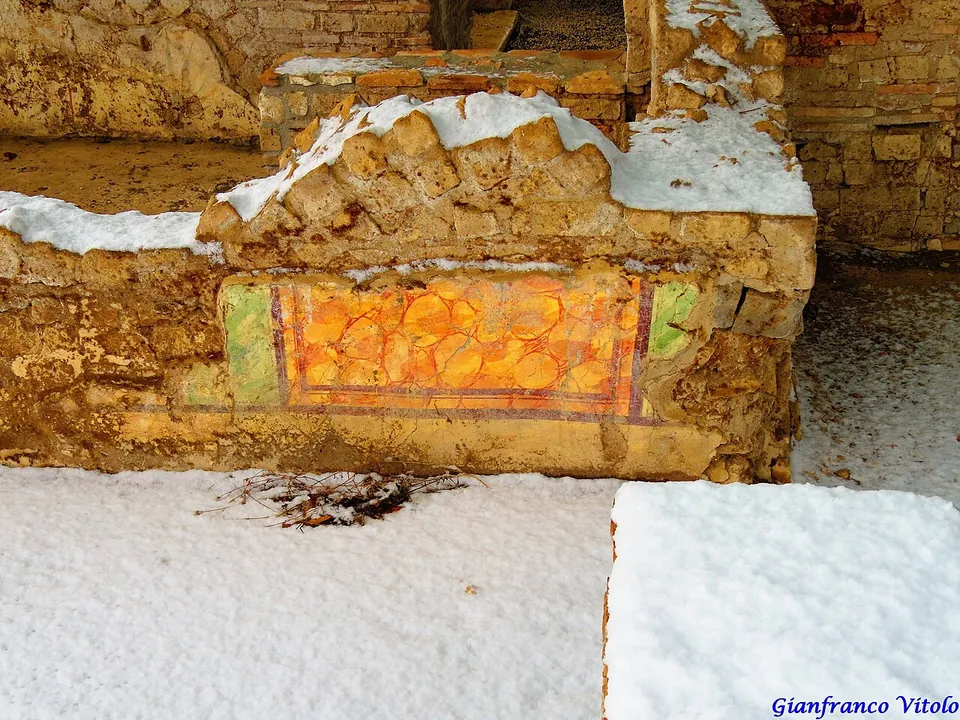
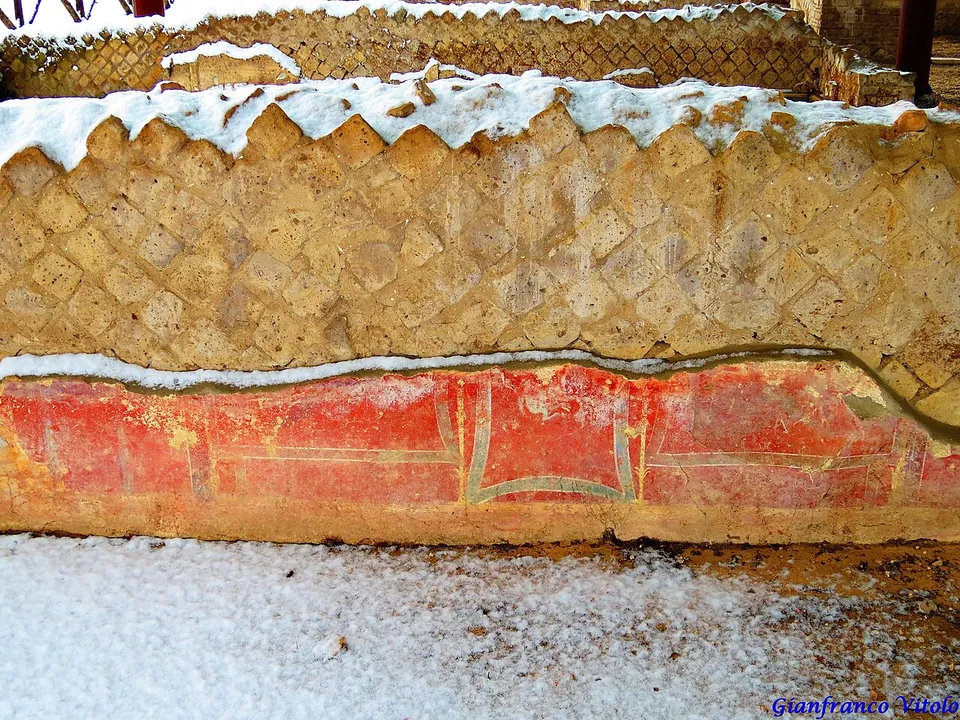
At the entrance, on the north side of the plateau, part of the Roman town wall still stands, built in opus reticulatum, a facing of small stones set in a diagonal net (the operator). Inside, the public quarter with the baths and the forum lay to the east, and in the north-east is a domus of the Hellenistic-Pompeian type, about 2,500 m², presumably the house of Marcus Vipsanius Primigenius, a freedman of Augustus’s son-in-law Agrippa (the operator). Its rooms and peristyle can still be made out, including a bedroom decorated with plants on a Pompeian-red ground (it.wikipedia).
it.wikipedia describes the archaeological park as about 25 hectares inside walls some 2 km long, with the remains of two large round towers, a bath building with a calidarium, the hot room, known as the Torre degli Orefici, and a section of the Roman aqueduct from Serino. The amphitheatre has left only a few pieces of structure (it.wikipedia). de.wikipedia adds a necropolis to the east, at San Ippolisto, in use into Christian times.
Many of the finds are in museums. A 1st-century marble altar dedicated to Tiberius and many other pieces from the temples on the forum are in the Museo Irpino in Avellino (it.wikipedia), and the Palazzo della Dogana dei Grani, about 250 m away on Piazza Umberto I and run with the site, shows finds from Abellinum and from the Capo La Torre necropolis in Atripalda (the operator).
Is it worth the trip?
For the painted house, yes, if you are already in Avellino or passing through Irpinia on a weekday: red and ochre plaster and painted plants are still on the walls of its rooms, as the photographs show, and entry appears to be free. It is not a large set piece to build a day around. Of the amphitheatre only a few pieces remain, and no source describes the rest of the town as standing buildings, so the visit centres on the house. The real catch is the timetable: the site is closed at weekends.
Getting there
The site is on the edge of Atripalda, a few kilometres from Avellino (it.wikipedia), and the way in is from Piazza Umberto I up Rampa San Pasquale (the operator). Street parking is mapped a couple of hundred metres away; no bus stop or station is mapped near the site (OpenStreetMap).
From 4 May to 30 September it opens Monday to Friday, 09.00 to 19.00, last entry 18.30, and is closed on Saturdays and Sundays. The operator’s listing gives no winter timetable, and extra openings on public holidays are announced one at a time. The operator’s notices for 2025 and 2026 describe entry as free, though one 2026 notice also prints a €5 ticket (€2.50 reduced) without explaining it. Booking is optional, on +39 0825 626586 (Ministero della cultura listing, as updated by the operator in May 2026 - check before travelling). The Palazzo della Dogana dei Grani keeps shorter summer hours: Monday 11.20 to 19.00, Tuesday to Friday 09.00 to 15.10 (the same listing).
Visiting details
- Opening hours
- From 4 May to 30 September, Monday to Friday 09.00–19.00 (last entry 18.30); closed Saturday and Sunday. The operator's listing gives no winter timetable; extra openings on public holidays are announced one by one.
- Tickets
- Free, according to the operator's own notices for its 2025 and 2026 openings, including a Saturday evening opening on 23 May 2026 ("ingresso libero e gratuito"). The listing page itself prints no price, and one 2026 notice also carries a €5 / €2.50 ticket table, so ask when booking.
- Parking
- Street-side parking is mapped about 215 m from the site point (OSM way/1562767400 and neighbours). The entrance is from Piazza Umberto I by way of Rampa San Pasquale.
Before you go
- Closed at weekends. The operator recommends booking ahead (optional) on +39 0825 626586.
- No bus stop or railway station is mapped near the site.
Hours and prices checked 8 June 2026 on the operator's own site. Confirm before travelling.
History
The plateau was first a Samnite settlement of the Hirpini (it.wikipedia; the operator dates it to the 4th-3rd centuries BC). When the Roman colony was founded is recorded differently: the operator puts it in the Gracchan age at the end of the 2nd century BC, while it.wikipedia and de.wikipedia credit Sulla, it.wikipedia saying he razed the old site and founded the colonia Veneria Abellinatium on the left bank of the Sabato in 82 BC, with regular streets and a strong ring of walls. de.wikipedia records the colony in the tribe Galeria.
Under Augustus the town took the name of his wife Livia, who held land in the district, and under Severus Alexander it was enlarged again; its full title became Colonia Veneria Livia Alexandriana Abellinatium (de.wikipedia). it.wikipedia links that third-century growth to large-scale immigration from the East, which spread cults such as Sol Invictus.
The end was slow. An earthquake in 346, a volcanic eruption in 472, the war between the Byzantines and the Goths (535-555) and the Lombard invasion of Italy from 568 drove the inhabitants out of the walls (it.wikipedia), and they resettled on the surrounding heights, where Avellino grew (de.wikipedia).
In modern times access has not been simple. In May 2011, after a long legal dispute, the excavated part of the park was handed back to the family that owned the land, and for several years it could not be visited (it.wikipedia). Today it is open again, run by the ministry’s regional museums directorate together with the Palazzo della Dogana dei Grani (the operator).
More photographs

Nearby
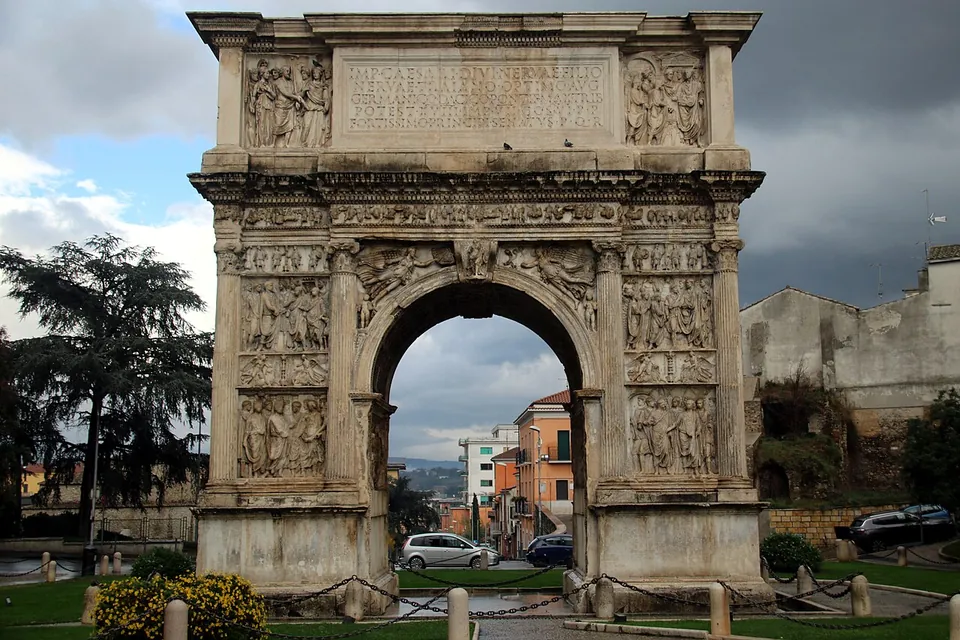
Photo: Mongolo1984 · CC BY-SA 4.0 · Commons
24 km · city · Campania
Beneventum – Benevento
The stops below are grouped by where they are; each has its own page.
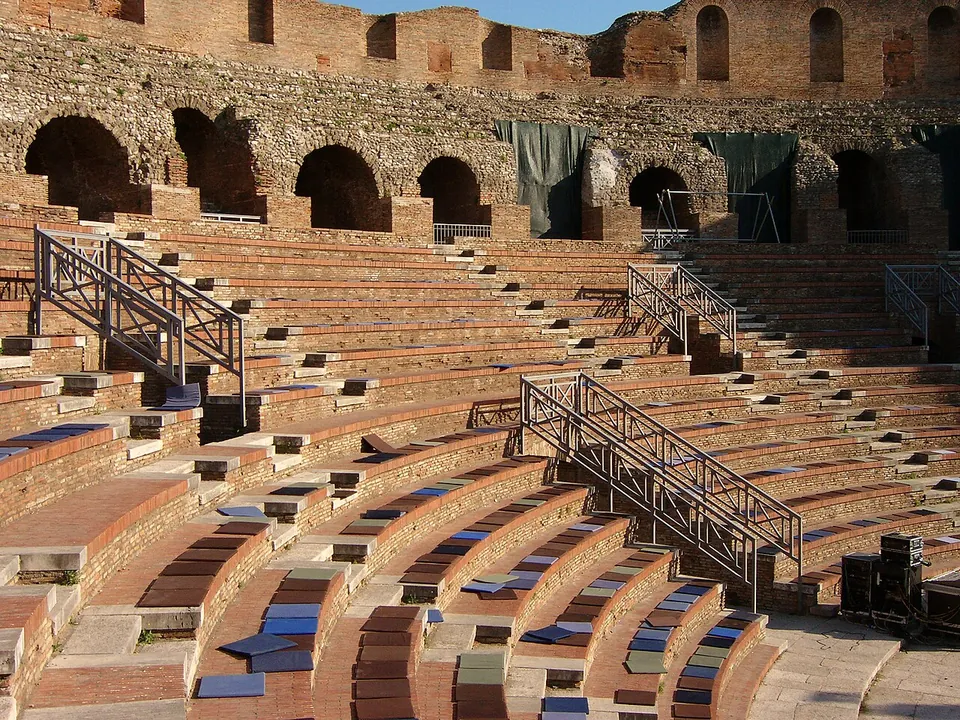
Photo: Simblek at Italian Wikipedia · Public domain · Commons
24 km · theatre · Campania
Roman Theatre of Benevento
The seating is the centrepiece: a semicircle 90–98 m across (published figures differ) around an orchestra of 30 m, built in concrete faced with limestone blocks and brick (the operator; it.wikipedia).
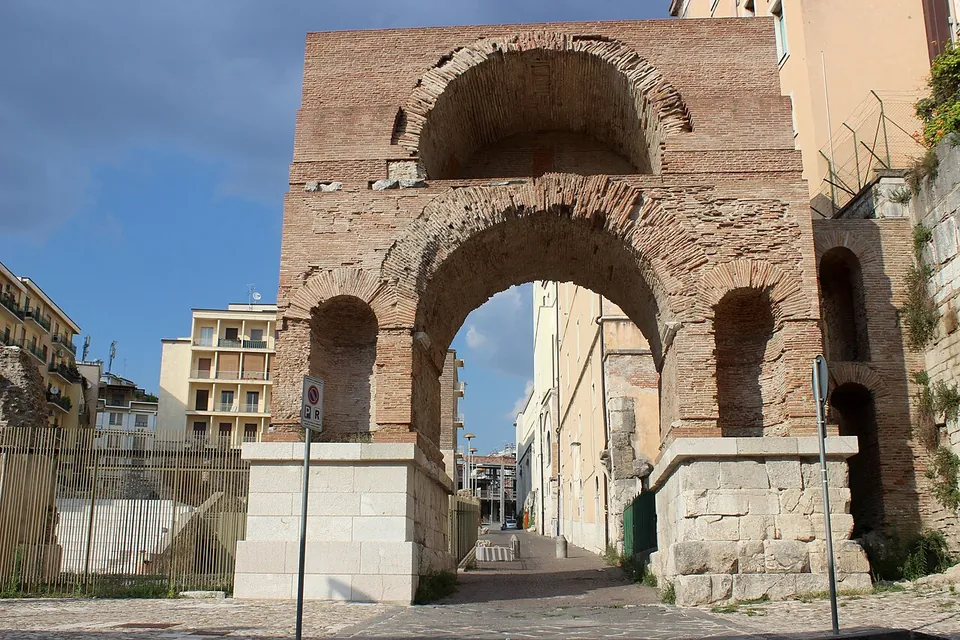
Photo: Miguel Hermoso Cuesta · CC BY-SA 4.0 · Commons
24 km · arch · Campania
Arco del Sacramento
The arch stands over Via Carlo Torre: a tall brick structure on two bases of squared stone, with the main opening flanked by an arched niche on each side and a second, recessed arch above it.


Straight-line distances.
Sources
Every fact on this page comes from the records below, each used under the licence noted.
| Source | Licence |
|---|---|
| Pleiades 432618 | CC BY |
| Wikidata Q318664 | CC0 |
| Vici.org 3981 | CC BY-SA (text), CC0 (metadata) |
| OpenStreetMap way/228022534 | ODbL |
| Wikipedia (it) — Abellinum | CC BY-SA 4.0 |
| Wikipedia (de) — Abellinum | CC BY-SA 4.0 |
| Wikipedia (fr) — Abellinum | CC BY-SA 4.0 |
| Ministero della cultura — Palazzo della Dogana dei Grani e Area archeologica dell'Antica Abellinum (the operator's listing) | licence not recorded |
| Ministero della cultura — 2 giugno 2026 at the Antica Abellinum (opening notice) | licence not recorded |
| Ministero della cultura — Notte Europea dei Musei 2026 at the Antica Abellinum (opening notice) | licence not recorded |
| Ministero della cultura — Pasquetta 2026 at the Antica Abellinum (opening notice) | licence not recorded |