What is there today
The archaeological park is two zones with separate entrances, on either side of the modern road and the river Aterno (the operator).
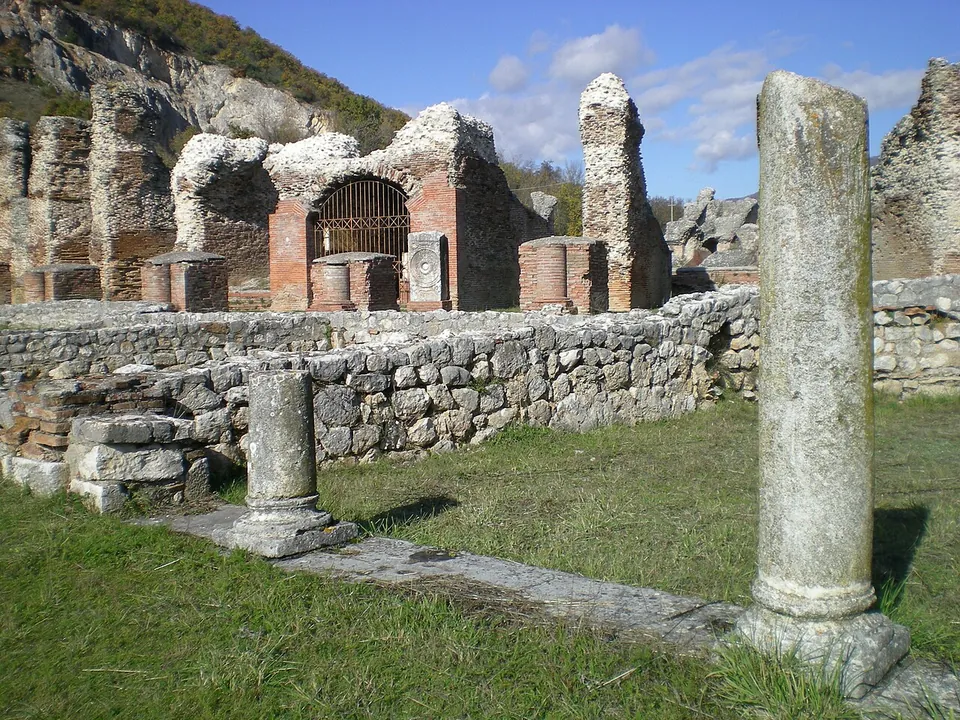
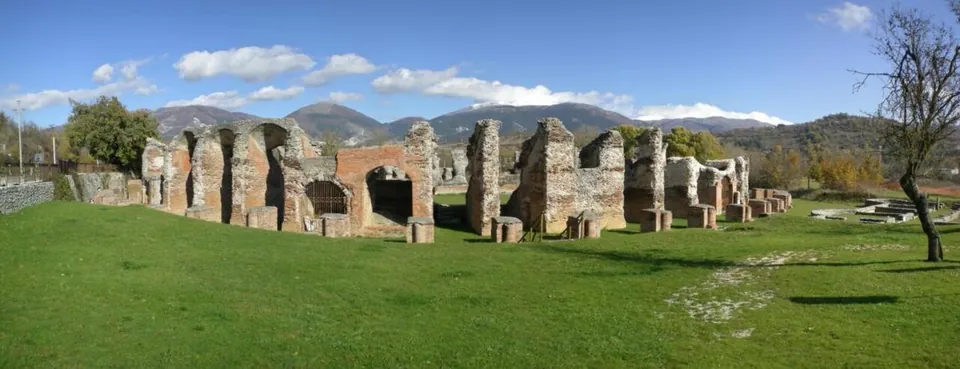
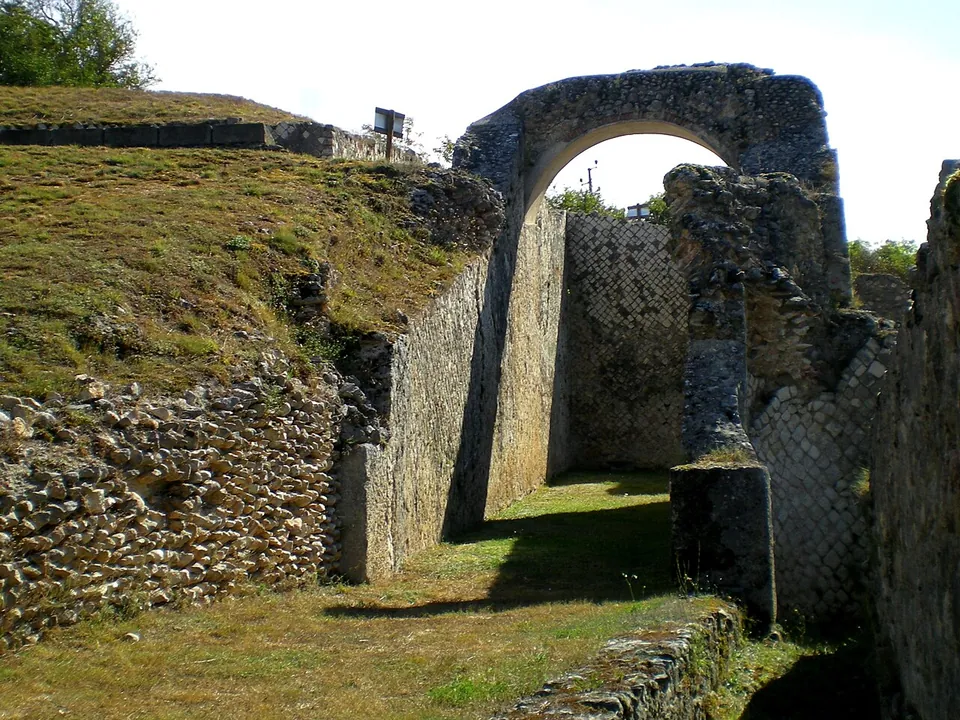
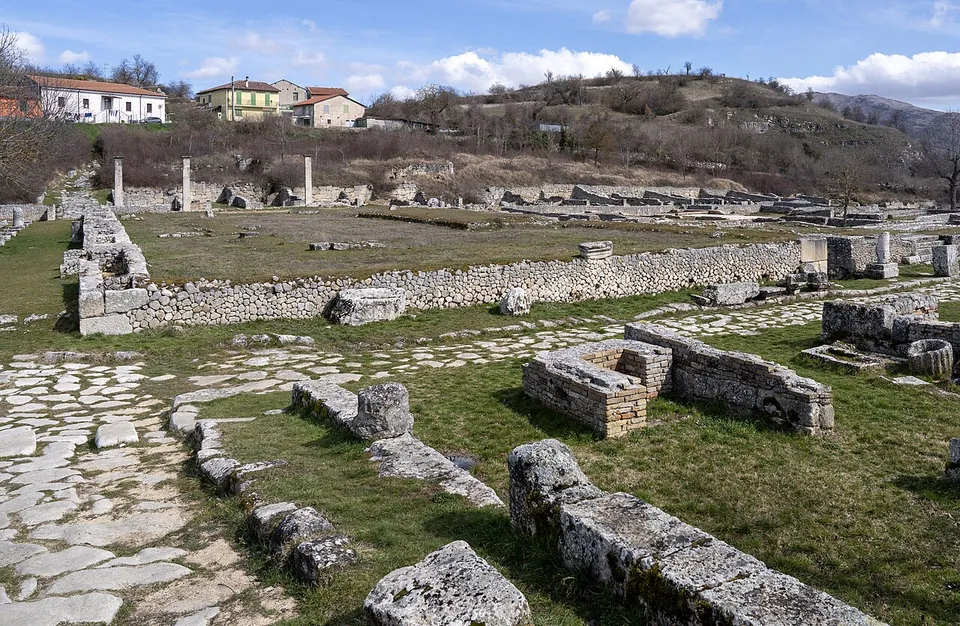
The amphitheatre, on the flat ground south of the river, is the larger sight. It measures 68 by 53 m and is estimated to have held 6,000 people. Its seating has almost entirely gone, but the outer corridor still runs right round the building, marked by its brick piers (it.wikipedia; the operator), and the arena and the gallery behind the podium wall are still easy to read (the operator). Next to it is the “domus a peristilio”, a house built round a large rectangular courtyard, with mosaics in its rooms and painted plaster on its walls; its date is uncertain (the operator). A stretch of the paved Via Caecilia, the Roman road the city grew along, also survives by the amphitheatre (the operator; it.wikipedia).
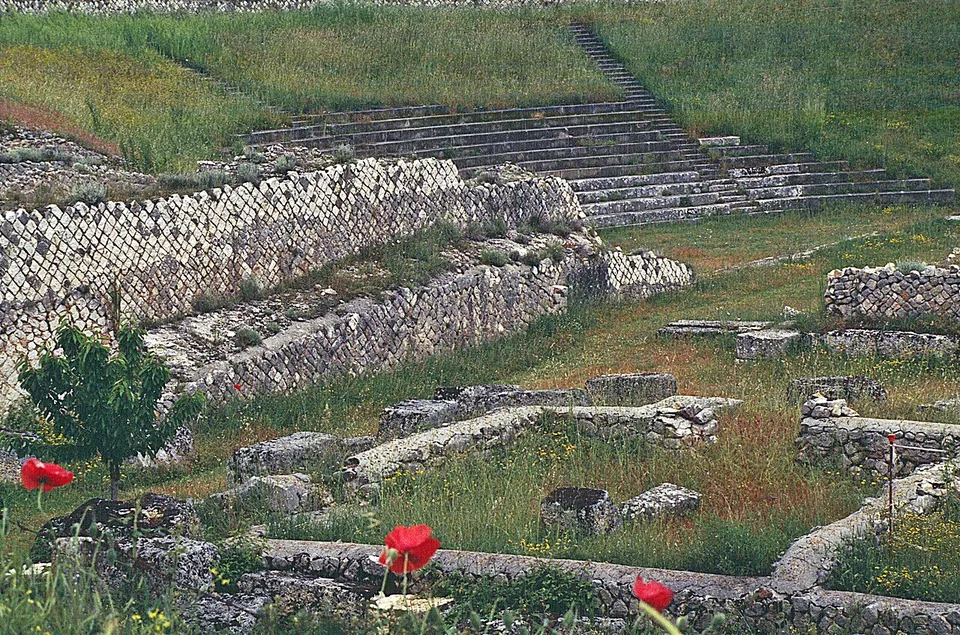
The theatre lies north of the river at the foot of the San Vittorino hill. Its seating was 80 m across and held about 2,000 people. The lower part, eighteen rows reached by three stairways, has been partly uncovered, and in front of it are the remains of the stage building, almost 60 m long; the walls still clearly show their opus reticulatum, a facing of small stones set in a net pattern (it.wikipedia). The rows have been partly restored, while the stage survives as foundations (de.wikipedia). Friezes and columns from the excavations are kept nearby (it.wikipedia).
Remains of baths and an aqueduct are also recorded (it.wikipedia; de.wikipedia), but most of the city, including its forum, basilica and sanctuaries, is known mainly from geophysical survey (en.wikipedia), and the operator describes the park as the theatre and amphitheatre zones alone. Near the amphitheatre, the University of L’Aquila has been excavating the cathedral of Santa Maria since 2012: a church with three aisles whose apse dates from the 6th or 7th century (it.wikipedia).
Is it worth the trip?
If you are in L’Aquila, yes: it is a short drive, and it gives you an amphitheatre whose brick piers still stand all the way round, with a theatre and its seating close by. Do not expect a town to walk through, though. Apart from the house and the stretch of road by the amphitheatre, the city’s streets and buildings are not on show, so the visit is the two monuments rather than a day out.
The timing takes planning. The park opens only in the morning on most days, only in the afternoon on Friday, and is closed on Sunday and Monday. There is no bus stop mapped near either entrance, so you need a car. A ticket is €5, or €2 for 18 to 25-year-olds, and under-18s go free.
Getting there
The park is in San Vittorino, a frazione of L’Aquila, along the SS 80; published distances from L’Aquila run from 9 to 11 km (en.wikipedia; it.wikipedia). The amphitheatre entrance is at SS 80 DIR, km 0+650, and the theatre entrance at SS 80, km 9+500 (the operator). No bus stop is mapped near either one (OpenStreetMap).
From October the park is open Tuesday, Wednesday, Thursday and Saturday 08.30–13.30 and Friday 14.30–18.30, and closed on Sunday and Monday, except public holidays and the first Sunday of the month, when it opens 08.30–13.30. Until 30 September the Friday opening runs to 19.30; the official ticket office gives Friday 14.30–17.30 in November and Tuesday to Saturday mornings, 08.30–13.30, in December. The ticket office closes half an hour before the site.
A ticket is €5 and covers both the amphitheatre and the theatre; the reduced ticket is €2 for 18 to 25-year-olds, under-18s go free, and entry is free for everyone on the first Sunday of the month. Tickets are sold on site or online through CoopCulture or the Musei Italiani app, and booking is optional (MuNDA, Ministero della Cultura and CoopCulture, read 21 October 2026; check before travelling, as the timetable changes with the season).
Visiting details
- Opening hours
- From October: Tuesday, Wednesday, Thursday and Saturday 08.30–13.30, Friday 14.30–18.30; closed Sunday and Monday, except public holidays and the first Sunday of the month (08.30–13.30). Until 30 September the Friday opening runs to 19.30. The official ticket office lists Friday 14.30–17.30 in November and Tuesday to Saturday 08.30–13.30 in December. The ticket office closes 30 minutes before the site.
- Tickets
- €5; €2 reduced (ages 18–25); free under 18 and for everyone on the first Sunday of the month. One ticket, sold as "Anfiteatro e Teatro", covers both zones; at the ticket office or online through CoopCulture or Musei Italiani, booking optional.
Before you go
- The theatre and the amphitheatre are two separate zones with their own entrances, on either side of the modern road and the river Aterno, about 500 m apart.
- Open in the morning only on most days and in the afternoon only on Friday; closed Sunday and Monday.
- No bus stop is mapped near either entrance; the site needs a car.
Hours and prices checked 21 October 2026 on the operator's own site. Confirm before travelling.
History
Amiternum was one of the most important Sabine towns, and its name comes from the river Aternus; according to Cato, the Sabines traced their origin to Testruna, a village near it (it.wikipedia). Rome took it in 293 BC (Pleiades; en.wikipedia), or 290 BC in another account (it.wikipedia). The hilltop settlement at San Vittorino was then given up for a new town in the valley, laid out along the Via Caecilia (de.wikipedia; en.wikipedia). The city lay where four Roman roads met: the Via Caecilia, the Via Claudia Nova and two branches of the Via Salaria (Pleiades). The historian Sallust was born here in 86 BC (Pleiades).
At first a praefectura, Amiternum became a municipium under Augustus (it.wikipedia). The theatre was built in the second half of the 1st century BC and the amphitheatre in the 1st century AD (the operator; it.wikipedia), and by the end of the 2nd century AD all the main buildings of the centre were in place (de.wikipedia). The town lived mainly from livestock, helped by its position on the routes of seasonal transhumance (the operator). The best-known inscription found here is a calendar, the Fasti Amiterni (de.wikipedia).
The town became the seat of a bishop under the later empire, and a severe earthquake in 346 began its decline (de.wikipedia). From the 5th century houses and cemeteries were built over the public monuments, and in the early Middle Ages the theatre, by then largely buried, was occupied by wooden huts and then a cemetery (the operator). The founding of L’Aquila nearby in the 13th century drew its people away (en.wikipedia; it.wikipedia), though the operator records the site as still inhabited into the 15th century.
The theatre was uncovered in 1878 and the amphitheatre in 1880, and both were declared national monuments in 1902; the theatre was restored in the 1960s and 1970s, and work to consolidate the amphitheatre began in 1996 (it.wikipedia). Between 2006 and 2013 a research project of the universities of Bern and Cologne studied the city, finding its forum with a basilica, a large house of the local elite and several sanctuaries (de.wikipedia). In the village of San Vittorino, the church of San Michele stands over early Christian catacombs (it.wikipedia; de.wikipedia).
More photographs
Nearby
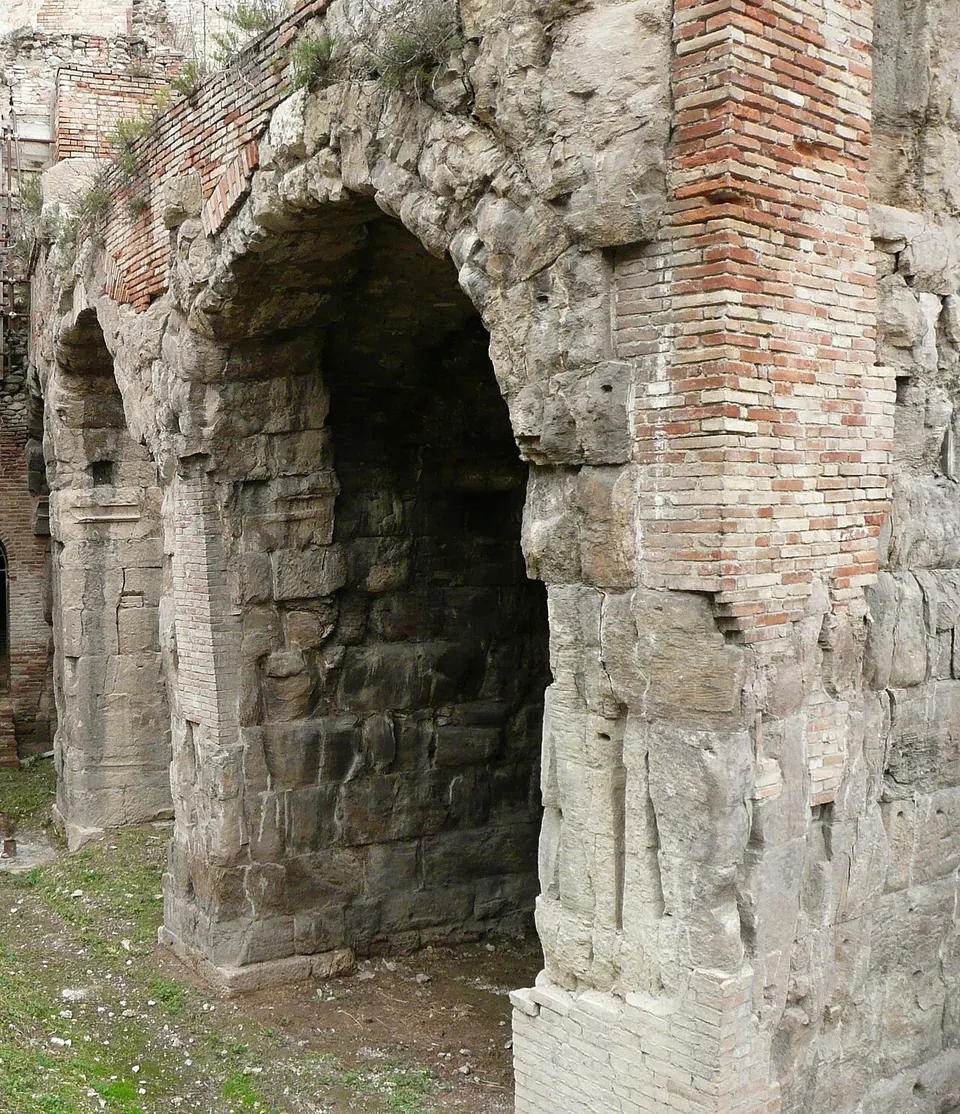
Photo: Franco TamTam · Public domain · Commons
43 km · city · Abruzzo
Interamnia Praetuttiorum – Teramo
The theatre and the amphitheatre stand side by side next to the cathedral, in what was the western quarter of the Roman town; a theatre and an amphitheatre a few metres apart is described as almost unique (it.wikipedia).
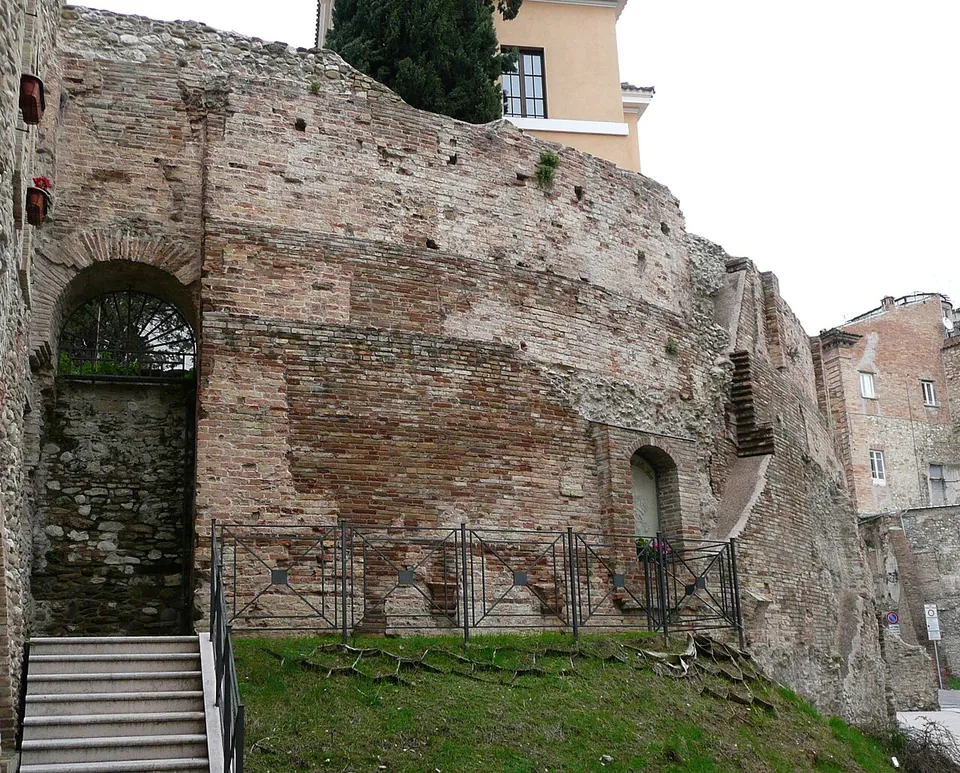
Photo: Franco TamTam · Public domain · Commons


Straight-line distances.
Sources
Every fact on this page comes from the records below, each used under the licence noted.