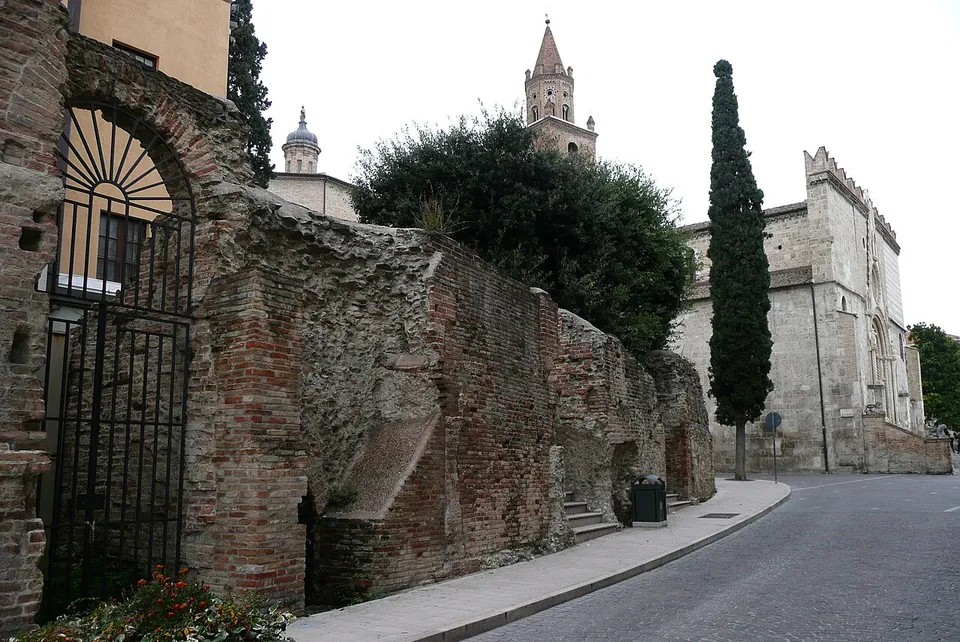
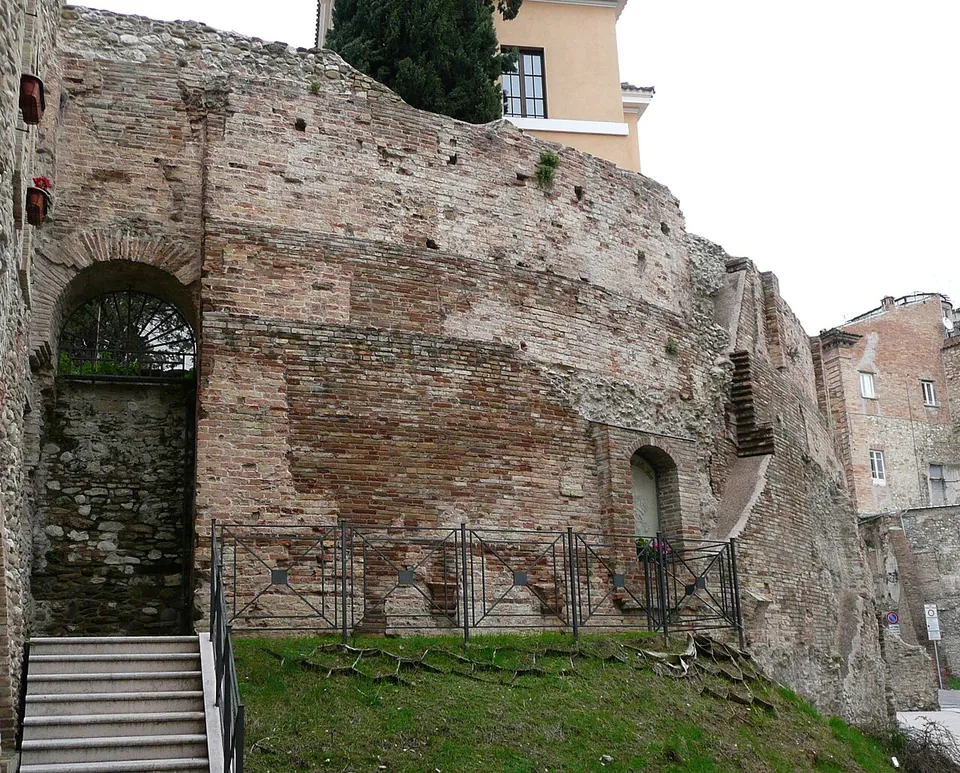
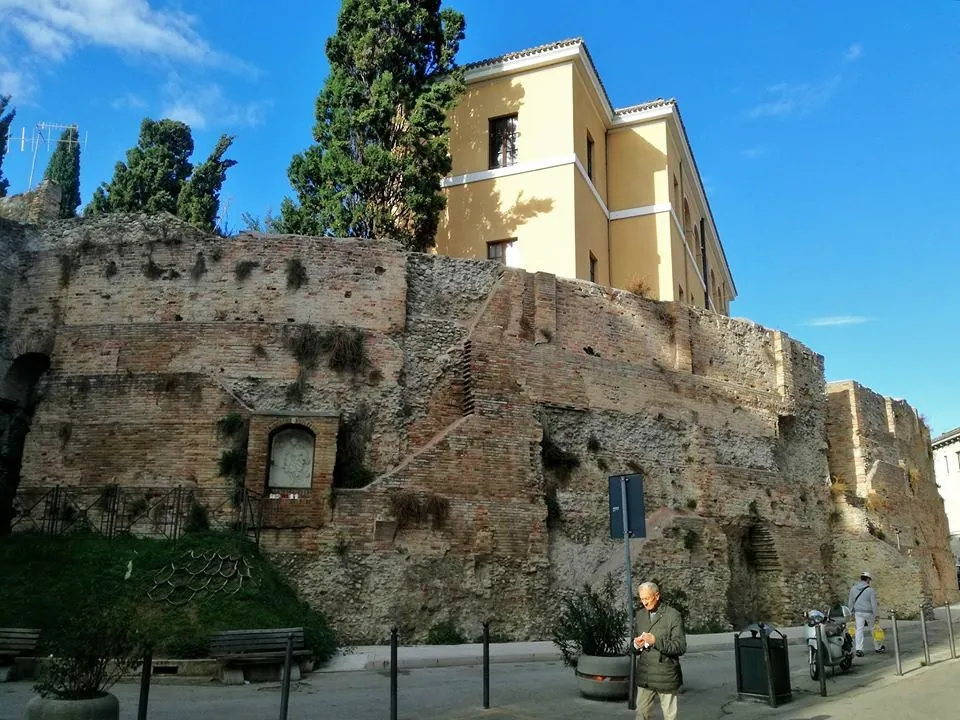


What is there today
The outer wall is the monument. Its brick masonry is best seen in via San Berardo and immediately to the left of the cathedral, and several entrances can be made out in it: an arch on the short axis of the ellipse and three arches side by side on the long one (it.wikipedia). The building was an ellipse 74 m long and 56 m wide, 208 m round, and its ancient ground level lies 6 m below today’s street (it.wikipedia), so the arena floor lay well below the level you walk at now.
Of the inside, nothing is left to see. No trace remains of the structure that carried the seating: the large building of the former seminary stands on top of the amphitheatre, and its construction in the 18th century destroyed the interior (it.wikipedia). The cathedral next door was built in the 12th century over the north-western part of the amphitheatre, and carved stones taken from it can be picked out in the cathedral’s right-hand outer wall and in places inside (it.wikipedia). The Roman theatre stands only a few metres to the east; a theatre and an amphitheatre this close together is described as almost unique in the world (it.wikipedia).
Is it worth the trip?
Not on its own. This is a wall rather than an arena: you look at it from the street, you cannot go in, and the seating has gone. As a stop on a walk through Teramo’s old centre it is worth the ten minutes: it costs nothing to look at, and it sits between the cathedral, which is built partly on top of it, and the theatre. Bear in mind that the theatre is a building site, with works aimed at putting it back into use in 2027 (it.wikipedia), and is not open to visitors in the meantime.
Getting there
The amphitheatre is in the historic centre. Its wall is seen from via San Berardo, beside the cathedral (it.wikipedia), and from via Vincenzo Irelli (the street named on one of the photographs). No operator publishes a ticket or an opening time for it: the wall stands in public streets. Drivers will find a paid car park about 125 m away and a free one about 180 m away (OpenStreetMap). No bus stop is mapped right beside it, but all eight town bus lines pass through Piazza Garibaldi (it.wikipedia), about half a kilometre away. The town’s archaeological museum, the Museo archeologico Francesco Savini, is mapped about 200 m away (OpenStreetMap); the Interamnia page covers it and the town’s other Roman remains.
Visiting details
- Tickets
- Free
- Parking
- Paid surface car park about 125 m away (OSM way/237864628); a free surface car park about 180 m away (OSM way/451257055).
Before you go
- No operator publishes opening hours or a ticket for it. The remains are an outer wall seen from the surrounding streets, and the former seminary building stands over the arena.
- The Roman theatre a few metres away is a building site and is not open to visitors.
History
When the amphitheatre was built is uncertain. Pleiades describes it as a building of the 1st century AD and it.wikipedia puts it at about that time, while en.wikipedia dates it to about the 3rd–4th century AD.
In the Middle Ages it was quarried for stone, like the theatre, above all for the cathedral built over its north-western part (it.wikipedia). On 8 June 1583 Bishop Giulio Ricci, on a pastoral visit to the cathedral, had the earth cleared from the damp wall that emerged in the vegetable gardens beside it, and the record of that visit describes what was found: almost a quarter of the outer curve, radial walls that had carried the seating, a wall face 12 m high, three brick arches of the southern entrance and a woman’s right hand in Greek marble (it.wikipedia). In the 18th century the seminary was built over the interior.
Because houses had been built over both buildings, the remains of the amphitheatre were confused with those of the theatre until 1926. Excavations in 1937 identified them better, and the buildings later cleared from against the outer wall left its north–south course plainer to read (it.wikipedia). In the same year the minister of national education, Giuseppe Bottai, visited the theatre and the first exposed parts of the amphitheatre and decided to fund the recovery of both (it.wikipedia). Tunnels found beneath the structure, apparently dug for a military purpose, have led to the suggestion that the amphitheatre was once used as a fortress, though this remains a hypothesis (it.wikipedia).
Nearby
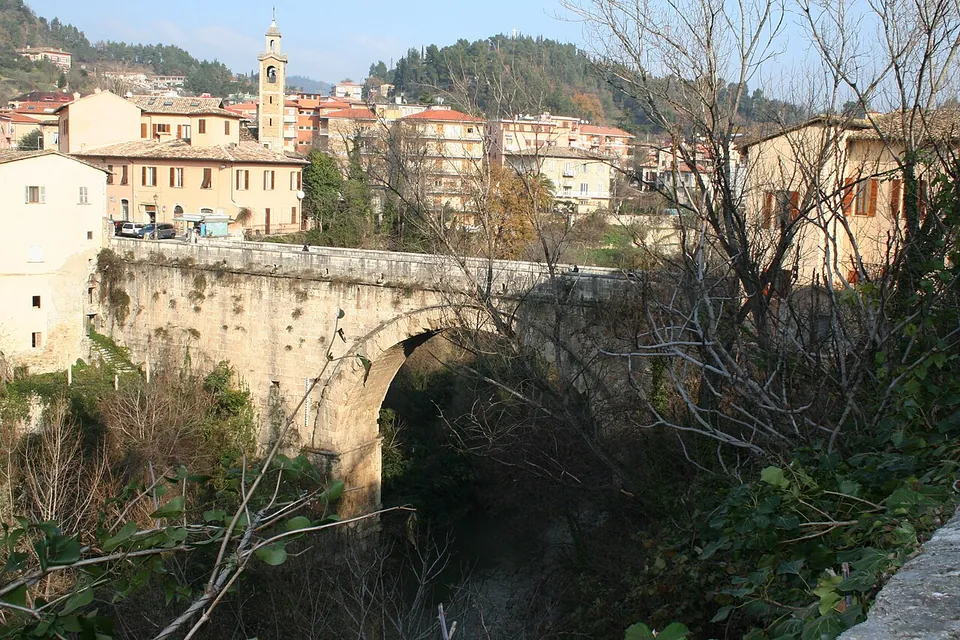
Photo: Infinitispazi at Italian Wikipedia · CC BY-SA 3.0 · Commons
24 km · city · Marche
Asculum Picenum – Ascoli Piceno
The showpiece is the Ponte di Solestà, an Augustan bridge that crosses the Tronto in a single arch of travertine blocks with a span of about 22 m; it stands 25 m high to the roadway, which is 62 m long.
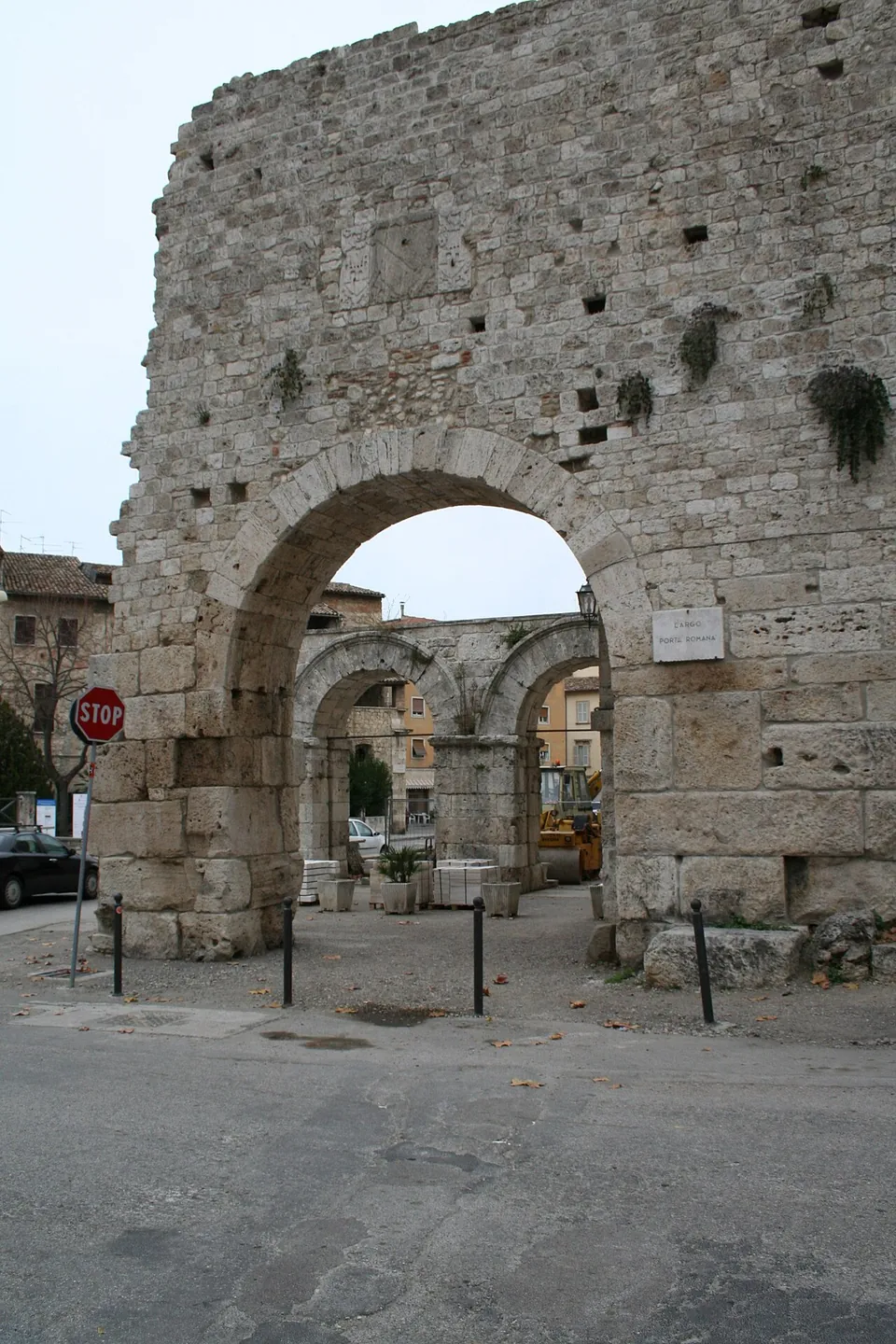
Photo: Sibilla.io at Italian Wikipedia · CC BY-SA 3.0 · Commons
25 km · gate · Marche
Porta Gemina
The gate is two arches carried on three massive travertine piers, built of large squared blocks laid without mortar.
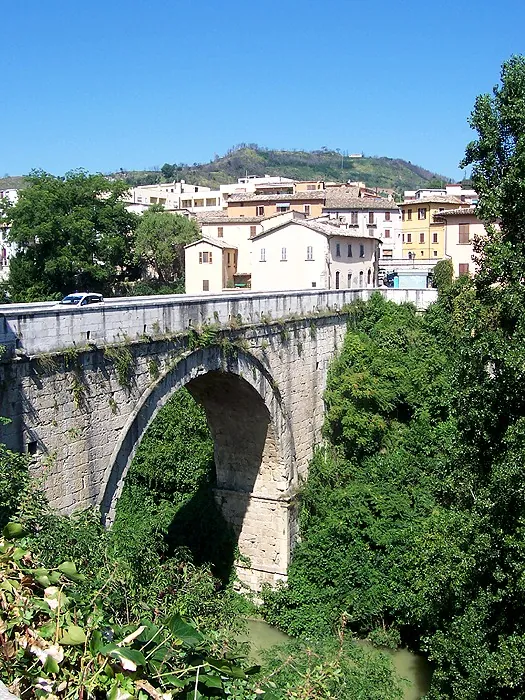
Photo: MarkusMark · CC BY-SA 3.0 · Commons
25 km · bridge · Marche
Ponte di Solestà
The bridge is one round arch of squared travertine blocks with a span of 22.20 m, standing 25 m high to the roadway, which is 62 m long and 6.50 m wide (it.wikipedia; de.wikipedia and the city's tourism site give the same span and length).


Straight-line distances.
Sources
Every fact on this page comes from the records below, each used under the licence noted.
| Source | Licence |
|---|---|
| Pleiades 493909773 | CC BY |
| Wikidata Q3616688 | CC0 |
| Vici.org 4233 | CC BY-SA (text), CC0 (metadata) |
| OpenStreetMap way/235747563 | ODbL |
| Wikipedia (it) — Anfiteatro romano di Teramo | CC BY-SA 4.0 |
| Wikipedia (fr) — Amphithéâtre romain de Teramo | CC BY-SA 4.0 |
| Wikipedia (it) — Teatro romano di Teramo | CC BY-SA 4.0 |
| Wikipedia (it) — Teramo | CC BY-SA 4.0 |
| Wikipedia (en) — Teramo | CC BY-SA 4.0 |
| Pleiades — Interamnia Praetuttiorum (413179) | licence not recorded |