

What is there today
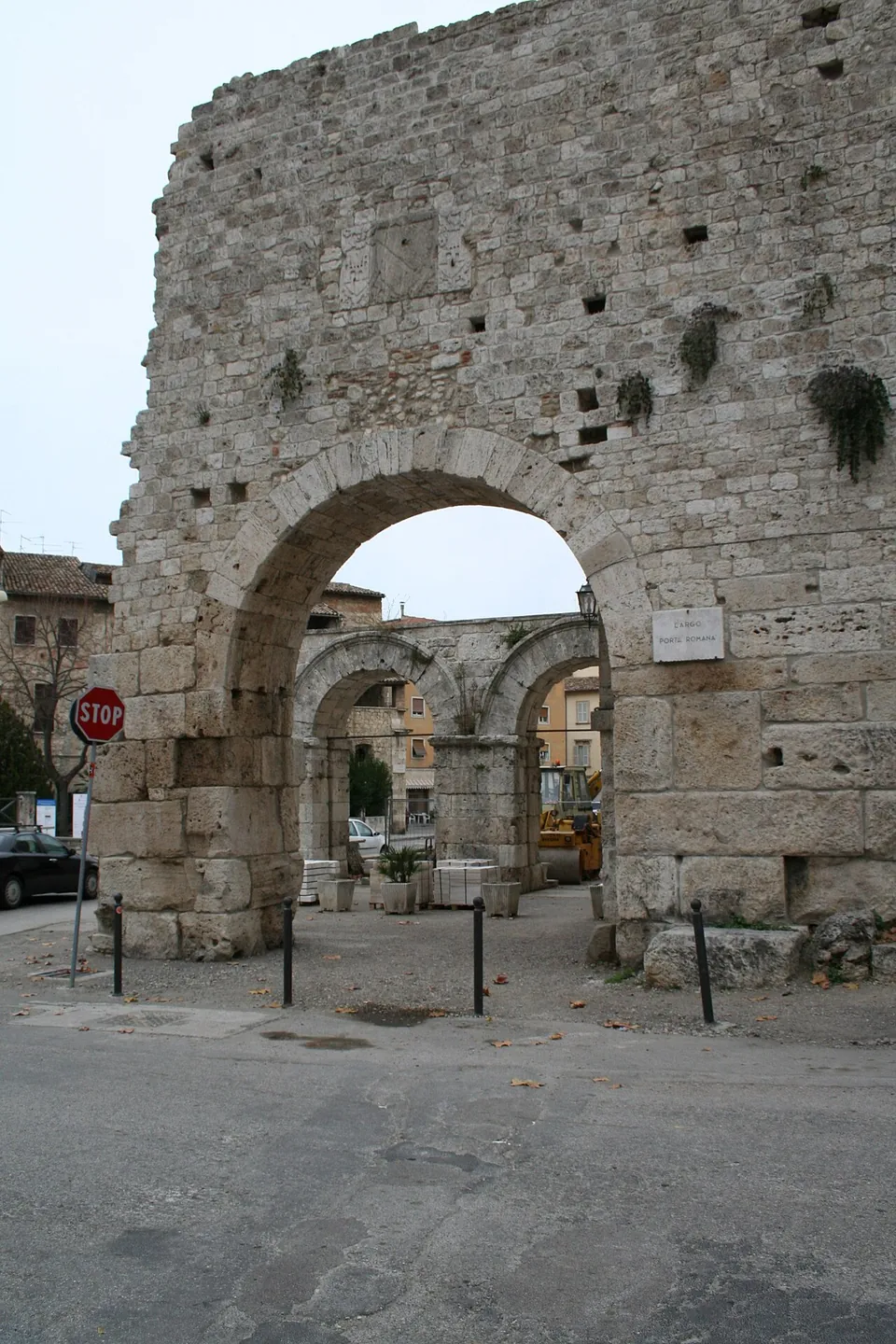
The gate is two arches carried on three massive travertine piers, built of large squared blocks laid without mortar. It stands 6.75 m high and 9.47 m wide; each arch is 5.70 m high and 2.95 m wide, and a cornice runs over both arches and on across the side piers. Inside the arches you can still see the grooves in which the portcullises slid (it.wikipedia). Beside the gate rises a crenellated round tower of the 13th century (it.wikipedia), and the city’s tourism site points out that three layers of the town’s defences are visible here, the oldest of them square sandstone blocks of the Picene wall, with later walls in opus quasi reticulatum set above them (visitascoli.it). OpenStreetMap marks the pre-Roman walls as a sight of their own about 30 m from the gate.
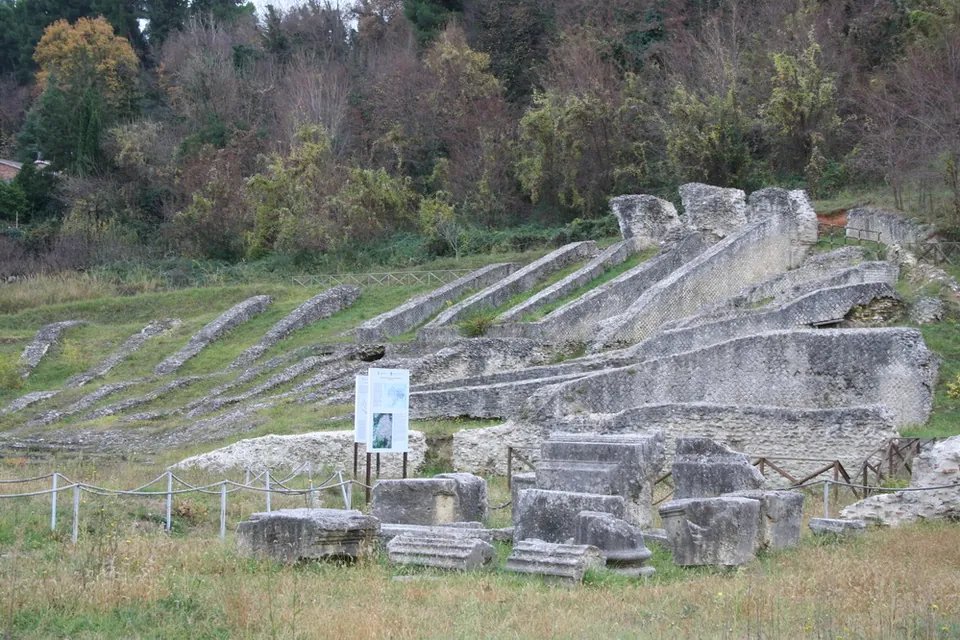
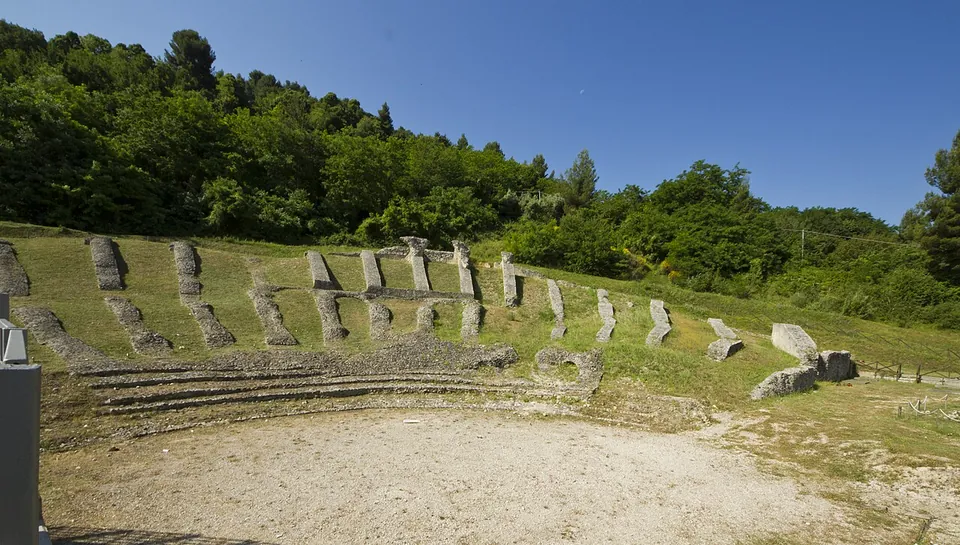
About 190 m away, against the slope of the Annunziata hill, are the excavated remains of the Roman theatre. The seating, the cavea, shows as 32 radial walls built in a near-reticulate facing of small travertine blocks, and reached a diameter of up to 95 m. It faces north, to keep the sun off the audience during the day. Near the western entrance a half-buried semicircular exedra of the 1st century AD keeps walls in opus reticulatum. The stage building lies mostly under the church of Santa Croce (it.wikipedia). Travertine seats from the theatre, marked with seat numbers and often with the name of the seat-holder, are in the Archaeological Museum on Piazza Arringo (visitascoli.it).
Is it worth the trip?
As one of Ascoli’s Roman stops, yes; as a journey on its own, no. The gate is a Roman city gate with both its arches standing, in a small square by the road, free and always there, and it takes ten minutes to look at properly. It makes most sense on a walk through the town that also takes in the Roman bridges, Porta Solestà and the Annunziata terraces (see the Ascoli Piceno page). The theatre is the harder part: it opens only on request, so unless you arrange a visit in advance you should not count on getting in.
Getting there and what it costs
Porta Gemina stands on Largo Porta Romana, on the western side of the historic centre, about 0.7 km in a straight line from Piazza del Popolo. Buses stop right beside the gate at Largo Porta Romana and on Viale Treviri, and there is paid street parking about 60 m away (OpenStreetMap).
The gate is in the street and costs nothing. The city’s tourism site lists the theatre as open on request only, and its page still carries a notice of a temporary closure; no published hours or price for it were found (visitascoli.it, read 24 October 2026). In summer the restored theatre is used for performances (it.wikipedia).
Visiting details
- Opening hours
- The gate stands in the street on Largo Porta Romana and can be seen at any time. The Roman theatre, about 190 m away, opens only on request.
- Tickets
- Free; the gate has no enclosure and no ticket. No published price was found for a visit to the theatre.
- Parking
- Paid street-side parking about 60 m from the gate (OSM way/1223098261). Buses stop right beside it at Largo Porta Romana (node/637948933) and Viale Treviri n° 1 (node/683657716).
Before you go
- The Roman theatre opens only on request, according to the city's tourism site, whose page still carries a notice of a temporary closure; arrange a visit before travelling for it.
Hours and prices checked 24 October 2026 on the operator's own site. Confirm before travelling.
History
The Roman gate was built over an earlier Picene gate destroyed by Gnaeus Pompeius Strabo (it.wikipedia) in 89 BC (visitascoli.it). The Via Salaria came into the town through it, between the slope of the Annunziata hill and the river Tronto (it.wikipedia).
The army of Frederick II brought heavy damage to the town, and in the repairs that followed a second set of medieval arches was added in front of the Roman ones. Through the Middle Ages the gate was part of the town’s fortifications and only one of its arches was used, the other being out of use because a small church filled the space between the Roman and the medieval walls (it.wikipedia). The gate was opened up in full again in the 19th century (it.wikipedia; visitascoli.it).
The theatre was built in the 1st century BC and restored and enlarged in the first half of the 1st and of the 2nd century AD. After the Lombard sack of the town in 578 it fell out of use, and over the centuries its stone was carried off for medieval buildings and burnt for lime in kilns found nearby, until landslides buried what was left. It was excavated in 1932, 1951 and 1959, and after a restoration with contributions from the Fondazione CARISAP and the city it reopened for summer performances in July 2010 (it.wikipedia).
Nearby
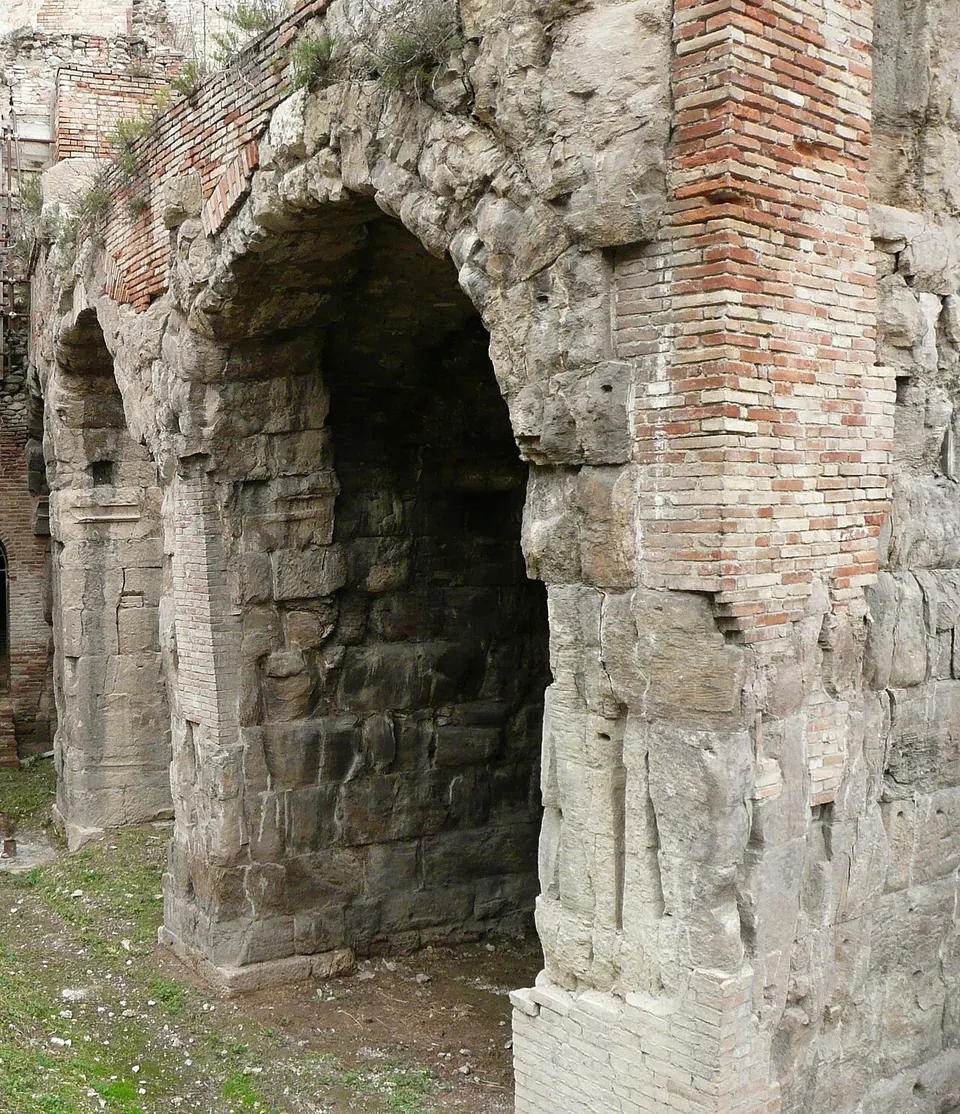
Photo: Franco TamTam · Public domain · Commons
24 km · city · Abruzzo
Interamnia Praetuttiorum – Teramo
The theatre and the amphitheatre stand side by side next to the cathedral, in what was the western quarter of the Roman town; a theatre and an amphitheatre a few metres apart is described as almost unique (it.wikipedia).
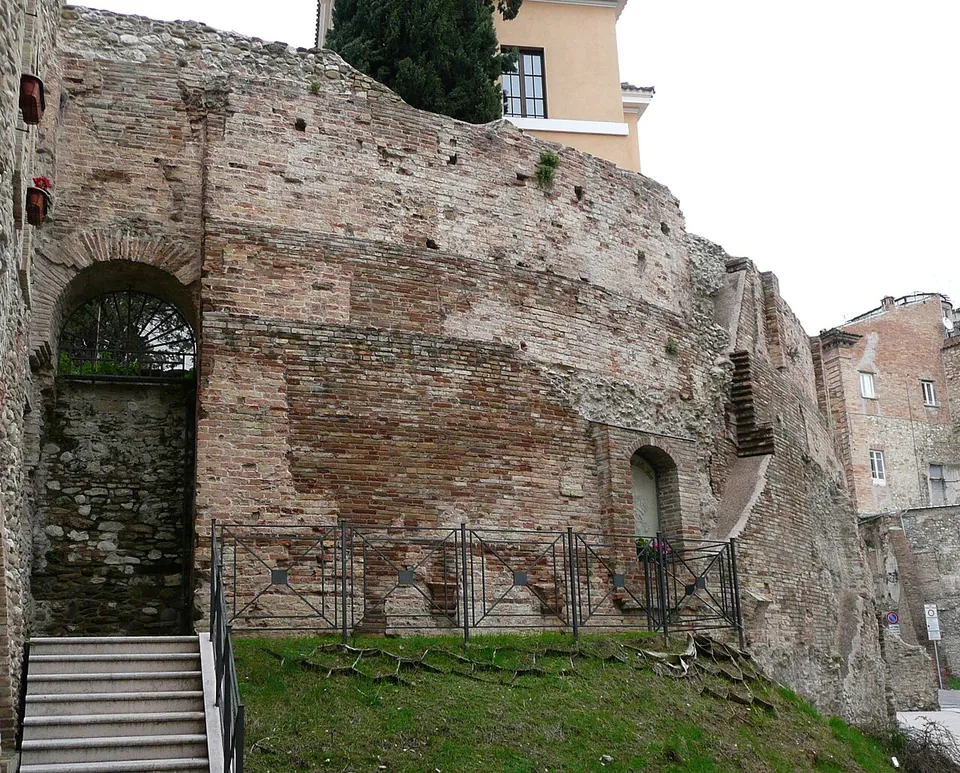
Photo: Franco TamTam · Public domain · Commons
Photo: Franco TamTam · Public domain · Commons


Straight-line distances.
Sources
Every fact on this page comes from the records below, each used under the licence noted.
| Source | Licence |
|---|---|
| Pleiades 220487220 | CC BY |
| Wikidata Q3908717 | CC0 |
| OpenStreetMap way/460537439 | ODbL |
| Wikipedia (it) — Porta Romana (Ascoli Piceno) | CC BY-SA 4.0 |
| Wikipedia (it) — Teatro romano di Ascoli Piceno | CC BY-SA 4.0 |
| Wikipedia (fr) — Théâtre romain d'Ascoli Piceno | CC BY-SA 4.0 |
| Pleiades — Theatre at Asculum (220487222) | licence not recorded |
| Wikidata — Roman theatre of Ascoli Piceno (Q3982366) | licence not recorded |
| Visit Ascoli (Comune di Ascoli Piceno) — Porta Romana | licence not recorded |
| Visit Ascoli (Comune di Ascoli Piceno) — the Roman theatre | licence not recorded |