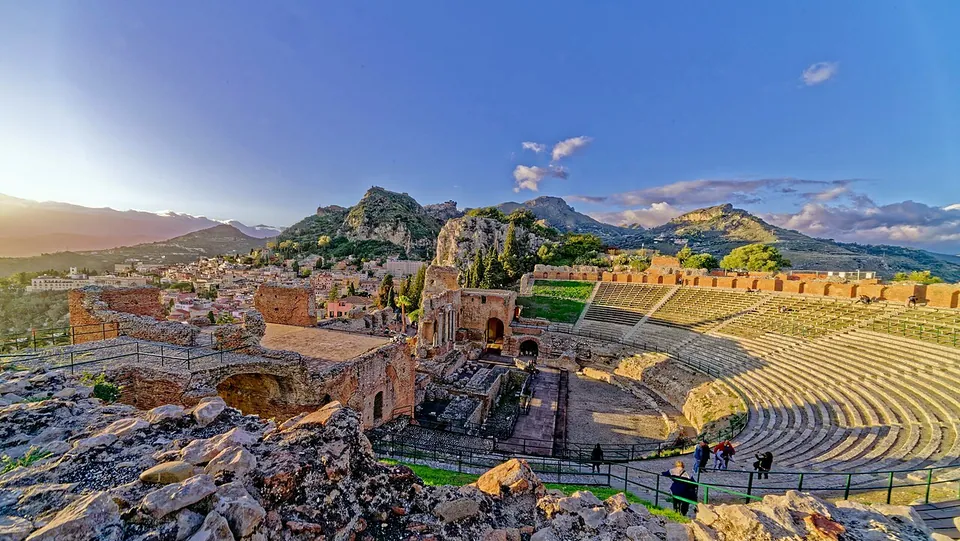
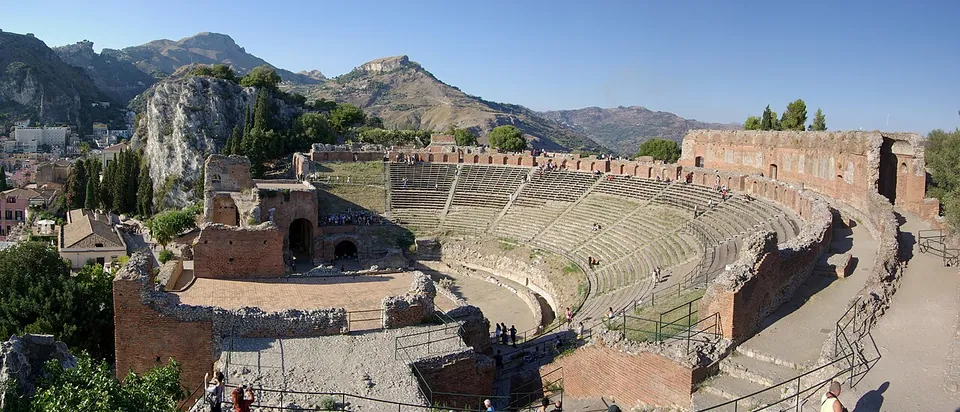


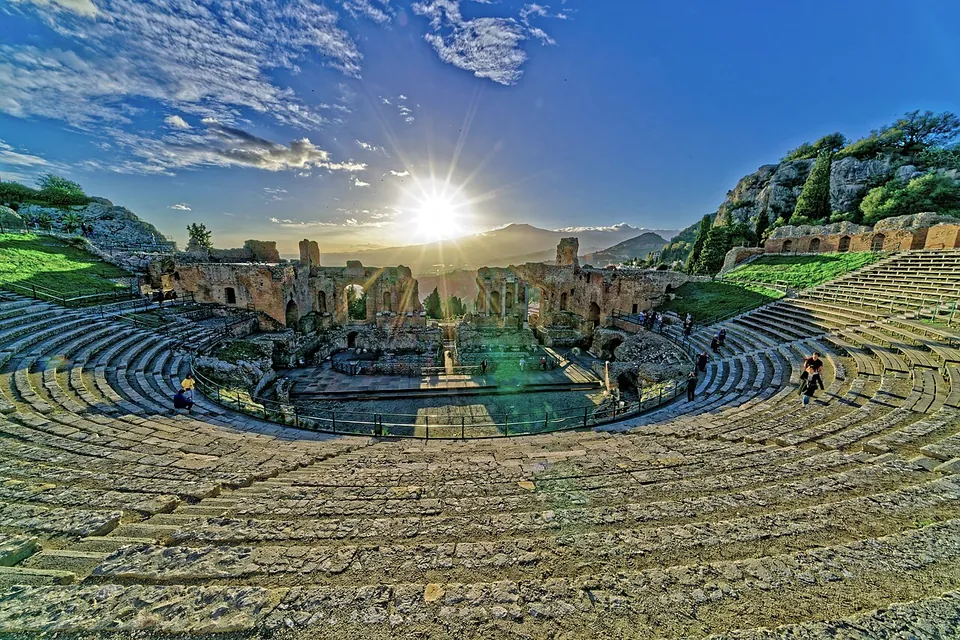
The ancient theatre of Taormina is a Roman theatre built over a Greek one on the ridge of Taormina, on Sicily’s east coast, and it is the second largest ancient theatre on the island after Syracuse’s. Its seating bowl looks over the Ionian Sea and towards Etna, and it is still used for summer concerts and the Taormina Film Fest.
What is there today
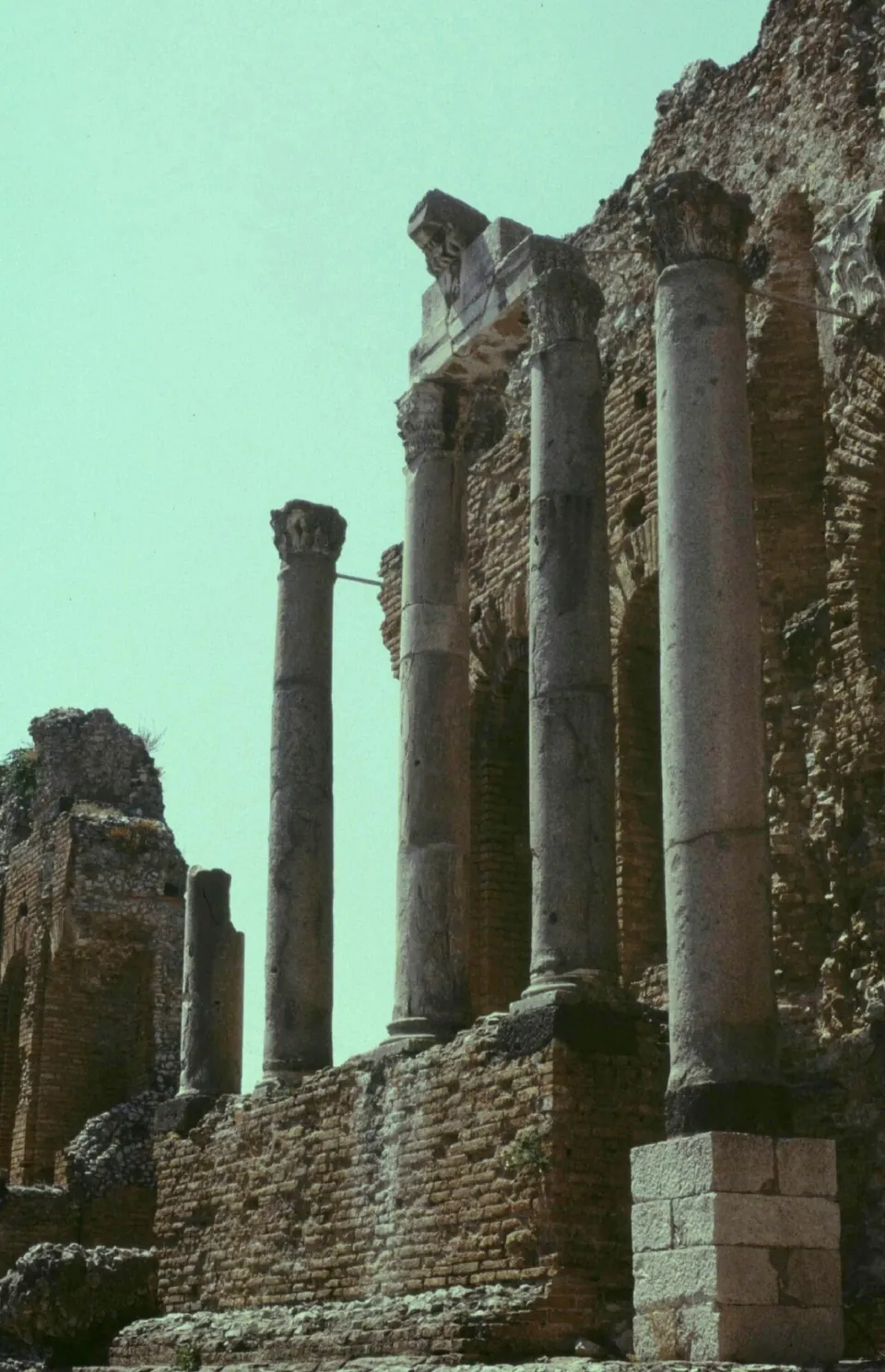
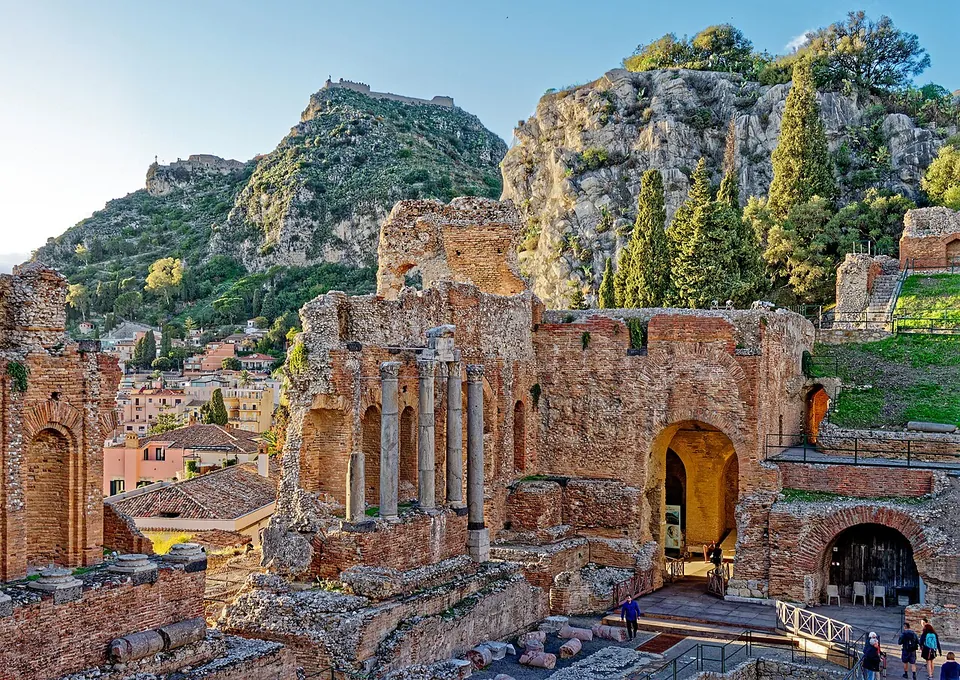
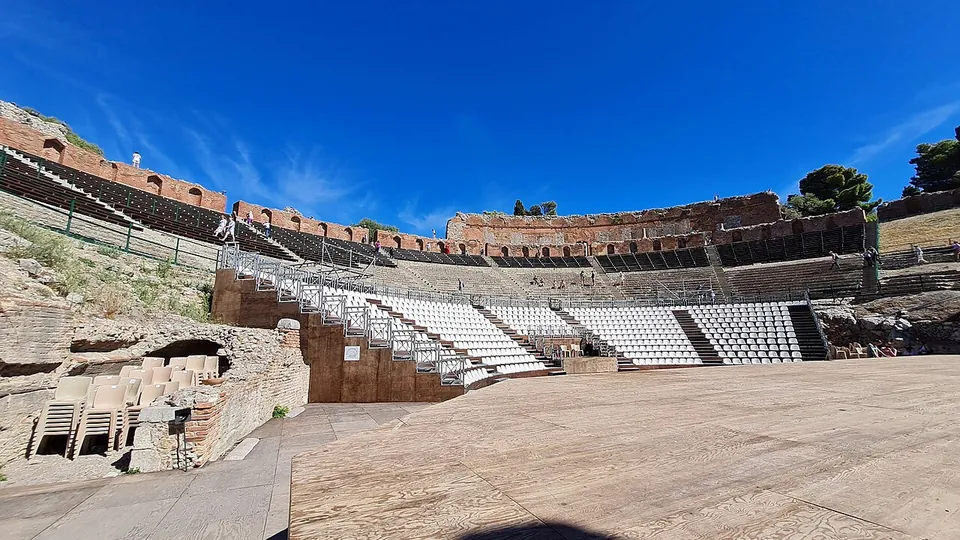
Despite the name Teatro Greco, what stands is Roman: the operator states that everything visible belongs to the Roman rebuilding, above all the work of the first half of the 2nd century AD. The seating bowl is 109 m across and divided into nine wedges by eight stairways. The operator describes the bowl itself as poorly preserved; it was crowned by a double brick portico with granite columns, and the wall that ran round the whole bowl still stands (the operator, en.wikipedia). Facing it is the brick stage building, flanked by two large halls that led into the orchestra. Its front keeps the two side doorways, while the central one has collapsed, and the stage front as reconstructed today is the work of a 19th-century restoration (the operator); its marble columns were set up between 1835 and 1840 (de.wikipedia).
A gap about 10 m wide in the stage wall now frames Etna and the bay of Giardini-Naxos (de.wikipedia). That view is the theatre’s fame, and it is a product of ruin: in antiquity the stage building, at its full height, blocked it (it.wikipedia).
Is it worth the trip?
Yes. fr.wikipedia counts it among the most prized ruins in Sicily, for how well it is preserved and for the beauty of its setting. Come knowing what you will see: a Roman brick stage building and a seating bowl that the operator calls poorly preserved, in a theatre that is still a working venue, so modern seating for performances may be in place. The ticket office reckons on about an hour for the visit.
Two things nearby are closed for now: the Antiquarium, the small museum next to the theatre, is shut for restoration, and the Goethe path is not open (the ticket office, read 14 October 2026).
Getting there
The theatre stands near the town centre, on the east side of the promontory (fr.wikipedia), reached by Via Teatro Greco. The Interbus terminal is mapped about 175 m away, and the Taormina station of the cable car down to Mazzarò, which serves the beaches, about 250 m away (OpenStreetMap, en.wikipedia). The car parks nearest the theatre are for permit holders or customers; a paid multi-storey car park, Parcheggio Porta Pasquale, is mapped about 280 m away (OpenStreetMap).
Opening times move through the year, and the official ticket office publishes them one day at a time: on 14 October 2026 it was open from 09.00 to 18.15, with tickets sold until 17.30. A ticket is €14, or €7 for EU citizens aged 18 to 25; under-18s go free, and so does everyone on the first Sunday of the month, when tickets are issued only at the ticket office on site. Luggage is not allowed in. Check the day’s hours before you go, especially in summer, when the theatre hosts performances (the ticket office, read 14 October 2026).
Visiting details
- Opening hours
- The times change through the year and the official ticket office publishes them one day at a time; no weekly closing day is stated. On 14 October 2026 the theatre was open 09.00–18.15, with the ticket office open 09.00–17.30.
- Tickets
- €14; €7 for EU citizens aged 18 to 25 and FAI members; free under 18, for visitors with disabilities and one companion, and for several professional groups. Entry is free on the first Sunday of every month, and free tickets are issued only at the site, not online.
- Parking
- A paid multi-storey car park, Parcheggio Porta Pasquale, is mapped about 280 m from the theatre (OSM way/255812474); the car parks closer in are for permit holders or customers only.
Before you go
- Luggage is not allowed inside the theatre.
- The Antiquarium, the small museum by the theatre, is closed for restoration, and the Goethe path is not open to the public.
Hours and prices checked 14 October 2026 on the operator's own site. Confirm before travelling.
The theatre
The first theatre here was Greek, built in the 3rd century BC: blocks of its wall survive inside the Roman stage building, three inscribed seats come from its bowl, and a small shrine stood at the top of the seating (the operator, it.wikipedia). fr.wikipedia dates it to the rule of Hieron II of Syracuse.
Rome rebuilt it. A first reconstruction came in the Republic or the early Empire, perhaps under Augustus (it.wikipedia); the enlargement that gave the theatre its present form, in the first half of the 2nd century AD, is placed under Trajan, citing an inscription (CIL X 6996) that mentions one Paternus, or under Hadrian (the operator). The bowl reached its diameter of 109 m then (it.wikipedia). Published figures for how many it held range from about 5,400 (de.wikipedia, fr.wikipedia) to about 10,000 (it.wikipedia, en.wikipedia); for performances today it seats 4,500 (it.wikipedia).
Later the theatre was adapted for wild-beast shows and gladiatorial fights. The orchestra was made into an arena: the lowest rows of seats gave way to a vaulted corridor leading to an underground chamber in the middle, where stage machinery worked (it.wikipedia). Published dates for the change range from the 2nd to the 3rd century AD (de.wikipedia, fr.wikipedia, en.wikipedia). In late antiquity a portico was added behind the stage, and the theatre was probably abandoned after the Vandal siege (it.wikipedia).
The odeon and the baths
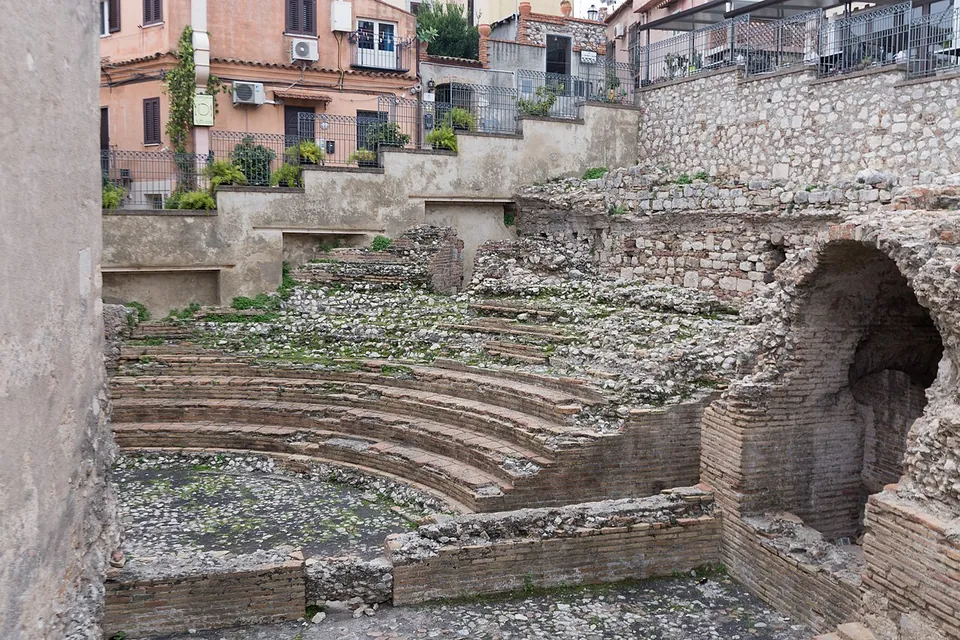
Two more Roman buildings survive in the centre of the town, 300–400 m north-west of the theatre. The odeon, a small concert hall and theatre (Wikidata), dates from the reign of Hadrian (Pleiades); its semicircle of seating lies in a sunken plot about 40 m from Palazzo Corvaja (OpenStreetMap). The baths were built over a Hellenistic public building, fronted on the forum and were enlarged in the 2nd century AD (Pleiades); their ruins are mapped close to Porta Messina (OpenStreetMap). Mosaics with marine subjects, of the 1st to 2nd century AD, found near Porta Messina in the late 1950s, at least two of them probably from the baths, are shown in the Casina degli Inglesi, once the theatre’s 19th-century Antiquarium, which also holds the town’s large collection of Greek inscriptions (the operator). The ticket office reports the Antiquarium closed for restoration, so they may not be on view.
History
Tauromenium was founded in 358 BC (Pleiades). Ancient accounts of its origins differ; the one it.wikipedia follows has survivors of nearby Naxos, the first Greek colony in Sicily, destroyed by Dionysius I of Syracuse in 403 BC, resettled on the hill by Andromachus. It stayed part of the Syracusan kingdom until the Roman conquest of Sicily in 212 BC. Under Rome it was one of the island’s three allied cities, which Cicero mentions; it was held by rebel slaves in the First Servile War (134–132 BC), and after the war between Sextus Pompey and Octavian, Augustus settled a colony of Romans loyal to him there in 21 BC (it.wikipedia). The operator dates the colony to 36 or 21 BC.
In the Middle Ages the stage building and its two stair towers were turned into a private palace (it.wikipedia). The ruin’s romantic fame grew with the Grand Tour: Goethe visited it on 7 May 1787 and described it in his Italian Journey (de.wikipedia). Since the 1950s it has been used for summer performances, and since 1983 it has been the home of the Taormina Arte festival and the Taormina Film Fest (it.wikipedia).
More photographs




Nearby
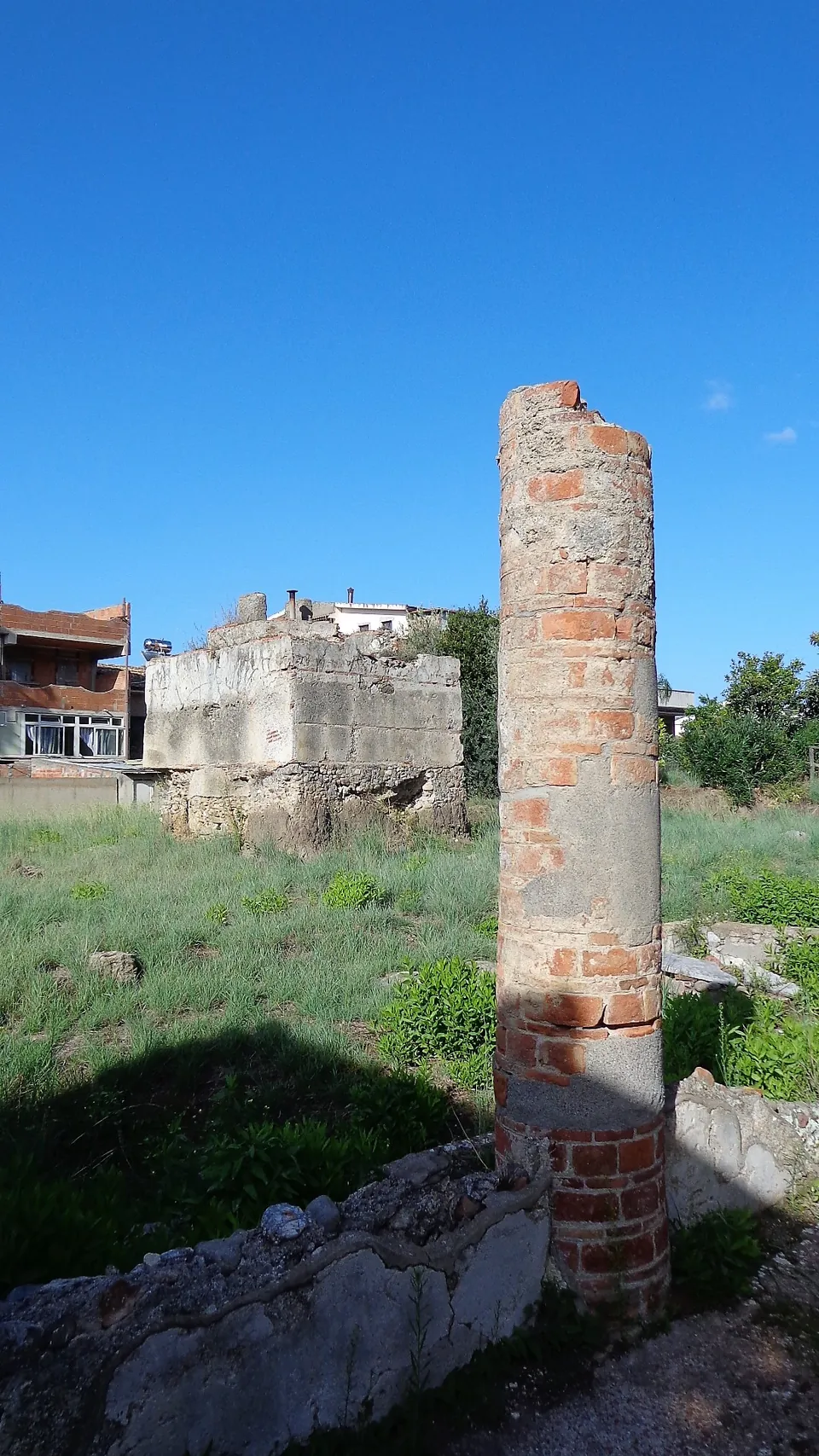
Photo: Effems · CC BY-SA 4.0 · Commons
33 km · villa · Sicily
Roman villa of San Biagio
The house was laid out on a square plan around a courtyard with a portico of eight columns a side, the peristyle (it.wikipedia, de.wikipedia).
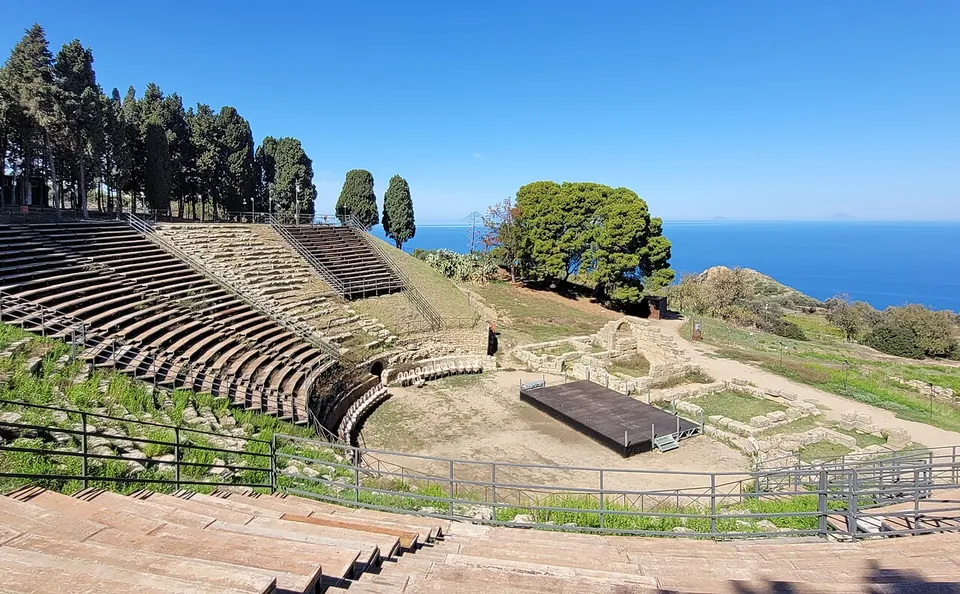
Photo: Bernard Gagnon · CC BY 4.0 · Commons
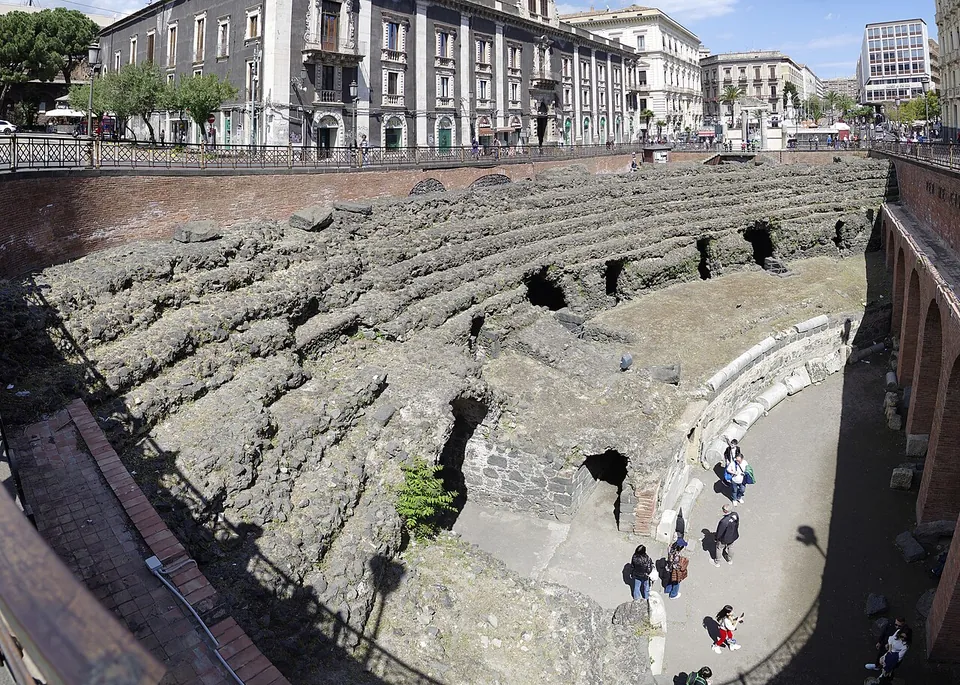
Photo: Berthold Werner · CC BY-SA 4.0 · Commons
42 km · amphitheatre · Sicily
Roman amphitheatre of Catania
The exposed part is the north-western section (the operator): the curving lava-stone structure that carried the seating, and arches whose red brick stands out against the dark stone (it.wikipedia).


Straight-line distances.
Sources
Every fact on this page comes from the records below, each used under the licence noted.
| Source | Licence |
|---|---|
| Pleiades 937547557 | CC BY |
| Wikidata Q747484 | CC0 |
| Vici.org 8515 | CC BY-SA (text), CC0 (metadata) |
| OpenStreetMap way/42403497 | ODbL |
| Pleiades — Tauromenium | licence not recorded |
| Pleiades — Roman Odeum of Tauromenium | licence not recorded |
| Pleiades — Roman baths of Taormina | licence not recorded |
| Wikidata — Roman Odeum of Taormina (Q4331373) | licence not recorded |
| Wikidata — Roman baths of Taormina (Q141503913) | licence not recorded |
| Wikipedia (en) — Ancient theatre of Taormina | CC BY-SA 4.0 |
| Wikipedia (it) — Teatro antico di Taormina | CC BY-SA 4.0 |
| Wikipedia (de) — Antikes Theater Taormina | CC BY-SA 4.0 |
| Wikipedia (fr) — Théâtre de Taormine | CC BY-SA 4.0 |
| Wikipedia (it) — Taormina | CC BY-SA 4.0 |
| Wikipedia (en) — Taormina | CC BY-SA 4.0 |
| Parco Archeologico Naxos Taormina — Teatro Antico di Taormina (the operator, Regione Siciliana) | licence not recorded |
| Aditus Culture — Teatro Antico di Taormina (the official ticket office the operator links to) | licence not recorded |