

What is there today
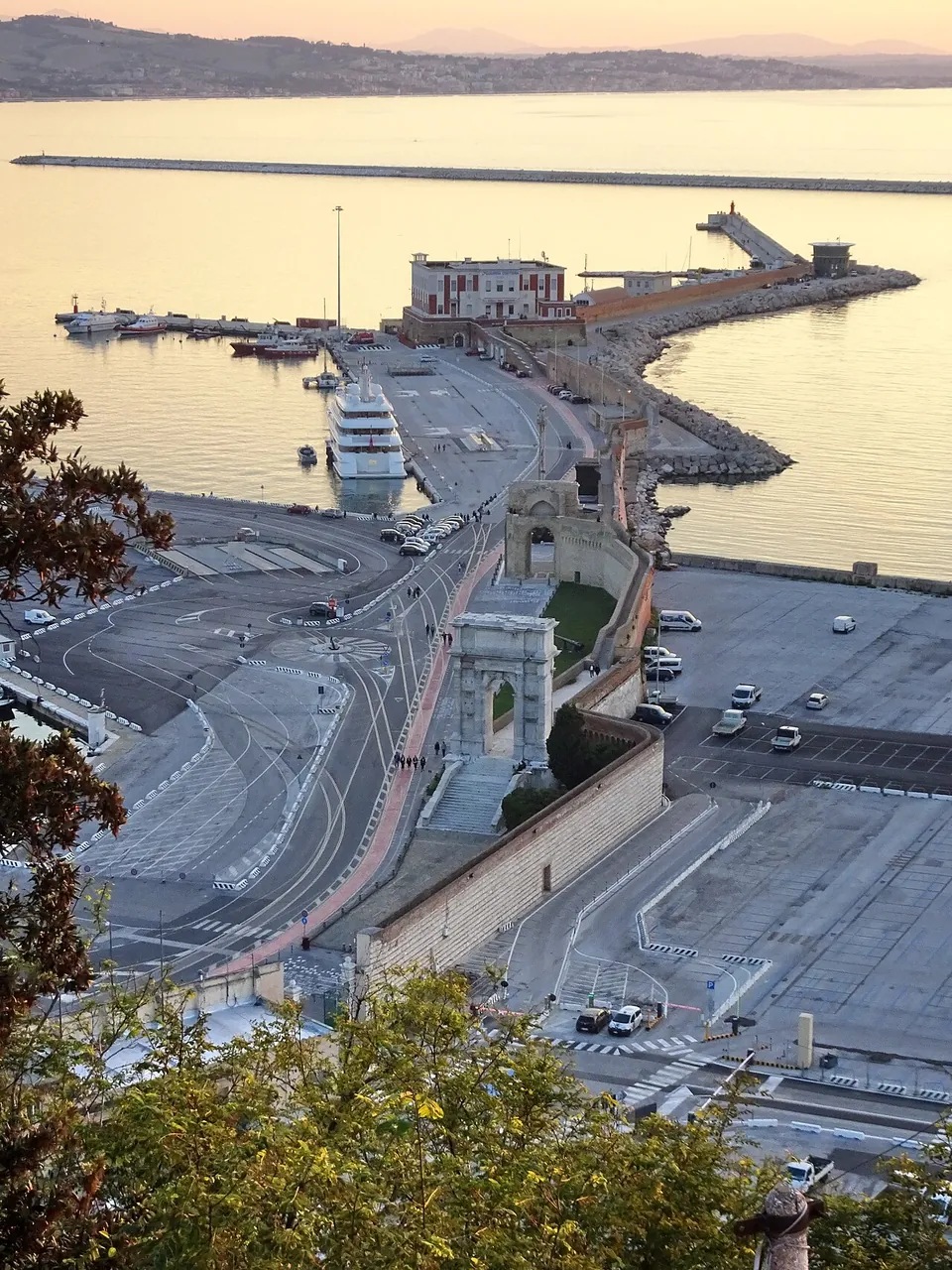
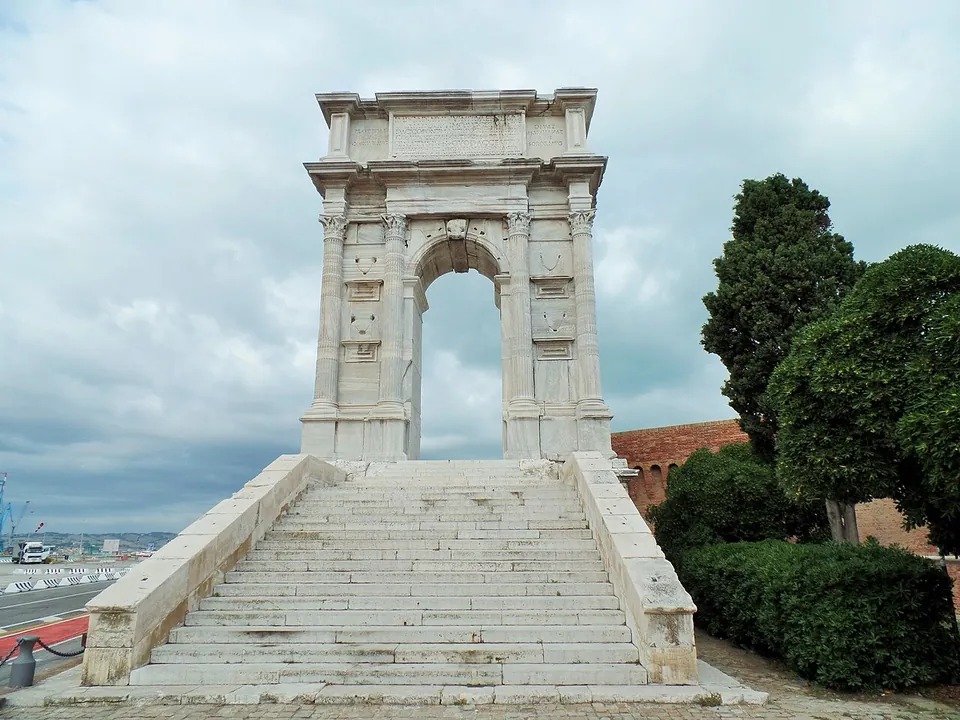
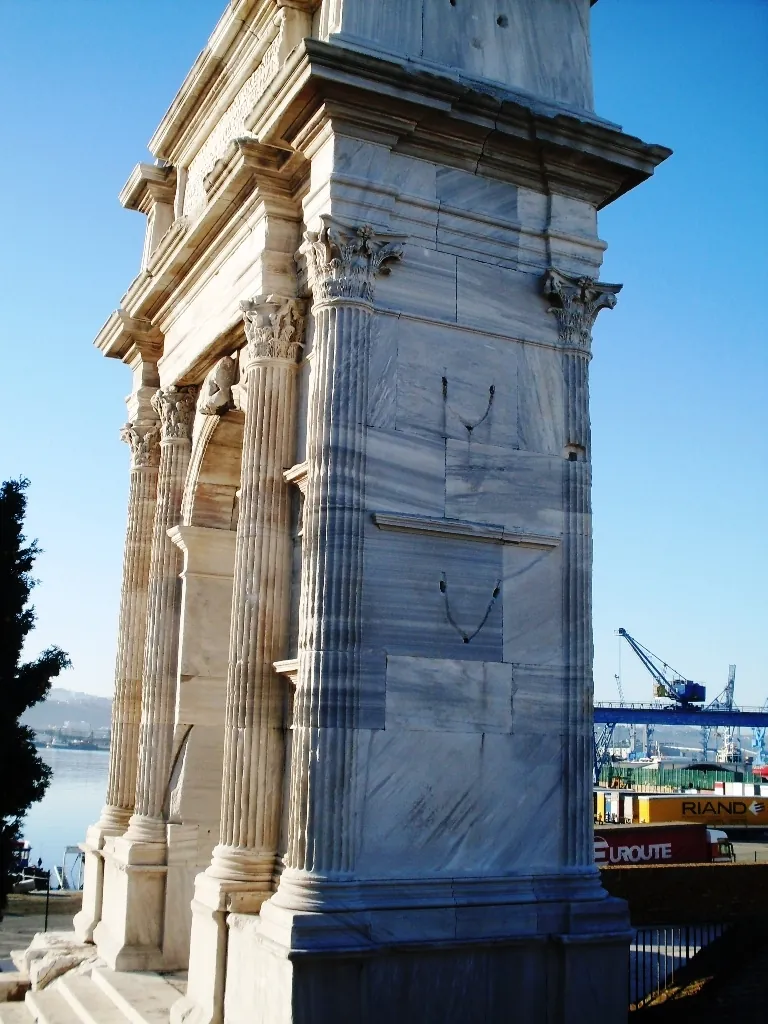
The Arch of Trajan is the set piece. It is a single, unusually slender archway of marble from the island of Marmara, framed by pairs of fluted Corinthian columns and raised on a high podium, and 18.5 m high (en.wikipedia). The three inscriptions on the attic can still be read from the marks of their lost bronze letters, and the keystones carry busts of Oceanus, still well preserved, and Tellus, badly worn (it.wikipedia). The flight of steps up to it dates from 1859. The gate that used to close it off was removed in a restoration in 2000, and the arch is now floodlit; since the war, landfill for the docks has pushed the sea back from what was a waterfront monument (it.wikipedia).
The amphitheatre sits in the saddle between the Guasco and Cappuccini hills, about 50 m above the sea. On the side facing Piazza del Senato a long stretch of its outer wall stands in alternating bands of reticulate and brick facing, with the main gate (the porta pompae, known locally as the Arco Bonarelli), two radial buttresses, one almost at full height, and two spectator entrances along Via Pio II; later houses sit directly on the Roman wall. Beside the main gate, under a modern roof, is a building read either as a gladiator school or as baths, with a small swimming pool, traces of wall painting and a mosaic floor with two dolphins and an inscription naming the two magistrates who had it built with public money. On the Via Birarelli side the excavation stopped part way and shows a covered section of seating, the gate through which dead gladiators were carried out, and a little of the arena (it.wikipedia). The ellipse measured 93 × 74 m, and it is estimated to have held 8,000 to 10,000 spectators (it.wikipedia).
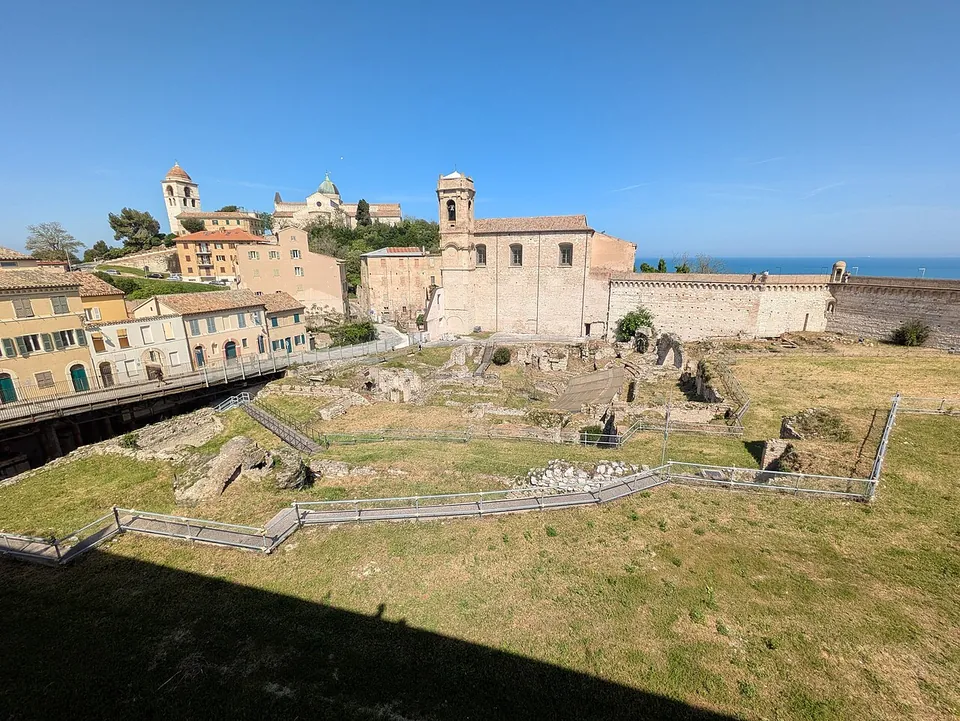
The temple of Aphrodite lies under the cathedral of San Ciriaco on the top of the Guasco hill. What survives are its sandstone foundations, a rectangle of 19 × 32 m preserved up to about 2 m high, under the crossing and one arm of the cathedral’s transept (it.wikipedia), and they can be seen in the Crypt of Tears below the church (en.wikipedia, Ancona Cathedral). The church’s own interior is built with re-used antique Roman columns (en.wikipedia).
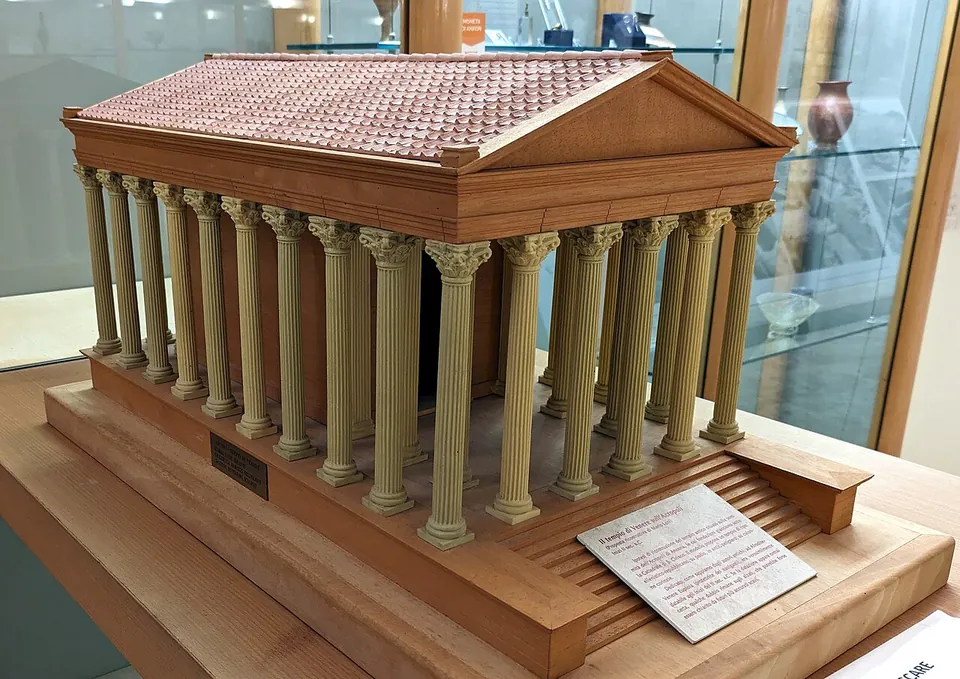
The Museo Archeologico Nazionale delle Marche, in Palazzo Ferretti about 200 m from the cathedral, has a section on the city of Ancona in the Hellenistic and Roman periods and a Roman section reopened in 2023 (the operator). It holds a model of the arch as it first looked (it.wikipedia) and one of the temple.
Is it worth the trip?
For the arch, yes. It is among the best-preserved honorary arches of its time (it.wikipedia), it costs nothing to see, and it stands where it always has, on the quay of a working port. Add the walk up the Guasco hill to the amphitheatre and the cathedral and the museum below them, and Roman Ancona fits comfortably into half a day on foot, since all of it lies within about 300 m of the cathedral.
Set expectations for the rest. The amphitheatre is a partly excavated ruin hemmed in by later houses, not a standing arena, and its interior opens only on scheduled days; from the street you see its wall and gate. The temple is a set of foundations under a church.
Getting there
The arch is on the harbour quay below the old town; the cathedral, the amphitheatre and the museum are on and around the Guasco hill above it. A bus stop named Duomo - Cattedrale San Ciriaco is mapped about 35 m from the cathedral, a free car park about 150 m away and a paid one about 170 m away, and public toilets about 85 m away (OpenStreetMap).
The arch can be seen at any time. The museum opens Tuesday to Thursday 08.30–13.30, Friday and Saturday 08.30–19.30 and Sunday 14.00–19.30, and is closed on Mondays, with last entry 45 minutes before closing. A ticket is €5 (reduced €2), and €8 buys the museum together with a visit to the amphitheatre on the days it is open; under-18s go free, and the museum is free on the first Sunday of every month (the operator, as published in March 2026). The operator’s amphitheatre timetable could not be read, so ask the museum (+39 071 202602) which days the amphitheatre opens before planning around it. The cathedral is a working church; visit outside services.
Visiting details
- Opening hours
- The Arch of Trajan stands in the open on the harbour quay. The Museo Archeologico Nazionale delle Marche, which also sells the amphitheatre visit, opens Tuesday to Thursday 08.30–13.30, Friday and Saturday 08.30–19.30 and Sunday 14.00–19.30, and is closed on Mondays; last entry 45 minutes before closing. The amphitheatre opens on scheduled days only, which are announced by the museum.
- Tickets
- The arch, in the open on the quay, costs nothing to see. Museum €5, reduced €2. Museum plus a visit to the Roman amphitheatre on its opening days, €8; reduced rate for ages 18 to 25, free under 18. The museum is free on the first Sunday of every month and on 25 April, 2 June and 4 November.
- Parking
- A free surface car park about 150 m from the cathedral on the Guasco hill, and a paid one about 170 m away (OSM way/1160585355 and way/1160585356); public toilets about 85 m from the cathedral (OSM node/14051618953).
Before you go
- The inside of the amphitheatre is not open every day; the operator's own amphitheatre page could not be read, so ask the museum (+39 071 202602) which days it opens. Its outer wall and main gate can be seen from Piazza del Senato and Via Pio II, and the northern sector from Via Birarelli, at any time.
- The temple remains lie under a working cathedral; avoid services.
Hours and prices checked 11 March 2026 on the operator's own site. Confirm before travelling.
History
Greeks from Syracuse founded Ankon in 387 BC on an existing trading post, and it stayed a Greek-speaking city for some three centuries (it.wikipedia, Ankón; Pleiades). It came into Rome’s orbit gradually: in 178 BC it let Rome use its harbour as a base against Illyrian piracy, in 133 BC a Latin colony was settled on its land, and after the Social War, in 90 BC, it became a Roman municipium (it.wikipedia). Roman writers still called it “Dorica Ancon”, and Catullus and Juvenal both name its temple of Venus, the Roman name for Aphrodite (it.wikipedia).
How old the temple is remains open. Its foundations were found in 1932 and fully excavated in 1948, after war damage to the cathedral. One reconstruction makes it a Doric temple of the 4th century BC, from the city’s Greek foundation; another a Corinthian temple on a podium of the 2nd century BC, a Roman type, on the strength of quarry marks in Latin letters; a third has it rebuilt from the one to the other (it.wikipedia). A Christian basilica was built over it in the 6th century (en.wikipedia, Ancona Cathedral).
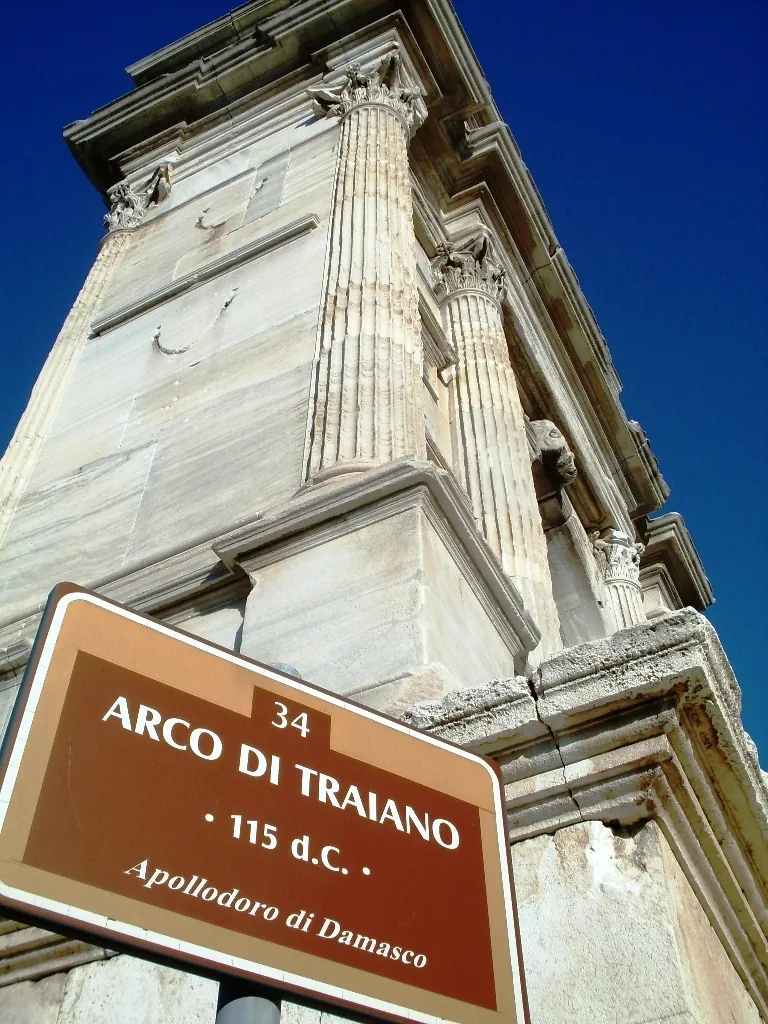
The amphitheatre is thought to date in its core from the reign of Augustus and to have been enlarged under Trajan; some of the squared masonry in its southern side may come from an earlier Greek theatre (it.wikipedia). Trajan enlarged the port at his own expense, and the Senate and people of Rome thanked him with the arch, as its inscription says; it is attributed to the architect Apollodorus of Damascus (it.wikipedia). Its date is debated: the inscription points to completion in 117, and the city’s sign at the arch gives 115, but the arch already appears in scene 58 of Trajan’s Column, where Trajan sets sail from Ancona for the Dacian war of 105. Recent studies resolve this with an arch built around AD 100, topped by statues of three gods of the sea, ports and travellers, and rededicated in 114–115 with bronze statues of Trajan, his wife Plotina and his sister Marciana (it.wikipedia). The bronzes, the letters of the inscriptions and the ship’s rams that decorated it were carried off by Saracen raiders in the 9th century; published dates for the raid differ, 839 or 848 (it.wikipedia, en.wikipedia).
The amphitheatre was abandoned, it seems, in the 6th century, when burials were made in its seating, and was built over in the following centuries (it.wikipedia). The abbot Antonio Leoni recognised it in 1810 in the cellars of Palazzo Bonarelli; excavations ran for two years from 1811, and again from the 1930s and after the 1972 earthquake, and in 2025 it joined the national network of state museums, with regular openings and new excavations planned (it.wikipedia). The arch had its own place in the rediscovery of antiquity: in 1421 Cyriac of Ancona, then thirty, copied its inscription from the restorers’ scaffolding, the first of the many he recorded on his travels (it.wikipedia).
More photographs



Nearby
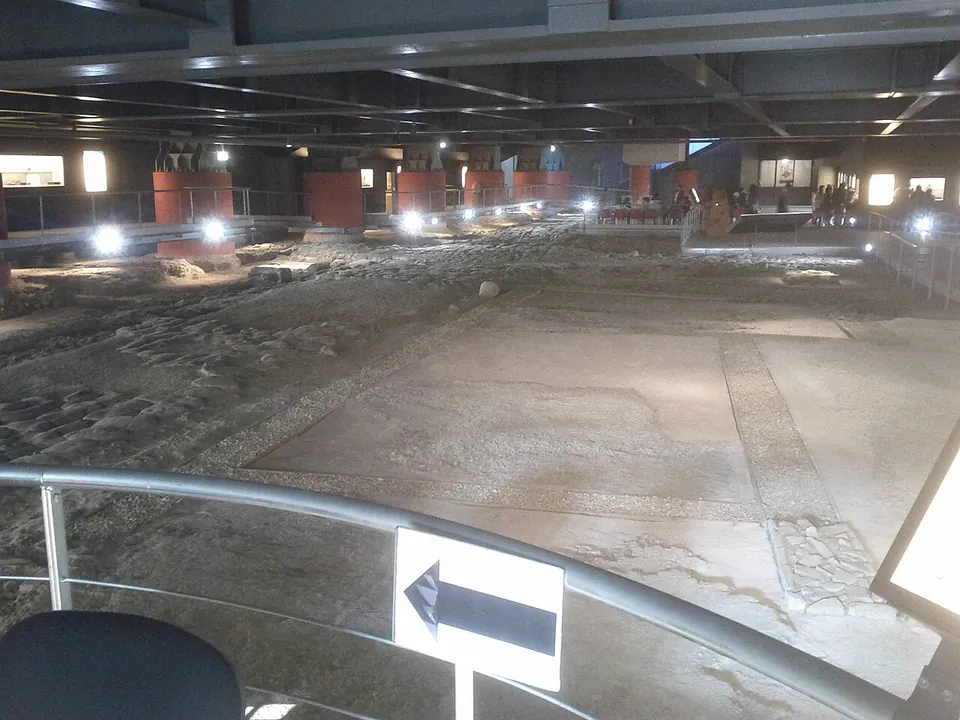
Photo: Accurimbono · CC BY-SA 3.0 · Commons
25 km · city · Marche
Area archeologica la Fenice
You walk a few metres below today's street level, on walkways over the excavated ground.
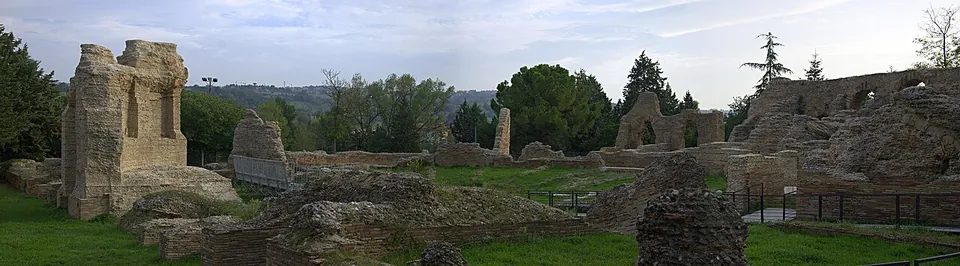
Photo: Maxmar69 · CC BY-SA 3.0 · Commons
34 km · theatre · Marche
Helvia Recina
The theatre is the only well-preserved part of the town above ground (en.wikipedia).
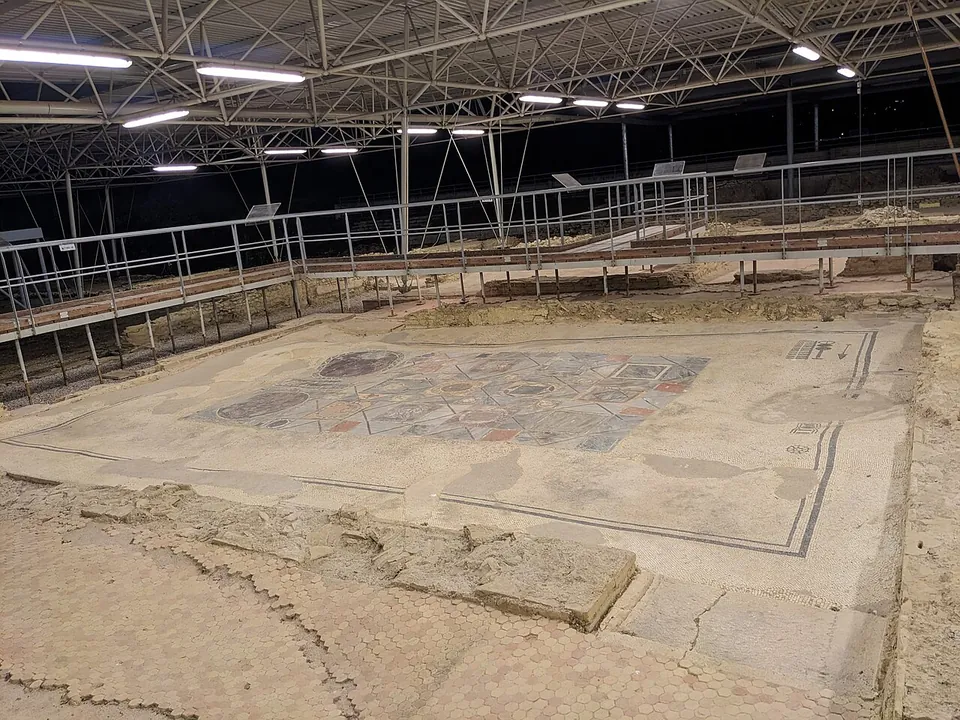
Photo: Accurimbono · CC BY-SA 4.0 · Commons
42 km · town house · Marche
Parco Archeologico di Suasa
The house is big — about 105 by 34 m, some 3,500 m² (the operator; it.wikipedia) — and is presented in the open air, much of it under a modern roof, with raised walkways that let you look down into the rooms (it.wikipedia; en.wikipedia).


Straight-line distances.
Sources
Every fact on this page comes from the records below, each used under the licence noted.
| Source | Licence |
|---|---|
| Pleiades 413014 | CC BY |
| Wikidata Q48075573 | CC0 |
| Vici.org 1663 | CC BY-SA (text), CC0 (metadata) |
| OpenStreetMap relation/1749100 | ODbL |
| Pleiades — Arch of Trajan, Ancona | licence not recorded |
| Pleiades — Amphitheatre, Ancona | licence not recorded |
| Wikidata — Arch of Trajan, Ancona (Q1509102) | licence not recorded |
| Wikidata — Roman amphitheatre of Ancona (Q3616680) | licence not recorded |
| Wikidata — Temple of Aphrodite, Ancona (Q124737095) | licence not recorded |
| Wikipedia (it) — Ankón | CC BY-SA 4.0 |
| Wikipedia (it) — Arco di Traiano (Ancona) | CC BY-SA 4.0 |
| Wikipedia (en) — Arch of Trajan (Ancona) | CC BY-SA 4.0 |
| Wikipedia (it) — Anfiteatro romano di Ancona | CC BY-SA 4.0 |
| Wikipedia (it) — Tempio di Afrodite (Ancona) | CC BY-SA 4.0 |
| Wikipedia (en) — Ancona Cathedral | CC BY-SA 4.0 |
| Ministero della cultura — Museo archeologico nazionale delle Marche, hours and tickets (the operator; archived copy of 11 March 2026) | licence not recorded |