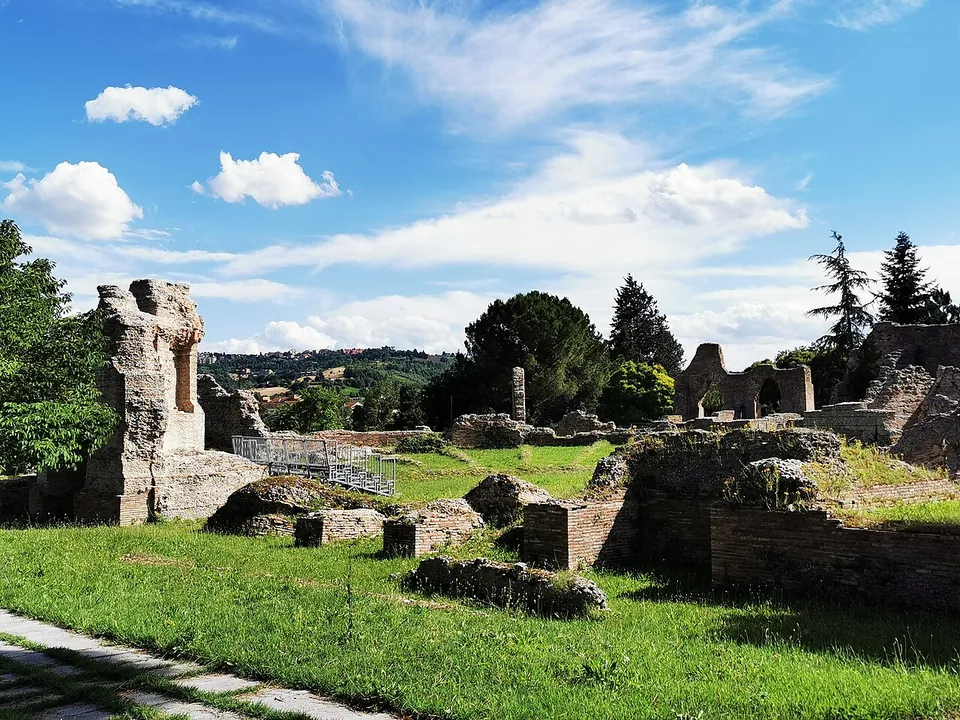
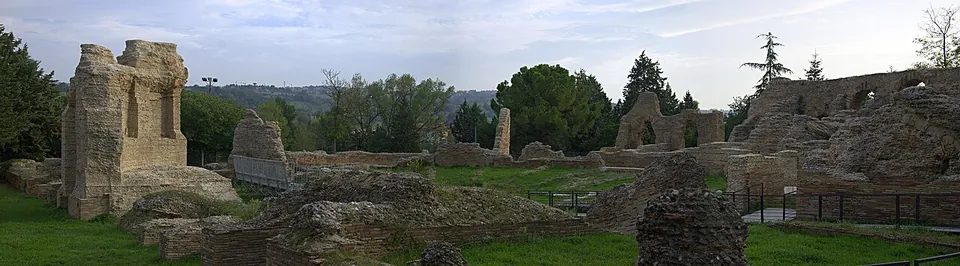
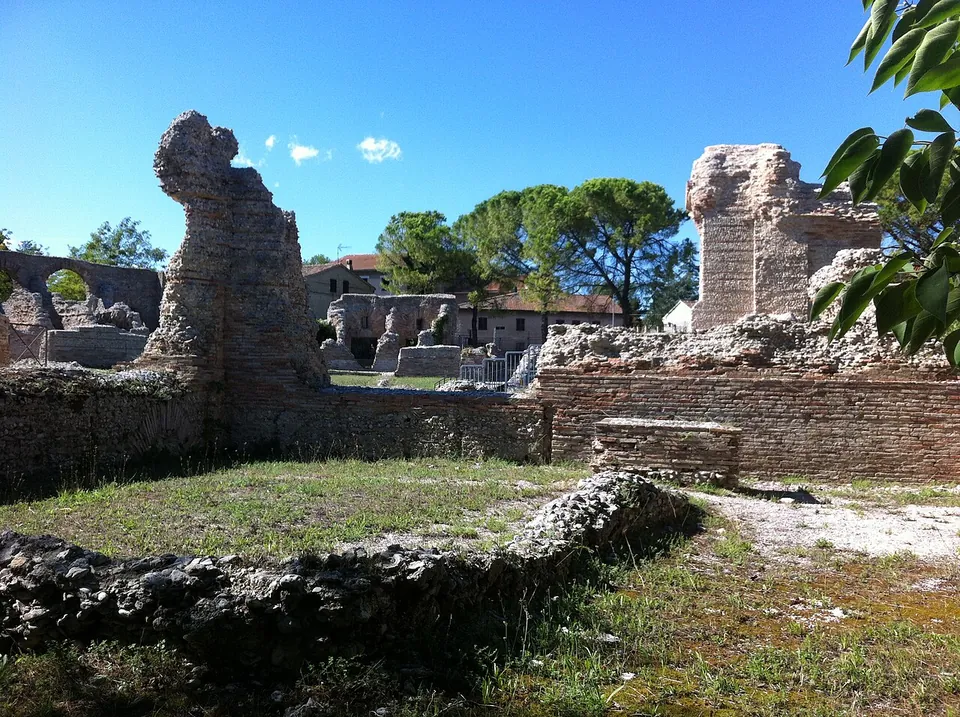


Ricina, which its operator calls Helvia Recina, was a Roman town in the Potenza valley below Macerata, and what you visit today is its theatre: brick walls of the seating and the stage building, still standing to about 7 m, in an archaeological area among the houses of Villa Potenza. Entry is free, but only by appointment booked at least a day ahead.
What is there today
The theatre is the only well-preserved part of the town above ground (en.wikipedia). It was built entirely on flat ground, its seating raised artificially rather than set into a hillside, and faced in brick (opus testaceum); it measures 75.45 m across and 62.55 m deep, probably rose to about 17 m and survives to about 7 m (it.wikipedia). The orchestra, the seating and the brick front of the stage are still easy to make out; fragments of the stage decoration lie among the fallen masonry, and some marble architectural pieces are displayed on site (it.wikipedia).
Next to the theatre are the town’s funerary monuments. In 1966-67 some 150 carved and decorated stone blocks came out of the bed of the Potenza during quarrying, where they had been reused, perhaps in the Middle Ages, as an embankment. They allowed at least six funerary monuments of different types to be reconstructed, and the fragments are kept under a roofed structure near the theatre (it.wikipedia). The operator lists funerary monuments, marbles and inscriptions alongside the theatre.
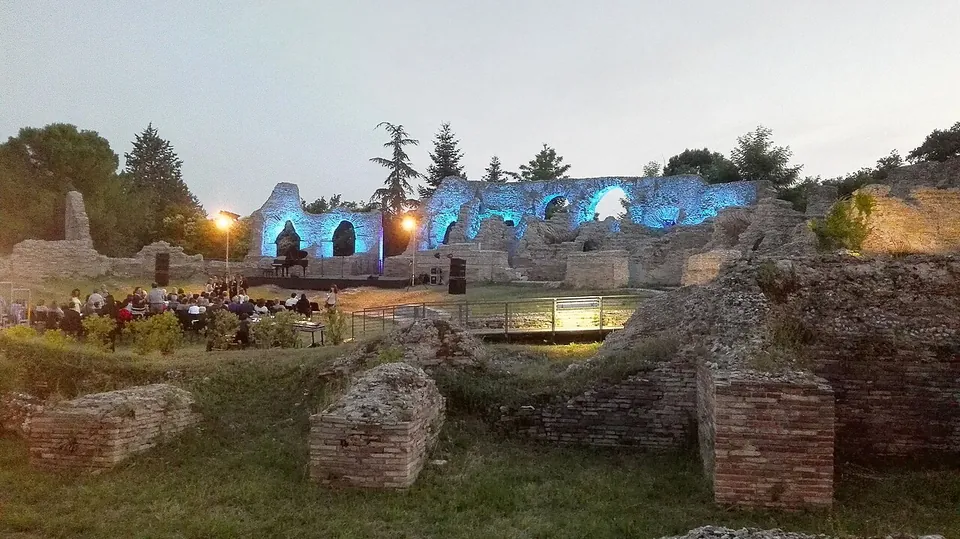
Since 2021 the area has new information panels with QR codes, and its reception point holds a 3D model of the theatre and a virtual-reality reconstruction of it; the operator also provides 3D prints and Braille cards for blind and partially sighted visitors. Since 2011 the theatre has also been used again as a venue for concerts and performances (it.wikipedia).
The rest of the town, an almost rectangular area of about 22 ha, lies under Villa Potenza and the surrounding fields. Aerial photographs and field surveys have picked out a probable main temple, large houses and traces of an amphitheatre east of the theatre, and suggest where the forum lay, but none of it is visible to a visitor (en.wikipedia). One exception is a stretch of Roman paving 5 m wide with cart ruts, found in 1963 when a petrol station was built; it.wikipedia records it as visible but does not say where.
Is it worth the trip?
If you are in Macerata, yes: this is a substantial Roman theatre a few kilometres from the city, free to enter, with the stage building and the curve of the seating standing several metres high. The catch is the appointment, which has to be made at least a day ahead, so it cannot be a spur-of-the-moment stop.
It is not worth a long detour on its own. The theatre and the funerary monuments beside it are the whole visit; the town that surrounded it is under the modern village. A good complement is in Macerata itself: the entrance hall and courtyard of the Palazzo Comunale hold twenty-five inscriptions, most of them from Ricina, among them the dedication that records the town becoming a colony (it.wikipedia).
Getting there
The theatre is in Via Teatro Romano in Villa Potenza, a village that belongs to the comune of Macerata, about 4 km from the town centre (OpenStreetMap). A bus stop is mapped about 130 m from the theatre (OpenStreetMap); no car park is mapped beside it.
Visits are by appointment only, booked at least one day ahead through the Pro Loco Villa Potenza at [email protected] or the phone numbers on the operator’s hours page; in August bookings go to the Pro Loco on 0733 1838401. Entry is free (musei.macerata.it, read 23 October 2026 - check before travelling).
Visiting details
- Opening hours
- Always open by appointment, booked at least one day before the visit, through the Pro Loco Villa Potenza ([email protected], or the phone numbers on the operator's hours page). In August bookings go to the Pro Loco on 0733 1838401.
- Tickets
- Free.
Before you go
- Visits are by appointment only, booked at least a day ahead; turning up unannounced is not enough.
Hours and prices checked 23 October 2026 on the operator's own site. Confirm before travelling.
History
Small rescue excavations suggest the site was already widely settled by the later 2nd century BC (en.wikipedia); it.wikipedia traces the town to an earlier settlement of the Picenes, perhaps of the 3rd century BC. Ricina became a municipium around the middle of the 1st century BC, when veterans of the civil wars were settled there. It flourished under Augustus and Tiberius, to judge from its funerary monuments and inscriptions, an aqueduct and its theatre, described as the largest in Picenum (en.wikipedia). Published dates for the theatre run from the end of the 1st century BC to the 2nd century AD; most place it in the first half of the 1st century AD (the operator; it.wikipedia). Pliny the Elder, writing in the 1st century AD, is the first author to name the town (it.wikipedia).
In the 2nd century AD streets and squares were repaved and baths built or restored with money that the Roman advocate Tuscilius Nominatus had left to Trajan, as an inscription in Macerata’s Palazzo Comunale records (it.wikipedia). In 205 Septimius Severus raised the town to a colony, named Helvia Ricina Pertinax after his predecessor Pertinax (CIL IX 5747; the operator, it.wikipedia), and the theatre was probably restored in the same period (it.wikipedia).
Gothic invasions in the 4th or 5th century drove most of the people to the hills, where Macerata and Recanati grew up, and in the Gothic War of the mid-6th century the town was destroyed completely (it.wikipedia). Its ruins were still impressive in 1341; from 1432 Macerata’s statutes allowed citizens to take building stone from them, which is how the town almost entirely disappeared (it.wikipedia). The theatre was known in the Renaissance - Antonio da Sangallo the Younger made a survey drawing of it, now in the Uffizi - and was still being stripped for stone in the 19th century, partly for the present bridge over the Potenza (it.wikipedia).
The name is shared: Pleiades records a separate Ricina, a road station on the Via Aemilia Scauri thought to have stood near Recco on the Mediterranean coast, which has nothing to do with this town.
More photographs

Nearby
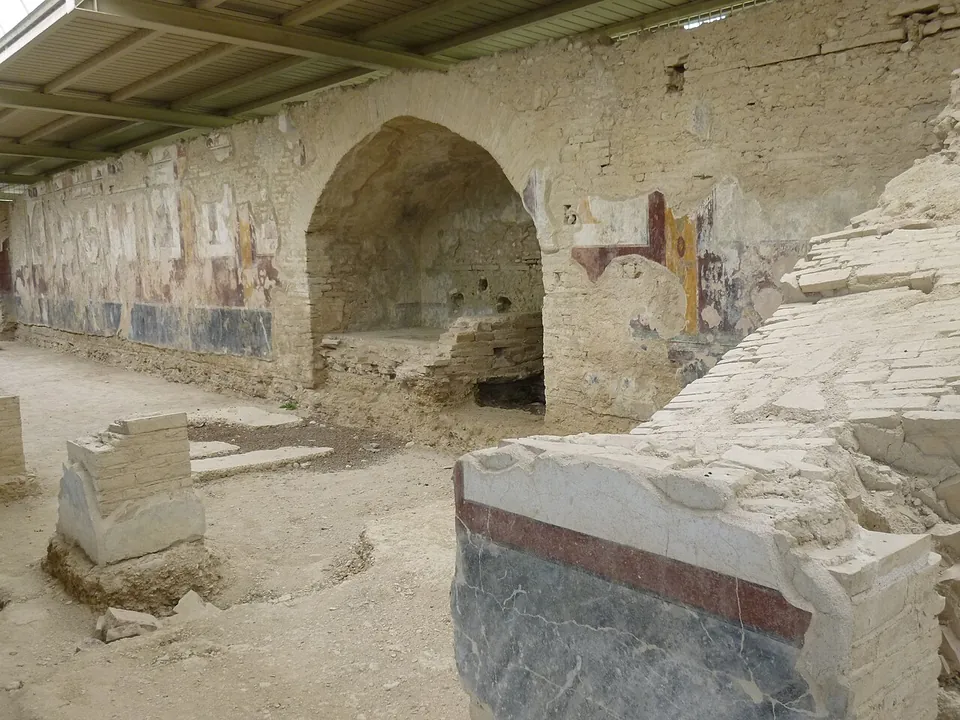
Photo: Diego Baglieri · CC BY-SA 4.0 · Commons
15 km · city · Marche
Urbs Salvia
The park takes in the town inside its Augustan walls, which still stand to height for long stretches (Ministry of Culture), and the amphitheatre outside them.
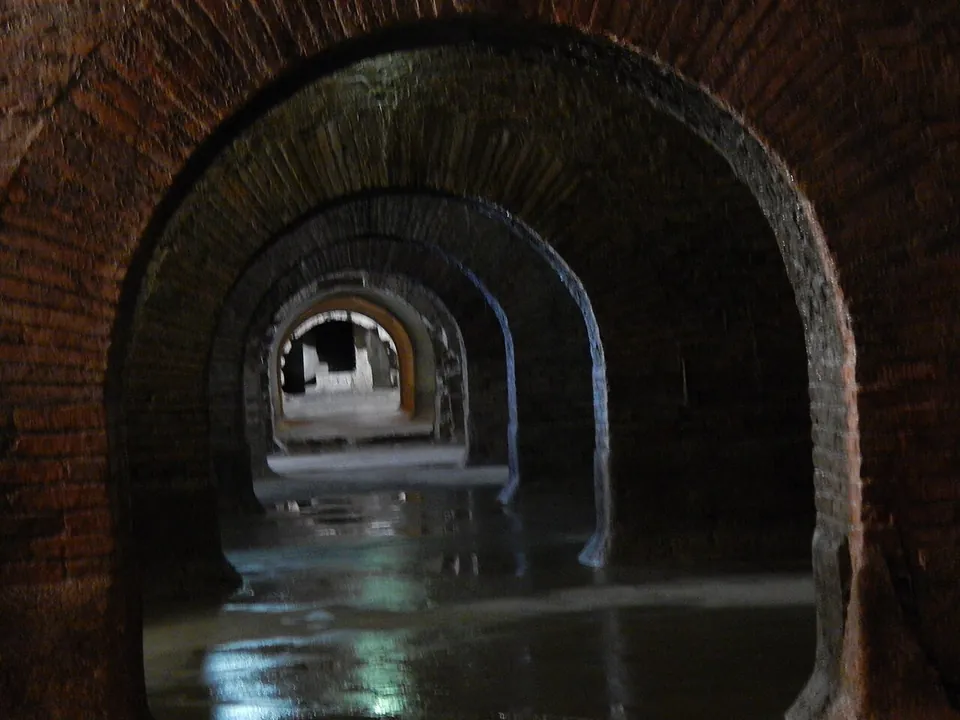
Photo: Giacomo Alessandroni · CC BY-SA 4.0 · Commons
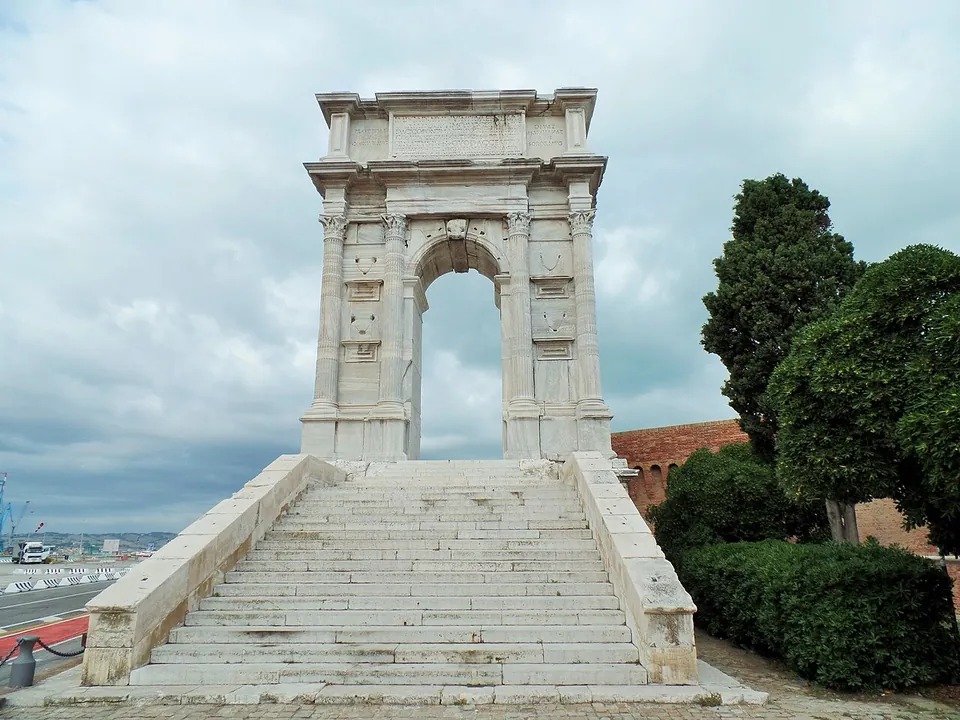
Photo: Claudio.stanco · CC BY-SA 4.0 · Commons


Straight-line distances.
Sources
Every fact on this page comes from the records below, each used under the licence noted.
| Source | Licence |
|---|---|
| Pleiades 413166 | CC BY |
| Wikidata Q3784754 | CC0 |
| Vici.org 1675 | CC BY-SA (text), CC0 (metadata) |
| OpenStreetMap way/995585964 | ODbL |
| Macerata Musei — hours, tickets and guided visits (the operator) | licence not recorded |
| Macerata Musei — Helvia Recina archaeological area (the operator) | licence not recorded |
| Pleiades — Roman theater at Helvia Ricina | licence not recorded |
| Wikidata — Roman theatre of Helvia Recina (Q28001156) | licence not recorded |
| Wikipedia (it) — Helvia Recina | CC BY-SA 4.0 |
| Wikipedia (it) — Teatro romano di Helvia Recina | CC BY-SA 4.0 |
| Wikipedia (en) — Ricina | CC BY-SA 4.0 |