

Urbs Salvia is a Roman town at the foot of the hill town of Urbisaglia, in the Marche, whose remains lie spread across about 40 hectares of open country: long stretches of its walls, a temple surrounded by half-sunken galleries still covered in wall paintings, a theatre built into the hillside and an amphitheatre outside the walls. It is the largest archaeological park in the region (it.wikipedia).
What is there today
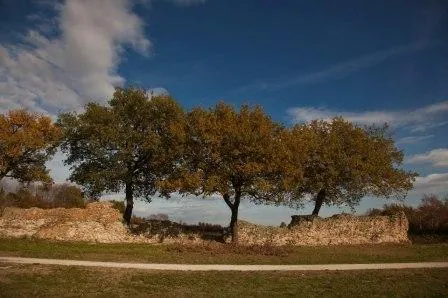
The park takes in the town inside its Augustan walls, which still stand to height for long stretches (Ministry of Culture), and the amphitheatre outside them. A route of about a kilometre leads downhill through it (the operator), and it.wikipedia describes three: a red one from the amphitheatre through the forum to the theatre and on up to the old town and its reservoir, a blue one along the north wall up to the theatre, and a shorter green one to the temple and its galleries, the paved streets south of them and the eastern gate.
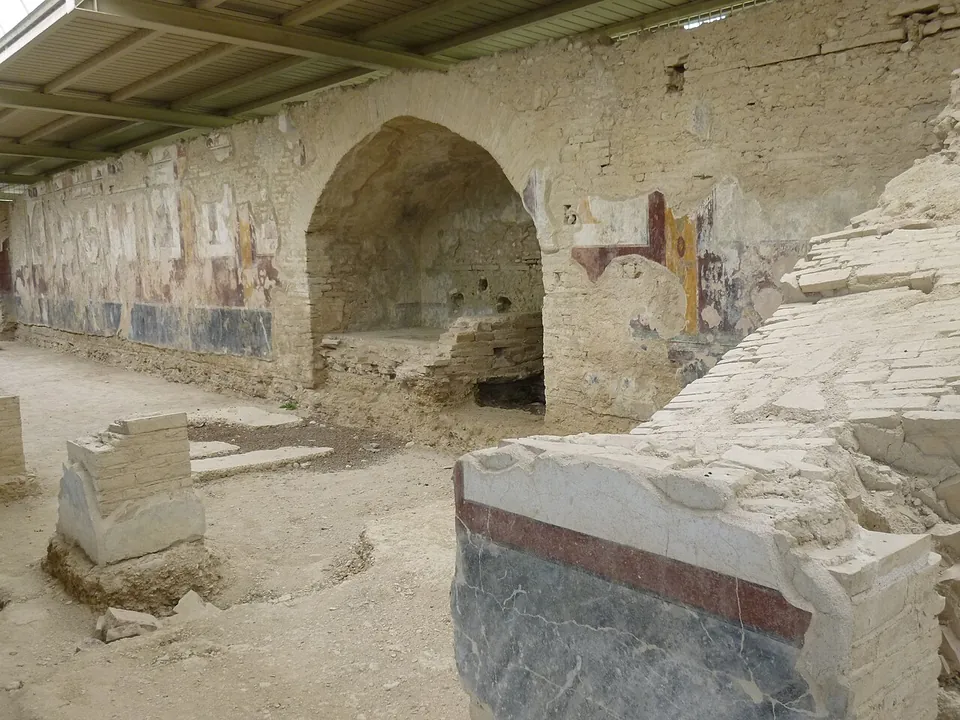
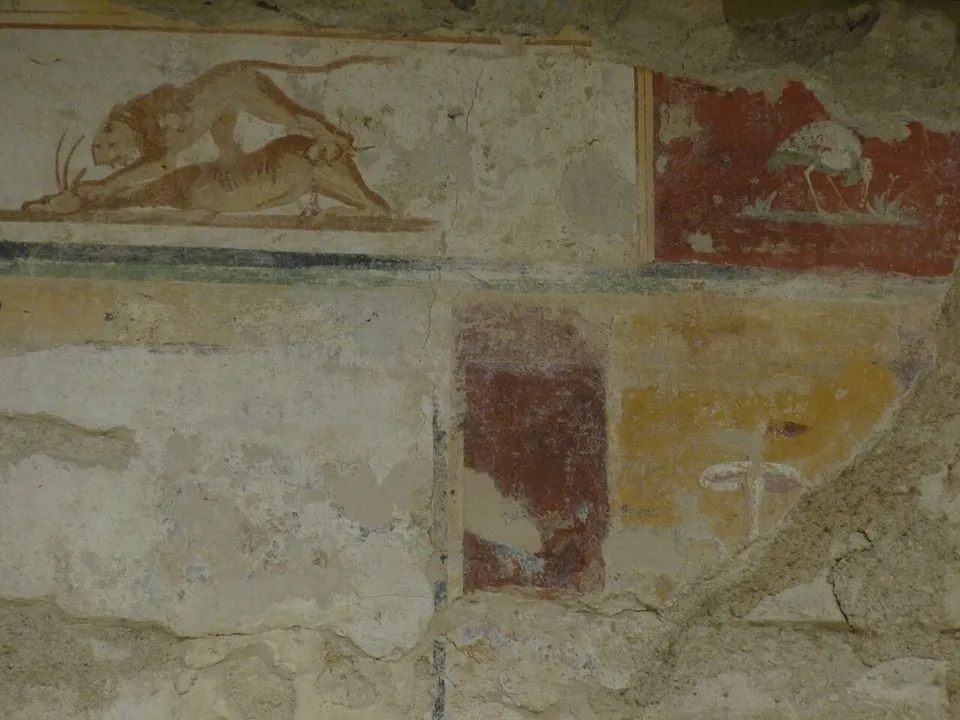
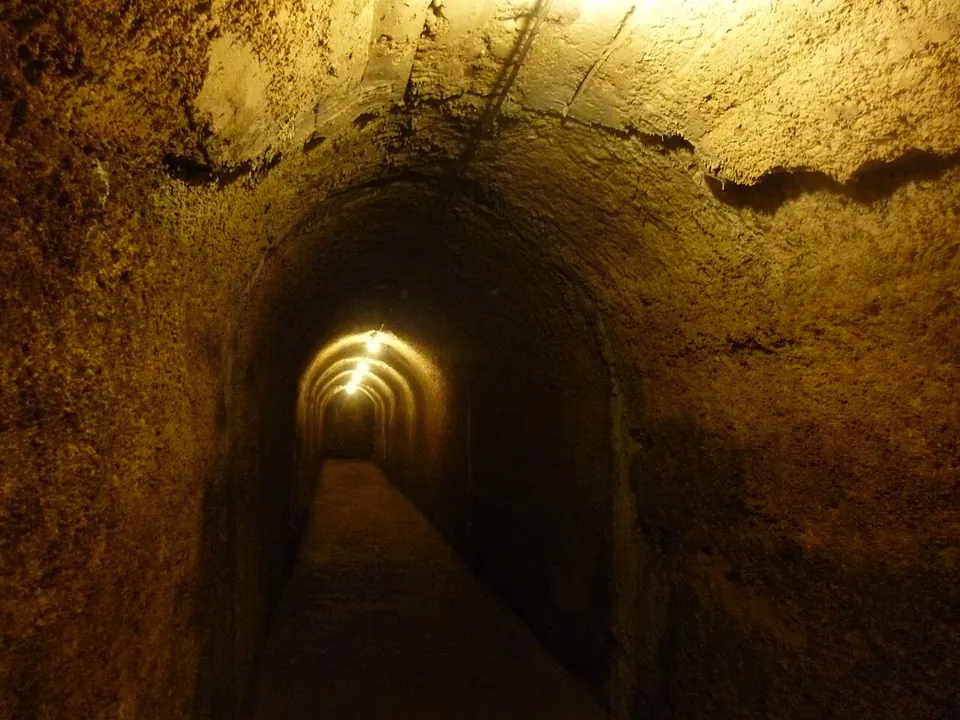
The highlight is the complex of the temple of Salus Augusta. Of the temple itself, part of the podium survives; around it runs a U-shaped cryptoporticus, a set of half-sunken galleries, whose walls carry one of the largest and best-preserved cycles of Roman wall painting in central Italy: panels of military trophies, with hunting scenes, exotic animals and masks above them (it.wikipedia). The south gallery, under a modern roof, can be entered.
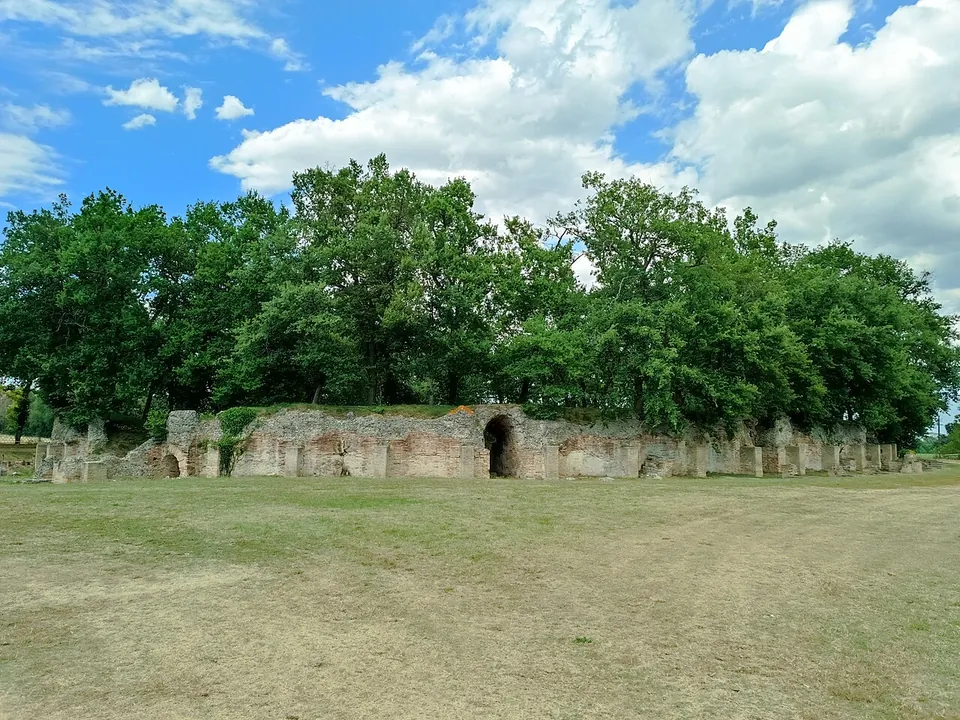
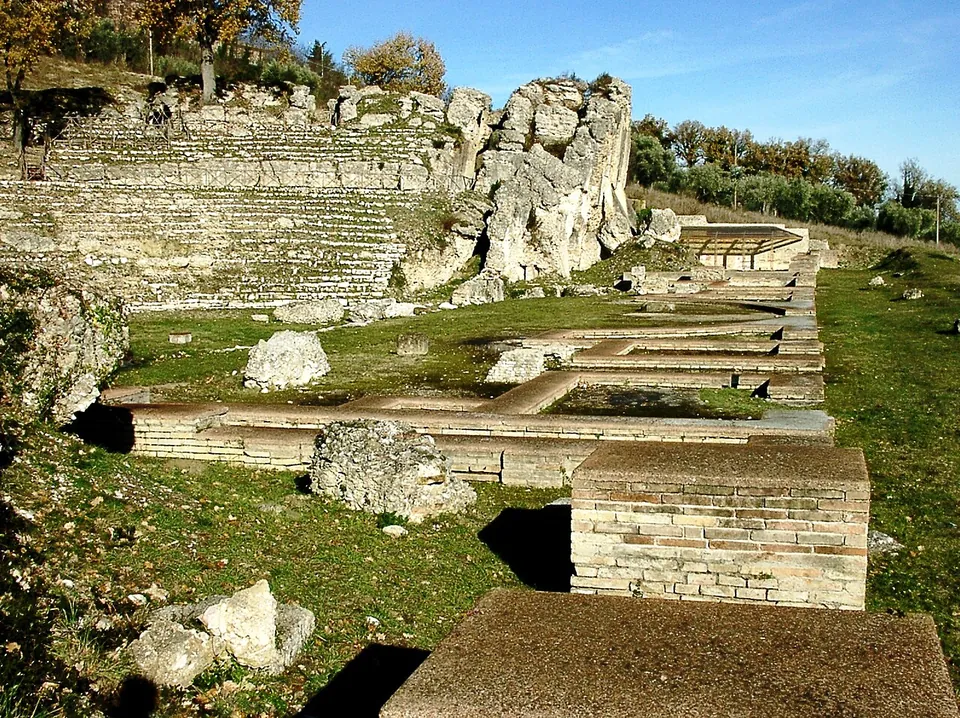
The theatre stands on one of the highest terraces, its seating built against the slope; the stage survives as foundations, and it.wikipedia calls it one of the largest in Italy. It is described as closed to the public at present (it.wikipedia). The amphitheatre, outside the walls, survives all the way round to the height of its first tier of seats (it.wikipedia, en.wikipedia). Between the theatre and the forum stands the “edificio a nicchioni”, a retaining wall with six large niches that linked the town’s levels; outside the North Gate are the concrete cores of two tower tombs; and in the excavated quarter south of the temple you can walk on Roman street paving (it.wikipedia). At the top of the hill, by the medieval town, is the reservoir that received the aqueduct (it.wikipedia).
Is it worth the trip?
Yes, if you are anywhere in the Marche. The painted galleries alone make it unusual: it.wikipedia ranks them among the largest and best-preserved painted complexes in central Italy, and they are still on the walls they were made for. Add a walled town you can walk through, an amphitheatre and the setting, open country beside the Abbadia di Fiastra nature reserve; the whole park can fill a day, or one of the shorter routes takes in the highlights (it.wikipedia).
The catch is the calendar. Outside May to August the park opens only at weekends and on public holidays (from November to February only on Sundays and holidays), and only for two hours in the morning and two in the afternoon, so plan around it. The theatre is currently closed, and the museum in the town has been shut since the 2016 earthquake (Ministry of Culture). No public transport is mapped near the entrance, so it needs a car.
Getting there
The park lies below Urbisaglia, in the province of Macerata, about 8 km from Tolentino (OpenStreetMap). The entrance, with the ticket office, an information point and a large car park, is on the Picena road (SP 78) (it.wikipedia). The route from the car park to the amphitheatre and the south gallery of the cryptoporticus can be done in a wheelchair with a companion (it.wikipedia). A footpath leads from the amphitheatre down through woods and fields to the Cistercian abbey of Fiastra, about 45 to 60 minutes on foot (it.wikipedia).
The park is open 10.30 to 12.30 and 15.00 to 17.00 on opening days: Thursday to Sunday and public holidays from May to August; Saturdays, Sundays and public holidays in March, April, September and October; Sundays, public holidays and 26 December to 6 January from November to February. It is closed on Mondays, and the Ministry of Culture lists it as closed throughout February; other days can be booked through the operator. A ticket is €5, €2 for EU citizens aged 18 to 25, and free for EU citizens under 18 (urbssalvia.it, read 21 October 2026 – check before travelling). The reservoir is opened on request to the Urbisaglia tourist office (it.wikipedia).
Visiting details
- Opening hours
- Open 10.30–12.30 and 15.00–17.00 on opening days. May to August, Thursday to Sunday and public holidays; March, April, September and October, Saturdays, Sundays and public holidays; November to February, Sundays, public holidays and 26 December to 6 January. Closed on Mondays; the Ministry of Culture lists the park as closed throughout February. Other days by booking.
- Tickets
- €5; €2 for EU citizens aged 18 to 25; free for EU citizens under 18 and in the other free-entry cases the operator lists. Tickets can also be bought online through Vivaticket, which the operator links to.
- Parking
- A large car park beside the ticket office and information point on the Picena road (SP 78) below Urbisaglia (it.wikipedia); OSM maps it about 180 m from the point.
Before you go
- Open only a few days a week, with a midday break, and closed on Mondays; check the operator's calendar before going.
- The theatre is described as closed to the public at present (it.wikipedia).
- The reservoir on the hilltop, inside the medieval town, is opened only on request to the Urbisaglia tourist office.
- The archaeological museum in the town has been closed since the 2016 earthquake for repair and refitting.
- No bus stop or railway station is mapped near the entrance; the site needs a car.
Hours and prices checked 21 October 2026 on the operator's own site. Confirm before travelling.
The temple of Salus Augusta and its cryptoporticus
The temple had six columns across its front (en.wikipedia). Traces of its inner walls show a porch and a cella ending in a semicircular wall, where the cult statue probably stood. It rises on a raised platform made by building the cryptoporticus round it: four galleries, three of them divided into two aisles by central piers and the fourth serving as the entrance corridor (it.wikipedia). The paintings are in the Third Pompeian Style, in three bands: a brown base, a middle band of panels showing military trophies, and an upper band of hunting scenes and nature scenes with exotic animals and masks. Their subjects belong to the imagery of Augustan and imperial propaganda (it.wikipedia). The temple was dedicated to Salus Augusta, the goddess who protected the emperor, and was probably used for the imperial cult promoted by Tiberius (en.wikipedia). it.wikipedia attributes the complex, very probably, to Gaius Fufius Geminus, who also built the theatre, and links it to the grave illness in AD 22 of Livia, Augustus’s wife and Tiberius’s mother.
The theatre
The theatre was built by Gaius Fufius Geminus in the years before AD 23 (it.wikipedia; en.wikipedia gives AD 23), set against the hill in the Greek manner, of brick-faced concrete (it.wikipedia). Its seating is divided into three tiers, reached from a corridor that runs round the back of the auditorium; at the top stood a small temple (en.wikipedia, it.wikipedia). The corridor also held back the hill and drained its water (it.wikipedia). Of the stage, only the lower walls survive, with the central recess for the main doorway; behind it a terrace held up on three sides by a massive wall carried a colonnaded square (it.wikipedia, en.wikipedia). it.wikipedia calls it the only Roman theatre in Italy that keeps substantial traces of painted plaster. Excavations in the 18th century and the 1950s and 1960s recovered statues from its stage front, among them a head of Dionysus and a portrait of the emperor Tiberius, now in the archaeological museum in the town (it.wikipedia).
The amphitheatre
The amphitheatre stands outside the walls, where crowds could come and go easily (it.wikipedia). Two inscriptions in the town’s museum record that it was given to the town around AD 81 by Lucius Flavius Silva Nonius Bassus, a native of Urbs Salvia, after he had taken Masada as Titus’s lieutenant (it.wikipedia; en.wikipedia dates it after 81). The arena measures 59 by 35 m, and it.wikipedia gives seating for about 5,150. It is built of brick-faced concrete. The two gladiators’ entrances lie on the long axis, and beside the southern one a narrow passage is identified as the Porta Libitinensis, through which the dead were carried out. Much of the outer brick facing was taken in the Middle Ages to build Urbisaglia and the nearby abbey of Fiastra, which is why the concrete core shows (it.wikipedia). In June and July it hosts a theatre season (it.wikipedia).
The walls, gates and tombs
The circuit is about 2,500 m long and encloses about 40 hectares. It was built more to display the town’s standing than for any real need of defence, of concrete faced with brick, with polygonal towers; the north side survives almost complete and much of the south and east, while the west side is lost (it.wikipedia). Two of the four gates survive: the North Gate, on the Via Salaria Gallica, and the eastern Porta Gemina, named for its two arches, whose remains are built into a 19th-century farmhouse. A few metres outside the North Gate are two tower tombs, now only their concrete cores; they were once faced with white limestone and held the urns of the dead (it.wikipedia).
The reservoir
On the top of the hill of San Biagio, the highest point of the ancient town, the reservoir received the water of the aqueduct and let it settle before it ran down to the town (it.wikipedia). It is two barrel-vaulted galleries linked at both ends, each about 51 m long, 2.90 m wide and 4.10 m high, lined with waterproof mortar and holding about 1,000 m³ of water (en.wikipedia). The inlet, the outlet and the inspection shafts in the vault can still be seen (it.wikipedia, en.wikipedia).
History
The town grew up on the Via Salaria Gallica, a road that left the Via Salaria at Asculum and ran north to Fossombrone (Forum Sempronii), and which formed the town’s main street. Settlers from Etruria and Latium gathered here at the end of the 3rd or the beginning of the 2nd century BC; in the second half of the 2nd century BC new colonists organised it as a town called Pollentia. Under Augustus, new colonists, among them veterans discharged by Octavian and Antony, rebuilt it with the theatre and the temple complex, and building reached its peak under the Flavian emperors, paid for by local men who had grown rich in imperial service (it.wikipedia). The colony probably took the name Urbs Salvia from the sanctuary of Salus Augusta (it.wikipedia).
Signs of crisis appear in the 4th century, when public and private buildings were damaged, partly by earthquakes, as the cryptoporticus was, and were not rebuilt. Alaric’s Visigoths passed through in 408–409, and the population drifted up to the hill of San Biagio, where present-day Urbisaglia began. In the 6th century the historian Procopius, travelling with Belisarius’s army, described a town reduced to a wretched state but probably still lived in (it.wikipedia). Dante, in the Paradiso, names Urbisaglia with Luni as cities that have passed away (en.wikipedia, it.wikipedia). Since 1995 the University of Macerata has excavated here every year; its recent work has uncovered a small Republican-era temple in the forum, an ironworking forge of the 3rd–2nd century BC, and a quarter of paved streets south of the temple complex that opened to the public in 2025 (it.wikipedia).
More photographs



Nearby
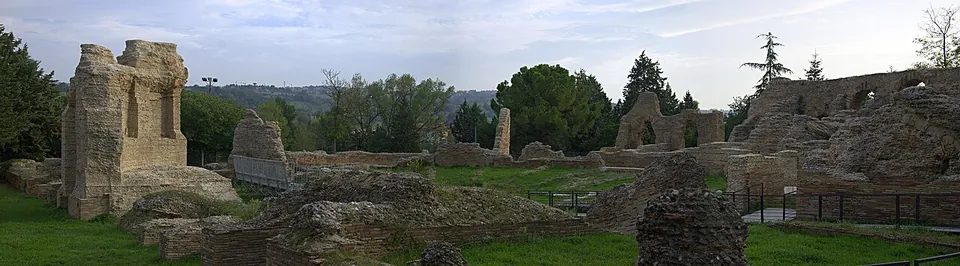
Photo: Maxmar69 · CC BY-SA 3.0 · Commons
15 km · theatre · Marche
Helvia Recina
The theatre is the only well-preserved part of the town above ground (en.wikipedia).
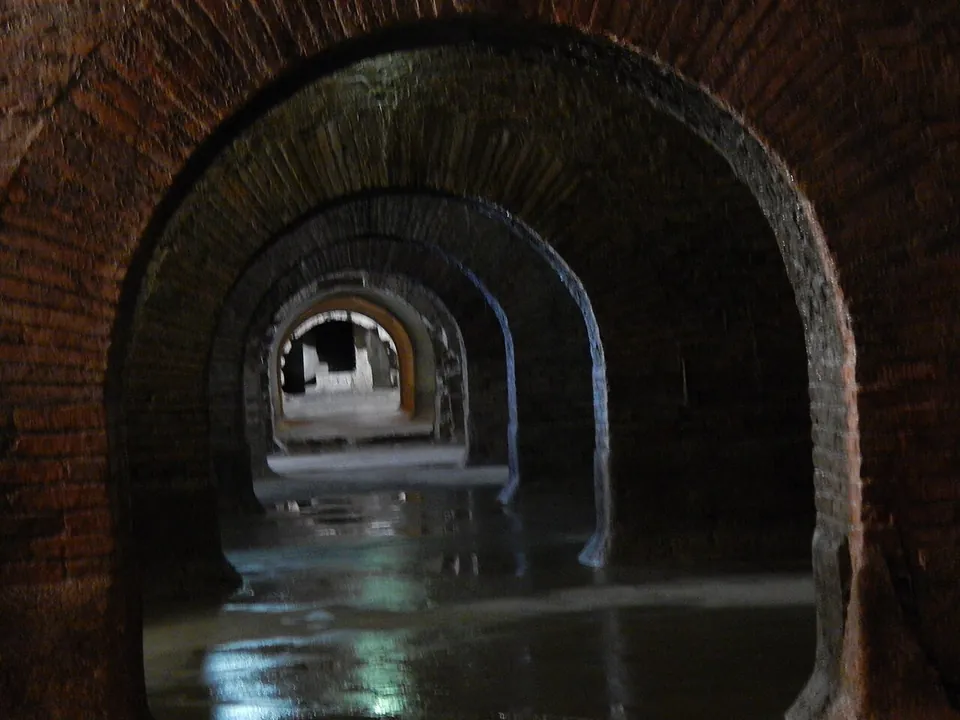
Photo: Giacomo Alessandroni · CC BY-SA 4.0 · Commons
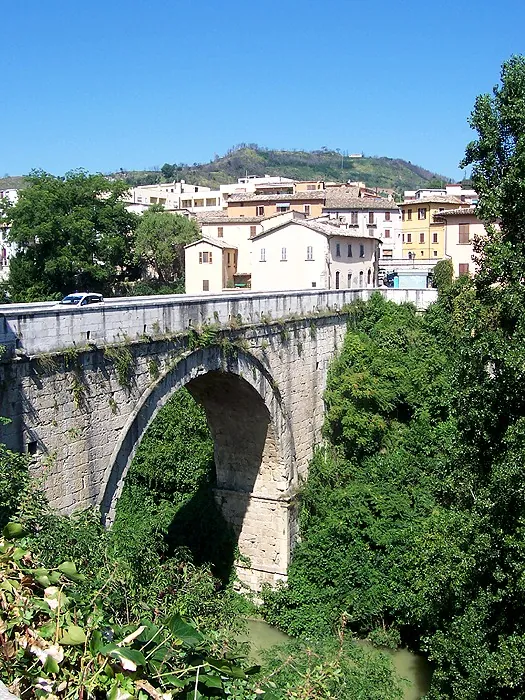
Photo: MarkusMark · CC BY-SA 3.0 · Commons
41 km · bridge · Marche
Ponte di Solestà
The bridge is one round arch of squared travertine blocks with a span of 22.20 m, standing 25 m high to the roadway, which is 62 m long and 6.50 m wide (it.wikipedia; de.wikipedia and the city's tourism site give the same span and length).


Straight-line distances.
Sources
Every fact on this page comes from the records below, each used under the licence noted.
| Source | Licence |
|---|---|
| Pleiades 413364 | CC BY |
| Wikidata Q2372655 | CC0 |
| Vici.org 1676 | CC BY-SA (text), CC0 (metadata) |
| OpenStreetMap way/161577954 | ODbL |
| Parco Archeologico Urbs Salvia — prepara la visita (hours and tickets, the park's own site) | licence not recorded |
| Ministero della Cultura — Museo archeologico nazionale e Parco archeologico di Urbs Salvia | licence not recorded |
| Wikipedia (it) — Parco archeologico di Urbs Salvia | CC BY-SA 4.0 |
| Wikipedia (en) — Archaeological Park of Urbs Salvia | CC BY-SA 4.0 |
| Pleiades — Roman amphitheater at Urbs Salvia | licence not recorded |
| Wikidata — Amphitheatre of Urbs Salvia (Q28978100) | licence not recorded |
| Wikidata — Roman Theatre of Urbisaglia (Q28001184) | licence not recorded |
| Wikidata — reservoir of the Roman aqueduct, Urbisaglia (Q56258846) | licence not recorded |