

What is there today
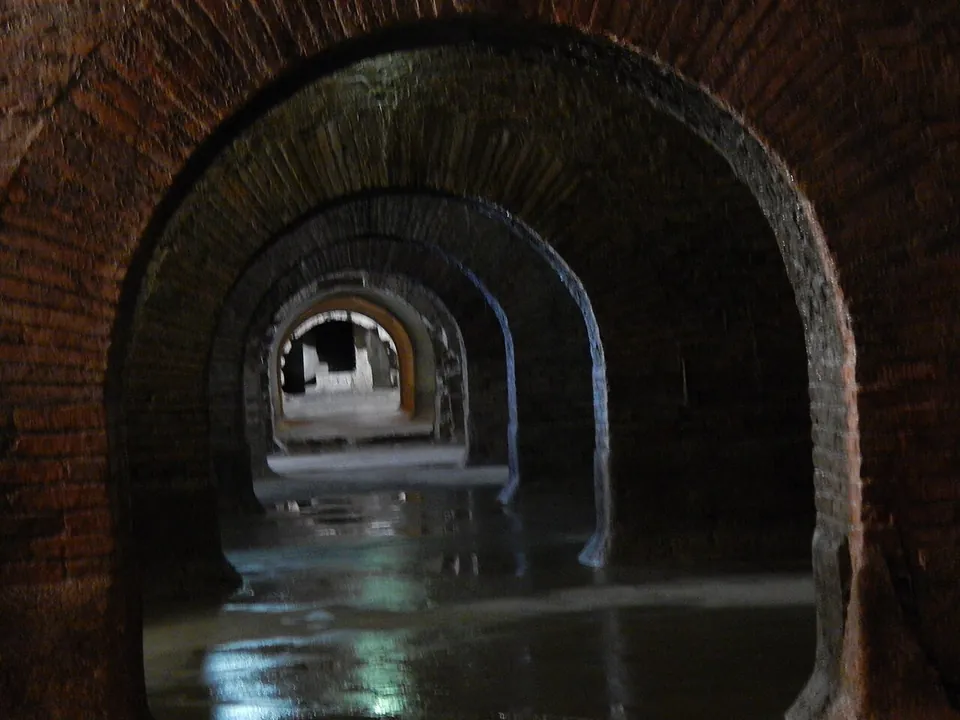
The Roman cisterns are the set piece. Thirty rooms in three parallel rows, covering about 2,000–2,200 m², lie under Via Paccarone and partly under the former Dominican convent beside the church of San Domenico, below the area where the forum probably stood (it.wikipedia; the operator). Every chamber can be walked. Inside you see the concrete walls (opus caementicium), traces of the waterproof plaster (opus signinum) on the lowest 70 cm or so, fifteen ventilation and inspection shafts, drainage channels, and the two lead pipes that fed the town’s fountains (it.wikipedia). The way in is through the Museo Civico Archeologico, whose rooms cover the history of the collections, protohistory and the Roman period (it.wikipedia). A smaller cistern of the same kind and date lies at the entrance to Piazza del Popolo, under part of the town hall (it.wikipedia); the museum service has used it for exhibitions (the operator).
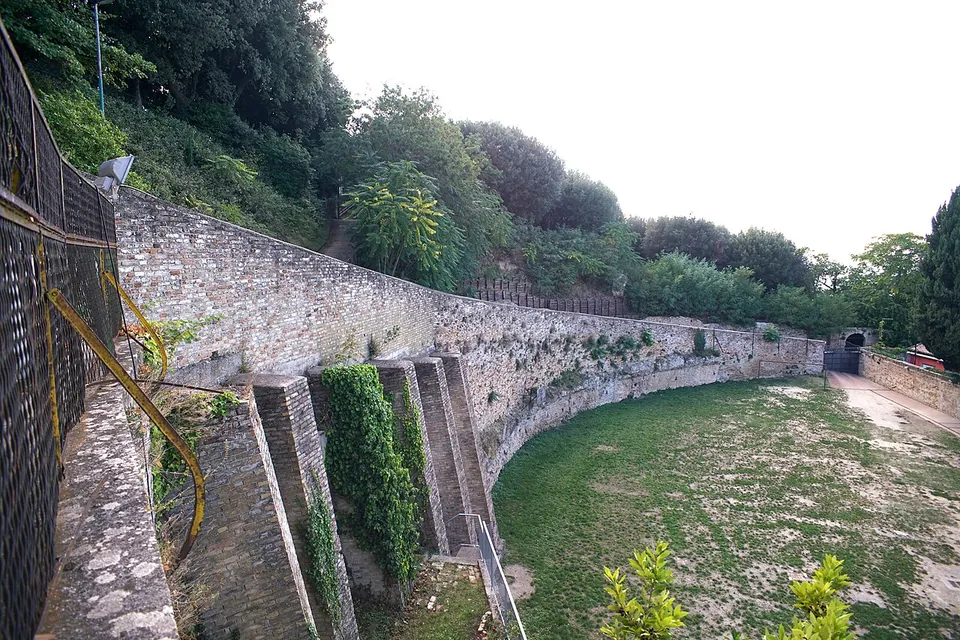
The Roman theatre lies on the northern side of the hilltop, below the Girfalco, the summit with the cathedral (it.wikipedia; the operator). What survives is a set of long curved walls in brick and stone; the operator puts its capacity at up to two thousand spectators. The street Via del Teatro Antico runs right past the remains (OpenStreetMap).
Elsewhere in town, the cathedral keeps the excavations made under its floor, and a 4th-century early Christian sarcophagus (the operator). The digs of 1934–35 found remains from the reign of Antoninus Pius in the 2nd century AD and a 6th-century basilica (en.wikipedia). The mosaics are described differently: en.wikipedia names one of a pair of peacocks, a Christian theme, while the operator ascribes them to an earlier pagan temple. There are scant traces of an amphitheatre, and remains of the city wall in squared limestone blocks are reported just outside Porta San Francesco (en.wikipedia).
Is it worth the trip?
For the cisterns, yes. They are among the largest and best-preserved Roman cisterns in Italy (en.wikipedia), and the it.wikipedia article calls their size unique in Italy. They are the one Roman sight here that holds a visit by itself. Add the theatre walls, a few minutes’ walk away, and the cathedral excavations, and the Roman town takes an hour or two inside a handsome hilltop town.
This is not a city of standing Roman monuments. Apart from the cisterns, Firmum survives in pieces. Outside the summer season, check the times before you go: from Tuesday to Friday the cisterns open only for two guided visits, at 11.00 and 16.00, and on Mondays not at all.
Getting there
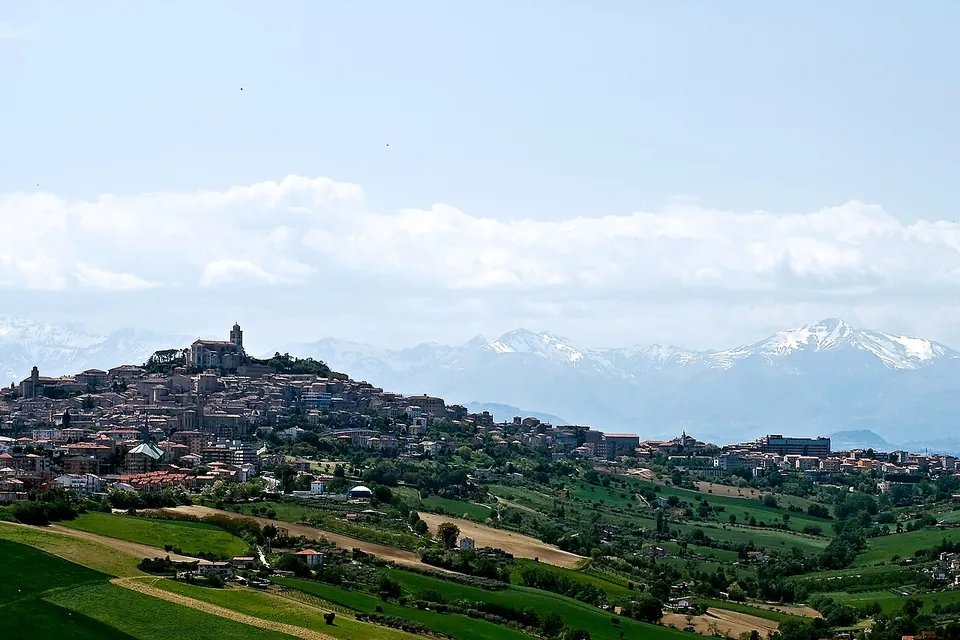
Fermo stands on a hill about 6 km from the Adriatic (it.wikipedia). The nearest railway station, Porto San Giorgio-Fermo, is on the Adriatic line, and town buses run between Porto San Giorgio and Fermo every 20 minutes during the day (it.wikipedia). By car, leave the A14 at Fermo-Porto San Giorgio (it.wikipedia). Parcheggio Piazzale Carducci, a paid car park, is about 200 m from the hilltop around the cathedral, and a bus stop at Largo Calzecchi is about 160 m away (OpenStreetMap).
The cisterns are entered from the Museo Civico Archeologico, Via Paccarone 36. Until the end of May 2027 they are closed on Mondays. From Tuesday to Friday there are guided visits at 11.00 and 16.00, and at weekends they are open 10.30–13.00 and 15.30–19.00. The archaeological museum’s page says its own weekday entries at those times start from Palazzo dei Priori on Piazza del Popolo. From 13 June to 13 September 2026 they were open daily, 10.00–13.00 and 15.00–19.00, and also until midnight on Thursdays in July and August. A ticket for the cisterns alone is €4. The combined ticket for the town’s museums and monuments is €10 and is valid for a year. It costs €8 for ages 14 to 25 and for groups of more than 15, and is free under 14 (fermomusei.it, read 19 October 2026; check before travelling). No ticket is mentioned for the theatre.
Visiting details
- Opening hours
- Roman cisterns, entered through the Museo Civico Archeologico (Via Paccarone 36): until 31 May 2027 closed on Mondays, guided visits at 11.00 and 16.00 Tuesday to Friday, and open 10.30–13.00 and 15.30–19.00 on Saturdays and Sundays; from 13 June to 13 September 2026 open daily 10.00–13.00 and 15.00–19.00, and on Thursday evenings in July and August until midnight. The theatre remains lie beside a public street, with no opening hours published.
- Tickets
- Cisterns alone: €4. The combined ticket for the town's circuit of museums and monuments, valid for a year, is €10, or €8 for ages 14–25, groups of more than 15 and members of FAI, Touring Club Italiano, Italia Nostra and ADSI; free under 14, for disabled visitors, ICOM members and accredited journalists. Tickets are sold at Palazzo dei Priori, the Museo Civico Archeologico and the Torre di Palme museum, or online. No ticket is mentioned for the theatre remains.
- Parking
- Parcheggio Piazzale Carducci, a paid surface car park (OSM way/363109762), lies about 200 m from the point mapped for the ancient town; street-side parking is mapped about 165 m away.
Before you go
- Until the end of May 2027 the cisterns are closed on Mondays and from Tuesday to Friday can be seen only on the guided visits at 11.00 and 16.00.
Hours and prices checked 19 October 2026 on the operator's own site. Confirm before travelling.
History
Firmum Picenum was founded in 264 BC as a Latin colony of 6,000 colonists (Pleiades), after Rome’s conquest of the Picentes. It was the local seat of Roman power and stayed loyal to it (en.wikipedia). The town’s motto, Firmum firmae fidei romanorum colonia, carries the title Romanorum Colonia, earned by that loyalty in the First and Second Punic Wars (it.wikipedia), and its people received Roman citizenship in 90 BC (it.wikipedia). Pleiades records municipal status after 48 BC; en.wikipedia says that after the battle of Philippi it became a colony with full rights, with men of the 4th Legion settled there. It lay where roads to Pausulae, Urbs Salvia and Asculum met, and a short branch road linked it with the coast road at Castellum Firmanum, today’s Porto San Giorgio (en.wikipedia).
The cisterns are conventionally dated to about AD 40, from a tile fragment in one wall stamped by a builder working in those years. They may be older, from the end of the 1st century BC (it.wikipedia). The operator’s pages give both: the end of the 1st century BC on its monuments page, the 1st century AD on the cisterns’ own page. Six of the rooms still held the town’s drinking water until 1980. The others were cleared of centuries of debris around 1960 (it.wikipedia).
Alaric took the town in 408. It then passed to the Lombards and, with the Franks, to the Church (the operator). Under the cathedral, a basilica of the 6th century AD (en.wikipedia) is the latest Roman-era building the sources name.
Nearby
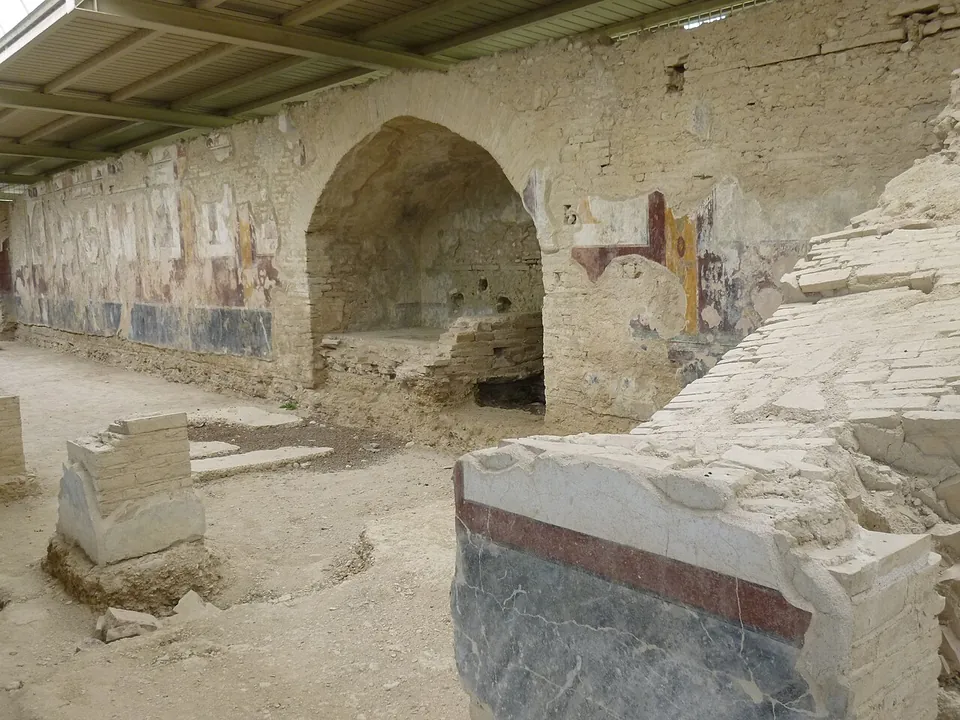
Photo: Diego Baglieri · CC BY-SA 4.0 · Commons
27 km · city · Marche
Urbs Salvia
The park takes in the town inside its Augustan walls, which still stand to height for long stretches (Ministry of Culture), and the amphitheatre outside them.
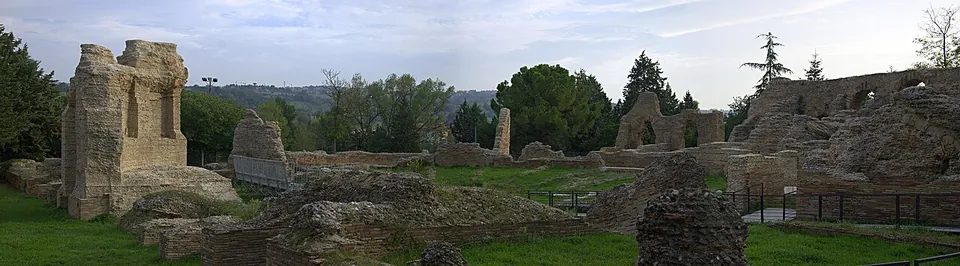
Photo: Maxmar69 · CC BY-SA 3.0 · Commons
30 km · theatre · Marche
Helvia Recina
The theatre is the only well-preserved part of the town above ground (en.wikipedia).
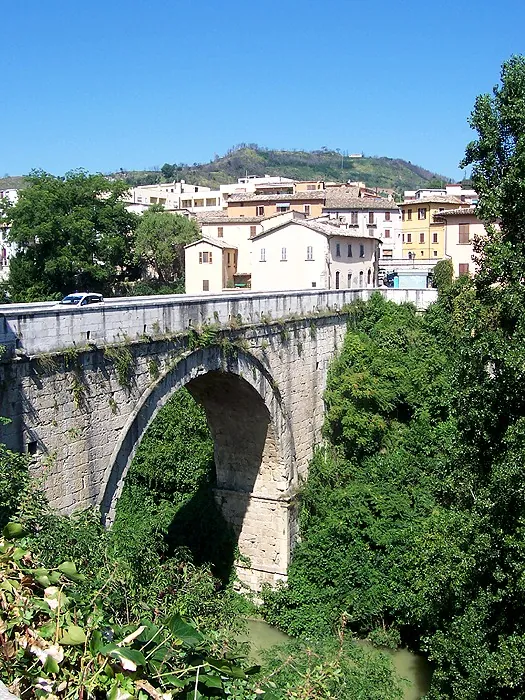
Photo: MarkusMark · CC BY-SA 3.0 · Commons
36 km · bridge · Marche
Ponte di Solestà
The bridge is one round arch of squared travertine blocks with a span of 22.20 m, standing 25 m high to the roadway, which is 62 m long and 6.50 m wide (it.wikipedia; de.wikipedia and the city's tourism site give the same span and length).


Straight-line distances.
Sources
Every fact on this page comes from the records below, each used under the licence noted.
| Source | Licence |
|---|---|
| Pleiades 413135 | CC BY |
| OpenStreetMap way/632174674 | ODbL |
| Fermo Musei — Cisterne Romane, hours and tickets (the municipal museum circuit) | licence not recorded |
| Fermo Musei — Museo Civico Archeologico di Fermo | licence not recorded |
| Fermo Musei — Monumenti, palazzi, chiese, musei | licence not recorded |
| Fermo Musei — La storia | licence not recorded |
| Wikipedia (en) — Fermo | CC BY-SA 4.0 |
| Wikipedia (it) — Fermo (Italia) | CC BY-SA 4.0 |
| Wikipedia (it) — Cisterne romane di Fermo | CC BY-SA 4.0 |
| Wikipedia (fr) — Citernes romaines de Fermo | CC BY-SA 4.0 |
| Wikidata — Teatro Romano di Fermo (Q56220237) | licence not recorded |
| Wikidata — Anfiteatro romano di Fermo (Q28978028) | licence not recorded |