What is there today
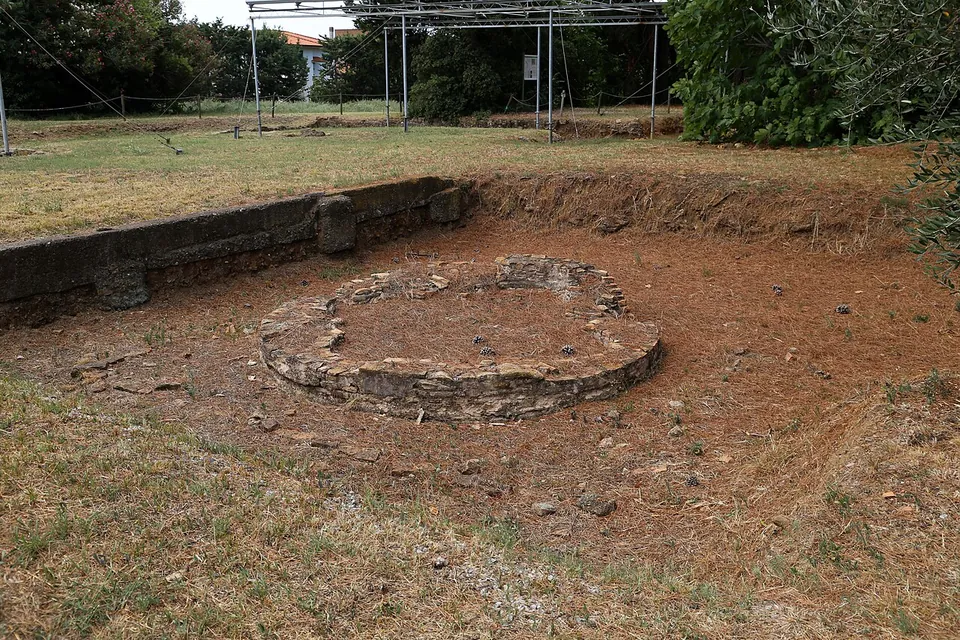
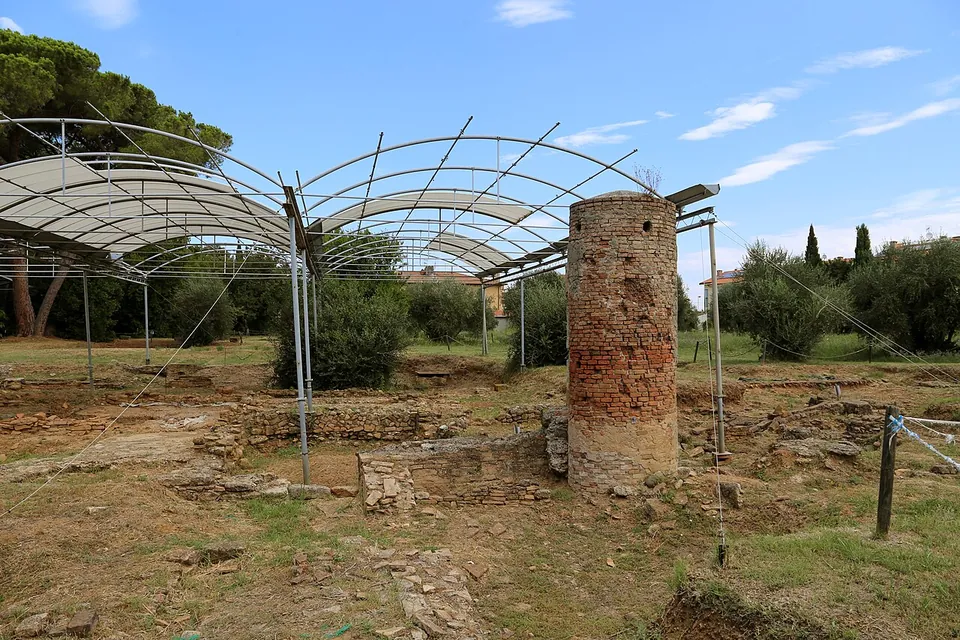
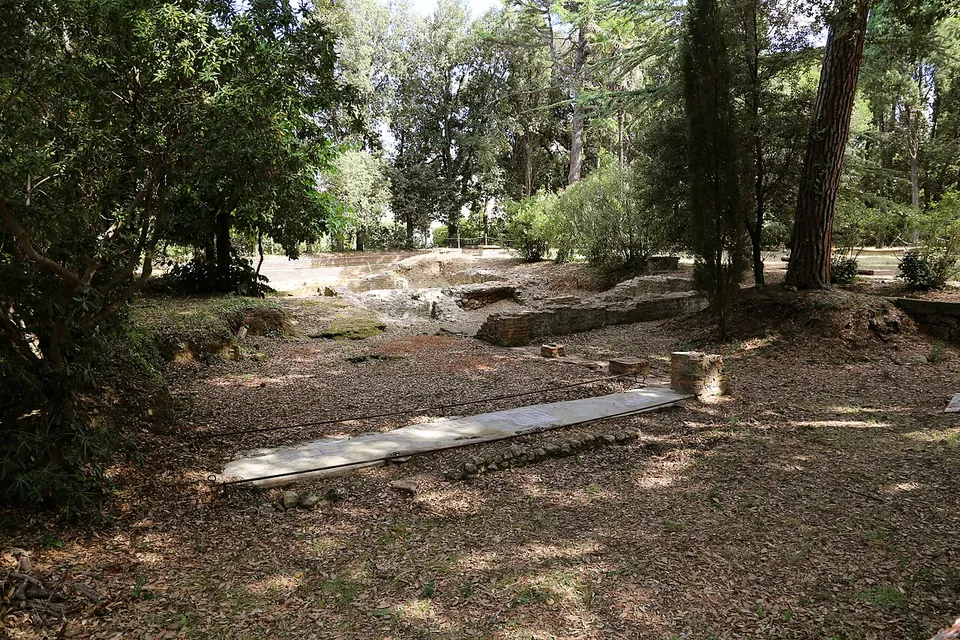
The villa survives as low walls and floor levels, partly in a shaded park among tall trees and partly under metal shelters over the excavations. When it was abandoned it was stripped even of its marble floors, only scant traces remain of the marble and glass mosaic that decorated the baths, and the most important finds are in the town’s archaeological museum at La Cinquantina, not here (it.wikipedia). What the park’s own audio guide walks you through on the ground is the baths, the production quarter, the atrium and the great colonnaded garden with the remains of its fountain at the centre (the operator).
The cistern
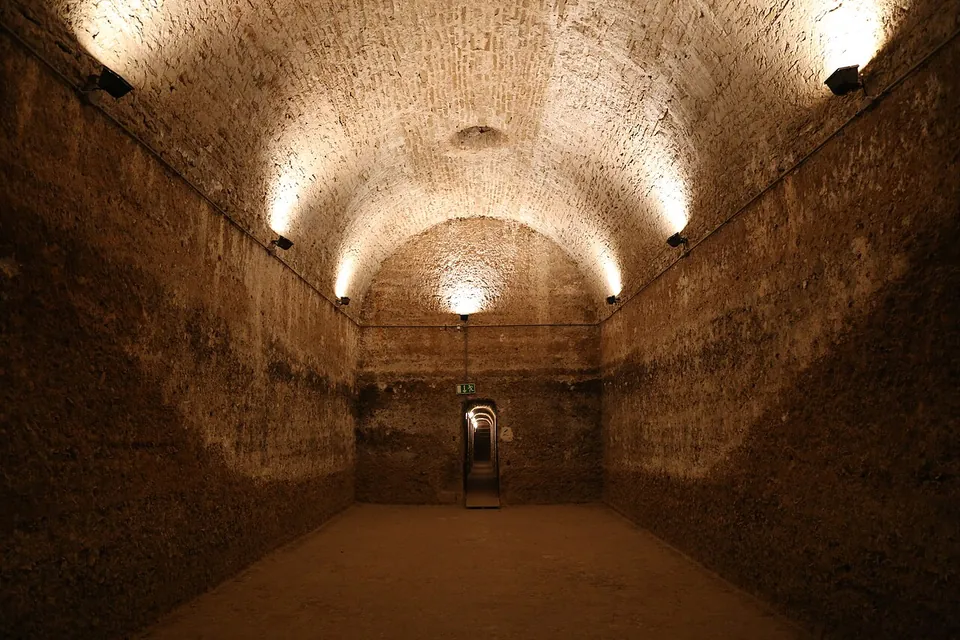
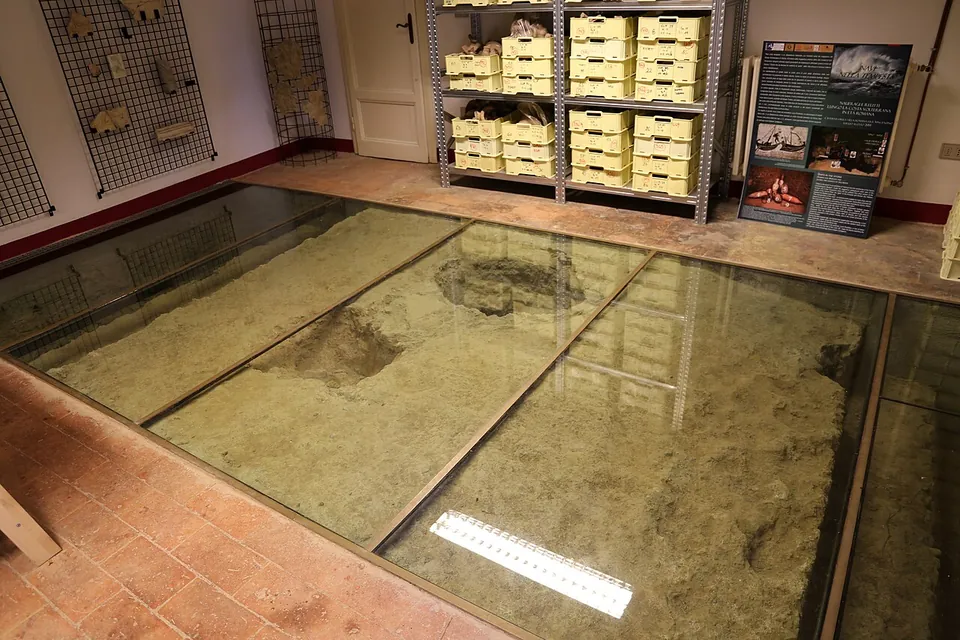
The one structure that survives whole is underground. Rainwater from the villa’s roofs ran through channels into a barrel-vaulted cistern, and two galleries leading off it in opposite directions, with a system of channels that filtered the water, carried it to the working areas and the private baths (the operator). The Comune gives the chamber as 16 by 5 m, with walls 80 cm thick and room for 540 cubic metres of water, and fitted it with new LED lighting in 2024. It is the part of the visit the operator singles out, “completely intact and open to visitors”. In the park’s store room, opened in 2017, a glass floor looks down onto the top of the vault (it.wikipedia).
The Villa Rossa, a building of the early-20th-century sugar works on the site, houses an antiquarium with some of the finds from the excavations (it.wikipedia) and a room of reproductions of ancient Roman musical instruments (the operator).
Is it worth the trip?
If you are in Cecina or on this stretch of coast, yes, for an hour: the cistern is a chance to stand inside a complete Roman water tank, and the combined ticket with the museum in town, where the villa’s best finds are, makes a coherent half-day. It is not worth a long detour on its own. Above ground this is a plan of a villa, not standing rooms, and it opens only on certain days, so check the hours before you set out.
Getting there
The park is at Via Carlo Ginori 33, between Cecina and Marina di Cecina, near the mouth of the River Cecina (the operator; it.wikipedia). A car park is mapped about 105 m from the remains and a bus stop, “V. Ginori 29”, about 160 m away (OpenStreetMap).
It shares its opening hours with the town’s archaeological museum. From 1 May to 30 September it is open Tuesday to Thursday 16.00–19.00 and Friday to Sunday 10.00–13.00 and 16.00–19.00; from 1 October to 30 April, Wednesday and Thursday 14.00–17.00 and Friday to Sunday 10.00–13.00 and 14.00–17.00. A combined ticket for the park and the museum is €6.00, or €15.00 for a family of two adults and two paying children; the published tariff gives no price for the park alone. The museum ticket on its own is €4.50 (€3.00 for ages 6–18, over-65s and students in Tuscany), and under-6s, visitors with disabilities with one companion, and ICOM members go free (Comune di Cecina, read 24 October 2026 - check before travelling, since prices and hours change).
Visiting details
- Opening hours
- From 1 May to 30 September: Tuesday to Thursday 16.00–19.00; Friday to Sunday 10.00–13.00 and 16.00–19.00. From 1 October to 30 April: Wednesday and Thursday 14.00–17.00; Friday to Sunday 10.00–13.00 and 14.00–17.00. The park keeps the same hours as the town's Museo Archeologico; Monday is not listed in either season.
- Tickets
- €6.00 for a combined ticket to the park and the Museo Archeologico at La Cinquantina; a combined family ticket (two adults and two paying children) is €15.00. The Comune's tariff gives no separate price for the park alone. The museum ticket is €4.50, or €3.00 for ages 6–18, over-65s and students in Tuscany; free for under-6s, visitors with disabilities and one companion, and ICOM members.
- Parking
- A car park is mapped about 105 m from the site (OSM node/6515448888), and the entrance is on Via Carlo Ginori 33.
Before you go
- The Comune's tariff prints no price for the park on its own; information and guided-tour bookings through the museum on +39 0586 611588.
Hours and prices checked 24 October 2026 on the operator's own site. Confirm before travelling.
History
The villa stood on a low rise later called the Poggetto del Fico, on the left bank of the Cecina, a little over a kilometre from the coast, close to the Via Aurelia (it.wikipedia). It was probably begun around 30 BC and its original core was complete by AD 70. Between about AD 80 and 120 the rooms beside the atrium were remodelled, perhaps for the farm manager, with a store of more than twenty large buried jars for fermenting wine, and the owners’ quarters to the north were turned over to making olive oil and grinding grain (it.wikipedia; the operator). The wine went out in amphorae made locally, near the river mouth (it.wikipedia).
In the second and third centuries the owners added rooms for show: a summer dining room of 10 by 6.5 m with a basin and a nymphaeum, a round fountain of four basins faced with marble at the centre of the garden, and baths of about 940 m² with a palaestra, cold, warm and hot rooms and two pools. A great hall, perhaps for receptions, followed in the fourth century and, early in the fifth, an apsed hall that could be entered from outside, used for public ceremony. A hoard of late antique coins was found hidden under the floor of the hot room, and the alabaster torso of a statuette of Isis from a niche of the nymphaeum is in the museum at La Cinquantina (it.wikipedia).
Published figures for the size of the villa differ, between about 0.7 hectares (the operator) and 1.7 hectares (it.wikipedia). The villa is traditionally attributed to Albinus Caecina, of an old Etruscan family of Volterra: it may be the villa of Decius Albinus Caecina, prefect of Rome in 414, near which the poet Rutilius Namatianus describes salt pans in a lagoon (it.wikipedia). The Comune’s portal reports that Fulvia Donati of the University of Pisa confirmed the attribution in her publication on the villa; fr.wikipedia notes that no document attests it.
The villa was abandoned in the fifth century and stripped even of its marble floors. From the seventh century its southern part served as a cemetery, with burials into the tenth, and a modest settlement occupied the northern part in the fourteenth. The remains were still showing above ground in the 18th century; Leonetto Cipriani made a first excavation in the 19th, and systematic digs followed in the 1960s and 1970s and above all from 1983, by the Soprintendenza archeologica della Toscana with the University of Pisa (it.wikipedia). The park opened to the public in the mid-1990s: it.wikipedia gives 1995, fr.wikipedia 6 July 1996.
More photographs
Nearby
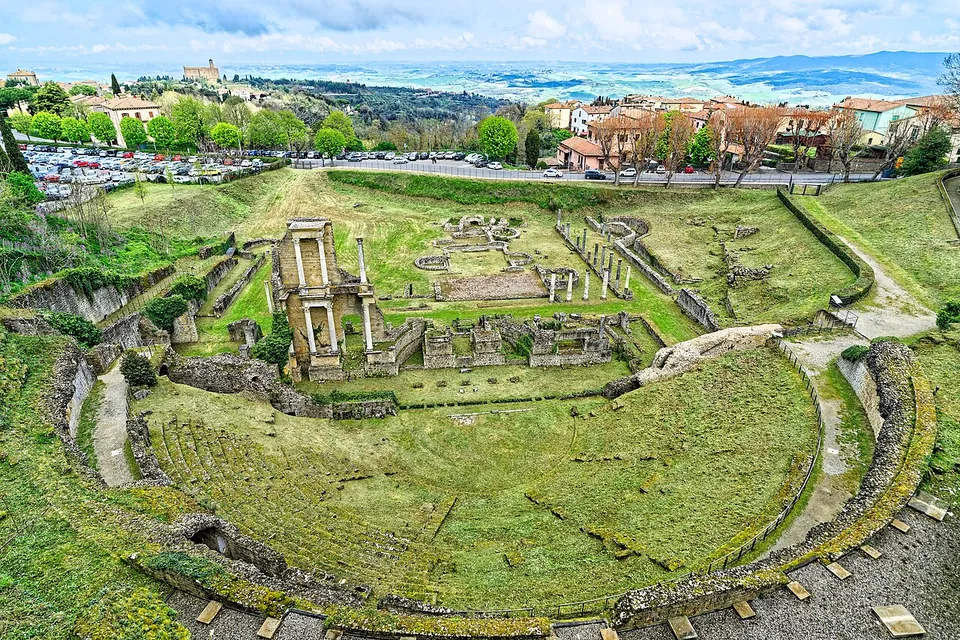
Photo: Holger Uwe Schmitt · CC BY-SA 4.0 · Commons
30 km · city · Tuscany
Volaterrae – Volterra
The Roman remains sit in and around a town that also keeps substantial Etruscan and medieval buildings (en.wikipedia), and all of them lie within about 650 m of the main square.
30 km · theatre · Tuscany
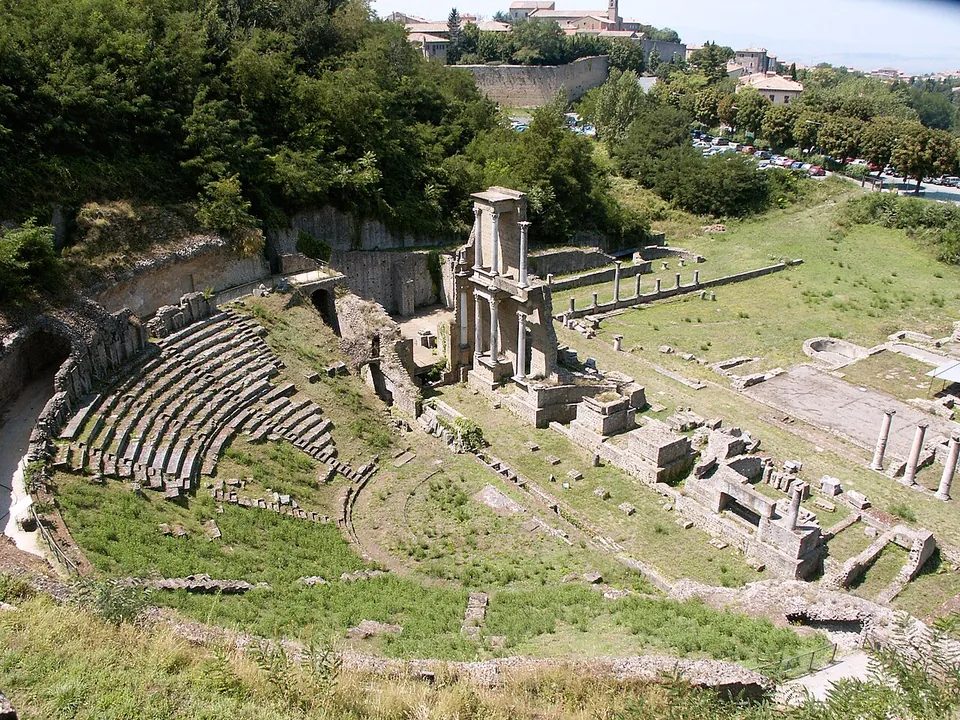
Roman Theatre of Volterra
The seating still curves round the slope: two tiers, of nine and ten rows, divided by a narrow walkway.
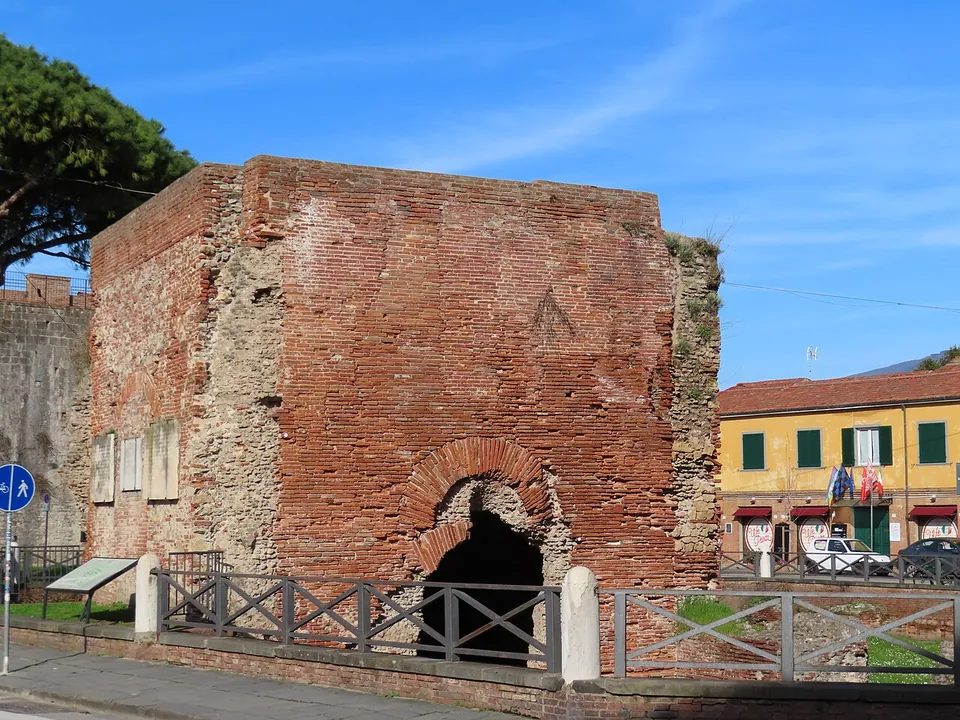
Photo: Superchilum · CC BY-SA 4.0 · Commons
47 km · bath · Tuscany
Baths of Nero
The piece that stands is the laconicum, the room for hot-air bathing: square on the outside and octagonal inside, it keeps its four brick outer walls (Comune di Pisa).


Straight-line distances.
Sources
Every fact on this page comes from the records below, each used under the licence noted.
| Source | Licence |
|---|---|
| Pleiades 403275 | CC BY |
| Wikidata Q47531808 | CC0 |
| Vici.org 59090 | CC BY-SA (text), CC0 (metadata) |
| OpenStreetMap node/1805428339 | ODbL |
| Wikipedia (it) — Parco archeologico di San Vincenzino | CC BY-SA 4.0 |
| Wikipedia (fr) — Parc archéologique de San Vincenzino | CC BY-SA 4.0 |
| Wikidata — the villa's cistern (Q99742729) | licence not recorded |
| Comune di Cecina — Museo Archeologico Comunale (hours and tickets for the museum and the park) | licence not recorded |
| Museo e Parco Archeologico di Cecina — guide to the archaeological park | licence not recorded |
| Visit Cecina (the Comune's tourism portal) — Parco Archeologico di San Vincenzino | licence not recorded |
| Visit Cecina — new lighting for the villa's cistern (Comune press release, 13 June 2024) | licence not recorded |