

What is there today
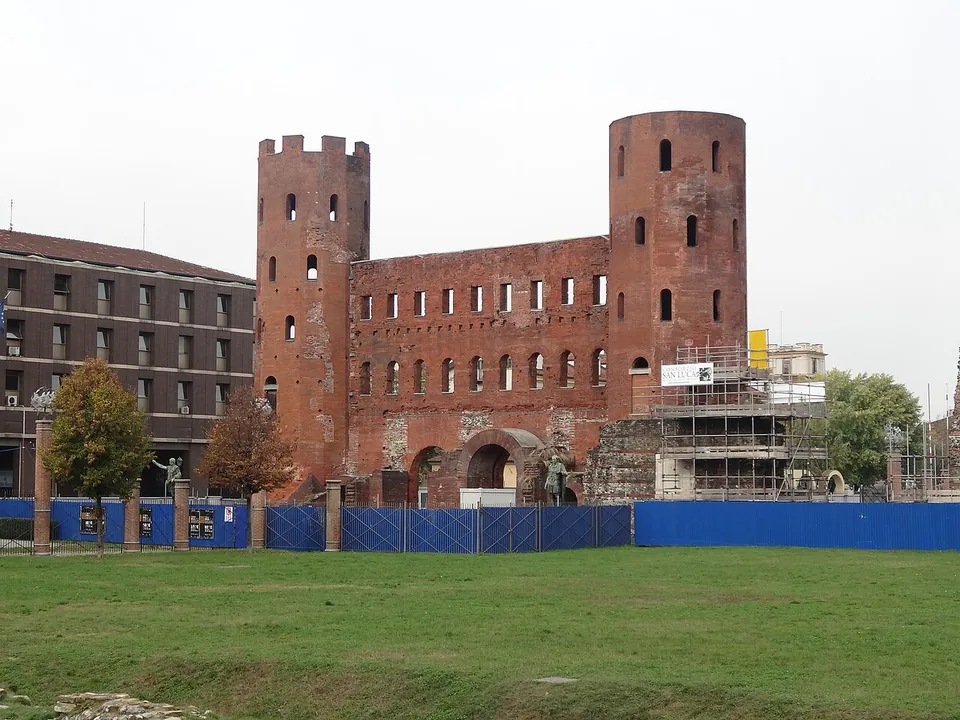
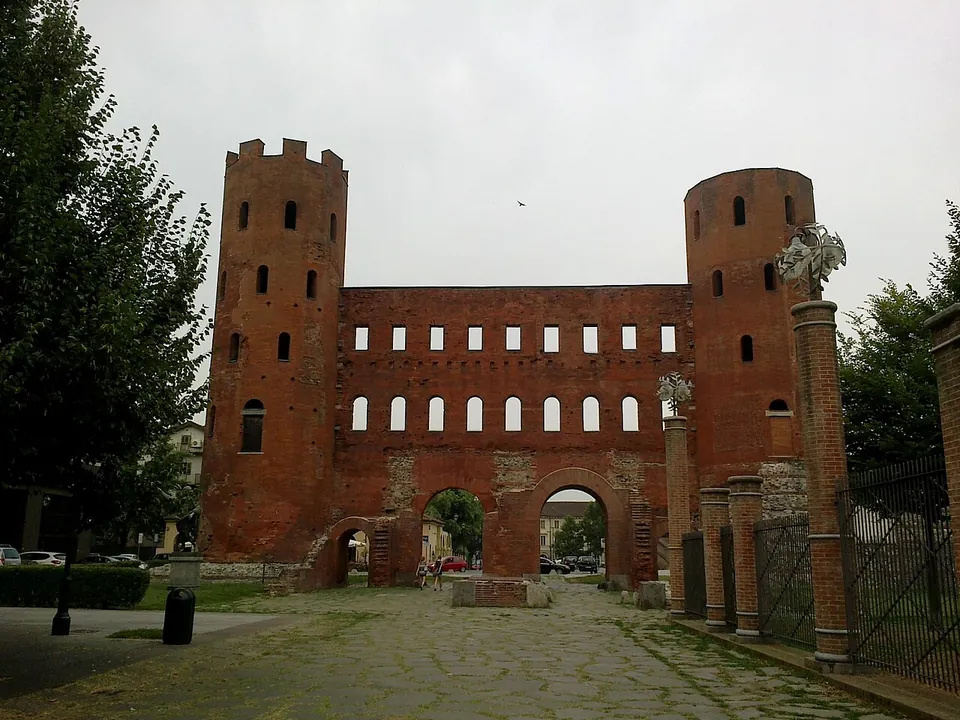
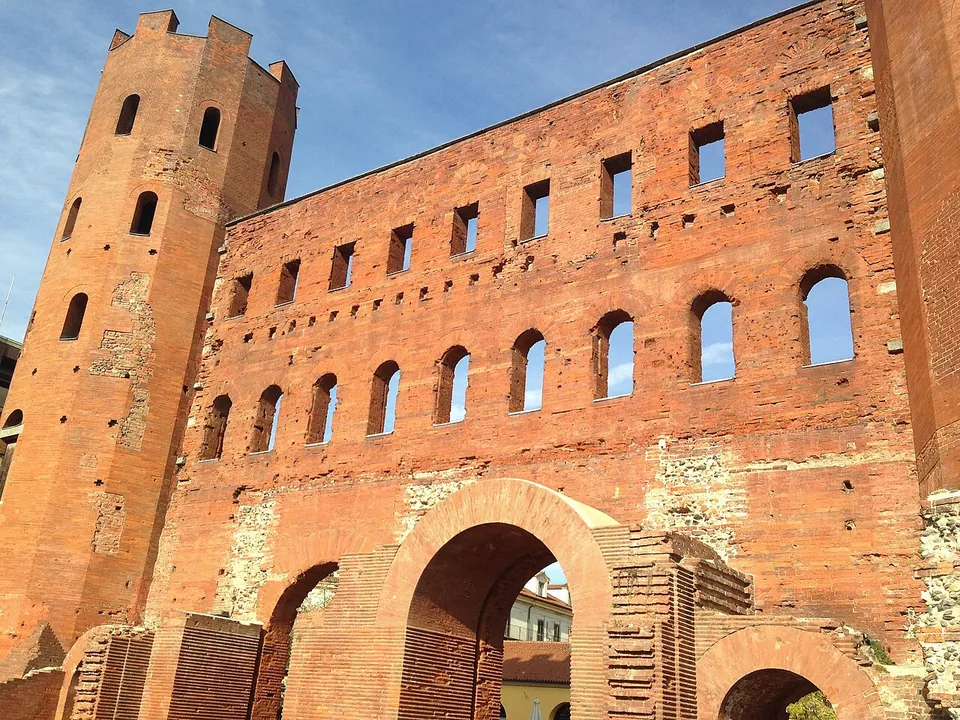
The Porta Palatina. This was the northern gate of the Roman city, where the main north–south street, the cardo maximus, left the walls; Via Porta Palatina and Via San Tommaso follow its line today (en.wikipedia). Between the two sixteen-sided towers runs a front about 20 m long with two storeys of windows, arched below and flat-topped above, and four passages at ground level: two large ones for wheeled traffic and two narrower ones for people on foot. Grooves inside the passages suggest they could once be closed with portcullises worked from the floor above (en and it.wikipedia). Not all of it is Roman: one of the two towers was rebuilt in 1404 and both were given battlements then (en and it.wikipedia). On the ground right by the gate part of the Roman paving survives, with ruts worn by cart wheels (it.wikipedia). The two bronze statues of Julius Caesar and Augustus are modern copies dating from the restoration of 1934, and archaeologists have criticised their position inside the gate rather than outside it (it.wikipedia). The gate stands in an archaeological park laid out in 2006, with stretches of the Roman wall beside it (it.wikipedia; OpenStreetMap). en.wikipedia counts it among the best-preserved Roman gateways of its century anywhere.
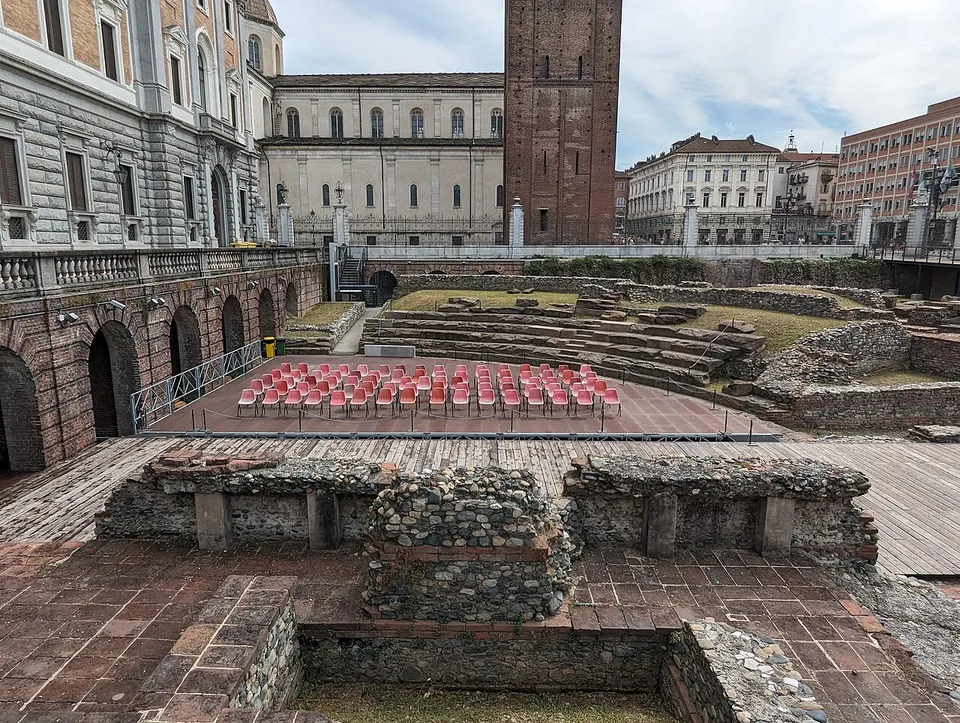
The Roman theatre. A little over 100 m south-east of the gate, beside the cathedral, are the excavated remains of the city’s theatre, found between 1899 and 1906 when a new wing of the royal palace was being built (it.wikipedia; OpenStreetMap for the distance). What is visible lies at ground level: foundations and the curve of the seating, with the twelve pits that held the posts of the curtain machinery and the patrol walk inside the city wall (it.wikipedia). It is part of the visit to the Museo di Antichità in the Musei Reali, on the same route as the museum’s section on the archaeology of Turin (the operator). It.wikipedia counts it among the smallest theatres of its kind; it held about 3,000 people after its enlargement.
Other traces. Via Garibaldi follows the line of the main east–west street, the decumanus maximus (en.wikipedia). A few remains of the eastern gate survive in the basement of Palazzo Madama on Piazza Castello, and the base of a corner tower of the walls at Via della Consolata and Via Giulio (it.wikipedia). Further stretches of wall were found during building work and are on show in some of the pedestrian entrances of the underground car park on Via Roma (it.wikipedia).
Is it worth the trip?
If you are in Turin, yes: the Porta Palatina costs nothing, is in the middle of the old town and is one of the best-preserved Roman gates of its age, and it makes a short stop on any walk through the centre. The theatre is a different proposition. It is a field of foundations rather than a building, and it is reached on the €15 Musei Reali ticket, which pays for a royal palace, an armoury and a picture gallery as well; worth it if you want the whole complex, much less so for the theatre alone. Roman Turin on its own is not a reason to come to the city: apart from the gate, what survives is scattered and mostly below ground.
Getting there
Everything is on foot in Turin’s historic centre. The gate is on Piazza Cesare Augusto, at the northern end of Via Porta Palatina; the theatre is beside the cathedral, near the Musei Reali’s side entrance on Piazza San Giovanni (the operator). A public transport stop named Duomo - Musei Reali is about 100 m from Piazza San Giovanni (OpenStreetMap). From Porta Nuova station the walk to the Musei Reali is 1.4 km, about 20 minutes, by Via Roma and Piazza Castello; from Porta Susa it is 1.7 km, about 25 minutes (the operator). The centre is a limited-traffic zone with restrictions on cars (the operator), so it is easier to arrive on foot or by public transport.
The gate and its park are open ground with no ticket. The Musei Reali, and with them the theatre, are open Thursday to Tuesday from 09.00 to 19.00, last entry 18.00, and closed on Wednesdays. A ticket is €15, €2 for visitors aged 18 to 25 and free under 18, and it is valid for the whole day; entry is free for everyone on the first Sunday of the month, 25 April, 2 June and 4 November (museireali.beniculturali.it, read 20 October 2026 — check before travelling, since prices move).
Visiting details
- Opening hours
- The Porta Palatina stands in a public garden. The Roman theatre is inside the Musei Reali, open Thursday to Tuesday 09.00–19.00, last entry 18.00; closed on Wednesdays.
- Tickets
- Porta Palatina free. The theatre is on the Musei Reali ticket, €15 (€2 aged 18–25, free under 18), valid for the whole day across the complex. Free for everyone on the first Sunday of each month, 25 April, 2 June and 4 November.
- Parking
- The Musei Reali lie inside Turin's central limited-traffic zone (ZTL); the operator advises checking the restrictions with GTT, the city transport company, and using a nearby car park.
Before you go
- The theatre can only be seen on a Musei Reali ticket, and the museum is closed on Wednesdays.
Hours and prices checked 20 October 2026 on the operator's own site. Confirm before travelling.
History
The Taurini were a Celto-Ligurian people of the upper Po valley; in 218 BC Hannibal took their chief town after a three-day siege (en.wikipedia), a village that probably stood where the Dora meets the Po (it.wikipedia). Pleiades records that Augusta Taurinorum was re-settled as a Roman veteran colony in 28 BC; it.wikipedia adds an earlier military camp under Julius Caesar in 58 BC and a first colony in 44 BC, and notes that an inscribed stone dated to 21 BC proves the colony existed by then.
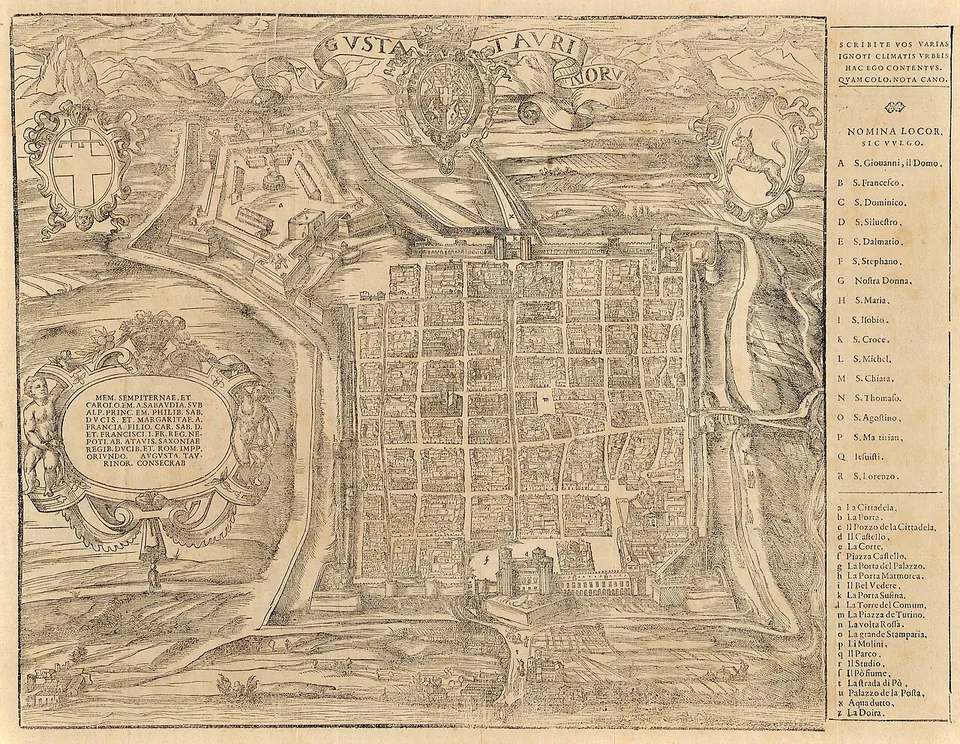
The town was laid out as a grid inside walls that were built in the 1st century AD, more than 5 m high and over 2 m thick, with four gates; the circuit is reckoned at 2,875 m, enclosing about 45 hectares (it.wikipedia). The Porta Palatina was built in the age of Augustus or of the Flavian emperors, possibly before the walls themselves (en and it.wikipedia). It.wikipedia dates the first theatre to Augustus and its enlargement to AD 70–90, while the Musei Reali date the theatre to the 1st and 2nd centuries AD. The city stayed a modest provincial colony, its population estimated at about 5,000 (en and it.wikipedia). In AD 69 part of it burned in a fire started by the campfires of a legion of Otho’s army quartered there, as Tacitus records (it.wikipedia).
In 312 Constantine defeated Maxentius’s forces in a battle about 20 km west of the city, months before the battle of the Milvian Bridge; in 398 some seventy bishops met in council in Turin; and in the early 5th century the city suffered from the raids that swept Piedmont (it.wikipedia). The theatre had been abandoned by the end of the 4th century and was quarried for building stone for the first cathedral (it.wikipedia). The gate, by contrast, stayed in use for centuries and was saved from demolition in the early 18th century by the engineer Antonio Bertola, who persuaded Duke Vittorio Amedeo II to keep it (en and it.wikipedia). Alfredo d’Andrade stripped it of later additions in the early 20th century, at the same time as he fought to preserve the newly found theatre, and the restoration of 1934–1938 cleared the houses around it (it.wikipedia).
More photographs


Nearby
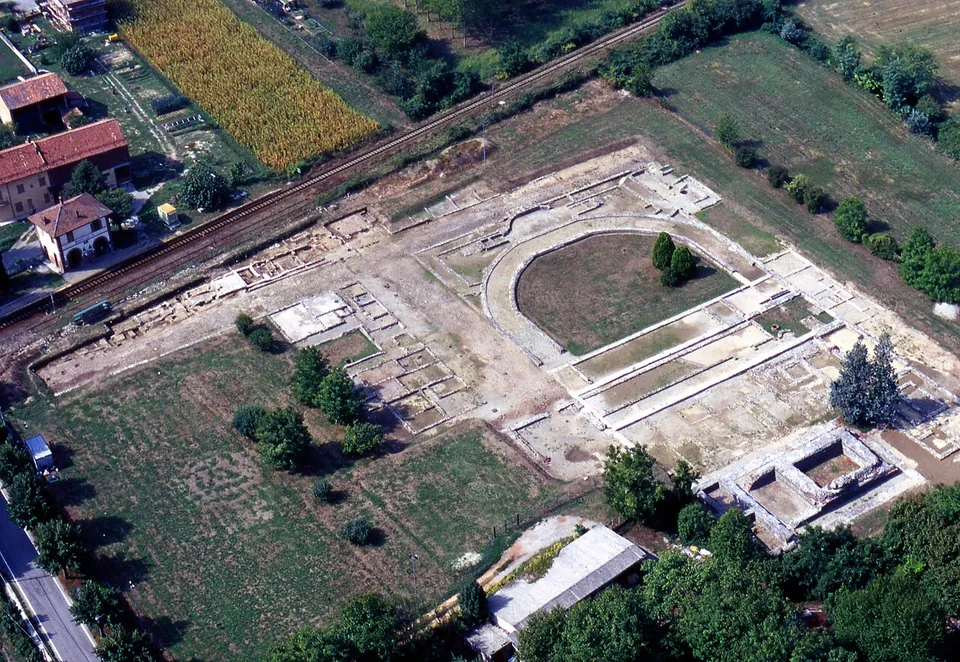
Photo: Soprintendenza per i Beni Archeologici del Piemonte e del Museo Antichità Egizie · CC BY-SA 3.0 · Commons
28 km · city · Piedmont
Industria
The archaeological area covers 2.65 hectares (the Soprintendenza), of which about 1.5 hectares has been excavated, roughly a tenth of the ancient town (it.wikipedia).
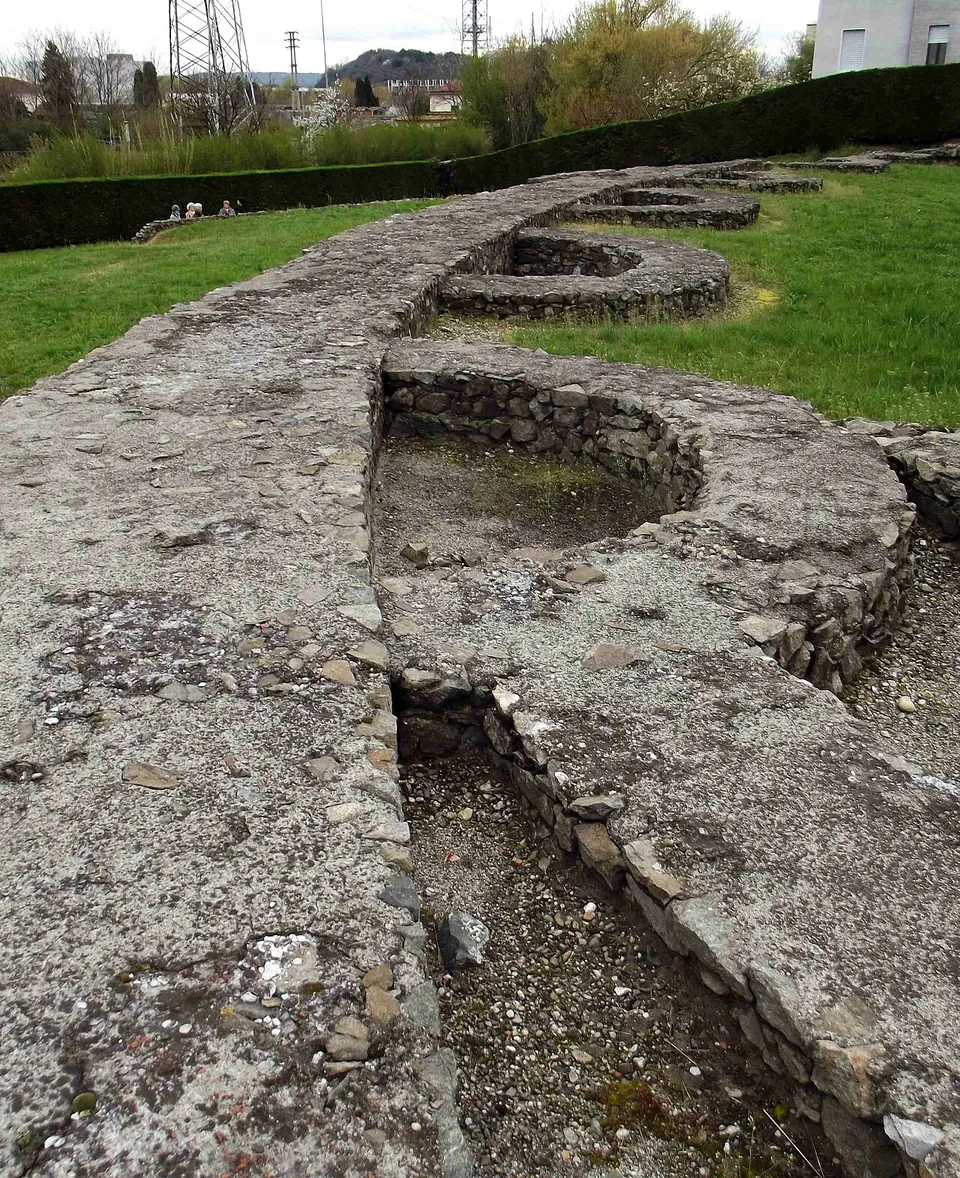
Photo: F Ceragioli · CC BY-SA 3.0 · Commons
46 km · city · Piedmont
Eporedia – Ivrea
The amphitheatre is the one Roman monument you can stand in front of.
Photo: F Ceragioli · CC BY-SA 3.0 · Commons
47 km · amphitheatre · Piedmont
Roman Amphitheatre of Ivrea
What you see is the plan of the building rather than the building.


Straight-line distances.
Sources
Every fact on this page comes from the records below, each used under the licence noted.
| Source | Licence |
|---|---|
| Pleiades 383580 | CC BY |
| Wikidata Q11907223 | CC0 |
| Pleiades — Porta Palatina | licence not recorded |
| Wikidata — Porta Palatina (Q1054755) | licence not recorded |
| Wikidata — Roman theatre of Turin (Q3982371) | licence not recorded |
| Wikipedia (it) — Storia di Torino | CC BY-SA 4.0 |
| Wikipedia (en) — Turin | CC BY-SA 4.0 |
| Wikipedia (en) — Porta Palatina | CC BY-SA 4.0 |
| Wikipedia (it) — Porta Palatina | CC BY-SA 4.0 |
| Wikipedia (de) — Porta Palatina | CC BY-SA 4.0 |
| Wikipedia (it) — Teatro romano di Torino | CC BY-SA 4.0 |
| Musei Reali Torino — hours and tickets (the operator of the theatre) | licence not recorded |
| Musei Reali Torino — suggested visits (the theatre on the archaeological route) | licence not recorded |