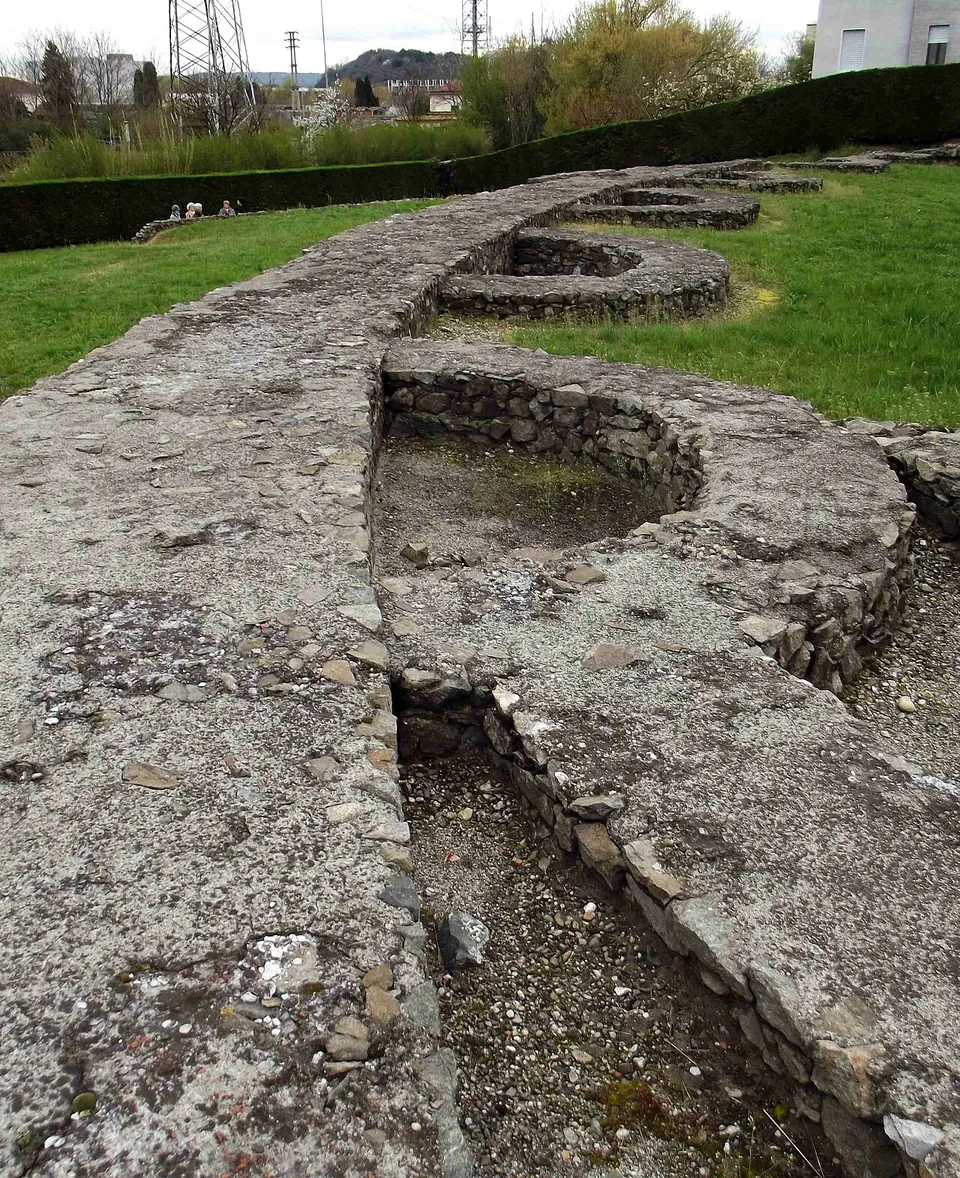

What is there today
What you see is the plan of the building rather than the building. The foundations of its walls remain, in particular the outer elliptical wall and the walls of its substructures, built partly below ground to carry what stood above, and some of the underground passages where the fighting animals were kept can still be made out (Ministero della Cultura). Wikipedia describes an underground chamber in the middle of the arena, linked by a corridor to the service areas beneath the seating, which let animals and stage equipment be moved about (en.wikipedia).
Next to it are the remains of a villa that the Romans partly demolished to make room for the amphitheatre; some of its walls were built into the amphitheatre’s structure (en/it.wikipedia). Some of the villa’s remains are visible, and they had recently been restored by 2023 (Ministero della Cultura). The site is fenced, and you look at it from outside the fence, where there are information panels (it.wikipedia). Some of the finds from the excavations are in the Museo Civico P.A. Garda in the town centre (it.wikipedia).
Is it worth the trip?
On its own, no: this is a low ground plan seen through a fence, and a look round the outside does not take long. It is worth the short walk if you are in Ivrea anyway. It is free, you can see it at any hour, and it is the one Roman building in town you can stand in front of: the rest of Eporedia – Ivrea is a river crossing rebuilt in 1716 and the fragments of a bridge in the bed of the Dora Baltea (it.wikipedia). The road from the amphitheatre into the old town keeps the line of the Roman road that linked Rome with the lands beyond the Alps (Ministero della Cultura), so the walk in is part of the visit. The painted plaster from the villa, shown in the Museo Garda, completes it.
Getting there
The amphitheatre stands on Corso Vercelli, about 1 km east of the historic centre (Ministero della Cultura; OpenStreetMap). Bus stops on Corso Vercelli are about 130 m away, Ivrea railway station is about 1.1 km in a straight line, and there is a free gravel car park about 60 m from the site, mapped as open Monday to Saturday (OpenStreetMap).
There is nothing to pay to see it from outside the fence. The interior is listed as closed every day (Ministero della Cultura). It opens on special days, or by arrangement with the Comune di Ivrea or the Soprintendenza (it.wikipedia). For the European Heritage Days the Soprintendenza’s archaeologists and the Museo Garda offered guided visits starting at the amphitheatre, entered from Via dei Cappuccini: on 23 September 2023, free, to the restored villa, and on 13 June 2026, to present restoration work at the amphitheatre that was then about to begin; bookings for the 2026 visit went through the museum, on 0125 410512 (Ministero della Cultura).
The Museo Garda in Piazza Ottinetti opens Tuesday to Sunday, 09.00 to 13.00 and 15.00 to 18.00, and is closed on Mondays and public holidays. A ticket is €8, or €6 for over-65s and university students up to 25; under-18s go free (museogardaivrea.it, read 24 October 2026).
Visiting details
- Opening hours
- Seen from outside the fence at any time. The interior is listed as closed every day; it opens only for occasional guided visits, such as those for the European Heritage Days on 23 September 2023 and 13 June 2026, or by arrangement with the Comune di Ivrea or the Soprintendenza.
- Tickets
- Free to see from outside the fence. The 2023 heritage-day visit inside was free; no price is published for other visits. Museo Civico P.A. Garda, which shows finds from the excavations: €8, €6 reduced, free under 18.
- Parking
- Free gravel car park about 60 m from the amphitheatre, mapped as open Monday to Saturday 07.30–19.00 (OSM way/178898640); street parking 120–140 m away.
Before you go
- The amphitheatre cannot normally be entered; you look at it through the fence.
- In June 2026 the Soprintendenza described restoration work at the amphitheatre as about to start. No later notice says whether the site or its surroundings are affected.
Hours and prices checked 24 October 2026 on the operator's own site. Confirm before travelling.
History
The amphitheatre was built around the middle of the 1st century AD outside the walls of Eporedia, along the road to Vercelli (Ministero della Cultura; it.wikipedia). Pleiades reads it as evidence of the town’s growing suburbs, and the Ministry describes the same expansion: Eporedia was an obligatory stage on the road from Rome across the Alps, became an important trading centre, and in the imperial period spread beyond its walls, mainly to the east, with new quarters between the amphitheatre and the Porta Praetoria. Published estimates of its capacity run from 10,000 to 15,000 spectators (it.wikipedia; Ministero della Cultura). Spectators came in through entrances at both ends of the long axis, and the podium was faced with studded bronze plates (it.wikipedia).
Its remains have been known since the early 20th century and were excavated systematically between 1955 and 1964 (it.wikipedia). The excavators found many fragments of frescoes and a long stretch of the bronze facing from the backs of the podium seats (Ministero della Cultura), along with coins, pottery and pieces of statues (it.wikipedia). The work was extended to the neighbouring villa in the early 1980s, and only some of its rooms have been explored so far (it.wikipedia). The Ministry lists coins, amphorae, fragments of statues and painted plaster among the finds there (Ministero della Cultura).
Nearby
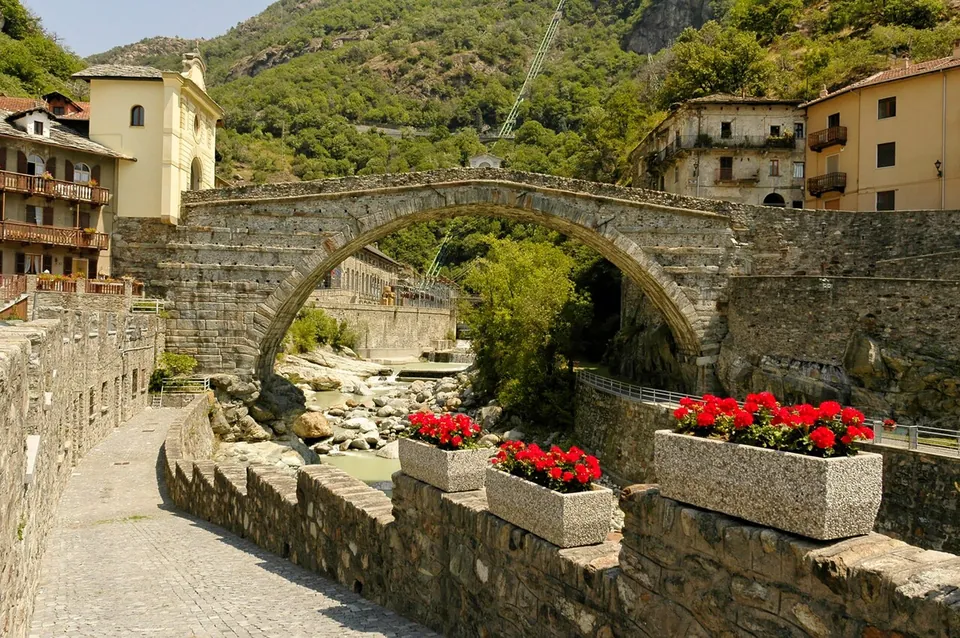
Photo: dacolje · CC BY-SA 2.5 · Commons
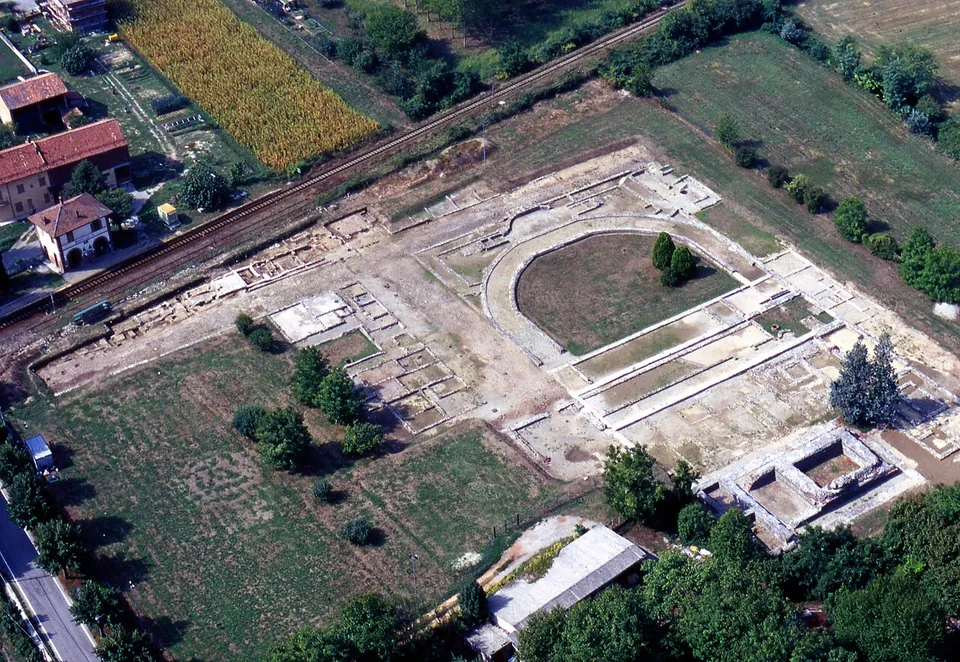
Photo: Soprintendenza per i Beni Archeologici del Piemonte e del Museo Antichità Egizie · CC BY-SA 3.0 · Commons
36 km · city · Piedmont
Industria
The archaeological area covers 2.65 hectares (the Soprintendenza), of which about 1.5 hectares has been excavated, roughly a tenth of the ancient town (it.wikipedia).
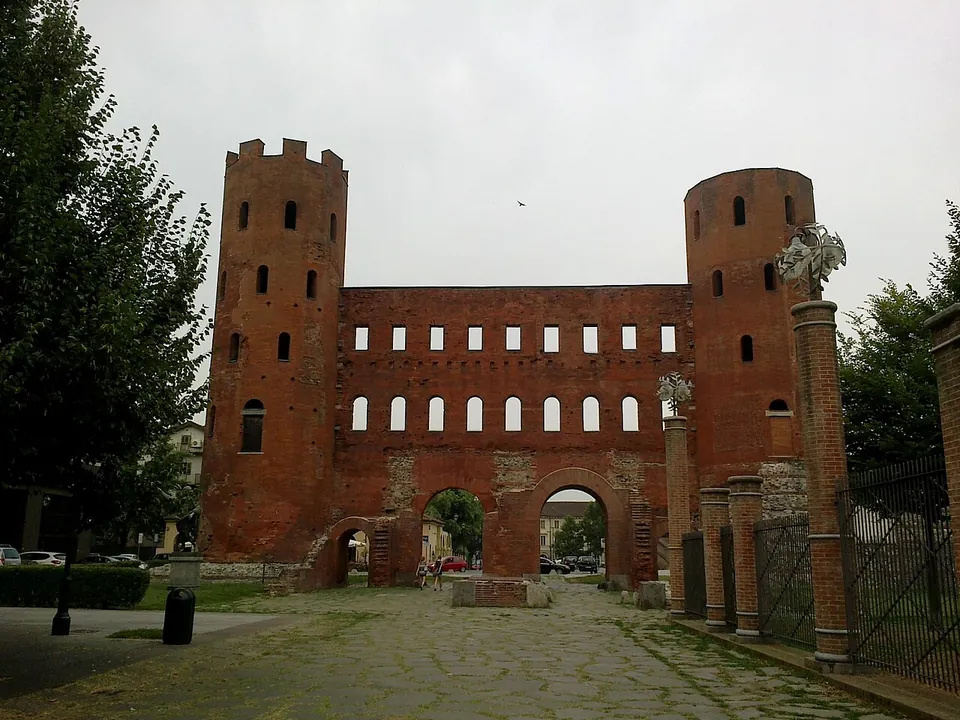
Photo: rene boulay · CC BY-SA 3.0 · Commons


Straight-line distances.
Sources
Every fact on this page comes from the records below, each used under the licence noted.
| Source | Licence |
|---|---|
| Pleiades 998834783 | CC BY |
| Wikidata Q16526592 | CC0 |
| Vici.org 4221 | CC BY-SA (text), CC0 (metadata) |
| OpenStreetMap relation/2539009 | ODbL |
| Pleiades — Eporedia (the Roman town the amphitheatre belongs to) | licence not recorded |
| Wikipedia (it) — Anfiteatro romano di Ivrea | CC BY-SA 4.0 |
| Wikipedia (en) — Ivrea Roman Amphitheatre | CC BY-SA 4.0 |
| Wikipedia (fr) — Amphithéâtre romain d'Ivrée | CC BY-SA 4.0 |
| Ministero della Cultura — Anfiteatro romano di Ivrea | licence not recorded |
| Ministero della Cultura — guided visit to the amphitheatre and Museo Garda, 13 June 2026 | licence not recorded |
| Ministero della Cultura — European Heritage Days 2023 in Ivrea (the restored villa) | licence not recorded |
| Museo Civico P.A. Garda — hours and prices 2026 (the museum's own site) | licence not recorded |