

What is there today
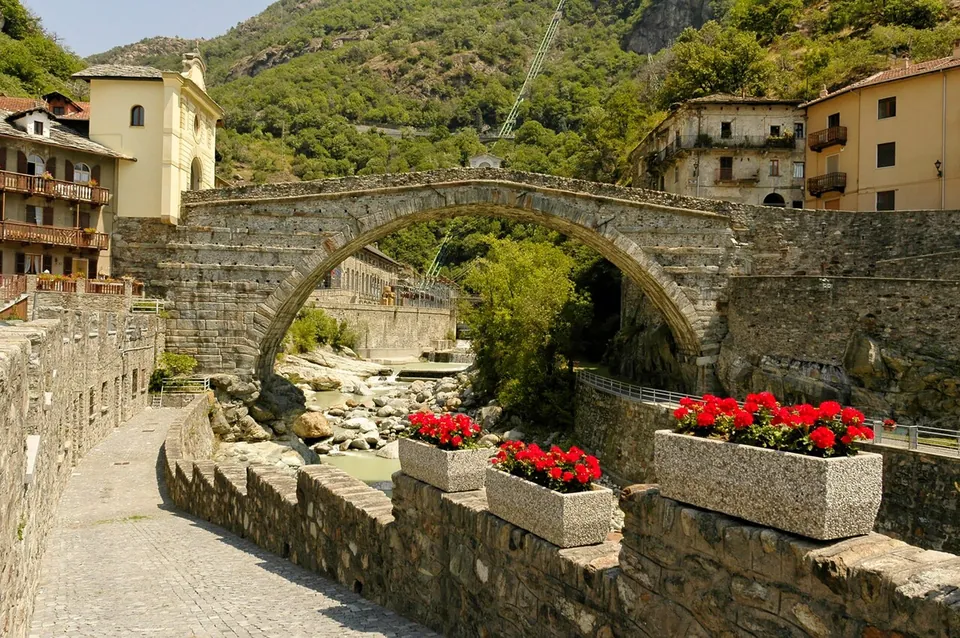
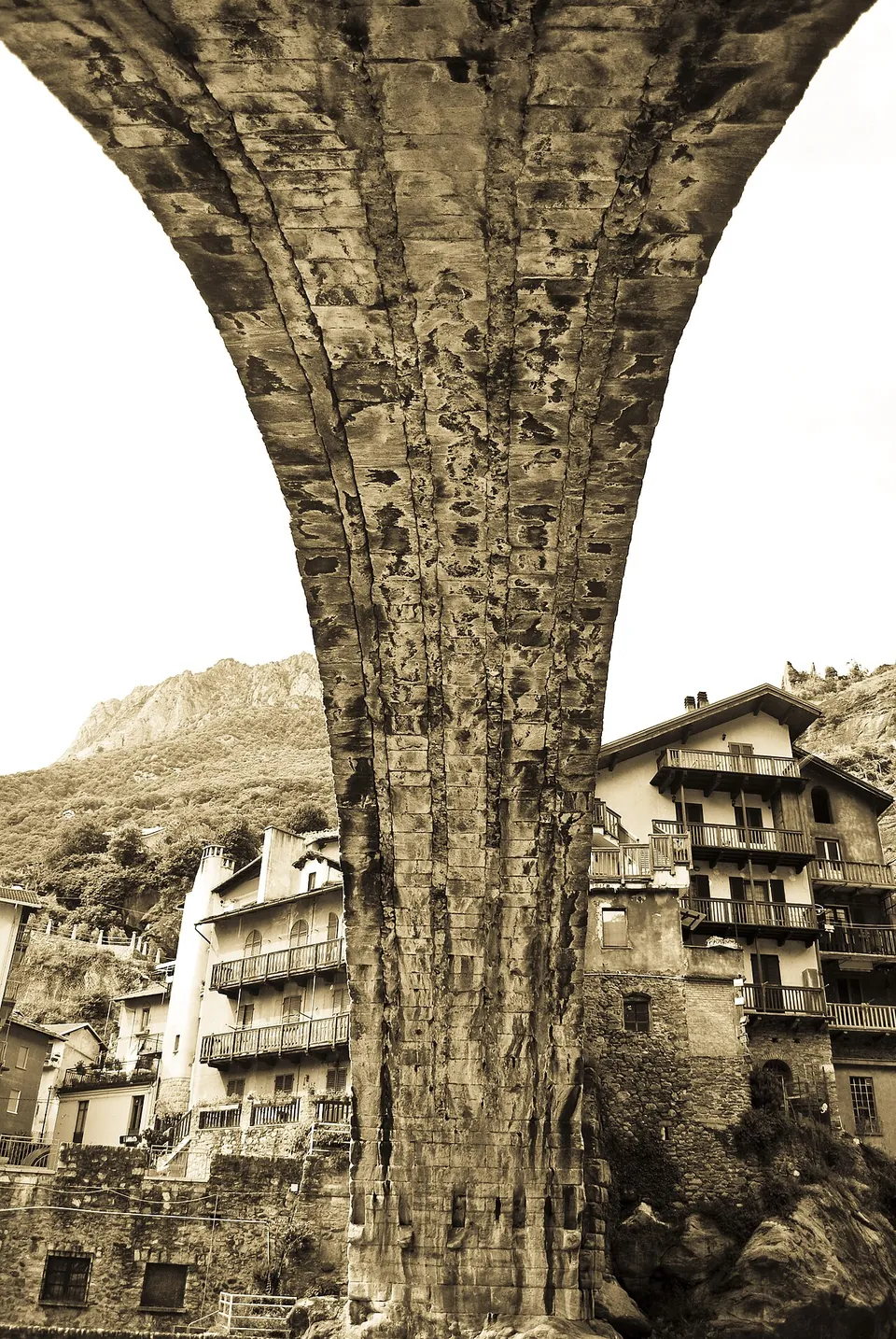
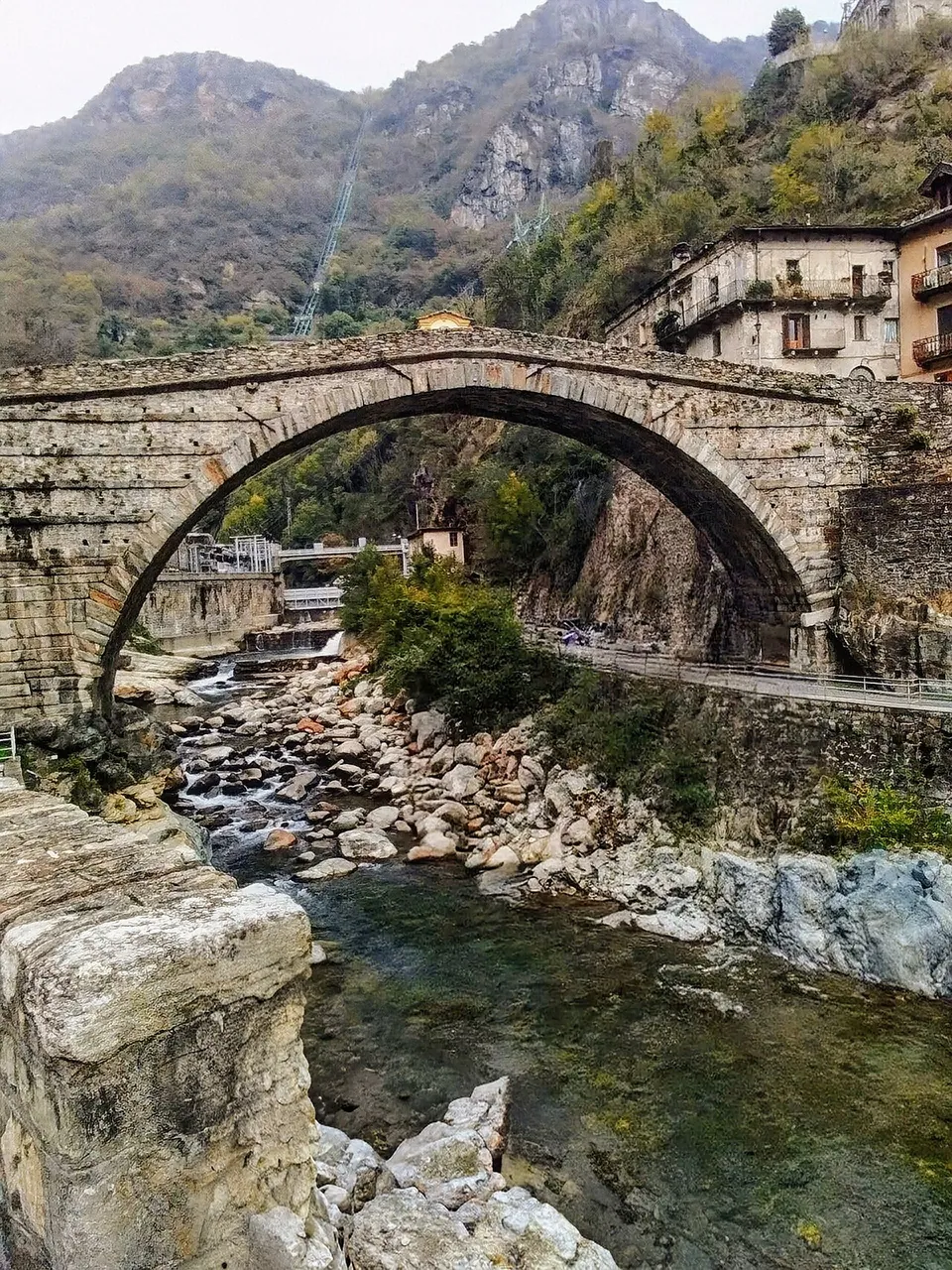
The whole bridge. One flattened arch, anchored in the living rock on both banks (the Aosta Valley Region), spans the stream in a single leap: published figures for the span range from 31.4 m, the figure of recent research, to 36.65 m (en.wikipedia, de.wikipedia), which either way puts it among the largest Roman bridges still standing. It is 5.8 m wide, with parapets narrowing the roadway to 4.6 m, and the arch ring is only about a metre thick (de.wikipedia). You can walk over it on a cobbled path from Via Roma, or look at it from below from the flower beds beside it (the Region; OpenStreetMap). At the foot of the arch, cut into the rock, are the sockets for the timber framework the stone arch was built on; iron reinforcements were added at the end of the 19th century to strengthen it (the Region).
A few steps away on Piazza IV Novembre, a small museum explains how the bridge was built, its legends, its 19th-century restoration and its narrow escape from Allied bombing in August 1944, with photographs, drawings and documents, and a film introduces the town (the Region; Ministry of Culture).
Is it worth the trip?
As a stop, yes, without hesitation. This is a complete Roman bridge, not a stump of masonry, it is free, and it sits in the town centre beside a car park, a bus stop and cafés (OpenStreetMap). Pont-Saint-Martin is the first town of the Aosta Valley as you come up from Piedmont (the Region), so it costs almost nothing to break a drive up the valley here.
As a destination on its own, it is one structure: half an hour on the bridge, under it and in the museum covers it. If you are heading on up the valley, it belongs to the same Roman road as Augusta Praetoria – Aosta, and the Pont d’Aël is another Roman bridge of the valley (en.wikipedia).
Getting there
The bridge is in the centre of Pont-Saint-Martin, next to the main square (the Region); the museum is on Piazza IV Novembre. There are several car parks within about 120 m, one of them free, and a bus stop on the square, 84 m away (OpenStreetMap). The town is on the Pont-Saint-Martin–Aosta bus line; the railway was temporarily closed when the Region’s tourism site was read in October 2026, with replacement buses running (lovevda.it).
The bridge itself has no ticket and no opening hours. The Region lists the museum as open every day of the year from 09.00 to 18.00, free of charge (balteus.lovevda.it, read 21 October 2026). The Ministry of Culture’s listing shows it closed every day, so if the museum matters to you, phone ahead (+39 0125 804843).
Visiting details
- Opening hours
- The bridge is a public footway in the town centre, with no opening hours. The Museum of the Roman Bridge beside it is listed as open every day of the year, 09.00–18.00.
- Tickets
- Free. Walking over the bridge costs nothing, and the Region lists the museum as free admission.
- Parking
- Several car parks within about 120 m, among them the square at Piazza IV Novembre (OSM way/164988726, 64 m) and a free surface car park (way/325205836, 116 m).
Before you go
- The Ministry of Culture's listing for the museum shows it closed every day; the Aosta Valley Region's tourism site lists it open daily. Phone +39 0125 804843 before making the trip for the museum alone.
- The Region's tourism site says the railway to Pont-Saint-Martin is temporarily closed, with replacement buses.
Hours and prices checked 21 October 2026 on the operator's own site. Confirm before travelling.
History
The bridge carried the Roman road through the Aosta Valley, which divided at Augusta Praetoria (Aosta) for the passes of the Great and Little St Bernard into Gaul (it.wikipedia); the road was built up step by step in the second and first centuries BC as Rome expanded across the Alps (de.wikipedia). The bridge standing today most likely dates from the time of Augustus, who took Aosta in 25 BC, refounded it as the colony of Augusta Praetoria and had the local road system renewed. Its foundations of dressed stone blocks differ clearly from the rubble facing above them, which has led to the suggestion that an earlier bridge of similar span stood here from 141 or 120 BC and did not last, the concrete technique of the time not yet being mature (de.wikipedia). The Region’s own page gives the date as uncertain, around 120 BC or 25 BC.
What makes it unusual is the arch. It is one of the few flat, segmental arches known from antiquity: its centre lies 5.8 m below the springing points, so the vault describes 144 degrees of a circle rather than a half-circle. A flatter arch saves material but pushes harder sideways, so it needs strong abutments in the banks. The arch ring of 71 voussoirs is only about 1.03 m thick. The engineer Colin O’Connor treated the ratio of ring thickness to span as the key figure for a stone arch bridge: Roman builders usually kept it above 1/20 on large bridges, and here it drops to 1/34, unmatched among the more than forty Roman bridges he examined (de.wikipedia). The nearness of the Pont de Pierre in Aosta, on the same stretch of road and also Augustan, may point to the segmental arch having become a local practice (de.wikipedia).
Local legend says the devil built the bridge in one night for Saint Martin, in exchange for the soul of the first to cross it; the saint threw a piece of bread over and sent a hungry dog across first. The story is still a theme of the town’s carnival, which ends with a devil burned in effigy under the bridge (the Region).
Nearby
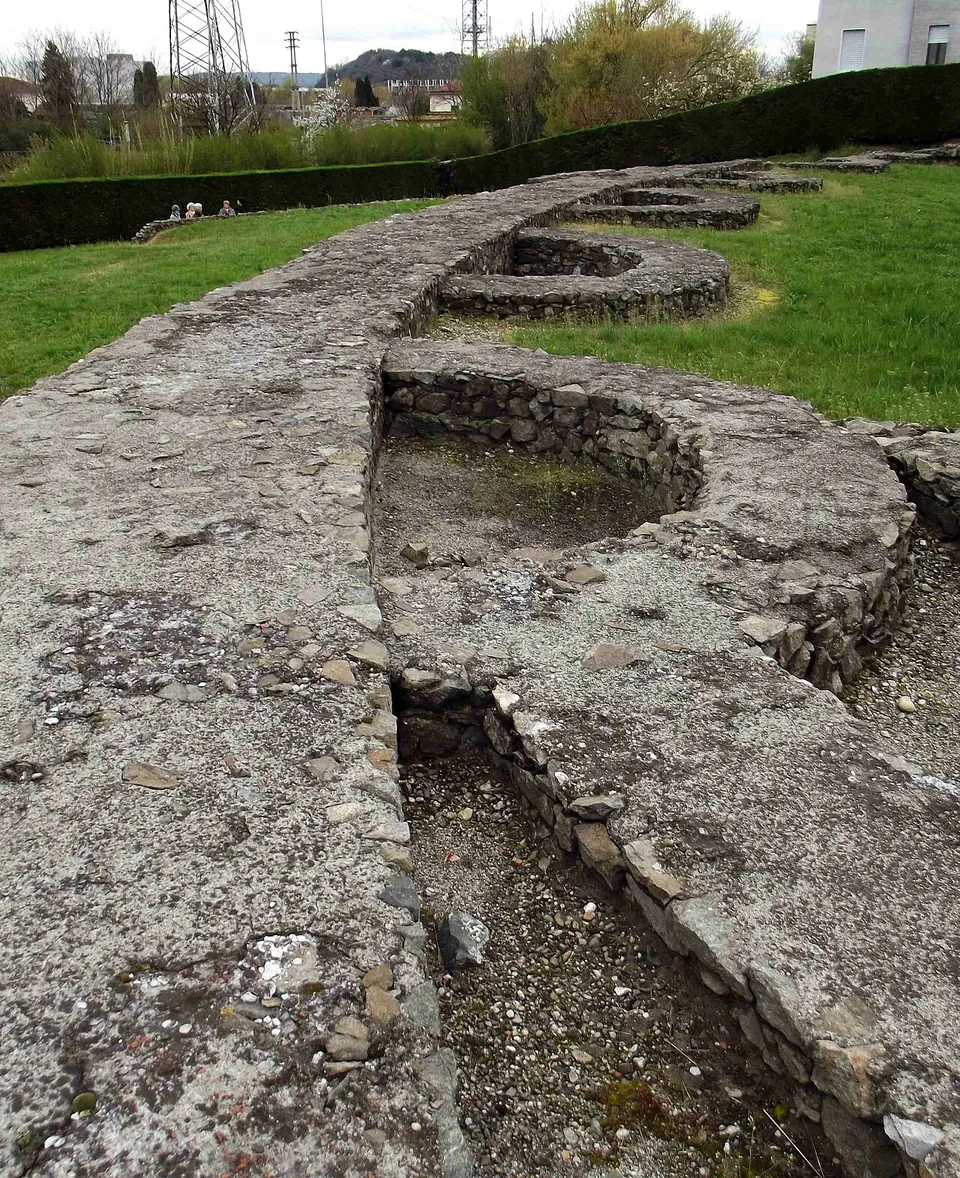
Photo: F Ceragioli · CC BY-SA 3.0 · Commons
16 km · city · Piedmont
Eporedia – Ivrea
The amphitheatre is the one Roman monument you can stand in front of.
Photo: F Ceragioli · CC BY-SA 3.0 · Commons
16 km · amphitheatre · Piedmont
Roman Amphitheatre of Ivrea
What you see is the plan of the building rather than the building.
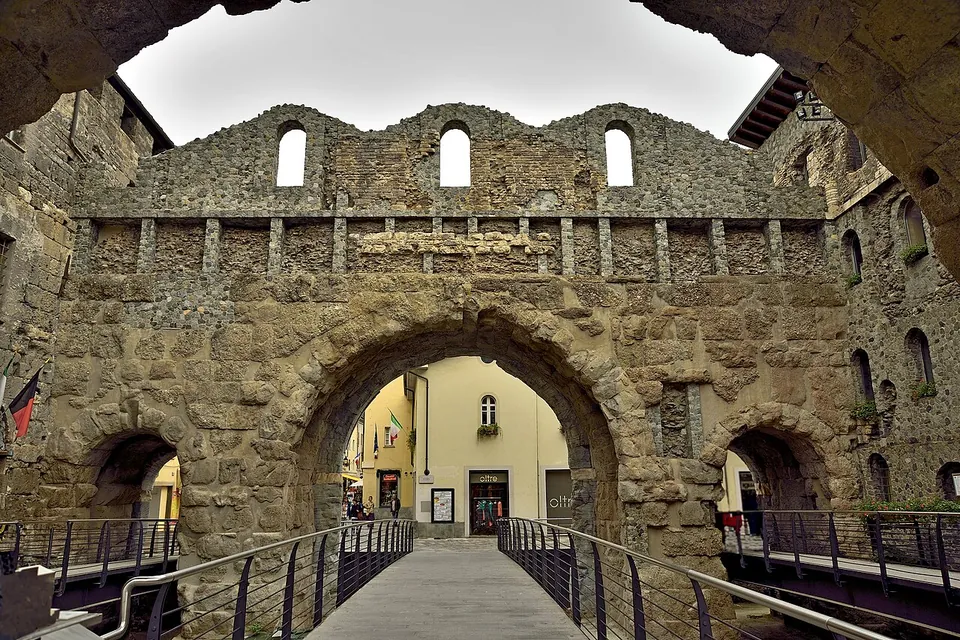
Photo: Carlo grifone · CC BY-SA 4.0 · Commons
40 km · gate · Aosta Valley
Porta Praetoria
The gate is two parallel rows of arches with a small square between them, which served as a parade ground for troops (it.wikipedia; Lovevda).


Straight-line distances.
Sources
Every fact on this page comes from the records below, each used under the licence noted.
| Source | Licence |
|---|---|
| Pleiades 385056 | CC BY |
| Wikidata Q1339290 | CC0 |
| Vici.org 38665 | CC BY-SA (text), CC0 (metadata) |
| OpenStreetMap way/164988572 | ODbL |
| Wikipedia (de) — Pont Saint-Martin | CC BY-SA 4.0 |
| Wikipedia (it) — Pont Saint-Martin | CC BY-SA 4.0 |
| Wikipedia (fr) — Pont Saint-Martin (Italie) | CC BY-SA 4.0 |
| Wikipedia (en) — Pont Saint-Martin | CC BY-SA 4.0 |
| Aosta Valley Region tourism site — Roman Bridge, Pont-Saint-Martin | licence not recorded |
| Aosta Valley Region tourism site — Museum of the Roman Bridge (hours and admission) | licence not recorded |
| Aosta Valley Region tourism site — Pont-Saint-Martin (the town) | licence not recorded |
| Ministry of Culture — Museo del Ponte romano | licence not recorded |