

What is there today
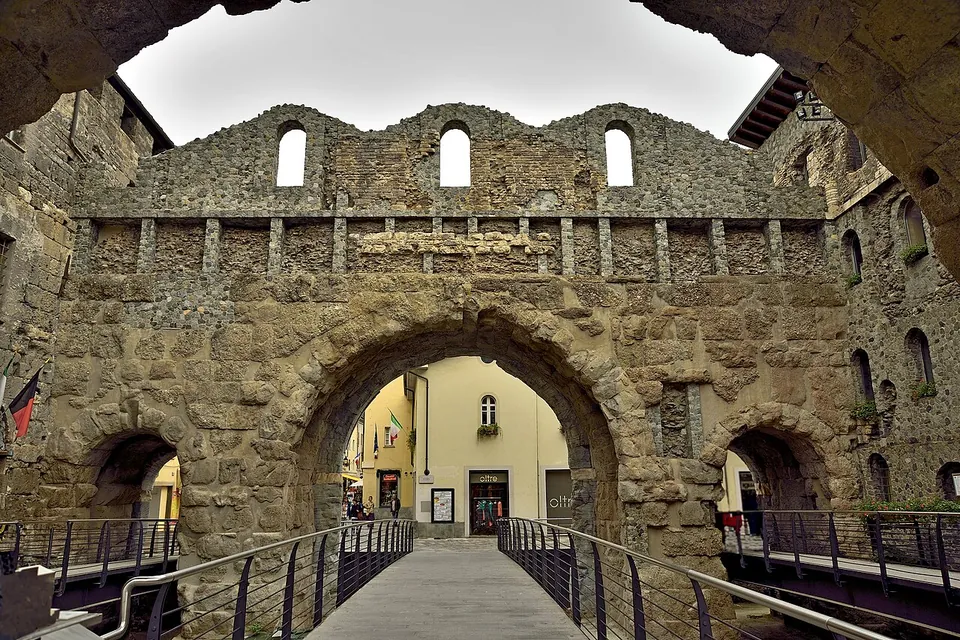
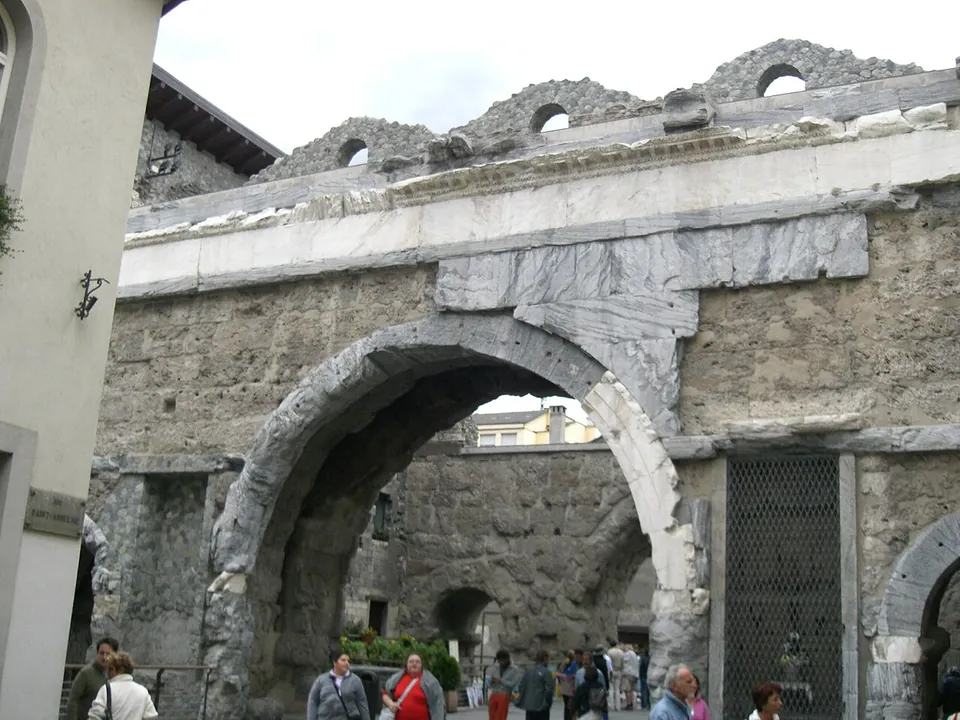
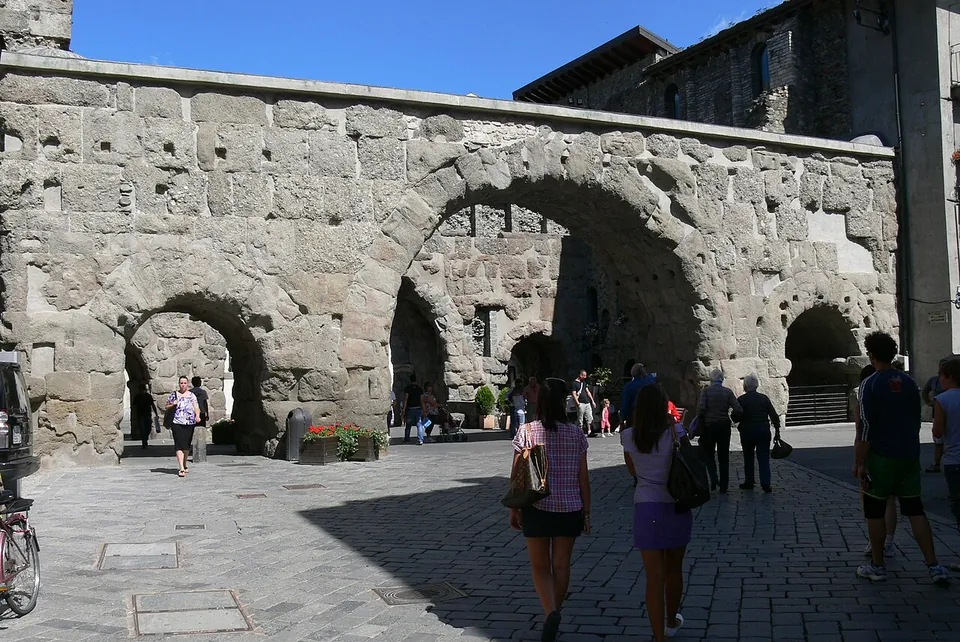
The gate is two parallel rows of arches with a small square between them, which served as a parade ground for troops (it.wikipedia; Lovevda). Each row has a large central arch, about 7 m wide, for carts, and two side arches of 2.65 m for people on foot; the sentries’ walkways can still be made out on both rows (it.wikipedia). On the outer openings are the grooves for the gates that were let down at night (Lovevda). Inside, the gate is built of blocks of puddingstone; on the eastern face some of the marble slabs that once covered the whole monument are still in place (Lovevda; Italia.it).
Two towers on rectangular plans flanked the gate. Both have been altered over the centuries, the northern one more visibly; the southern one keeps some of its Roman features (it.wikipedia).
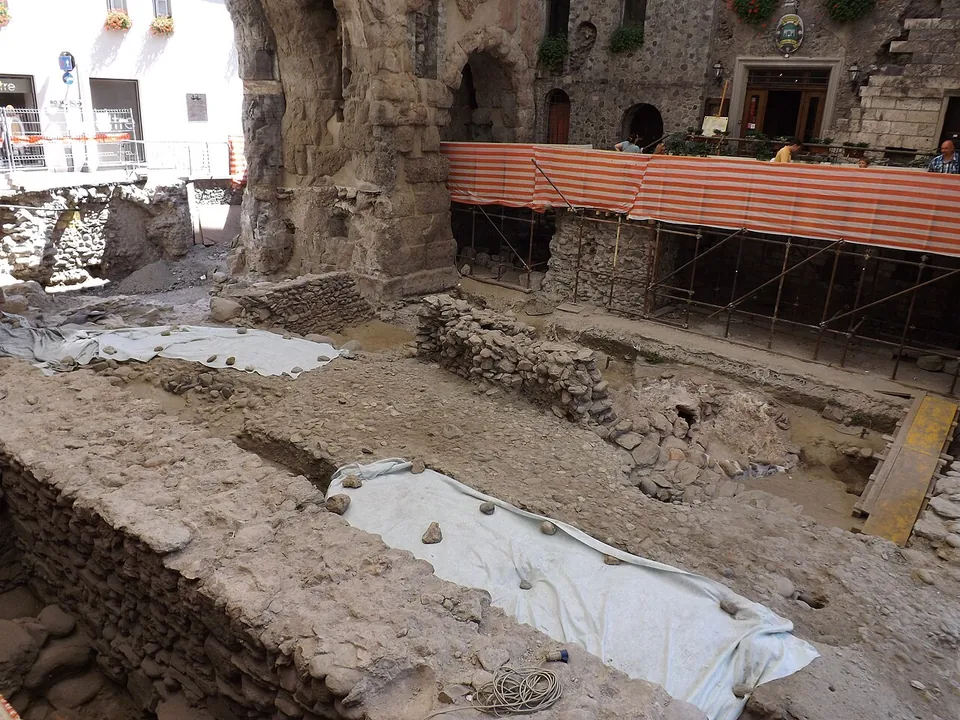
The street level has risen since Roman times, by debris the river floods left behind (Lovevda). Excavations in 2012–2013 went down to the original paving in the southern part of the courtyard, 2–2.5 m below today’s street (published figures differ), and over the excavated area the ground has been replaced by walkways, so you can see the gate at its original height (it.wikipedia; Lovevda).
Is it worth the trip?
Yes, and it costs nothing. it.wikipedia calls the gate excellently preserved, and the Ministry of Tourism’s site says it has survived undamaged; it stands in the street, so you can walk through it at any hour. On its own it is a short stop, and the reason to make the trip is Aosta as a whole: the theatre is about 110 m away and the Arch of Augustus about 400 m east, on the line of the same Roman road (OpenStreetMap; the candidate records), and the walls, the forum cryptoporticus and the Roman bridge are a short walk further.
Getting there and what it costs
The gate is in the centre of Aosta, between Via Sant’Anselmo and Via Porta Praetoria (Lovevda). Coming from the Arch of Augustus, you walk west along Via Sant’Anselmo and enter the historic centre through it (Italia.it). The tourist office is mapped 15 m from the gate and the nearest bus stop, Via Festaz Piazza Plouves, about 130 m away (OpenStreetMap).
It stands in the public street, so there is no ticket and no opening time, and no operator page lists either (Lovevda and Italia.it, read 20 October 2026). The theatre, the forum cryptoporticus and the archaeological museum nearby are sold together on the Aosta Archeologica ticket; the Roman Theatre of Aosta page has its hours and prices.
Visiting details
- Opening hours
- Always open. The gate stands in the street, between Via Sant'Anselmo and Via Porta Praetoria, and the way into the historic centre still runs through it.
- Tickets
- Free. It is not part of the Aosta Archeologica ticket, which covers the theatre, the forum cryptoporticus and the museums.
- Parking
- No car park is mapped next to the gate, which stands on a pedestrian street; there are bicycle racks 26–50 m away and a bus stop, Via Festaz Piazza Plouves, about 130 m away (OpenStreetMap).
Hours and prices checked 20 October 2026 on the operator's own site. Confirm before travelling.
The Arch of Augustus
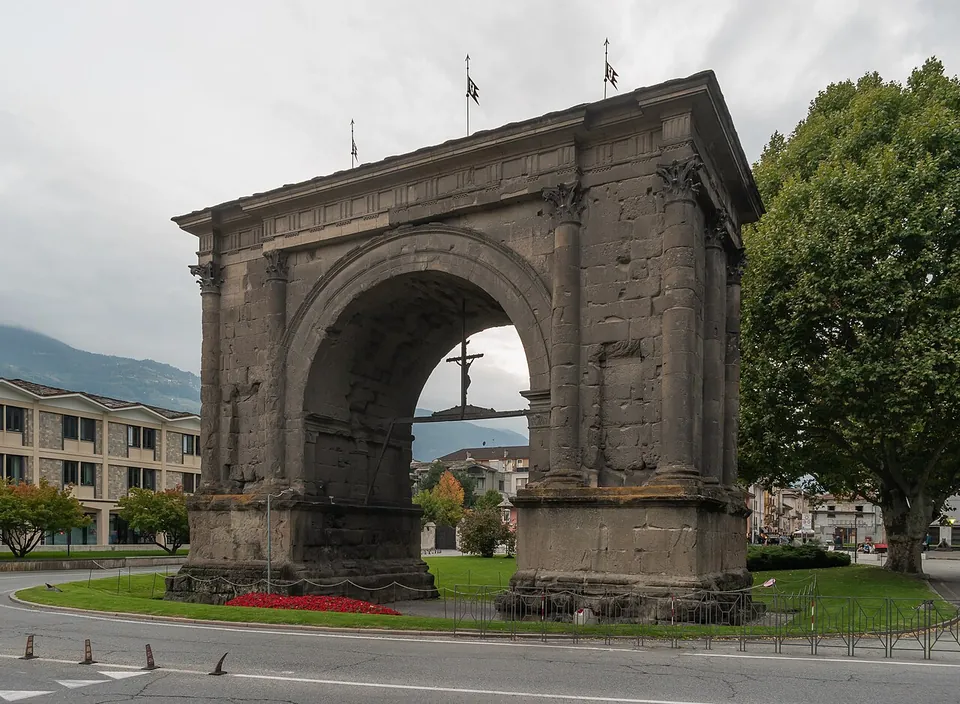
About 400 m east of the gate, outside the walls, stands the Arch of Augustus, raised in 25 BC for the Roman victory over the Salassi under Aulus Terentius Varro Murena (it.wikipedia; en.wikipedia; Pleiades, “ca. 25 BC”). It stands on the axis of the decumanus maximus, the town’s main street, and the road to the gate passed under it (it.wikipedia; de.wikipedia). Today it sits on a lawn in the middle of a roundabout.
It is a single arch of conglomerate blocks, 11.4 m high under the keystone. Ten engaged columns on its faces and sides end in Corinthian capitals, while the entablature above, with its metopes and triglyphs, is Doric (it.wikipedia; en.wikipedia). The attic that once crowned it was replaced by a slate roof in 1716 because water was getting in, and its present appearance is the result of the restoration of 1912 under Ernesto Schiaparelli (it.wikipedia; en.wikipedia). Excavations near the arch at that time found two gilded bronze letters, probably from an inscription on the lost attic (de.wikipedia). The wooden crucifix under the vault is a copy of one hung there in 1449 as a votive offering against the floods of the Buthier; the original is in the cathedral treasury museum (it.wikipedia; en.wikipedia). In the 12th century a noble family lived in the arch, and in 1318 a small fort for crossbowmen was built inside it (it.wikipedia; en.wikipedia). Italia.it notes that the soft local stone has weathered so much that the reliefs which once decorated it can no longer be read.
History
Augusta Praetoria was built after Terentius Varro defeated the Salassi in 25 BC, and the Porta Praetoria, on the eastern side of the walls, was its main entrance (Lovevda). it.wikipedia and Pleiades date the gate to 25 BC, at the founding of the colony; en.wikipedia’s article on Aosta puts it in the 1st century AD. en.wikipedia adds that, apart from the loss of its marble facing, it has kept its original form.
In the Middle Ages a chapel dedicated to the Holy Trinity was built on top of the gate, along the line of the old patrol walkway, and for several centuries the gate took its name from it (Lovevda). it.wikipedia records the chapel from the 12th century, above the central eastern arch, with a bread oven beneath it whose dark marks can still be seen on the stone. The chapel was demolished in 1926, and an old oratory against the eastern side of the gate was restored, of which only a niche now remains (Lovevda).
More photographs


Nearby
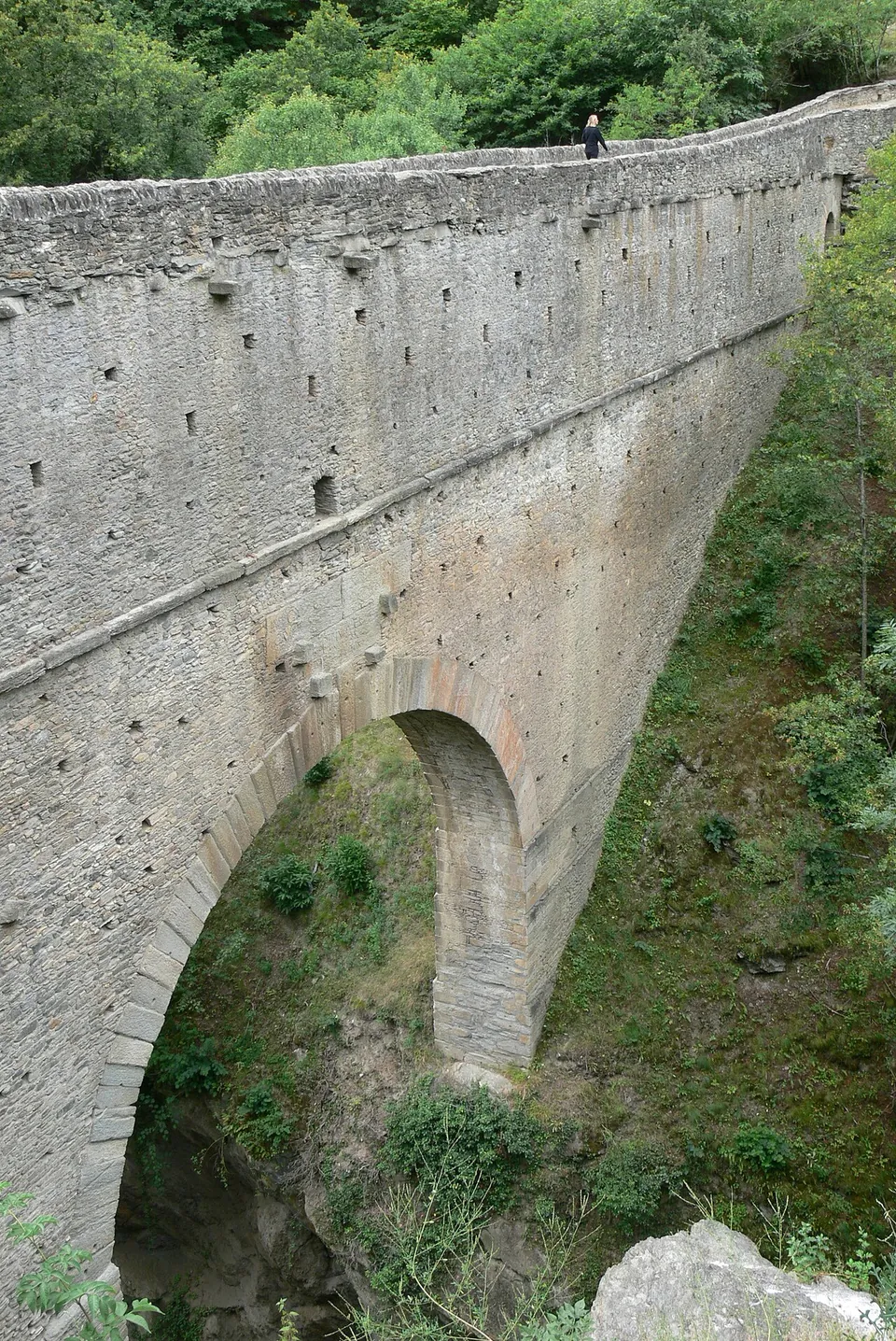
Photo: Wolfgang Sauber · CC BY-SA 3.0 · Commons
10 km · aqueduct · Aosta Valley
Pont d'Aël
The bridge itself, complete to its deck: a single arch with a span of 14.24 m carrying a stone structure 60.46 m long and 2.26 m wide across a gorge only 12 m wide at this point (de.wikipedia).
Photo: dacolje · CC BY-SA 2.5 · Commons
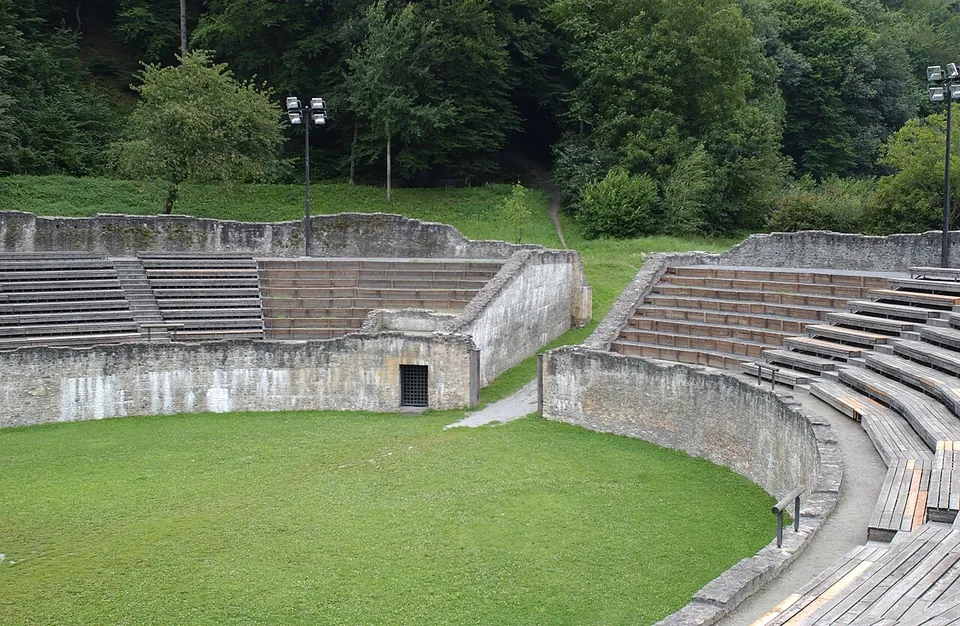
Photo: Jean Housen · CC BY 3.0 · Commons
44 km · amphitheatre · Martigny District, Valais
Roman amphitheatre of Martigny
The arena measures 75.5 by 63.7 m and held about 5,000 spectators (de.wikipedia).


Straight-line distances.
Sources
Every fact on this page comes from the records below, each used under the licence noted.
| Source | Licence |
|---|---|
| Pleiades 310024671 | CC BY |
| Wikidata Q3908766 | CC0 |
| Pleiades — Arch of Augustus at Aosta | licence not recorded |
| Wikidata — Arch of Augustus (Q1891991) | licence not recorded |
| Wikipedia (it) — Porta Pretoriana (Aosta) | CC BY-SA 4.0 |
| Wikipedia (en) — Aosta | CC BY-SA 4.0 |
| Wikipedia (it) — Arco di Augusto (Aosta) | CC BY-SA 4.0 |
| Wikipedia (en) — Arch of Augustus (Aosta) | CC BY-SA 4.0 |
| Wikipedia (fr) — Arc d'Auguste (Aoste) | CC BY-SA 4.0 |
| Wikipedia (de) — Augustusbogen (Aosta) | CC BY-SA 4.0 |
| Lovevda, the Aosta Valley Region's tourism site — Porta Praetoria | licence not recorded |
| Italia.it (Ministry of Tourism) — Roman Aosta | licence not recorded |