

The catacombs of Syracuse are the underground cemeteries of the city’s early Christians, and after those of Rome they are counted among the largest known (de.wikipedia). The one you can walk through any day of the season is San Giovanni: a 4th-century maze of rock-cut galleries, round burial chambers and some 10,000 graves, entered through the ruins of the basilica above it.
What is there today
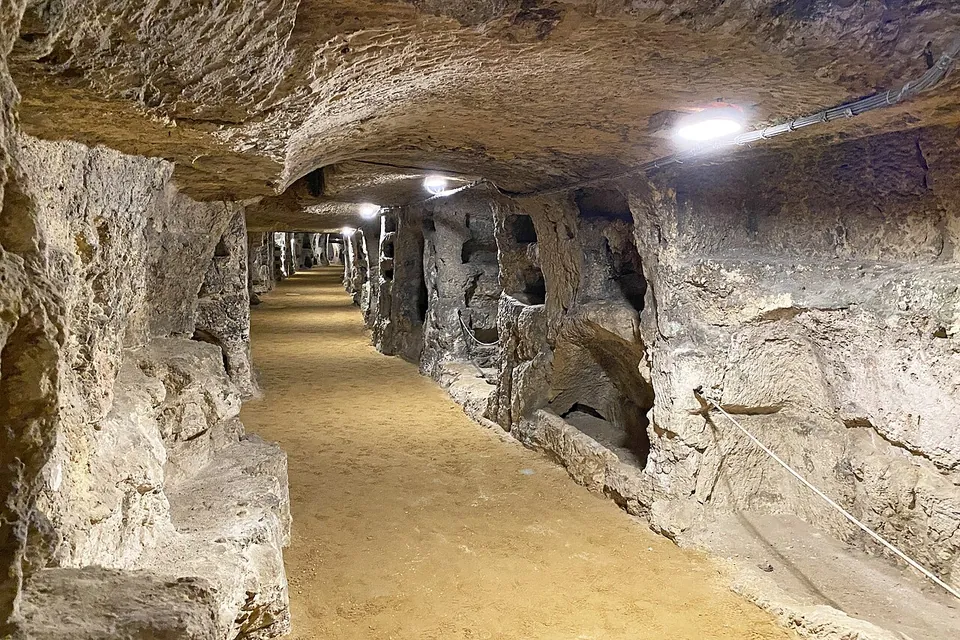
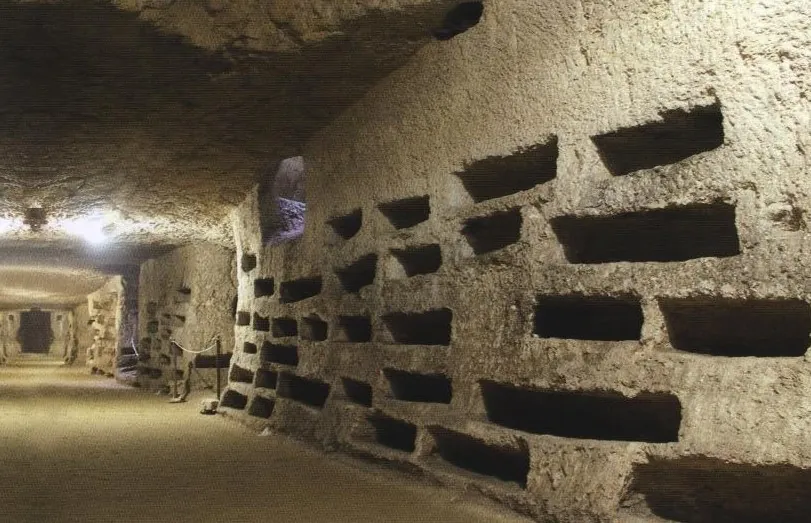
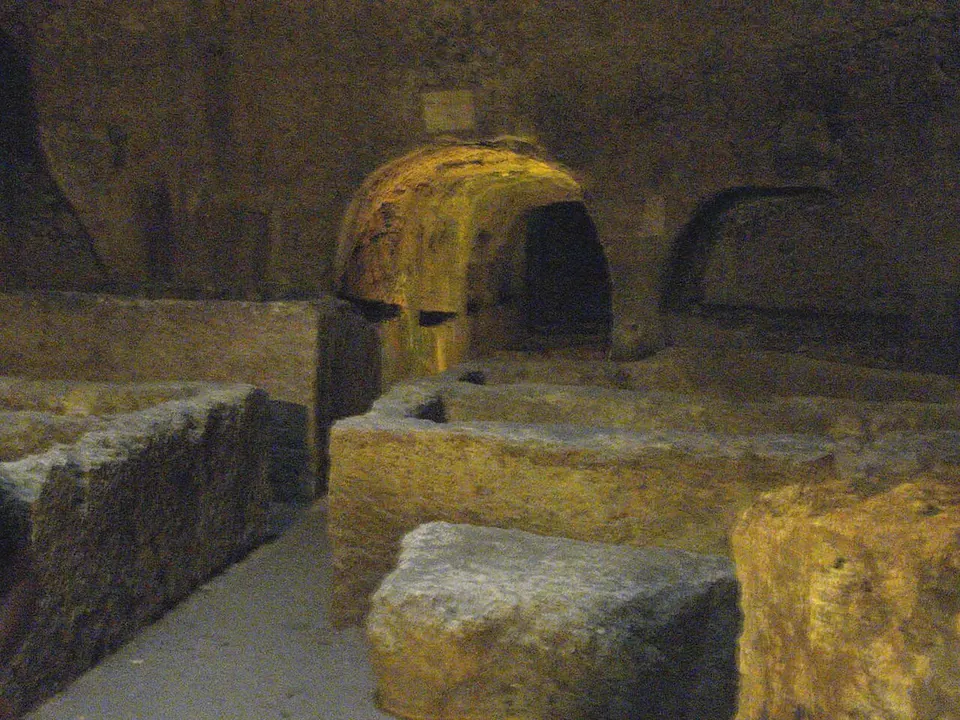
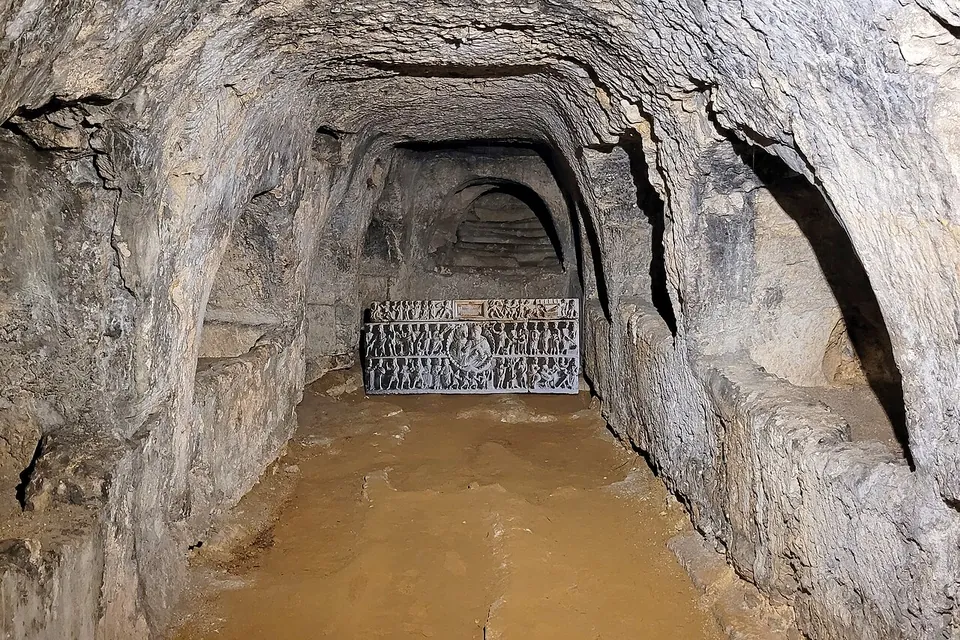
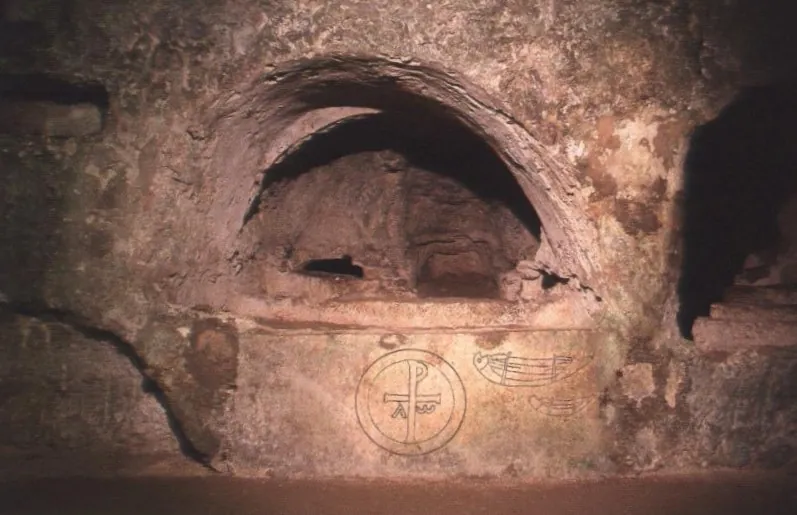
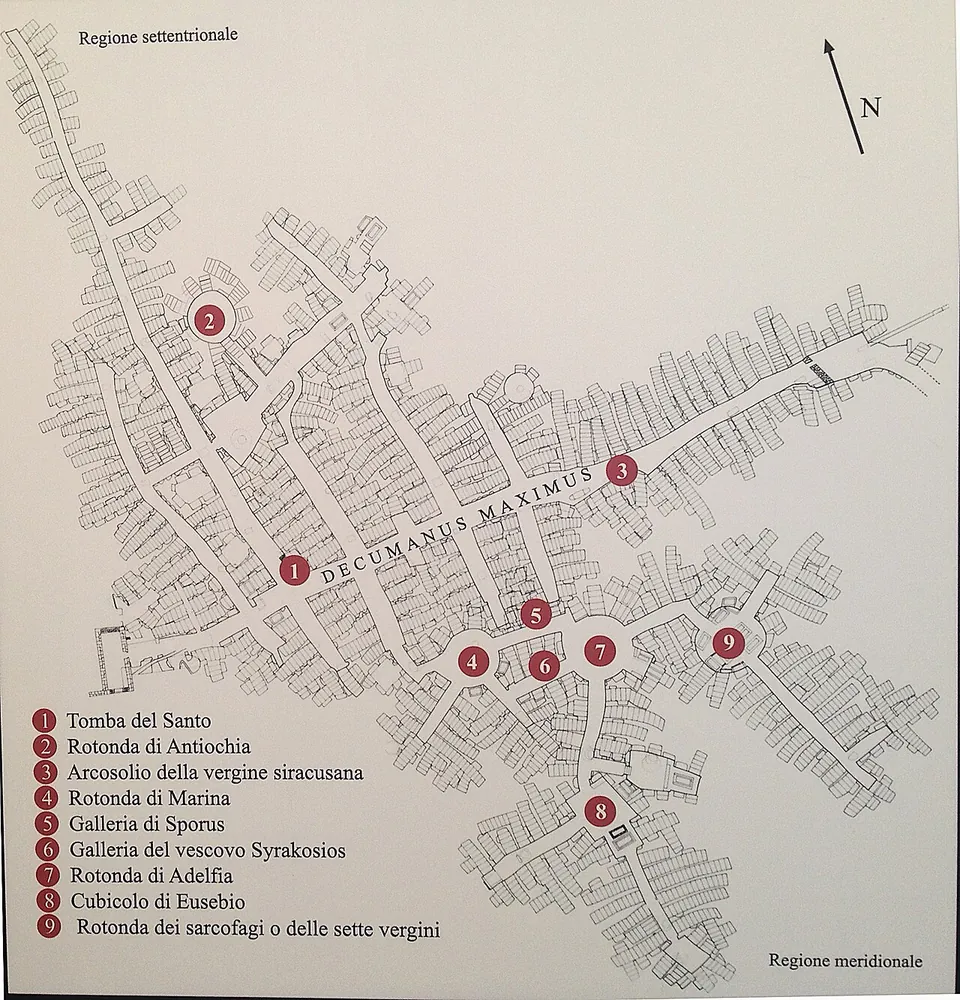
San Giovanni is a cemetery cut entirely into the rock. A main gallery, made by widening an older Greek water channel, runs through it, and side galleries branch off it (de.wikipedia); traces of the aqueduct can still be seen in the vault (it.wikipedia). In about 10,000 m² there are roughly 10,000 graves, family and communal ones, set in the walls and floors, sometimes twenty in a row (de.wikipedia). Five large chambers open off the galleries: round or square spaces named after Eusebius, Adelphia and Antiochia, the Seven Virgins, and one left anonymous (it.wikipedia). The visit passes tombs with rich decoration, a fresco of the Syracusan Virgin crowned by Christ, and old cisterns turned into chapels, among them the rotundas of Marina and of Adelphia and the cubicle of Pope Eusebius (the operator). Little of the original wall decoration has survived (de.wikipedia).
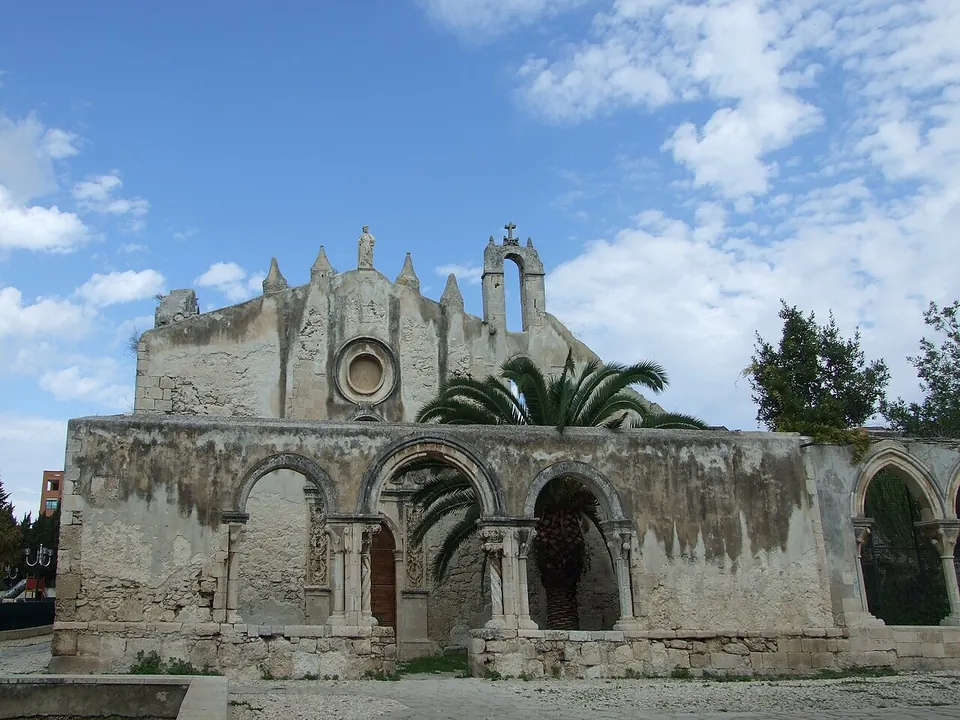
Above ground stands the basilica of San Giovanni, built in the 6th century over the place where Marcian, the first bishop of Syracuse, was by tradition buried. It is roofless; parts of its colonnade and its apse survive, and its two fronts are Norman, with a large rose window, and 15th-century Gothic-Catalan (the operator). A stair leads down from it to the crypt of Saint Marcian, with frescoes (de.wikipedia dates them from the 5th century onwards, the operator to the 13th) and four columns of the Norman period whose capitals show the four Evangelists (de.wikipedia).
Is it worth the trip?
Yes. With the amphitheatre, this is one of the two Roman-era sights in Syracuse that are worth a visit on their own. Unlike most Roman remains in the city, it is complete enough to read as it was used: you walk along the galleries between the tombs rather than looking at a plan of foundations. Two things to know. You cannot wander on your own, because every visit is a guided tour, and little of the wall decoration has survived, so what you see is mostly the rock-cut cemetery itself. It sits next to the Paolo Orsi archaeological museum, which holds the splendid sarcophagus of Adelphia found here (de.wikipedia), so the two make an easy pair.
Getting there
The entrance is at Largo San Marciano 3 (the operator), in the Akradina district (it.wikipedia), about 1 km in a straight line from Siracusa railway station and about 100 m from the Paolo Orsi museum. The Neapolis archaeological park, with the theatre and amphitheatre, is under 1 km away. Bus stops named Via Von Platen and Teocrito are about 165 m away, and a free car park lies about 160 m from the site (OpenStreetMap).
The visit is by guided tour only, in Italian or English, and includes a virtual-reality presentation of reconstructions of the spaces as they were. A ticket costs €12 plus a €2 service fee; the reduced ticket, for ages 6 to 15, students of archaeology, architecture, art history and cultural heritage, and teachers, all with proof, is €9 plus €2, and under-sixes go free. Online sales are suspended, so buy at the ticket office on site. Tours leave as soon as a group is large enough.
The ticket office is open daily 09.30–12.30 and 14.30–17.30 from April to June and in September and October, and 10.00–13.00 and 14.30–17.30 in July and August; in March it is closed on Mondays. The catacomb closes from 7 to 31 January and reopens in stages through February (Secret Siracusa, the operator, read 20 October 2026). The operator gives no hours for November and December; the Pontifical Commission for Sacred Archaeology’s own page for the catacomb lists Monday to Saturday 09.30–12.30 and 14.30–16.30 outside the summer. Check before travelling.
Visiting details
- Opening hours
- San Giovanni: April to June and September to October daily 09.30–12.30 and 14.30–17.30; July and August daily 10.00–13.00 and 14.30–17.30; March the same as April but closed on Mondays. Closed from 7 to 31 January; in February open mornings only (09.30–12.30) from the 10th to the 22nd and full days from the 24th, closed on Mondays. The operator's page gives no hours for November and December; the Pontifical Commission's own page gives Monday to Saturday 09.30–12.30 and 14.30–16.30 outside the summer, and 09.30–12.30 and 14.30–17.00 from 26 December to 6 January.
- Tickets
- Guided tour only, with a virtual-reality presentation included: €12 plus a €2 service fee; reduced €9 plus €2 (ages 6–15, and students of archaeology, architecture, art history and cultural heritage and teachers, with proof); free under 6. Online sales are suspended, so tickets are sold only at the site's ticket office. The Siracusa Visitor Pass (€25 plus €2, €15 plus €2 for ages 10–18) adds the catacomb of Santa Lucia, the cathedral and the Secreta Palatii route.
- Parking
- A free surface car park lies about 160 m away (OSM way/325739007).
Before you go
- The visit is by guided tour only; a group leaves as soon as it reaches its minimum size, and the time chosen when booking is not binding.
- Hours may change or be cut for religious services, celebrations and special events (the operator).
Hours and prices checked 20 October 2026 on the operator's own site. Confirm before travelling.
The other catacombs
Syracuse has three catacomb complexes, each with its own entrance. In order of age they are Santa Lucia, Vigna Cassia and San Giovanni (de.wikipedia).
Santa Lucia lies under the church of Santa Lucia al Sepolcro, where the city’s patron saint is said to have been beheaded in the 4th century. It came into use around 220, has a complex plan on three levels, and was later turned into a place of worship: a Byzantine oratory there holds a fresco of the Forty Martyrs of Sebaste, dated to the 8th century, and was in use until the 13th (de.wikipedia). The operator runs guided tours from Piazza Santa Lucia 26, closed on Sundays, for €10 (€7 reduced) (Secret Siracusa).
Vigna Cassia, named after the owner of the vineyard above it when it was found, has three regions. Two began in the 3rd century, from around 256, and the third, Marcia, in the 4th (de.wikipedia; the Pontifical Commission). Its Santa Maria di Gesù region grew out of an abandoned Hellenistic aqueduct whose walls were cut with graves (de.wikipedia), and one of the underground tombs above the cemetery, hypogeum M2, keeps paintings of two scenes from the story of Jonah, Daniel in the lions’ den and the raising of Lazarus (the Pontifical Commission). The Commission lists it as open on weekdays, 11.00–13.00 and 14.30–17.00, at Via Augusto von Platen 38, while it.wikipedia describes it as closed apart from special openings, and the operator’s ticket site does not offer it: check before going.
History
San Giovanni is the youngest of the three. It is the largest communal cemetery made in Syracuse after the Peace of the Church of 313 (the Pontifical Commission), and was dug between 315 and 360 (it.wikipedia; Pleiades), around the tomb of Marcian, whom tradition makes the city’s first bishop, sent by Saint Peter (de.wikipedia; it.wikipedia). By the same tradition the apostle Paul preached to the first Christians of the West in the crypt beside it (it.wikipedia). It was planned almost entirely around one kind of tomb, the arched recess for several burials; the rotundas were made to give room to leaders of the Church and of the empire (the Pontifical Commission). Five of these rotundas served first to carry out the spoil while the galleries were dug, then as chapels and to bring in light and air (de.wikipedia). It was in use through the 4th and 5th centuries, and inscriptions referring to Goths still appear in the first decades of the 6th (the Commission dates them 491–535).
Published dates for the church over Marcian’s tomb differ: de.wikipedia has the first cathedral of Syracuse built there in the 4th century, the operator dates the basilica to the 6th. Marcian’s remains were moved into a niche in the 6th century and taken to safety from the Arabs in the 9th, when the church was destroyed; the Normans rebuilt it, the earthquake of 1693 brought it down, and it was finally ruined in the Napoleonic wars (de.wikipedia). The catacombs were later disturbed by people searching for saints’ bodies and treasure (it.wikipedia). Pietro Della Valle described them in 1626, and Jean Houel and Vivant Denon visited in 1777 and 1778 (it.wikipedia). The sarcophagus of Adelphia was found in 1872, systematic excavation followed between 1893 and 1919, and in the Second World War the galleries served as air-raid shelters (de.wikipedia).
More photographs




Nearby
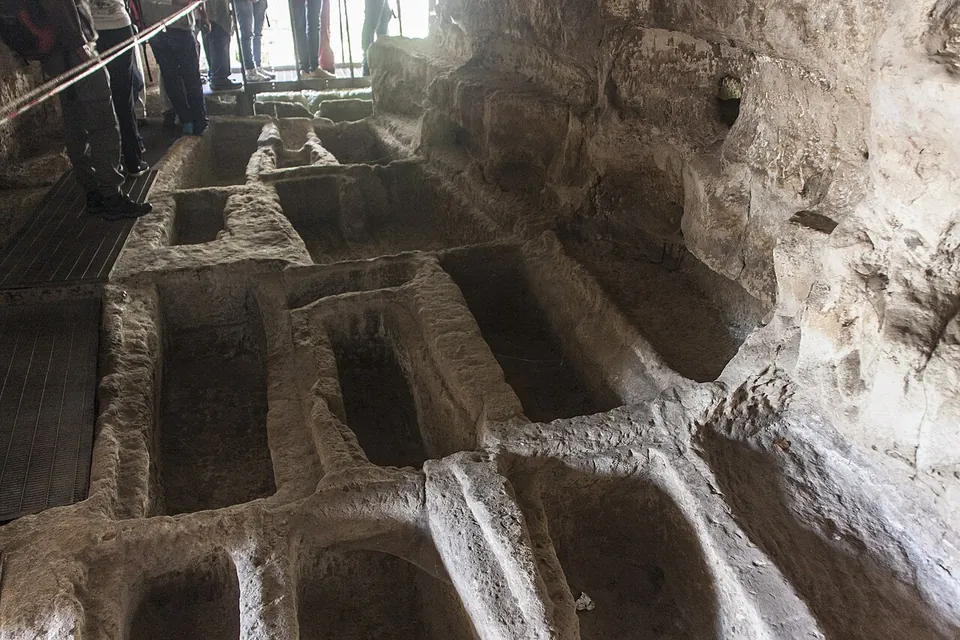
Photo: Davide Mauro · CC BY-SA 4.0 · Commons
47 km · necropolis · Sicily
Cava d’Ispica
The ticketed archaeological area lies at the Modica end of the gorge.

Straight-line distances.
Sources
Every fact on this page comes from the records below, each used under the licence noted.
| Source | Licence |
|---|---|
| Pleiades 560149180 | CC BY |
| Wikidata Q3663213 | CC0 |
| OpenStreetMap node/290930171 | ODbL |
| Wikipedia (de) — Katakomben von Syrakus | CC BY-SA 4.0 |
| Wikipedia (it) — Catacombe di Siracusa | CC BY-SA 4.0 |
| Pontificia Commissione di Archeologia Sacra — Catacomba di S. Giovanni a Siracusa | licence not recorded |
| Pontificia Commissione di Archeologia Sacra — Catacomba di Vigna Cassia | licence not recorded |
| Secret Siracusa (Kairós) — the catacomb of San Giovanni (the operator) | licence not recorded |
| Secret Siracusa (Kairós) — opening hours (the operator) | licence not recorded |
| Secret Siracusa (Kairós) — San Giovanni tickets (the operator) | licence not recorded |
| Secret Siracusa (Kairós) — Santa Lucia tickets (the operator) | licence not recorded |