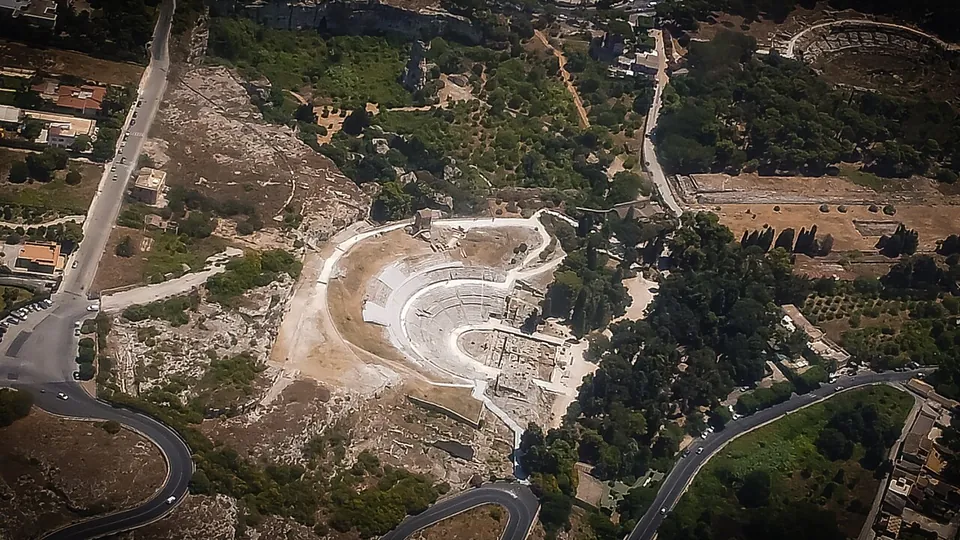


The Neapolis Archaeological Park holds most of ancient Syracuse’s surviving monuments. In one fenced park in the north-western part of the modern city are a great Greek theatre that the Romans rebuilt, a Roman amphitheatre cut largely out of the rock, the base of the largest altar known from antiquity and the deep quarries that supplied the city’s stone (it.wikipedia; de.wikipedia; en.wikipedia).
What is there today
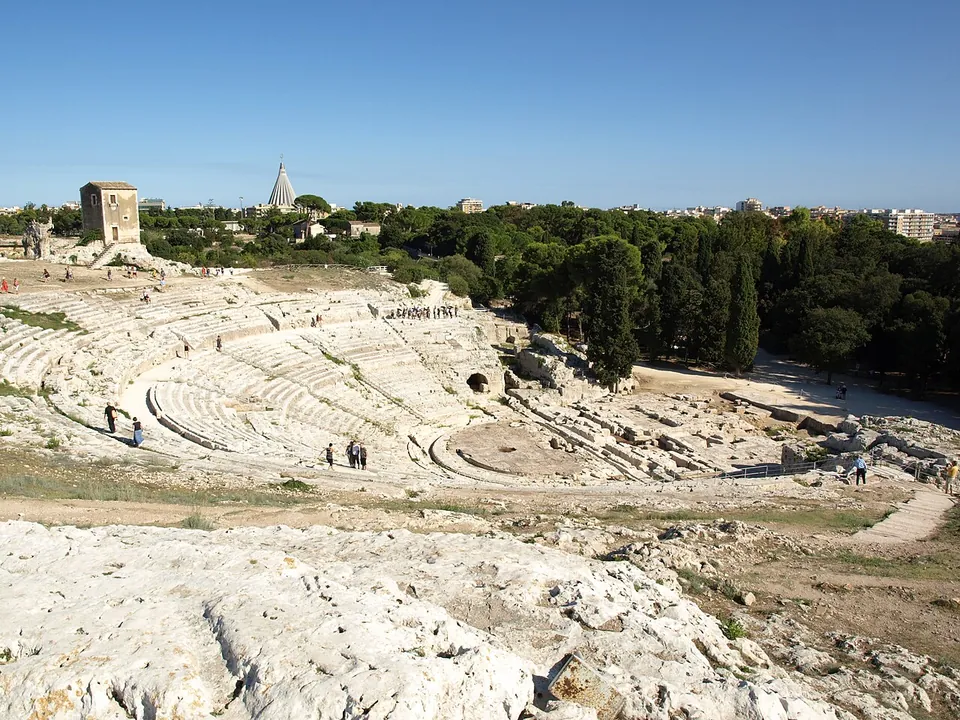
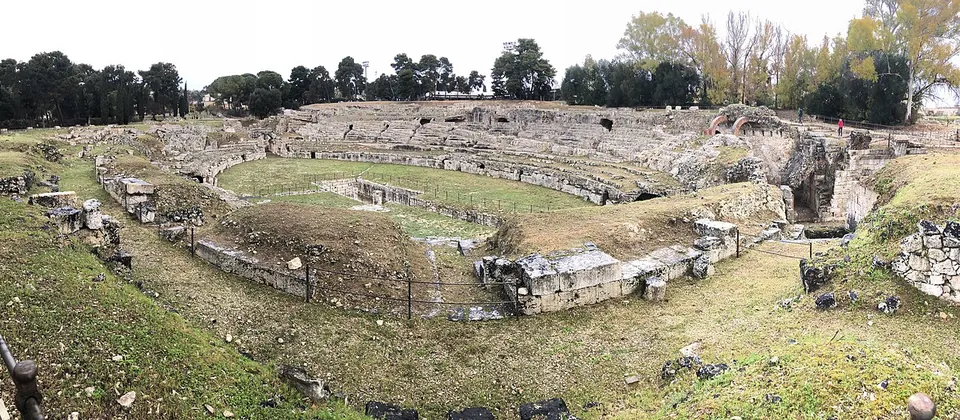
Two buildings carry the visit. The Greek theatre is cut into the south slope of the Temenite hill. Its seating was 138.6 m across, one of the largest in the Greek world, mostly carved from the living rock and split into nine wedges by stairways (it.wikipedia). The Roman amphitheatre lies about 370 m to the south-east and measures about 140 by 119 m (Pleiades; it.wikipedia). It too is mostly dug into the rock. The oval of the arena and the rectangular pit in its middle, which served the stage machinery, can still be made out, but almost nothing is left of the built upper part (it.wikipedia).
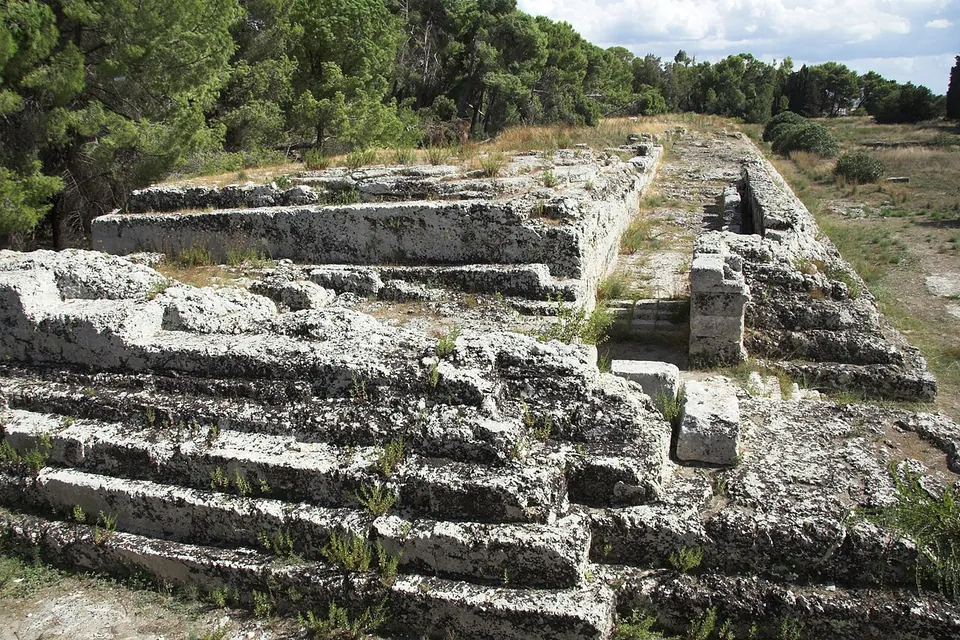
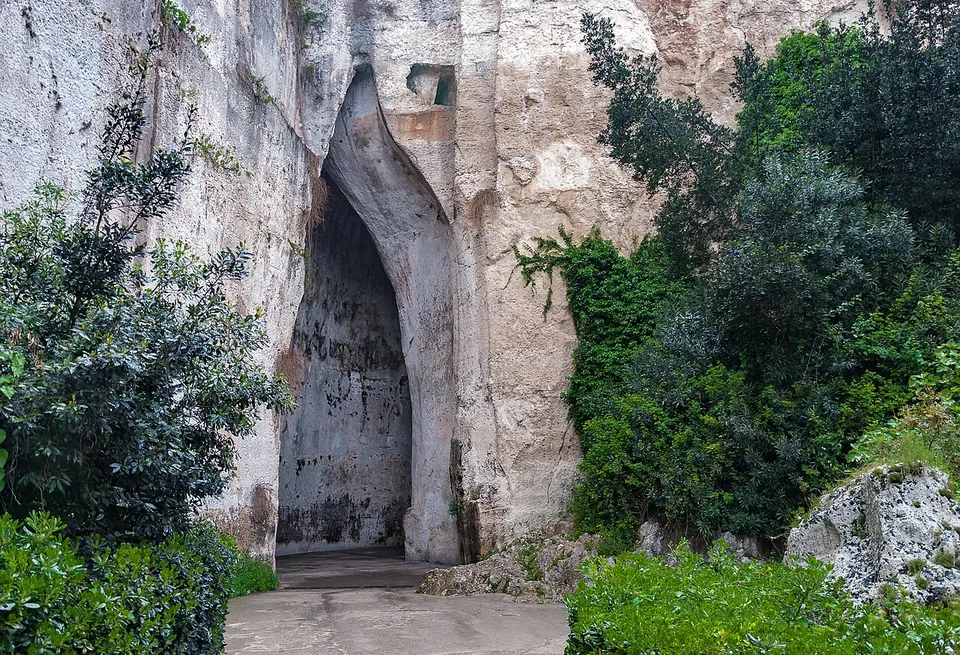
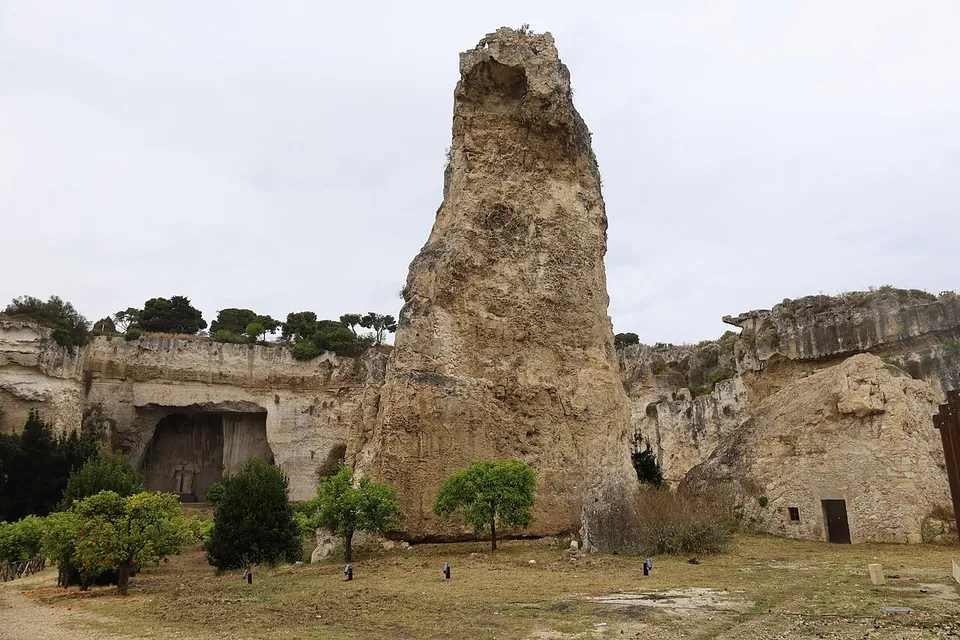
Between them is the altar of Hieron II. Almost nothing remains but its base, nearly 200 m long (it.wikipedia; en.wikipedia). North of the theatre the old quarries, the latomie, open out below the hill as sunken gardens. The largest, the Latomia del Paradiso, holds the cave called the Ear of Dionysius, which runs 65 m into the cliff (it.wikipedia; en.wikipedia). Above the theatre, a rock-cut street lined with niches, the Via dei Sepolcri, climbs about 150 m to the top of the hill. At the far end of the park, the Grotticelle necropolis has Roman imperial chamber tombs, one of them known by tradition as the Tomb of Archimedes (it.wikipedia; the operator).
Is it worth the trip?
Yes. If you come to Syracuse for its ancient sites, this park is the centre of the visit, and both the theatre and the amphitheatre are big, legible buildings rather than foundations. Be clear about what is Roman, though. The theatre, the altar and the quarries are Greek works. Rome’s share is the amphitheatre, the Roman rebuilding of the theatre, the footings of the Augustan arch and the tombs at the far end, so a visitor looking only for Roman remains will spend most of the time at the amphitheatre. Allow for walking: the monuments are spread out among trees and quarry gardens, and the park is counted among the largest archaeological areas in the Mediterranean (it.wikipedia).
Getting there
The park is in the north-western part of Syracuse (de.wikipedia). Siracusa railway station is about 750 m away in a straight line, and the “Augusto” bus stop is about 200 m away. A car park is mapped a little over 100 m away, and the ticket office for individual visitors is next to the park (all OpenStreetMap).
A ticket costs €14. EU citizens aged 18 to 25 pay €7, and visitors under 18 enter free. Tickets are sold at the gate and online through TicketOne, which the operator’s ticket page links to. The park publishes its hours one month at a time. In October it opens at 08.30, closing at 18.15 until the 24th and at 17.15 from the 25th; the ticket office shuts 45 minutes before closing (Parco archeologico di Siracusa, the operator, read 18 October 2026; check before travelling, since hours change through the year). From May to July the theatre hosts its season of classical plays (en.wikipedia), and the operator’s pages do not say how performances affect daytime visits.
The park is one stop of Syracusae – Syracuse, which also covers the forum, the so-called Roman gymnasium, the catacombs and the Augustan arch. The arch’s footings stand near the southern end of the amphitheatre, inside the park (it.wikipedia), and are described on that page.
Visiting details
- Opening hours
- Published month by month. For October, 08.30–18.15 from the 1st to the 24th (ticket office closes 17.30) and 08.30–17.15 from the 25th to the 31st (ticket office closes 16.30).
- Tickets
- €14; reduced €7 for EU citizens aged 18 to 25 (non-EU visitors of that age on reciprocity). Free under 18, for people with disabilities and one companion, and for several professional and student groups listed by the operator. Tickets are also sold online through TicketOne, which the operator's ticket page links to.
- Parking
- A car park is mapped about 140 m from the park (OSM node/10887233830).
Before you go
- The Greek theatre hosts the annual season of classical plays from May to July; the operator's pages do not say how performances affect daytime visits.
- The path to the so-called Tomb of Archimedes at the far end of the park is sometimes closed for lack of staff.
Hours and prices checked 18 October 2026 on the operator's own site. Confirm before travelling.
The Greek theatre
A theatre is recorded at Syracuse from the 5th century BC. Its present form seems to date from a rebuilding under Hieron II, after 238 BC and before his death in 215 BC. Inscriptions on the wall around the seating name gods and members of Hieron’s family, one name for each wedge (it.wikipedia; Pleiades). It was laid out to look over the curve of the harbour and Ortygia (it.wikipedia).
The Romans rebuilt it, perhaps when the colony was founded in the early Augustan period. They reshaped the seating into the semicircle typical of Roman theatres. They also built a monumental stage front with niches, and widened the orchestra from 16 m to 21.4 m (Pleiades; it.wikipedia). In the later empire the orchestra was adapted for water shows, and there is no sign that the theatre was ever converted for gladiators, who probably fought in the amphitheatre instead. A lost inscription names a Neratius Palmatus as the restorer of the stage. If he is the man who restored the Senate house in Rome after the sack of 410, this was the last work on the theatre, early in the 5th century AD (it.wikipedia).
From 1526 the Spanish under Charles V took the cut blocks for new fortifications on Ortygia, and the stage building and the upper rows disappeared. Water mills were later set up on the seating, and the millers’ house still stands at the top. Since 1914 the Istituto Nazionale del Dramma Antico has staged Greek plays here (it.wikipedia).
The Roman amphitheatre
The amphitheatre is counted among the most representative buildings of the early Roman imperial period (it.wikipedia), though its date is disputed: some attribute it to Augustus, others to Septimius Severus (the operator), and Pleiades has it in use from the 1st to the 3rd century. Four limestone fragments survive of a large inscription that probably crowned the main entrance (it.wikipedia; en.wikipedia). Its orientation differs from the theatre’s and probably follows an older street grid. The road from the Achradina district reached it through the Augustan arch (it.wikipedia).
It had two entrances and a system of stairs coming down from the ground outside. Behind the high podium round the arena ran a covered corridor with openings through which gladiators and animals entered. The front rows above it were reserved for people of rank, and inscriptions cut into the parapet blocks seem to have marked out the seating areas. The pit in the centre of the arena was originally covered and linked by an underground passage to one end of the building. A cistern still preserved under the nearby church of San Nicolò supplied its water (it.wikipedia; en.wikipedia). The French Wikipedia gives its capacity as 20,000 and calls it the largest amphitheatre in Sicily. It was excavated in 1839 by the Duke of Serradifalco (it.wikipedia).
The altar of Hieron II
Diodorus credits the altar to Hieron II and says it was a stade long and stood by the theatre (it.wikipedia). Its stepped base is about 199 by 22.5 m, which makes it the largest altar known from the ancient world (en.wikipedia). It was probably dedicated to Zeus Eleutherios, though that reading is disputed, and the sacrifice of 450 bulls has been linked to it (it.wikipedia; en.wikipedia). The feet of one of the figures that flanked the northern entrance survive in place. The upper structure was quarried away for later buildings, most recently for the Spanish fortifications of Ortygia. Under Augustus the courtyard west of the altar was planted with trees as a sacred grove (en.wikipedia).
History
Neapolis, the “new city”, was one of the five districts of Greek and Roman Syracuse, and the park covers its northern part (it.wikipedia; the operator). The park was laid out between 1952 and 1955 by the antiquities service of eastern Sicily. Its fence kept the monuments clear of the building boom that, from the 1950s to the 1980s, covered many of the ancient city’s cemeteries, baths and streets (it.wikipedia). The church of San Nicolò dei Cordari at the entrance dates from the Norman period; the building was a granary in Roman times, and the cistern beneath it is the one that fed the amphitheatre (it.wikipedia).
More photographs



Nearby
Photo: Davide Mauro · CC BY-SA 4.0 · Commons
46 km · necropolis · Sicily
Cava d’Ispica
The ticketed archaeological area lies at the Modica end of the gorge.

Straight-line distances.
Sources
Every fact on this page comes from the records below, each used under the licence noted.