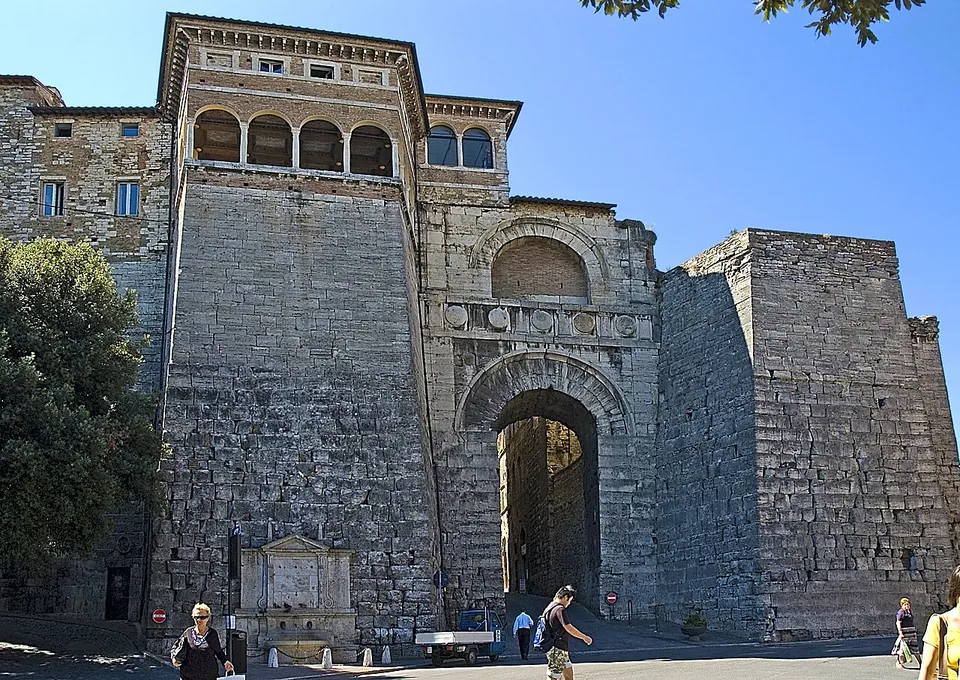
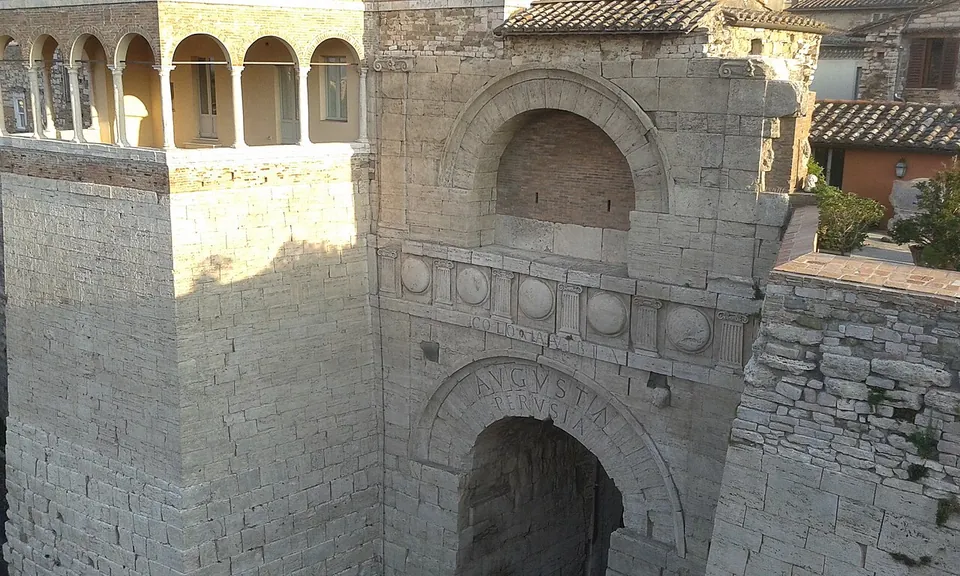
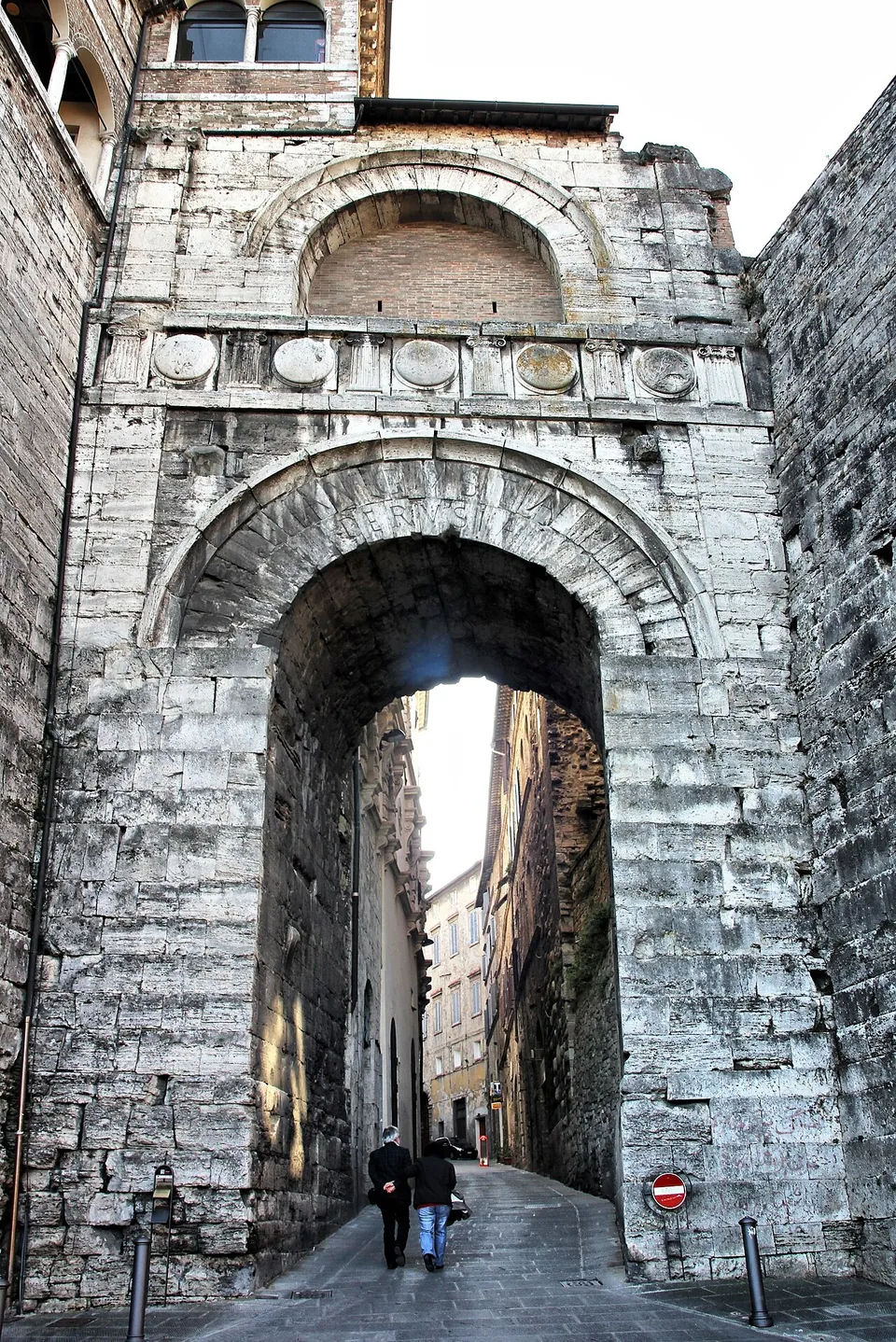
The Etruscan Arch is the northern gate of ancient Perugia: two massive travertine towers and an archway that the Etruscans built in the 3rd century BC, restored under Augustus after he took the city in 40 BC, when its new name, AVGVSTA PERVSIA, was carved on the arch (it.wikipedia; Pleiades). The gate is Etruscan; the Roman part is the restoration and the two inscriptions on it. It is free, it stands in an open square, Piazza Fortebraccio, and it is the most intact and monumental of the city’s ancient gates (it.wikipedia).
What is there today
The gate is still built into the Etruscan wall it belonged to, and it is still the main way into the upper town (the Ministry of Culture). Two massive towers with trapezoidal fronts flank a central façade with a single archway; over the arch runs a frieze of round shields and triglyphs, and above that a second, smaller arch between two pilasters (it.wikipedia; en.wikipedia). Published figures put the archway at 9 to 11 m high and the towers at about 20 m (de.wikipedia; en.wikipedia; the Comune di Perugia). The arch opens on the cardo maximus, the main street of the ancient town, which is today’s Via Ulisse Rocchi (it.wikipedia).
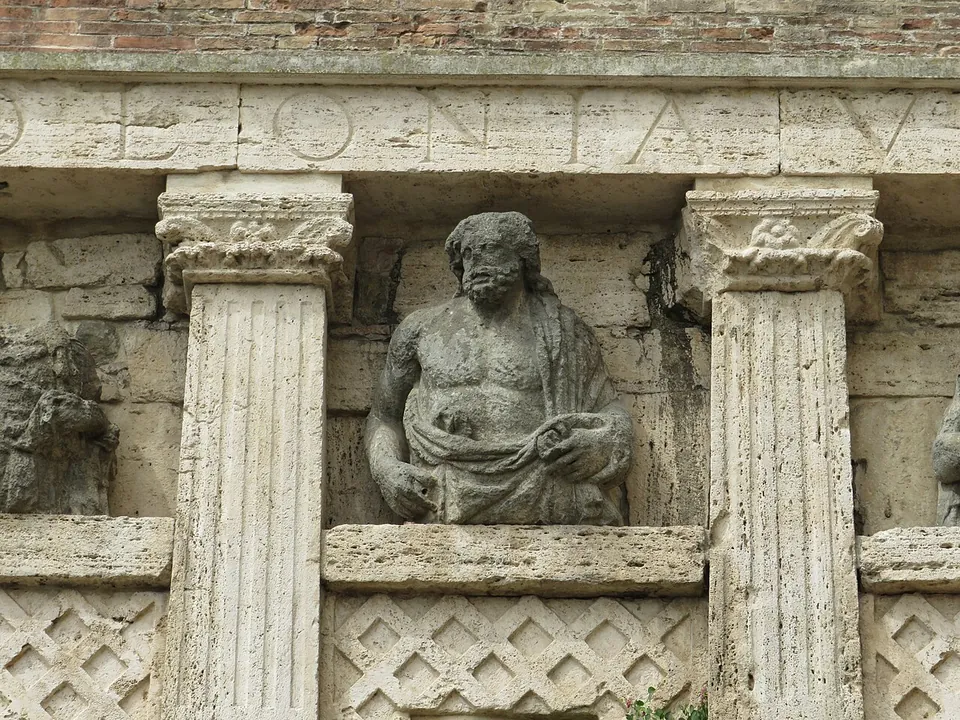
Two inscriptions are the Roman layer. AVGVSTA PERVSIA, the name the city took after its rebuilding under Augustus, is cut into the Etruscan stones of the arch itself; in the band above it is COLONIA VIBIA, added when the emperor Trebonianus Gallus (251–253), a native of Perusia, made the town a Roman colony (it.wikipedia; de.wikipedia; the Comune di Perugia). Published descriptions do not say which parts of the decorated upper front belong to the Augustan restoration and which are Etruscan; the Comune notes only that the upper arch is thought to have been open originally, for military purposes.
Later centuries added to it. The open loggia on top of the left-hand tower is Renaissance work of the 16th century, and the fountain at the foot of the same tower was finished in 1621 (it.wikipedia; en.wikipedia). To the right of the gate, along Via Cesare Battisti, runs one of the best stretches of the city’s Etruscan wall (the Comune di Perugia). Facing the arch across the square is Palazzo Gallenga Stuart, seat of the University for Foreigners (it.wikipedia).
Is it worth the trip?
If you are in Perugia, yes: it costs nothing, and the gate is the most intact and monumental of the city’s ancient gates (it.wikipedia). Ten minutes are enough for the gate itself; the stretch of wall beside it adds a few more.
Be clear about what it is. It is an Etruscan city gate that Rome took over, repaired and inscribed, not a Roman building, and the Roman part a visitor can pick out for certain is the lettering. As a reason on its own to travel to Perugia for Roman remains, it is thin; as the start of a walk round the gates of the ancient circuit, below, it is the best of them.
Getting there
The gate stands in Piazza Fortebraccio (the Comune di Perugia). A bus stop named Arco Etrusco is about 30 m away, the Pincetto station of the Minimetrò is about 470 m away, and the Perugia Sant’Anna railway station about 930 m. The nearest car parks are Parcheggio Sant’Antonio, multi-storey, about 150 m away, and Piazza Piccinino, about 180 m; both charge (OpenStreetMap).
There is no ticket and no opening time: the gate is a public street, and the Comune lists it as wheelchair accessible (the Comune di Perugia tourism page, as archived on 7 July 2025). The loggia on the tower is part of the offices of the Soprintendenza for Umbria and is normally closed to the public; it opens only on occasional guided visits that must be booked, most recently on 6 and 7 September 2025, when its terrace gave a view over the north side of the city (the Ministry of Culture).
Visiting details
- Tickets
- Free. The gate stands in Piazza Fortebraccio and the street runs through it; there is no ticket. The Comune lists it as wheelchair accessible.
- Parking
- Parcheggio Sant'Antonio, a multi-storey car park (fee), about 150 m away, and Piazza Piccinino (surface, fee) about 180 m (OpenStreetMap way/77049782 and way/23079630). A bus stop named Arco Etrusco is about 30 m from the gate.
Before you go
- The Renaissance loggia on top of the left-hand tower is part of the offices of the Soprintendenza for Umbria and is normally closed to the public. It opens only on occasional guided visits that must be booked, most recently on 6-7 September 2025.
Hours and prices checked 7 July 2025 on the operator's own site. Confirm before travelling.
The other gates of the circuit
The walls ran for about 2.9 km round the city, built of travertine blocks laid without mortar (en.wikipedia). Two of their gates keep a round ancient arch, this one and Porta Marzia; three more still stand in the line of the walls but were given pointed arches in the 14th century (it.wikipedia; fr.wikipedia). All four lie within about 700 m of the Etruscan Arch as the crow flies, linked by the hillside streets of the old town and, at Sant’Ercolano, a long flight of steps.
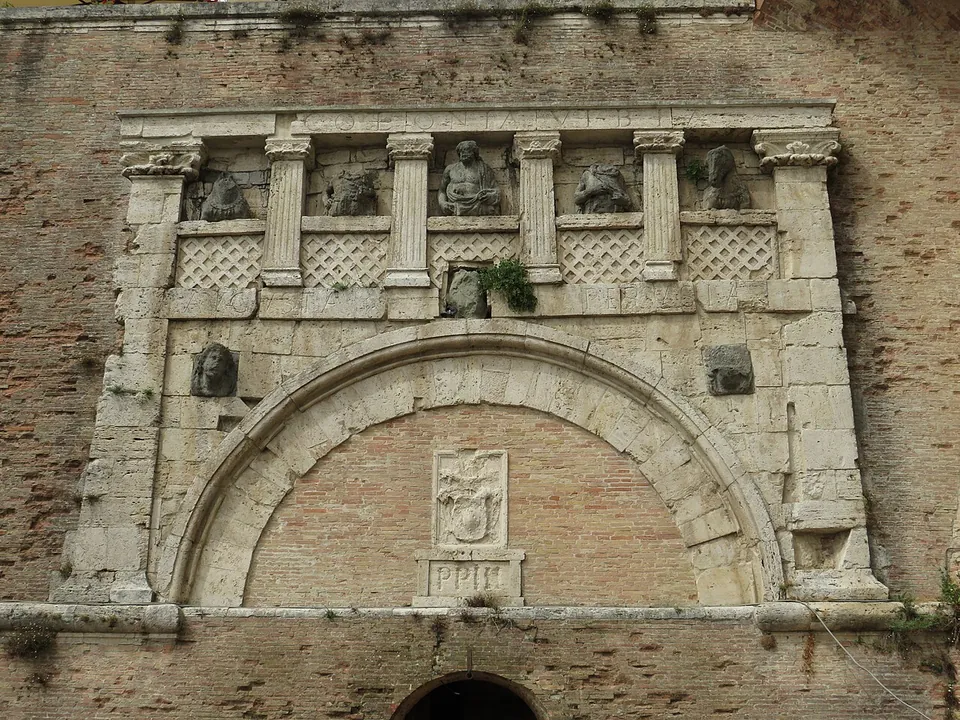
- Porta Marzia, about 700 m south, is the one with the most to show for the Roman period. Dated to the 3rd century BC, it was taken down in 1540 by Antonio da Sangallo the Younger and rebuilt about four metres from its old position in the outer wall of the Rocca Paolina, the fortress Pope Paul III had built. Its travertine arch is framed by pilasters and topped by a balustrade with five sculptures: Jupiter between Castor and Pollux, the city’s protectors, with their horses at each end. AVGVSTA PERVSIA is cut on the architrave over the arch and COLONIA VIBIA on the cornice above (it.wikipedia; de.wikipedia).
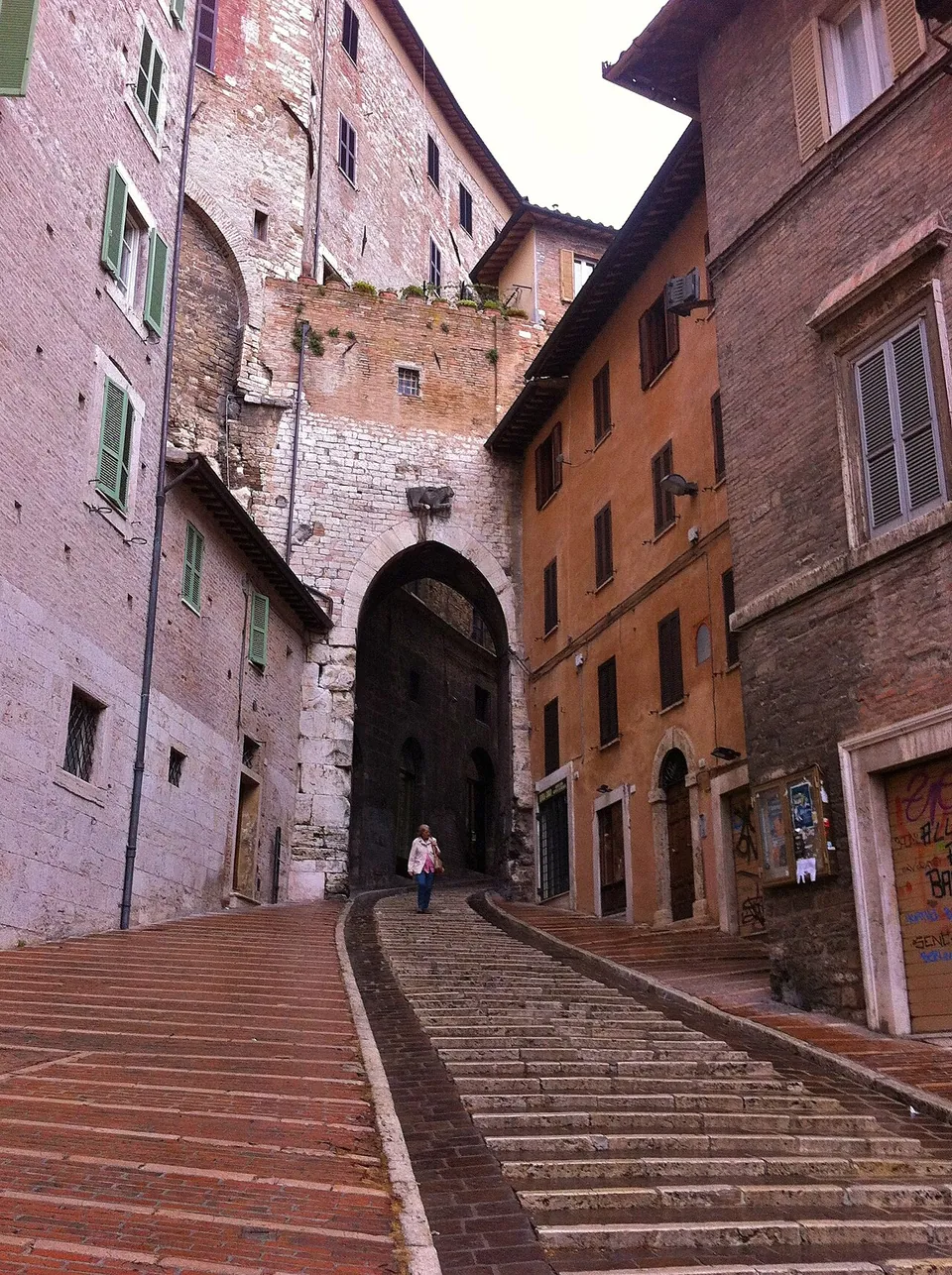
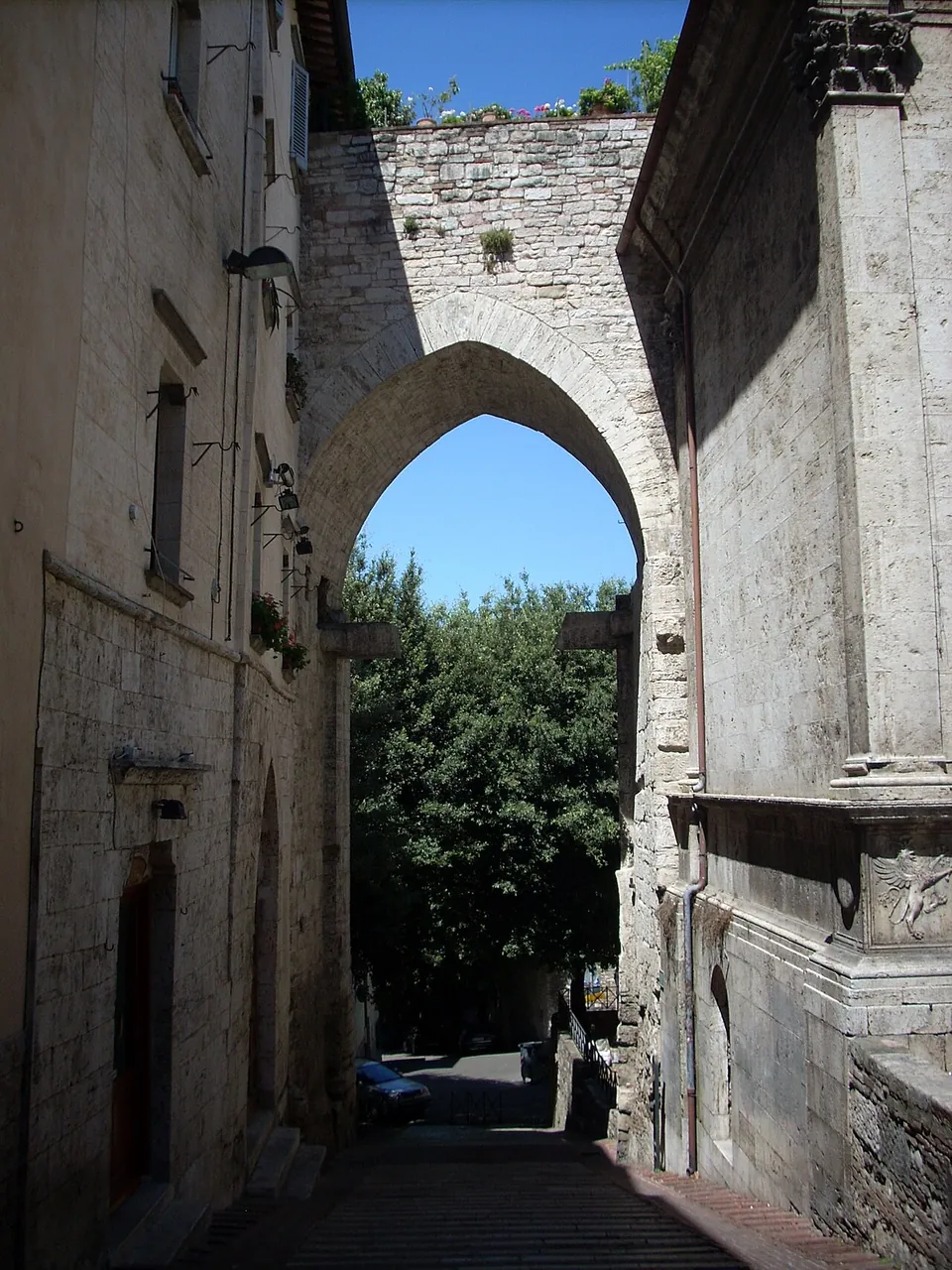
- Arco di Sant’Ercolano, also called Porta Cornea, about 600 m south, stands over the steps of the same name. It was rebuilt in the 14th century with a pointed arch, and the lion over the outer arch is a 13th-century emblem of the Guelph party (it.wikipedia; fr.wikipedia).
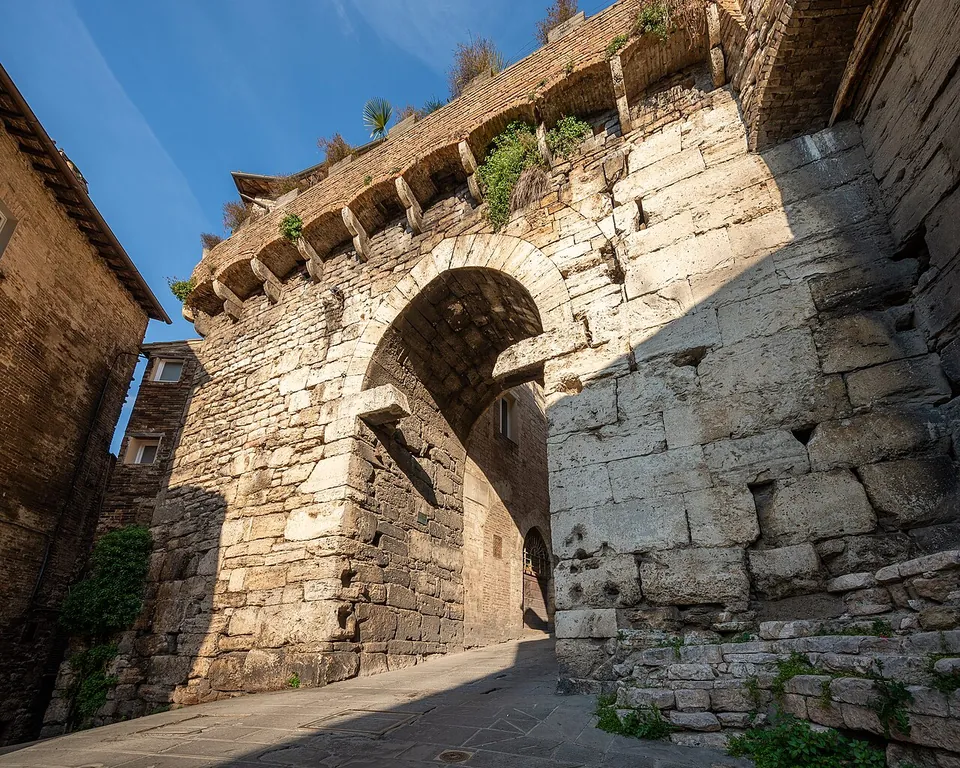
- Porta Eburnea, or Arco della Mandorla, about 700 m south-west in Piazza Mariotti, keeps its original travertine blocks up to the springing of the arch, which was rebuilt as a pointed arch in the 14th century. A lion’s head from the ancient gate survives, with a few letters that probably belonged to the same AVGVSTA PERVSIA – COLONIA VIBIA inscription (it.wikipedia; fr.wikipedia).
- Porta Trasimena, also called Porta San Luca, about 500 m west, faced the road to Lake Trasimeno, which gave it its name. Its round arch was made pointed in the 14th century; on its left side, above a niche, are a travertine lion and the Roman inscription AVGVSTA PERVSIA – COLONIA VIBIA (fr.wikipedia).
History
Perusia was one of the twelve cities of the Etruscan league. It first appears in the account of the war between Etruscans and Romans of 310 or 309 BC, joined the rebellion of 295 BC and sued for peace the following year; in the Second Punic War it supported Rome, and the circuit of walls that made the city so hard to take was built in that period (it.wikipedia). De.wikipedia suggests that the gate was probably built new in the existing Etruscan wall in the middle of the 3rd century BC, when the Via Amerina was extended to Perusia: the road entered the town through Porta Marzia and left it again through this gate.
In the civil war, Lucius Antonius, brother of Mark Antony, held the city, and Octavian besieged it for about seven months until it surrendered in 40 BC; the siege ended with the city burning (it.wikipedia). The city was then restored under Augustus’s patronage, with families loyal to him, the Vibii above all, put in charge, and AVGVSTA PERVSIA was carved on the gate (it.wikipedia). Pleiades describes the gate as “refashioned under Augustus”.
The second inscription, COLONIA VIBIA, records the rank of Roman colony granted between 251 and 253 AD under Trebonianus Gallus, who came from Perusia and belonged, like his son and co-emperor Volusianus, to the gens Vibia (it.wikipedia; de.wikipedia). The loggia on the left tower was added in the 16th century and the fountain below it completed in 1621 (it.wikipedia; en.wikipedia).
More photographs
Nearby
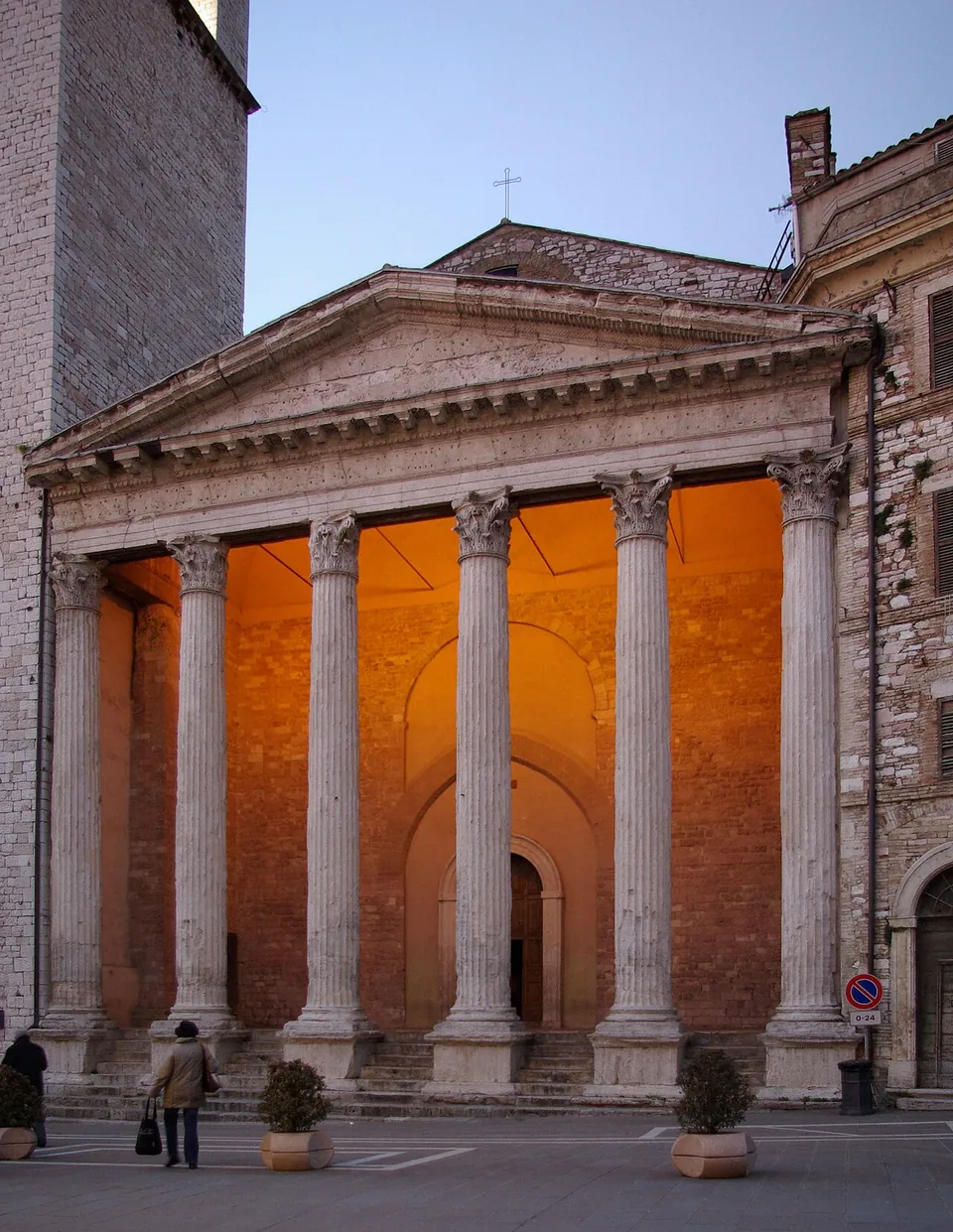
Photo: Berthold Werner · Public domain · Commons
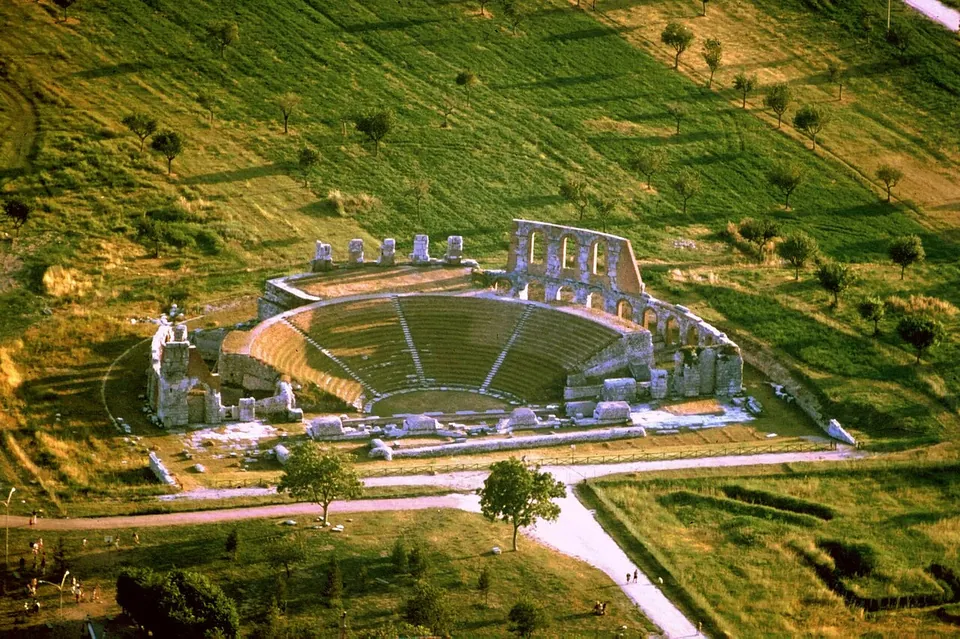
Photo: Celsius1 at Italian Wikipedia · CC BY-SA 3.0 · Commons
30 km · theatre · Umbria
Roman Theatre of Gubbio
The theatre is built of squared limestone blocks with a rusticated face.


Straight-line distances.
Sources
Every fact on this page comes from the records below, each used under the licence noted.
| Source | Licence |
|---|---|
| Pleiades 923690483 | CC BY |
| Wikidata Q1892295 | CC0 |
| Pleiades — Perusia | licence not recorded |
| Wikipedia (it) — Arco Etrusco | CC BY-SA 4.0 |
| Wikipedia (en) — Etruscan Arch | CC BY-SA 4.0 |
| Wikipedia (de) — Etruskischer Bogen | CC BY-SA 4.0 |
| Wikipedia (it) — Porta Marzia | CC BY-SA 4.0 |
| Wikipedia (it) — Porta Eburnea | CC BY-SA 4.0 |
| Wikipedia (fr) — Arco di Sant'Ercolano | CC BY-SA 4.0 |
| Wikipedia (fr) — Porta Trasimena | CC BY-SA 4.0 |
| Comune di Perugia, Turismo — Arco Etrusco or Arch of Augusto (archived copy of 7 July 2025) | licence not recorded |
| Ministero della cultura — Soprintendenza dell'Umbria, Arco Etrusco, guided visit (September 2025) | licence not recorded |
| Ministero della cultura — Arco Etrusco e Loggiato, guided visit by the Soprintendenza dell'Umbria (2020) | licence not recorded |