What is there today
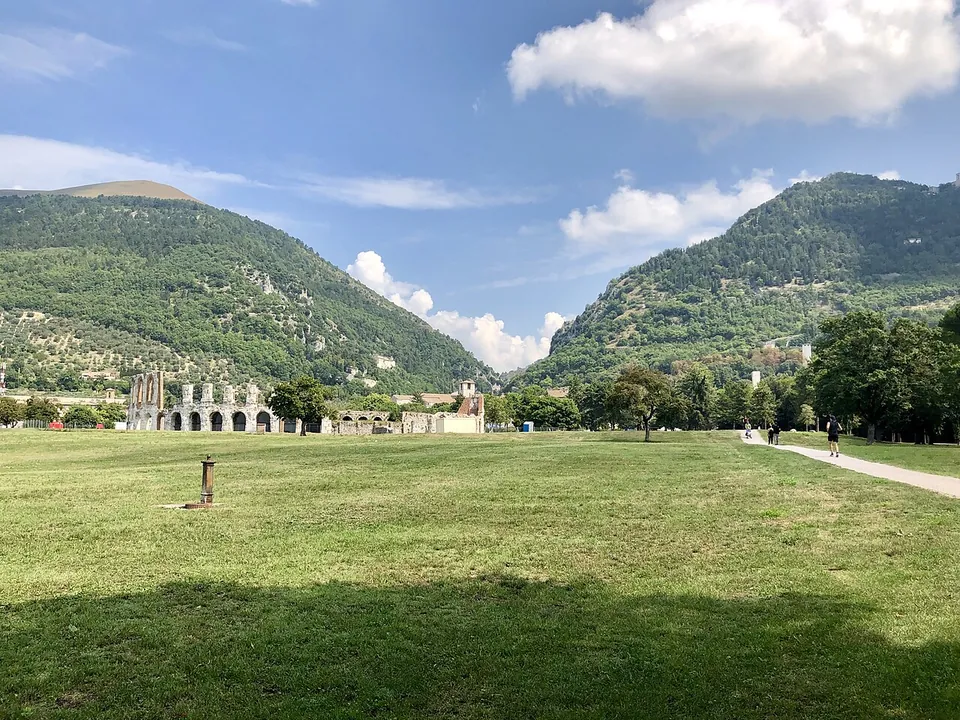
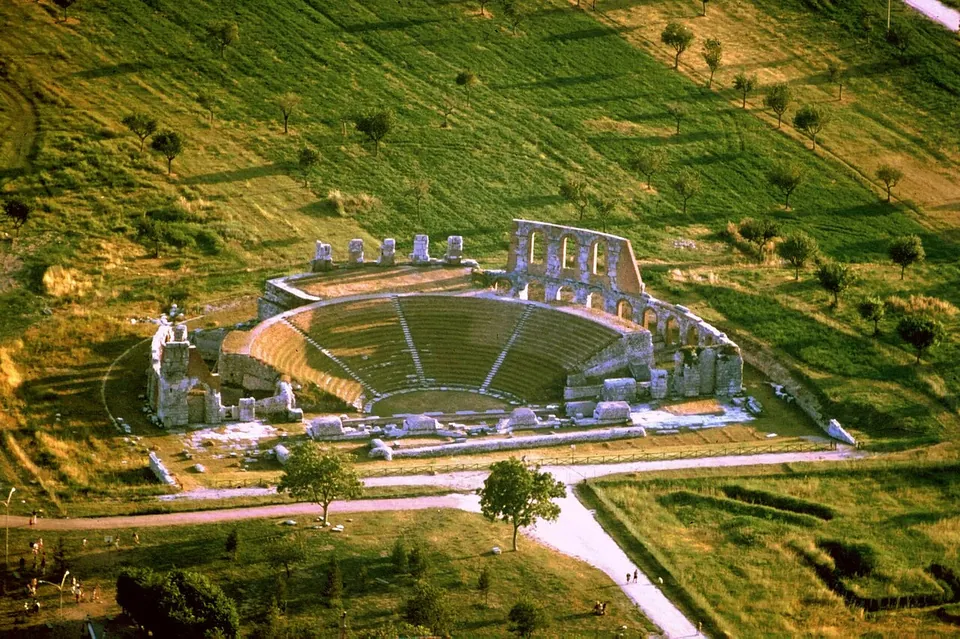
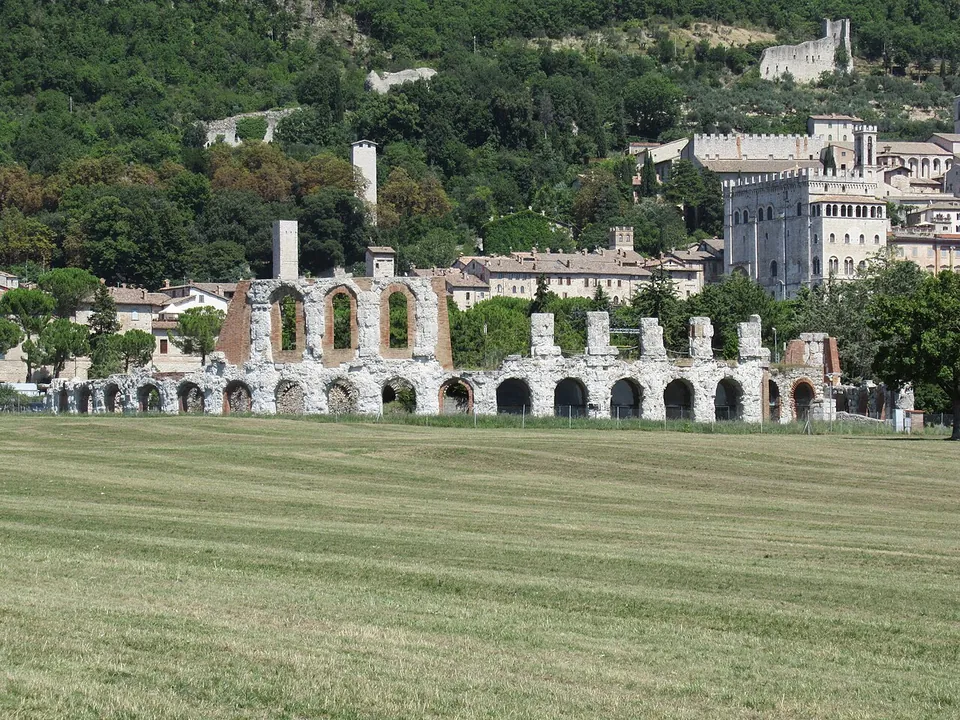
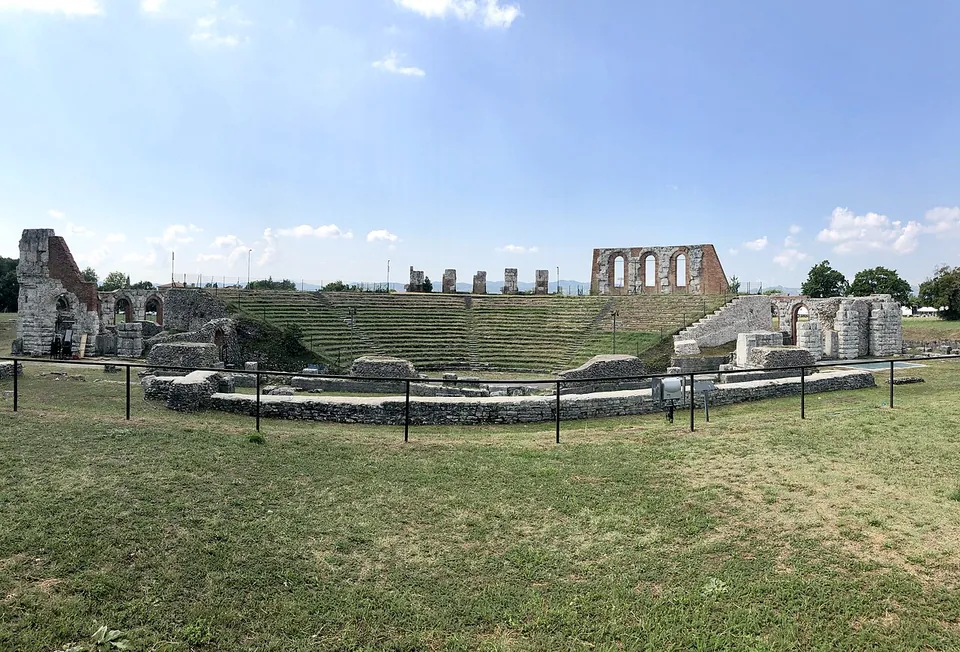
The theatre is built of squared limestone blocks with a rusticated face. It had two storeys of arcades: the lower one still stands, and a few arches of the upper gallery survive above it (the operator). Within their curve the seating is divided into four wedges, the orchestra keeps its paving of limestone slabs, which drains rainwater into a large cistern under the front of the stage, and the back wall of the stage has two rectangular niches either side of a semicircular central one (the operator). The seating is put at nearly 6,000 spectators (Wikipedia). Much of what you see has been put back together: the present layout derives from restoration over the past two centuries (en.wikipedia).
About 170 m away (OpenStreetMap), the Antiquarium occupies a small two-storey farmhouse built over a large Roman house. The house’s remains include an atrium, the main reception room, a kitchen and a latrine, with floors of mortar and mosaic; the reception room keeps fragments of a black-and-white geometric mosaic around a coloured central panel showing Scylla, of which only the middle survives, and a reconstruction drawing shows the whole floor (the operator). The upper floor displays finds from around Gubbio, from the Umbrian and Roman periods (the operator; it.wikipedia).
In summer the theatre is used for open-air performances (en.wikipedia).
Is it worth the trip?
If you are in Gubbio, yes: it is a short walk from the old town, the ticket is €3, and the arcades against the town and the mountains are a fine sight. The Roman house with its Scylla mosaic under the Antiquarium adds a second, quite different thing to see on the same ticket.
As a destination in its own right it is modest. Its present layout owes much to restoration, and only a few arches of the upper arcade stand. Come for Gubbio, which also keeps the Iguvine Tablets, and take the theatre in as part of the visit.
Check the day before you go. The site is closed on Mondays, opens only in the morning on Tuesdays and Fridays and only in the afternoon on Wednesdays and Thursdays, and the ticket machines take cards only.
Getting there
The theatre lies in a grassy park just south of the SR298 road where it passes the historic centre of Gubbio (en.wikipedia), about 400 m from the town centre. There are two surface car parks about 180 m from the theatre and paid street parking about 200 m away, and public transport stops named “Gubbio (Parruccini)” about 150 m away (OpenStreetMap). The nearest railway station is Fossato di Vico-Gubbio, in Fossato di Vico (it.wikipedia).
The site is open on Tuesday and Friday from 08.30 to 13.30, on Wednesday and Thursday from 14.10 to 19.30, and on Saturday and Sunday from 08.30 to 19.30; it is closed on Mondays, and last entry is half an hour before closing. A ticket is €3, reduced €2, and free for EU citizens under 18, with the other reductions that apply at all Italian state museums. Payment is by card or digital payment only (the operator, the Direzione regionale Musei nazionali Umbria, read 24 October 2026 - check before travelling, since hours change).
Visiting details
- Opening hours
- Tuesday and Friday 08.30–13.30; Wednesday and Thursday 14.10–19.30; Saturday and Sunday 08.30–19.30. Closed on Mondays. Last entry half an hour before closing.
- Tickets
- €3; reduced €2; free for EU citizens under 18, with the other reductions of the national rules for state museums. The ticket covers the theatre and the Antiquarium. Tickets are sold only by card or digital payment, from automatic machines; no cash.
- Parking
- Two surface car parks about 180 m from the theatre (OSM way/176593704 and way/96982398), and paid street parking about 200 m away (way/459386626).
Before you go
- Weekday opening is half-days only - mornings on Tuesday and Friday, afternoons on Wednesday and Thursday - and the site is closed on Mondays.
- The ticket machines take cards only; cash is not accepted.
Hours and prices checked 24 October 2026 on the operator's own site. Confirm before travelling.
History
The town was Ikuvium, or Iguvium, a walled city of the ancient Umbrians (it.wikipedia). It allied itself with Rome in 295 BC and became a Roman municipium with citizenship in the early 1st century BC - in 89 or 82 BC, by different accounts (it.wikipedia). Its best-known relic is written in Umbrian rather than Latin: the Iguvine Tablets, seven bronze tablets written in the Umbrian language, were found near the theatre in the 15th century and are kept in the civic museum in the Palazzo dei Consoli (it.wikipedia).
The theatre stood just outside the town walls, at the northern edge of the ancient town (the operator; it.wikipedia). It was built in the late Republic (Pleiades), between 55 and 27 BC (it.wikipedia), and Pleiades cites Sear (2004) for several important architectural innovations in its construction. An inscription of the reign of Augustus found here records works paid for by a magistrate of the town, Gnaeus Satrius Rufus, who roofed “the basilicas” and laid a stone pavement; it is in the civic museum in the Palazzo dei Consoli, with pieces of the theatre’s architectural decoration (the operator; it.wikipedia).
Excavation and restoration have gone on since the 15th century and have turned up several fine mosaics. One, a large panel of a lion attacking a leopard, was found in the mid-16th century during excavations promoted by the Gabrielli counts, who owned the land; Count Girolamo Gabrielli took it to Rome, and it was later bought by Thomas Coke, first Earl of Leicester, for his house at Holkham Hall, where it still is (it.wikipedia).
About 400 m from the theatre (OpenStreetMap), a Roman tomb with a barrel-vaulted burial chamber was long taken for the grave of Gentius, the last king of Illyria, who was held prisoner at Iguvium in 167 BC; it is in fact the mausoleum of Pomponius Grecinus (it.wikipedia).
More photographs
Nearby
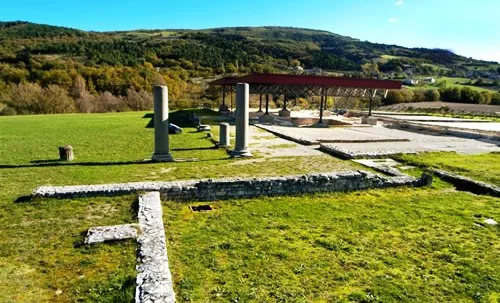
Photo: FAM1885 · CC BY-SA 4.0 · Commons
24 km · city · Marche
Sentinum
The park has two areas, Civita and Santa Lucia, either side of the provincial road to Fabriano and joined by a walkway (the operator).
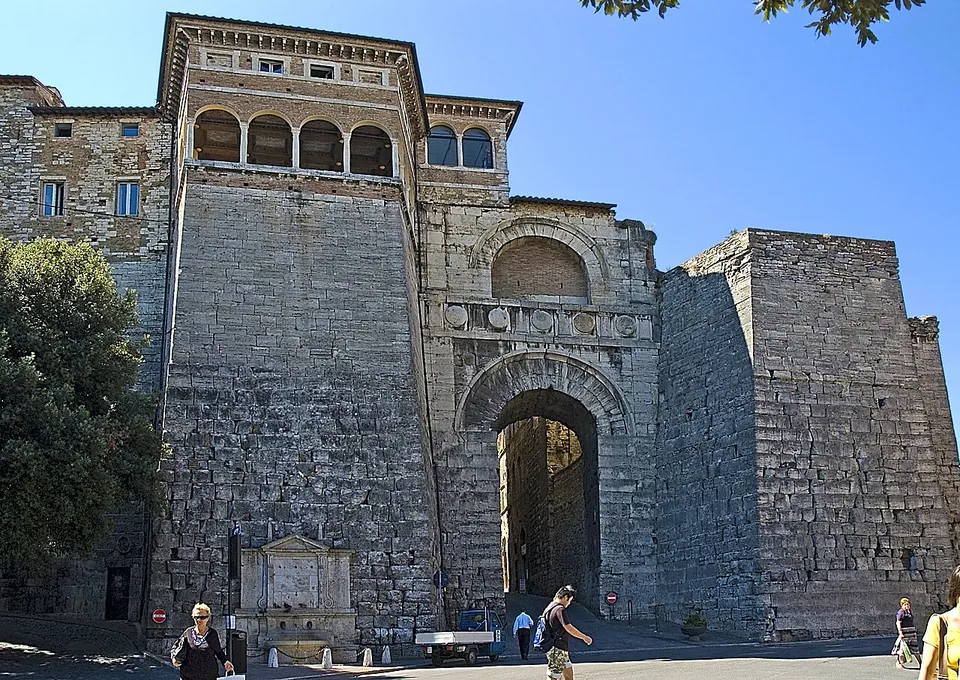
30 km · gate · Umbria
Etruscan Arch
The gate is still built into the Etruscan wall it belonged to, and it is still the main way into the upper town (the Ministry of Culture).


Straight-line distances.
Sources
Every fact on this page comes from the records below, each used under the licence noted.
| Source | Licence |
|---|---|
| Pleiades 418202453 | CC BY |
| Wikidata Q55164614 | CC0 |
| Vici.org 11063 | CC BY-SA (text), CC0 (metadata) |
| OpenStreetMap way/176589635 | ODbL |
| Wikipedia (en) — Roman Theatre of Gubbio | CC BY-SA 4.0 |
| Wikipedia (it) — Gubbio | CC BY-SA 4.0 |
| Wikipedia (it) — Ikuvium | CC BY-SA 4.0 |
| Wikidata — Ikuvium (Q3792526) | licence not recorded |
| Direzione regionale Musei nazionali Umbria — Parco archeologico del Teatro romano di Gubbio (the operator; hours and admission) | licence not recorded |