Sentinum is the site of a Roman town on a plateau just outside Sassoferrato, in the Marche, best known as the place near which Rome won the battle of Sentinum in 295 BC. Today it is an archaeological park of two areas where you walk on stretches of Roman street and among the floors and low walls of two bath buildings.
What is there today
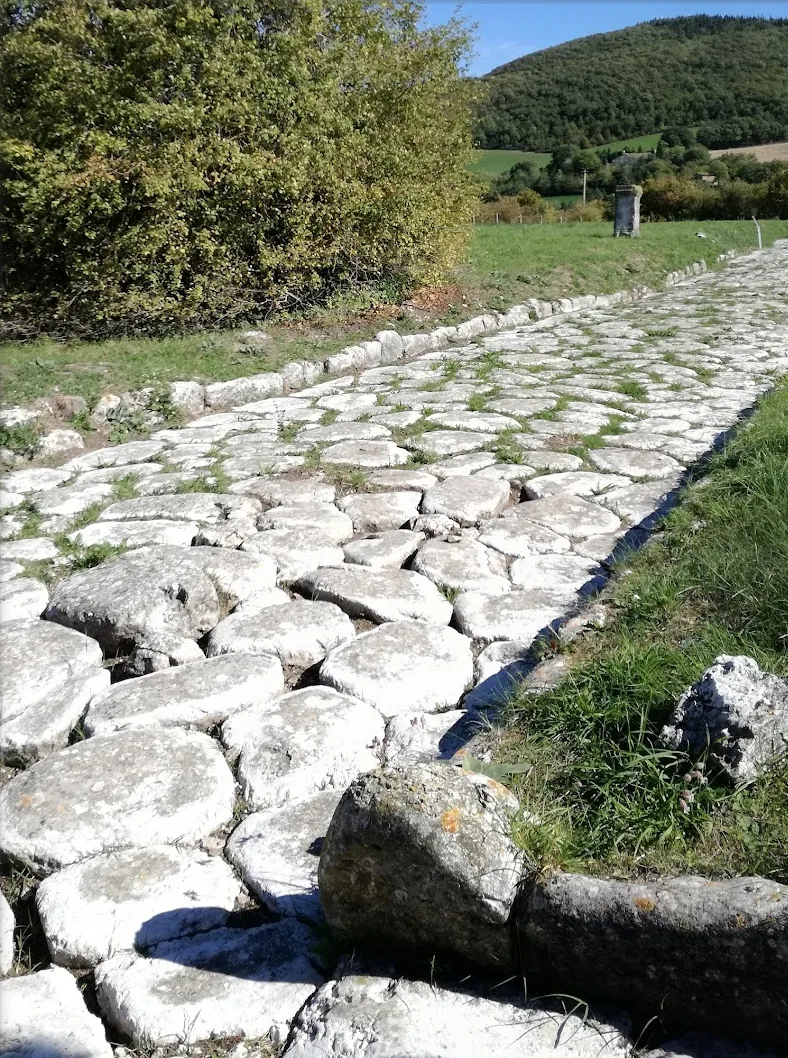
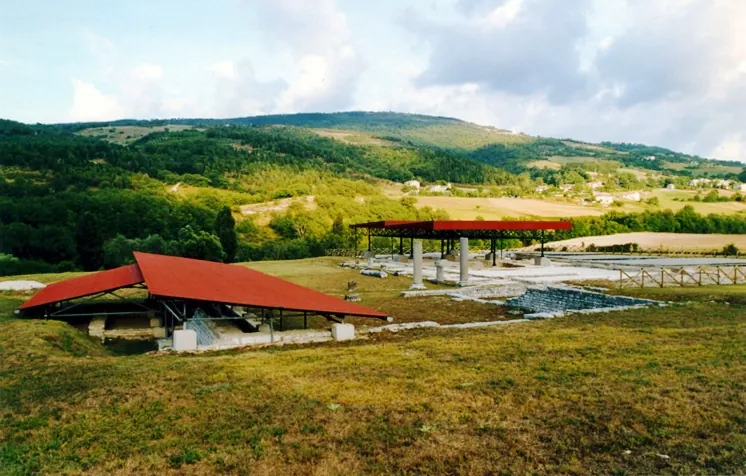
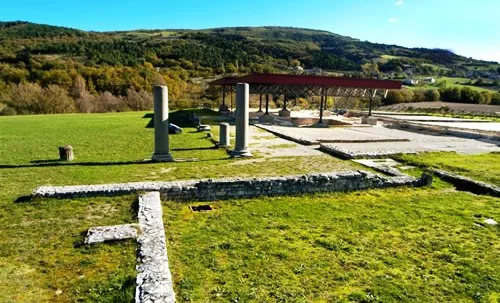
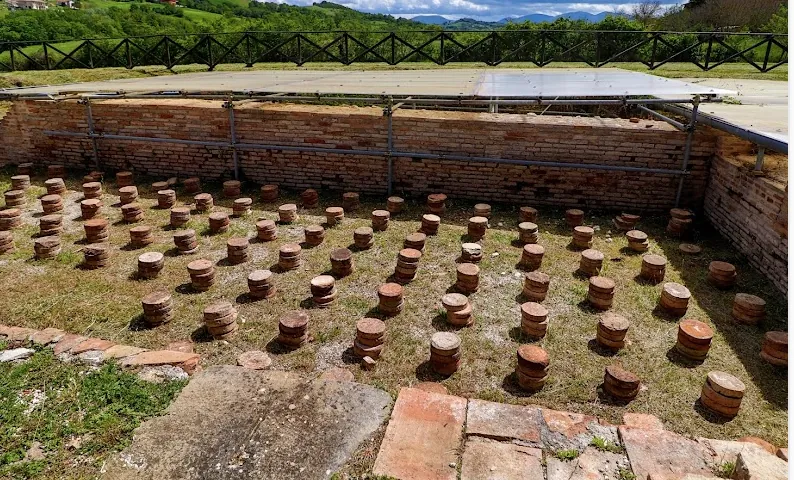
The park has two areas, Civita and Santa Lucia, either side of the provincial road to Fabriano and joined by a walkway (the operator). At Civita are the remains of the town’s baths, with a pool, the hot and cold bathing rooms and a large apsed hall floored with coloured marble; short stretches of two paved side streets, a cardo and a decumanus, laid with big white limestone blocks; and a foundry where bronze statues were cast, in use from the 1st century BC to the 3rd century AD (it.wikipedia). Fragments of gilded bronze from that foundry are linked to the gilded bronze group of Cartoceto di Pergola (the ticket office’s description). At Santa Lucia, just outside the town walls, stands a large building with bath rooms, facing a broad courtyard with a mosaic floor and columns; it was once read as a suburban villa and is now thought more likely to have served travellers on the road (it.wikipedia). Some floor mosaics, mostly black and white, are still in place in the Santa Lucia baths (en.wikipedia). Several of the excavated areas are under modern shelter roofs.
All of this is, in it.wikipedia’s words, only a modest portion of the ancient town. The best-known mosaics left long ago: the Aion mosaic is in the Glyptothek in Munich, and the Rape of Europa and a fragment of the great sea-monster mosaic are in the civic archaeological museum in Sassoferrato, in the medieval Palazzo dei Priori (it.wikipedia; Ministero della Cultura).
Is it worth the trip?
Worth an hour if you are already in this corner of the Marche, and best paired with the museum in Sassoferrato, where the mosaics and the sculpture from the town are shown. It is not worth a long detour on its own: what you see is a town plan at ground level, floors, paving and a few columns, not standing buildings, and the town’s most famous mosaic is in Germany. The practical catch is access. The operator describes visits as booked through the tourist office, and the guided visit sold through the ticket office it links to had no dates on offer when this page was checked in late October, so this is a place to arrange ahead rather than drop in on.
Getting there
The remains lie about a kilometre south of Sassoferrato (en.wikipedia), either side of the provincial road to Fabriano (the operator), which is about 10 km away. OpenStreetMap maps a free car park next to the remains; no bus stop or railway station is mapped near the entrance.
The tourism site of the Comune di Sassoferrato says visits are booked at the tourist office (IAT), “max 24 hours in advance”. The office is open daily from 10.00 to 13.00 and 15.30 to 18.30 (+39 0732 956257), and says reservations are required at weekends for the town’s museums. The online ticket office it links to sells a one-hour guided visit of the park from €5, for groups of two to fifteen people (read 22 October 2026). No standing opening hours for the park are published. The tourism site also sells a €10 museum card covering all of Sassoferrato’s museums.
Visiting details
- Opening hours
- No regular opening hours are published. The town's tourism site says visits are booked through the Sassoferrato tourist office (IAT), "max 24 hours in advance"; the office is open daily 10.00–13.00 and 15.30–18.30 (+39 0732 956257).
- Tickets
- From €5 for a one-hour guided visit, for groups of 2 to 15, sold through the online ticket office the tourism site links to (Happennines cooperative, on Regiondo). On 22 October 2026 it offered no dates.
- Parking
- A free surface car park beside the remains (OSM way/866754290, about 60 m from the point); the walkway linking the two areas of the park ends at a large car park (the operator).
Before you go
- Visits are by guided tour booked through the tourist office; when the ticket office was read in late October it offered no dates, so book or phone before going.
- The remains are mostly low walls, floors and paving; many of the town's mosaics are in the archaeological museum in Sassoferrato, and the famous Aion mosaic is in Munich.
- No bus stop or railway station is mapped near the entrance; plan on a car.
Hours and prices checked 22 October 2026 on the operator's own site. Confirm before travelling.
History
Sentinum lay on a plateau where the Sentino meets the Marena, close to the Via Flaminia (it.wikipedia). Its name enters history with the battle fought nearby in 295 BC, in the Third Samnite War, when a Roman army defeated the Samnites and the Senone Gauls (de.wikipedia; it.wikipedia and the operator add Etruscans to the coalition, the operator Umbrians too). Whether a town already stood here then is open: no excavation has found a pre-Roman settlement beneath the Roman one, and it.wikipedia treats Sentinum as a new foundation, perhaps of the later 3rd century BC. It became a Roman municipium enrolled in the tribe Lemonia (it.wikipedia; Pleiades).
In the Perusine War of 41 BC the town took Mark Antony’s side and was taken and destroyed by Quintus Salvidienus Rufus, commanding for Octavian (en.wikipedia, de.wikipedia). It was rebuilt, probably under Augustus, on a grid of streets with new walls (en.wikipedia; it.wikipedia), and traces of a fire of the second half of the 1st century BC found in the ruins in 1947 were taken as confirming the destruction (the operator). The town prospered for some centuries; its wealth shows in the number of mosaics found in houses and public buildings inside and outside the walls (en.wikipedia). The most celebrated, showing Aion, the personification of eternal time, within the circle of the zodiac, was found in a house of the “insula del pozzo” and sold; it is now in Munich (en.wikipedia; the operator). en.wikipedia gives 1806 for its discovery and dates it to the reign of Antoninus Pius (138–161).
The last dated inscription from Sentinum is of AD 343. Civic life may already have collapsed with Alaric’s invasion (en.wikipedia); it.wikipedia has the town abandoned a couple of centuries later, its people weakened by famine and plague and unable to hold off raids, the Lombards above all, moving to the heights nearby where the Castrum Saxum Ferratum rose around the year 1000. From the early Middle Ages the ruins served as a quarry for Sassoferrato’s buildings. Ciriaco d’Ancona was the first to take an interest in them in the 15th century. The Fabriano–Urbino railway cut the town in two, and the finds made while building it led to the excavations of 1890–91 under Edoardo Brizio with Raniero Mengarelli, which traced the walls and the main streets; further campaigns followed in 1954–60, in 1974 and, with the universities of Genoa and Urbino, in 2002–07, when magnetometer surveys located the forum (it.wikipedia). The Marche region made the site an archaeological park in 1994 (it.wikipedia).
More photographs
Nearby
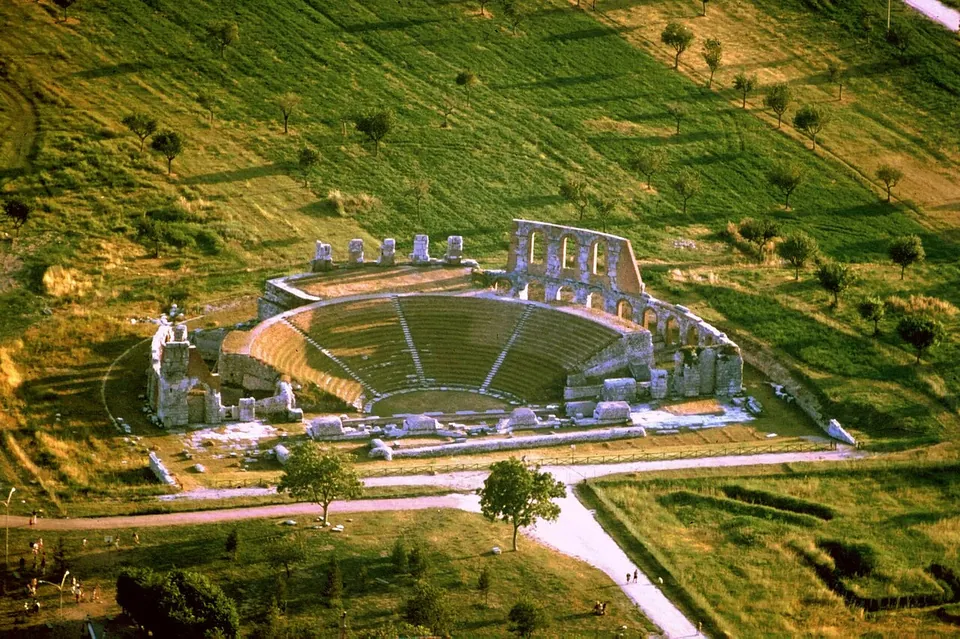
Photo: Celsius1 at Italian Wikipedia · CC BY-SA 3.0 · Commons
24 km · theatre · Umbria
Roman Theatre of Gubbio
The theatre is built of squared limestone blocks with a rusticated face.
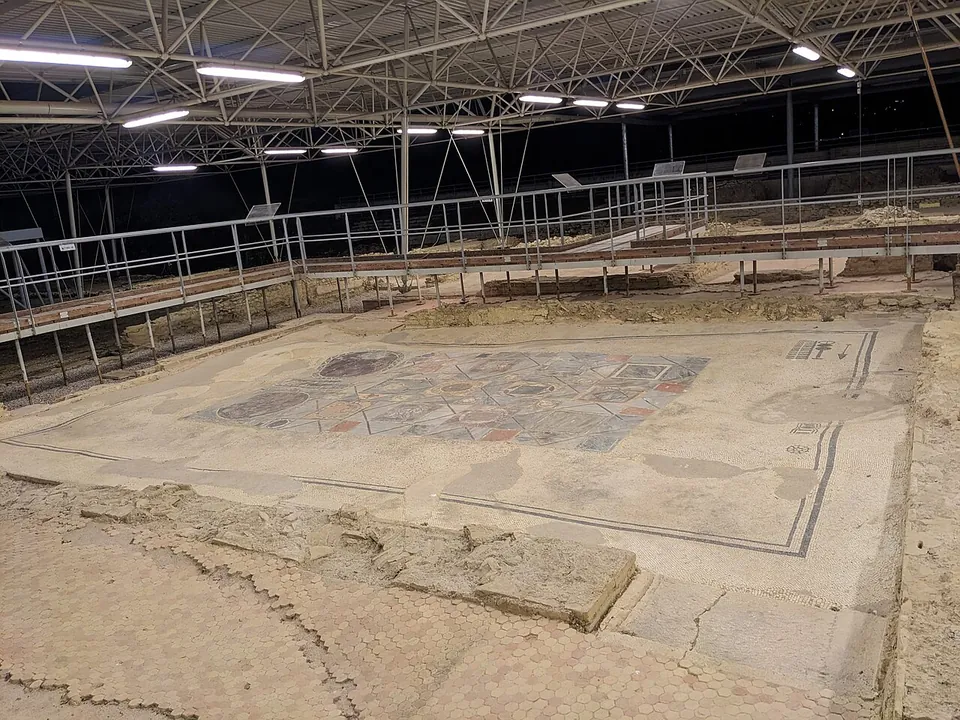
Photo: Accurimbono · CC BY-SA 4.0 · Commons
25 km · town house · Marche
Parco Archeologico di Suasa
The house is big — about 105 by 34 m, some 3,500 m² (the operator; it.wikipedia) — and is presented in the open air, much of it under a modern roof, with raised walkways that let you look down into the rooms (it.wikipedia; en.wikipedia).


Straight-line distances.
Sources
Every fact on this page comes from the records below, each used under the licence noted.
| Source | Licence |
|---|---|
| Pleiades 413312 | CC BY |
| Wikidata Q683244 | CC0 |
| OpenStreetMap relation/11832017 | ODbL |
| Sassoferrato Turismo — Sentinum Archaeological Park (the town's tourism site, linked from the Comune di Sassoferrato homepage) | licence not recorded |
| Sassoferrato Turismo — Tourist Office (opening hours, bookings) | licence not recorded |
| Happennines on Regiondo — Visita guidata al Parco Archeologico Sentinum (the ticket office the tourism site links to) | licence not recorded |
| Ministero della Cultura — Museo civico archeologico di Sassoferrato | licence not recorded |
| Wikipedia (it) — Parco archeologico di Sentinum | CC BY-SA 4.0 |
| Wikipedia (en) — Sentinum | CC BY-SA 4.0 |
| Wikipedia (de) — Sentinum | CC BY-SA 4.0 |