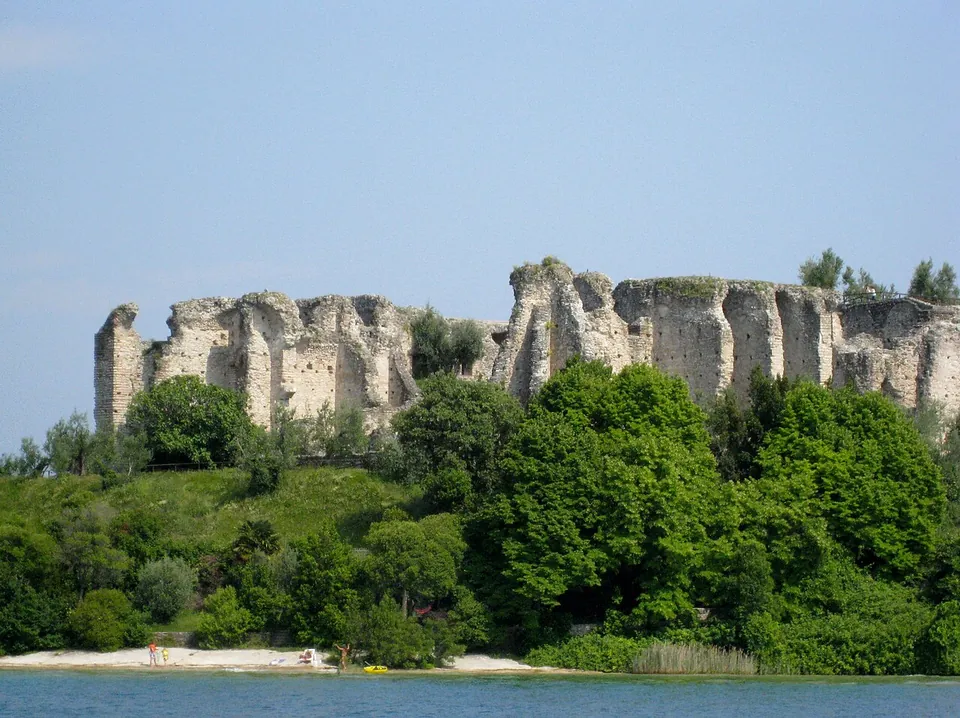
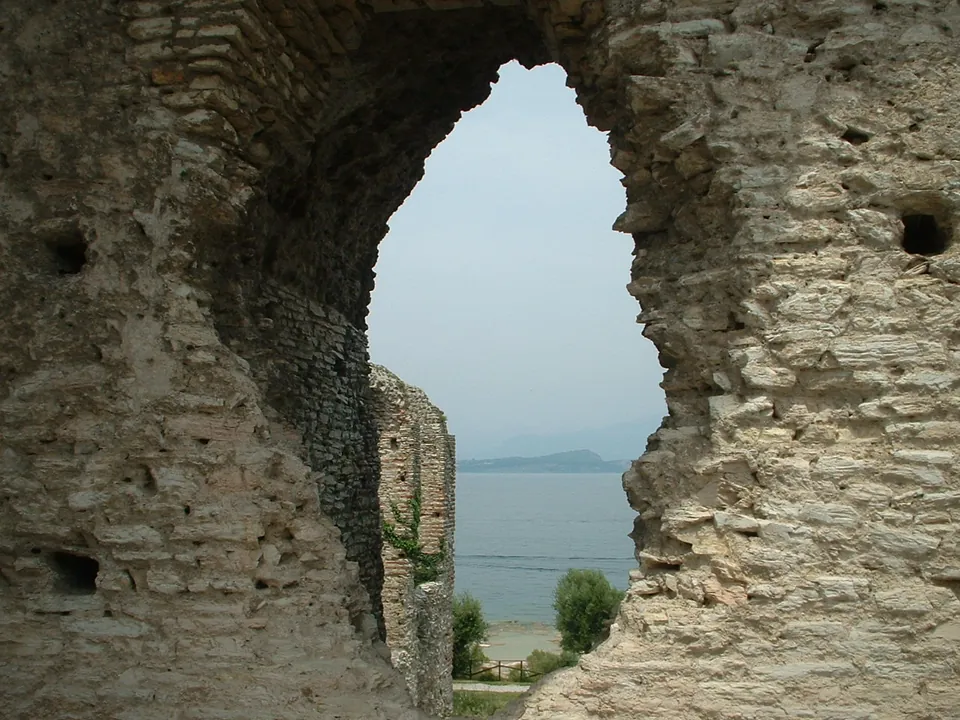
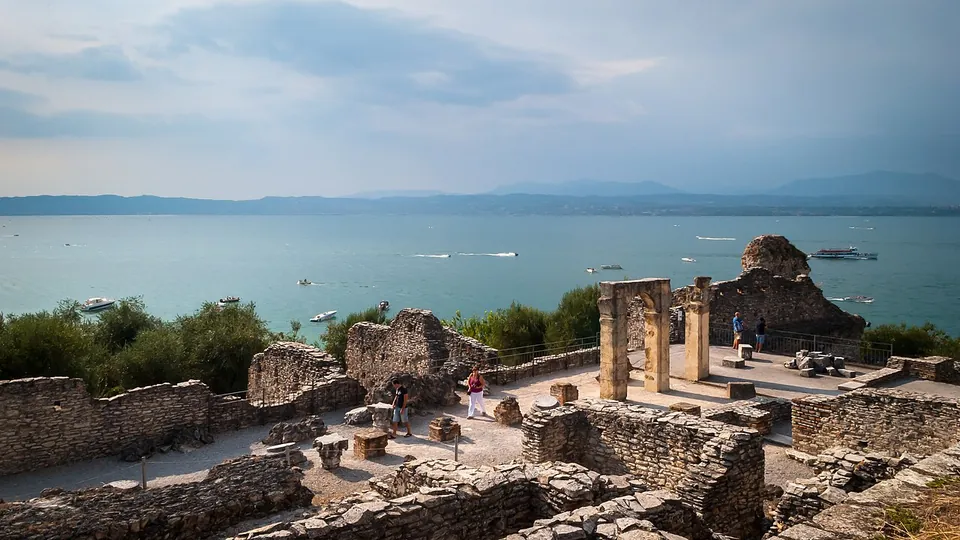


The Grottoes of Catullus are the ruins of a large Roman villa of about the turn of the era on the northern tip of the Sirmione peninsula, on the southern shore of Lake Garda. The name comes from 15th-century travellers, who took the overgrown ruins for natural caves (the operator).
What is there today
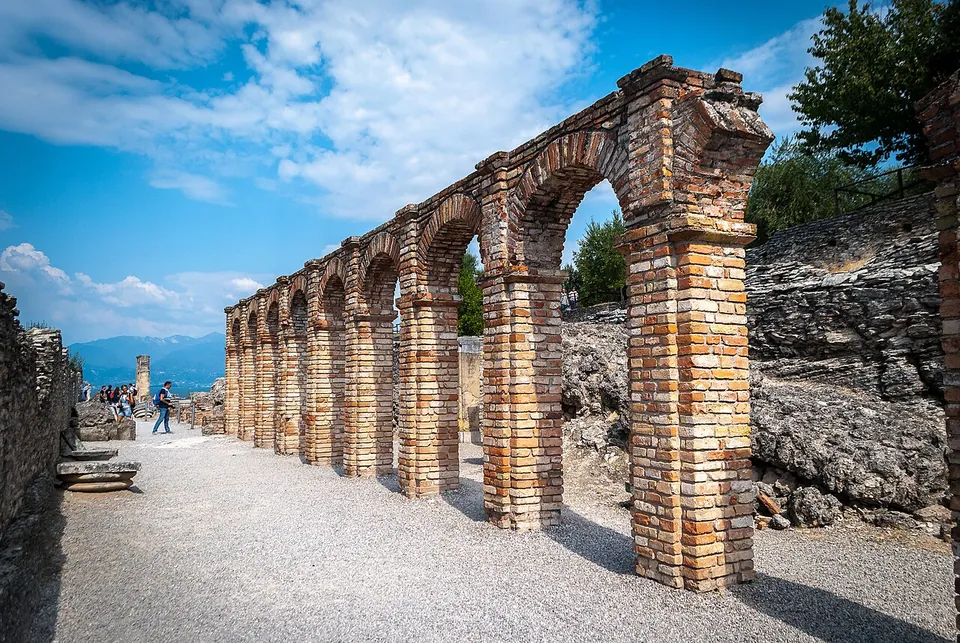
The villa was a rectangle of 167 by 105 m, with a projecting wing at each short end, built on a sloping rock shelf that the builders cut back and propped up with massive substructures on the north side (it.wikipedia). That is most of what survives. The owner’s own floor is the most damaged, because it was the most exposed and because the abandoned villa served for centuries as a quarry; the middle and lower levels are better preserved (it.wikipedia). What you walk among, then, are the huge foundations of the west and north sides, which local tradition and the first excavators gave names such as the “Botteghe” (“shops”), the Grande Criptoportico, a two-aisled underground walk with three large niches, and the Aula dei Giganti, the hall of the giants (the operator).
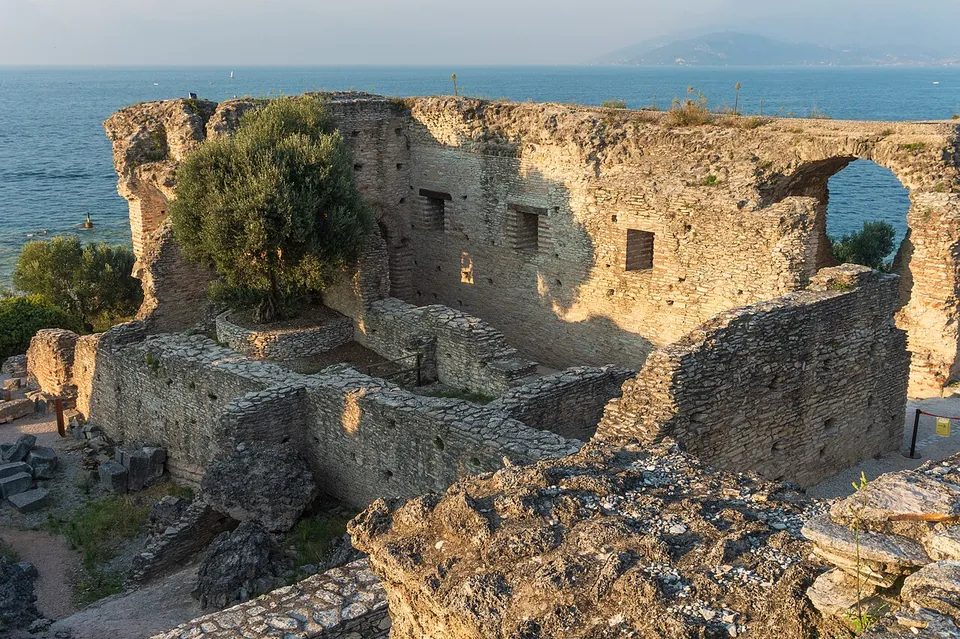
The great belvedere terrace that crowned the northern end has collapsed completely, but on the level below it a long corridor led to a loggia with a three-arched window, the Trifora del Paradiso, named for its view (the operator). In the south, the upper residential level survives better, with mosaic-floored rooms, and on the south side of the old garden court lies an underground cistern almost 43 m long beneath a herringbone brick floor, still visible and, the operator says, perfectly preserved (the operator; it.wikipedia). The bath rooms in the south-west were probably added at the start of the 2nd century (it.wikipedia). The garden in the middle is now an olive grove: about 1,500 trees of local varieties grow across the site, some of them 400 to 500 years old (the operator).
The archaeological museum inside the grounds, opened in 1999, holds architectural pieces, mosaics and fragments of the fresco and stucco decoration from the villa’s rooms, with further sections on the older history of the peninsula and other settlements on the lake (the operator).
Is it worth the trip?
Yes, if you are on Lake Garda. This is described as the most imposing Roman villa in northern Italy (it.wikipedia), and the setting does a lot of the work: tall Roman walls at the very tip of a peninsula, with the lake beyond. Go knowing what it is. You see the foundations of a vast house rather than its rooms, and the surviving fresco and stucco decoration is in the museum, not on the walls. The operator puts the shortest route round at about 40 minutes; with the museum and the views you will want longer. In 2013 it was the 27th most visited state site in Italy, with 215,961 visitors (it.wikipedia), so expect company.
Getting there
The site is at Piazzale Orti Manara, at the northern tip of the peninsula about 1 km beyond Sirmione’s town centre (the operator; OpenStreetMap). No public car park or bus stop is mapped close to the entrance. In summer a paid electric road train, run privately, goes from Piazza Piatti by the Terme di Catullo to the gate (the operator).
It opens Tuesday to Saturday 8.30 to 19.30, Sunday 10.00 to 19.30 and on Mondays only from 9.00 to 13.00, with last entry 40 minutes before closing; it is closed on 1 January and 25 December. A ticket is €10, or €2 for EU citizens aged 18 to 25, and under-18s go free; a €20 combined ticket, valid for seven days, adds the Scaliger Castle in Sirmione and the Roman villa at Desenzano. Bring a card: the operator says the single ticket cannot be paid in cash (Direzione regionale Musei Lombardia and the Ministry of Culture, read 19 October 2026 - check before travelling, since hours and prices change). The paths are gravel with steep stretches, and on very hot summer days the operator says to bring plenty of water.
Visiting details
- Opening hours
- Monday 9.00–13.00; Tuesday to Saturday 8.30–19.30; Sunday 10.00–19.30. Last entry 40 minutes before closing. Closed 1 January and 25 December.
- Tickets
- €10; €2 for EU citizens aged 18 to 25; free for under-18s. A €20 combined ticket, valid 7 days, adds the Scaliger Castle in Sirmione and the Roman villa and Antiquarium at Desenzano. The operator says the single ticket can be paid only by debit or credit card.
- Parking
- No public car park is mapped near the entrance (only a private one, about 290 m away, and a bicycle rack). In summer a paid private electric road train runs from Piazza Piatti, by the Terme di Catullo, to the entrance at Piazzale Orti Manara.
Before you go
- The paths are gravel with steep stretches; the operator advises visitors with reduced mobility to come with a companion and to telephone ahead. The shortest route, about 40 minutes, is the one suited to them.
- On very hot summer days the operator says to bring plenty of water.
- On Mondays the site closes at 13.00.
Hours and prices checked 19 October 2026 on the operator's own site. Confirm before travelling.
History
Structures of the 1st century BC lie beneath the villa, which was built as a single planned project, laid out on a strict axis and symmetry, at the end of the 1st century BC or the start of the 1st century AD (it.wikipedia; the operator). Who owned it is not known. It has been suggested that it belonged to the Valerii, an aristocratic family of Verona (the operator; de.wikipedia), but not to the poet Catullus himself: Catullus (84-54 BC) had a house at Sirmione and wrote verses about returning to it, yet the villa visible today was built after his death, and nothing securely locates his house (the operator; it.wikipedia). A fresco fragment showing a man in a toga holding a scroll, kept in the museum, may be a portrait of him (the operator; de.wikipedia).
The villa was probably already abandoned in the 3rd century, when some of its architectural decoration was reused in Sirmione’s other Roman villa, on today’s Via Antiche Mura (it.wikipedia). In the 4th and 5th centuries parts of it were patched up and lived in again, a large cemetery grew up around it, and in the 5th century it became part of the defences built in the north of the peninsula (the operator). Lombard burials with grave goods have been found at the villa too, and the museum keeps stonework from Sirmione’s Lombard monastery of San Salvatore, including part of a carved screen dedicated to King Desiderius and his son Adelchis (the operator).
The name goes back to the 15th century, when Catullus’s poems were rediscovered; Marin Sanudo the Younger first attached the ruins to the poet in 1483, and Isabella d’Este (in 1514 and 1535) and Andrea Palladio, who came to study its building techniques, were among its 16th-century visitors (it.wikipedia). The first real study was made in 1801 by General Lacombe-Saint-Michel, an artillery commander in Napoleon’s army, and Count Giovanni Girolamo Orti Manara published his excavations and surveys in 1856 (it.wikipedia). The state archaeological service began a large programme of excavation and restoration in 1939 and bought the whole site in 1948 (it.wikipedia). More recently the ruins were one of the settings of the 2017 film Call Me by Your Name (en.wikipedia).
More photographs


Nearby
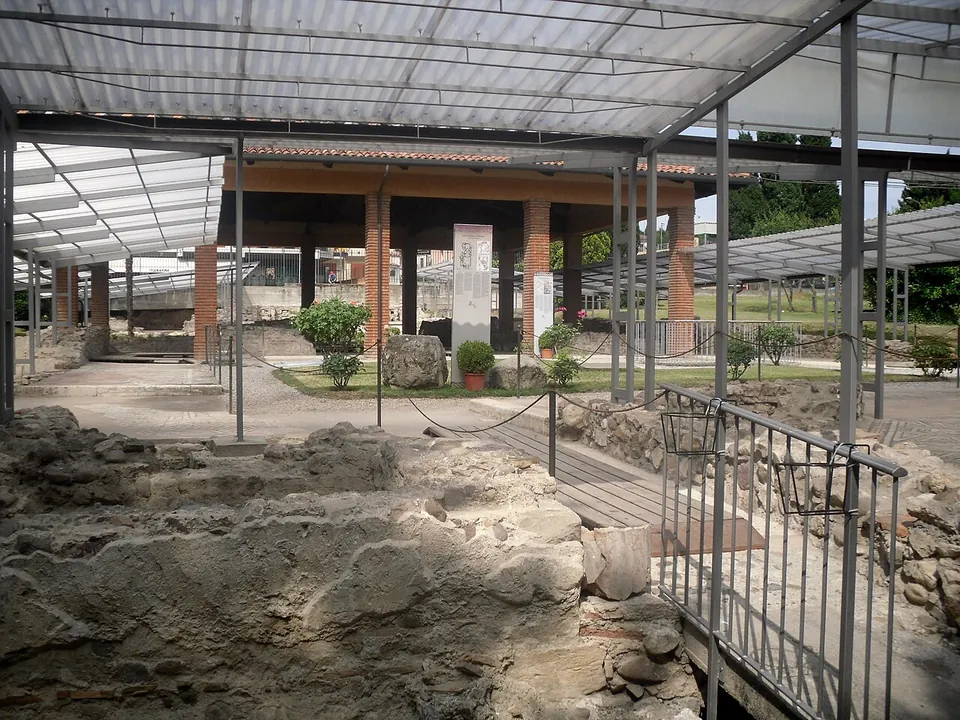
Photo: Imiimane · CC BY-SA 3.0 · Commons
6 km · villa · Lombardy
Roman villa of Desenzano del Garda
The excavated villa covers about one hectare, with residential wings and working quarters side by side (the operator).
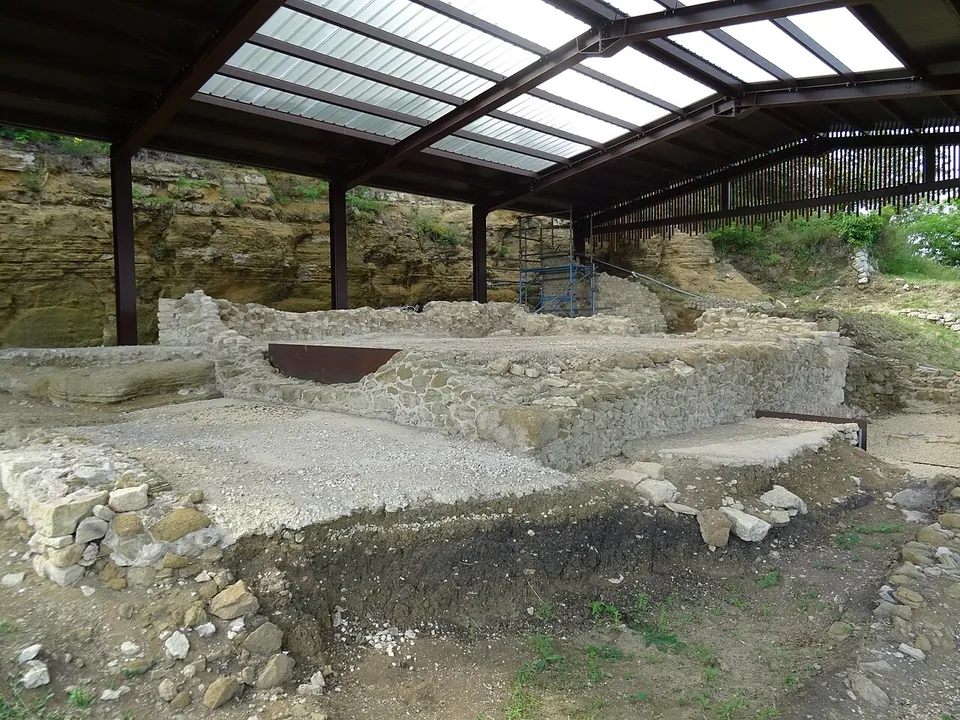
Photo: Syrio · CC BY-SA 4.0 · Commons
25 km · temple · Veneto
Temple of Minerva (Marano di Valpolicella)
What you see are the remains of the temple rebuilt in the Augustan age: the walls of its four-sided central chamber (the cella) and of the galleries that ran round it, under a modern shelter roof set against the rock face of the hill (the operator).
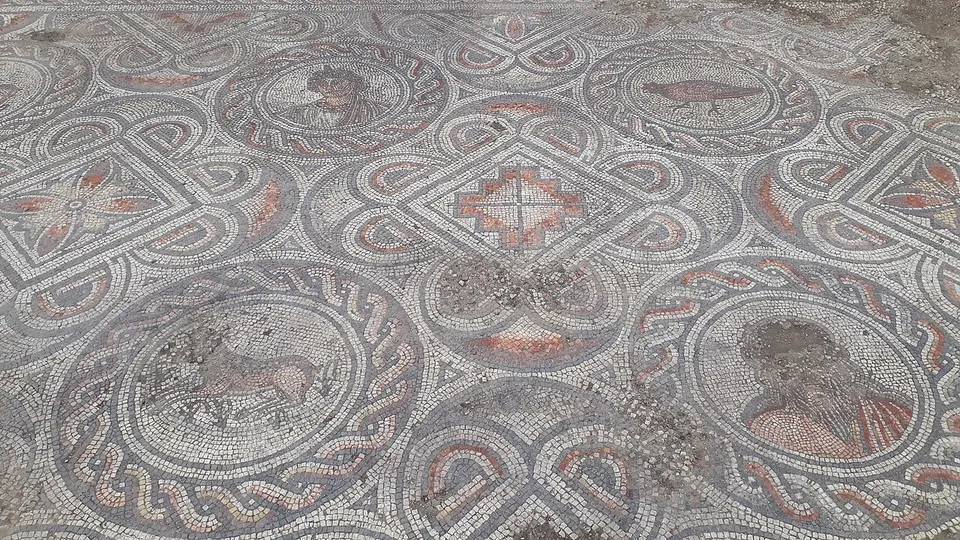
Photo: Piergiovanna Grossi · CC BY-SA 4.0 · Commons
27 km · villa · Veneto
Villa dei Mosaici
The villa has been brought to light almost entirely (it.wikipedia).


Straight-line distances.
Sources
Every fact on this page comes from the records below, each used under the licence noted.
| Source | Licence |
|---|---|
| Pleiades 870993210 | CC BY |
| Wikidata Q3777121 | CC0 |
| OpenStreetMap way/32151932 | ODbL |
| Pleiades — Sirmio | licence not recorded |
| Wikipedia (it) — Grotte di Catullo | CC BY-SA 4.0 |
| Wikipedia (en) — Grottoes of Catullus | CC BY-SA 4.0 |
| Wikipedia (de) — Grotten des Catull | CC BY-SA 4.0 |
| Wikipedia (fr) — Grottes de Catulle | CC BY-SA 4.0 |
| Direzione regionale Musei Lombardia — Grotte di Catullo e Museo Archeologico di Sirmione (the operator) | licence not recorded |
| Ministero della Cultura — Agevolazioni per l'ingresso (free and reduced entry at state sites) | licence not recorded |