What is there today
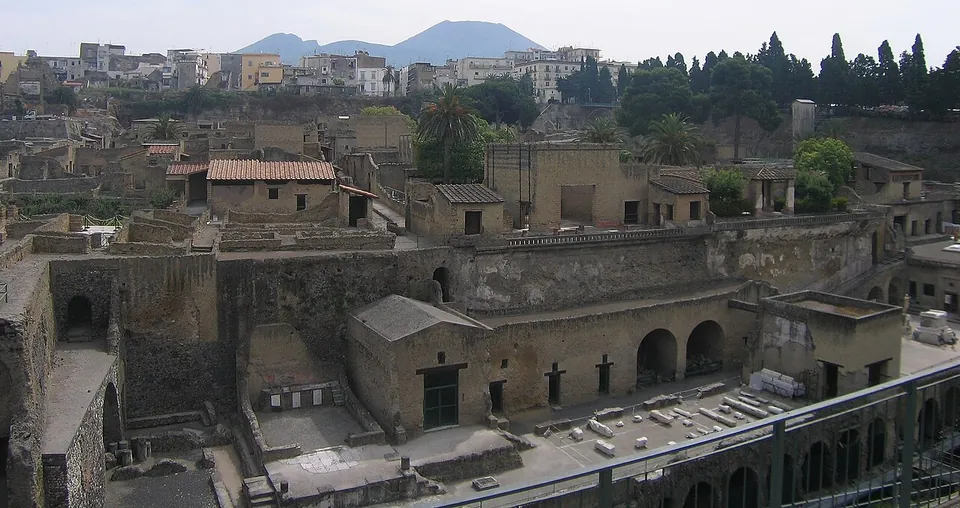
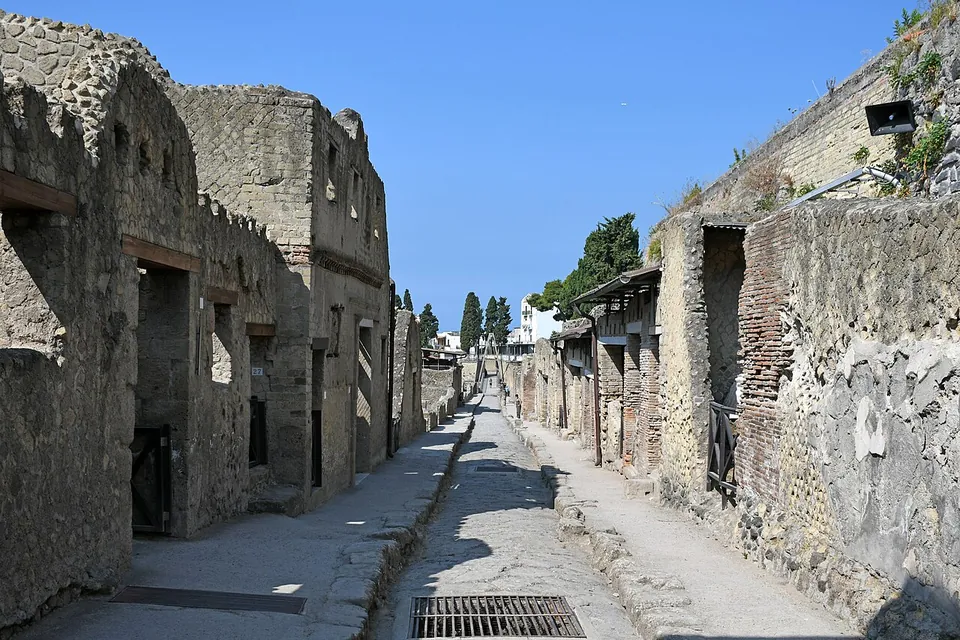
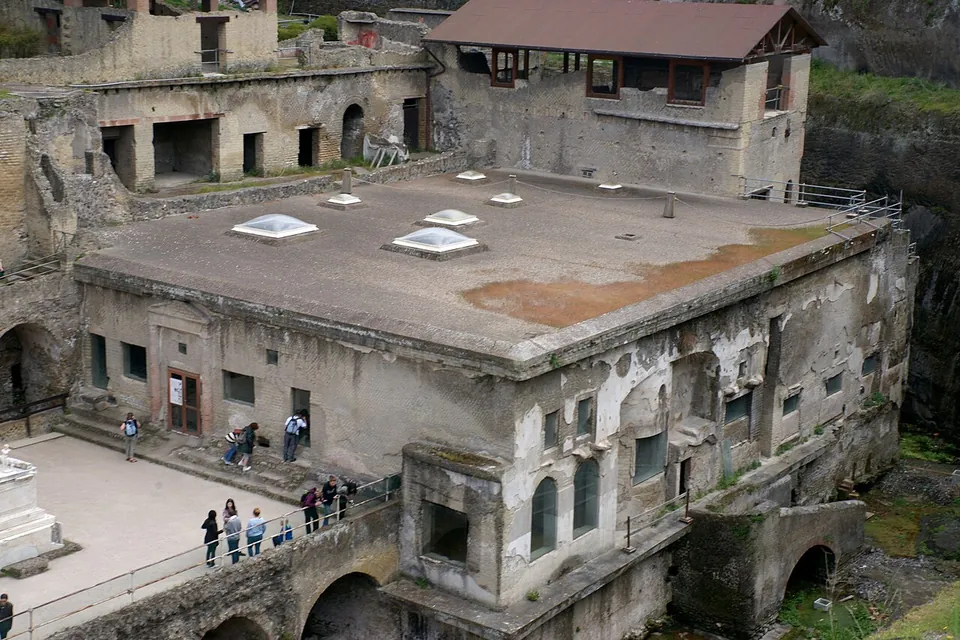
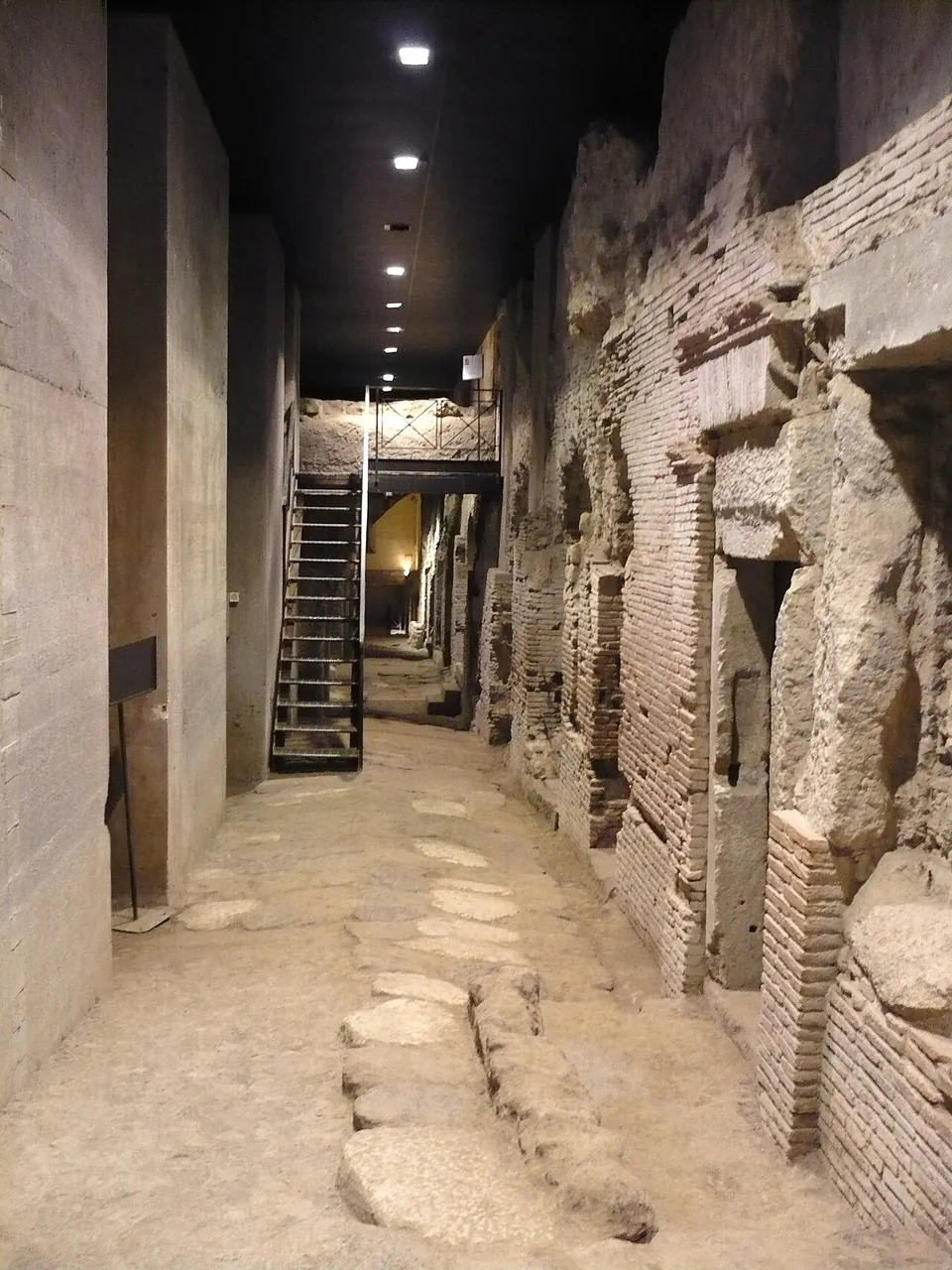
Excavation has uncovered about 4 to 4.5 hectares of a town of roughly 20, so this is a compact site: four fully excavated blocks of houses and shops (insulae III to VI) and parts of others, between excavated streets, with the rest of ancient Herculaneum, including most of its forum and its temples, still under modern Ercolano (it.wikipedia, fr.wikipedia). The visitor path enters along the edge at today’s street level and looks down into the ancient town, then descends into it (fr.wikipedia; the operator).
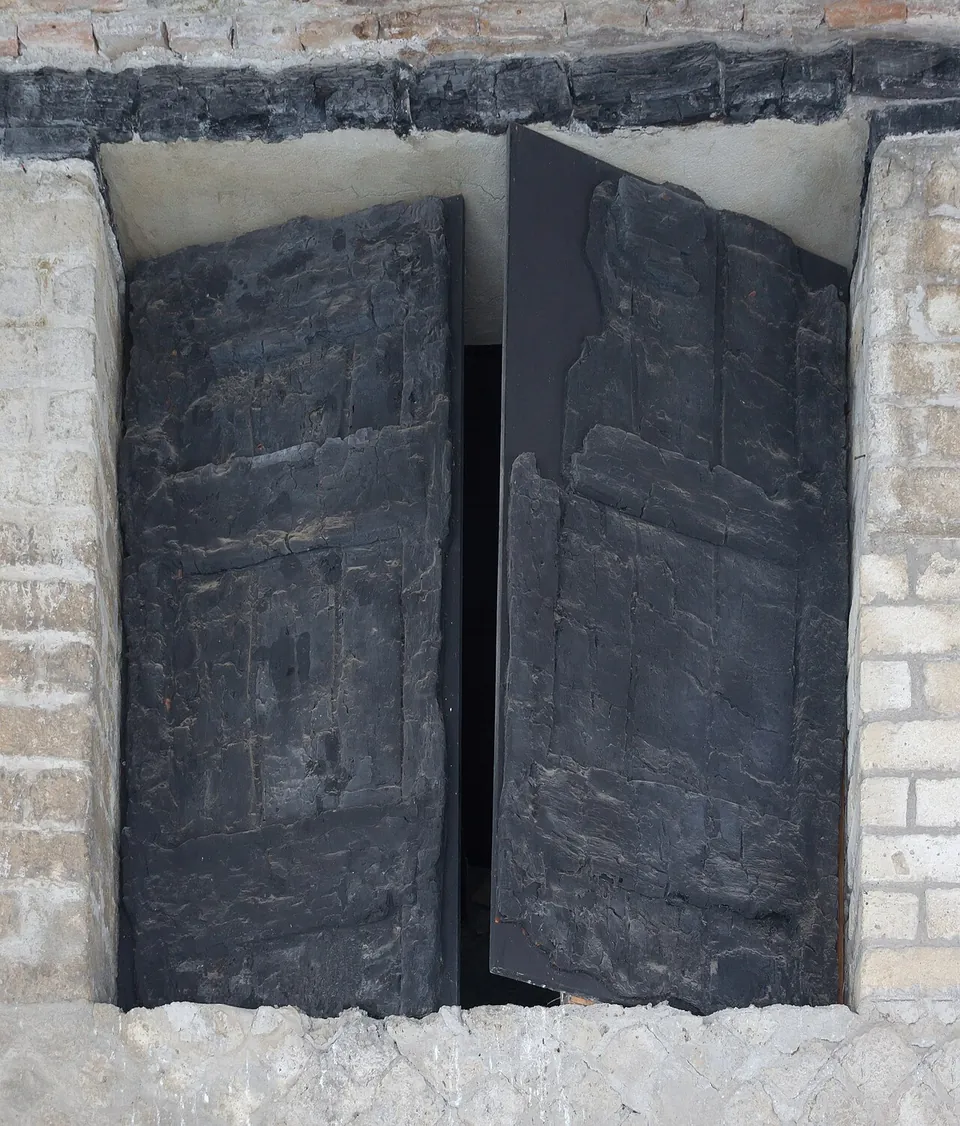
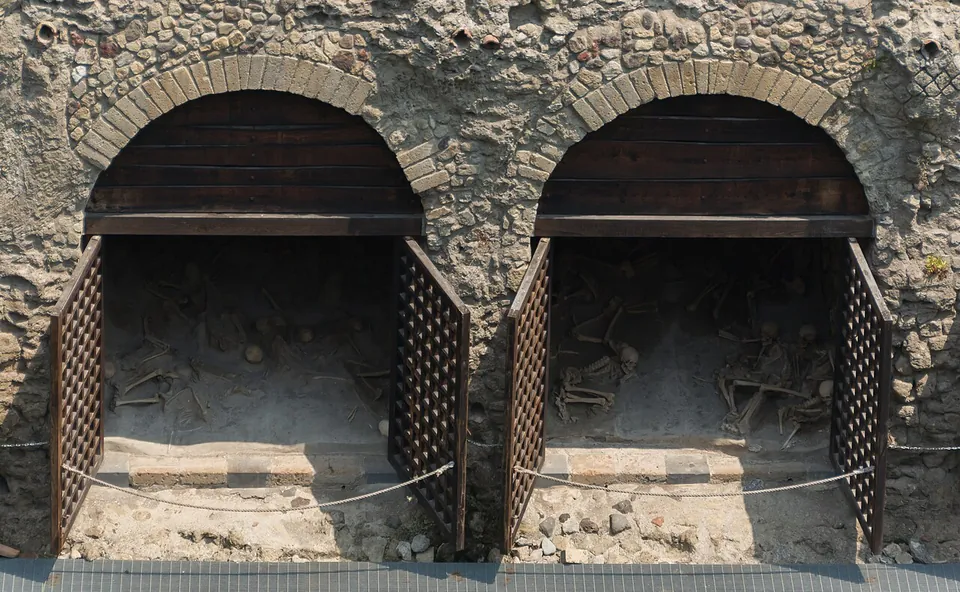
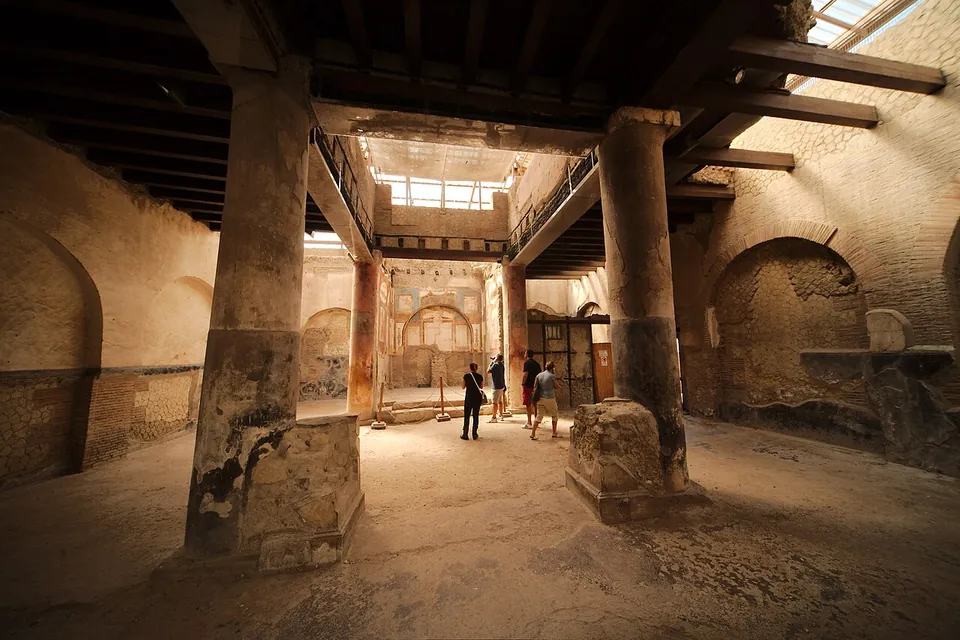
The houses are the core of the visit. Between them they keep upper storeys, balconies, mosaic floors and wall paintings (it.wikipedia, en.wikipedia), and in places the carbonised wood is still where it was: in the House of the Wooden Partition a charred wooden screen with bronze studs still divides the atrium from the room behind it (fr.wikipedia). Around them you walk along the shops, among them counters with storage jars set into them, as in the Great Taberna near the palaestra, and a bakery with its millstones and oven (it.wikipedia); the Forum Baths, with separate men’s and women’s sections and their mosaics (it.wikipedia); the palaestra, two-thirds excavated (it.wikipedia); and the hall of the Augustales, the priests of the emperor’s cult (en.wikipedia). Down at the old shoreline, which reopened to visitors in 2024, are the vaulted boat sheds where the remains of more than 300 people were found, together with the Suburban Baths, one of the best-preserved bath buildings of antiquity (it.wikipedia). The Suburban Baths are being restored for a permanent reopening; in autumn 2025 the operator opened their first restored rooms for special guided visits (the operator). A boat found on the beach is kept and shown (it.wikipedia), and OpenStreetMap maps a Padiglione della barca (boat pavilion) and the Antiquarium beside the excavations.
Not everything is open. Many house interiors are closed to visitors (fr.wikipedia). The Villa of the Papyri, the great villa outside the walls where the carbonised library was found, is closed for works, and so is the theatre, which lies underground away from the main site and was reached only on guided tours through 18th-century tunnels (the operator; it.wikipedia). Two of the most important houses, closed for decades, reopen on 21 October 2026: the House of the Mosaic Atrium and the Casa a Graticcio, which the operator calls the Wattle-and-Daub House in English.
Is it worth the trip?
Yes. It is much smaller than Pompeii and draws far fewer people (about 563,000 visitors in 2023, it.wikipedia; in 1997 a tenth of Pompeii’s numbers, fr.wikipedia), yet its buildings stand to a good height, many under restored roofs (fr.wikipedia), and the eruption preserved more of their wood and other organic material than at Pompeii (en.wikipedia). fr.wikipedia calls it the best-preserved of all the cities the eruption buried. Your ticket gets you into the town and the old shore; it does not get you into the Villa of the Papyri or the theatre, both closed at present.
Getting there
The entrance is at Corso Resina 187 in Ercolano. From Napoli Centrale take the Circumvesuviana train on the Naples–Sorrento line to Ercolano Scavi, a six-minute walk from the gate; by car, leave the A3 Naples–Salerno motorway at the Ercolano Scavi exit and follow the signs. There is a municipal car park at Via dei Papiri Ercolanesi 19, where the park has a second gate, and there are private car parks in the area (the operator).
It is open every day except 1 January and 25 December. From 16 March to 14 October the gates are open 08.30–19.30, last entry 18.00, and visitors must leave the excavations by 19.00; from 15 October to 15 March it is 08.30–17.00, last entry 15.30, and out of the excavations by 16.40. A ticket is €16, and €2 for 18–25-year-olds; it is valid for one entry on the day you buy it. Advance sales add a €1.50 charge, and reduced and free tickets must always be booked. Entry is free for everyone on the first Sunday of each month and on 25 April, 2 June and 4 November, when the ticket is collected at the ticket office on the day. Backpacks, umbrellas and bags larger than 30 × 30 × 15 cm go into the free luggage room (ercolano.cultura.gov.it, read 21 October 2026; check before travelling, since prices and closures change).
Visiting details
- Opening hours
- Daily. 16 March to 14 October 08.30–19.30 (last entry 18.00; leave the excavations by 19.00); 15 October to 15 March 08.30–17.00 (last entry 15.30; leave the excavations by 16.40). The closing times are those of the gates on Corso Resina and Via dei Papiri Ercolanesi. Closed 1 January and 25 December.
- Tickets
- €16; €2 for 18–25-year-olds; free entry as Italian law provides. Free for everyone on the first Sunday of each month and on 25 April, 2 June and 4 November (ticket collected at the ticket office on the day, no booking). Reduced and free-by-law tickets must otherwise always be booked; advance sales add a €1.50 pre-sale charge. The ticket is valid for one entry on the day of purchase.
- Parking
- Municipal car park in Via dei Papiri Ercolanesi, next to the park's second entrance, as well as private car parks in the area (the operator). The nearest mapped car park is about 180 m from the point (OSM way/349873598).
Before you go
- The Villa of the Papyri is closed for excavation, maintenance and accessibility works, and the ancient theatre is closed until further notice for maintenance (the operator, read 21 October 2026).
- Backpacks, umbrellas and bags larger than 30 × 30 × 15 cm must be left in the free luggage room.
- The paths through the ancient city have slopes and uneven surfaces; closed, flat shoes are recommended. Visitors who cannot manage the entrance ramp can use the bridge from Cardo III both ways.
Hours and prices checked 21 October 2026 on the operator's own site. Confirm before travelling.
History
Ancient writers disagreed about who founded the town: Dionysius of Halicarnassus credited Hercules, Strabo the Oscans. It came under the Samnites in the 4th century BC, fought against Rome in the Social War, and became a Roman municipium in 89 BC (en.wikipedia). Its walls lost their purpose after that war and were built into houses (en.wikipedia). Smaller and wealthier than Pompeii, with an estimated population of 4,000 to 5,000, it became a seaside resort for the Roman elite, which explains the density of rich houses (en.wikipedia, fr.wikipedia). The benefactor Marcus Nonius Balbus paid for new buildings; his funerary altar and statue stand on a terrace by the Suburban Baths (it.wikipedia).
The first phase of the eruption in AD 79 dropped only a few centimetres of ash on Herculaneum, which lay west of Vesuvius, but it was enough to make most of the inhabitants leave. In the night, pyroclastic surges of ash and hot gas swept through the town, and a succession of flows buried it under 10 to 25 m of material (it.wikipedia; en.wikipedia gives about 20 m). Those who had gone down to the beach and the boat sheds to escape by sea were overtaken there by the pyroclastic flows (it.wikipedia, en.wikipedia).
Herculaneum was the first of the Vesuvian cities to be found. In 1709 the Prince d’Elbeuf bought a newly dug well and tunnelled out from its bottom in search of statues, reaching the theatre; from 1738 the Bourbon court of Naples ran tunnel excavations whose publication fed Neoclassical taste across Europe, and between 1752 and 1754 workmen recovered the carbonised papyrus scrolls of the Villa of the Papyri (en.wikipedia, fr.wikipedia). Open-air digging began in 1828, and Amedeo Maiuri’s campaign of 1927–1942 uncovered about four hectares of what is seen today (it.wikipedia, en.wikipedia). The skeletons on the old shore were found from 1980 onwards and changed the long-held view that most of the inhabitants had got away (en.wikipedia, it.wikipedia). Herculaneum became part of a UNESCO World Heritage Site with Pompeii and Oplontis in 1997. Since 2001 the Herculaneum Conservation Project, a partnership with the Packard Humanities Institute, has supported the site’s conservation, and the emphasis is now on preserving what has been dug rather than exposing more (en.wikipedia, it.wikipedia). The site has had its own management body, the Parco Archeologico di Ercolano, since 2016 (it.wikipedia, fr.wikipedia).
More photographs
Nearby
9 km · forum · Campania
Macellum of Naples
The excavation lies under the Gothic church and its cloister, where Neapolis had its forum, the successor of the Greek agora (Scabec; en.wikipedia).
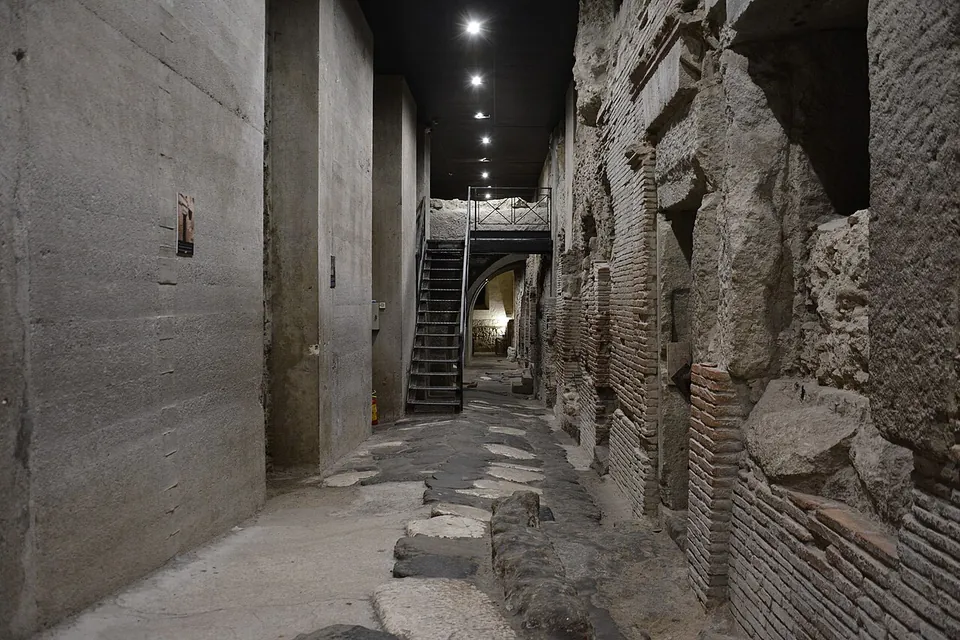
Photo: MentNFG · CC BY-SA 4.0 · Commons
9 km · city · Campania
Neapolis – Naples
The best single visit is the excavation under San Lorenzo Maggiore, about 10 m below the church (Scabec).
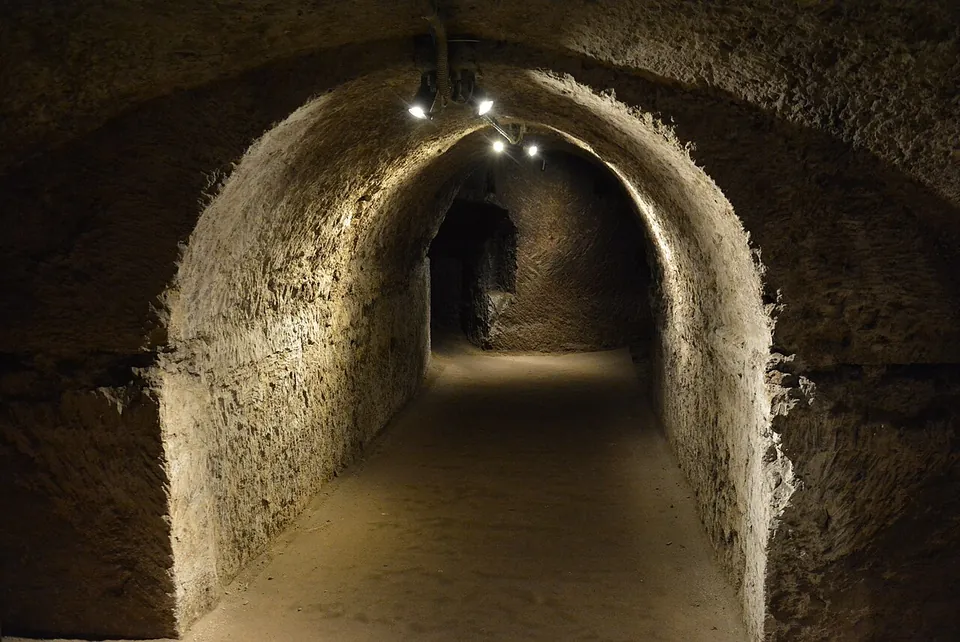
Photo: Mentnafunangann · CC BY-SA 4.0 · Commons
10 km · necropolis · Campania
Catacombs of Saint Gaudiosus
The visit starts in the crypt under the church's raised choir, which was once a corridor of the catacomb and is now a chapel with ten side altars, painted with stories of the martyrs by Bernardino Fera (it.wikipedia; the operator).


Straight-line distances.
Sources
Every fact on this page comes from the records below, each used under the licence noted.
| Source | Licence |
|---|---|
| Pleiades 432873 | CC BY |
| Wikidata Q178813 | CC0 |
| OpenStreetMap way/351900172 | ODbL |
| Wikidata — Herculaneum, the ancient settlement (Q24933000) | licence not recorded |
| Wikipedia (en) — Herculaneum | CC BY-SA 4.0 |
| Wikipedia (it) — Scavi archeologici di Ercolano | CC BY-SA 4.0 |
| Wikipedia (fr) — Herculanum | CC BY-SA 4.0 |
| Wikipedia (de) — Herculaneum | CC BY-SA 4.0 |
| Parco Archeologico di Ercolano — opening hours and tickets (the operator) | licence not recorded |
| Parco Archeologico di Ercolano — how to get there | licence not recorded |
| Parco Archeologico di Ercolano — rules and advice for visitors | licence not recorded |
| Parco Archeologico di Ercolano — winter hours and the reopening of two houses (news, 15 October 2026) | licence not recorded |
| Parco Archeologico di Ercolano — visit to the Suburban Baths (2025 special opening) | licence not recorded |
| Parco Archeologico di Ercolano — the theatre's underground route | licence not recorded |