Hidden gemHub · 3 stops8th c. BC – 7th c. ADTicketed
Neapolis – Naples
Parthenope, Νεάπολις, Napoli
city · Campania, Italy
What it is
Under the old centre of Naples lies Neapolis, a Greek city of around 500 BC that stayed Greek in language and custom long after Rome took it, and most of what survives of it is underground: a Roman market and street beneath a Gothic church, a theatre swallowed by later houses, and early Christian catacombs cut into the hill to the north.
What you’ll see
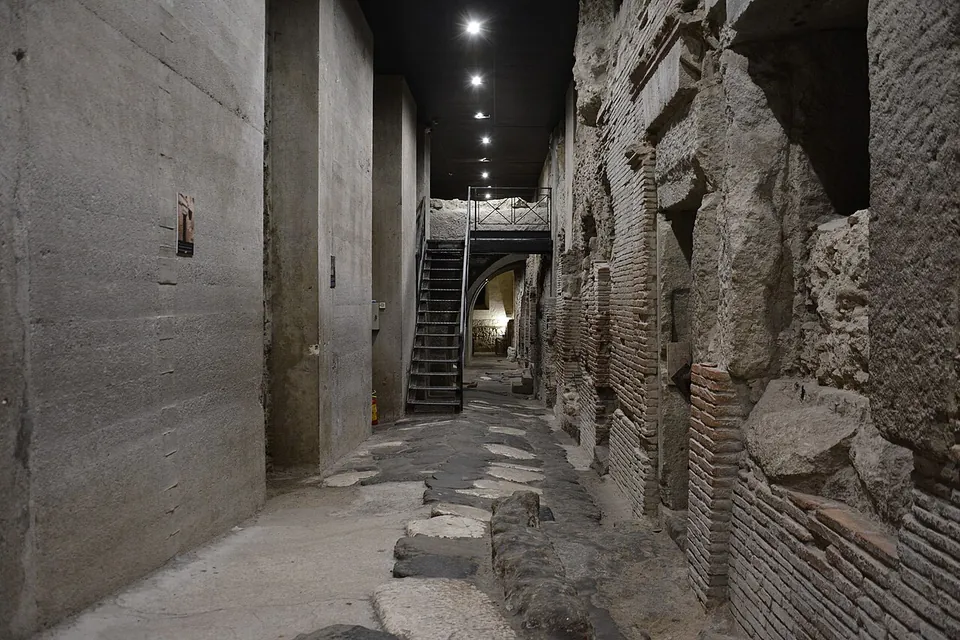
The best single visit is the excavation under San Lorenzo Maggiore, about 10 m below the church (Scabec).
Worth the trip?
If you are in Naples, yes. Give it a day, but do not expect Pompeii: no Roman town survives above ground, and the pleasure lies in finding the ancient city under the modern one.
Getting there & cost
Naples is best explored on foot and by metro. The excavations are entered from the San Lorenzo Maggiore complex at Piazza San Gaetano 316; Napoli Sotterranea starts on the same square, at Piazza San Gaetano 69, next to San Paolo Maggiore.Ticketed · San Lorenzo Maggiore: €9 · checked 18 October 2026Hours, tickets and parking
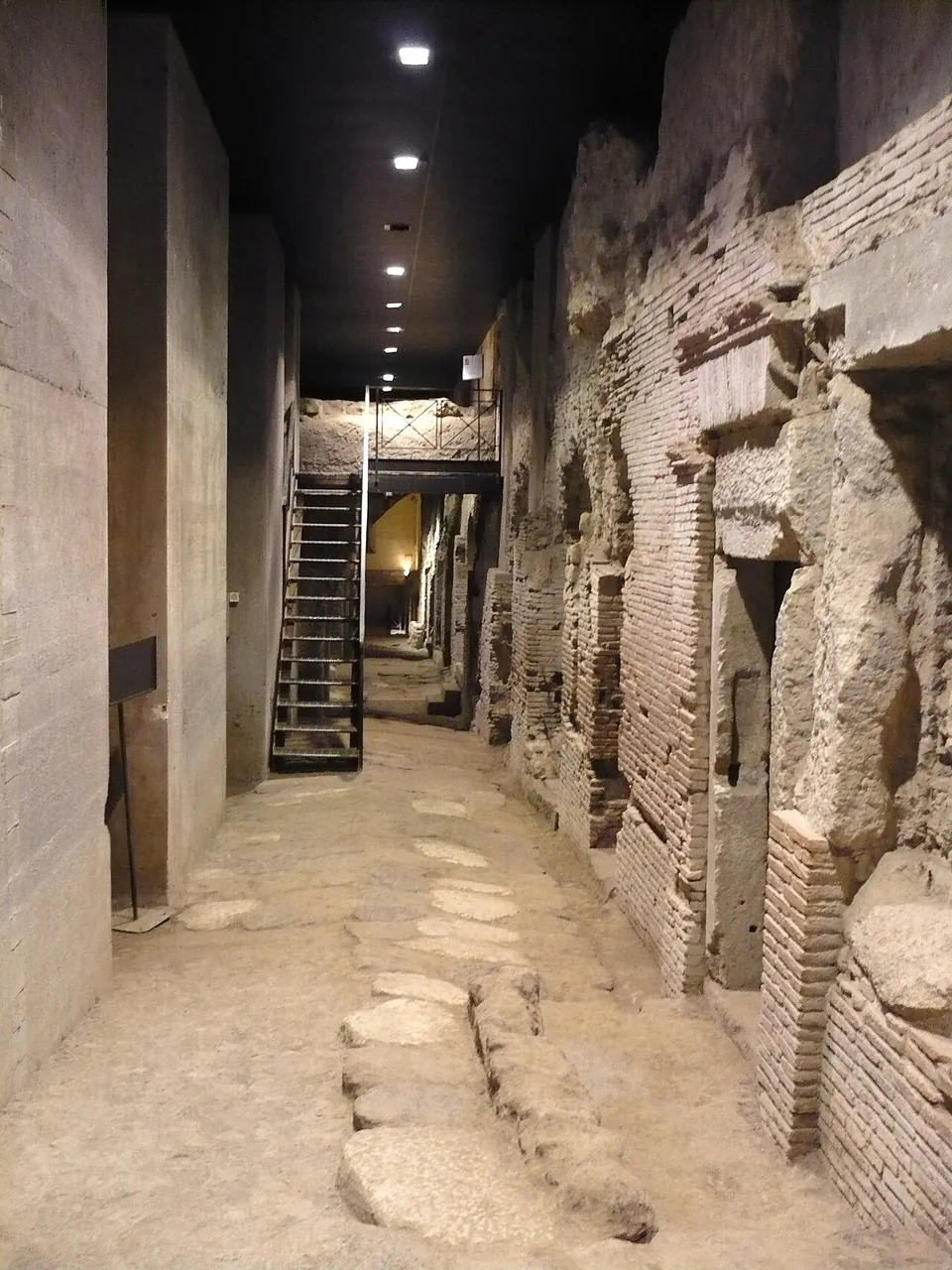
The Roman street under San Lorenzo Maggiore, lined with the openings of its shops. · Photo: MentNFG · CC BY-SA 4.0 · Wikimedia Commons
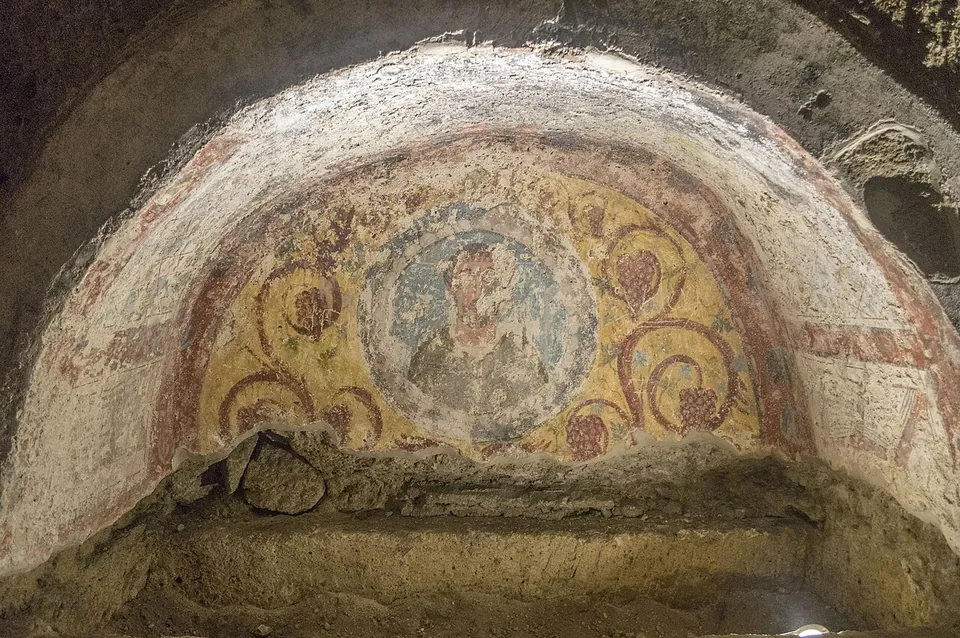
A painted burial niche in the Catacombs of San Gennaro. · Photo: Dominik Matus · CC BY-SA 4.0 · Wikimedia Commons
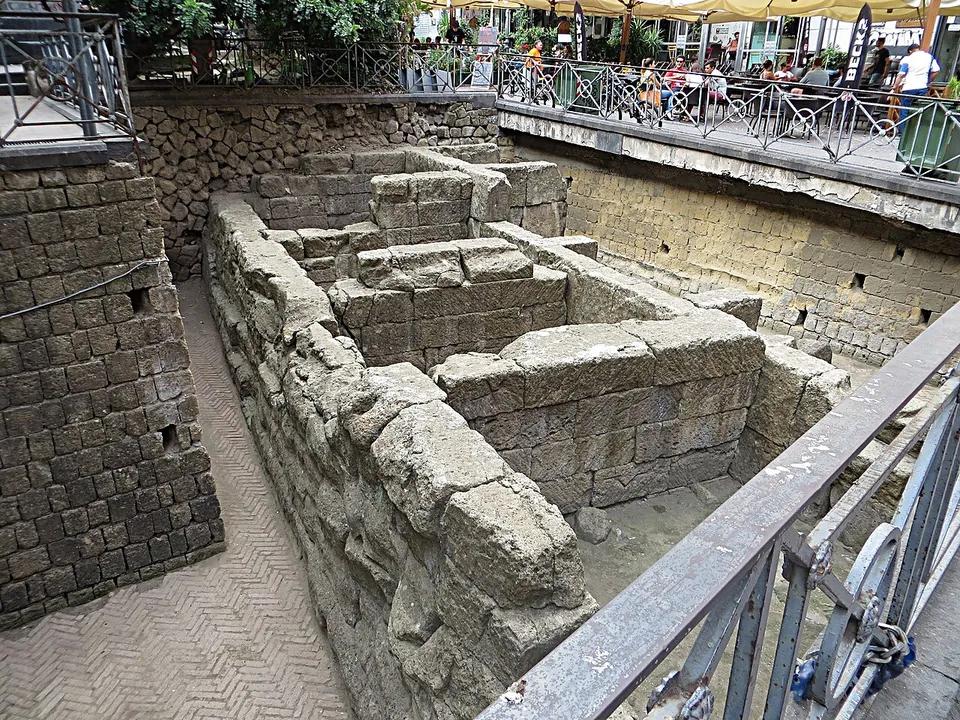
Greek city walls in the open excavation in Piazza Bellini. · Photo: Mister No · CC BY 3.0 · Wikimedia Commons
The stops
3 places to see, the best preserved and best known first.
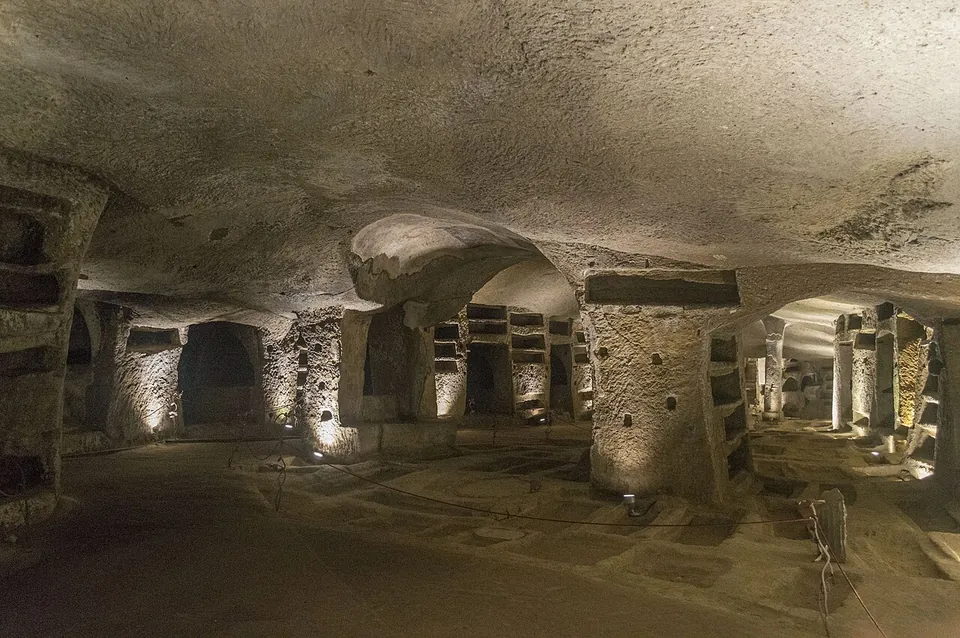
The catacombs lie on two levels, side by side rather than stacked, and both are unusually spacious, unlike the better-known catacombs of Rome, because the tuff was easy to cut and strong enough to stand (the operator).
Ticketed
Photo: http://www.everyfoto.com · CC BY 3.0 · Commons
The visit starts in the crypt under the church's raised choir, which was once a corridor of the catacomb and is now a chapel with ten side altars, painted with stories of the martyrs by Bernardino Fera (it.wikipedia; the operator).
Ticketed
What is there today
The best single visit is the excavation under San Lorenzo Maggiore, about 10 m below the
church (Scabec). Excavation since 1976 has uncovered the macellum, the city’s market, with
porticoes and shops around a courtyard that held a small round tholos, and a
stretch of street about 60 m long onto which shops opened, one of them possibly the city treasury. The Greek foundations go back to
the 4th century BC, with a complex of the 1st century AD built over them (it.wikipedia); part of
the mosaic floor of a 6th-century basilica can still be seen under the church’s transept
(it.wikipedia). A mudslide in the 5th century buried the market, which is why it survived
(en.wikipedia).
A few minutes’ walk away, the Roman theatre lies inside the blocks between Via Anticaglia,
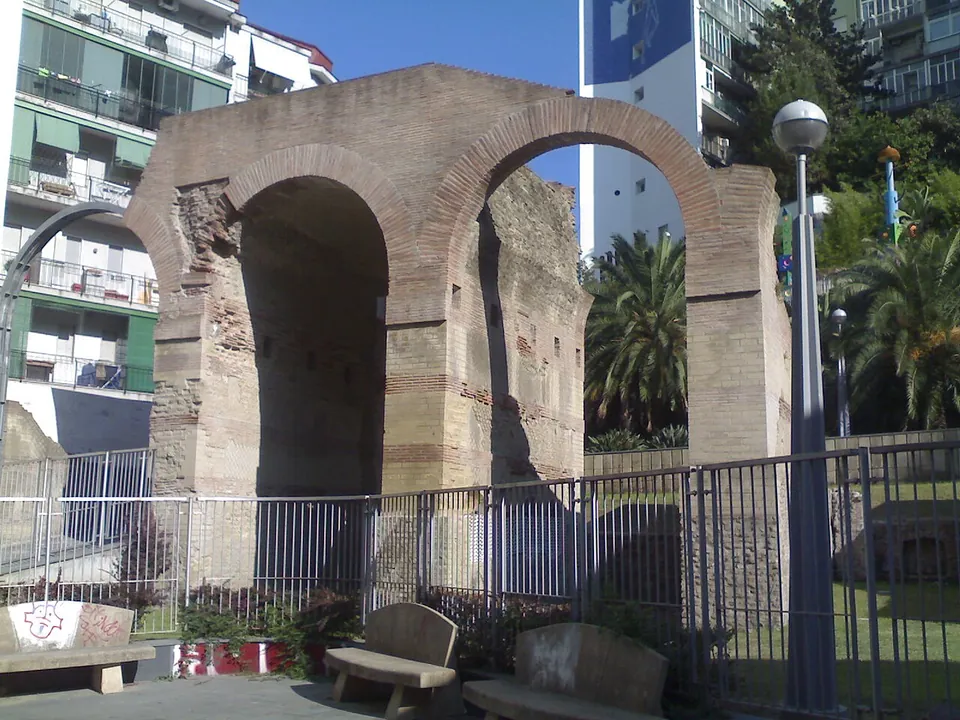
Via San Paolo and Vico Giganti. Two massive arches on Via Anticaglia, now built into later houses,
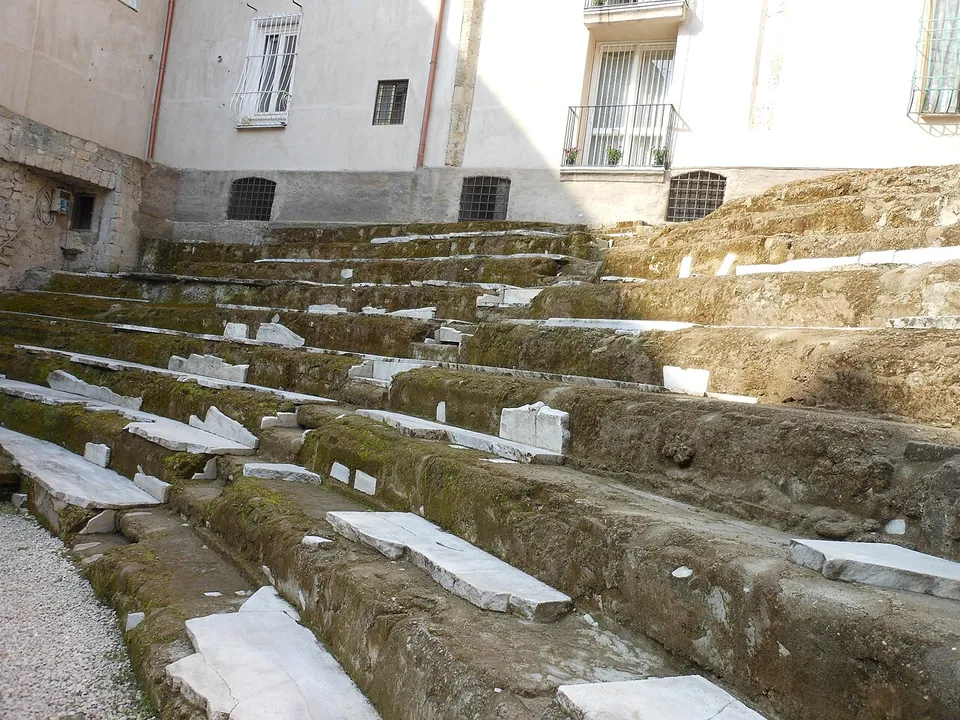
were its outer supports and can be seen from the street; inside, the seats held 5,000 to 6,000 people, and some still
carry their marble facing. Nero made his singing debut in Naples, and his performances filled
the theatre (it.wikipedia). Part of the theatre is the last stop of a tour of underground Naples
(it.wikipedia), and Napoli Sotterranea lists it on its route (the operator), while the seating
uncovered in a courtyard opens only on special occasions (it.wikipedia). On Piazza
San Gaetano, two Corinthian columns of the Temple of the Dioscuri, rebuilt probably under
Tiberius, stand in the façade of the church of San Paolo Maggiore (it.wikipedia).
Stretches of the city walls survive along their circuit. In Piazza Bellini they lie in an
open excavation below the café tables: the ancient ground level was about 10 m lower, and the
date of this stretch, 5th or 4th century BC, is disputed (it.wikipedia). These walls are Greek;
the Romans refaced them in tougher stone, and Valentinian III is said to have extended them
towards the port around AD 440, as an inscription found in 1747 records (it.wikipedia).
North of the centre, in the Sanità district, the Catacombs of San Gennaro are the largest
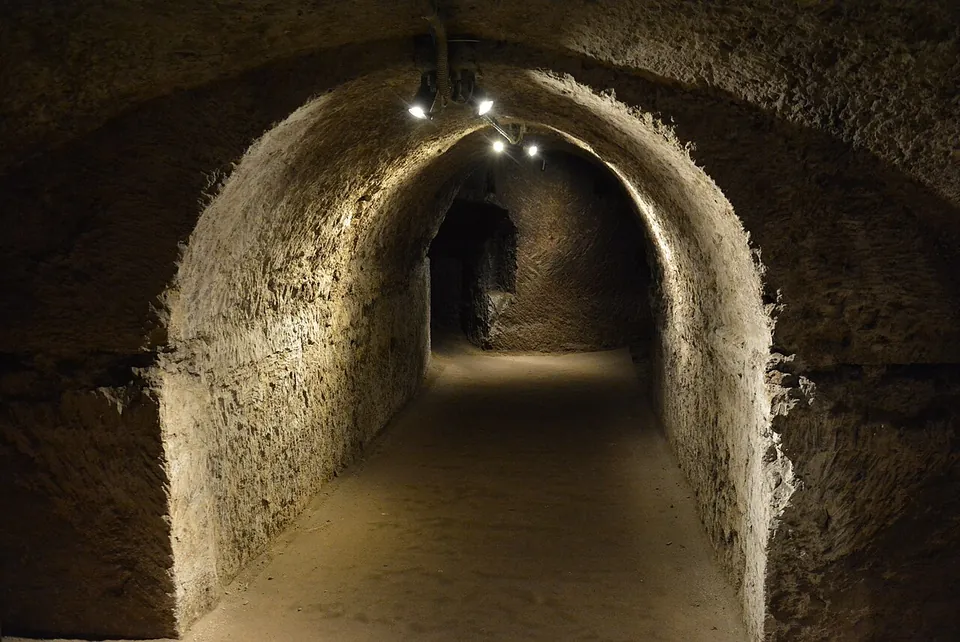
Christian catacomb complex in southern Italy, on two levels with much roomier passages than
the catacombs of Rome (en.wikipedia). They grew from a family tomb of the 2nd–3rd century and
hold the oldest known portrait of San Gennaro, from the 5th century, a basilica carved out of
the tuff, and 5th-century mosaic portraits of bishops in the Crypt of the Bishops (it.wikipedia).
The ticket also covers the Catacombs of San Gaudioso under the church of Santa Maria della
Sanità (the operator), a 4th–5th-century cemetery of which only a small part remains, with 5th–6th
century frescoes and a 6th-century mosaic over the saint’s tomb, overlaid by grim 17th-century
burials (en.wikipedia).
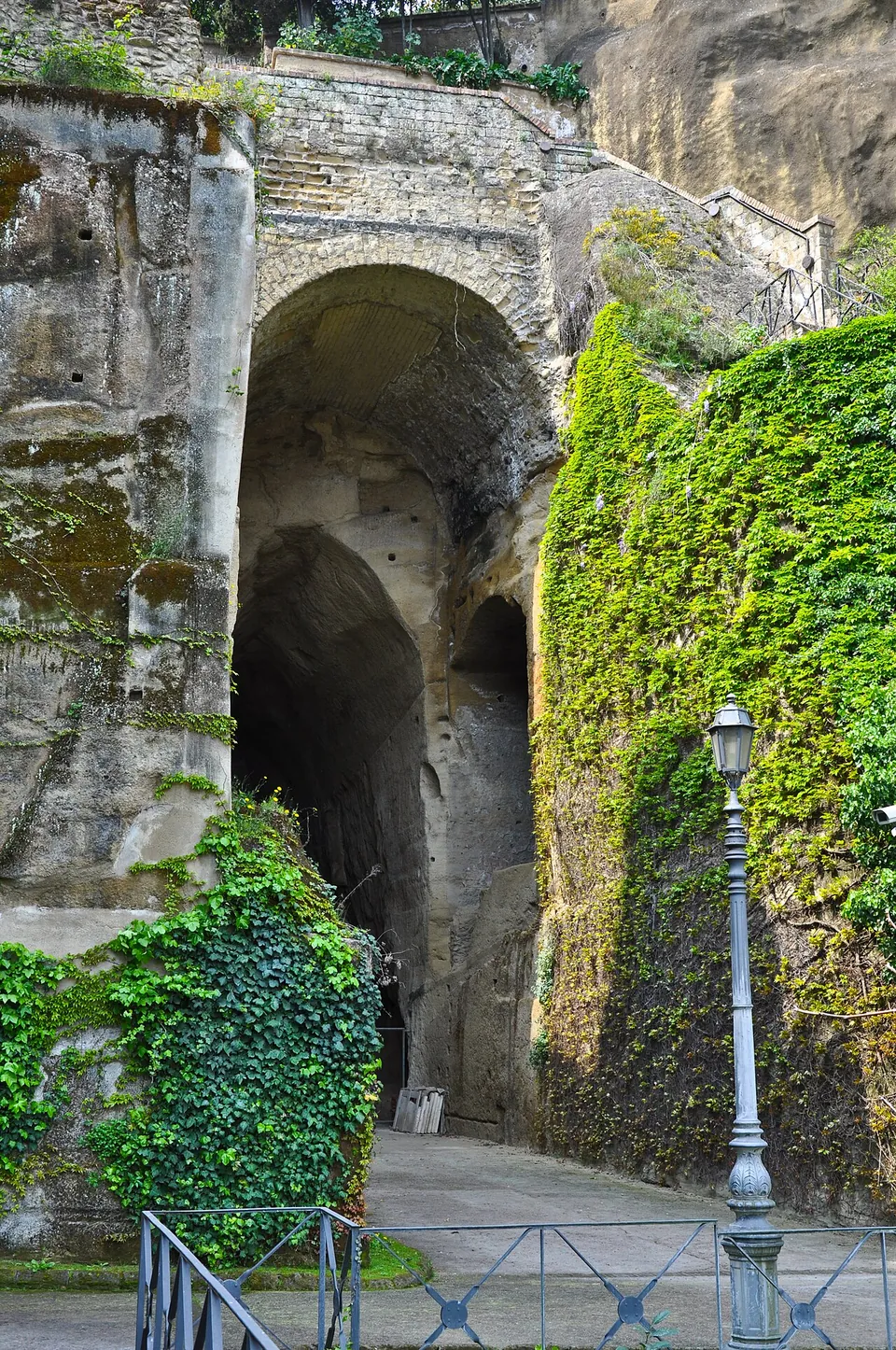
Farther out, at Piedigrotta, the Crypta Neapolitana is a Roman road tunnel more than 700 m long,
built around 37 BC for Agrippa by the architect Lucius Cocceius Auctus to take the road to
Pozzuoli through the hill. Its eastern entrance is in the Parco Vergiliano, next to a Roman burial
vault traditionally called Virgil’s tomb (en.wikipedia). The brick arches of a Roman bridge, found
in 2000 while the Salvator Rosa metro station was being built, stands restored in the park beside
the station (it.wikipedia). Remains of Lucullus’s villa survive in the cellars of Castel
dell’Ovo, where Roman columns still stand in the “hall of columns” (en.wikipedia), and archaeological
finds have been worked into the Municipio station of metro Line 1 (the catacombs’ operator).
Is it worth the trip?
If you are in Naples, yes. Give it a day, but do not expect Pompeii: no Roman town survives above
ground, and the pleasure lies in finding the ancient city under the modern one. The core is
compact. The theatre and the Dioscuri columns are within about 250 m of San Lorenzo, the walls in
Piazza Bellini about half a kilometre away, and the catacombs 1.3 to 1.7 km north. If you only
have a morning, take San Lorenzo, which shows a stretch of Roman street with its shops, and the
San Gennaro catacombs.
Things to know before you go: San Lorenzo, the catacombs and the underground tour each charge
their own ticket, the catacombs can only be seen on a booked guided tour and are shut on
Wednesdays, and the Crypta Neapolitana and Virgil’s tomb are about 4 km west of the centre, in a
park that closes on Tuesdays and by early afternoon on most other days. Napoli Sotterranea’s
route mixes the theatre with the remains of the Greek and Roman aqueduct, cisterns and Second
World War air-raid shelters, so
it is a general tour of underground Naples rather than a Roman one (the operator).
Getting there
Naples is best explored on foot and by metro. The excavations are entered from the San Lorenzo
Maggiore complex at Piazza San Gaetano 316; Napoli Sotterranea starts on the same square, at Piazza
San Gaetano 69, next to San Paolo Maggiore. The San Gennaro catacombs are entered beside the
Basilica del Buon Consiglio at Via Capodimonte 13, and San Gaudioso at Via Sanità 123 (the
operators). The Parco Vergiliano is at Salita della Grotta 20 (Ministry of Culture), and the Roman
bridge is beside the Salvator Rosa metro station.
San Lorenzo Maggiore is open daily 09.30–17.30; a ticket is €9, €7 for over-65s, teachers and
university students, €6 under 18, free under 6, and a guide costs €2 more (laneapolissotterrata.it,
read 18 October 2026). The catacombs run guided tours on the hour from 10.00 to 17.00, booking is
compulsory, and they close on Wednesdays and 25 December; one ticket for both catacombs was €13,
€9 for students and over-65s, €6 under 18, on the operator’s tariff as last readable in May 2024.
Napoli Sotterranea’s tours leave on the hour from 10.00 to 18.00 in Italian and English; its own
pages give no price. The Parco Vergiliano is free, open Thursday to Monday 08.45–14.45 and
Wednesday 14.00–19.00, and closed on Tuesdays (Ministry of Culture). Hours and prices change, so
check them before you go.
Visiting details
Opening hours
San Lorenzo Maggiore excavations: daily 09.30–17.30. Catacombs of San Gennaro and San Gaudioso: guided tours on the hour, daily 10.00–17.00 (last tour 17.00), closed on Wednesdays and 25 December, booking compulsory. Napoli Sotterranea (the underground route that includes the Roman theatre): tours in Italian and English leave at 10.00, 11.00, 12.00, 13.00, 14.00, 15.00, 16.00, 17.00 and 18.00, with a Thursday 21.00 tour by reservation. Parco Vergiliano (Crypta Neapolitana entrance and Virgil's tomb): Thursday–Monday 08.45–14.45 (last entry 14.15), Wednesday 14.00–19.00 (last entry 18.30), closed on Tuesdays.
Tickets
San Lorenzo Maggiore: €9; €7 for ArteCard holders, teachers, university students and over-65s; €6 under 18; free under 6; an optional guided visit adds €2 (€1 for ages 6–14). Catacombs: one ticket covers both San Gennaro and San Gaudioso, €13; €9 students and over-65s; €6 under 18; free under 6 (the operator's tariff as last readable, in May 2024). Parco Vergiliano: free. Napoli Sotterranea: no price found on the operator's own pages.
Parking
The old centre is a place to walk, not drive. OpenStreetMap maps no car park or public-transport stop close to the point used here, the San Lorenzo excavations; the nearest mapped ways are the lanes Vico dei Maiorani, Via dei Tribunali and Vico Giganti, 40–55 m away. The Roman bridge stands beside the Salvator Rosa metro station.
Before you go
The catacombs are seen only on a guided tour, booking is compulsory, and they are closed on Wednesdays. Their website refused automated reading on 18 October 2026; the hours are the operator's as archived on 13 October 2026, and the prices date from a copy of May 2024.
The Campania region's Scabec listing for San Lorenzo Maggiore reads "temporarily closed until further notice", while the complex's own site gives daily opening. The operator's page is the one used here, but check before you go.
The Parco Vergiliano hours come from a Ministry of Culture page published for a summer 2025 event; no newer page from the operator could be read. - The Roman theatre's seating in the courtyard off Via San Paolo opens only on special occasions; Napoli Sotterranea sells visits to the theatre with its underground tour.
No operator page was found saying whether Castel dell'Ovo, which holds remains of Lucullus's villa, is open, or whether the Crypta Neapolitana tunnel itself can be entered rather than seen from the park.
Hours and prices checked 18 October 2026 on the operator's own site. Confirm before travelling.
History
Naples began as a Greek foundation. Merchants from Cumae founded a trading post called Parthenope
here in the 8th century BC, and at the end of the 6th century BC Greek settlers founded the new
city, Neapolis, beside it (fr.wikipedia; Pleiades). The city was laid out on a grid of streets, with its agora where Piazza San
Gaetano is now (en.wikipedia, History of Naples).
Neapolis came under Rome in 326 BC, when a Roman army besieged it for a year until it surrendered. Rome left it wide
autonomy and its Greek language and customs under a treaty, the foedus Neapolitanum. Neapolis
later backed the losing side twice, Marius against Sulla in 82 BC, when Sulla’s armies devastated it, and Pompey
against Caesar, and lost ground to Puteoli as a port. Under Augustus it recovered as a centre of
Greek culture, and in AD 2 he founded games there on the model of Olympia. Rich Romans lined the
coast with villas, Lucullus among them; Rome built roads and tunnels to Pozzuoli, enlarged the
port, and added baths and aqueducts. The earthquakes of 62 and 64 and the eruption of Vesuvius in
79 brought further setbacks (en.wikipedia, History of Naples). Virgil asked for his ashes to be
brought back to his villa outside Naples when he died in 19 BC (en.wikipedia, Virgil’s tomb).
The catacombs grew from a Roman family tomb of the 2nd–3rd century into Christian cemeteries; San Gennaro,
martyred in 305, was brought to the catacomb that took his name, and Neapolitan bishops were
buried there until the 11th century (en.wikipedia, it.wikipedia). The last western emperor,
Romulus Augustulus, was exiled to Lucullus’s former villa, by then a fortress, after he was
deposed in 476 (en.wikipedia). In the Gothic War Belisarius took the city in 536 by sending troops
through its aqueduct, and after the Lombard invasions Naples remained loyal to the Eastern Roman
Empire (en.wikipedia, History of Naples).
More photographs
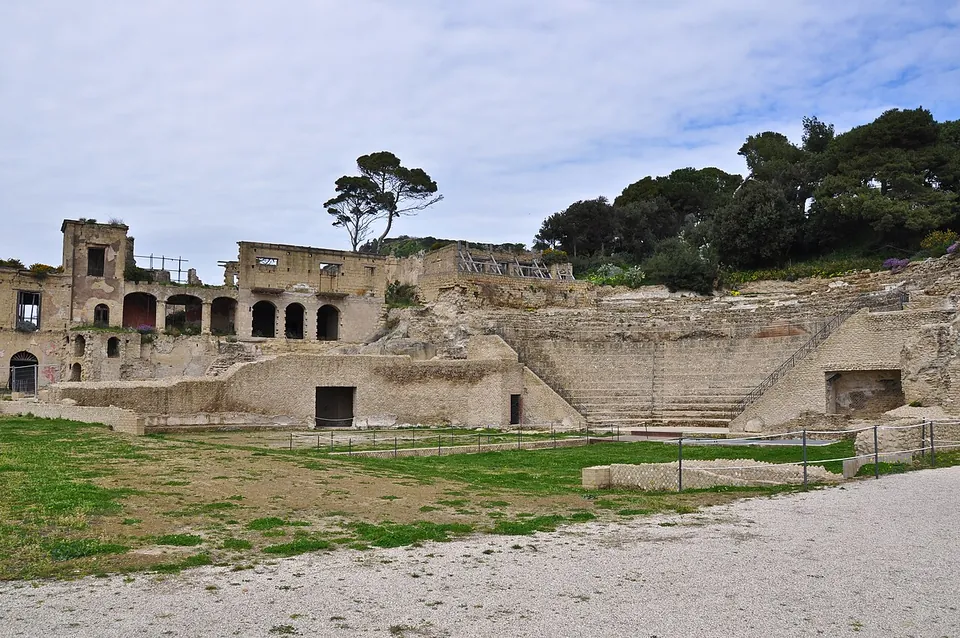
Part of the theatre's seating, uncovered in a courtyard among the houses built over it. · Photo: CityClass · CC BY-SA 3.0 · Wikimedia Commons
The Catacombs of San Gennaro, cut into the tuff of the slope below Capodimonte. · Photo: Dominik Matus · CC BY-SA 4.0 · Wikimedia Commons
The eastern entrance of the Crypta Neapolitana, the Roman road tunnel, in the Parco Vergiliano. · Photo: Armando Mancini · CC BY-SA 2.0 · Wikimedia Commons
The Roman bridge in Via Conte della Cerra, beside the Salvator Rosa metro station. · Photo: Baku · CC BY-SA 3.0 · Wikimedia Commons
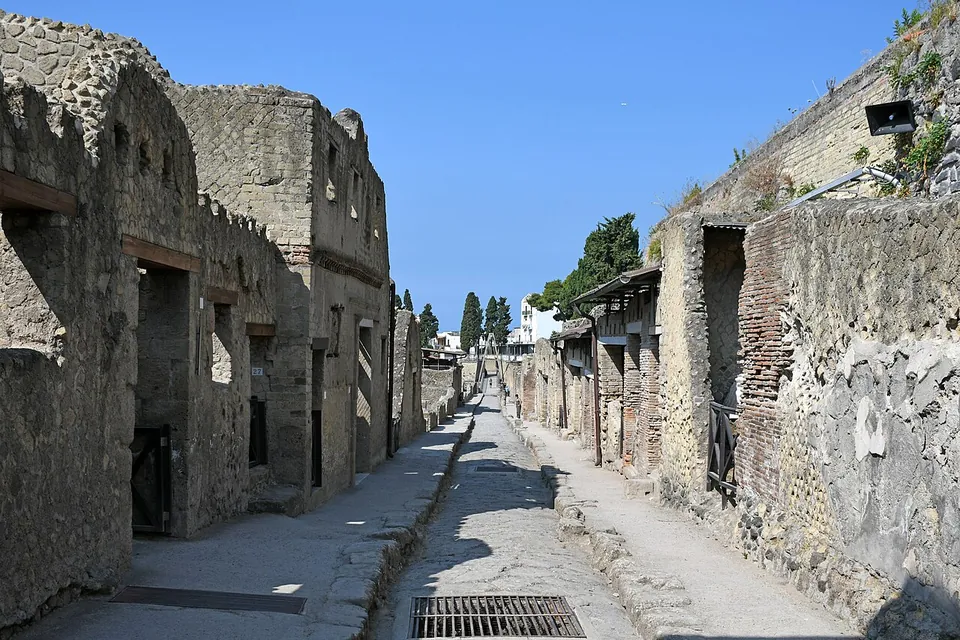
Excavation has uncovered about 4 to 4.5 hectares of a town of roughly 20, so this is a compact site: four fully excavated blocks of houses and shops (insulae III to VI) and parts of others, between excavated streets, with the rest of ancient Herculaneum, including most of its forum and its temples, still under modern Ercolano (it.wikipedia, fr.wikipedia).