Hidden gemHub · 1 stop6th c. BC – 7th c. ADTicketed
Puteoli – Pozzuoli
Dicaearchia, Δικαιαρχία, Pozzule
city · Campania, Italy
What it is
Puteoli, now Pozzuoli on the bay west of Naples, began as the Greek colony of Dicaearchia around 531 BC and became a Roman colony in 194 BC. It was Rome's great trading port before Ostia took over.
What you’ll see
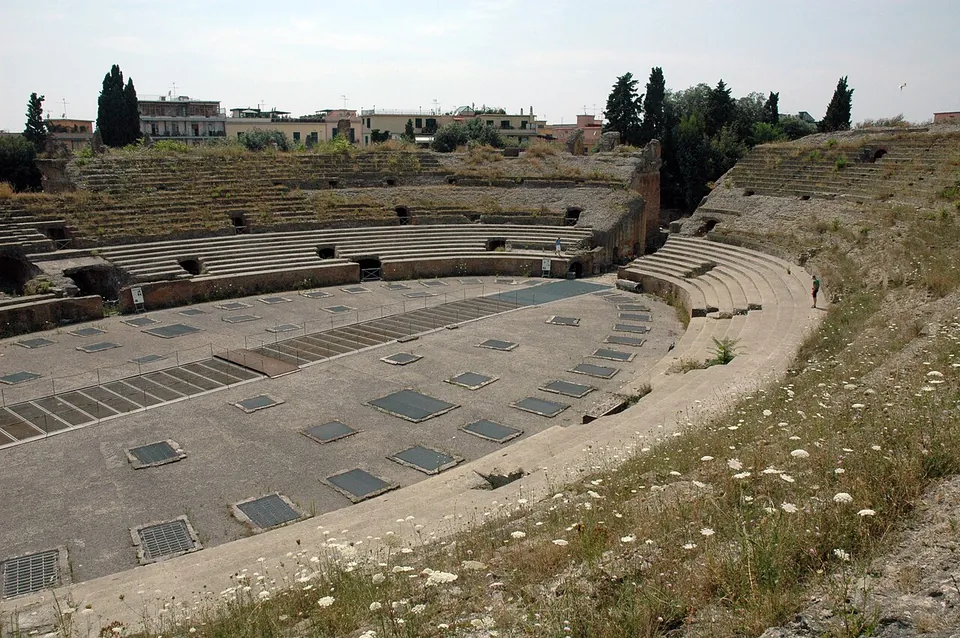
The Flavian Amphitheatre is the set piece: only the Colosseum and the amphitheatre of Capua are larger. Published figures put it at about 147–150 m by 116–117 m, holding 40,000 to 50,000 spectators (en.wikipedia; it.wikipedia).
Worth the trip?
From Naples, yes: Pozzuoli is on the city's metro, and the amphitheatre is a big Roman arena and a quiet one, with 28,899 visitors in 2016 (it.wikipedia). Expect less than the full monument for now.
Getting there & cost
Pozzuoli is on Linea 2 of the Naples metro, which ends at Pozzuoli Solfatara, and on the Cumana railway from Naples, which has four stations in the comune. Ferries sail from its port to Ischia and Procida (it.wikipedia).Ticketed · Flavian Amphitheatre €5, reduced €2 for EU citizens aged 18–25, free under 18 · checked 18 October 2026Hours, tickets and parking
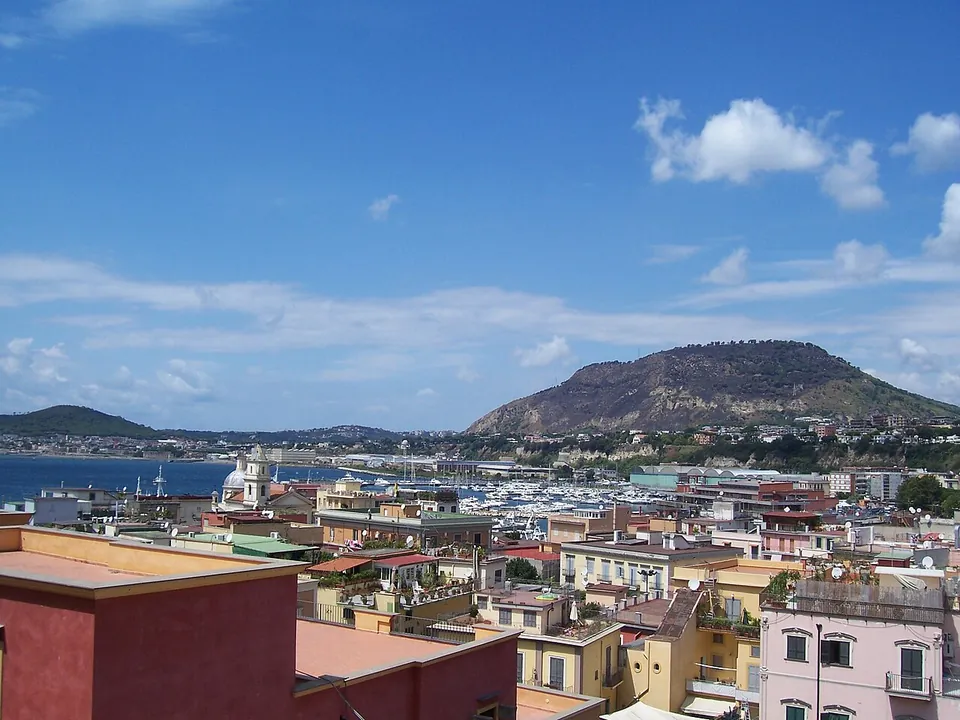
Modern Pozzuoli on its bay. Many of the Roman remains lie among its streets. · Photo: Ferdinando Marfella · CC BY-SA 2.0 · Wikimedia Commons
The arena of the Flavian Amphitheatre. The openings in its floor are where animals and scenery were lifted up from the level below. · Photo: DimiTalen · CC0 · Wikimedia Commons
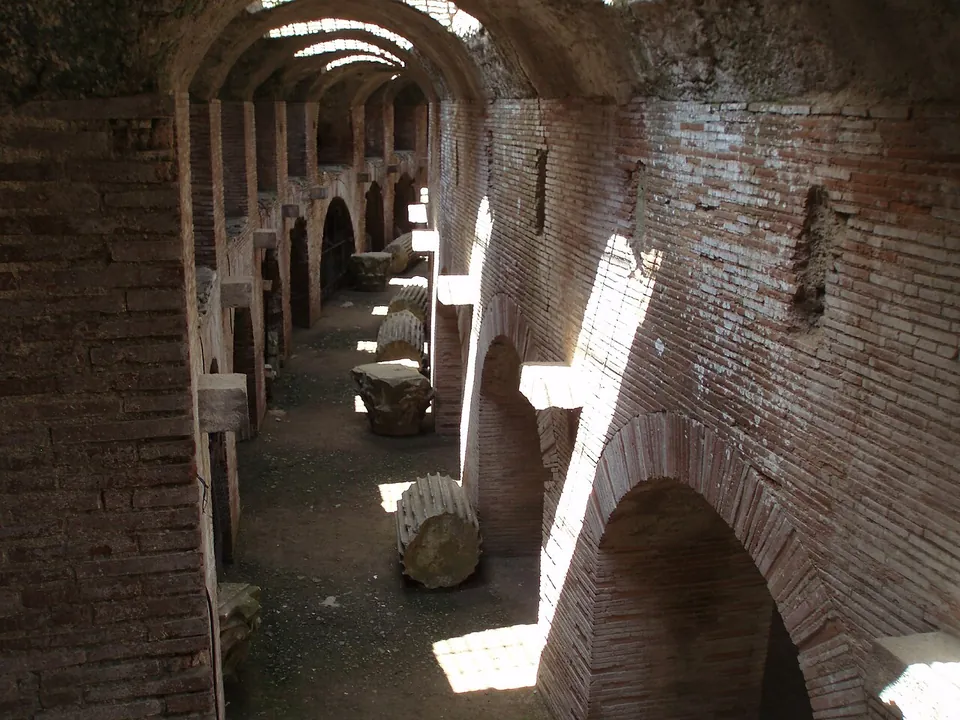
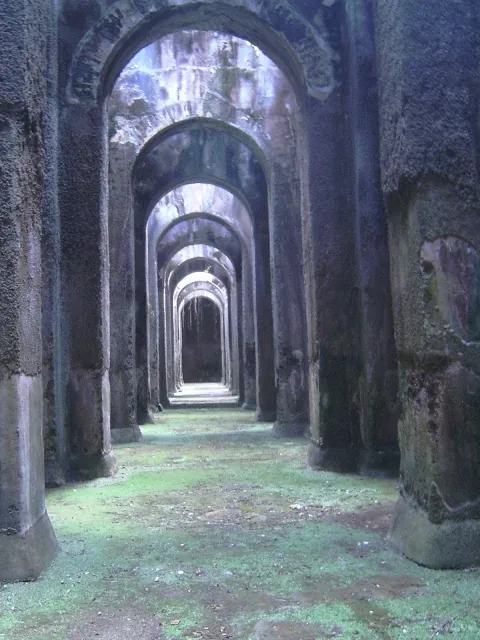
A vaulted corridor in the amphitheatre's underground level, which is temporarily closed to visitors. · Photo: David Holt · CC BY-SA 3.0 · Wikimedia Commons
The stops
1 place to see, the best preserved and best known first.
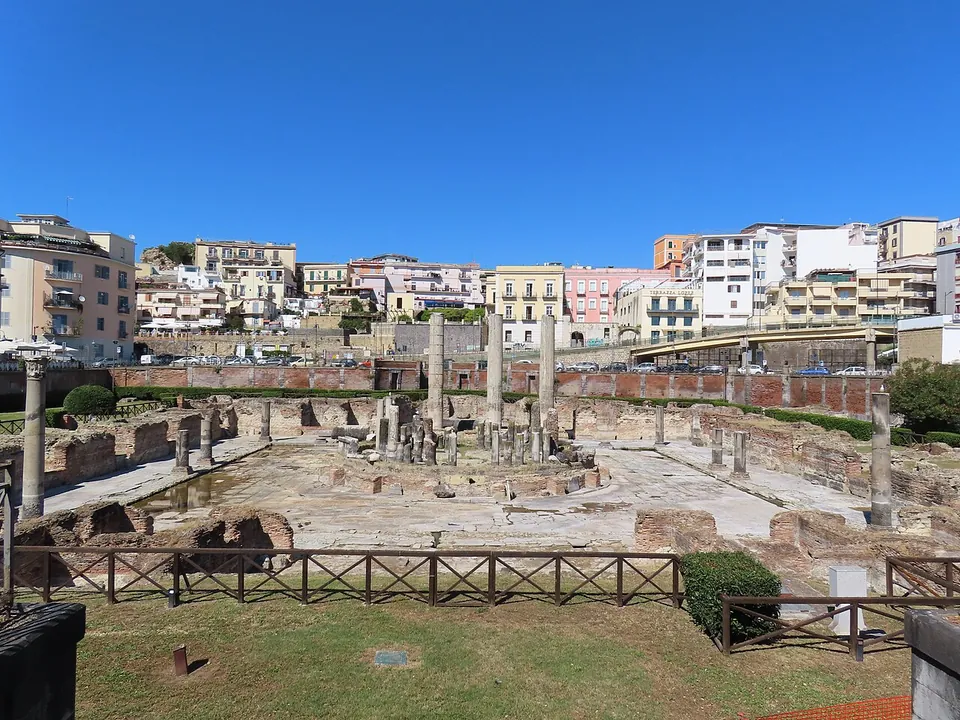
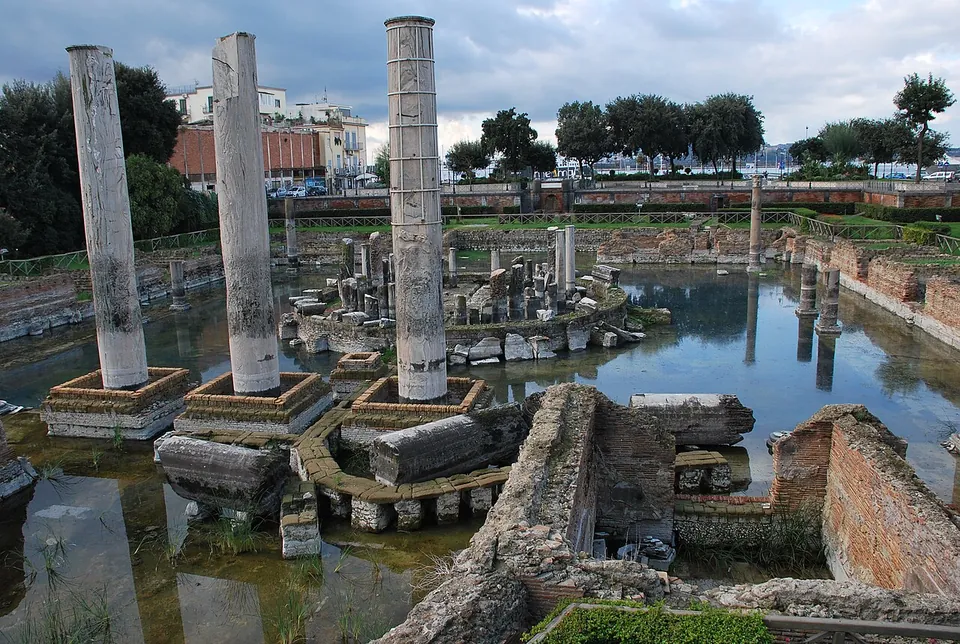
The whole plan of the market lies open in a sunken square of about 58 by 75 m, a few steps from the harbour quays in the centre of Pozzuoli (the operator).
Restricted access
Puteoli, now Pozzuoli on the bay west of Naples, began as the Greek colony of Dicaearchia
around 531 BC and became a Roman colony in 194 BC. It was Rome’s great trading port
before Ostia took over. Its Roman town survives in pieces among the modern streets, led by the
third-largest Roman amphitheatre in Italy.
What is there today
The Flavian Amphitheatre is the set piece: only the Colosseum and the amphitheatre of
Capua are larger. Published figures put it at about 147–150 m by 116–117 m, holding
40,000 to 50,000 spectators (en.wikipedia; it.wikipedia). The marble of its exterior was
stripped in the Middle Ages. The arena and the banks of seating remain, and the arena
floor still has the openings through which animals and scenery were lifted from the level
below. That underground level, about 7 m deep, is the best-preserved part of the building
(it.wikipedia), and it is temporarily closed, so a visit currently covers only the arena
(the operator).
The rest of the Roman town is scattered through the modern one:
the Macellum, the city’s food market, long called the “Temple of Serapis”. Its three
standing marble columns are bored by marine molluscs, the record of centuries spent
under the sea (en.wikipedia). It is temporarily closed to the public (the operator);
Rione Terra, the promontory of the first settlement, where an underground route
follows Roman streets past shops, granaries and a bakery (it.wikipedia);
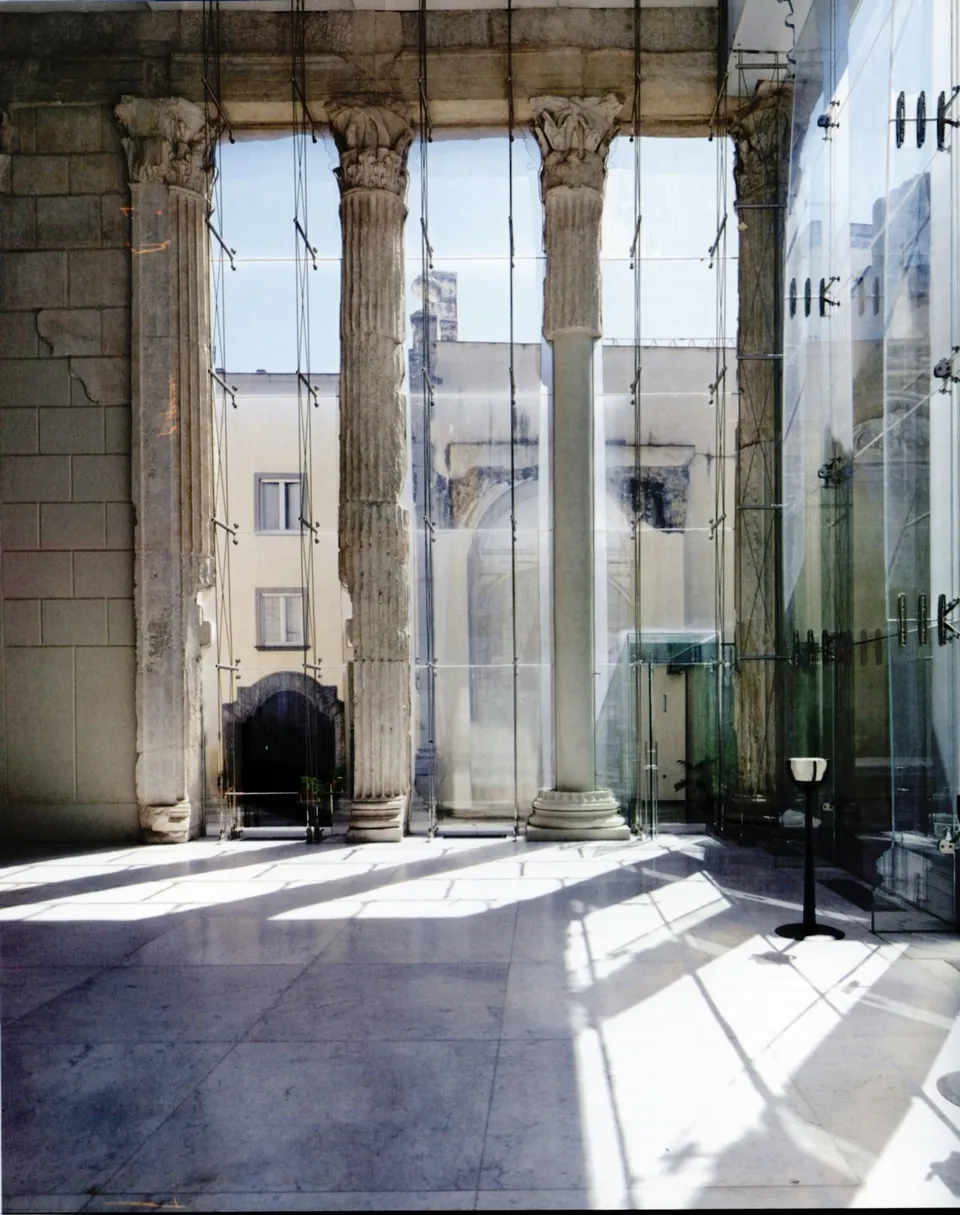
the Temple of Augustus, built into the cathedral on Rione Terra (it.wikipedia);
the older amphitheatre, cut in two by the Rome–Naples railway: about ten arches can
still be glimpsed from the street (it.wikipedia);
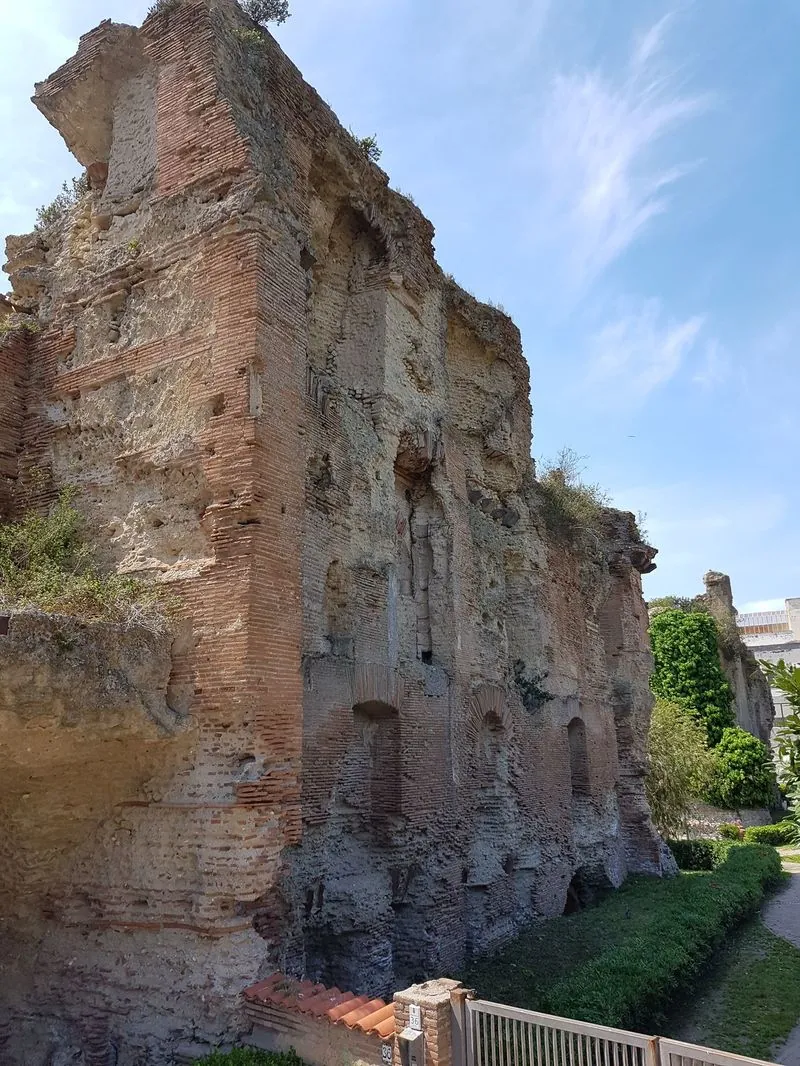
the so-called Temple of Neptune, the remains of a large bath complex on Corso
Terracciano (en.wikipedia);
the Stadium of Antoninus Pius, just west of the ancient city, which opens only on
request (the operator).
Farther out, about 5 km west-north-west of the centre, stands the so-called Arco Felice,
which Pleiades records as a city gate of the first century AD built under Domitian.
The Macellum, Rione Terra and Arco Felice have pages of their own.
Is it worth the trip?
From Naples, yes: Pozzuoli is on the city’s metro, and the amphitheatre is a big Roman
arena and a quiet one, with 28,899 visitors in 2016 (it.wikipedia). Expect less than the
full monument for now. The underground level is closed, the Macellum is shut, entry runs
in capped half-hour slots, the older amphitheatre can only be glimpsed from the street and
the stadium opens only on request. The Campi Flegrei are an active volcanic area
where sites close at short notice when the ground moves; the park refunds tickets for such
closures. Check its page on the day. If you are also going to Cuma or Baia, the
three-day CircuitoFlegreo ticket makes the amphitheatre part of a fuller day out.
Getting there
Pozzuoli is on Linea 2 of the Naples metro, which ends at Pozzuoli Solfatara, and on the
Cumana railway from Naples, which has four stations in the comune. Ferries sail from its
port to Ischia and Procida (it.wikipedia). The amphitheatre is a few steps from the Linea
2 stop (it.wikipedia).
The amphitheatre opens at 09.00. It closes at 18.30 on weekdays and 19.00 on weekends and
holidays, with last entry an hour earlier, and it is closed on Tuesdays. A ticket is €5,
reduced to €2 for EU citizens aged 18 to 25, and free under 18. The €10 CircuitoFlegreo
ticket (€5 reduced) adds the archaeological museum in the castle at Baia, the Baia baths
and Cuma over three consecutive days. Buy online through Musei Italiani or at the machine
by the entrance. The park strongly advises buying online, and groups of more than ten must
(Parco Archeologico dei Campi Flegrei, read 18 October 2026; check before travelling).
Visiting details
Opening hours
Flavian Amphitheatre: 09.00–18.30 Monday to Friday (last entry 17.30) and 09.00–19.00 on Saturdays, Sundays and holidays (last entry 18.00); closed on Tuesdays. Its underground level is temporarily closed, so the visit is limited to the arena. The Macellum is temporarily closed to the public. The Stadium of Antoninus Pius opens only on request ([email protected]).
Tickets
Flavian Amphitheatre €5, reduced €2 for EU citizens aged 18–25, free under 18. The €10 CircuitoFlegreo ticket (€5 reduced) also covers the Baia castle museum, the Baia baths and Cuma over three consecutive days, one entry per site. Buy online through Musei Italiani or at the machine by the entrance; buying online is strongly advised and compulsory for groups of more than ten.
Parking
A surface car park about 160 m from the town-centre point (OSM way/1006776132); the amphitheatre is a few steps from the Linea 2 metro stop.
Before you go
The Campi Flegrei are an active volcanic area, and sites close at short notice because of ground movement (bradyseism); the archaeological park refunds tickets for such closures, so check its page on the day.
Entry to the amphitheatre is in capped half-hour slots.
Hours and prices checked 18 October 2026 on the operator's own site. Confirm before travelling.
History
The town began as Dicaearchia, a Greek colony founded around 531 BC by refugees from
Samos (en.wikipedia; it.wikipedia gives 530 BC). The Samnites took it in 421 BC. Rome garrisoned the port during the war with
Hannibal and founded a colony there in 194 BC; some accounts give 195 (en.wikipedia;
it.wikipedia; Pleiades). The Latin name Puteoli is traced either to puteus, a well, or to
puteo, to stink, after the sulphur fumes of the Solfatara (en.wikipedia).
It became Rome’s port for the eastern Mediterranean and the harbour of the Alexandrian
grain ships. The poet Lucilius called it a “lesser Delos” (it.wikipedia). Its population included
Greeks, Jews and Nabataeans, and the merchants of Tyre kept a trading station there. The apostle Paul landed here
on his way to Rome and stayed seven days (Acts 28:13–14). The volcanic sand of the area,
pulvis puteolanus, was the basis of Roman concrete (en.wikipedia).
The port began to decline once Claudius, Nero and Trajan built up Ostia from AD 42,
although Antoninus Pius repaired its storm-damaged pier in 139. Vespasian rewarded the
town for its loyalty with land and the title Colonia Flavia (en.wikipedia). The ground
here rises and sinks slowly (bradyseism). In the late 5th or early 6th century the
sinking shore drove the people out of the lower town and the harbour quarter to the
height of Rione Terra, which was then walled (it.wikipedia). The town was sacked by Alaric in 410, Genseric in 455 and Totila in 545
(en.wikipedia).
The Flavian Amphitheatre
The amphitheatre was begun under Vespasian and probably finished under Titus
(en.wikipedia). Some scholars have argued from its building technique for a start under
Nero, but an inscription recording that the Colonia Flavia Augusta Puteolana paid for it
supports the Flavian date (it.wikipedia). It stands where the roads from Naples, Capua and
Cumae met (en.wikipedia), and it replaced an older, smaller arena. The outer façade had
three tiers of arches, and twenty stairways climbed from the outer portico to the top of
the seating (it.wikipedia).
In 305 the Christians Januarius (San Gennaro), Festus, Desiderius and Sossius were
condemned to the beasts here. According to tradition the animals spared them, and they
were beheaded near the Solfatara (it.wikipedia). The cell where they are said to have been
held became a chapel in the 17th or 18th century. Farms and vineyards later filled the
ruin. Excavation began in 1839 and was completed by Amedeo Maiuri between 1926 and 1947
(it.wikipedia).
The older amphitheatre
Puteoli was the only town in ancient Italy apart from Rome with two amphitheatres
(it.wikipedia). The older one measured about 130 m by 95 m (en.wikipedia; it.wikipedia).
Its date is given as Republican, between Sulla and Caesar, or as Augustan or a little
earlier (it.wikipedia). It was discovered when the Rome–Naples railway was dug through it
in 1915 (it.wikipedia). About ten arches of rough stonework that carried the seating
survive and can be glimpsed from the road near the metro overpass (it.wikipedia).
According to Cassius Dio, a freedman of Nero’s staged games with wild beasts in it in
AD 66 for Tiridates, whom Nero had made king of Armenia (it.wikipedia).
The Temple of Augustus
A merchant, Lucius Calpurnius, paid for the marble temple to Augustus, designed by the
architect Lucius Cocceius Auctus. It replaced a temple of about 194 BC that Sulla had
restored (Pleiades; it.wikipedia). The temple became a church of the town’s patron saint,
Proculus, in the late 5th or early 6th century, and later disappeared inside a Baroque
cathedral. After a fire in 1964 the Roman structure was brought back to light, and the
cathedral reopened for worship in 2014 (it.wikipedia).
The Stadium of Antoninus Pius
Antoninus Pius built the stadium in honour of his predecessor Hadrian, who had died at
Baiae in 138 and was first buried at a villa of Cicero’s near here. Greek-style games
called the Eusebeia were held in it (it.wikipedia; the operator). The stadium measures
about 300 m by 70 m (the operator). The Via Domiziana was driven through it lengthwise in
1932. The site was excavated and opened to the public in 2008 (it.wikipedia). Two rows of
stone seats and the vaulted corridor under the upper seating survive (it.wikipedia).
More photographs
The Macellum, the Roman food market, with its three standing columns and water over its floor. · Photo: Lamberto Zannotti · CC BY-SA 3.0 · Wikimedia Commons
Columns of the Augustan temple, now enclosed in the cathedral on Rione Terra. · Photo: FAM1885 · CC BY-SA 4.0 · Wikimedia Commons
Walls of Roman baths in the town centre. · Photo: Izabela Miszczak · CC BY-SA 3.0 · Wikimedia Commons