What is there today
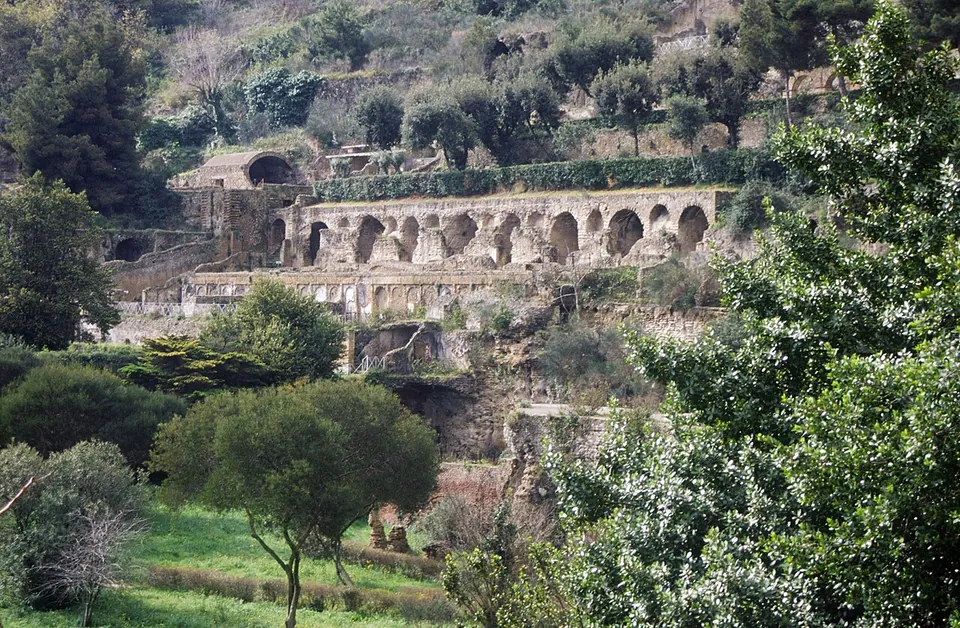
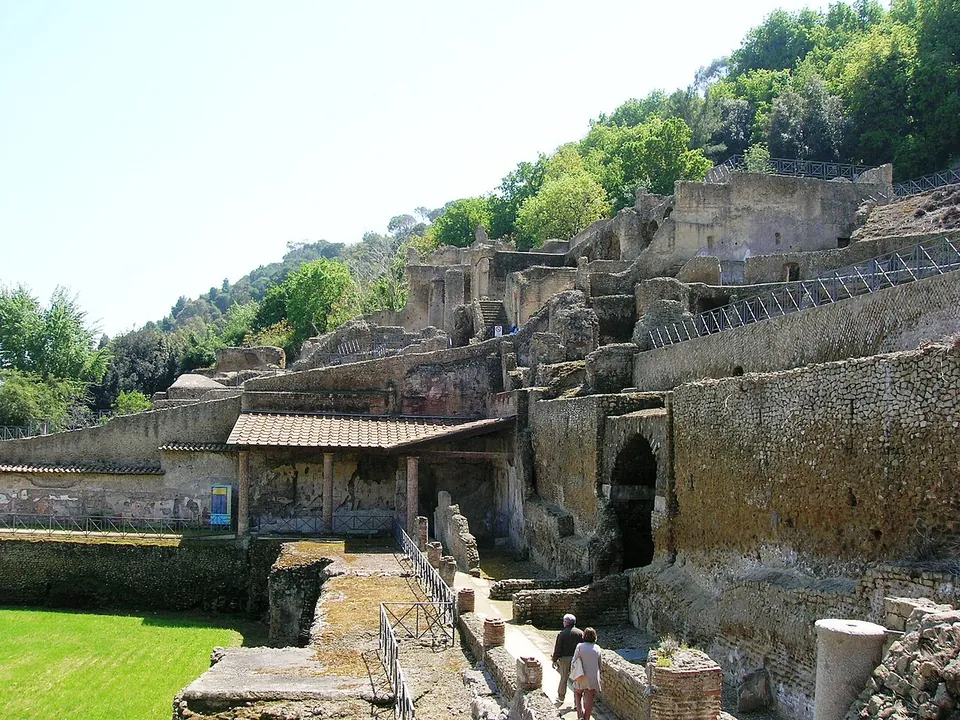
The remains step down the slope in terraces along a front of about 450 m. The domed halls long called temples of Mercury, Venus and Diana were in fact rooms of the baths; the popular names simply stuck (fr.wikipedia; it.wikipedia). Most of the ancient town lies under the sea, sunk by bradyseism, so this is the upper part of it (it.wikipedia).
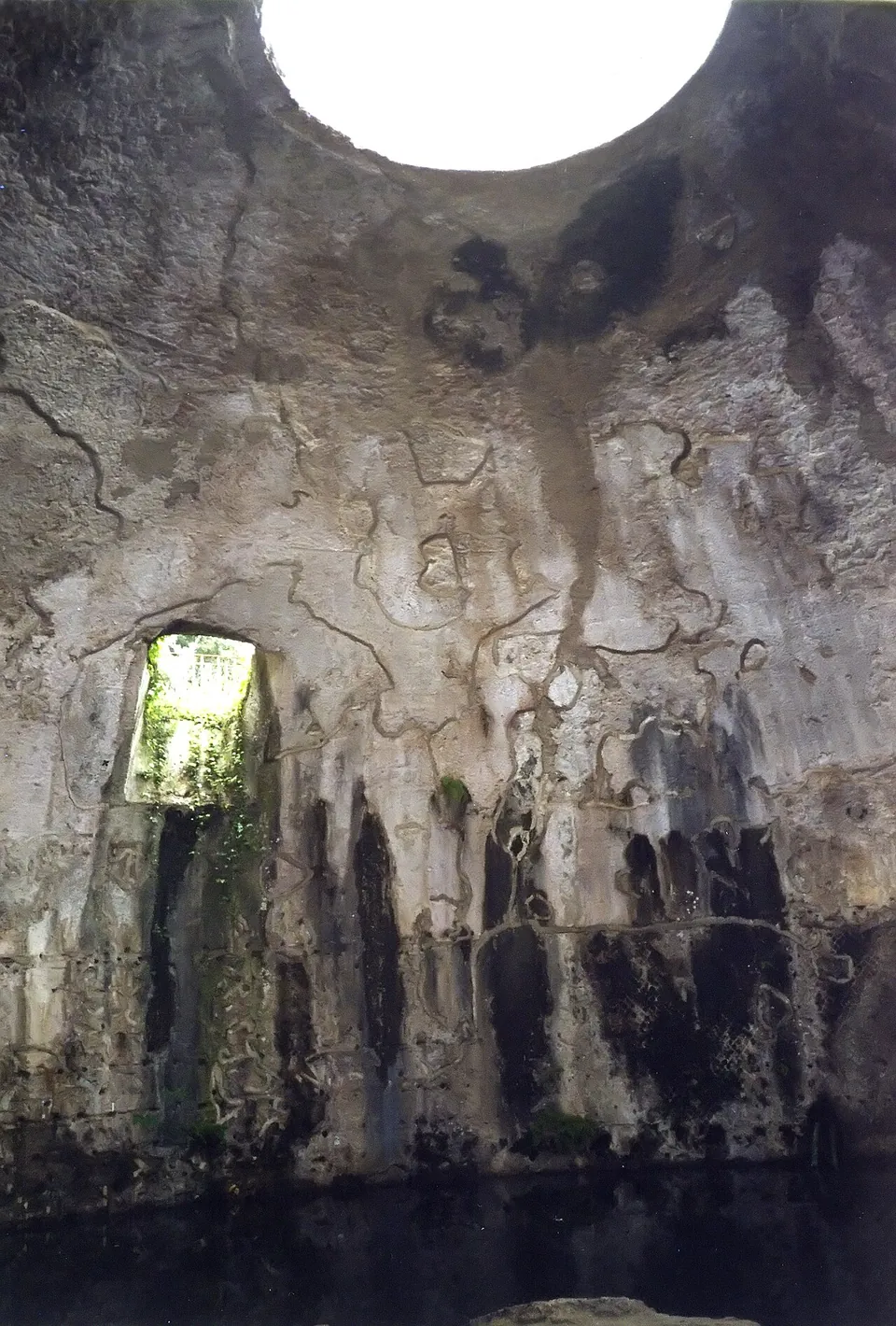
- The “Temple of Mercury”. The cold-water pool of a public bath, under a dome 21.5 m across with an oculus at the top, built in the 1st century BC and described as the oldest known surviving concrete dome (en.wikipedia). The way sound reverberates inside has also earned it the name Temple of Echo (fr.wikipedia).
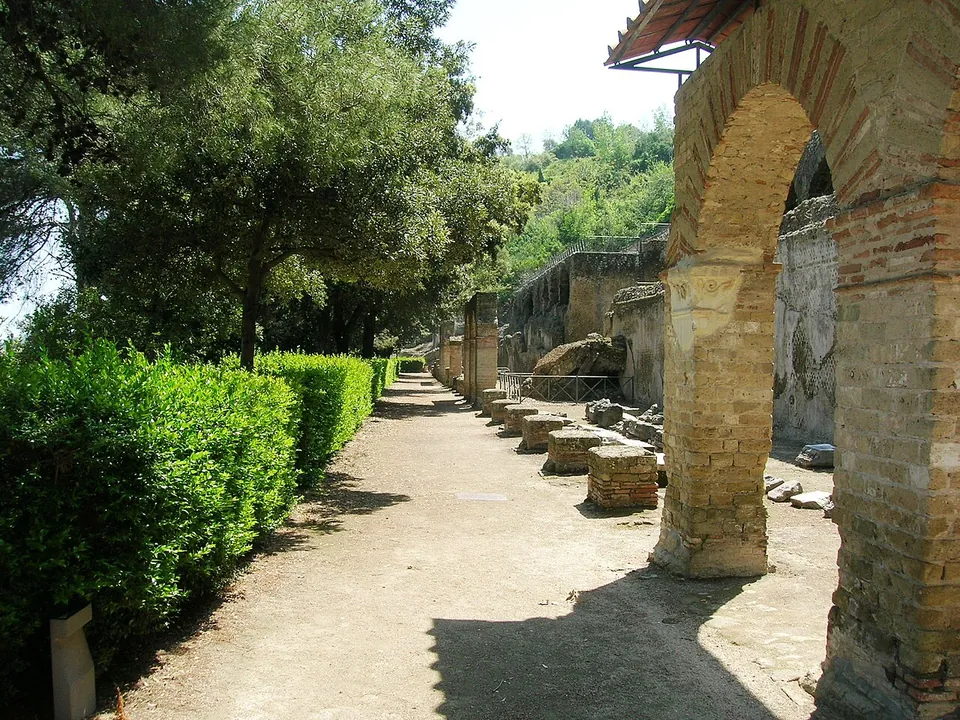
- The Villa of the Ambulatio. Six terraces joined by staircases, named after the covered walk on the second terrace that looked out over the gulf; traces of stucco survive on its brick pillars (en.wikipedia).
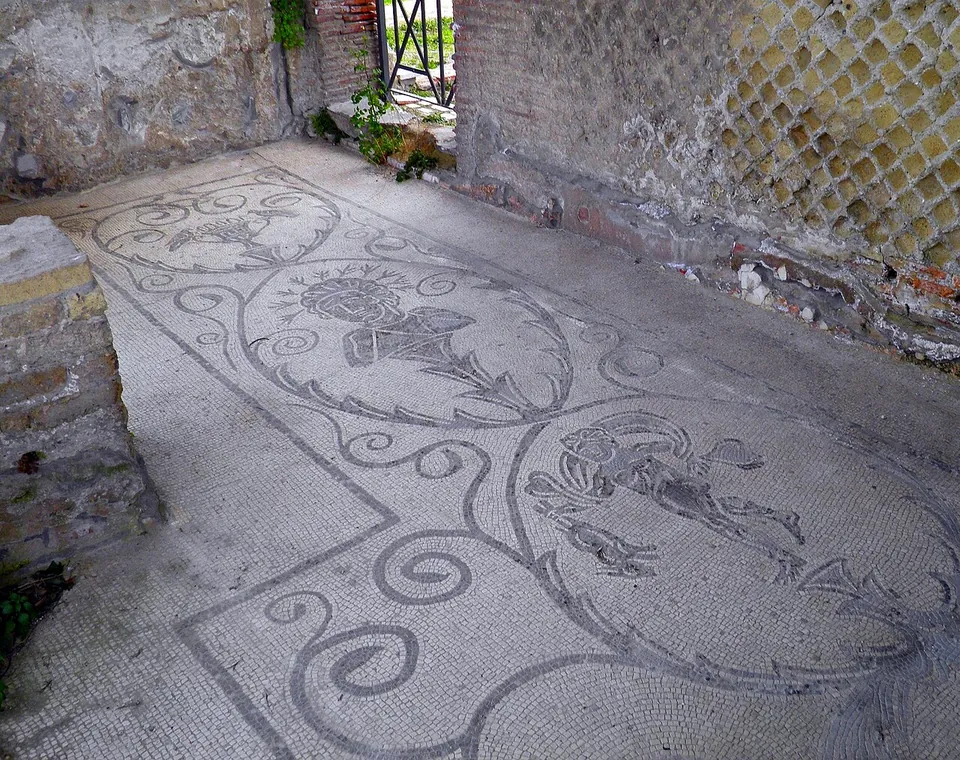
- The sector of Sosandra. Named after a statue found here in 1953, now in the National Museum in Naples (it.wikipedia). Its terraces hold a semicircular building with vaulted rooms in front of a round basin and a large rectangular pool (fr.wikipedia), and the portico of the lower terrace keeps wall paintings of the 1st and 2nd centuries AD (en.wikipedia).
- The sector of Venus. Rooms decorated in stucco, dated by their style to the 1st century (fr.wikipedia), and, about 300 m from the entrance (OpenStreetMap), the “Temple of Venus” itself: an octagonal hall, circular inside and about 26 m across, set some 3 m into the ground, which en.wikipedia attributes to Hadrian (it.wikipedia; en.wikipedia).
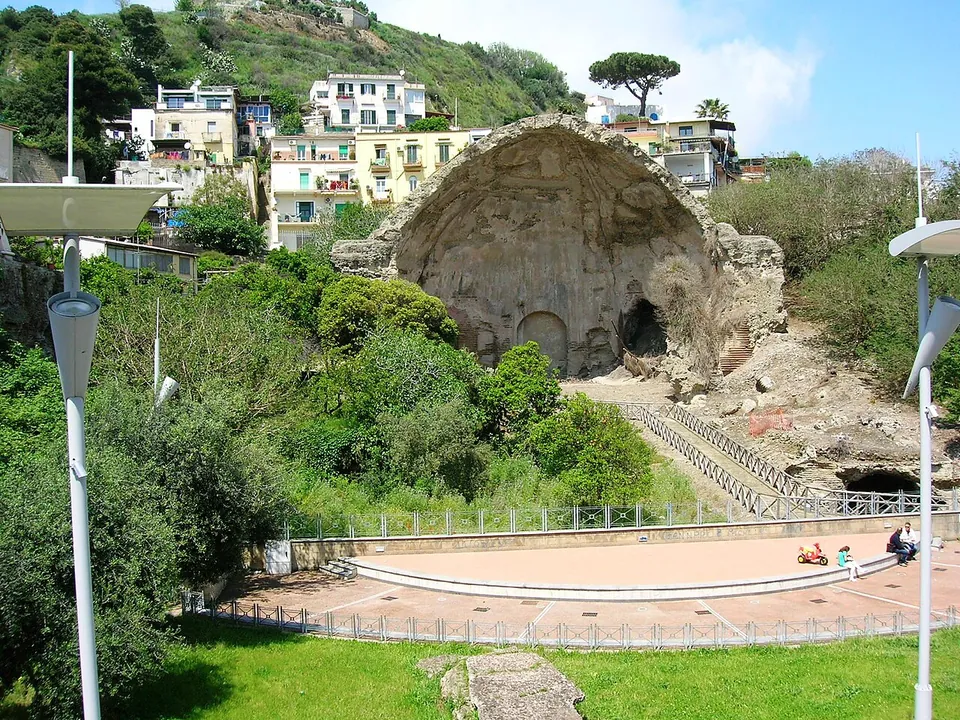
- The “Temple of Diana”. A great dome split in half, so its construction can be read in section: layers of concrete laid between facings of rubble (fr.wikipedia). It is visible from the Cumana railway station (it.wikipedia).
Is it worth the trip?
Yes. Here Roman bath architecture fills a whole hillside rather than a single building, and the “Temple of Mercury” alone is worth the €5: you stand inside a concrete dome built more than a century before Rome’s Pantheon (en.wikipedia). It pairs naturally with the Archaeological Museum of the Campi Flegrei in the Castello di Baia, which holds the statues raised from the sunken nymphaeum in the bay (it.wikipedia), and with the Piscina Mirabilis, about 2.7 km away.
Three things to plan around. It is closed on Mondays. In winter it shuts as early as 15.45, with the last tickets an hour before. And the Campi Flegrei are an active volcanic area: the operator refunds tickets when a site has to close because the ground is moving, so check on the day.
Getting there and what it costs
The park is in Baia, a frazione of Bacoli in the Campi Flegrei, with its entrance on Via Sella di Baia (the Ministry of Culture). Baia has a station on the Cumana railway, on Via Terme Romane, and EAV buses (it.wikipedia); an EAV bus stop is mapped about 60 m from the entrance and a car park about 45 m away (OpenStreetMap).
The park opens at 09.00 every day except Monday. Closing follows the daylight: 19.00 from April to August, 18.30 then 18.00 in September, 17.40 then 17.15 in October, down to 15.45 from mid-November through December, and back up through 16.00 in early January to 17.40 by late March. The ticket office closes an hour before the park. Entry is staggered, 50 visitors every 30 minutes, and you may stay up to two hours.
A ticket costs €5; EU citizens aged 18 to 25 pay €2, and under-18s go free. The €10 Circuito flegreo ticket (reduced €5) adds the castle museum, Cumae and the Flavian Amphitheatre at Pozzuoli, one visit each over three consecutive days, booked ahead. Tickets are sold on the Musei Italiani website and app, or by card at the machines at the entrance; the operator strongly recommends buying online (the operator, read 23 October 2026).
Visiting details
- Opening hours
- Opens at 09.00; closed on Mondays. Closing time follows the season: 19.00 from April to August, 18.30 in the first half of September and 18.00 in the second, 17.40 and then 17.15 in October, 16.00 and then 15.45 in November, 15.45 in December, 16.00 and then 16.20 in January, 16.40 and then 17.00 in February, 17.20 and then 17.40 in March. The ticket office closes an hour before the park. Entry is limited to 50 visitors every 30 minutes, and a visit to 120 minutes.
- Tickets
- €5; €2 for EU citizens aged 18–25; free under 18. The Circuito flegreo ticket (€10, reduced €5), valid for three consecutive days with one entry per site and booked ahead, adds the Castello di Baia museum, Cumae and the Flavian Amphitheatre at Pozzuoli. Tickets are sold on the Musei Italiani website and app, and by card at the ticket machines at the entrance.
- Parking
- A surface car park lies about 45 m from the entrance point (OSM way/839406641), and a fee-paying one about 185 m away (OSM way/839395545).
Before you go
- The Campi Flegrei are volcanically active, and the operator refunds tickets when a site has to close because of bradyseism (ground movement). Check before travelling.
- The operator strongly recommends buying tickets online; for groups of more than ten and for schools it is compulsory.
- The remains climb a hillside in terraces joined by staircases, so a visit involves a good many steps.
Hours and prices checked 23 October 2026 on the operator's own site. Confirm before travelling.
History
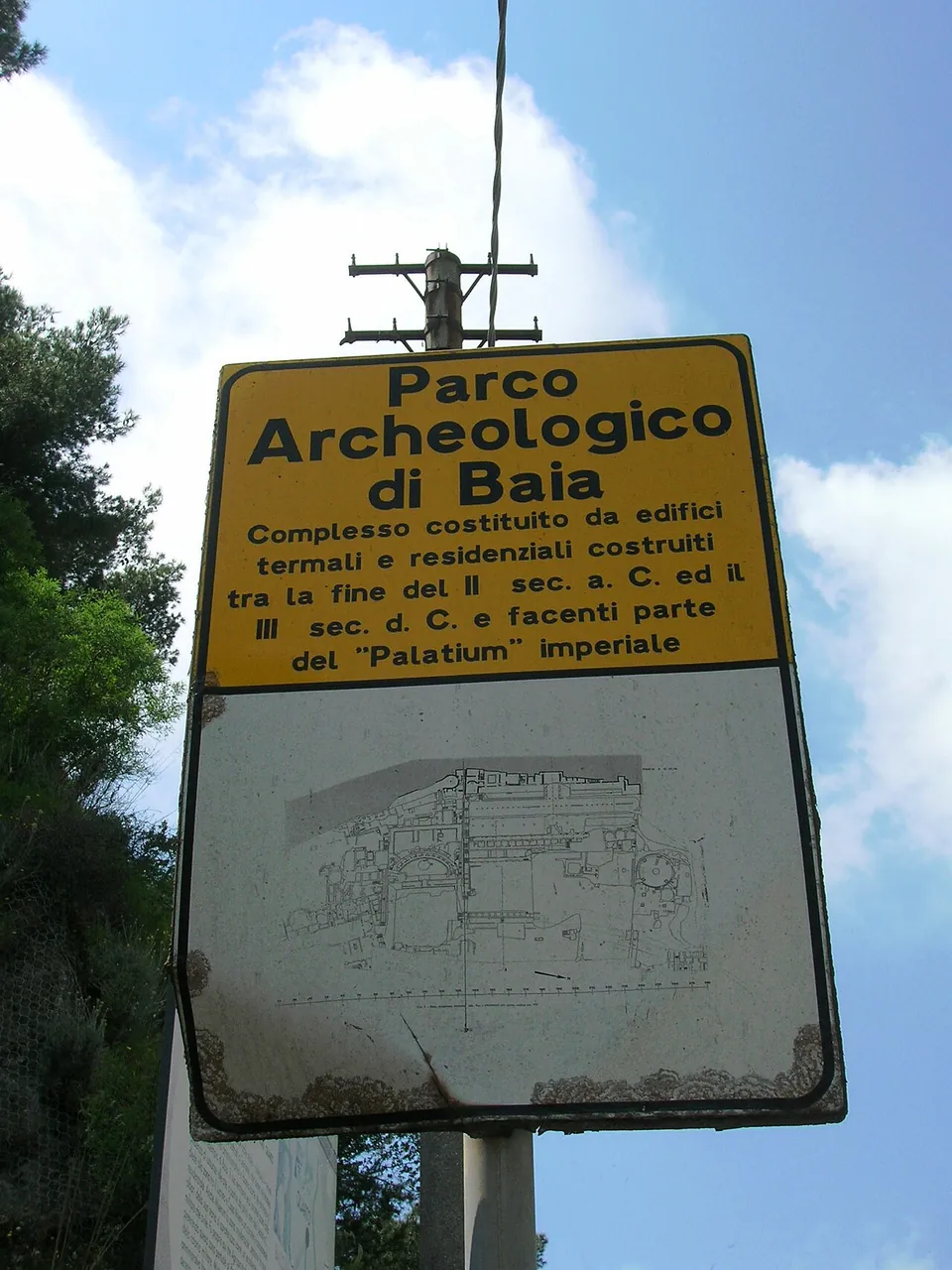
Baiae was a resort for the Roman aristocracy from around 80 BC, and much of the town became imperial property under Augustus; Nero built a villa here and Hadrian died at his in AD 138 (en.wikipedia). The buildings in the park belong to the late Republic and the Augustan, Hadrianic and Severan ages, layer over layer (it.wikipedia). Because of their scale they were first identified as one vast bath complex and then as an imperial palace (fr.wikipedia); the park’s own sign describes bath and residential buildings of the end of the 2nd century BC to the 3rd century AD that were part of the imperial palace. The “Temple of Diana” is attributed to Alexander Severus (r. 222–235), in honour of his mother Julia Mamaea, and the sector of Sosandra is identified as the rest house that Cassius Dio says Nero built for the sailors of the fleet at Misenum (en.wikipedia).
The ground then sank. Bradyseism took the coast below sea level in two phases, from the 3rd to the 5th century and again some centuries later, and by the 7th–8th century most of Baia was under the sea (it.wikipedia). The remains on the hill were excavated intensively from 1941 (it.wikipedia), under Amedeo Maiuri (fr.wikipedia). In 1954 plaster casts of Greek statues, used by a workshop to make copies, were found in the baths of Sosandra; among them were the Tyrannicides of Athens (fr.wikipedia). They are now shown in the castle museum (en.wikipedia).
More photographs
Nearby
Photo: AlexanderVanLoon · CC BY-SA 3.0 · Commons
4 km · city · Campania
Cumae
The visit centres on the acropolis, a hill above the coast with remains on two terraces (the operator).
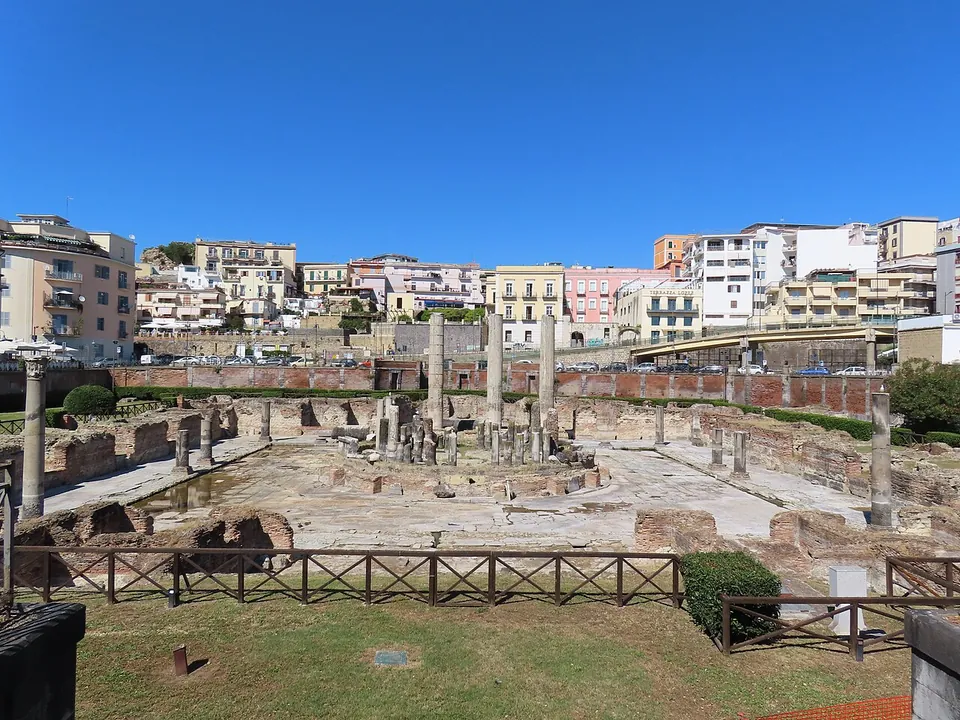
Photo: Superchilum · CC BY-SA 4.0 · Commons
4 km · site · Campania
Macellum of Pozzuoli
The whole plan of the market lies open in a sunken square of about 58 by 75 m, a few steps from the harbour quays in the centre of Pozzuoli (the operator).
5 km · city · Campania
Puteoli – Pozzuoli
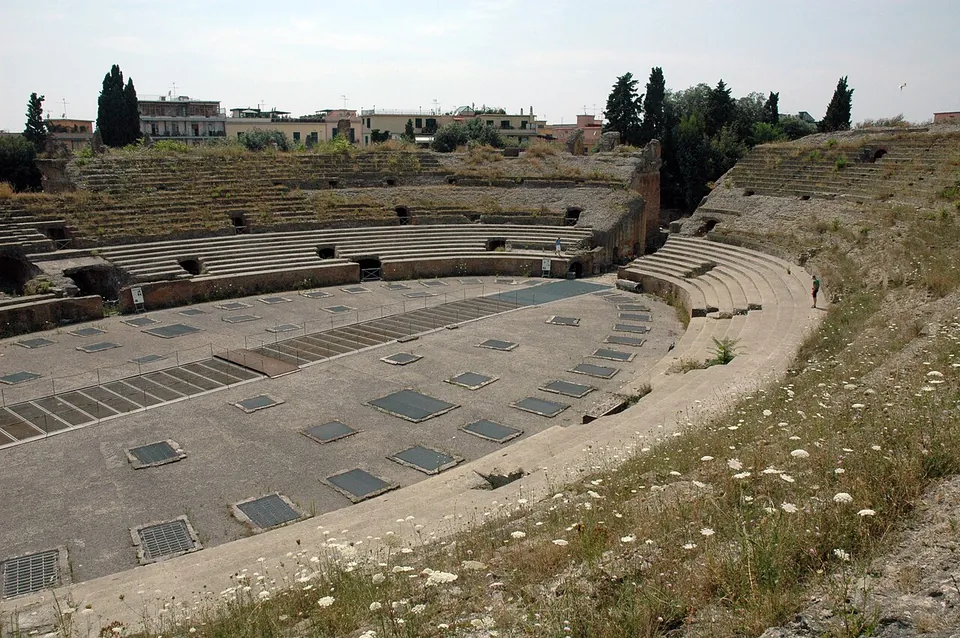
The Flavian Amphitheatre is the set piece: only the Colosseum and the amphitheatre of Capua are larger.


Straight-line distances.
Sources
Every fact on this page comes from the records below, each used under the licence noted.
| Source | Licence |
|---|---|
| Wikidata Q3685188 | CC0 |
| OpenStreetMap way/124092891 | ODbL |
| Wikipedia (it) — Complesso archeologico di Baia | CC BY-SA 4.0 |
| Wikipedia (fr) — Parc archéologique de Baïes | CC BY-SA 4.0 |
| Wikipedia (en) — Baiae | CC BY-SA 4.0 |
| Wikipedia (it) — Baia (Bacoli) | CC BY-SA 4.0 |
| Parco Archeologico dei Campi Flegrei — visitor information (the operator) | licence not recorded |
| Parco Archeologico dei Campi Flegrei — opening and closing times of the Terme di Baia and Cuma parks (the operator's timetable, PDF) | licence not recorded |
| Parco Archeologico dei Campi Flegrei — tariffs (the operator) | licence not recorded |