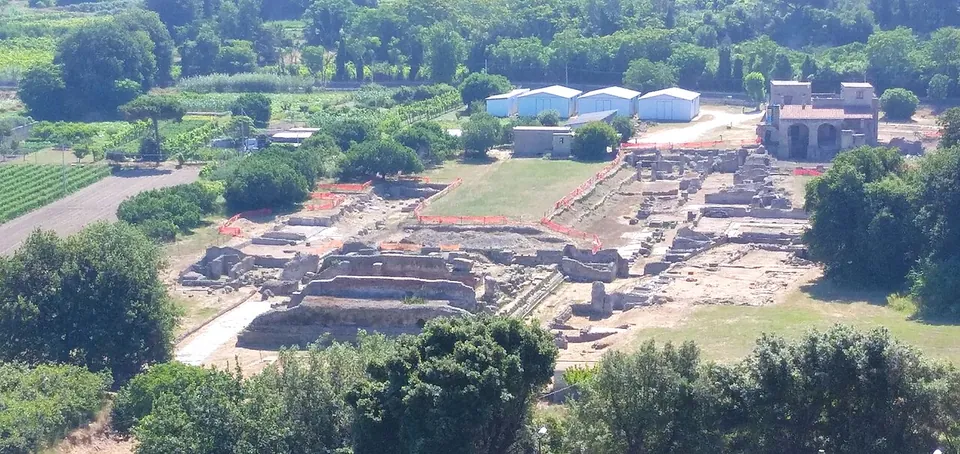
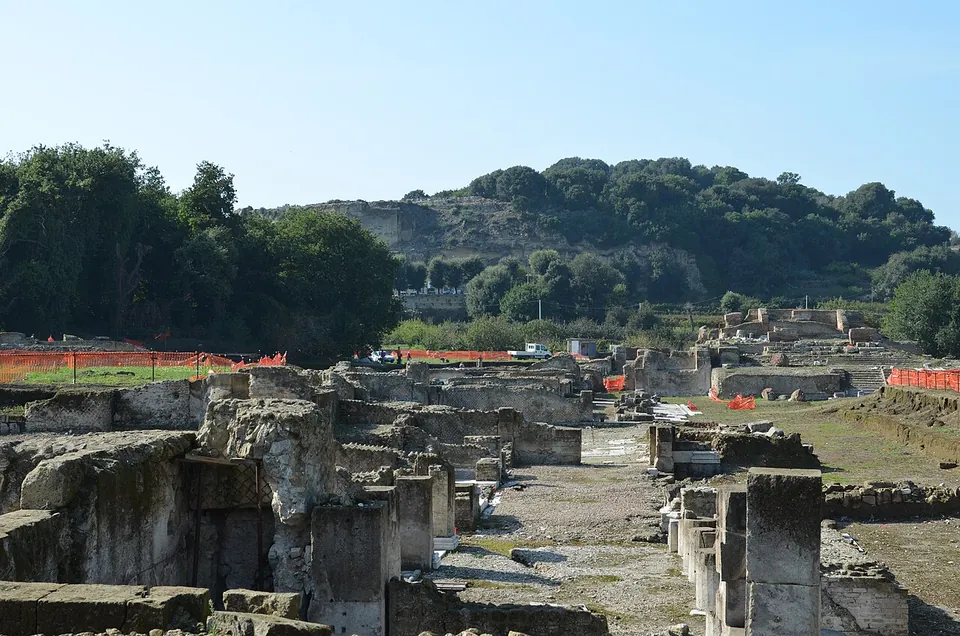


Cumae began as a Greek colony, the first on the Italian mainland, founded by settlers from Euboea around 750 BC, and came under Rome in 338 or 334 BC (published dates differ), and later grew into a prosperous Roman town (en.wikipedia; it.wikipedia). What you visit today is its acropolis above the sea west of Naples, with the long rock-cut gallery known as the Cave of the Sibyl and the ruins of two temples that were rebuilt under Augustus (en.wikipedia; it.wikipedia).
What is there today
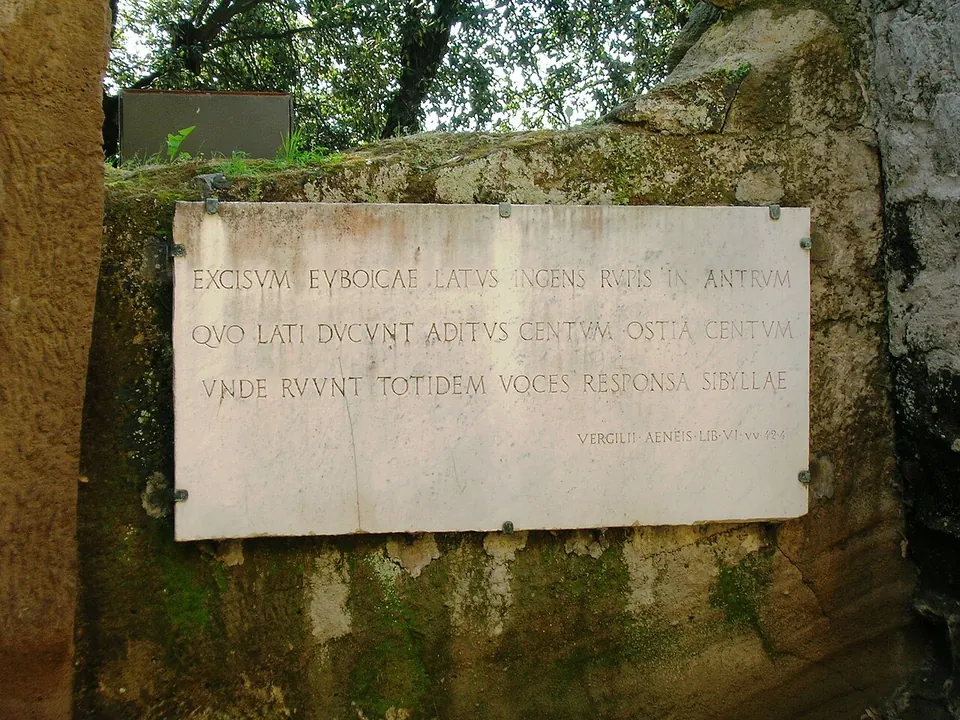
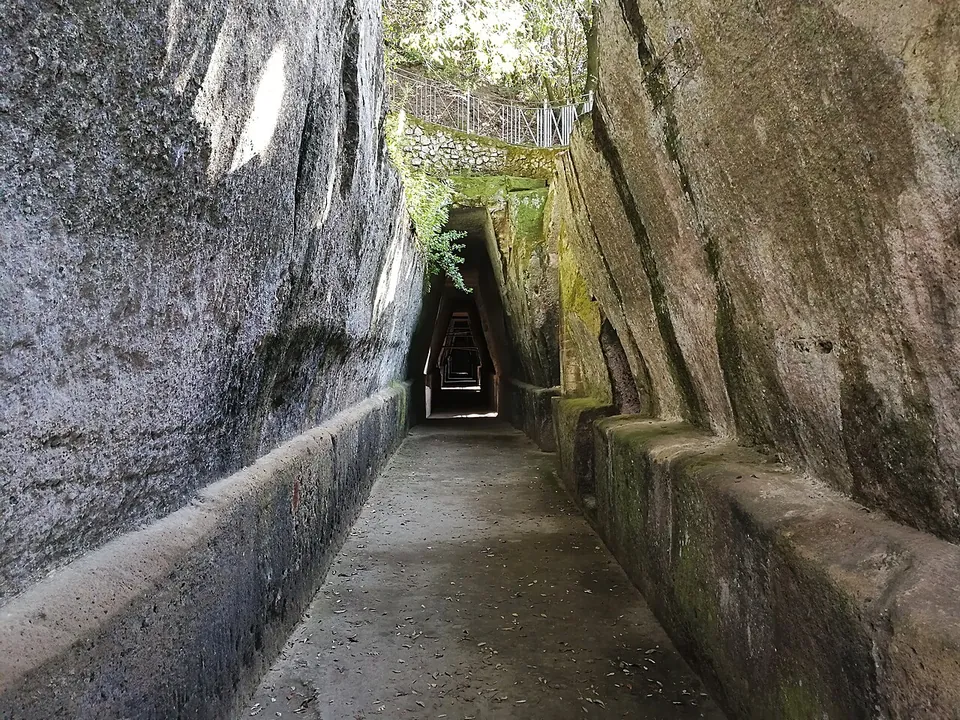
The visit centres on the acropolis, a hill above the coast with remains on two terraces (the operator). Its most famous piece is the so-called Antro della Sibilla, the Cave of the Sibyl: a gallery more than 131 m long cut into the tufa, ending in a chamber where tradition placed the Sibyl’s oracle (fr.wikipedia). The association comes from Virgil’s Aeneid, whose lines on the cave are quoted on a marble plaque at the site. The gallery itself had no religious or oracular function and more probably belonged to the town’s Hellenistic defences (fr.wikipedia); the operator ties it to the acropolis fortifications, of which substantial walls survive, the oldest a Samnite-period wall of tufa blocks and a Greek wall along the north and east sides of the sanctuary of Apollo.
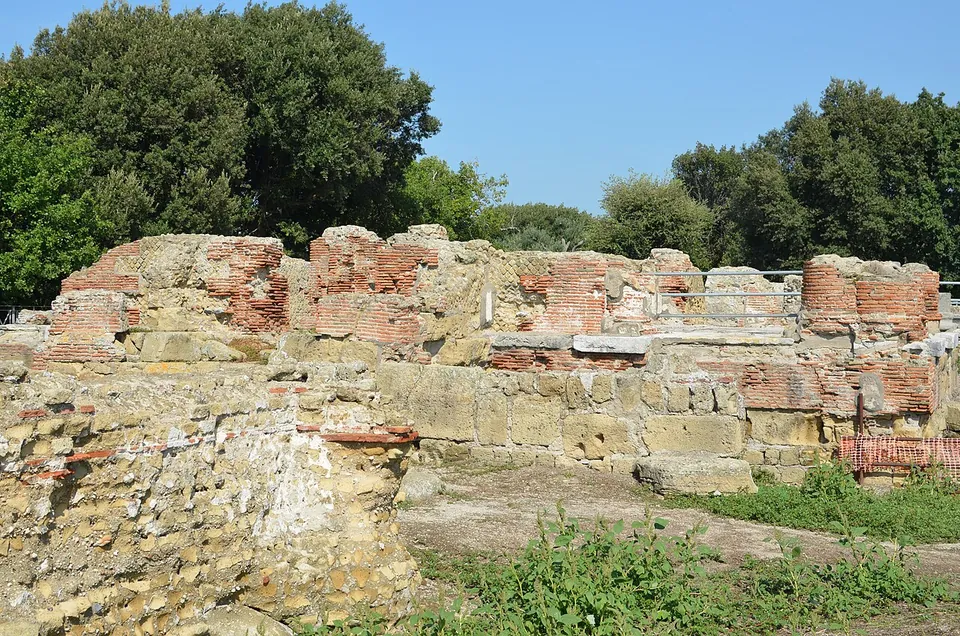
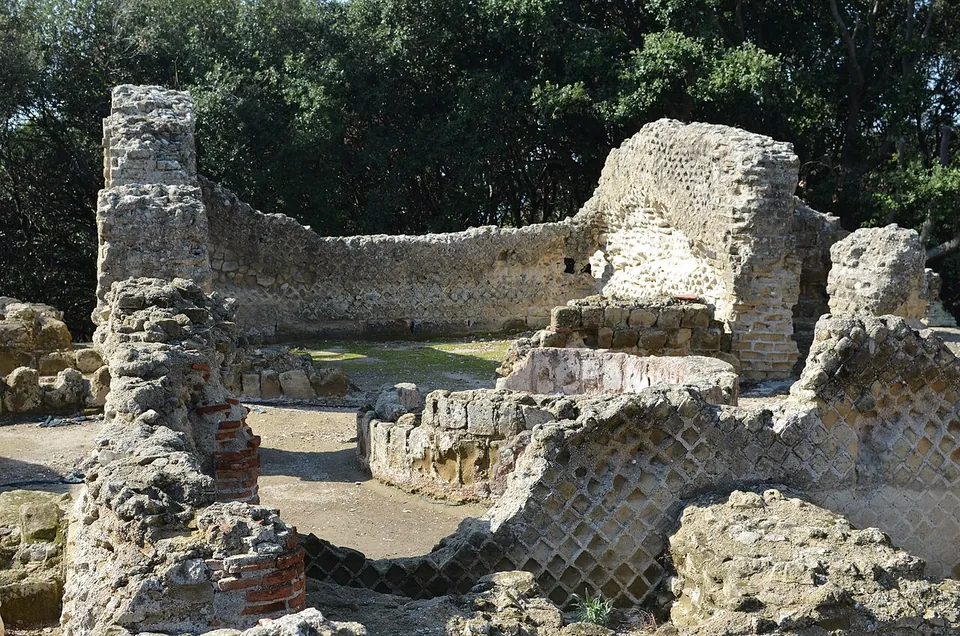
From there a path climbs past the Temple of Apollo on the lower terrace to the so-called Temple of Jupiter on the summit, the two linked by the Via Sacra, paved under Augustus (the operator). Both are Greek temples rebuilt in the Roman period and later turned into churches, and both are now ruins (it.wikipedia). At the Temple of Apollo the Roman brick columns still carry some of their stucco, and the church’s octagonal font stood on the south side of the cella. On the summit, nothing confirms that the temple was ever Jupiter’s; its Roman walls of net-patterned stone (opus reticulatum) were partly carried away when the edge of the hill collapsed; the church’s font, built for baptism by full immersion, can still be seen at the back of the building (it.wikipedia; the photograph’s Commons description). The temple is the subject of new research (the operator), and OpenStreetMap maps two viewpoints within 250 m of the site point.
At the foot of the acropolis lies the lower city, the town proper, with the forum and its tufa portico, the Capitolium, a temple with porticoes on the south side of the square, the “Masseria del Gigante”, the Central Baths and the Forum Baths (the operator). The Ministry of Culture’s listing says the lower city can be visited, but it was opened for the European Heritage Days of 2026 as a special event, so check before counting on it. Outside the park, OpenStreetMap maps the amphitheatre about 800 m from the acropolis, and the Arco Felice, a 20 m brick gateway Domitian built in AD 95 where the via Domitiana cuts through Monte Grillo, about 1 km away (en.wikipedia; OpenStreetMap). Many of the finds are in the Archaeological Museum of the Campi Flegrei in the Aragonese castle at Baia (en.wikipedia; the operator).
Is it worth the trip?
Yes, if you are already in the Campi Flegrei or in Naples with a morning to spare. The Cave of the Sibyl is the site’s great draw for visitors (it and fr.wikipedia), the acropolis has the sea on one side, and Cumae tells a story the Roman resort towns round the bay do not: it was Greek long before it was Roman, and the temples show Augustus’s builders reworking a Greek sanctuary.
Two honest caveats. The Roman buildings on the acropolis are ruins at wall height, not standing temples, so this is a place for setting and story more than for architecture. And it is awkward without a car: the nearest railway station has had no regular trains since 2014. The €10 Circuito Flegreo ticket, valid for three days, makes it easy to pair with the baths at Baia and the amphitheatre at Pozzuoli.
Getting there
The site lies at Cuma, between the comuni of Pozzuoli and Bacoli (en.wikipedia), beside the Strada Provinciale Acropoli di Cuma, with a paid car park about 110 m from the site and public toilets nearby (OpenStreetMap). OpenStreetMap maps bus stops on Via Cuma Licola and a bus terminus named Capolinea Cuma Scavi about 450 m away; the railway station of Cuma, as close, has had no regular service since August 2014 (it.wikipedia).
It is closed on Tuesdays. On other days it opens at 09.00 and closes at a time that follows the season, from 15.45 in winter to 19.00 between April and August, with the ticket office closing an hour earlier. Entry is timed, at most 50 people every 30 minutes, at most 25 inside the Cave of the Sibyl at once, and a visit may last up to two hours. A ticket is €5, €2 for EU citizens aged 18 to 25, and free under 18; buy it online on the Musei Italiani website or app, which the park strongly recommends, or at the machines at the entrance. The park refunds tickets when its sites close because of bradyseism, the ground movement of the Campi Flegrei (pafleg.cultura.gov.it, read 23 October 2026 — check before travelling).
Visiting details
- Opening hours
- Closed on Tuesdays. Other days from 09.00; closing time follows the season, from 15.45 (mid-November to December) to 19.00 (April to August), for example 17.40 in the first half of October and 17.15 in the second. The ticket office closes one hour before the site.
- Tickets
- €5; €2 for EU citizens aged 18 to 25; free under 18. The Circuito Flegreo ticket, €10 (reduced €5), is valid for three consecutive days at four sites of the park, Cumae, the Baia baths, the Baia castle museum and the Flavian amphitheatre in Pozzuoli. Tickets are sold online (Musei Italiani website or app) and at machines at the entrance; buying online is strongly recommended and compulsory for groups of more than ten.
- Parking
- Paid car park on the Strada Provinciale Acropoli di Cuma, about 110 m from the site point (OSM way/118640912); public toilets are mapped about 140 m away (OSM node/1333933285).
Before you go
- Entry is timed, at most 50 people every 30 minutes, with at most 25 inside the Cave of the Sibyl at once and a two-hour limit on the visit.
- Cuma railway station, about 450 m away, has had no regular trains since 2014. Buses stop on Via Cuma Licola, about 450 m away; come by car or check the bus lines first.
- The park refunds tickets for sites closed because of bradyseism, the ground movement of the Campi Flegrei, so check on the day.
Hours and prices checked 23 October 2026 on the operator's own site. Confirm before travelling.
History
Cumae was founded around 750 BC (it.wikipedia) by settlers from Chalcis and Eretria in Euboea, who were already established on Ischia (en.wikipedia). It grew into the dominant power on the Campanian coast, and the Euboean alphabet it brought, taken up by the Etruscans and then by the Romans, became the Latin alphabet. The Cumaeans defeated the Etruscans and their allies in 524 BC and, with the fleet of Syracuse, again in 474 BC; Tarquinius, the last king of Rome, died here in exile in 495 BC (en.wikipedia). In 421 BC the Oscans took the city.
Roman Cumae begins in 338 or 334 BC: published dates differ, en.wikipedia giving 338 and it.wikipedia 334. In that year the city, which had come under Roman rule together with Capua, was granted citizenship without the vote (civitas sine suffragio). It stayed loyal to Rome against Hannibal, and adopted Latin as its official language. In the civil wars it was one of Octavian’s strongholds against Sextus Pompey, and in 37 BC Agrippa’s works, to designs by Lucius Cocceius Auctus, linked the port of Cumae to the new naval harbour of Portus Iulius with road tunnels: the Crypta Romana under the acropolis and the Grotta di Cocceio towards Lake Avernus. Under Augustus the temples were rebuilt, and after 20 BC a branch of the Aqua Augusta brought water to the town; from AD 95 the via Domitiana gave it a road to the via Appia (en.wikipedia).
The Shepherd of Hermas, a Christian text of the 2nd century AD, mentions the Christian community at Cumae, and in late antiquity both temples on the acropolis became churches (en.wikipedia; it.wikipedia). During the Gothic Wars Cumae was one of the two fortified cities of Campania: Belisarius took it in 536, and when Narses won it back he found the Gothic treasury inside (en.wikipedia). Saracens sacked the acropolis in 915 and used it as a base until an army from Naples destroyed the town in 1207 (the operator). The first recorded excavations were in 1606; the Temple of Apollo was found in 1912 and identified by an inscription to Apollo Cumanus, and the Temple of Jupiter and the gallery of the Sibyl were investigated between 1924 and 1934 (en.wikipedia; it.wikipedia).
More photographs



Nearby
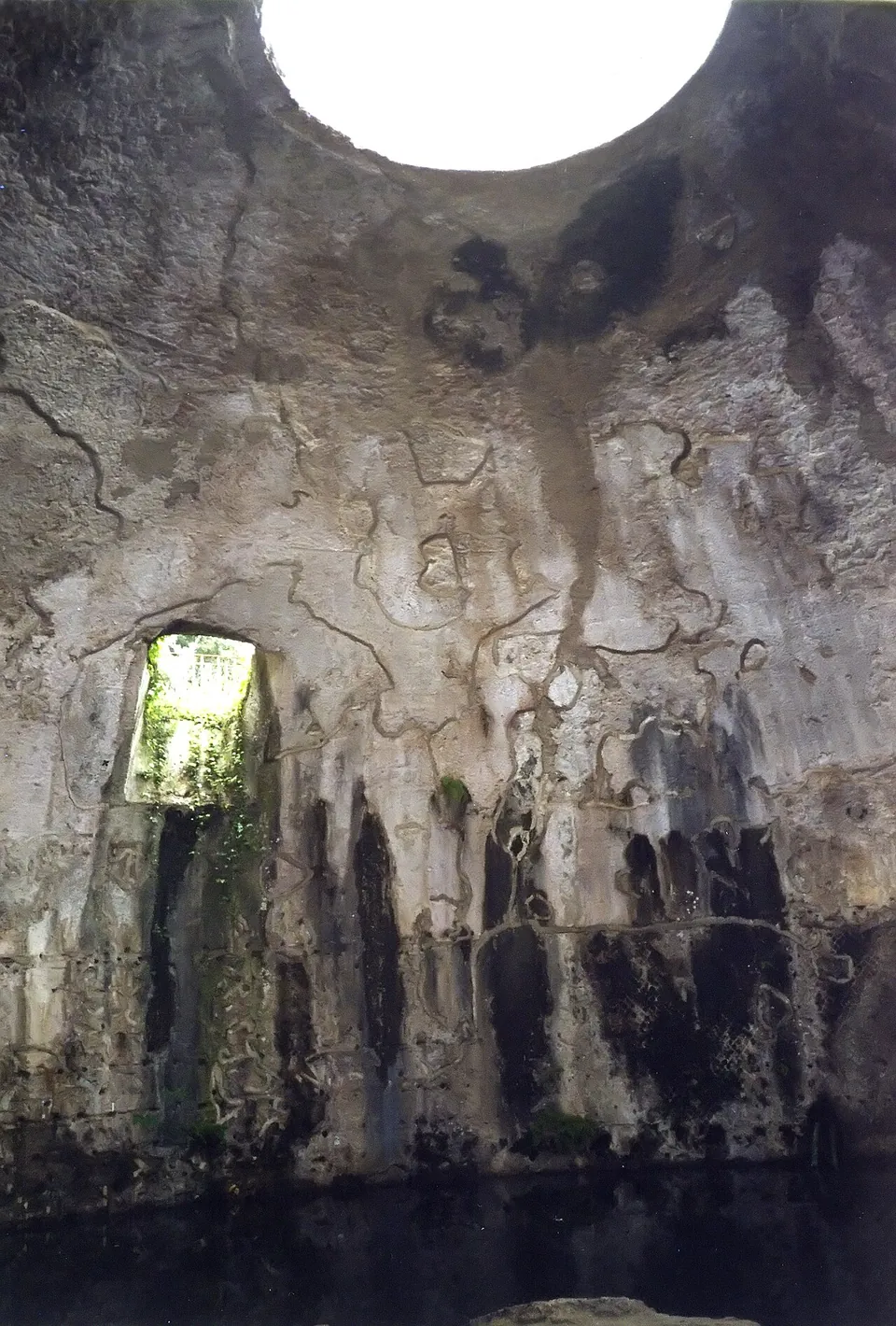
Photo: AM · CC BY-SA 2.5 · Commons
4 km · bath · Campania
Parco Archeologico delle Terme di Baia
The remains step down the slope in terraces along a front of about 450 m.
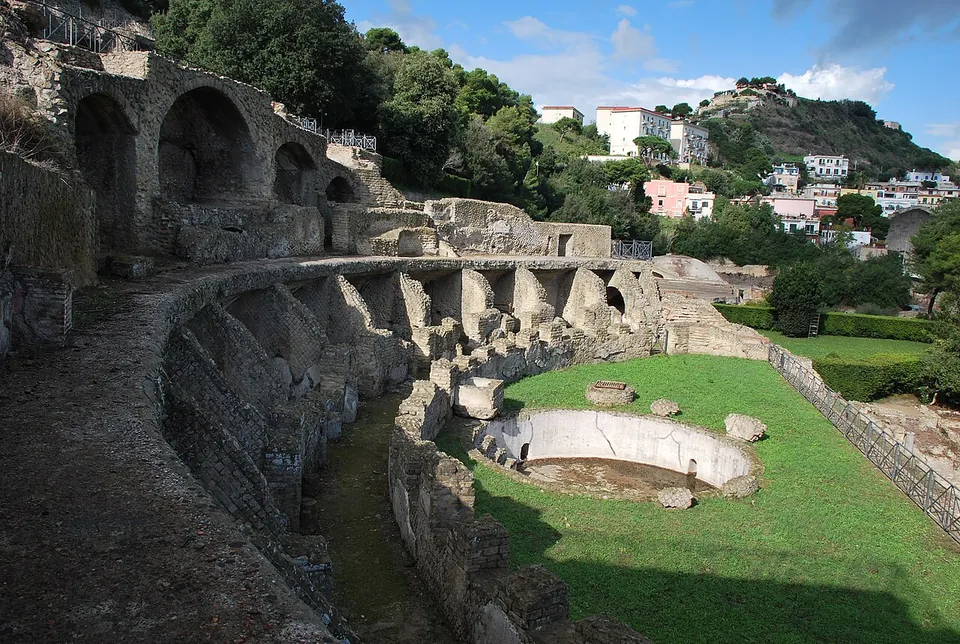
Photo: Lamberto Zannotti · CC BY-SA 3.0 · Commons
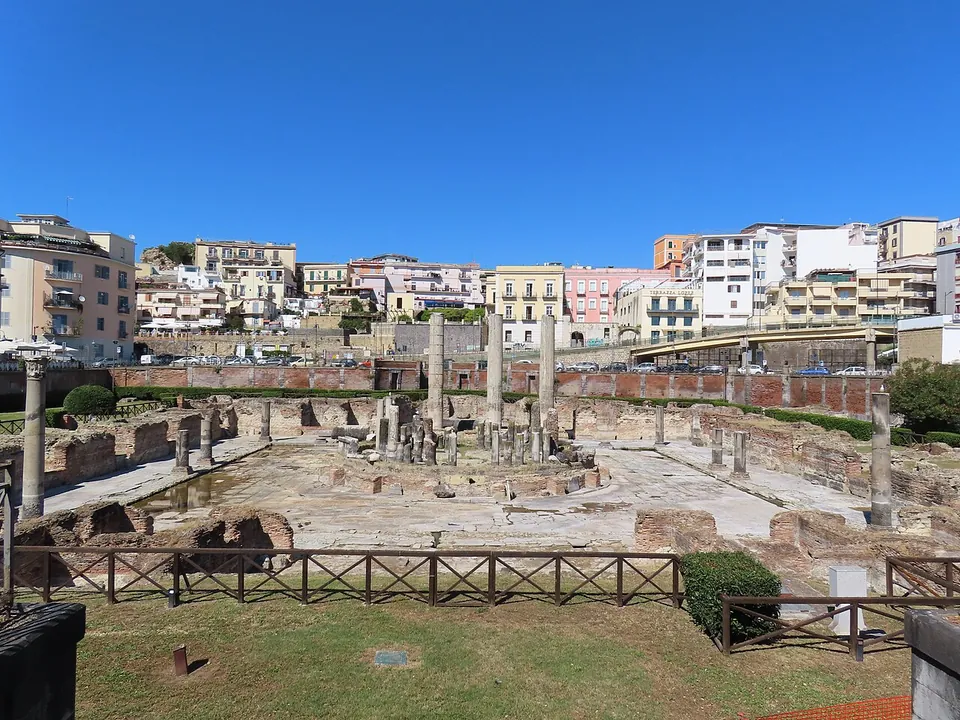
Photo: Superchilum · CC BY-SA 4.0 · Commons
6 km · site · Campania
Macellum of Pozzuoli
The whole plan of the market lies open in a sunken square of about 58 by 75 m, a few steps from the harbour quays in the centre of Pozzuoli (the operator).


Straight-line distances.
Sources
Every fact on this page comes from the records below, each used under the licence noted.
| Source | Licence |
|---|---|
| Pleiades 432808 | CC BY |
| Wikidata Q243456 | CC0 |
| OpenStreetMap way/1202134117 | ODbL |
| Wikipedia (en) — Cumae | CC BY-SA 4.0 |
| Wikipedia (it) — Cuma | CC BY-SA 4.0 |
| Wikipedia (de) — Cumae | CC BY-SA 4.0 |
| Wikipedia (fr) — Cumes | CC BY-SA 4.0 |
| Wikipedia (it) — Tempio di Apollo (Cuma) | CC BY-SA 4.0 |
| Wikipedia (it) — Tempio di Giove (Cuma) | CC BY-SA 4.0 |
| Wikipedia (it) — Anfiteatro romano di Cuma | CC BY-SA 4.0 |
| Wikipedia (it) — Stazione di Cuma | CC BY-SA 4.0 |
| Parco archeologico dei Campi Flegrei — info, access and opening calendar (the operator) | licence not recorded |
| Parco archeologico dei Campi Flegrei — tariffs (the operator) | licence not recorded |
| Parco archeologico dei Campi Flegrei — closing-time table for Cuma and Baia (the operator, PDF) | licence not recorded |
| Ministero della cultura — Parco archeologico di Cuma | licence not recorded |
| Ministero della cultura — GEP 2026, special opening of the lower city of Cuma | licence not recorded |