What is there today
The excavation lies under the Gothic church and its cloister, where Neapolis had its forum, the successor of the Greek agora (Scabec; en.wikipedia). The market itself was a rectangular porticoed building with shops round an open courtyard paved with mosaics; at its centre stood a small round building, a tholos, which en.wikipedia and Scabec describe as a food stall and it.wikipedia, citing the remains of a drain, as a fountain house. The porticoes ran along the sides of today’s cloister (it.wikipedia).
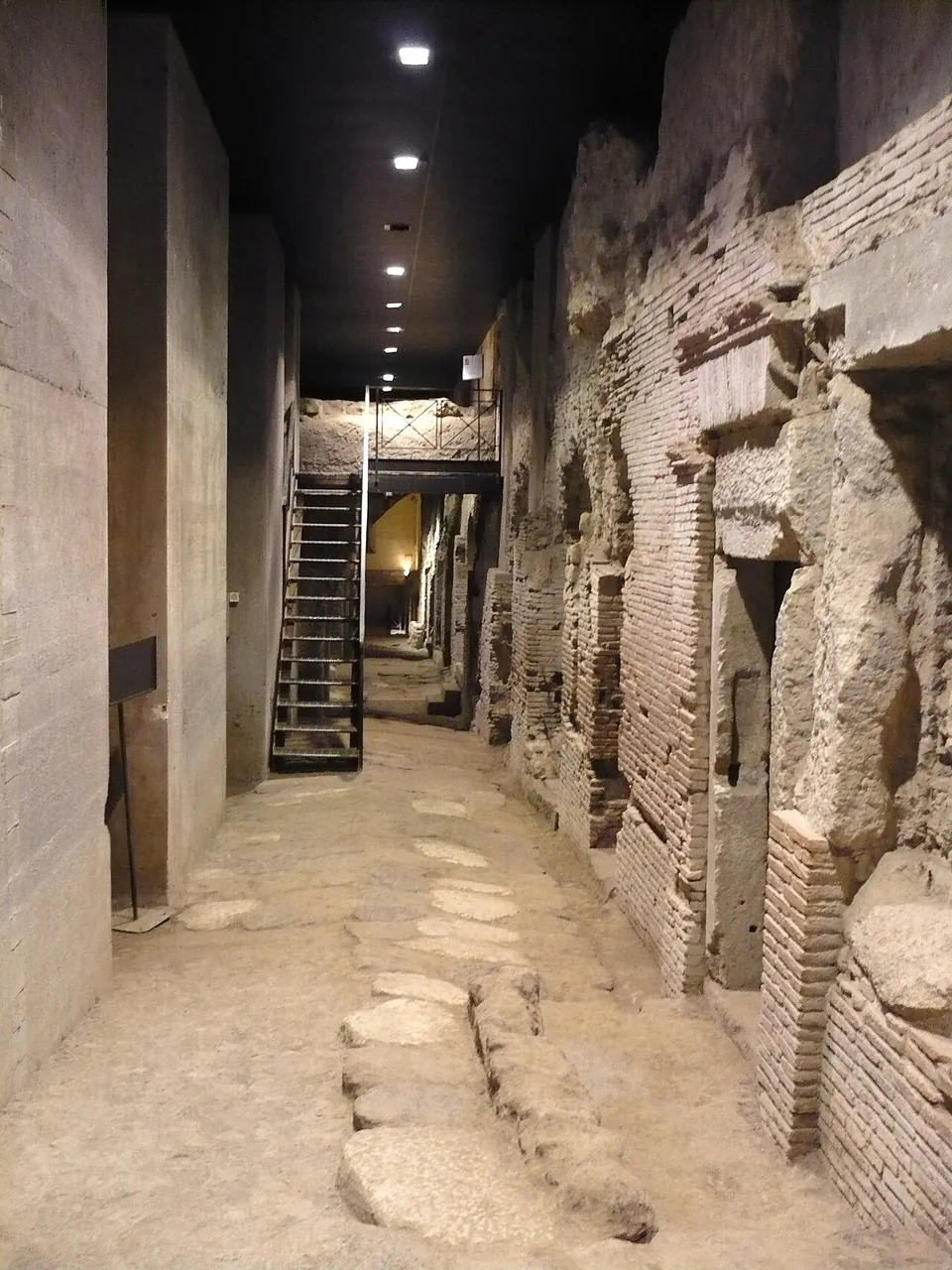
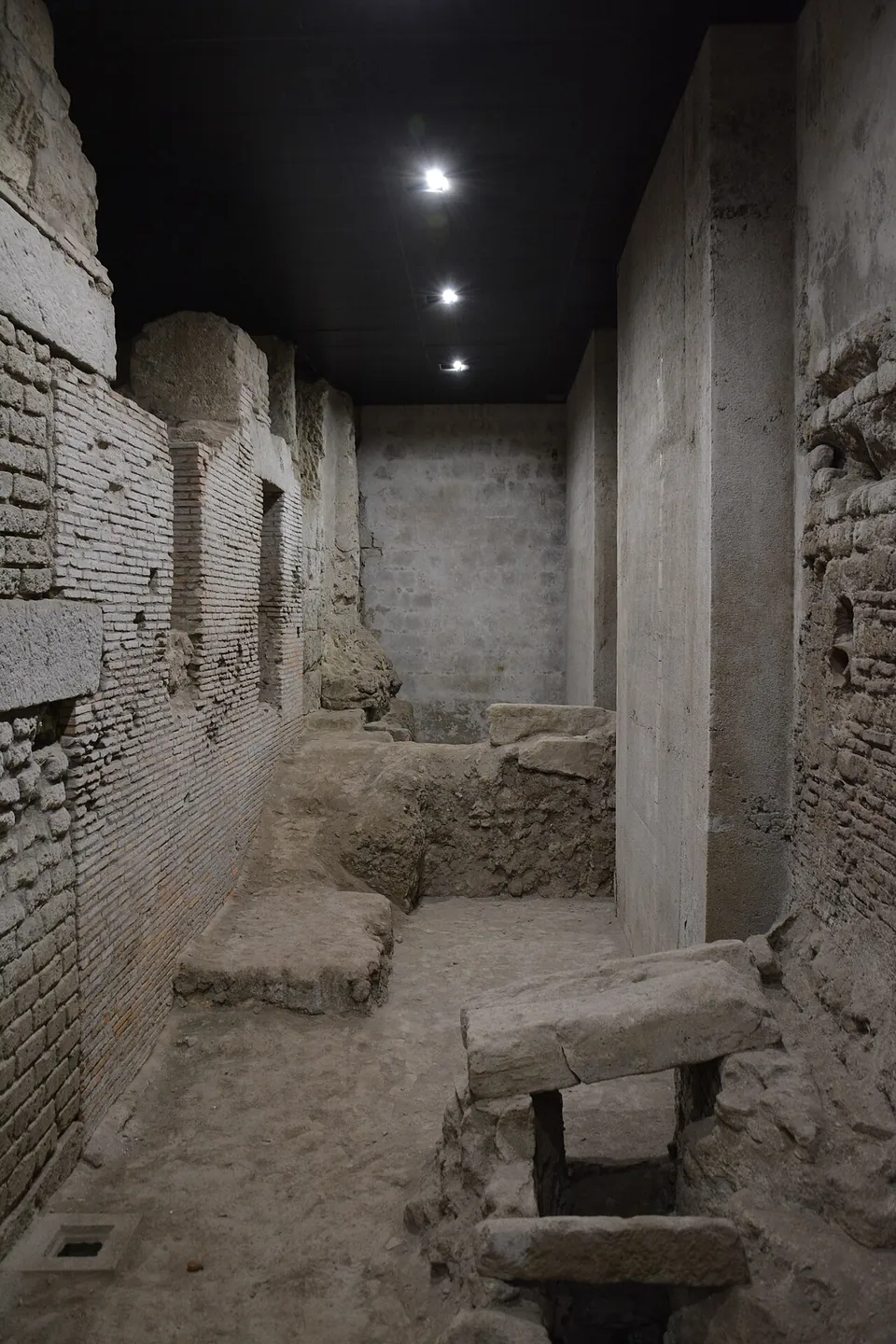
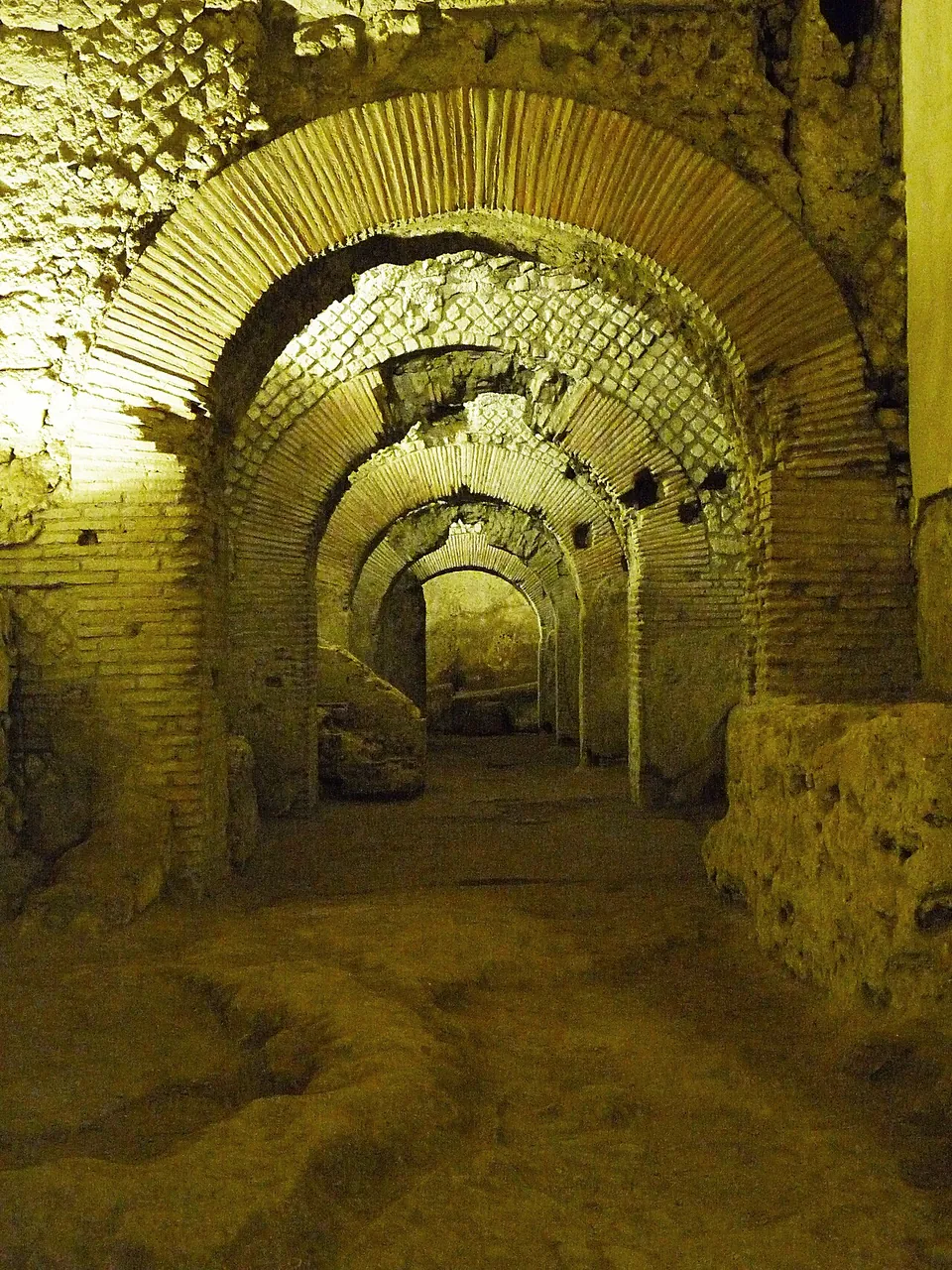
The lower levels hold the more striking remains. A paved street, identified as the cardo of Neapolis and about 60 m long, runs beneath the church’s transept, following the line of today’s Vico Giganti (Scabec; it.wikipedia). Along it a Roman building in three wings, which also held up the market terrace above, opens onto the street in nine shops of two barrel-vaulted rooms each, with an oven and tanks for dyeing cloth among them. At the end of the passage is the cryptoporticus, a covered market hall divided into small rooms with masonry counters, three of which are thought to have been the city treasury, the aerarium (Scabec). Part of the mosaic floor of a 6th-century early Christian basilica can be seen under the transept of the church (it.wikipedia), and the museum in the floors above the cloister tells the story of the area from classical archaeology onwards (en.wikipedia).
Three other Roman monuments stand within about 250 m:
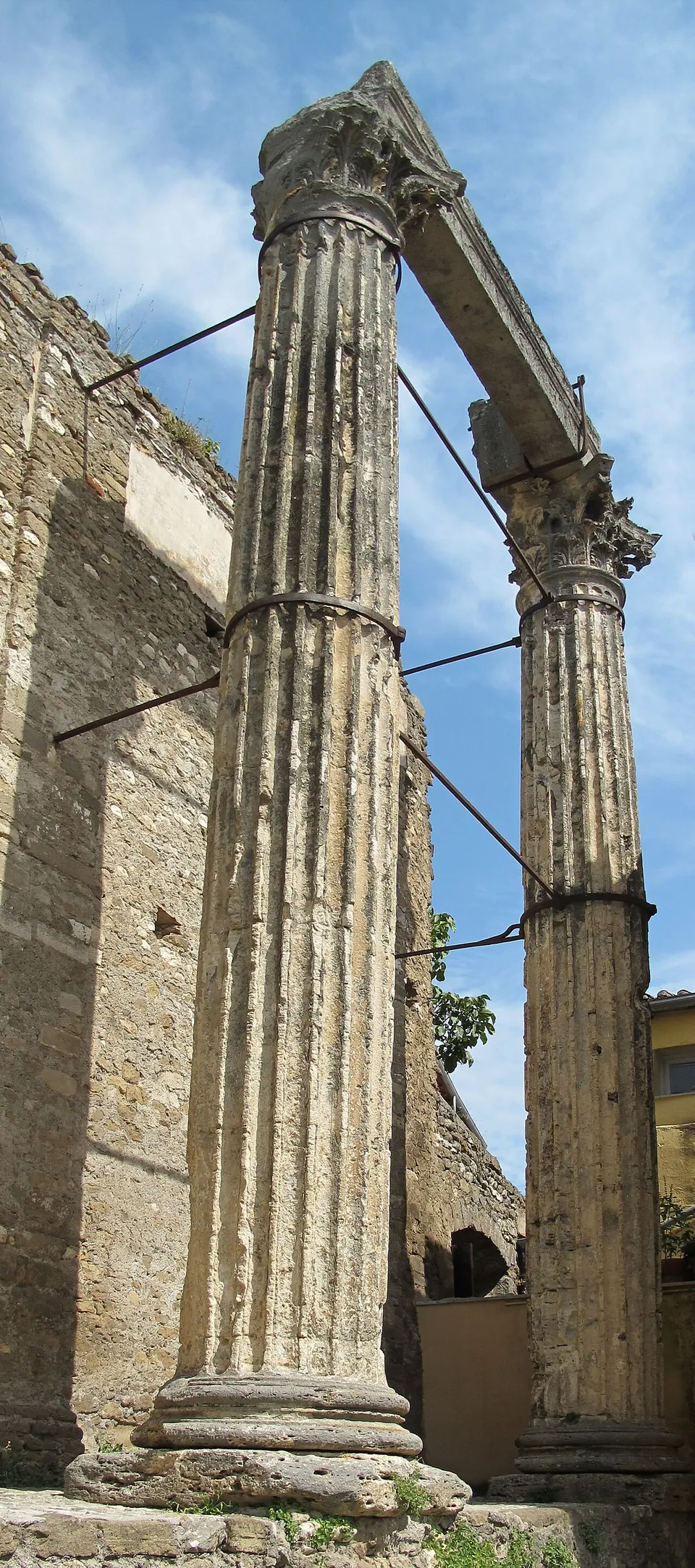
- Temple of the Dioscuri. On Piazza San Gaetano, 150 m away, two Corinthian columns of the temple of Castor and Pollux front the basilica of San Paolo Maggiore. The temple was rebuilt in the early imperial period, probably under Tiberius, on foundations attributed to the 5th century BC, and the church took it over in the 8th or 9th century, keeping its façade. The earthquakes of 1686–1688 left four of its eight columns standing, and two more were removed in the early 18th century (it.wikipedia).
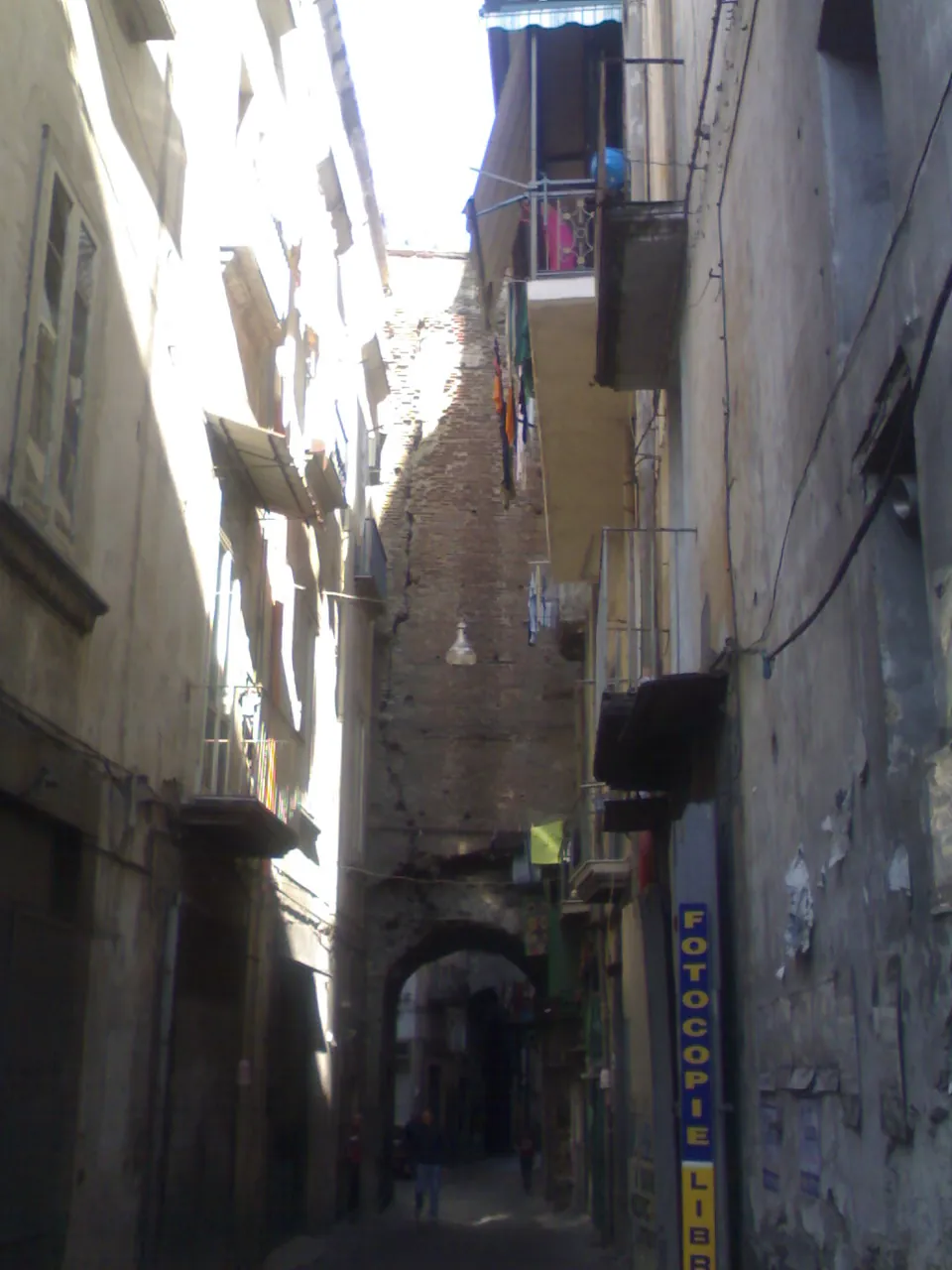
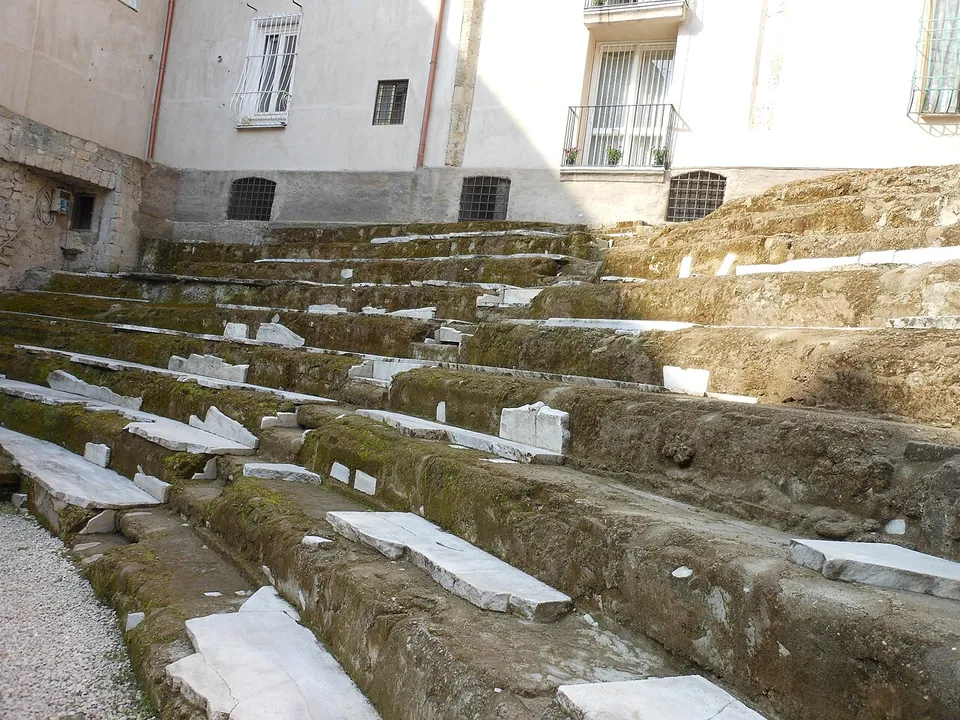
- Roman theatre. About 200 m to the north-west, in the blocks between Via Anticaglia, Via San Paolo and Vico Giganti, lies the theatre where Nero made his singing debut. Its seating held 5,000 to 6,000 people and some rows still carry their marble facing. Houses were built over it from the 15th to the 17th century, and two massive arches that once braced its outer wall are now part of the houses on Via Anticaglia, where anyone can see them from the street. Inside, one part is reached through a trapdoor in a ground-floor room on Vico Cinquesanti, where the owner of the room had hidden it under a bed that slid aside on rails; the seating in a courtyard off Via San Paolo opens only on special occasions (it.wikipedia).
- Santa Restituta and the baptistery. About 250 m to the north-east, inside the cathedral, Santa Restituta is the oldest basilica in Naples and was its first cathedral; tradition credits Constantine with its founding in the 4th century, and it probably stands on the site of a temple of Apollo (it.wikipedia; Pleiades). Cut down to a side chapel when the Angevin cathedral was built in the 13th century, it keeps 27 ancient columns with Corinthian capitals (it.wikipedia). Off it opens the baptistery of San Giovanni in Fonte, founded by Bishop Severus between the end of the 4th and the start of the 5th century, with the baptismal pool in its floor and mosaics in its dome showing scenes such as the Wedding at Cana, the Samaritan woman at the well and Christ handing over the law (the operator), probably of the 5th–6th century (Sussex database). Beneath the cathedral and Santa Restituta, excavations have exposed a Greek wall, the peristyle of a late imperial house, a stretch of Roman aqueduct and a Greek street (en.wikipedia); the operator’s visiting page does not say whether these are part of the free visit.
Wikidata and Vici.org also list an amphitheatre of Neapolis beside the theatre, but Vici.org marks it as invisible and neither describes anything, so there is nothing to look for.
Is it worth the trip?
Yes, if you are in Naples. Scabec, the Campania region’s cultural heritage company, calls the San Lorenzo excavation the most significant archaeological site in the historic centre, and en.wikipedia the only large-scale Greek-Roman site excavated there; it is where you walk a Roman street with its shops around you. Expect an underground site under artificial light rather than a ruin in the open.
The neighbours are worth adding. The Dioscuri columns are free to see from the square, Santa Restituta and the baptistery are a free guided visit, and the theatre needs Napoli Sotterranea’s tour, which mixes it with the Greek and Roman aqueduct and Second World War air-raid shelters (the operator), so it is a tour of underground Naples rather than a Roman one.
Getting there
The excavations are entered from the San Lorenzo Maggiore complex at Piazza San Gaetano 316, on Via dei Tribunali in the old town (the operator). OpenStreetMap maps no car park and no bus or metro stop near the entrance, and the surrounding lanes are a place to walk. Napoli Sotterranea starts on the same square, at Piazza San Gaetano 69 next to San Paolo Maggiore, and the cathedral is entered from Via Duomo 147 (the operators).
San Lorenzo Maggiore is open daily 09.30–17.30. A ticket is €9; €7 for ArteCard holders, teachers, university students and over-65s; €6 under 18; free under 6. A guide costs €2 more (€1 for ages 6–14), booked online and paid on site, and in busy periods visitors may be let in only with a guide (laneapolissotterrata.it, read 19 October 2026). Santa Restituta and the baptistery are shown on free guided visits, daily 09.30–17.00, leaving every half hour from the cathedral’s info point (the operator’s page as archived on 30 September 2026). Napoli Sotterranea’s tours leave on the hour from 10.00 to 18.00 in Italian and English; its own pages give no price. The Campania region’s listing calls San Lorenzo temporarily closed while the complex itself gives daily opening, so check before you go.
Visiting details
- Opening hours
- San Lorenzo Maggiore (the excavations): daily 09.30–17.30. Santa Restituta and the baptistery, in the cathedral: free guided visits daily 09.30–17.00, leaving every half hour. Napoli Sotterranea (the underground route that takes in the Roman theatre): tours in Italian and English leave on the hour from 10.00 to 18.00, with a Thursday 21.00 tour by reservation.
- Tickets
- San Lorenzo Maggiore: €9; €7 for ArteCard holders, teachers, university students and over-65s; €6 under 18; free under 6. An optional guided visit adds €2 (€1 for ages 6–14). Santa Restituta and the baptistery: free, with a voluntary donation. Napoli Sotterranea: no price on the operator's own pages. The Dioscuri columns are seen from the square.
- Parking
- The excavations are in the pedestrian old town, on Via dei Tribunali at Piazza San Gaetano. OpenStreetMap maps no car park and no bus or metro stop near the entrance; the nearest mapped ways are the lanes Vico dei Maiorani, Via dei Tribunali and Vico Giganti, 40–55 m away.
Before you go
- The Campania region's Scabec listing for San Lorenzo Maggiore reads "temporarily closed until further notice", while the complex's own site gives daily opening. The operator's page is the one used here, but check before you go.
- In busy periods the San Lorenzo complex may admit visitors only with a guide, at the guided-tour times (the operator).
- The cathedral's website refused automated reading on 19 October 2026; the Santa Restituta and baptistery hours are the operator's as archived on 30 September 2026.
- The Roman theatre's seating, in a courtyard off Via San Paolo, opens only on special occasions; otherwise the theatre is seen on Napoli Sotterranea's tour or from Via Anticaglia.
Hours and prices checked 19 October 2026 on the operator's own site. Confirm before travelling.
History
As early as the 5th century BC the Greek city laid out a square here on two levels, on either side of its main street, the line of today’s Via dei Tribunali: trade on the lower level, political life on the upper (Scabec). After Neapolis passed to Rome the agora was eventually turned into a macellum (en.wikipedia). Greek foundations of tuff blocks from the 4th century BC lie under a complex of the 1st century AD (it.wikipedia): the Roman layout of that century followed the older plan, and the market stood here in its second half (Scabec).
At the end of the 5th century AD alluvial mud, probably from a flood, buried the area, and that is what preserved it. An early Christian basilica rose on top, and in the 13th century the Franciscan monastery and Gothic church of San Lorenzo replaced what was left (en.wikipedia; Scabec). Excavation began in 1976 (it.wikipedia), and the site opened to visitors in the early 1990s (en.wikipedia; it.wikipedia); work completed in May 2009 doubled the area open to the public (it.wikipedia).
More photographs
Nearby
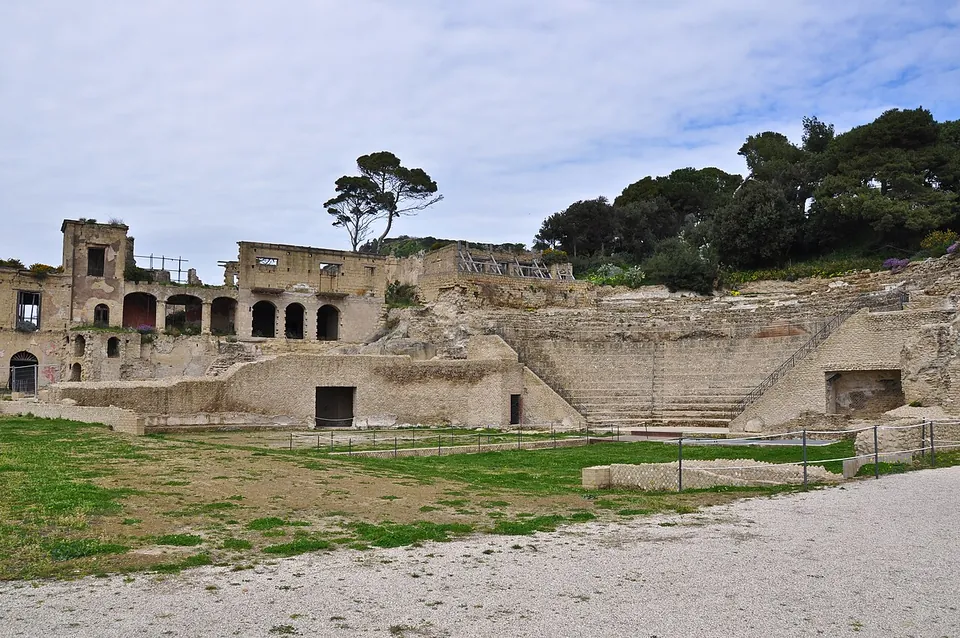
Photo: Armando Mancini · CC BY-SA 2.0 · Commons
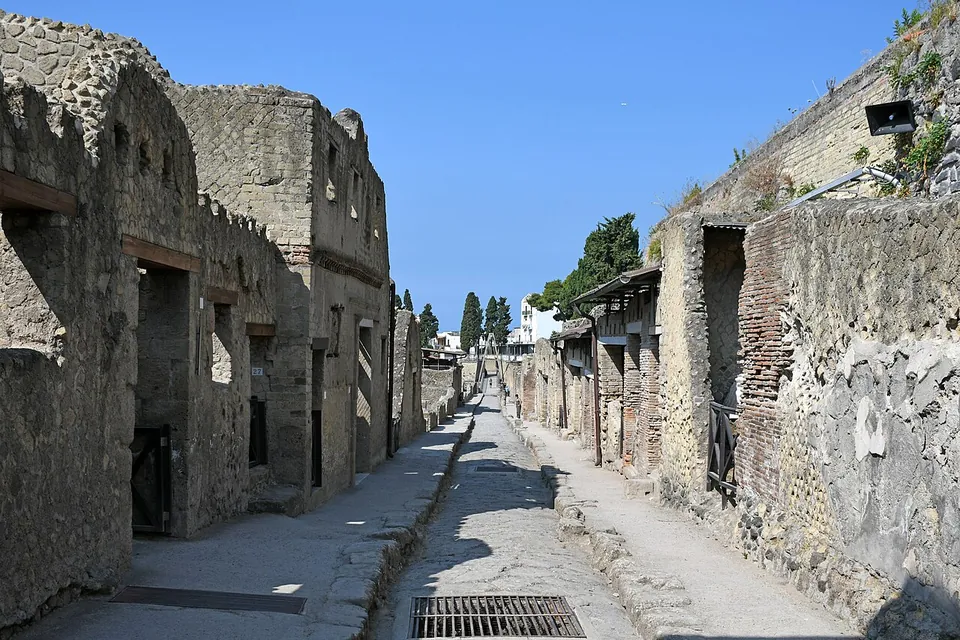
Photo: Phyrexian · CC BY-SA 4.0 · Commons
9 km · city · Campania
Herculaneum
Excavation has uncovered about 4 to 4.5 hectares of a town of roughly 20, so this is a compact site: four fully excavated blocks of houses and shops (insulae III to VI) and parts of others, between excavated streets, with the rest of ancient Herculaneum, including most of its forum and its temples, still under modern Ercolano (it.wikipedia, fr.wikipedia).
12 km · city · Campania
Puteoli – Pozzuoli
The Flavian Amphitheatre is the set piece: only the Colosseum and the amphitheatre of Capua are larger.


Straight-line distances.
Sources
Every fact on this page comes from the records below, each used under the licence noted.