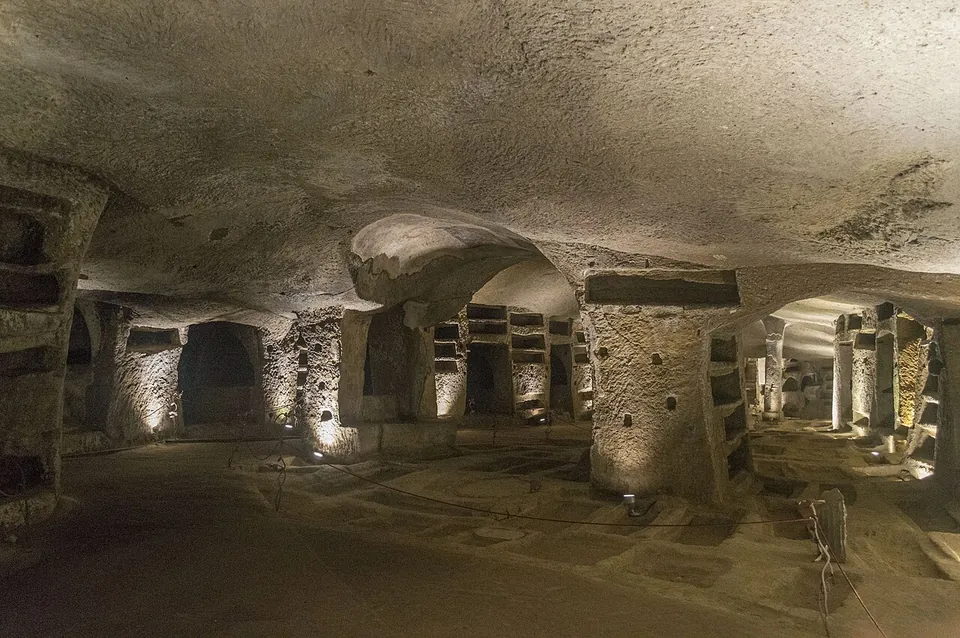
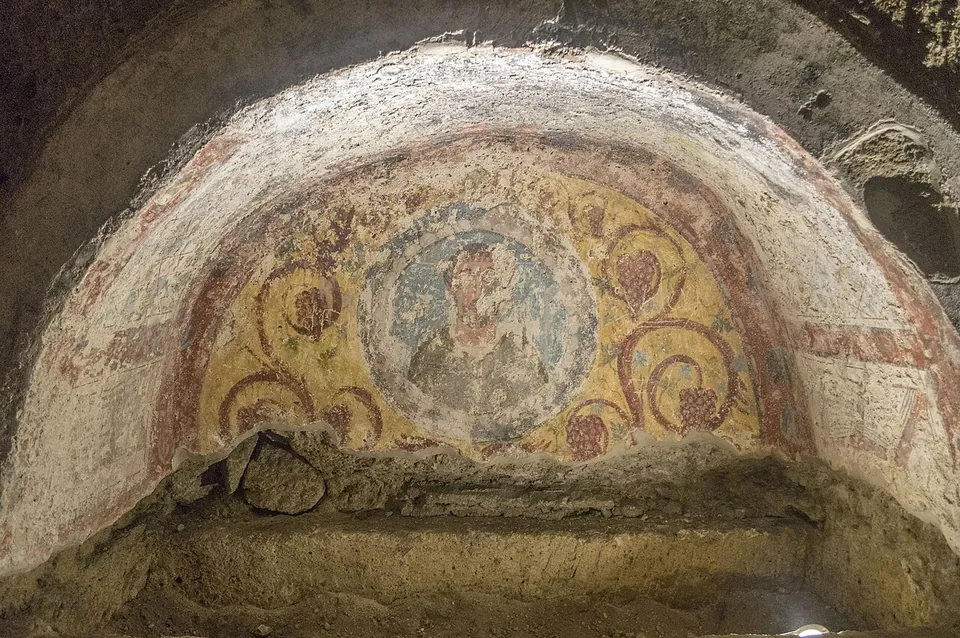
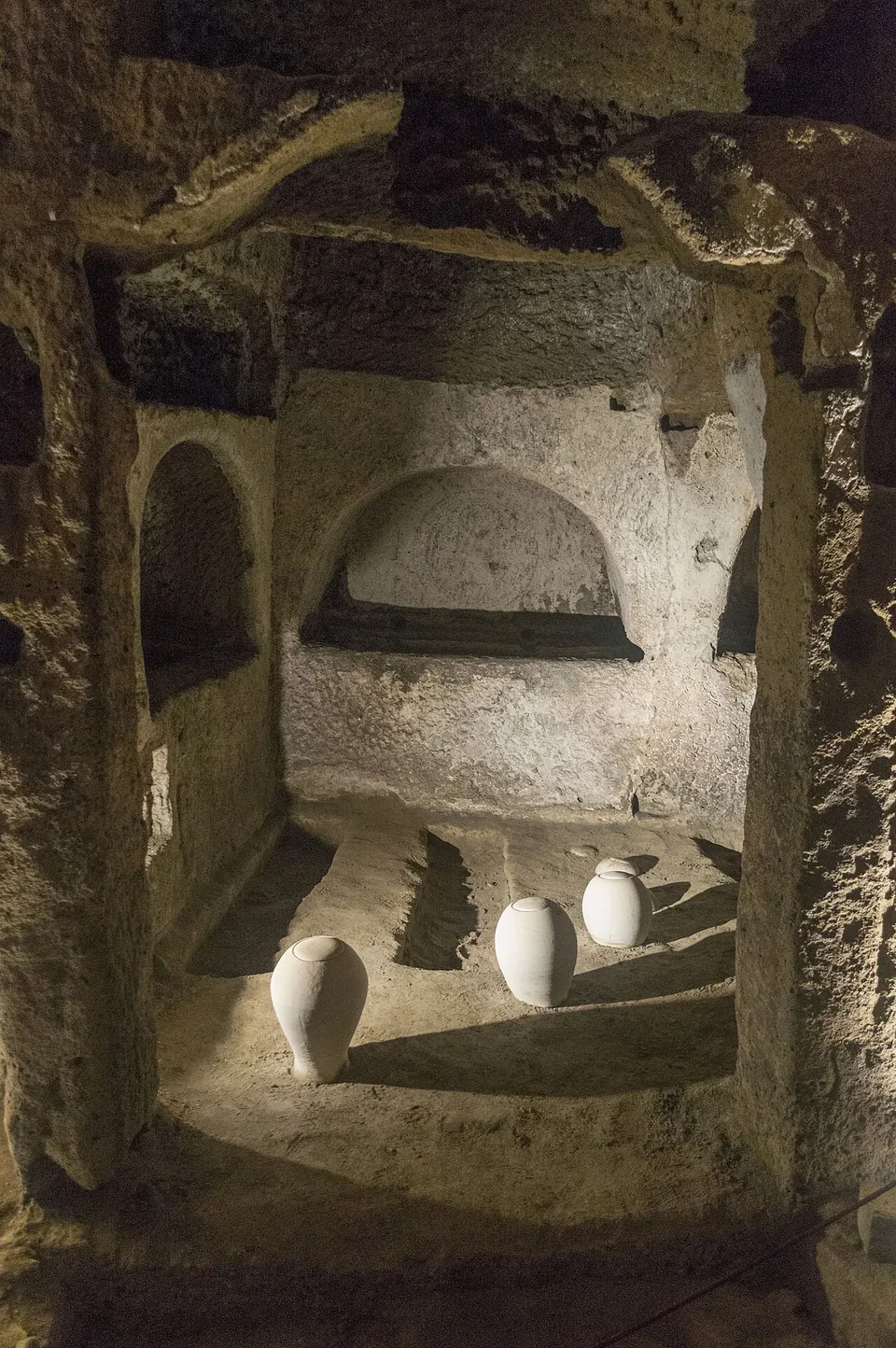
The Catacombs of San Gennaro are early Christian cemeteries cut into the volcanic tuff of the slope that leads up to Capodimonte, in the north of Naples, and the largest Christian catacomb complex in southern Italy (en.wikipedia): roomy galleries on two levels, underground basilicas and portraits in paint and mosaic from the 5th and 6th centuries. They are one stop of Neapolis – Naples.
What is there today
The catacombs lie on two levels, side by side rather than stacked, and both are unusually spacious, unlike the better-known catacombs of Rome, because the tuff was easy to cut and strong enough to stand (the operator). About 3,000 burials have been counted, an estimate, since not every chamber has been uncovered (the operator).
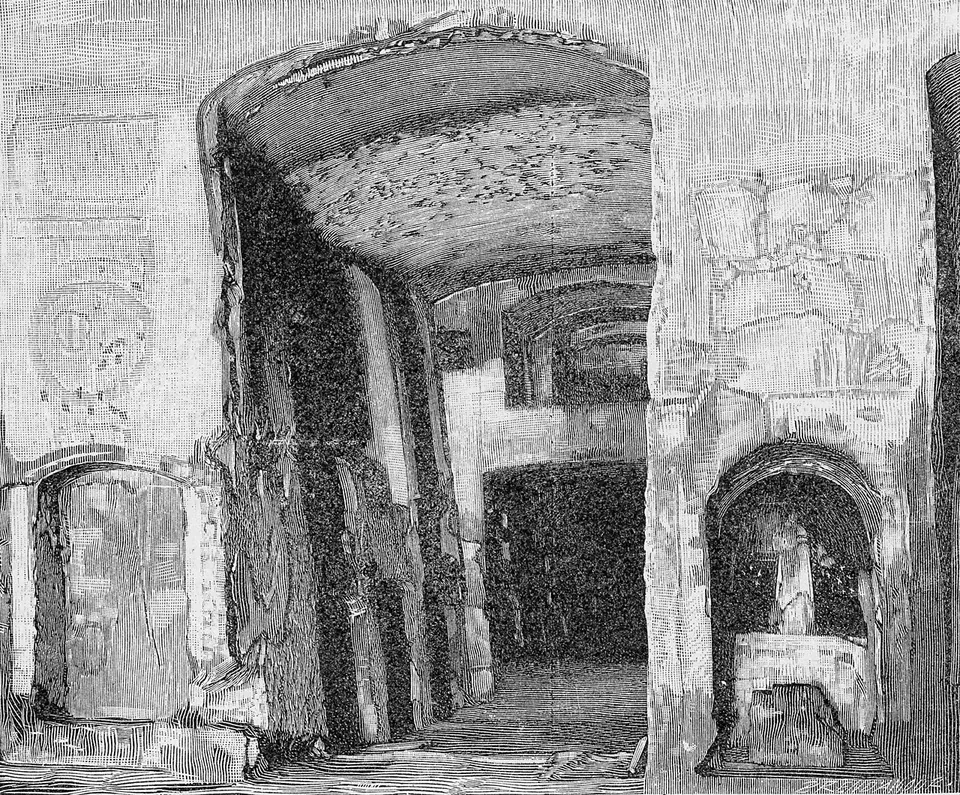
The lower catacomb spreads in a grid around the Basilica of Sant’Agrippino, a single nave dug out of the rock that still has a bishop’s chair carved from it and an altar with an opening through which the faithful could see and touch the saint’s tomb; Mass is still said there (the operator). Its vestibule, with ceilings up to 6 m high, holds a large baptismal basin made for Bishop Paul II in the 8th century (the operator), four complete sarcophagi carved in the tuff, and a ceiling painted in a manner that recalls the Pompeian style of the 2nd–3rd century (it.wikipedia).
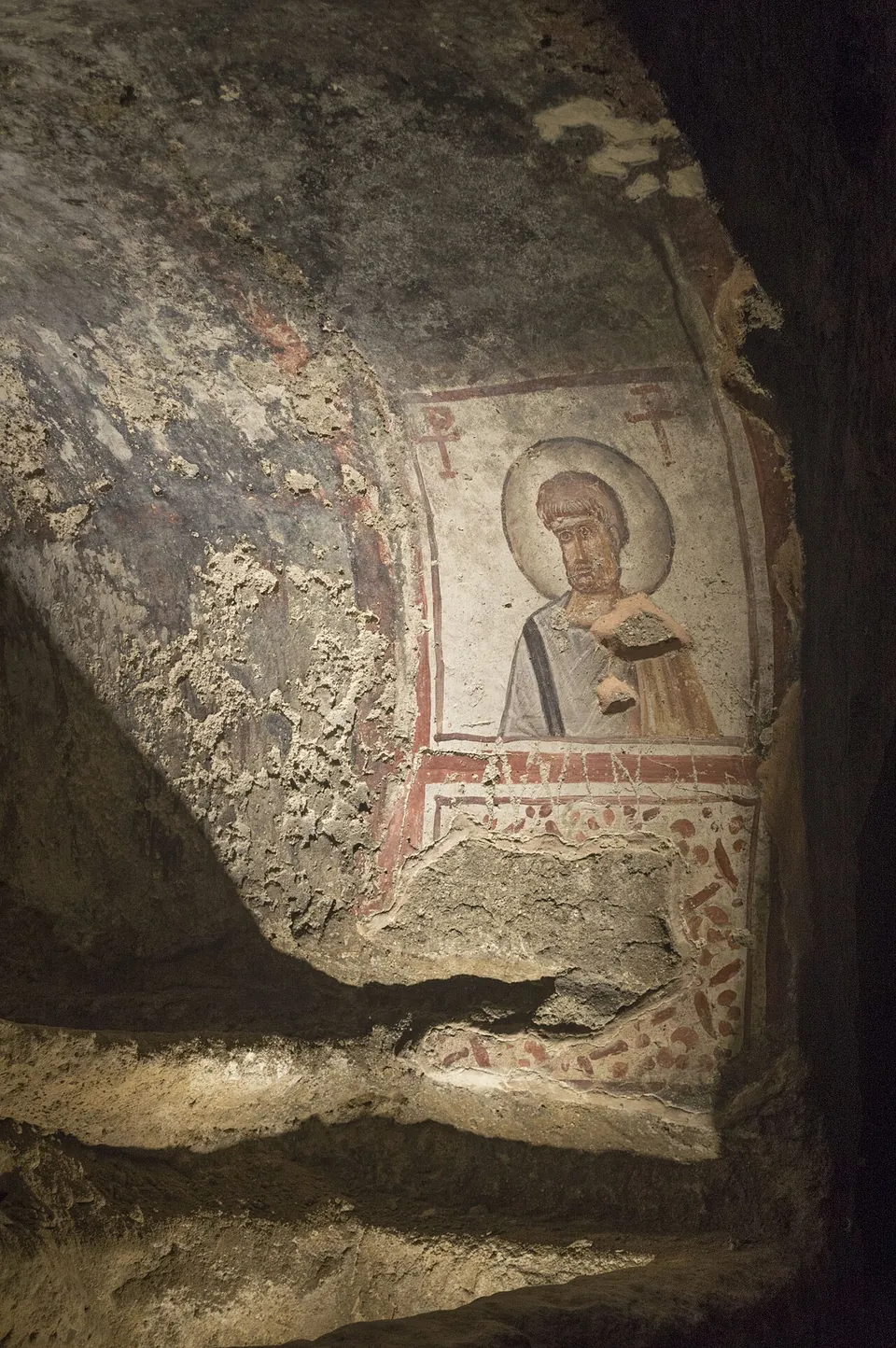
The upper catacomb, reached by the staircase from the entrance (it.wikipedia), grew from a 3rd-century tomb whose vestibule was painted early in that century in the so-called Pompeian style and holds some of the earliest Christian paintings in southern Italy (the operator). Here is the oldest known portrait of San Gennaro, of the 5th century, showing the martyr between a woman and a girl under the words Sancto Martyri Januario; the frescoes of the dead women Bitalia and Cerula, of the 5th–6th century; and a large basilica carved out of the tuff, which it.wikipedia calls very unusual, perhaps unique, in catacomb architecture. In the Crypt of the Bishops, 5th-century mosaics portray bishops, among them Quodvultdeus of Carthage, who was driven out by the Vandal king Genseric, reached Naples by sea and was buried here (it.wikipedia). The early 6th-century fresco of the family of Theotecnus, with his wife Ilaritas and little Nonnosa, has three layers of painted plaster, which suggests it was repainted at each death (the operator).
Is it worth the trip?
If you are in Naples, yes. it.wikipedia calls it the most important Christian monument in the city, and it survives as whole spaces: halls, galleries and churches cut into the rock, with their paintings and mosaics still in place. Be clear what it is, though: a Christian cemetery of the late empire, not temples or a theatre, and you see it only in a group on a guided tour of about an hour. If narrow passages put you off catacombs, these are wide.
Things to know before you go: booking is compulsory, it is closed on Wednesdays, and the way in is down a flight of steps; the step-free entrance was closed for works the last time the operator’s page could be read. Bring a sweater even in summer, since it is 15–22 °C underground (the operator). The same ticket admits you within 12 months to the smaller Catacombs of San Gaudioso, about 500 m away at the Basilica of Santa Maria della Sanità (the operator).
Getting there
The entrance is at Via Capodimonte 13, next to the Basilica del Buon Consiglio (the operator), the large church that marks the site (en.wikipedia), about 1.7 km north-west of the excavations under San Lorenzo Maggiore in the old centre. By bus, the operator gives lines 650, C63, 3M, 168, 178 and 204 from stop 1246 (Museo Nazionale) to stop 3250 (Basilica Incoronata – Catacombe San Gennaro), about 15 minutes. By car, leave the Tangenziale at exit 5, Capodimonte, and turn right into Via Capodimonte; the operator has a free car park at the catacombs.
Guided tours leave every hour from 10.00 to 17.00, in Italian and English, every day except Wednesday and 25 December (the operator; hours as archived on 17 October 2026). A ticket was €13; €9 for students and over-65s; €6 under 18; free under 6 and for disabled visitors (the operator’s tariff as last readable, in May 2024). The operator’s site could not be read directly, so check the current price and book on catacombedinapoli.it before you go.
Visiting details
- Opening hours
- Guided tours only, leaving every hour from 10.00 to 17.00 (the last at 17.00), every day except Wednesday; closed on 25 December. Booking is compulsory. A tour lasts about an hour and is given in Italian and English.
- Tickets
- €13; €9 for students, over-65s and members of the police; €6 under 18; free under 6 and for disabled visitors, with a companion at €9. The ticket also admits to the Catacombs of San Gaudioso within 12 months. These are the operator's prices as last readable, in May 2024.
- Parking
- The operator has a free car park at the catacombs (Tangenziale exit 5, Capodimonte, then right into Via Capodimonte; the basilica is on the right after 200 m). OpenStreetMap maps a car park 55 m from the point. By bus, the operator gives lines 650, C63, 3M, 168, 178 and 204 from stop 1246 (Museo Nazionale) to stop 3250 (Basilica Incoronata – Catacombe San Gennaro), about 15 minutes.
Before you go
- The catacombs can be seen only on a guided tour, booking is compulsory, and they are closed on Wednesdays.
- The operator's website refused automated reading on 23 October 2026. The hours are the operator's as archived on 17 October 2026; the prices, the bus lines and the car park come from its page as archived in May 2024, the newest copy that holds them.
- The step-free entrance, in Vicoletto San Gennaro dei Poveri 22, was closed for works on the tuff cliff beside it on the operator's pages of 2024 and February 2025, the newest copies that mention it; no notice of its reopening was found. The usual way in is down a flight of steps.
- It is 15–22 °C underground all year; the operator advises comfortable shoes and a sweater even in summer.
Hours and prices checked 23 October 2026 on the operator's own site. Confirm before travelling.
History
The catacombs began as the tomb of a rich Roman family of the 2nd–3rd century, whose name is lost because its inscriptions were dispersed, and which probably gave the space to the Christian community (it.wikipedia; the operator, which dates the core to the 2nd century AD). The oldest oil lamps found here, made in Naples, date from the second half of the 3rd century (en.wikipedia). The cemetery became a place of veneration when Saint Agrippinus, the sixth bishop of Naples and the city’s first patron saint, was buried in it at the end of the 3rd century (it.wikipedia); the enlargement that followed began in the 4th (the operator).
San Gennaro (Januarius) was beheaded at Pozzuoli in 305 and buried in the Agro Marciano. In the 5th century Bishop John I brought his remains to a chamber of the lower catacomb, and the cemetery took his name (it.wikipedia; the operator). Devotion to him made it grow: graves multiplied, galleries were lengthened, new chambers opened and painted, and when the walls were full, graves were dug into the floor (it.wikipedia). The portraits here are close to African painting of the 4th–6th centuries, and the link is direct: Christians fleeing the Vandal persecutions in Africa, under way from 439, came to Naples, among them Bishop Quodvultdeus of Carthage (it.wikipedia), who died in 450 (en.wikipedia).
The catacombs stayed in use long after Rome. Bishop Paul II lived here in 762–764, driven from the city by the party that followed the emperor’s iconoclast policy, and set up the baptismal basin; in 831 the Lombard prince Sico I besieged Naples and carried San Gennaro’s remains off to Benevento; dukes of Naples were buried here in the 9th and 10th centuries (it.wikipedia), and bishops until the 11th (en.wikipedia). Abandonment and looting followed from the 13th to the 18th century. Grand Tour travellers came in the 18th century, Andrea de Jorio wrote a guide in 1839, and in the Second World War the catacombs sheltered Neapolitans from air raids. In 1969 Cardinal Corrado Ursi opened a new entrance and began excavations that found the Crypt of the Bishops and the tomb of San Gennaro. From 2006, pressed by a network of young people from the Sanità district who already ran the San Gaudioso catacombs, the authorities opened the site to the general public, and visitors rose from 5,000 a year to 130,000 in 2018 (it.wikipedia).
More photographs
Nearby
Photo: Armando Mancini · CC BY-SA 2.0 · Commons
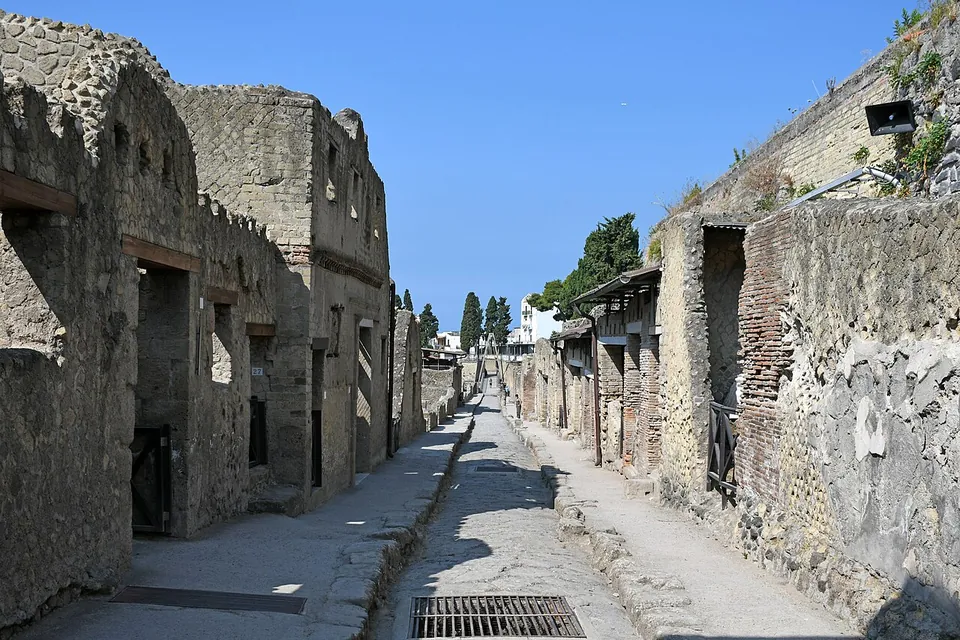
Photo: Phyrexian · CC BY-SA 4.0 · Commons
11 km · city · Campania
Herculaneum
Excavation has uncovered about 4 to 4.5 hectares of a town of roughly 20, so this is a compact site: four fully excavated blocks of houses and shops (insulae III to VI) and parts of others, between excavated streets, with the rest of ancient Herculaneum, including most of its forum and its temples, still under modern Ercolano (it.wikipedia, fr.wikipedia).
11 km · city · Campania
Puteoli – Pozzuoli
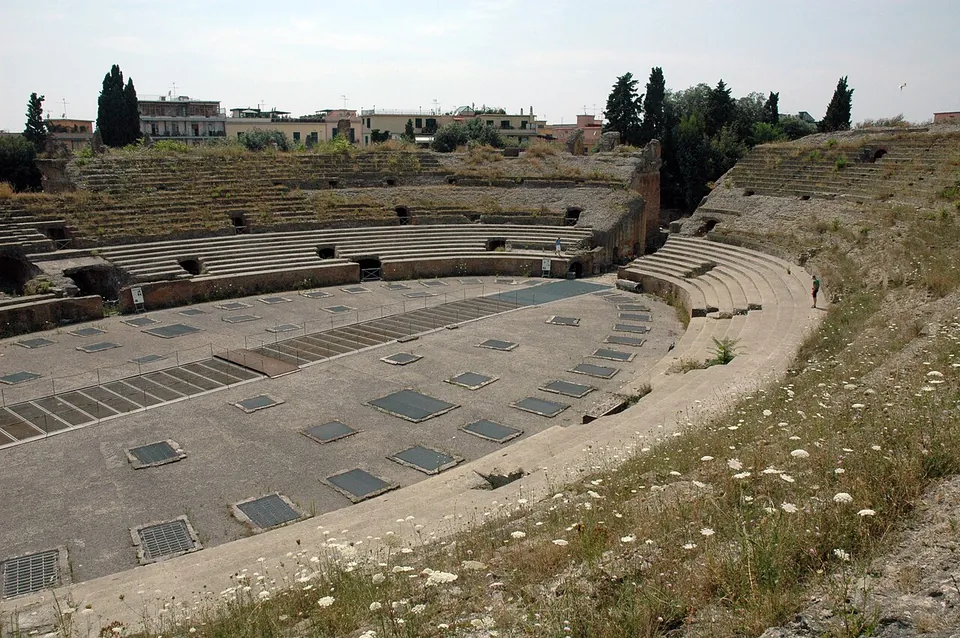
The Flavian Amphitheatre is the set piece: only the Colosseum and the amphitheatre of Capua are larger.


Straight-line distances.
Sources
Every fact on this page comes from the records below, each used under the licence noted.