

What is there today
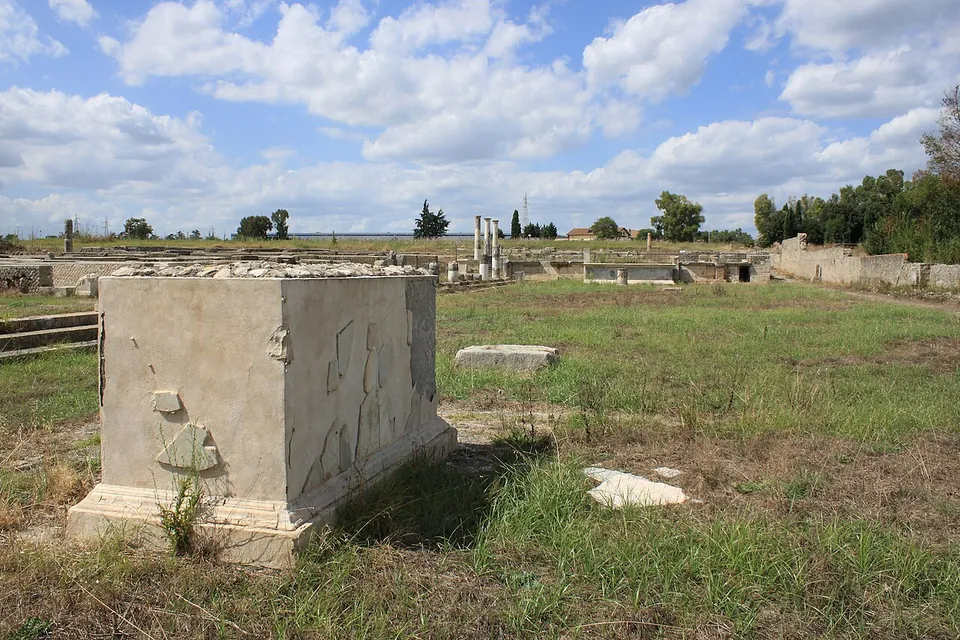
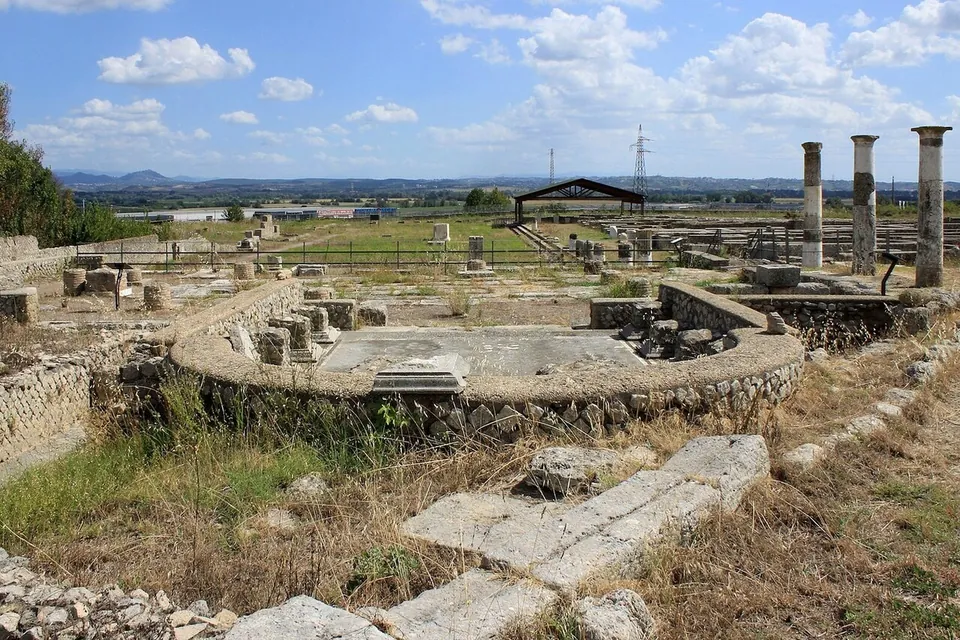
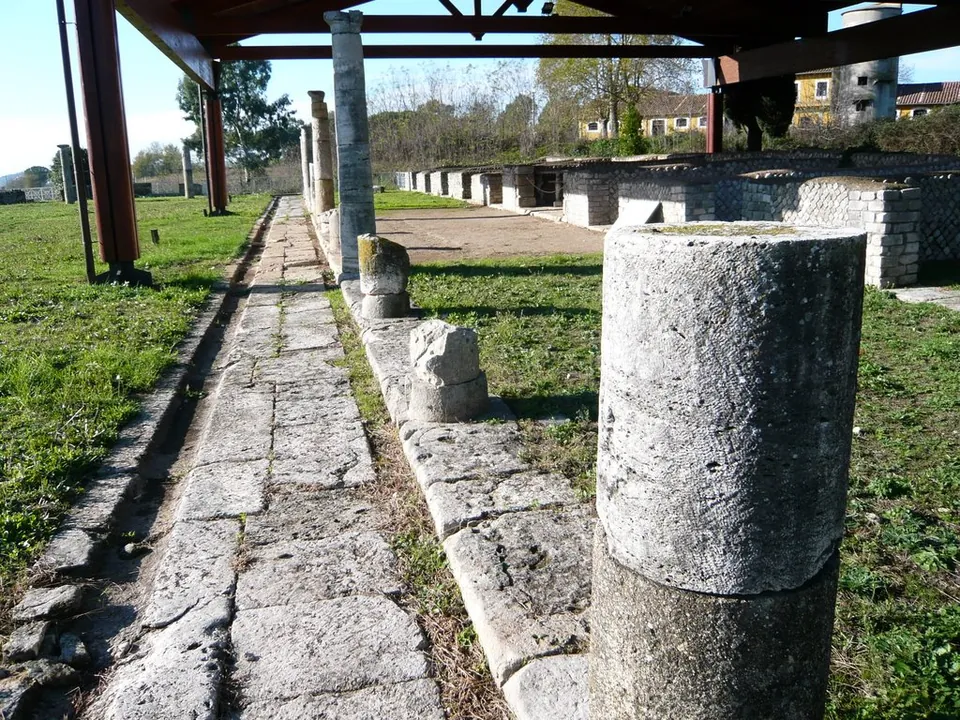
The forum is the centre of the visit: a long rectangular square with a colonnaded portico down its western side, where the shops opened, some of them paved with mosaics and some marked at the door with a sign of the trade inside (en.wikipedia; it.wikipedia). At its northern end stand the remains of the basilica and, behind it, the temple of Salus Frugifera and the Augusteum, a small apsed shrine of the imperial cult (en.wikipedia; de.wikipedia). The wall along the forum’s eastern side closed off the sanctuary of Feronia. What you see is a town plan at knee height — low walls, floors, statue bases, column stumps and a few standing columns — rather than standing buildings.
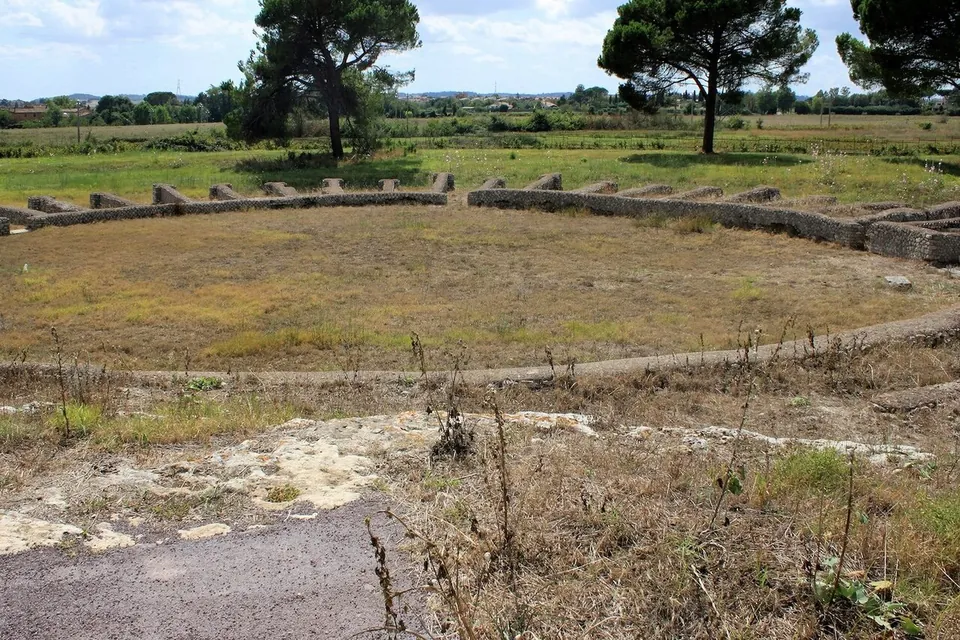
Beyond the forum there are houses with mosaic floors, two bath buildings, the paving of the Via Capenate and the amphitheatre: a nearly round building of 34 by 32 m whose walls survive only a little above ground and whose seats, probably of wood, are gone (de.wikipedia). Published figures for its capacity range from about 5,000 to 5,500 spectators (en.wikipedia; it.wikipedia).
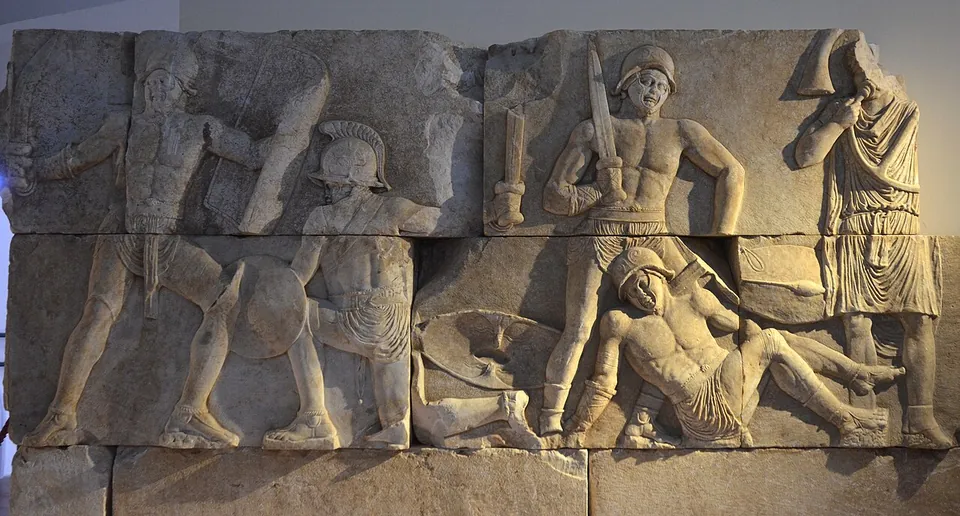
The Antiquarium, about 210 m from the forum (OpenStreetMap), shows the finds in six sections, including the statues of the shrine of the Augustales, displayed inside a full-size reconstruction of the shrine, and, in the atrium, part of a funerary monument with a gladiator relief from Fiano Romano (the operator).
About 400 m away, across the Via Tiberina, the Villa dei Volusii is the other half of the visit: a senatorial country house of the mid-1st century BC on a terrace above the lower Tiber valley, with mosaic floors of the late Republic under protective timber roofs (it.wikipedia; the operator).
Is it worth the trip?
Yes, if you are driving: it costs nothing, it sits right beside the A1 motorway, and in one stop you get a Roman town, its museum and a large senatorial villa that both its Wikipedia articles describe as the only one in Italy excavated almost entirely. Lower your expectations of height. Apart from a few columns, almost everything stands at foundation level on an open plain, the motorway cuts through the ancient site (en.wikipedia), and the amphitheatre is a grassy ring. It rewards someone who enjoys reading a town plan and good mosaics, not someone hoping for a second Ostia.
Getting there
The entrance is on the Via Tiberina at km 18.5, in the comune of Capena (the operator), close to the A1’s junction for Fiano Romano and Rome North (it.wikipedia; de.wikipedia). A car park is mapped about 230 m from the forum (OpenStreetMap). No bus stop or railway station is mapped nearby, so plan on a car. The villa is reached from the town by a footbridge over the road, and can also be entered from the Feronia Ovest service area of the A1, on the carriageway towards Rome (it.wikipedia).
Entry is free everywhere and needs no booking. Everything is closed on Mondays. The archaeological area opens Tuesday to Saturday from 08.30 until an hour before sunset, and on Sundays and holidays from 08.30 to 14.00 (the listing’s own timetable says 13.30 on Sundays). The Antiquarium keeps 08.30–19.30 Tuesday to Saturday and 08.30–14.00 on Sundays and holidays. The villa has shorter hours: 09.00 to 17.00 Tuesday to Saturday (the area’s listing says 16.00) and 09.00–14.00 on Sundays (Ministry of Culture listings, read 23 October 2026; check before travelling).
Visiting details
- Opening hours
- Closed on Mondays. Archaeological area: Tuesday to Saturday 08.30 until one hour before sunset; Sundays and public holidays 08.30–14.00 (the same listing's timetable grid gives 13.30), with holidays falling on a weekday kept to the weekday hours. Antiquarium (the site museum): Tuesday to Saturday 08.30–19.30, Sundays and public holidays 08.30–14.00. Villa dei Volusii: Tuesday to Saturday 09.00–17.00 (the archaeological area's listing gives 16.00), Sundays 09.00–14.00.
- Tickets
- Free for the archaeological area, the Antiquarium and the Villa dei Volusii; no booking needed.
- Parking
- A car park is mapped about 230 m from the forum (OSM way/1179819860), with the Antiquarium about 210 m away (OSM node/7166844288).
Before you go
- No bus stop or railway station is mapped near the site; plan on a car.
- The Villa dei Volusii has its own, shorter hours and lies about 400 m away across the Via Tiberina (SP 15/A), reached by a footbridge.
Hours and prices checked 23 October 2026 on the operator's own site. Confirm before travelling.
The forum and its buildings
The first forum buildings date from the second half of the 1st century BC and were laid over the earlier town. In the centre stood altars and statues, among them two equestrian statues, one of M. Volusius Saturninus, friend of the emperor, patron of the town and owner of the neighbouring villa (en.wikipedia). The basilica was built under Augustus with a porticoed courtyard for statues and honorific inscriptions; under Tiberius, in AD 14–20, its apsed shrine became the Augusteum, floored in coloured marble and holding twelve statues, and under Trajan the basilica was repaved (en.wikipedia). de.wikipedia adds that the basilica was built over an older substructure that was probably the temple of Feronia.
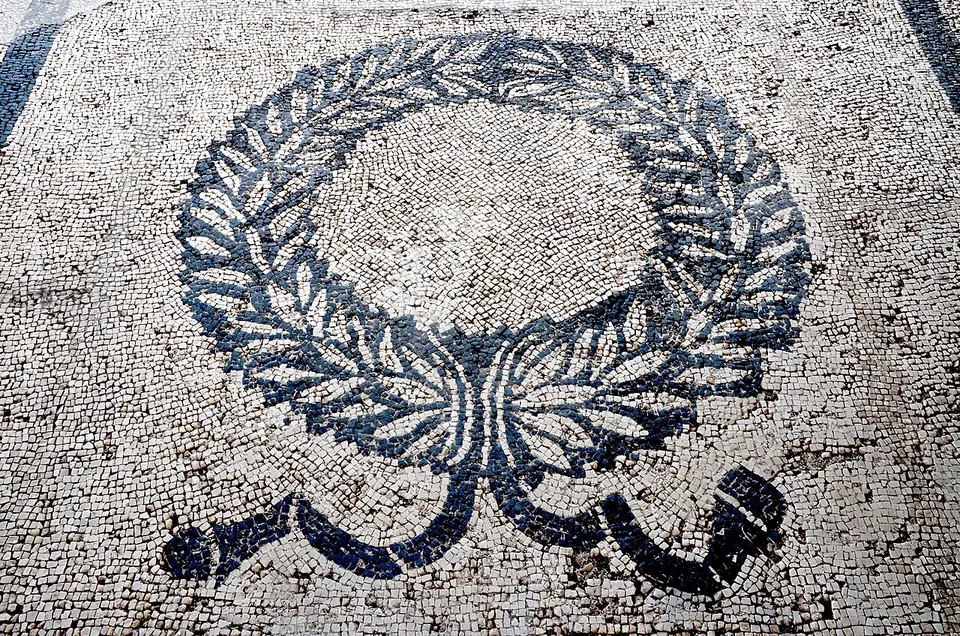
The forum baths, excavated in the 1970s, are the largest found in the town, with monochrome mosaic floors, one centred on a laurel wreath; brick stamps show repairs under Caracalla, and in the 5th century a church was built in their atrium. The smaller baths on the Via Capenate were built under Trajan and are the only building on that road excavated in full (en.wikipedia).
The sanctuary
Inscriptions show that the grove of Feronia lay behind the forum’s eastern wall, reached through a small portico built in the early Augustan period by the magistrate A. Ottavius (en.wikipedia). The sanctuary was rebuilt in stone between 143 and 129 BC as a Corinthian temple with porticoes round the sacred area, and was later destroyed, perhaps in the Social War after 90 BC (en.wikipedia). When the colony was founded the cult of Feronia gave way to that of Salus Frugifera (en.wikipedia), though Trajan later built two small temples in the sanctuary.
The amphitheatre
An inscription names its builder, the freedman M. Silius Epaphroditus, who paid for it himself (Pleiades; en.wikipedia). It was found only from the air: the walls are so low that its shape could be made out only from a height, and a flight over the site led to its excavation (de.wikipedia). The masonry, small tufa blocks set in a net pattern, dates it to the early 1st century AD, with repairs in the early 2nd (en.wikipedia); Pleiades puts it in the reign of Tiberius and it.wikipedia under Trajan. en.wikipedia calls it the smallest amphitheatre in the Roman Empire.
The Villa dei Volusii
The villa came to light by chance in the early 1960s, while the Autostrada del Sole was being built at the Fiano Romano junction. Building work destroyed part of it and the motorway’s access ramp cut it in two; the central part was excavated in full between 1962 and 1971, and its floors were later protected under roofs (the operator). It was built around the middle of the 1st century BC by the senatorial Volusii Saturnini, probably over an earlier villa of the Egnatii, and enlarged by Lucius Volusius Saturninus, consul in 12 BC (en.wikipedia; it.wikipedia).
It stands on two levels, the upper one carried on a cryptoporticus: a residence round an atrium, with a dining room and tablinum, and a great peristyle with a lararium (the operator). Around sixty rooms have been identified, and the floor of room 23, in opus sectile, is one of the oldest known floors of its kind (en.wikipedia). Published readings of the great peristyle differ: en.wikipedia describes slave quarters for at least 500 people around it, while it.wikipedia says the northern peristyle was once mistaken for slave quarters. Portraits found here include Caligula, Agrippina the Younger and Nero (it.wikipedia). The villa was enlarged again in the 2nd century, restored in the 3rd and 4th, and used until the 5th, when a small cemetery was set in its residential part (the operator).
History
The grove of Feronia, a goddess probably Sabine in origin, lay where Etruscan, Latin, Sabine and Faliscan lands met, near the Tiber, in the territory of Capena (en.wikipedia; de.wikipedia). Roman tradition already has its annual festival, a pilgrimage and a fair at once, in the time of the legendary king Tullus Hostilius (Livy and Dionysius, via en.wikipedia). Its wealth drew Hannibal, who plundered it in 211 BC on his retreat from Rome (en.wikipedia; it.wikipedia). Published dates for the first town around the sanctuary range from the 3rd to the 1st century BC.
In the 40s BC a colony of army veterans, the Colonia Iulia Felix Lucus Feroniae, was laid out with a regular street grid; published accounts differ on whether Caesar founded it or the triumvirs after his death. Augustus added an aqueduct and the basilica, among other buildings (en.wikipedia; it.wikipedia). Honorific inscriptions in the forum show a flourishing town from the Julio-Claudian age to AD 266; Trajan restored much of it, and the last building work dates from the 4th century (en.wikipedia). Published accounts put the town’s abandonment in the 4th century (it.wikipedia; de.wikipedia) or at the start of the 5th (en.wikipedia). Excavation began in 1952 (the operator), and part of the town was dug when the A1 motorway, which crosses the site, was built (en.wikipedia).
More photographs



Nearby
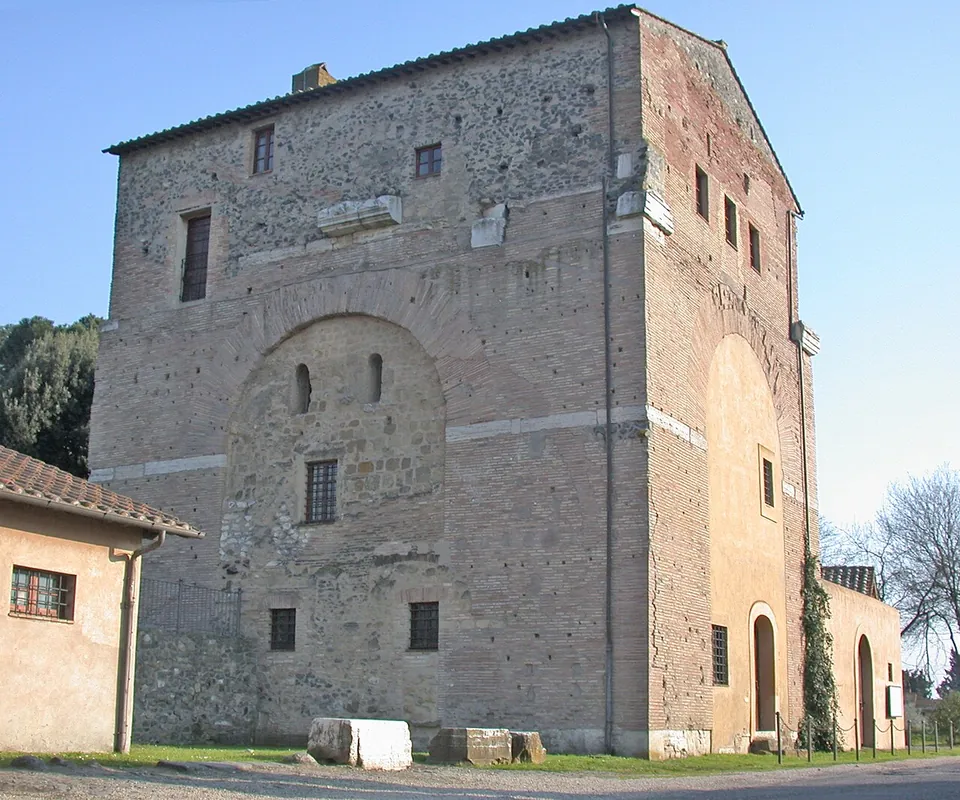
Photo: MM · Public domain · Commons
13 km · arch · Lazio
Arch of Malborghetto
At first sight you see an austere farmhouse rather than an arch (it.wikipedia).
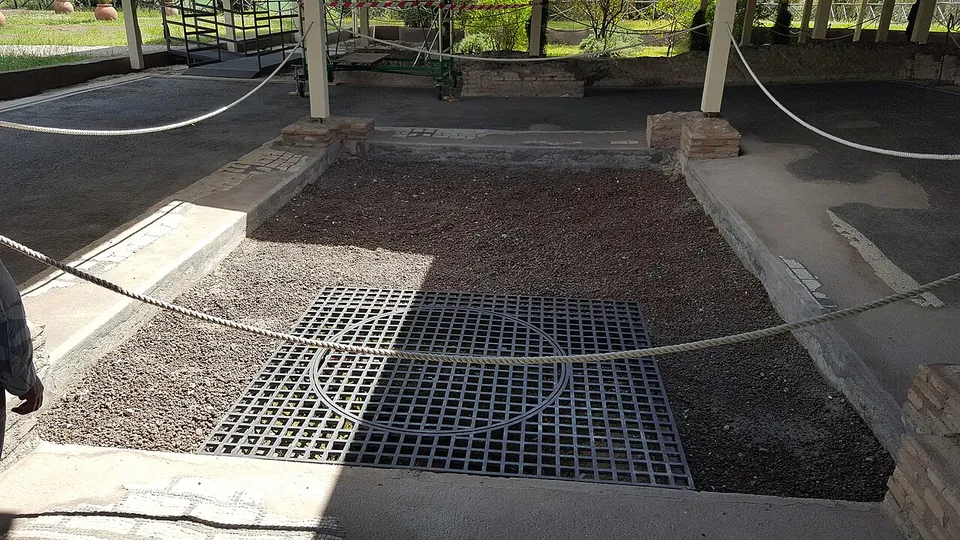
Photo: MumblerJamie · CC BY-SA 2.0 · Commons
17 km · villa · Lazio
Villa of Livia
The operator describes the private wing with the bedrooms of Livia and the emperor, an atrium and a small inner garden, and the large reception rooms that open onto a peristyle; the rooms once had painted walls and floors of mosaic and cut marble (Soprintendenza Speciale di Roma).
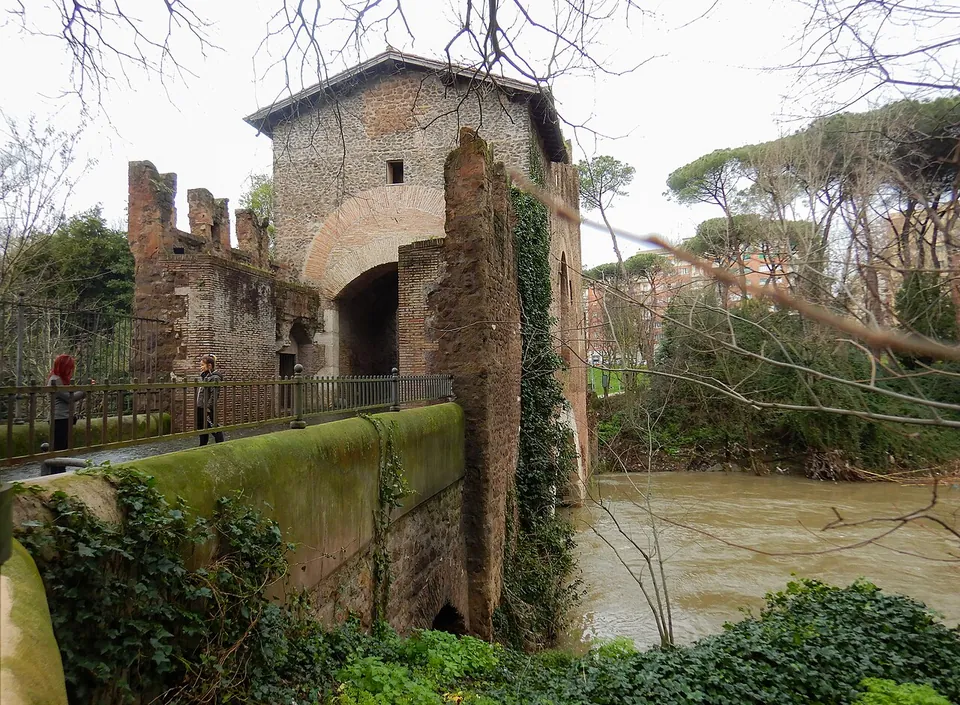
Photo: Albarubescens · CC BY-SA 4.0 · Commons
22 km · bridge · Lazio
Ponte Nomentano
The bridge is about 60 m long and 7.35 m wide, dimensions that have stayed practically unchanged since antiquity (en.wikipedia).


Straight-line distances.
Sources
Every fact on this page comes from the records below, each used under the licence noted.
| Source | Licence |
|---|---|
| Pleiades 413184 | CC BY |
| Wikidata Q3069606 | CC0 |
| OpenStreetMap way/215646299 | ODbL |
| Wikidata — Lucus Feroniae, the archaeological site (Q3265994) | licence not recorded |
| Pleiades — Forum of Lucus Feroniae | licence not recorded |
| Pleiades — Basilica of Lucus Feroniae | licence not recorded |
| Pleiades — Roman amphitheater at Lucus Feroniae | licence not recorded |
| Pleiades — Sanctuary at Lucus Feroniae | licence not recorded |
| Pleiades — Villa of the Volusii | licence not recorded |
| Wikipedia (en) — Feronia (Etruria) | CC BY-SA 4.0 |
| Wikipedia (en) — Lucus Feroniae | CC BY-SA 4.0 |
| Wikipedia (it) — Lucus Feroniae | CC BY-SA 4.0 |
| Wikipedia (de) — Lucus Feroniae | CC BY-SA 4.0 |
| Wikipedia (en) — Villa dei Volusii | CC BY-SA 4.0 |
| Wikipedia (it) — Villa dei Volusii | CC BY-SA 4.0 |
| Ministry of Culture — Antiquarium e Area archeologica di Lucus Feroniae (the operator's listing) | licence not recorded |
| Ministry of Culture — Villa dei Volusii (the operator's listing) | licence not recorded |