

What is there today
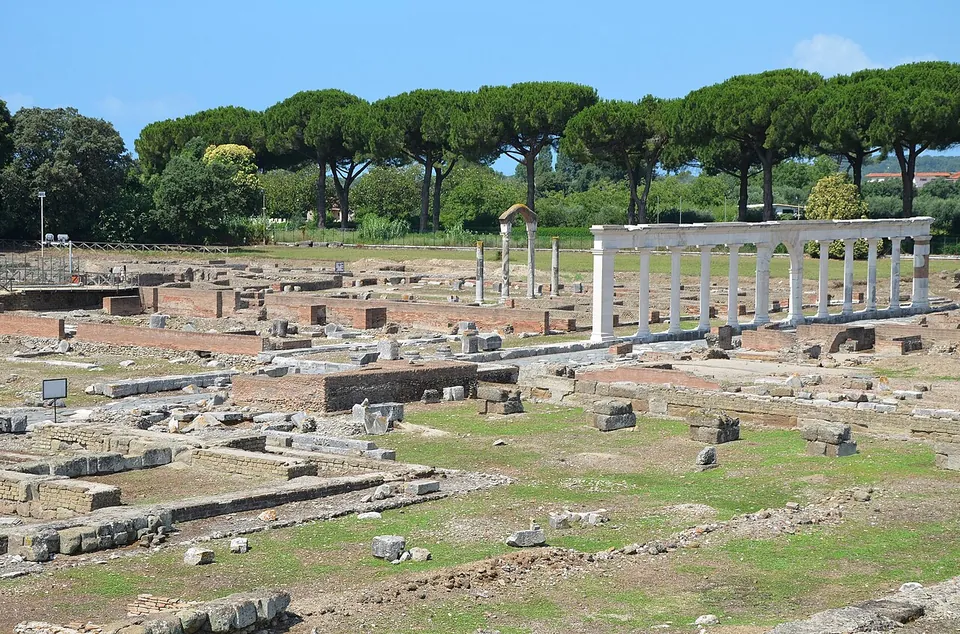
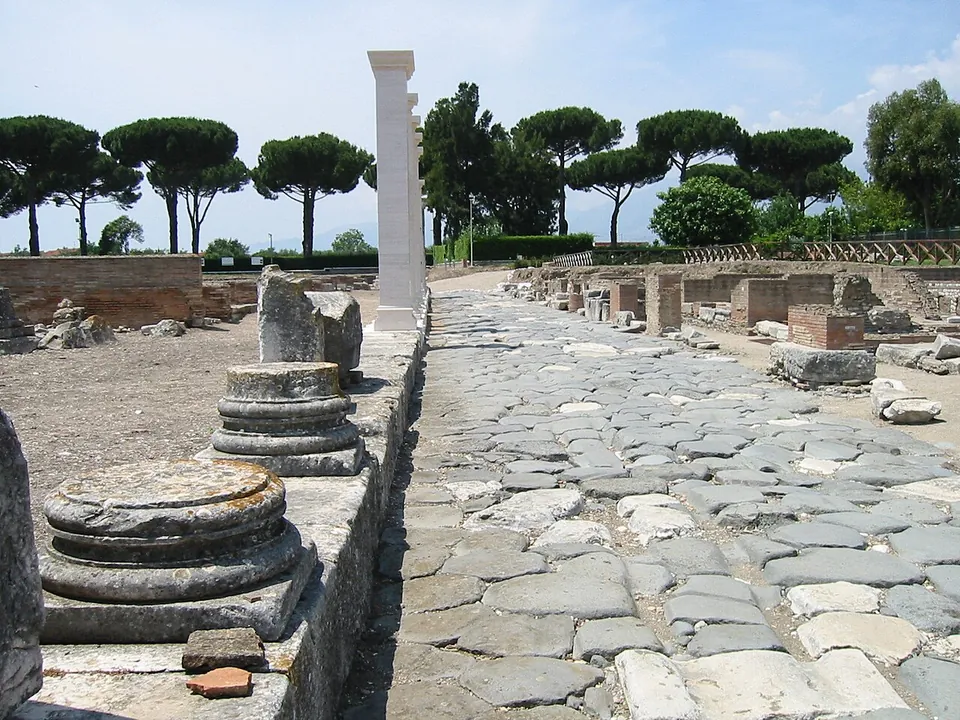
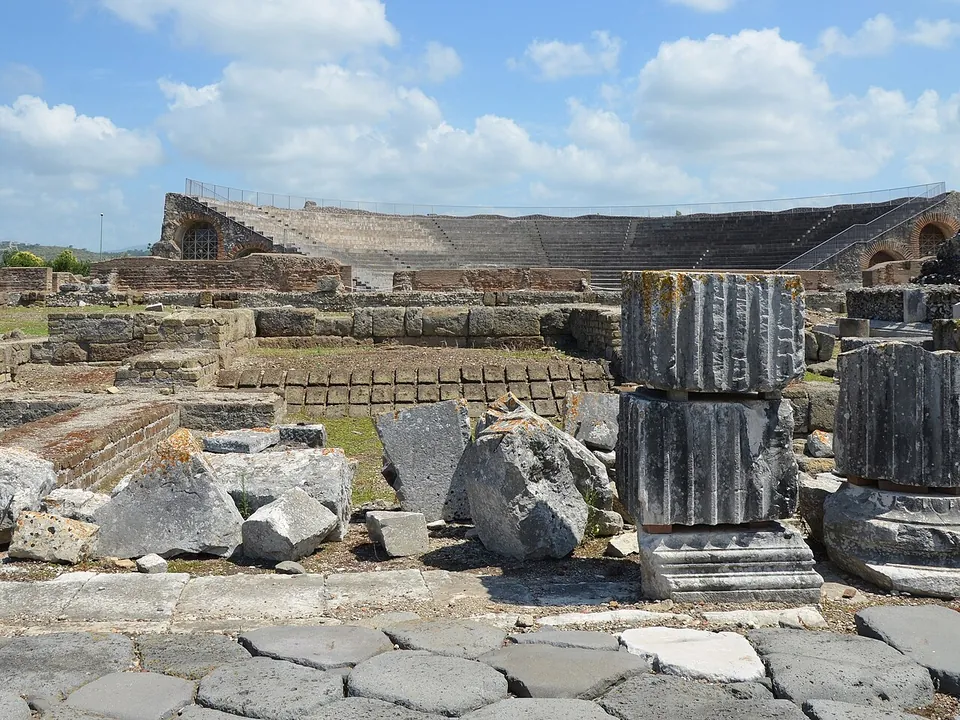
The Via Appia crosses the park as the ancient town’s main street, an original stretch paved in basalt blocks (it.wikipedia). North of it lies the Republican forum of the 2nd century BC, closed on three sides by porticoes, with two temples inside: the Capitolium, dedicated to Jupiter, Juno and Minerva, and the smaller Temple A (the operator). Of the Capitolium the foundations remain (de.wikipedia).
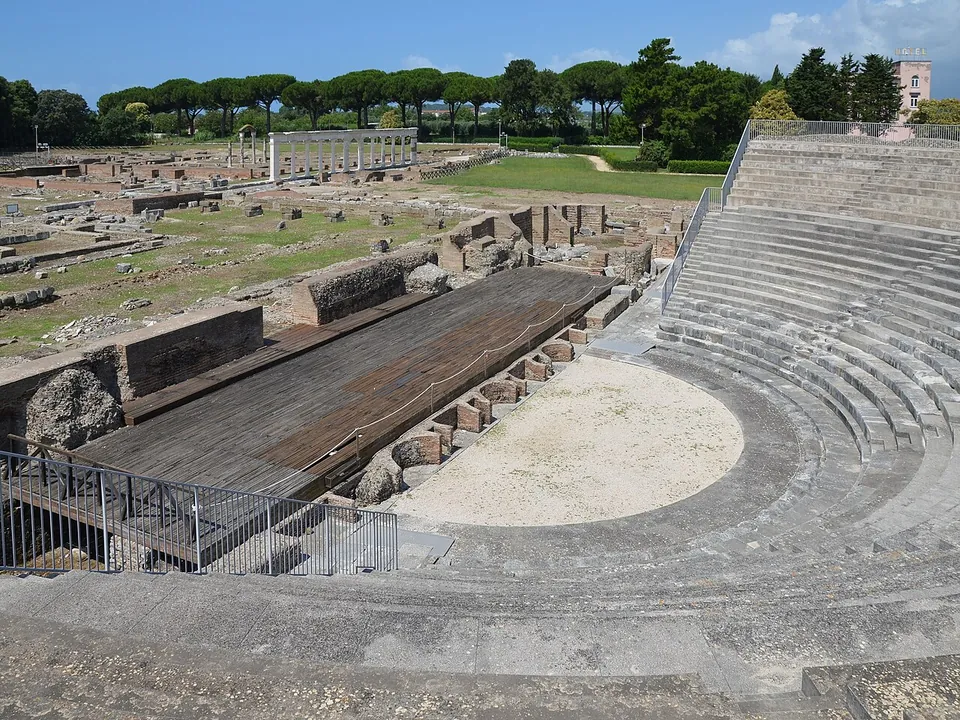
Beside the forum stands the theatre, with its tiered seating, orchestra and stage area. Published figures for its capacity run from about 4,000 to 4,600 spectators, and it has hosted plays and concerts in summer since 1960 (it.wikipedia; de.wikipedia). The galleries under its seating hold the Antiquarium, open since 1984: one side has the statues, among them Augustus and Livia and Muses from the theatre itself, the other carved architectural marble and a series of statues in togas (the operator).
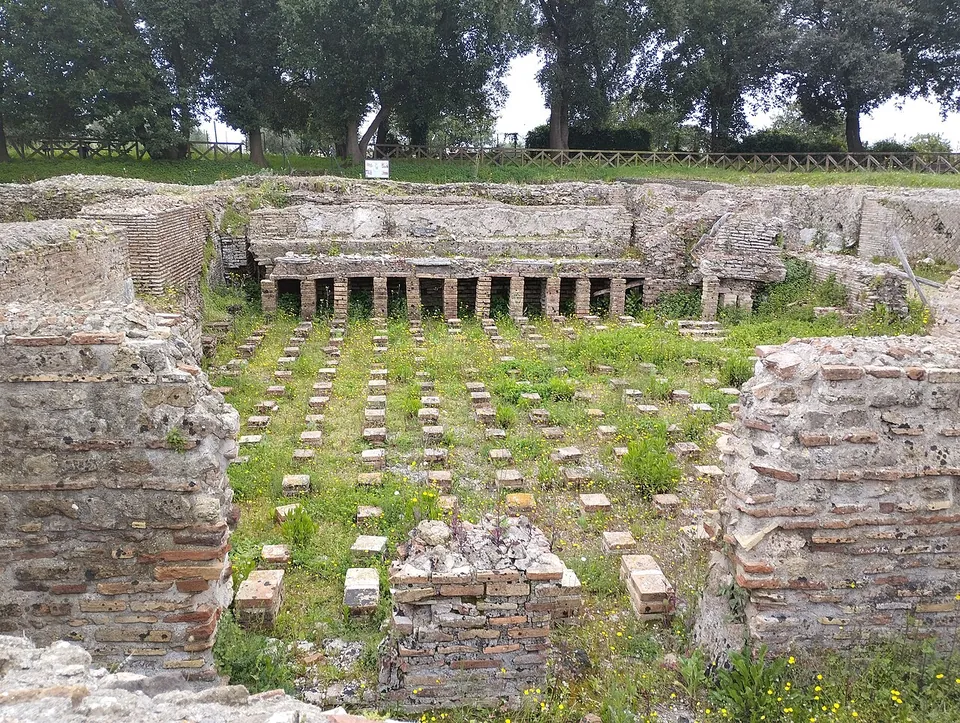
South of the Appia is the imperial forum, where long stretches of the paving in large slabs survive and walls and column bases mark out the curia and the basilica (the operator). A colonnade on the Appia leads into the market hall (macellum) of the 2nd century AD, and beyond it are the baths, where the small brick pillars of the underfloor heating can still be seen in three rooms (de.wikipedia) and mosaic decoration in the buildings attached to them (the operator). Most of the town is at foundation level, so the theatre and the road are what give it height.
Near the park, the modern Via Appia passes through the arches of the Roman aqueduct, which once ran about 11 km (it.wikipedia). Next to the park are the Ponte Real Ferdinando, completed in 1832 as the first iron chain suspension bridge in Italy (the operator), and the war cemetery of Minturno, where 2,049 soldiers of the British Empire killed in the Second World War are buried (it.wikipedia).
Two Roman structures are recorded nearby without any description of what survives: an amphitheatre about 400 m west of the theatre (Wikidata), and the Pons Tirenus, a bridge by its Latin name, which the Barrington Atlas places about 300 m east of the excavated centre (Pleiades).
Is it worth the trip?
Yes, if you are anywhere on this stretch of coast. One park holds a theatre, two fora, temples, a market and baths, strung along the Appian Way itself, and since July 2024 the park has been part of the UNESCO World Heritage listing of the Via Appia (the operator). The operator suggests two to four hours. It is also quiet: almost 20,000 visitors came in 2023 (it.wikipedia).
The caveats: it is closed on Mondays and Tuesdays, most of what you walk through is low walls and scattered column drums rather than standing buildings, and the suspension bridge in the park’s name opens only on announced special days.
Getting there
The entrance is on the right bank of the Garigliano, near the Ponte Real Ferdinando, at via Ferdinando II di Borbone in the comune of Minturno (the operator), at kilometre 156 of the SS 7 Appia (it.wikipedia). The modern town of Minturno is about 3 km away. There is a free, unguarded car park inside the park with room for coaches (the operator). Bus stops are mapped on the Appia about 125 m from the site (OpenStreetMap); no source names the routes. The park is partly accessible to disabled visitors, and the Antiquarium is accessible (the operator).
It opens Wednesday to Sunday: the archaeological area 08.30–19.00 in summer and 08.30–16.00 in winter, the Antiquarium 08.30–19.30; it is closed on Mondays, Tuesdays, 1 January and 25 December. A ticket is €5, or €2 for ages 18 to 25, and entry is free on the first Sunday of each month, 25 April, 2 June and 4 November. An €8 ticket valid for 30 days adds the museum and archaeological park at Cassino, and a €12 ticket valid for a year adds the Villa of Tiberius at Sperlonga and the museum at Formia. E-tickets are sold through the “Musei Italiani” app (direzioneregionalemuseilazio.cultura.gov.it, read 19 October 2026; check before travelling).
Visiting details
- Opening hours
- Wednesday to Sunday. Archaeological area 08.30–19.00 in summer and 08.30–16.00 in winter; the Antiquarium in the theatre 08.30–19.30. Closed Mondays and Tuesdays, 1 January and 25 December.
- Tickets
- €5; €2 for ages 18 to 25; free on the first Sunday of each month, 25 April, 2 June and 4 November, with other reductions under the national rules. An €8 ticket (valid 30 days) adds the Museo Archeologico Nazionale "G. Carettoni" and the archaeological park of Casinum at Cassino; a €12 ticket (valid a year, one entry each) adds the Villa of Tiberius and museum at Sperlonga and the national archaeological museum at Formia. E-tickets through the "Musei Italiani" app.
- Parking
- Free, unguarded car park inside the archaeological park, with room for cars, motorbikes and coaches (the operator); mapped about 150 m from the theatre (OSM way/300564117).
Before you go
- Closed every Monday and Tuesday.
- The Ponte Real Ferdinando, the 1832 suspension bridge in the park's name, opens only on announced special days (Sunday mornings in autumn 2026).
Hours and prices checked 19 October 2026 on the operator's own site. Confirm before travelling.
History
The first Minturnae belonged to the Aurunci, and Rome destroyed it in 314 BC, during the Second Samnite War (it.wikipedia; Pleiades). No remains of that town have been found, and whether it stood on this plain at all is disputed (de.wikipedia). In 296 or 295 BC (published dates differ by a year) Rome founded a colony here on the Liris, the ancient name of the Garigliano, for the trade the navigable river and the sea allowed (the operator; de.wikipedia). It began as a small square fort with walls of polygonal masonry and four corner towers, and the Via Appia, built in 312 BC, ran straight through it (de.wikipedia; the operator).
In the 2nd century BC the colony prospered as a port and market: amphora production and shipbuilding are attested, and it shipped local wine across the Mediterranean and was a market for fish salted on the spot (de.wikipedia). That wealth rested on slavery; one report tells of 450 slaves crucified at Minturnae after the slave revolt in Sicily of 133 BC (de.wikipedia). In 88 BC its people helped Gaius Marius escape Sulla’s killers, an episode Plutarch tells (it.wikipedia; de.wikipedia).
Augustus settled a new colony here and rebuilt the centre: porticoes along the Appia, a temple to Augustus on the old forum, a temple to the deified Caesar over the old fort, a new square and a rebuilt theatre. Under Hadrian the town was rebuilt again in mortared masonry, with the market, the baths, a larger theatre, new houses, and fountains fed by the aqueduct; the Minturnae you walk through today is essentially that Hadrianic town (the operator).
A bishop of Minturnae signed the Roman synod of 499 (de.wikipedia). The town emptied during the 6th century, perhaps as the marshy plain brought malaria, and in 590 Pope Gregory the Great merged its diocese into Formia’s (de.wikipedia). It was probably destroyed around the end of that century; accounts name the Lombards (it.wikipedia) or Saracens (de.wikipedia), and its people withdrew to the hill where Minturno stands (de.wikipedia).
Systematic excavation began in the 1930s under Jotham Johnson and continued from the 1960s to the 1980s (de.wikipedia). Earlier, in 1820, King Ferdinand I of the Two Sicilies had given 158 sculptures from the site to Marshal Laval Nugent, commander of the Bourbon army, and finds from Minturnae are now in the archaeological museums of Zagreb, Philadelphia and Naples (it.wikipedia).
More photographs


Nearby
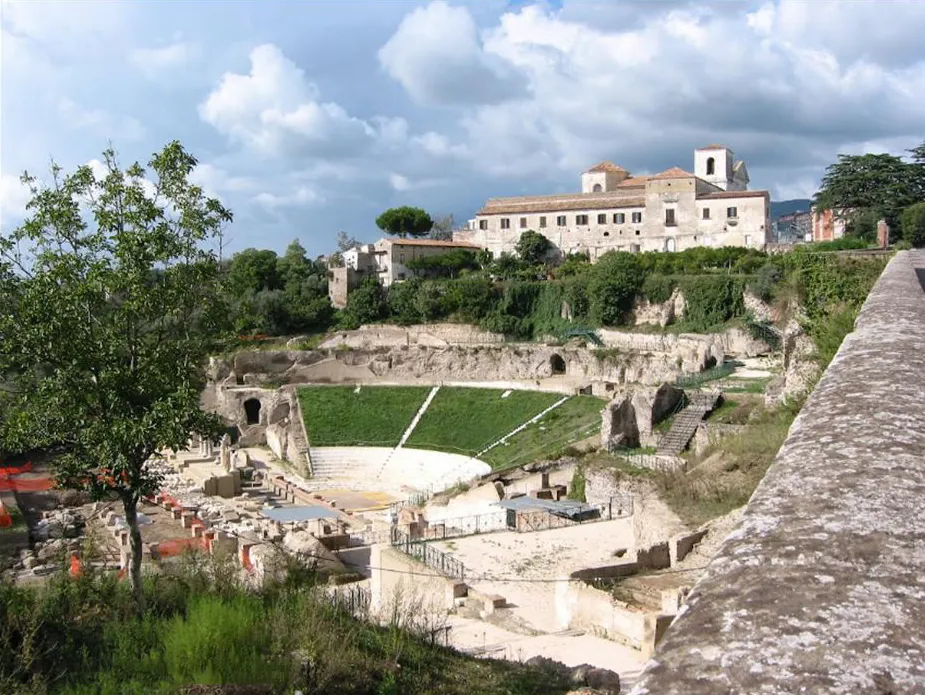
Photo: Gianni Bencivenga · CC BY-SA 3.0 · Commons
14 km · theatre · Campania
Roman Theatre of Sessa Aurunca
The theatre is one of the most imposing Roman public buildings found so far in Campania (the Ministry of Culture); it.wikipedia calls it the second-largest Roman theatre in the region after Naples.
Photo: MM · Public domain · Commons
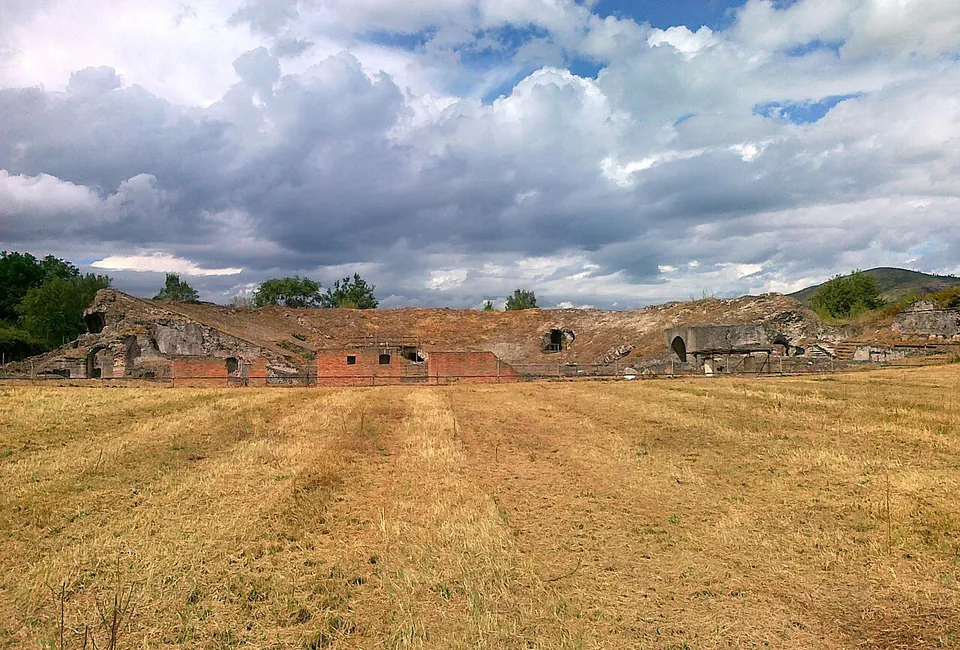
Photo: PietroCifone · CC BY-SA 3.0 · Commons
31 km · city · Campania
Cales
The ancient town survives across its whole extent, though the motorway runs through it, and the Ministry of Culture says plainly that its remains are not easy to read on the ground (cultura.gov.it).


Straight-line distances.
Sources
Every fact on this page comes from the records below, each used under the licence noted.
| Source | Licence |
|---|---|
| Pleiades 432940 | CC BY |
| Wikidata Q18170298 | CC0 |
| OpenStreetMap way/150975003 | ODbL |
| Parco archeologico di Minturnae e Ponte Real Ferdinando (Direzione regionale Musei nazionali Lazio, the operator) | licence not recorded |
| Ministero della cultura — Parco archeologico di Minturnae e Ponte Real Ferdinando | licence not recorded |
| Pleiades — Theater at Minturnae | licence not recorded |
| Pleiades — Pons Tirenus | licence not recorded |
| Wikidata — Roman theater of Minturnae (Q94896241) | licence not recorded |
| Wikidata — Basilica of Minturnae (Q110184772) | licence not recorded |
| Wikidata — Minturnae amphitheatre (Q28978041) | licence not recorded |
| Wikipedia (de) — Minturnae | CC BY-SA 4.0 |
| Wikipedia (it) — Minturnae | CC BY-SA 4.0 |
| Wikipedia (fr) — Minturnae | CC BY-SA 4.0 |