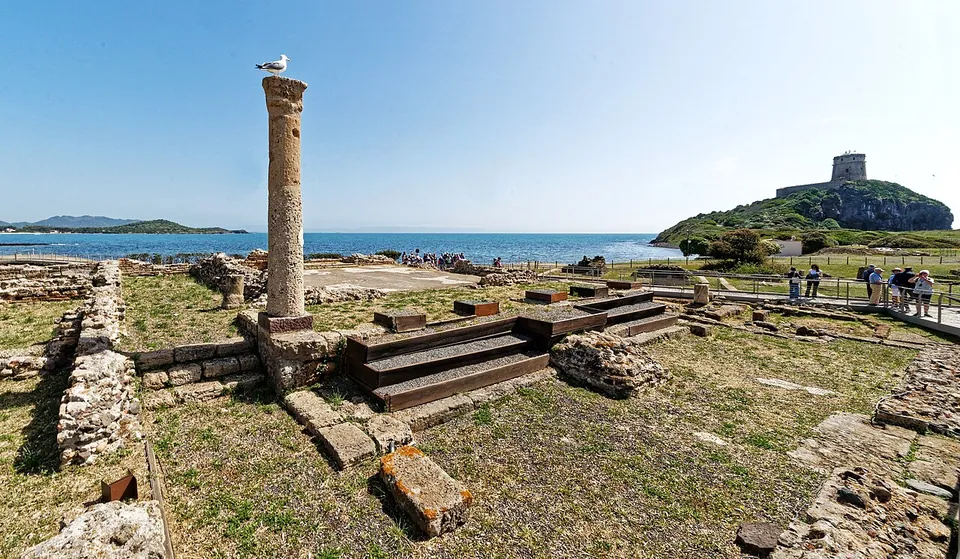
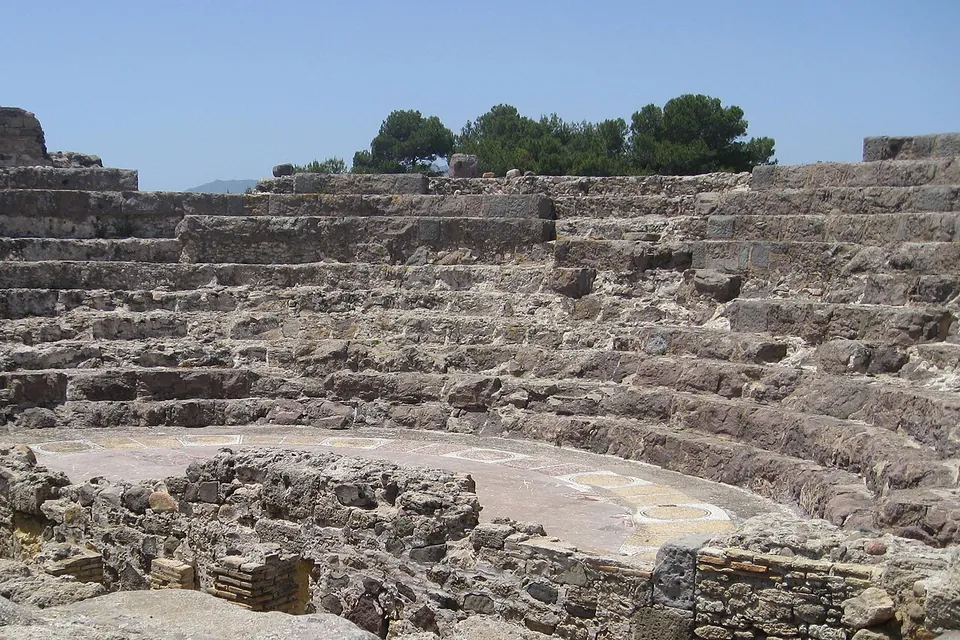
Nora is a Roman town on a narrow peninsula on Sardinia’s south coast, just south of Pula. The Phoenicians founded it and it later became a Roman municipium, and what you walk through today is mostly the Roman city: a theatre, baths decorated with mosaics, houses and a forum by the sea (the Ministry of Culture; de.wikipedia).
What is there today
The theatre is the building to see. The Ministry of Culture calls it one of the best preserved on the site; its tiers of stone seating still curve round the orchestra. Around it the town has been laid open along streets paved in andesite. The baths are impressive, often decorated with mosaics of the 2nd to 4th centuries AD, and the house of the tetrastyle atrium keeps mosaics of the 3rd to 4th centuries. There is a sanctuary of Asclepius of the 2nd to 3rd century AD, and near the sea a regular forum with the bases of honorary statues (the Ministry of Culture).
Older Nora is there too, but in smaller pieces: the Punic tophet, the temple of Tanit on its hill, the Phoenician necropolis, and a quarter of irregularly laid-out houses behind the theatre whose plans, cisterns and masonry are Punic in character, nicknamed the Kasbah of Nora (the Ministry of Culture; de.wikipedia).
Away from the theatre, most of the town stands as foundations, low walls and floors. The amphitheatre has not been excavated (it.wikipedia), a significant part of the town lies on army land and has not been dug either, and because the south of Sardinia is sinking, a substantial part of the former town is now under the sea (en.wikipedia).
Is it worth the trip?
Yes, if you are in southern Sardinia. It is one of the most important sites in the south of the island (the Ministry of Culture), and the setting is a large part of the draw: the ruins run out to the water on a narrow promontory, with a watchtower on the headland beyond. The theatre and the mosaic floors are the highlights.
Know what kind of site it is. Apart from the theatre, this is a town read in plan, low walls and floors rather than standing buildings, so it rewards a slow walk with the route’s information panels more than a quick look from the entrance. If you have already seen a Roman town at foundation level and a theatre, Nora offers the same by the sea.
Getting there
Nora lies on the coast south of Pula, about 2.7 km from the village’s mapped centre (OpenStreetMap). OpenStreetMap maps a free car park about 450 m from the entrance and paid car parks about 600 m away, and a bus stop named “Pilai – Nora” about 300 m from the entrance; the operator’s pages say nothing about buses.
The site is open every day: 09.00–17.00 from November to February, 09.00–18.00 in March, 09.00–19.00 in April, May and October, and from June to September until 20.00 or 20.30 — the operator’s page gives both. The Ministry of Culture’s listing, which gives 09.00–20.00, has the ticket office closing at 19.00.
A ticket is €10, €6 under 18, €7.50 for university students, cruise passengers and FAI members, and free for children under 5 and for disabled visitors and their companions. A combined ticket with the Museo Giovanni Patroni in Pula is €16.50, or €17.50 with the Coltellazzo tower as well. The route has 28 information panels with QR codes, and the free Norapp audio guide can be downloaded; the online ticket does not include a guide, who is booked by phone on +39 070 9209366. You may not walk on the walls or the mosaics, or enter in a swimsuit (fondazionepulacultura.it and SardegnaCultura, read 17 October 2026 — check before travelling).
Visiting details
- Opening hours
- Daily. 09.00–17.00 November to February; 09.00–18.00 in March; 09.00–19.00 in April, May and October; June to September until 20.00 or 20.30 (the operator's page gives both).
- Tickets
- €10; €6 under 18; €7.50 for university students, cruise passengers and FAI members; €8.50 each in groups of more than 20; free under 5 and for disabled visitors and their companions. Combined tickets add the Museo Giovanni Patroni in Pula (€16.50) or the museum and the Coltellazzo tower (€17.50). The online ticket does not include a guide, who is booked by phone.
- Parking
- OpenStreetMap maps a free car park about 450 m from the entrance (way/119647614) and paid car parks about 600 m away.
Before you go
- Walking on the walls and mosaics is not allowed, nor is entry in a swimsuit; dogs are admitted on a lead.
Hours and prices checked 17 October 2026 on the operator's own site. Confirm before travelling.
The theatre
The theatre’s date is published differently: the Ministry of Culture puts its construction at the beginning of the 1st century BC, while de.wikipedia describes a small, well-preserved theatre of the 2nd to 4th centuries AD. The space beneath the stage holds large clay storage jars (pithoi). They belong to a later phase, when the building was no longer used as a theatre, and were not acoustic resonators, as was once thought (de.wikipedia). The Ministry’s Musei della Sardegna page names the theatre among the buildings put to other uses during the Vandal occupation. In summer it is occasionally used for concerts again (en.wikipedia).
The forum
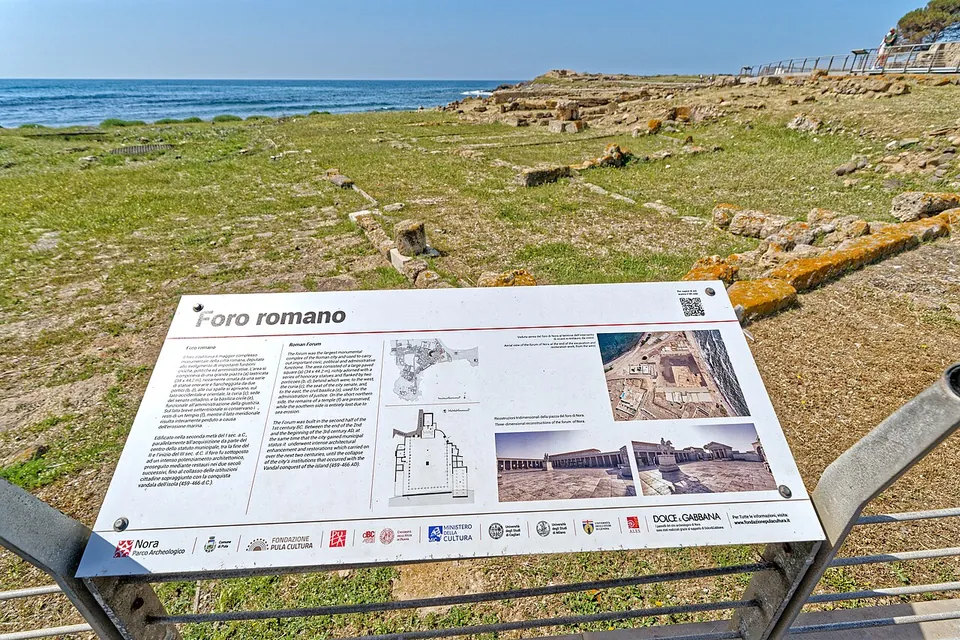
The panel at the forum describes a large square, 34 by 44.2 m, once lined with honorary statues and flanked by two porticoes, with the curia and the civil basilica opening off its long sides and the remains of a temple on its north side; the south side has been lost entirely to the sea. The forum was built in the second half of the 1st century BC, when the town gained the status of a municipium, given a major architectural upgrade at the end of the 2nd and start of the 3rd century AD, and restored for two more centuries until the town’s institutions collapsed with the Vandal conquest of the island (459–466 AD).
History
Pausanias, writing in the 2nd century AD, told how Iberians led by Norax founded Nora, the first city on the island (en.wikipedia). The record starts with the Phoenicians: they were on the promontory from the 8th century BC, and the Nora Stone, a Phoenician inscription found here, carries the oldest known mention of the name Sardinia. A permanent town probably grew only from the 6th century BC, with the arrival of the Carthaginians (Musei della Sardegna).
Rome took Sardinia in 238 BC and made it a province in 227 BC (Musei della Sardegna). it.wikipedia calls Nora probably the most important town on the island at the conquest, and says it was chosen at first as the capital of the province of Sardinia and Corsica. As a municipium it gained the buildings of a Roman town, the forum, the theatre and the baths (Musei della Sardegna), and what survives shows the town’s growth above all in the 2nd and 3rd centuries AD (it.wikipedia).
Decline began in the 5th century AD, when the Vandals occupied the island; the Eastern Roman Empire took Sardinia in 535 (en.wikipedia), and the Ravenna Cosmography lists Nora only as a fort, a praesidium (it.wikipedia). The last traces of occupation date from the 8th century (Musei della Sardegna).
A storm uncovered the tophet in 1889, and excavation followed in the next years. Between 1952 and 1960 Gennaro Pesce uncovered a large part of the Roman town, and since 1990 the universities of Cagliari, Genoa, Milan and Padua have excavated here continuously (Musei della Sardegna; SardegnaCultura).
More photographs
Nearby
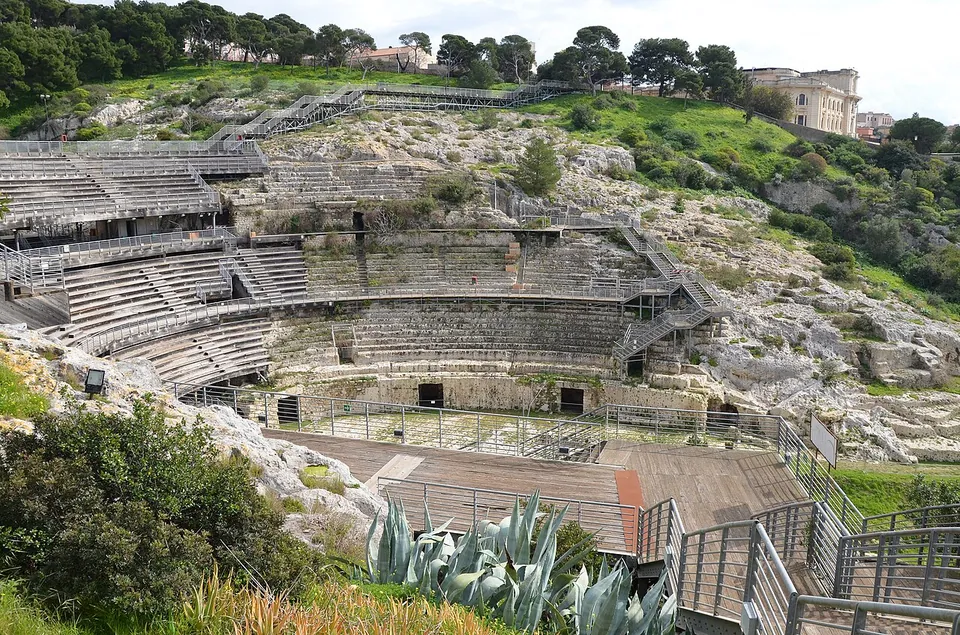
Photo: FollowingHadrian · CC BY-SA 4.0 · Commons
27 km · town house · Sardinia
Villa di Tigellio
What survives is the ground plan of a well-off Roman neighbourhood: the houses, two of which still show their foundations clearly, and the bath building (it.wikipedia; the city of Cagliari), with low walls of squared stone and a few columns still upright (the photographs below).
Photo: FollowingHadrian · CC BY-SA 4.0 · Commons
28 km · amphitheatre · Sardinia
Roman Amphitheatre of Cagliari
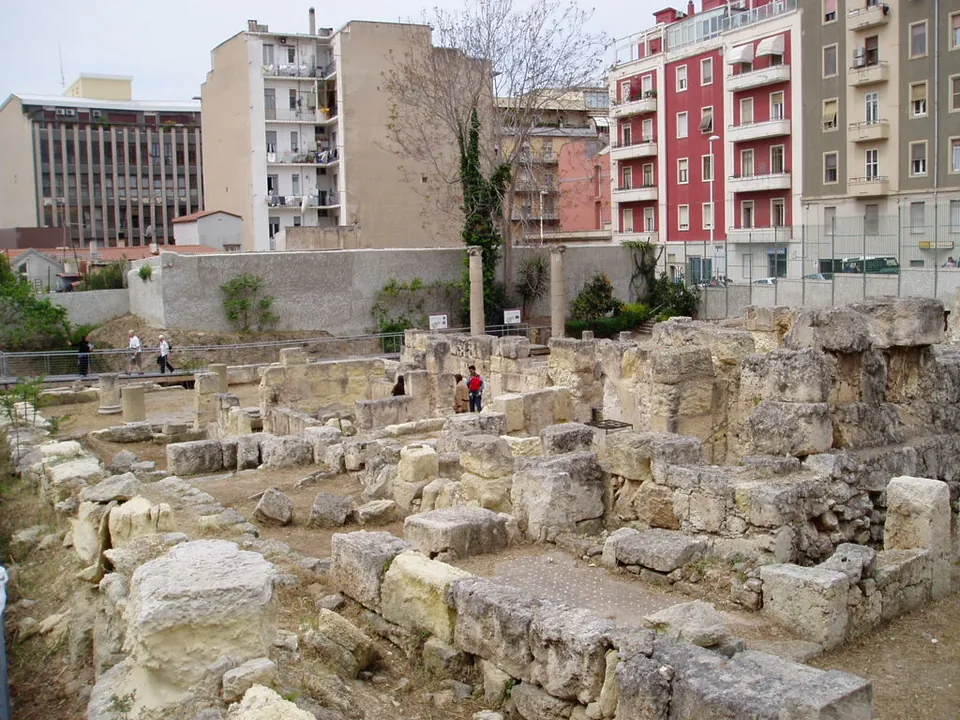
What survives is the bowl itself: tier after tier of rock-cut seating curving round an oval arena, with doorways in the wall round the arena that led to the gallery beneath (fr.wikipedia).


Straight-line distances.
Sources
Every fact on this page comes from the records below, each used under the licence noted.
| Source | Licence |
|---|---|
| Pleiades 471979 | CC BY |
| Wikidata Q677175 | CC0 |
| Vici.org 3500 | CC BY-SA (text), CC0 (metadata) |
| OpenStreetMap way/41180949 | ODbL |
| Wikidata — Roman Theatre of Nora (Q56478291) | licence not recorded |
| Wikipedia (it) — Nora (Italia) | CC BY-SA 4.0 |
| Wikipedia (de) — Nora (Italien) | CC BY-SA 4.0 |
| Wikipedia (en) — Nora, Italy | CC BY-SA 4.0 |
| Ministero della Cultura — Area archeologica di Nora | licence not recorded |
| Musei della Sardegna (Ministero della Cultura) — Area archeologica di Nora | licence not recorded |
| SardegnaCultura (Autonomous Region of Sardinia) — Pula, Archaeological Area of Nora | licence not recorded |
| Fondazione Pula Cultura Diffusa — tickets and opening hours (the site's operator) | licence not recorded |