

What is there today
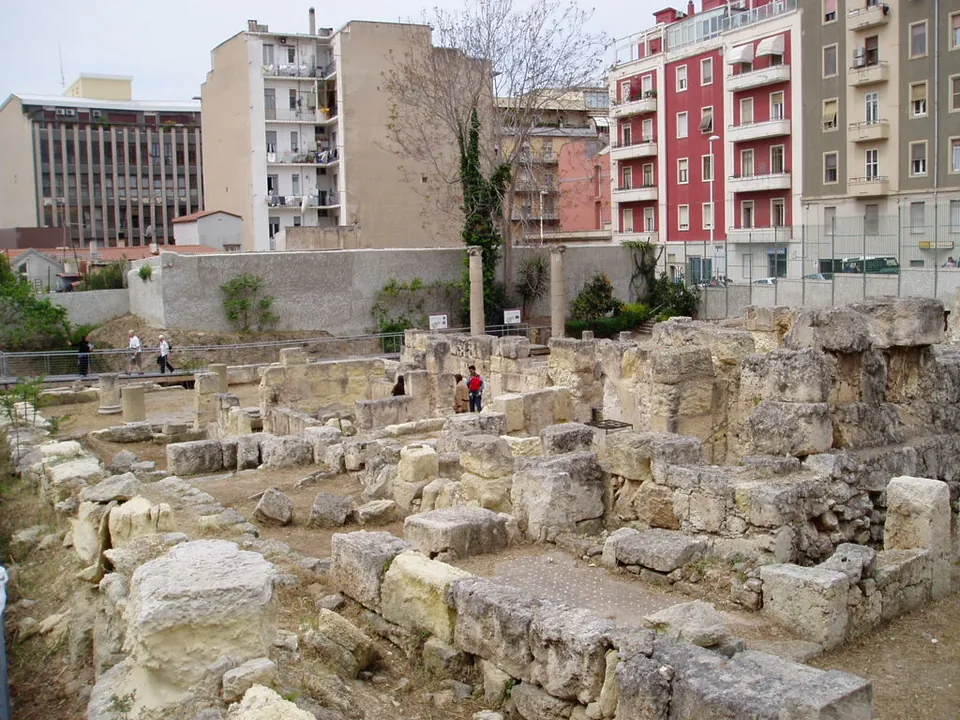
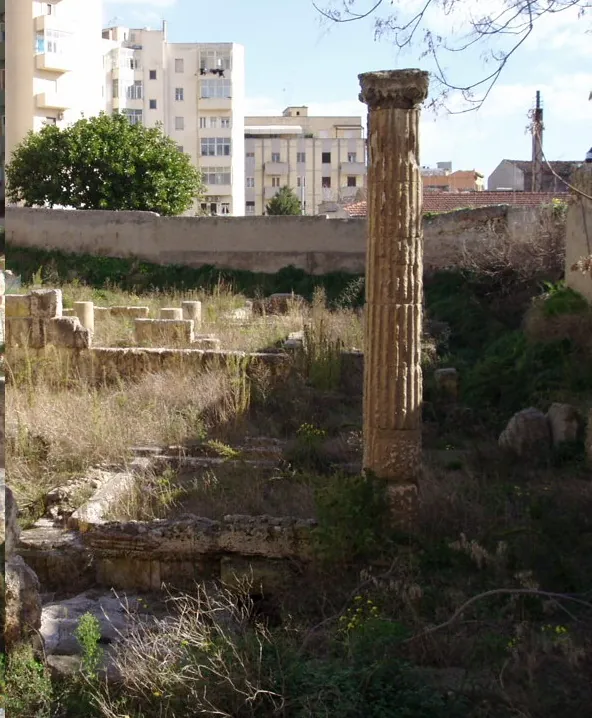
What survives is the ground plan of a well-off Roman neighbourhood: the houses, two of which still show their foundations clearly, and the bath building (it.wikipedia; the city of Cagliari), with low walls of squared stone and a few columns still upright (the photographs below). The front parts of the houses follow the usual plan of a Roman atrium house; what the rooms behind were for cannot be said precisely. Two floors of Roman signinum paving and a small mosaic of a lance-shaped flower can still be seen (the city of Cagliari). In the bath building, a brick floor probably carried the raised floor of the hot room, the caldarium (the city of Cagliari). The houses’ polychrome mosaics are in the National Archaeological Museum of Cagliari (L’Unione Sarda).
The names of two of the houses come from what was found in them: the House of the Stuccoes, for its fine stucco decoration, and the House of the Painted Tablinum, for the wall paintings in one of its rooms (the city of Cagliari; it.wikipedia).
Is it worth the trip?
Not at the moment. The city of Cagliari lists the site as temporarily closed and not open to visitors, with no reopening date. Works to make it safe, restore the walls and reopen it began in December 2024 and were expected to take about seven months (L’Unione Sarda), but in October 2026 it was still shown as closed. Check before you go.
When it does reopen, it is a short stop rather than a destination: a plan at ground level of three houses in a city block, about 570 m from the Roman amphitheatre, and worth adding to that visit for anyone curious how Caralis’s wealthier citizens lived. The best of its decoration is in the museum, not on site.
Getting there
The entrance is at Via Carbonazzi 7, in the Stampace quarter (the city of Cagliari), about 0.6 km from Piazza Matteotti and the station. Bus stops are mapped on Corso Vittorio Emanuele II about 165 m away, and there is street-side parking about 160 m away (OpenStreetMap).
When it is open, a ticket is €2, or €1 for students under 26, over-65s and groups of fifteen or more (the city of Cagliari, read 22 October 2026 - prices and the opening may change).
Visiting details
- Opening hours
- Temporarily closed and not open to visitors (the city of Cagliari, October 2026). No reopening date is published.
- Tickets
- When it reopens: €2, reduced €1 for students under 26, over-65s and groups of 15 or more.
- Parking
- Street-side parking about 160 m away (OSM way/667312335); the entrance is at Via Carbonazzi 7, in the city streets.
Before you go
- Closed - the city of Cagliari lists it as temporarily closed and not open to visitors (read 22 October 2026).
Hours and prices checked 22 October 2026 on the operator's own site. Confirm before travelling.
History
The houses went up in the 1st century BC, and the structures and the pottery found in them date the life of the area from the Republic to the 6th century AD, or the 6th-7th in the city’s tourism pages (the city of Cagliari). They show how far the Roman town reached into the western part of today’s city (the city of Cagliari).
The name is a mistake. In 1865 the historian Pietro Martini published a Life of Tigellius, attributed to a Latin author called Sertorius and later shown to be false, which said that Tigellius - a real Sardinian singer of the age of Augustus - owned a house decorated with stucco and mosaics near the amphitheatre (the city of Cagliari; it.wikipedia). That prompted the canon Giovanni Spano to dig here in 1876, and he found the remains of the House of the Stuccoes (the city of Cagliari). Apart from two occasional interventions the area was then left alone until Gennaro Pesce, the superintendent of antiquities, excavated again in 1963-64, uncovering two more houses - one only partly, the other, the House of the Painted Tablinum, almost entirely - and the bath building (it.wikipedia; the city of Cagliari). The University of Cagliari and the archaeological superintendency investigated the site once more in 1982-83 (it.wikipedia). No find connects Tigellius with the houses (the city of Cagliari).
Nearby
Photo: Helga Steinreich · CC BY-SA 3.0 · Commons

Straight-line distances.
Sources
Every fact on this page comes from the records below, each used under the licence noted.
| Source | Licence |
|---|---|
| Pleiades 520388219 | CC BY |
| Wikidata Q4012772 | CC0 |
| Vici.org 7922 | CC BY-SA (text), CC0 (metadata) |
| OpenStreetMap way/249468105 | ODbL |
| Wikipedia (it) — Villa di Tigellio | CC BY-SA 4.0 |
| Comune di Cagliari — Villa di Tigellio (description and access) | licence not recorded |
| Cagliari Turismo (city of Cagliari) — Tigellio's Villa, hours and admission | licence not recorded |
| Cagliari Turismo (city of Cagliari) — Villa di Tigellio (Italian) | licence not recorded |
| L'Unione Sarda — Cagliari, work begins to reopen Villa Tigellio to the public (12 December 2024) | licence not recorded |