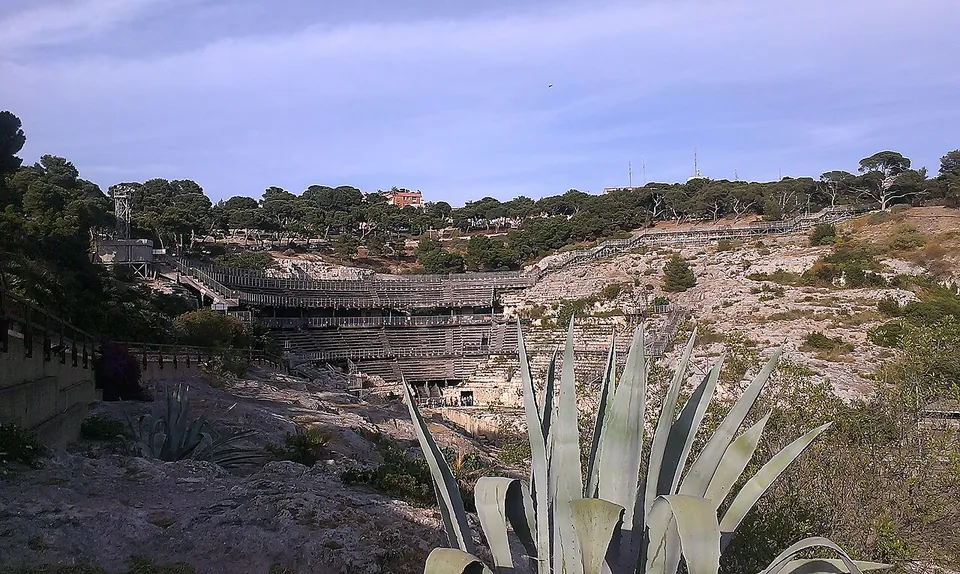
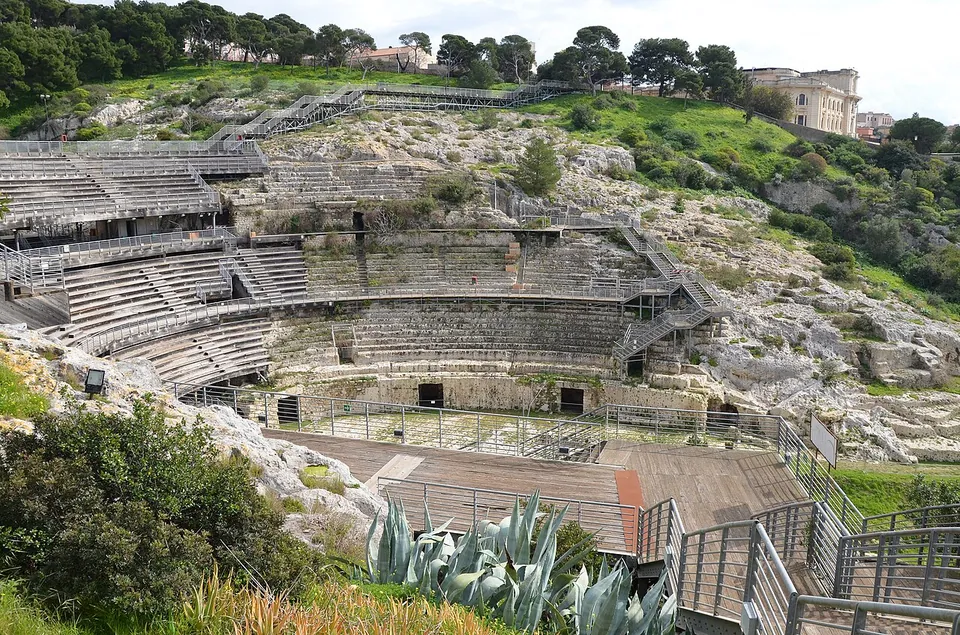
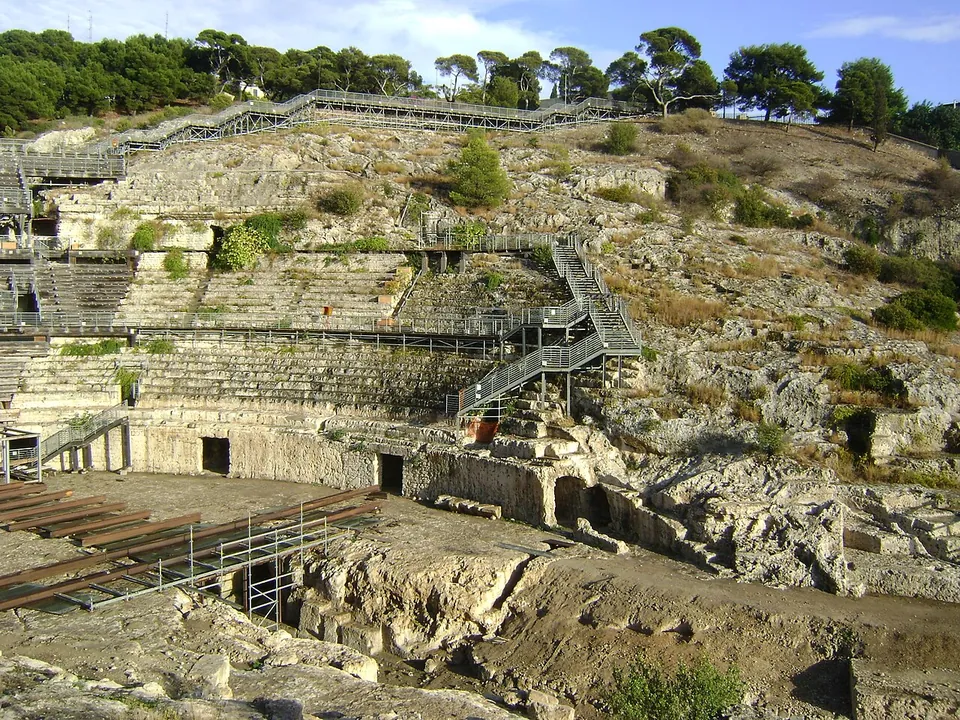


The Roman Amphitheatre of Cagliari is the arena of Roman Caralis, with most of its seating, its arena and its corridors carved straight out of the bedrock of a small valley on the Buon Cammino hill. The city of Cagliari calls it the most important public building of Roman Sardinia.
What is there today
What survives is the bowl itself: tier after tier of rock-cut seating curving round an oval arena, with doorways in the wall round the arena that led to the gallery beneath (fr.wikipedia). The builders cut the seats into the rock and used the spoil to level the arena; the rest of the building was put up in local white limestone. Missing today are the monumental southern façade, which must have stood more than 20 m high, and the opposite sector, where corridors and seating had to bridge a narrow rocky gorge (the city of Cagliari; en.wikipedia).
The building measured about 93 by 80 m, the arena about 46 by 31 m (en.wikipedia). The seats were divided, as elsewhere, into three bands for the different classes, and the cages for wild animals opened onto the corridor round the arena; rooms below the arena floor probably held the machinery for changing scenes (the city of Cagliari). Published estimates of the crowd it held run from 8,000 to 10,000 (en.wikipedia; it.wikipedia; the city of Cagliari).
Restoration is still under way. Since August 2017 the site has been partly open again: an 80 m walkway takes you close to the monument, but the arena and the underground spaces are closed (the city of Cagliari). The city’s own description also mentions a 95 m corridor that runs from the arena floor through the rock to a large underground cistern in the Orto dei Cappuccini; with the arena and the underground spaces shut, do not count on seeing it.
Is it worth the trip?
Yes, if you are in Cagliari. An amphitheatre carved into the living rock is an unusual thing to stand over, and at €3, open every day, it is the easiest Roman sight in the city to fit in. Be clear about what you get, though: for now this is a view from a walkway, not a walk through the arena and the passages underneath. It is not, on its own, a reason to travel to Sardinia. With the Grotta della Vipera, which opens on set days or by appointment, it makes a good half-day of Roman Cagliari; the Villa di Tigellio is temporarily closed (see Caralis – Cagliari).
Getting there
The entrance is on Viale Sant’Ignazio da Laconi, about 0.8 km from the point OpenStreetMap gives for the city centre (the city of Cagliari; OpenStreetMap). The nearest mapped public-transport stop, Ospedale (clinica Macciotta), is about 270 m away, and a free public car park about 160 m; public toilets are mapped about 230 m away (OpenStreetMap). The Villa di Tigellio lies about 0.6 km away and the Grotta della Vipera about 1.2 km.
It opens every day: 10.00 to 17.00 from 1 October to 27 April, and 10.00 to 13.00 and 15.00 to 19.00 from 28 April to 30 September, with the ticket office closing half an hour earlier. A ticket is €3, or €2 for students under 26, over-65s and groups of fifteen or more; children up to 6 and visitors with disabilities and their carers go free. An €8 combined ticket, valid for a week, adds the Grotta della Vipera, the Crypt of Santa Restituta, the Elephant Tower and the covered walkway and Sperone gallery (the city of Cagliari, read 20 October 2026 - check before going, since hours and prices change).
Visiting details
- Opening hours
- Daily, 10.00–17.00 from 1 October to 27 April, and 10.00–13.00 and 15.00–19.00 from 28 April to 30 September. The ticket office closes 30 minutes before closing.
- Tickets
- €3; €2 for students under 26, over-65s and groups of 15 or more; €1 for school groups; free for children up to 6 and for visitors with disabilities and their carers. An €8 combined ticket, valid for a week, adds the Crypt of Santa Restituta, the Grotta della Vipera, the Elephant Tower and the covered walkway and Sperone gallery.
- Parking
- A free public car park lies about 160 m from the amphitheatre (OSM way/156546284), with street parking for about 30 cars at a similar distance (OSM way/774993758).
Before you go
- Restoration is under way - you see the amphitheatre from an 80 m walkway and cannot go down into the arena or the underground spaces (the city of Cagliari).
Hours and prices checked 20 October 2026 on the operator's own site. Confirm before travelling.
History
The amphitheatre was built in the 1st or 2nd century AD, perhaps in more than one phase; published dates range from the 1st century to the end of the 2nd (it.wikipedia; the city of Cagliari; en.wikipedia gives the 2nd). It staged fights between men and wild beasts (venationes), gladiator combats (munera) and public executions, with fighters recruited in Sardinia and beyond (the city of Cagliari; en.wikipedia).
It fell out of use in the 5th century; it.wikipedia links its decline to the ban on gladiator fights by Valentinian III in 438. From the early Middle Ages its seating was carried off as cheap building stone for new fortifications by the island’s successive rulers - Byzantines, Pisans and Aragonese among them (en.wikipedia; it.wikipedia). When the city bought the site in the 19th century, the arena and the lower corridors lay completely buried. It entrusted the excavation to the canon Giovanni Spano, which turned up coins and other finds and a great many thin marble slabs, evidence of a facing of fine stone - on the seats according to the city of Cagliari, on the arena according to it.wikipedia (the city of Cagliari; it.wikipedia). Restoration followed in 1940 and again in 1984-85 (fr.wikipedia).
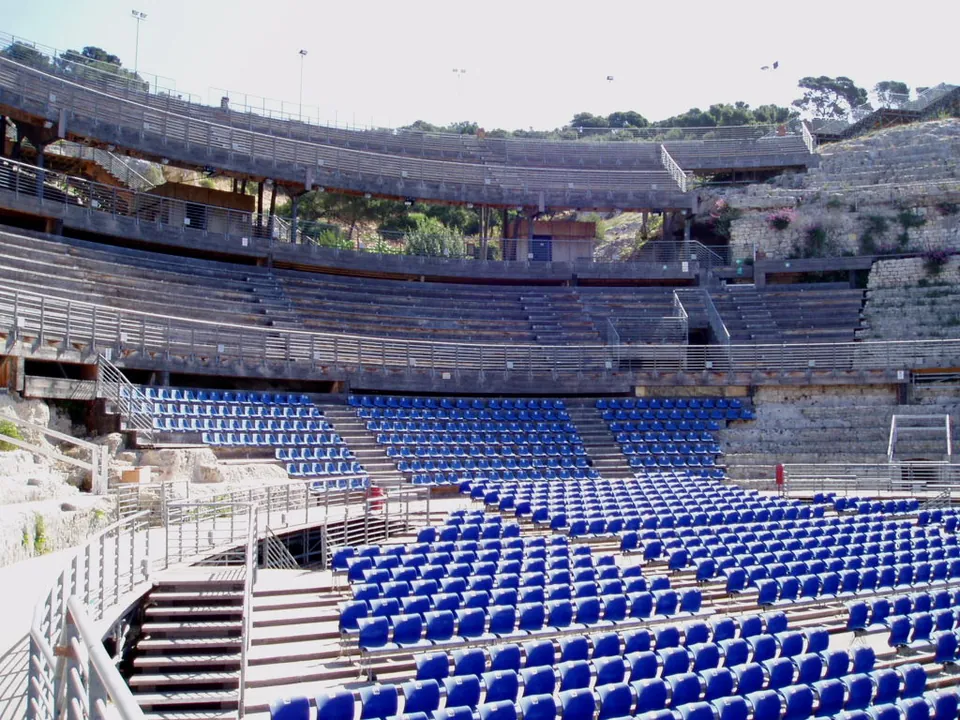
In the early 2000s the bowl was covered by an iron and timber structure so that it could host concerts and shows in summer; later city administrations removed it to return the amphitheatre to its role as an archaeological site (it.wikipedia).
More photographs

Nearby
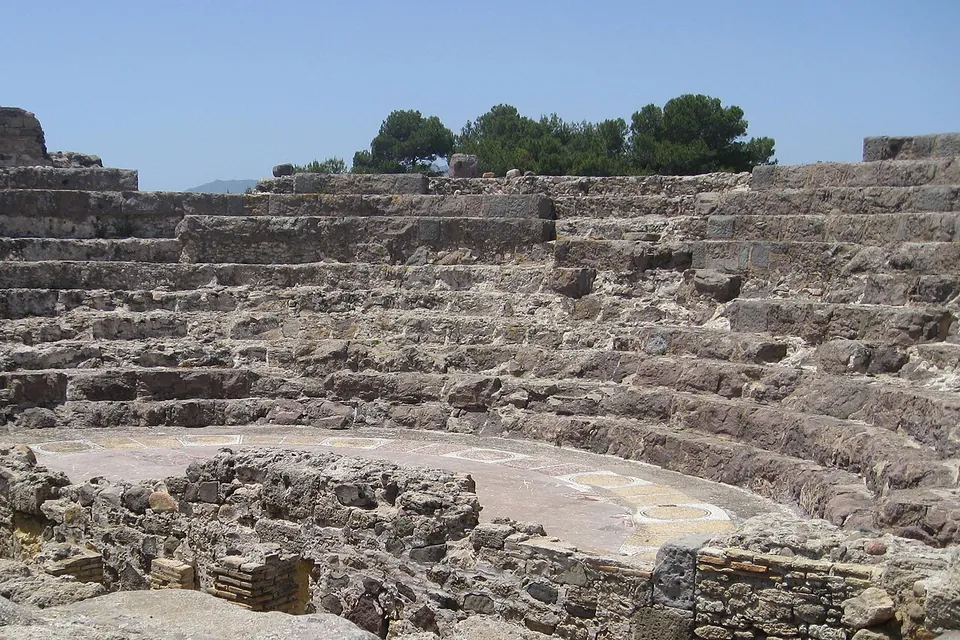
Photo: Helga Steinreich · CC BY-SA 3.0 · Commons

Straight-line distances.
Sources
Every fact on this page comes from the records below, each used under the licence noted.
| Source | Licence |
|---|---|
| Pleiades 32694356 | CC BY |
| Wikidata Q2844403 | CC0 |
| Vici.org 4211 | CC BY-SA (text), CC0 (metadata) |
| OpenStreetMap way/118555645 | ODbL |
| Wikipedia (en) — Roman Amphitheatre of Cagliari | CC BY-SA 4.0 |
| Wikipedia (it) — Anfiteatro romano di Cagliari | CC BY-SA 4.0 |
| Wikipedia (fr) — Amphithéâtre de Cagliari | CC BY-SA 4.0 |
| Cagliari Turismo (city of Cagliari) — Roman Amphitheatre, hours and admission (the operator) | licence not recorded |
| Comune di Cagliari — Anfiteatro romano (the operator) | licence not recorded |