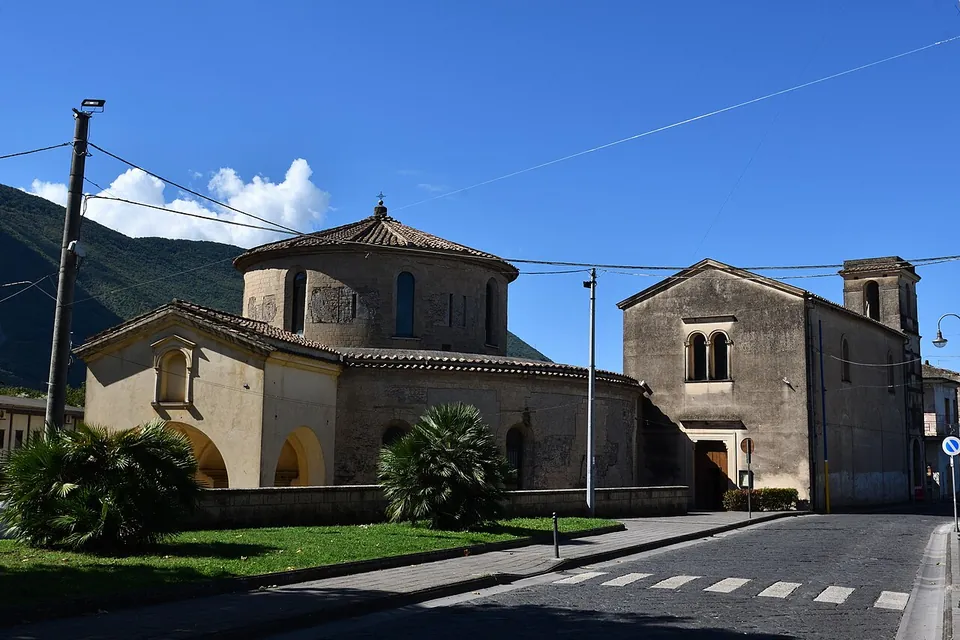
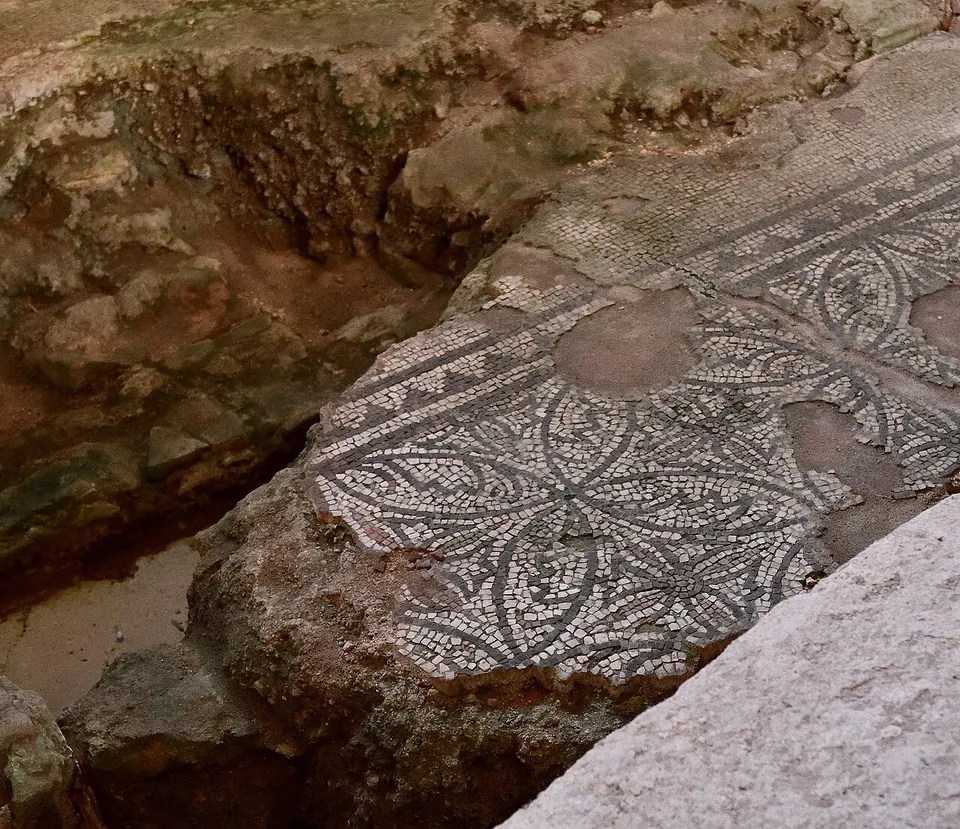
Nuceria is counted among the largest towns of ancient Campania (it.wikipedia), and its remains lie under and between the houses of Nocera Superiore, in the province of Salerno. The building to come for is a 6th-century round baptistery raised on the columns of the Roman city, with Roman mosaic floors exposed inside it; the theatre, a paved Roman street and a row of grand tombs survive too, but they open only on request or on a few days a year, and no operator publishes the baptistery’s own hours.
What is there today
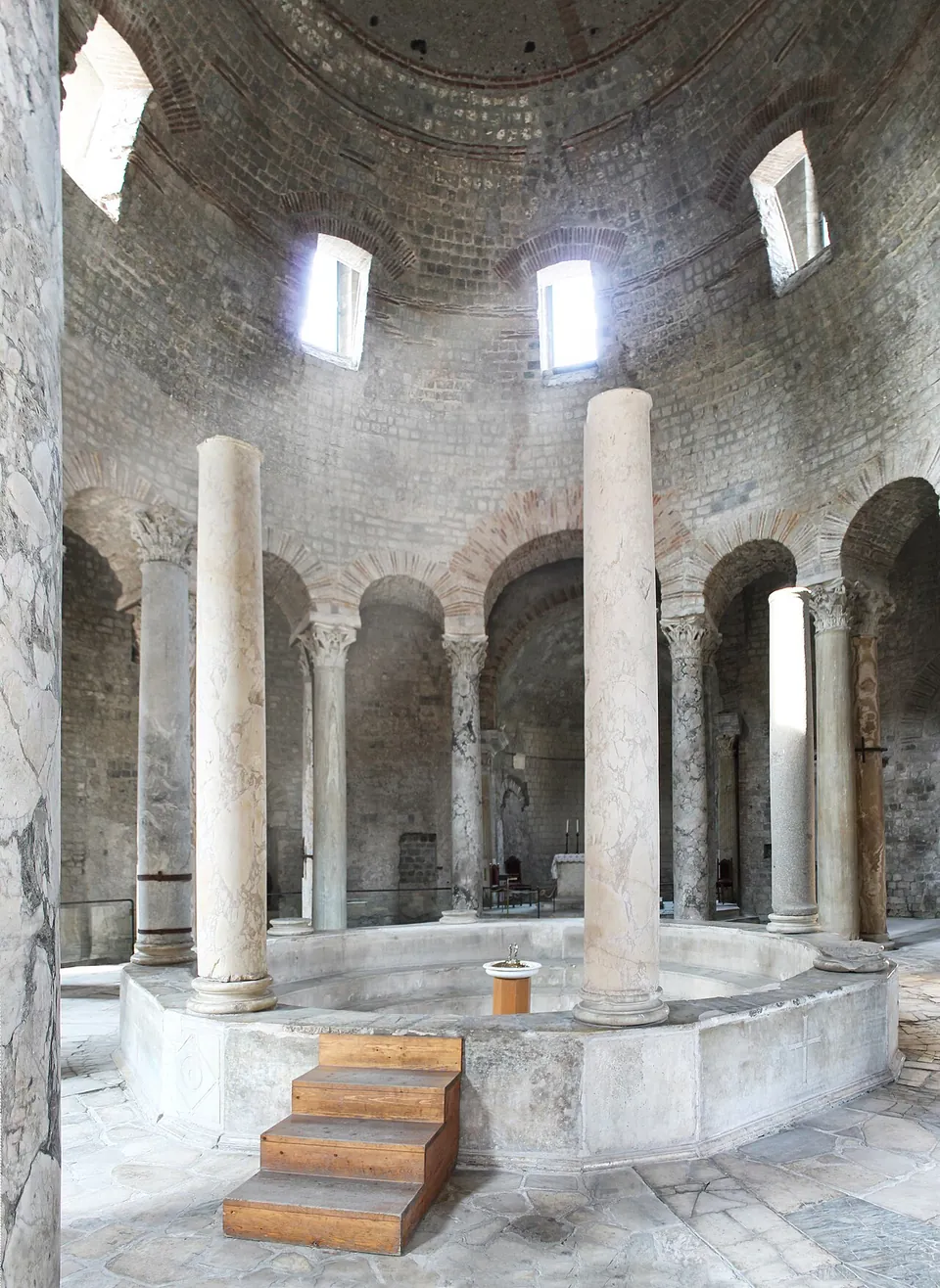
The baptistery of Santa Maria Maggiore (“La Rotonda”) is the set piece. It is a round building about 24 m across, with a dome some 15 m high resting on fifteen pairs of marble columns, all different, reused from the temples and public buildings of Roman Nuceria (it.wikipedia; the FAI says they came from the Roman theatre); some capitals carry dolphins. At the centre is the font, octagonal outside and round inside, 7.12 m across and the second largest in Italy after the Lateran’s. The baptistery was built in the 6th century over a Roman building of the 2nd–3rd century AD, and that building’s mosaic floors can be seen in the ambulatory and the apse. A small Antiquarium on two levels in the same complex holds inscriptions, columns and mosaic fragments from the ancient city, and has a balcony looking down into the baptistery (it.wikipedia). Behind the complex, an archaeological park covers the area identified as the Roman forum (it.wikipedia).
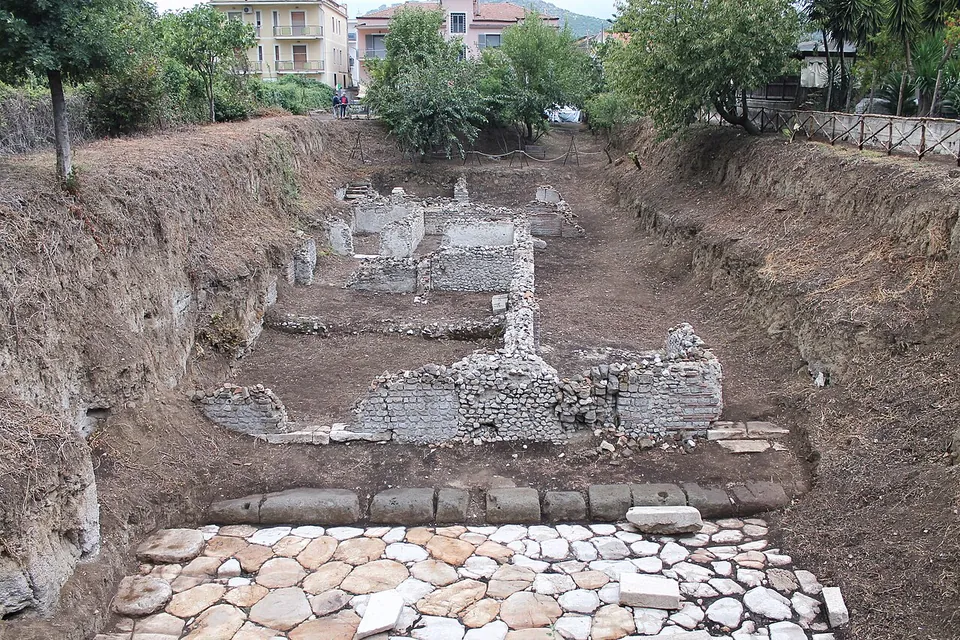
The Domus del Decumano, about 150 m north of the baptistery (Wikidata points), was dug between 1979 and 1984. It shows part of a house of the 1st–2nd century AD - half of the marble basin of its atrium, the rooms on its west side with mosaic and cocciopesto floors and patches of Fourth Style painting - and, in front of it, a stretch of the lower decumanus paved in large stone blocks with cart ruts, raised pavements and stepping stones, the only paved stretch of Nuceria’s streets preserved today; four late-antique graves dug into the house’s garden are also on show. The rest of the house lies under about 5 m of flood and volcanic deposits (it.wikipedia).
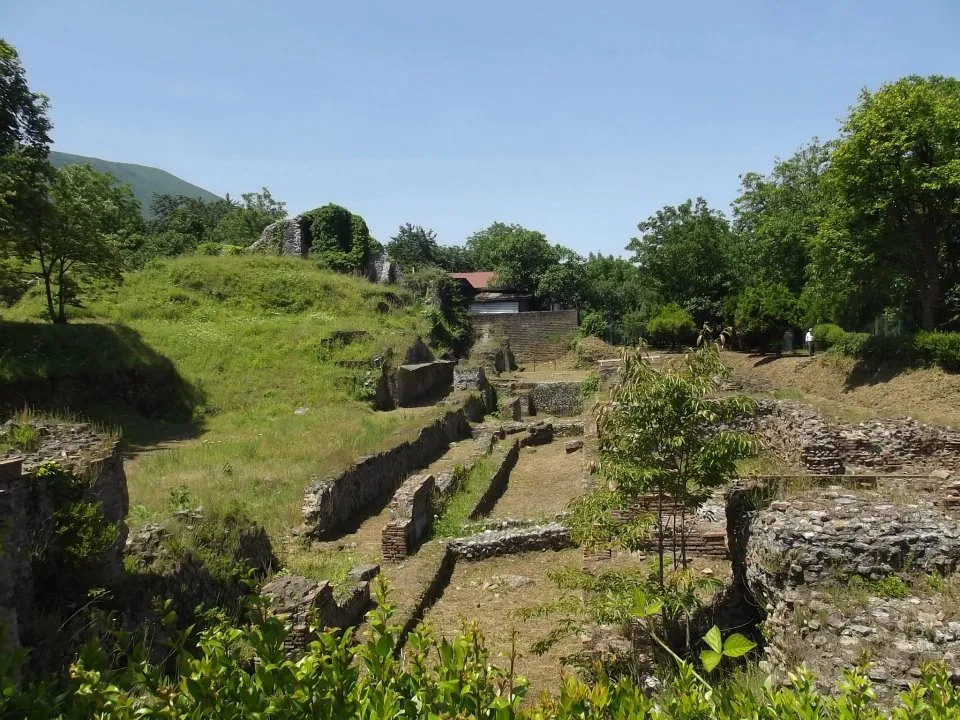
The theatre at Pareti, built in the 2nd century BC against the city walls and remodelled under Augustus, was about 96 m across in its Roman form, and the Ministry of Culture calls it the grandest of those documented in Campania. What survives is the lower and middle seating, stripped of its tuff facing, remains of a polychrome marble floor in the orchestra, and Third Style frescoes in the western entrance passage (it.wikipedia).
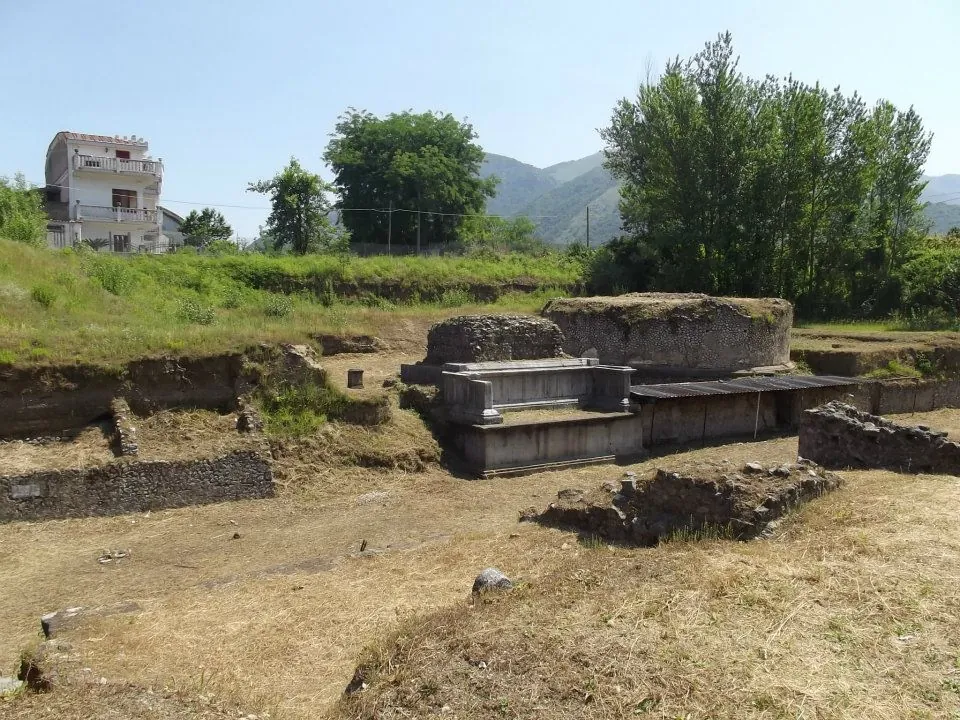
The Pizzone necropolis, east of the city, is a row of 1st-century BC tombs along a road cut 3 m deep into the ground: a tumulus of the Numisii that recalls the Mausoleum of Augustus, a square-based round tomb of the Cornelii, and a tomb of the Lutatii reached by two stairways (it/en.wikipedia). Seven monuments have been located; it.wikipedia says five have been uncovered, and the Ministry says three are visible.
A stretch of the 2nd-century BC double city wall survives, with a tower, by a sports field on via Pucciano, and a second tower, the “Cantina Vecchia”, stands on the east side. The amphitheatre, 125 m by 102 m, is not a monument to walk round: its structures are built into later houses in the Grotti district, and its outline survives in the curve of the street (it/en.wikipedia). OpenStreetMap also maps a stretch of aqueduct labelled Roman about 230 m from the baptistery.
Is it worth the trip?
For the baptistery, yes, if you are already in the area: it still stands roofed on its ring of reused Roman columns, and it.wikipedia counts it among the rare Justinian-era baptisteries in Italy. For the Roman town itself, only with planning. The theatre must be booked, the Pizzone tombs are listed as closed, and the only published openings of the Domus and the archaeological park are heritage days, so a visit on spec may show you the baptistery and little else - and with no published hours, even the baptistery is not certain to be open. Much of what was dug up is in the provincial museum in neighbouring Nocera Inferiore, which keeps regular hours.
Getting there
Nocera Superiore has its own railway station, though OpenStreetMap maps no stop right by the baptistery; two car parks are mapped about 100 m from it (OpenStreetMap). The baptistery stands in via Santa Maria Maggiore (FAI); the Domus del Decumano is at via Luigi Petrosino 7 (Ministry of Culture).
No operator page gives the baptistery’s hours. The theatre is visitable on request on any day, by booking on +39 081 932052 (Soprintendenza for Salerno and Avellino, read 23 October 2026). The Ministry lists the Pizzone necropolis as closed every day of the week. it.wikipedia says the Domus del Decumano has opened on Saturday and Sunday mornings, 09.00 to 12.00, since September 2022, but the Ministry’s own listings found are for special days only: free guided visits in June 2024, a Saturday morning in September 2025 that also opened the baptistery and the archaeological park, and a weekend in June 2026 that included the theatre. The Museo Archeologico Provinciale dell’Agro Nocerino, in the convent of Sant’Antonio in Nocera Inferiore, opens Tuesday to Saturday 09.00 to 15.00 and Sunday 09.00 to 14.00, and closes on Monday (Ministry of Culture). No admission price is published for any of these.
Visiting details
- Opening hours
- No regular public hours are published for the Roman sites. The theatre is visitable on request, by booking on +39 081 932052 (the Soprintendenza for Salerno and Avellino). The Ministry of Culture lists the Pizzone necropolis as closed every day. The Domus del Decumano and the archaeological park behind the baptistery open on special days such as the European Heritage and Archaeology Days. No operator page gives the baptistery's hours. The Museo Archeologico Provinciale dell'Agro Nocerino in Nocera Inferiore, which shows the finds, opens Tuesday to Saturday 09.00–15.00 and Sunday 09.00–14.00, and is closed on Monday.
- Tickets
- No operator publishes an admission price for the baptistery, the Roman sites or the museum. The Ministry's heritage-day visits to the Domus del Decumano in June 2024 were free guided tours.
- Parking
- Two surface car parks are mapped about 95 m and 105 m from the baptistery, and the paid Arena Mazzini car park (1.00 EUR an hour, per OSM) about 230 m away. A third car park at about 130 m is private.
Before you go
- Apart from the baptistery, the Roman sites are rarely open. Book the theatre in advance and check heritage-day dates before travelling for the Domus.
- The sites are spread across the modern town; the theatre and the Pizzone necropolis are more than 1 km apart.
Hours and prices checked 23 October 2026 on the operator's own site. Confirm before travelling.
History
Pleiades dates the place from the 8th century BC. Nuceria grew in the 6th century BC from the villages of the Sarno valley, under Etruscan influence, and under the Samnites it struck coins in the name Nuvkrinum Alafaternum (it.wikipedia). It fought Rome in the Second Samnite War, was taken in 308 BC and was Rome’s ally from then on (de.wikipedia). Hannibal destroyed it in 216 BC for that loyalty, and it was rebuilt; it was plundered in Spartacus’ revolt in 73 BC; and it became a colony, Nuceria Constantia, under the triumvirs or Augustus - published accounts differ (de/it/en.wikipedia). In AD 59, at games in the amphitheatre of Pompeii, a brawl between Pompeians and Nucerians left dead and wounded, most of them Nucerians, and the Senate banned such gatherings at Pompeii for ten years (de.wikipedia, after Tacitus). The earthquake of 62 struck the town too (de.wikipedia).
Nuceria was a bishopric from the 3rd century (it.wikipedia). In the 6th century, under Byzantine rule, the baptistery was raised as a sign of renewal, but the Lombard conquest ended the town’s role; its people moved away, part of them to the hill where Nocera Inferiore grew up. The two modern comuni on its ground, Nocera Superiore and Nocera Inferiore, took their present form in 1851 (it/en.wikipedia).
More photographs
Nearby
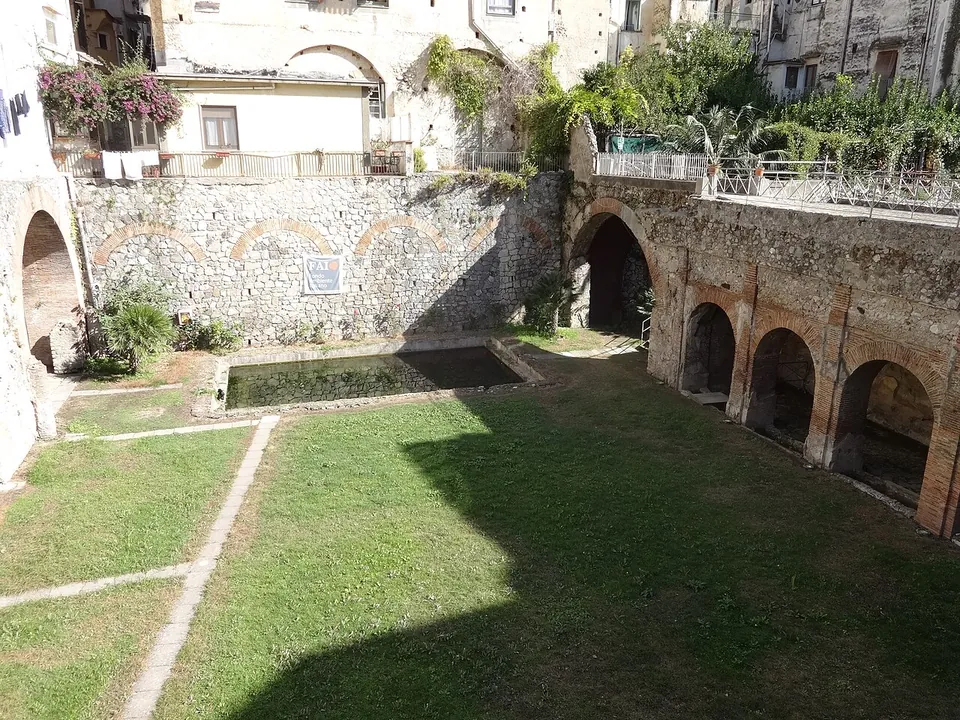
Photo: Derbrauni · CC BY-SA 4.0 · Commons
11 km · villa · Campania
Villa Romana of Minori
The villa was built around a garden, the viridarium, which had a pool at its centre and was enclosed on three sides by porticoes (it.wikipedia; the ministry).
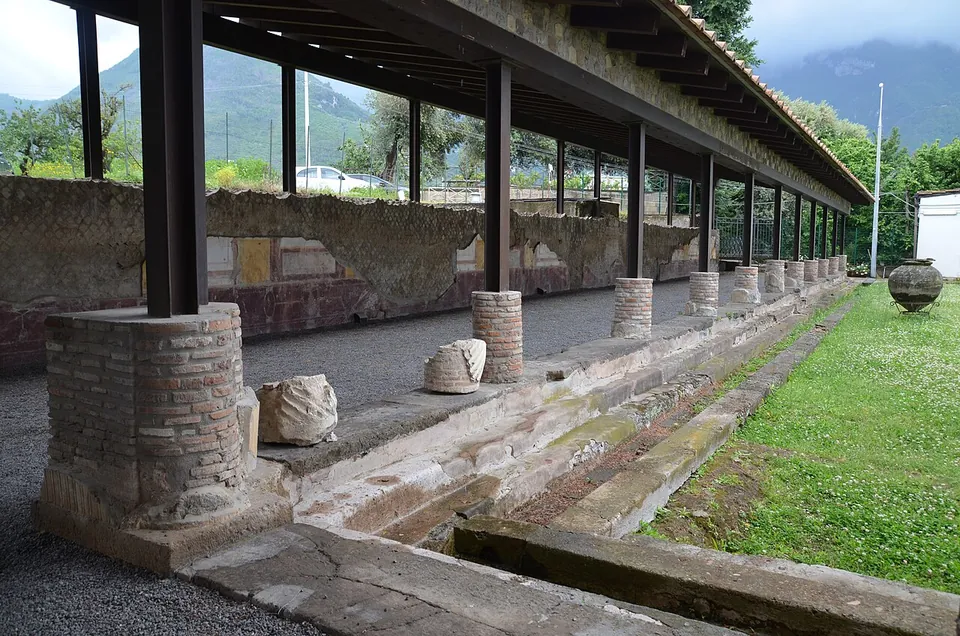
Photo: Carole Raddato · CC BY-SA 2.0 · Commons
15 km · villa · Campania
Stabiae
Two villas and the neighbouring Second Complex are open (the operator).
15 km · city · Campania
Pompeii
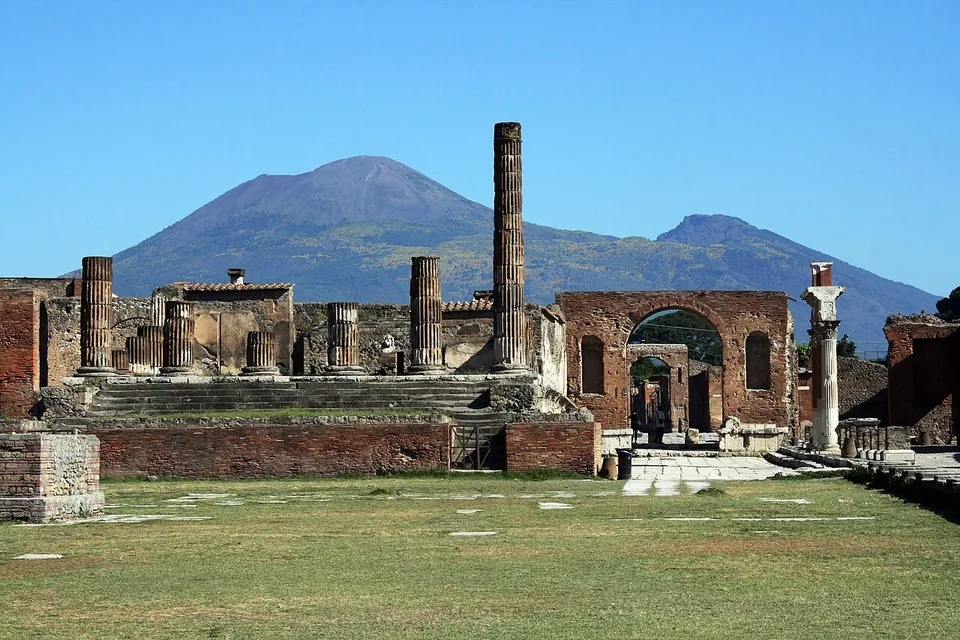
The walled town covered 64 to 67 hectares, and about two-thirds of it has been excavated (en.wikipedia), so this is a day out rather than a single monument: you walk the old streets from one block to the next.


Straight-line distances.
Sources
Every fact on this page comes from the records below, each used under the licence noted.