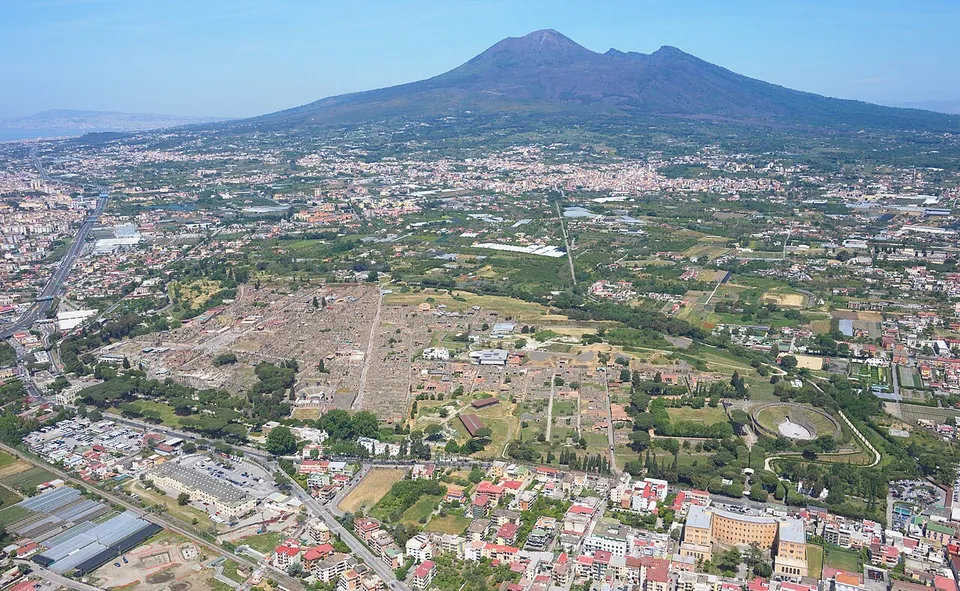


Pompeii is the Roman town near Naples that Vesuvius buried under 4 to 6 m of ash and pumice in AD 79, and it is the place to see what a Roman town was actually like: its streets, houses, shops, baths, temples and theatres are there to walk through (en.wikipedia), and some houses still have their paintings on the walls (en.wikipedia, House of the Vettii). UNESCO lists it as “the only archaeological site in the world that provides a complete picture of an ancient Roman city” (en.wikipedia). A ticket for the town is €20, and the park is open every day but two.
What is there today
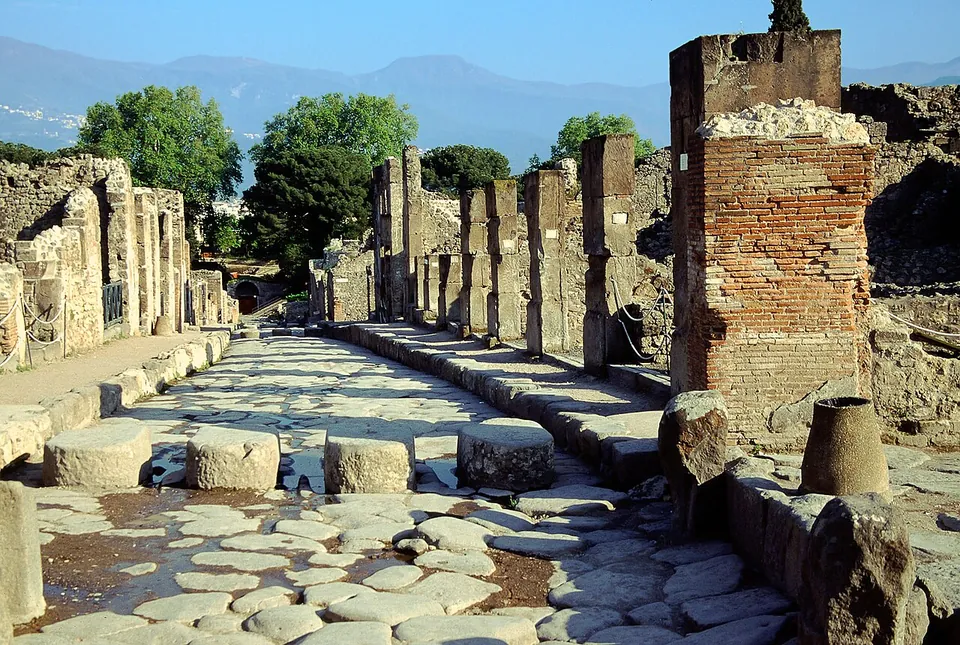
The walled town covered 64 to 67 hectares, and about two-thirds of it has been excavated (en.wikipedia), so this is a day out rather than a single monument: you walk the old streets from one block to the next. It is also the kind of place where some things are always shut. The houses open in rotation, and the park publishes the current list (pompeiisites.org/en/houses/).
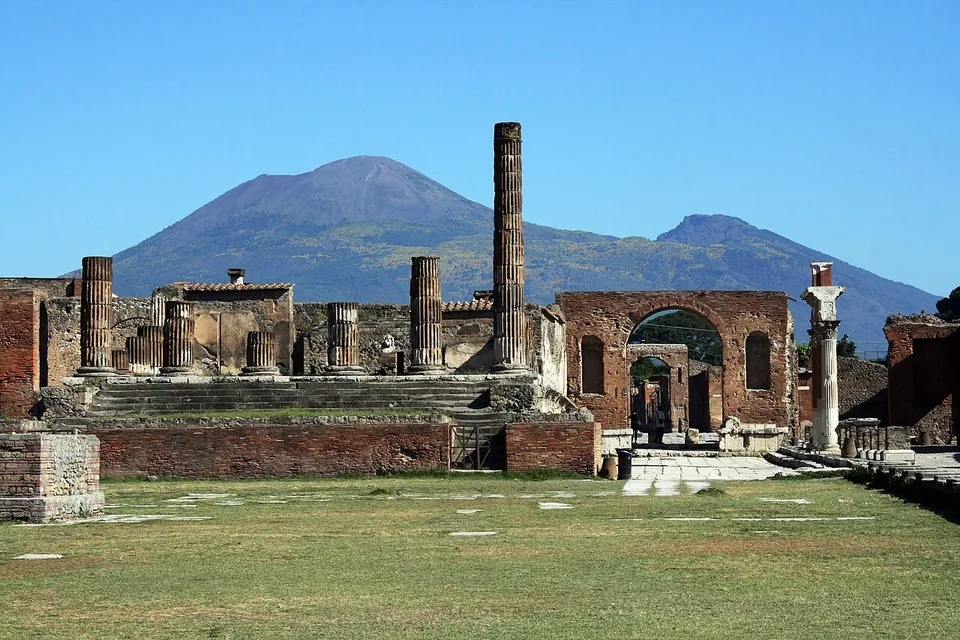
The forum and the public buildings. The forum was the town’s main square and its political, economic and religious centre (it.wikipedia). At its north end is the Temple of Jupiter, built in the mid-2nd century BC and rededicated to the Capitoline triad after Sulla took the town (en.wikipedia; it.wikipedia). Within 80 m of the square (by the gazetteers’ points) are the Temple of Apollo, one of the town’s oldest cults, whose sanctuary took its present form in the 2nd century BC (Pleiades); the Basilica, built between about 120 and 78 BC and an early example of the type, where courts sat and business was done (Pleiades; it.wikipedia); the Macellum, the food market (en.wikipedia); and the Building of Eumachia, which a public priestess of Venus paid for (Pleiades). All of them are on the park’s list of open buildings (the operator).
Theatres and temples to the south. The Great Theatre was built into a natural slope in the 2nd century BC and held about 5,000 (hr.wikipedia); the smaller covered Odeon beside it was built between 80 and 75 BC (Pleiades) and can now be seen only from outside (the operator). Behind them, a colonnaded court that served as the theatres’ foyer was later turned into a barracks for gladiators (it.wikipedia). Nearby are the Triangular Forum, with a Doric temple that goes back to the town’s Greek period (Pleiades; en.wikipedia), and the small Temple of Isis, one of the first buildings found, in 1764; its paintings and statues are in the National Archaeological Museum in Naples (en.wikipedia), and the temple is not on the park’s list of open buildings (the operator).
Baths. The Stabian Baths, from about 125 BC, were the oldest and largest of the town’s five public baths (en.wikipedia), and stand at the crossing of its two main streets, Via Stabiana and Via dell’Abbondanza (Pleiades). The Forum Baths were built after 80 BC (Pleiades), and the Central Baths were begun only after the earthquake of AD 62 (en.wikipedia).
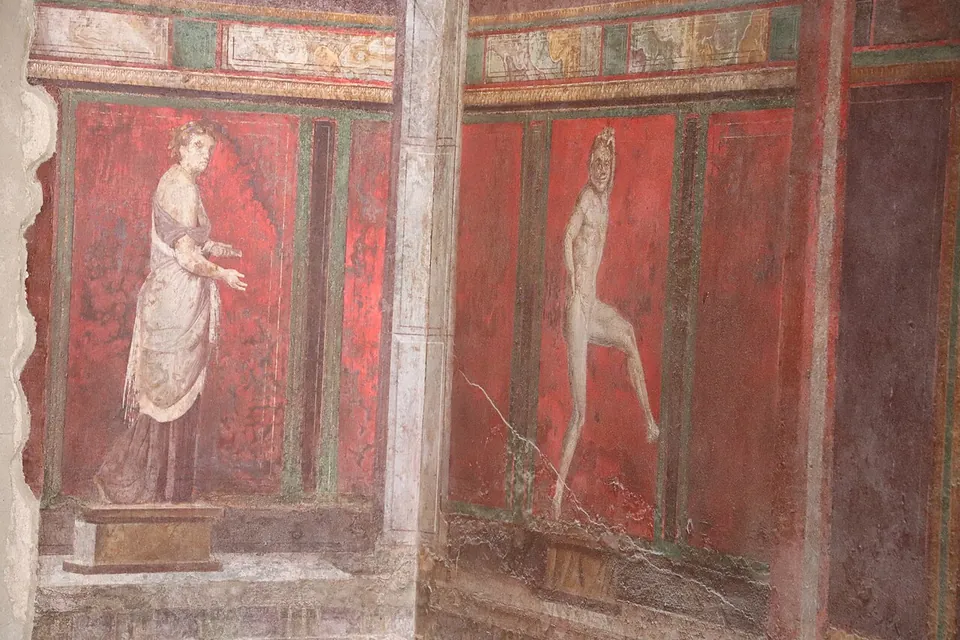
Houses, shops and bars. The House of the Faun, built about 180 BC, is the largest private house in the town at 2,940 m²; the Alexander Mosaic from its floor is in the Naples museum, with a copy in place (de.wikipedia). The House of the Vettii, which belonged to two freedmen, keeps almost all of its Fourth Style wall paintings and reopened in January 2023 after two decades of restoration (en.wikipedia). The small House of the Tragic Poet has the “cave canem” (beware of the dog) mosaic at its door (it.wikipedia); the House of Menander covers about 1,800 m² (en.wikipedia); and the House of Octavius Quartio is known for its paintings and large gardens (en.wikipedia). The town was full of food shops too: at least 31 bakeries and nearly 100 thermopolia, snack bars serving hot food (en.wikipedia), and the Lupanar, the brothel, is open to visitors (en.wikipedia; the operator).
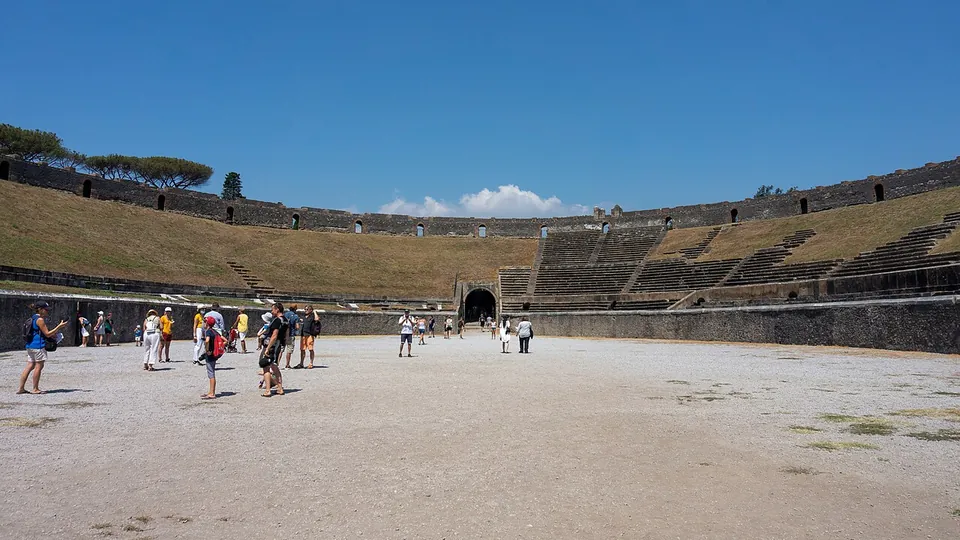
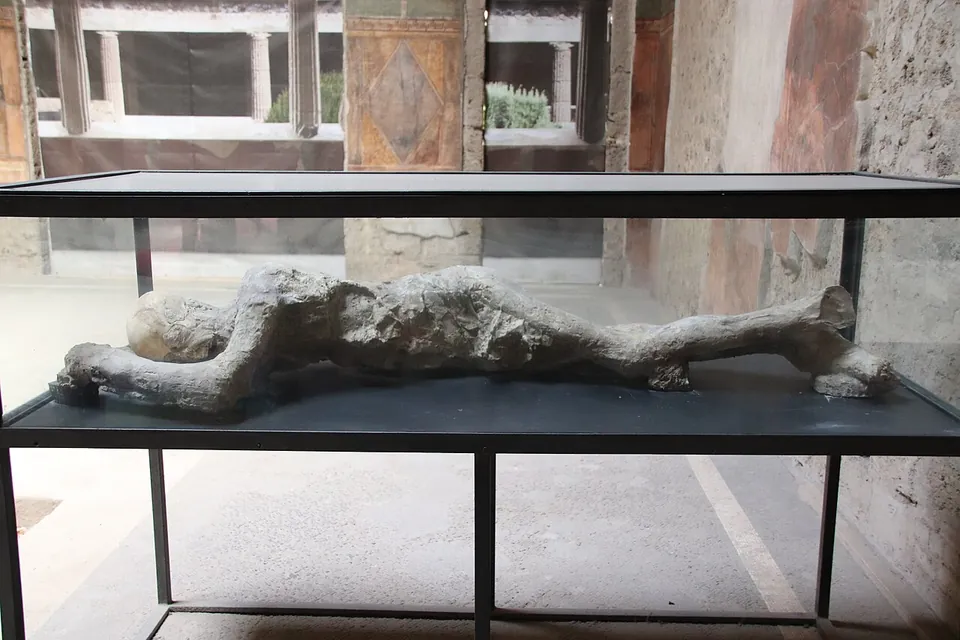
The amphitheatre and the Large Palaestra. In the south-eastern corner of the walls (fr.wikipedia), the amphitheatre, built between 80 and 70 BC (Pleiades), is one of the oldest Roman amphitheatres to survive (en.wikipedia); Pleiades calls it the earliest known. In AD 59 a riot there between Pompeians and Nucerians led the Senate to ban events for ten years (en.wikipedia). Next to it, the Large Palaestra, an open square of about 140 by 140 m inside porticoes (Pleiades), now holds the park’s permanent exhibition of the casts and the organic finds (the operator). The casts are Giuseppe Fiorelli’s technique: after he took charge of the excavations in 1863, he had plaster poured into the hollows that bodies had left in the ash (en.wikipedia).
Outside the walls. Tombs line the road out of the Herculaneum Gate, in the best known of the town’s cemeteries, in use from the mid-1st century BC (Pleiades); there are more at the Nocera Gate. Some 300 to 350 m beyond the Herculaneum Gate is the Villa of the Mysteries (de.wikipedia; fr.wikipedia), whose room of paintings, usually read as the initiation of a bride into a mystery cult, is among the best known of the rare Roman paintings to survive from the 1st century BC (en.wikipedia). The Villa of Diomedes is on the same road (en.wikipedia). Both villas are on a separate route that costs extra (the operator). The Castellum Aquae, part of the aqueduct’s supply to the town, is well preserved and shows many details of the distribution network and its controls (en.wikipedia); it can be seen from outside (the operator).
Is it worth the trip?
Yes, without qualification. Nowhere else shows a whole Roman town at street level, houses, bakeries and bars included, with the volcano that buried it still in view.
The caveats are practical. It is crowded: more than four million people visited in 2024 (it.wikipedia), entry is capped at 20,000 a day, and from mid-March to mid-October admissions run in time slots (the operator). Most of the finds, frescoes, mosaics and statues among them, are in the National Archaeological Museum in Naples rather than on site (it.wikipedia), and outside the best-protected buildings much of the decoration has faded or been lost (en.wikipedia). A particular house you have read about may be closed that month. The streets are uneven, with drops and gaps (the operator), so wear proper shoes, and bring only a small bag: anything larger than 30 by 30 by 15 cm goes to the left luggage.
Getting there and what it costs
There are three entrances: Porta Marina and Piazza Esedra, by the Pompei Villa dei Misteri stop of the Circumvesuviana’s Naples–Sorrento line, and Piazza Anfiteatro, by the Pompei Santuario stop of its Naples–Poggiomarino line. Mainline trains from Naples to Salerno stop at Pompei station, from which the Pompei Link train-and-bus service reaches the park in about 15 minutes; by car, the A3 motorway has a Pompeii Scavi exit (the operator). For the Antiquarium, the park recommends the Piazza Esedra entrance.
The town is open every day, 09.00 to 19.00 from 16 March to 14 October (last entry 17.30) and 09.00 to 17.00 from 15 October to 15 March (last entry 15.30); it closes on 25 December and 1 January. Most of the houses that are open keep shorter hours, 09.15 to 18.20 in summer and to 16.20 in winter (the operator).
Tickets, from the operator’s page read on 13 October 2026:
- Pompeii Express, €20: the ancient town only.
- Pompeii+, €25: the town plus the Villa of the Mysteries, the Villa of Diomedes, Villa Regina and the Antiquarium at Boscoreale, and the shuttle bus. With an Express ticket you can add the villas for €8 at the start of their route at the Herculaneum Gate, by card only.
- €2 for EU citizens aged 18 to 24.
- €30 for three days, adding Oplontis, Boscoreale and the villas and museum of Stabiae.
- Free on the first Sunday of every month.
Tickets are personal and good for one entry: you cannot leave and come back on the same ticket, and staff may ask for an identity document that matches the name on it (the operator). They are sold online and at the three entrances.
Visiting details
- Opening hours
- Daily 09.00–19.00 (last entry 17.30) from 16 March to 14 October, and 09.00–17.00 (last entry 15.30) from 15 October to 15 March. Most of the houses that are open keep shorter hours, 09.15–18.20 in summer and 09.15–16.20 in winter, last entry 20 minutes before. Last access to the villas' route at the Herculaneum Gate 17.30 in summer, 15.30 in winter. Closed 25 December and 1 January.
- Tickets
- Pompeii Express (the ancient city only) €20; Pompeii+ (the city, the Villa of the Mysteries, the Villa of Diomedes, Villa Regina and the Antiquarium at Boscoreale, and the shuttle bus) €25. Express holders can add the villas' route for €8 at the Herculaneum Gate, card payment only. €2 for EU citizens aged 18 to 24. A three-day ticket adding Oplontis, Boscoreale and the villas and museum of Stabiae is €30. Free on the first Sunday of the month. Tickets are personal and valid for one entry.
Before you go
- The houses open in rotation, and a change on 15 August 2026 closed several and opened others; the park's list of open buildings is the only current guide.
- Entry is capped at 20,000 a day, with timed slots from 16 March to 14 October. Staff may check that the name on the ticket matches an identity document.
- Only small bags (30 x 30 x 15 cm at most) are allowed in; larger ones go to the left luggage.
Hours and prices checked 13 October 2026 on the operator's own site. Confirm before travelling.
History
The first settlements here date to the 8th century BC, when the Oscans founded five villages; Greeks, Etruscans and from the late 5th century BC the Samnites followed (en.wikipedia; fr.wikipedia). After the Samnite Wars, from 290 BC, Pompeii was an ally of Rome while keeping its own language and administration, and it grew rich in the 2nd century BC, when the forum, the Great Theatre, the Temple of Jupiter, the Basilica and the Stabian Baths were built (en.wikipedia).
The town joined the Italian revolt against Rome, and in 89 BC Sulla besieged it, targeting the Herculaneum Gate with his artillery; the impact craters can still be seen in the walls. Pompeii became a Roman colony, Colonia Cornelia Veneria Pompeianorum, with land given to Sulla’s veterans, and Latin replaced Oscan as the main language (en.wikipedia; fr.wikipedia). The amphitheatre, the Forum Baths and the Odeon followed; under Augustus, from about 30 BC, came a wave of new public buildings, and from about 20 BC a branch of the Serino aqueduct brought running water (en.wikipedia).
On 5 February 62 a severe earthquake did considerable damage to the town; much was rebuilt afterwards, and some buildings, such as the Central Baths, were begun anew (en.wikipedia). Long dated to August, the eruption is now placed in the autumn: a charcoal inscription found in 2018 bears the date 17 October, and a 2022 study settled on 24–25 October (en.wikipedia). The first phase, about 18 hours of falling pumice, let most inhabitants escape; about 1,150 bodies have been found. Then pyroclastic flows swept the town, and heat, not suffocation, was the main cause of death (en.wikipedia).
The site was forgotten, known only as La Civita. Domenico Fontana’s workers cut through it in 1592 and kept the find secret; Bourbon excavations began in 1748, and in 1763 an inscription naming the town confirmed that this was Pompeii (en.wikipedia). Fiorelli divided it into the regions, blocks and numbered entrances still used today (en.wikipedia), which is why its houses are known by addresses such as VI.15.1, the House of the Vettii (Pleiades). UNESCO added Pompeii, with Herculaneum and Oplontis, to the World Heritage List in 1997 (it.wikipedia).
More photographs



Nearby
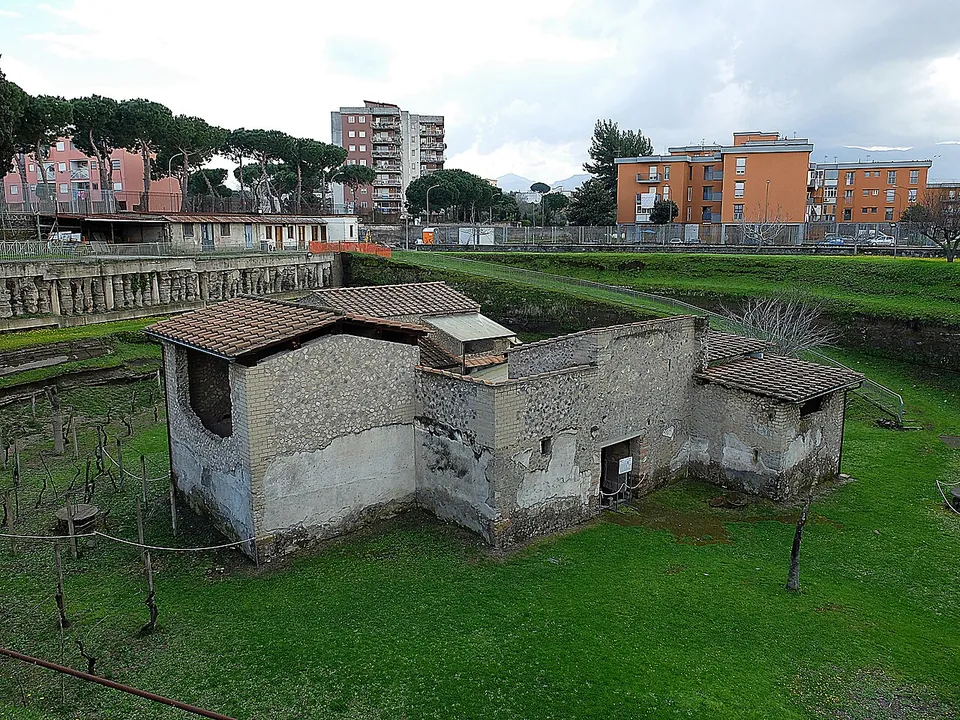
Photo: RealCarlo · CC BY 2.0 · Commons
2 km · villa · Campania
Villa Regina and Antiquarium
Villa Regina is a working farm rather than a luxury house.
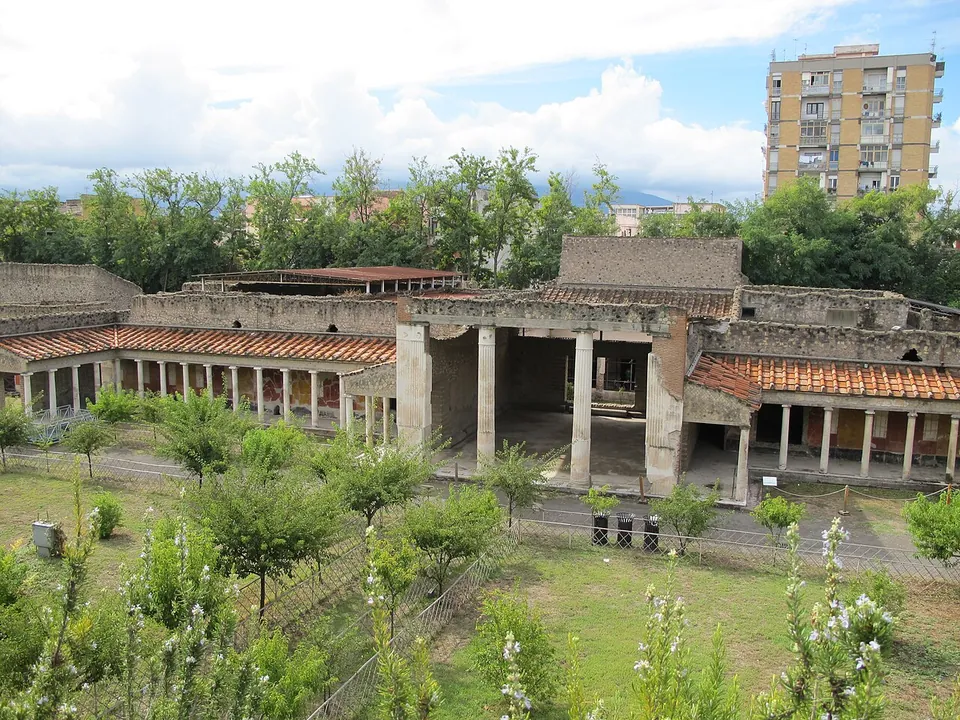
Photo: ho visto nina volare from Italy · CC BY-SA 2.0 · Commons
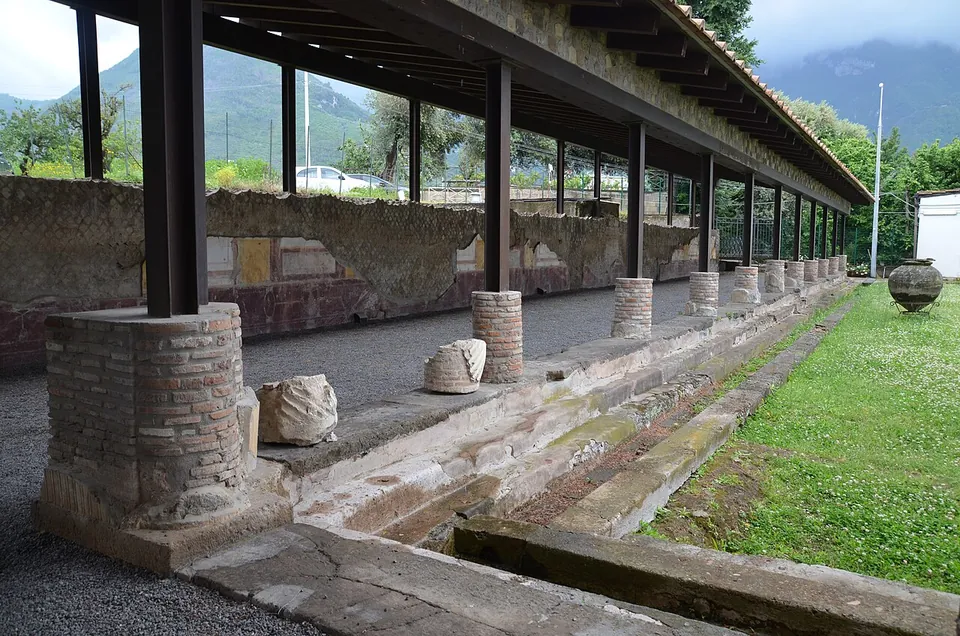
Photo: Carole Raddato · CC BY-SA 2.0 · Commons
5 km · villa · Campania
Stabiae
Two villas and the neighbouring Second Complex are open (the operator).


Straight-line distances.
Sources
Every fact on this page comes from the records below, each used under the licence noted.