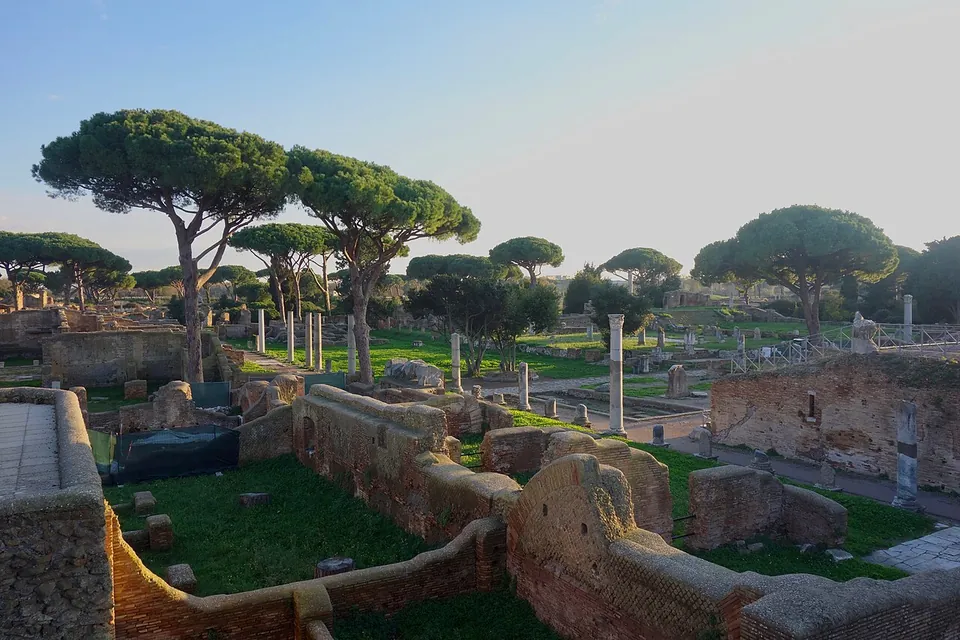
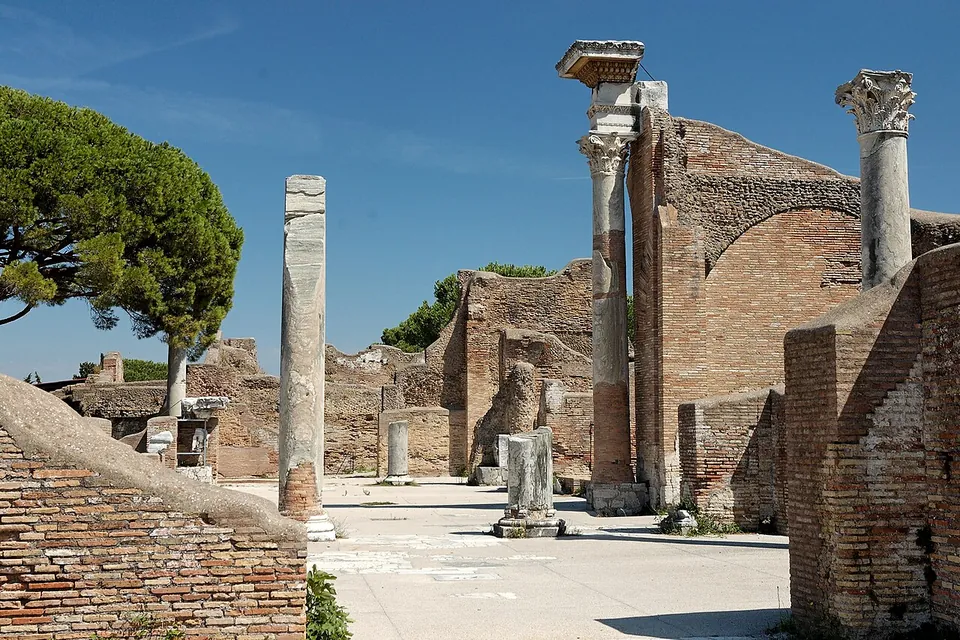


Ostia was the harbour town of ancient Rome, at the mouth of the Tiber, and its excavations show what the city of Rome itself no longer can: an ordinary Roman town of streets, apartment blocks, shops, warehouses, baths, temples and a theatre, preserved better than anywhere except Pompeii and Herculaneum (en.wikipedia). It lies 23 to 25 km south-west of central Rome (de.wikipedia; en.wikipedia), with its own station on the Rome–Lido railway, and one €18 ticket covers it and the park’s other sites for eight days. It is closed on Mondays.
What is there today
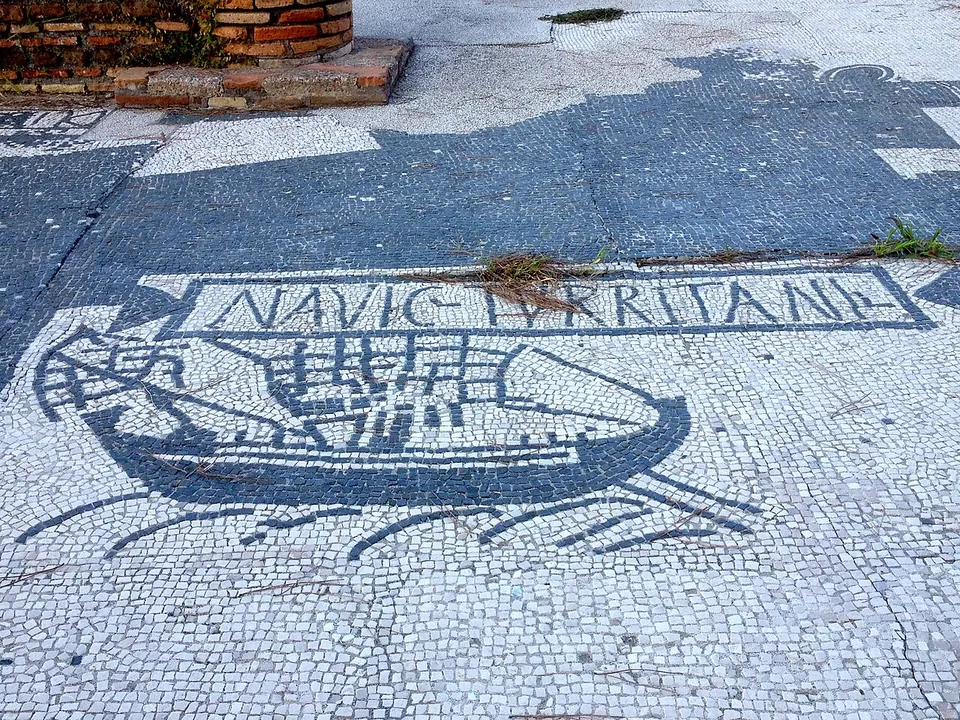
A whole town of brick to walk through: houses, shops, warehouses and apartment blocks, sometimes several storeys high (fr.wikipedia), with floor mosaics still in place in many buildings (de.wikipedia). The walled town covered about 69 hectares (en.wikipedia; it.wikipedia). Published estimates of how much of it has been dug differ, from a third (en.wikipedia) to two-thirds (de.wikipedia), but either way the excavated part is large: by the gazetteers’ points it is about a kilometre from the Porta Romana at the Rome end to the Porta Marina at the sea end, along the main street, the Decumanus Maximus. Much of the marble that once faced the public buildings was carried off over the centuries (en.wikipedia; it.wikipedia), and on the whole the ruins are in rather poor condition (de.wikipedia).
The ticket office is at the eastern end of the site, the Rome end (OpenStreetMap). From there, these are the buildings the sources single out, roughly in the order you meet them.
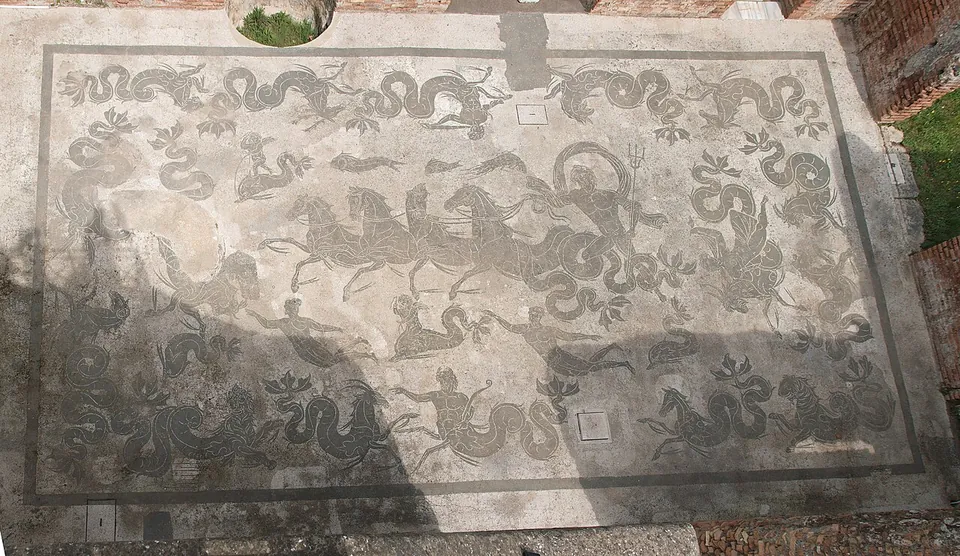
From the Porta Romana to the theatre. Outside the Porta Romana, tombs line the Via Ostiense: this was the oldest and largest of Ostia’s cemeteries, used from the 2nd century BC to the late empire (it.wikipedia). Inside the gate, the Baths of Neptune were rebuilt under Hadrian, who gave two million sesterces, and dedicated in 139 under Antoninus Pius; they are known above all for their black-and-white mosaics; the one that gave them their name shows Neptune driving his sea horses among tritons and sea creatures (it.wikipedia; de.wikipedia). In the same quarter is the barracks of the vigiles, the town’s fire brigade, rebuilt under Hadrian around a large courtyard (it.wikipedia; de.wikipedia).
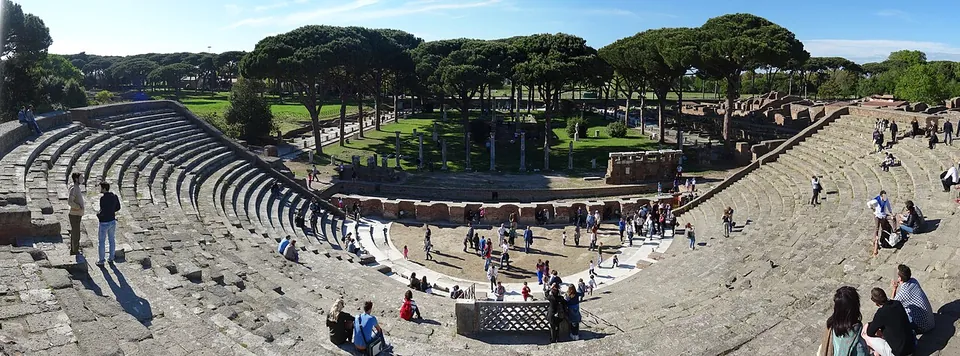
The theatre was first built by Agrippa under Augustus and rebuilt in brick at the end of the 2nd century AD, when it held about 4,000 people; it was restored in 1927 (it.wikipedia) and is still used for performances (de.wikipedia). Behind the stage lies the Piazzale delle Corporazioni, a square of about 110 by 80 m inside a portico with some 70 small rooms (de.wikipedia). The floor mosaics in front of the rooms show ships and name shipowners, traders and ports such as Alexandria and Sabratha. What the rooms were for is not certain, but they were most likely the offices of shipowners and merchants from port cities around the empire (fr.wikipedia; de.wikipedia). Close by, the four small temples known as the Quattro Tempietti go back to the Republic (Pleiades).
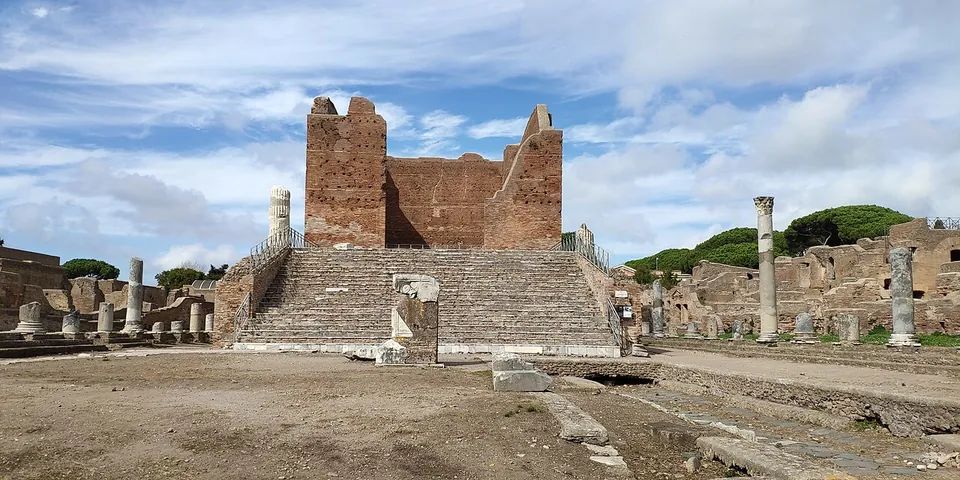
The forum. The forum is at the heart of the oldest town, where the two main streets cross (it.wikipedia). At its north end the Capitolium, the town’s chief temple, built for Jupiter, Juno and Minerva around 120 under Hadrian, still stands about 17 m high on its podium and rises above every other ruin; a broad flight of steps, partly rebuilt from the original material, leads up to it (it.wikipedia; de.wikipedia). Opposite is the Temple of Rome and Augustus, built under Tiberius, and the Basilica and the Curia, where the town council met, stand on the western side (en.wikipedia; de.wikipedia). South-east of the square, the Forum Baths, built about 160 by the praetorian prefect Gavius Maximus, were the largest in Ostia (de.wikipedia; it.wikipedia). Nearby are the Round Temple, probably for the cult of the emperors and now poorly preserved (de.wikipedia; it.wikipedia), and the Horrea Epagathiana, a warehouse of about 145–150 that still carries the names of its two owners over the door and is in good condition, unlike the much larger Grandi Horrea, the main grain stores (de.wikipedia).
Apartment blocks, houses and mithraea. North of the forum, the Caseggiato di Diana is an apartment block of the first half of the 2nd century, built around a courtyard and perhaps five storeys high (it.wikipedia), and one of the best-preserved of its kind, with a fountain, a latrine and a small mithraeum inside (Coopculture), but it opens only on the Sunday tours below. Rich houses of the 4th century, such as the House of Cupid and Psyche, still have walls covered in marble panels and floors of coloured marble (en.wikipedia). The cult of Mithras was popular in Ostia, where eighteen of its shrines have been found (en.wikipedia); the one under the Baths of Mithras, reached down a staircase, is the best preserved (fr.wikipedia; de.wikipedia).
Towards the sea. In the west of the town, the Baths of the Seven Sages, built under Hadrian, centre on a round hall that once had a dome, with a hunting mosaic on its floor (de.wikipedia). The Garden Houses, built around 128, were two blocks of four houses set in a garden with six fountains (Pleiades), and the House of the Muses among them keeps wall paintings that are well preserved for Ostia (de.wikipedia). Beyond the Porta Marina are the tomb of Gaius Cartilius Poplicola, a leading citizen, from about 30–20 BC (Pleiades), and at the southern edge of the site the synagogue, built under Claudius in the 1st century and used into the 5th; it is the oldest synagogue yet found in Europe (en.wikipedia; Pleiades).
The Museo Ostiense. Inside the site, in the Casone del Sale, a 16th-century building of the papal salt works, the museum has been rearranged in 12 rooms on the town’s origins, imperial power, its public life, its people, its cults, its cemeteries and its houses (the operator). It opens later and closes earlier than the excavations.
Closed, or open only on some days. Many painted interiors are kept closed because they are fragile. The park’s ticket and tour concessionaire, Coopculture, opens some of them on guided tours in Italian on the second, third and fourth Sundays of the month, 11.00 to 13.00, for €7 on top of the entrance ticket; October 2026’s three tours take in the Caseggiato di Diana and the Insula of the Painted Ceiling, the Baths of the Seven Sages and the Insula of the Painted Vaults, and the Mithraeum of the Seven Gates with the Insula of the Eagle (Coopculture). The Laurentine necropolis, a cemetery of freed slaves outside the Porta Laurentina, is closed for maintenance and restoration, and the Christian basilica at Pianabella, south of the walls, was covered over again after it was excavated in 1976 (the operator).
Is it worth the trip?
Yes. Ostia shows the everyday fabric of a Roman town, its apartment blocks, shops, warehouses and streets, in a way the city of Rome no longer can (en.wikipedia), and it is a train ride from the centre. About 274,000 people visited in 2023 (it.wikipedia), spread over a site of some 69 hectares.
Know what you are getting, though. This is a town of brick walls and floor mosaics rather than of frescoed rooms: the marble facing is largely gone, many of the best interiors are shut except on the Sunday tours, and many finds went to the site’s museum or, before the early 19th century, to collections elsewhere in Europe (it.wikipedia). The site is big enough to fill a day. With half a day, follow the Decumanus from the entrance to the forum: the Baths of Neptune, the theatre, the Piazzale delle Corporazioni and the Capitolium are all on or beside it. The ground is uneven, so wear comfortable shoes; picnics are not allowed inside, but there is a café (the operator). In winter the gates close at 16.30, with last entry at 15.30, so start early.
Getting there and what it costs
Take the Rome–Lido railway, branded Metromare, from Roma Porta San Paolo, next to the Piramide station of Metro line B, to Ostia Antica; trains run about every 20 minutes (it.wikipedia). From the station, cross the footbridge and follow the signs (Coopculture); the ticket office is about 400 m away in a straight line (OpenStreetMap). By car, the site is reached from the Via Ostiense (Coopculture), and there is an unguarded visitors’ car park by the entrance, open 07.30 to 19.30 (the operator).
The excavations open from Tuesday to Sunday and on public holidays at 08.30, and close at 16.30 from 25 October to the end of February, 17.15 in March, 19.00 from April to September and 18.30 from 1 to 24 October. Last entry is an hour before closing, when the ticket office also closes. They are closed on Mondays and on 25 December. The Museo Ostiense opens at 09.30 in summer and 10.30 in winter, and is closed on the first Sunday of every month (the operator).
Tickets, from the operator’s pages read on 14 October 2026:
- €18: one ticket, valid for eight days from the first entry, for all the park’s sites: the excavations and the Museo Ostiense, the imperial harbours of Claudius and Trajan at Portus, the Museo delle Navi (the ship museum) at Fiumicino, the Necropoli di Porto at Isola Sacra, the Castello di Giulio II in the village of Ostia Antica, and the Sant’Ippolito complex.
- €2 for EU citizens aged 18 to 25; free for everyone under 18.
- Free for everyone on the first Sunday of every month.
- €40 for the Ostia Antica Pass, a named card with unlimited entries for a year.
- Audio guides cost €7 for the long route and €5 for the short one.
Tickets are sold at the ticket office (cash or card), online and in the Musei Italiani app.
With the same ticket, Portus, the harbour Claudius began and Trajan enlarged, 3.3 km away by the gazetteers’ points, opens Tuesday to Sunday at 10.00; its viewpoint over Trajan’s basin is closed for now (the operator). The Castello di Giulio II, the castle of the late 15th century in the village of Ostia Antica (it.wikipedia), holds the exhibition “In Hoc Signo”, on early Christianity at Ostia and Portus, until 21 November 2026 (the operator).
Visiting details
- Opening hours
- Tuesday to Sunday and public holidays from 08.30. Closes 16.30 from 25 October to the end of February, 17.15 in March, 19.00 from 1 April to 30 September and 18.30 from 1 to 24 October; last entry, and the ticket office, one hour before closing. Closed on Mondays and 25 December. The Museo Ostiense inside the site opens at 09.30 from 1 April to 24 October and 10.30 from 25 October to 31 March, with last entry between 15.00 and 17.30 depending on the season, and is closed on the first Sunday of the month and the other free-entry days (25 April, 2 June, 4 November).
- Tickets
- €18, a ticket valid for eight days from the first entry at all the park's sites (the excavations and Museo Ostiense, Portus, the Museo delle Navi, the Necropoli di Porto at Isola Sacra, the Castello di Giulio II and the Sant'Ippolito complex). €2 for EU citizens aged 18 to 25; free under 18, and for everyone on the first Sunday of the month. Ostia Antica Pass, a year of unlimited entries, €40. Audio guide €7 (long route) or €5 (short). Tickets at the ticket office (cash or card), online and in the Musei Italiani app.
- Parking
- An unguarded visitors' car park by the entrance, open 07.30–19.30 (the operator); OpenStreetMap maps it as free of charge (way/252274646).
Before you go
- Closed on Mondays.
- Several painted houses, baths and mithraea are kept closed because they are fragile, and open only on guided tours in Italian on the second, third and fourth Sundays of the month, 11.00–13.00, for €7 on top of the entrance ticket.
- The Laurentine necropolis is closed for maintenance and restoration.
- The ground is uneven, and no picnics are allowed inside; there is a café in the site.
Hours and prices checked 14 October 2026 on the operator's own site. Confirm before travelling.
History
Tradition, recorded in an inscription, made Ostia the first colony of Rome, founded by its fourth king, Ancus Marcius, in the 7th century BC (en.wikipedia; de.wikipedia). The oldest remains are later: a fort of tuff blocks built to guard the river mouth, dated by the operator to the second half of the 4th century BC and by other accounts to the 3rd (en.wikipedia; de.wikipedia). Ostia probably grew up as a naval base, and in 267 BC it was the seat of a quaestor in charge of the fleet; by the 2nd century BC it had become the commercial port that received grain for Rome (en.wikipedia).
Marius captured and plundered it in 87 BC, and in 68 BC pirates sacked it and burned the fleet in the harbour (en.wikipedia). The new town walls were begun in 63 BC, in Cicero’s consulship, and completed in 58 BC by Publius Clodius Pulcher (en.wikipedia; it.wikipedia). Under Augustus, Agrippa built the theatre; the forum was probably laid out under Tiberius (en.wikipedia). Because the river harbour was too small, Claudius began a new harbour to the north in 42, and Trajan added a hexagonal basin between 106 and 113 (it.wikipedia). Ostia flourished with them: in the 2nd century it may have had about 50,000 inhabitants, and Hadrian, who twice held its chief magistracy, and his successors rebuilt much of the town (en.wikipedia; the operator). Most of what stands today dates from that century (de.wikipedia).
From the 3rd century trade moved to Portus, which Constantine made a town of its own, and Ostia declined, though in the 4th century it became a place of rich houses (de.wikipedia; en.wikipedia). Saint Monica, the mother of Augustine, died here in 387 on the way back to Africa (en.wikipedia; de.wikipedia). By the mid-6th century Ostia appeared abandoned (the operator), and in the 9th century its last inhabitants moved to Gregoriopolis, a fortified settlement built a short distance to the east (en.wikipedia; de.wikipedia).
The ruins were quarried for marble and lime for centuries (en.wikipedia; de.wikipedia). The first excavations were made from 1801 to 1805 under Pius VII; under Pius IX, from 1855, finds were left in place where possible and the first museum was opened in the Casone del Sale (it.wikipedia). The most extensive excavations, from 1938 to 1942, were meant to present the site at the world’s fair planned for Rome in 1942 (it.wikipedia). Excavation continues: in 2025 a ritual bath of the late 4th or early 5th century, possibly the oldest Jewish mikveh found outside Israel, was found in a large house (en.wikipedia).
More photographs



Nearby
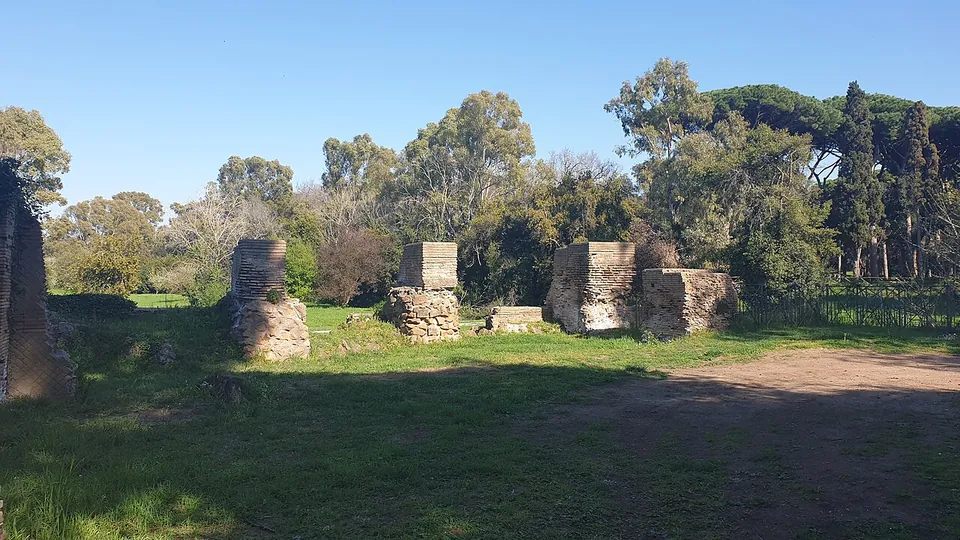
Photo: MumblerJamie · CC BY-SA 2.0 · Commons
4 km · harbour · Lazio
Portus
The visitable area is the Area archeologica dei Porti Imperiali di Claudio e Traiano, run by the Ostia Antica archaeological park.
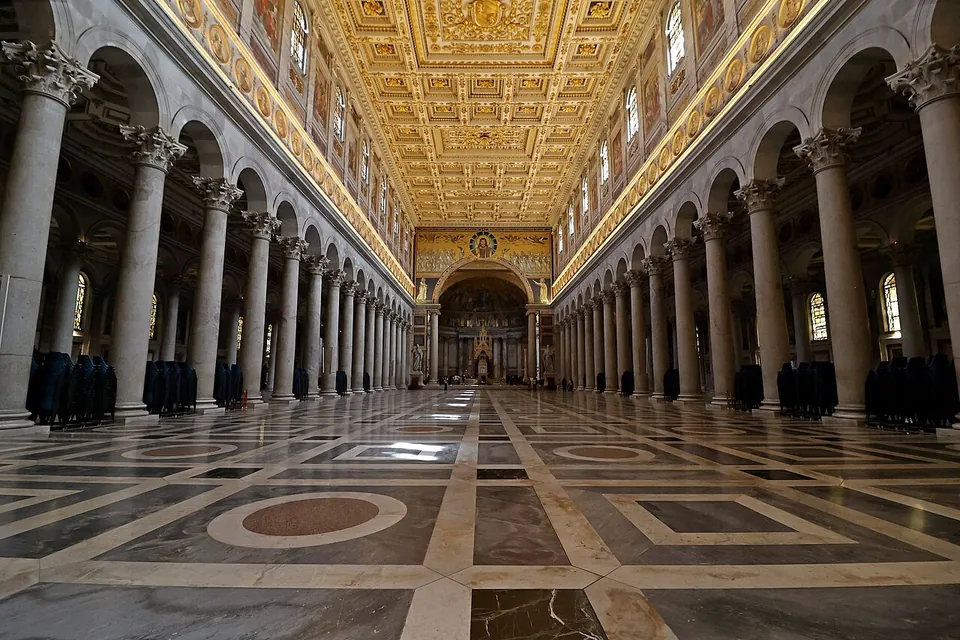
Photo: Monica_Rondoni · CC BY-SA 4.0 · Commons
20 km · church · Lazio
Basilica of Saint Paul outside the Walls
Very little of the late Roman church survived the fire.
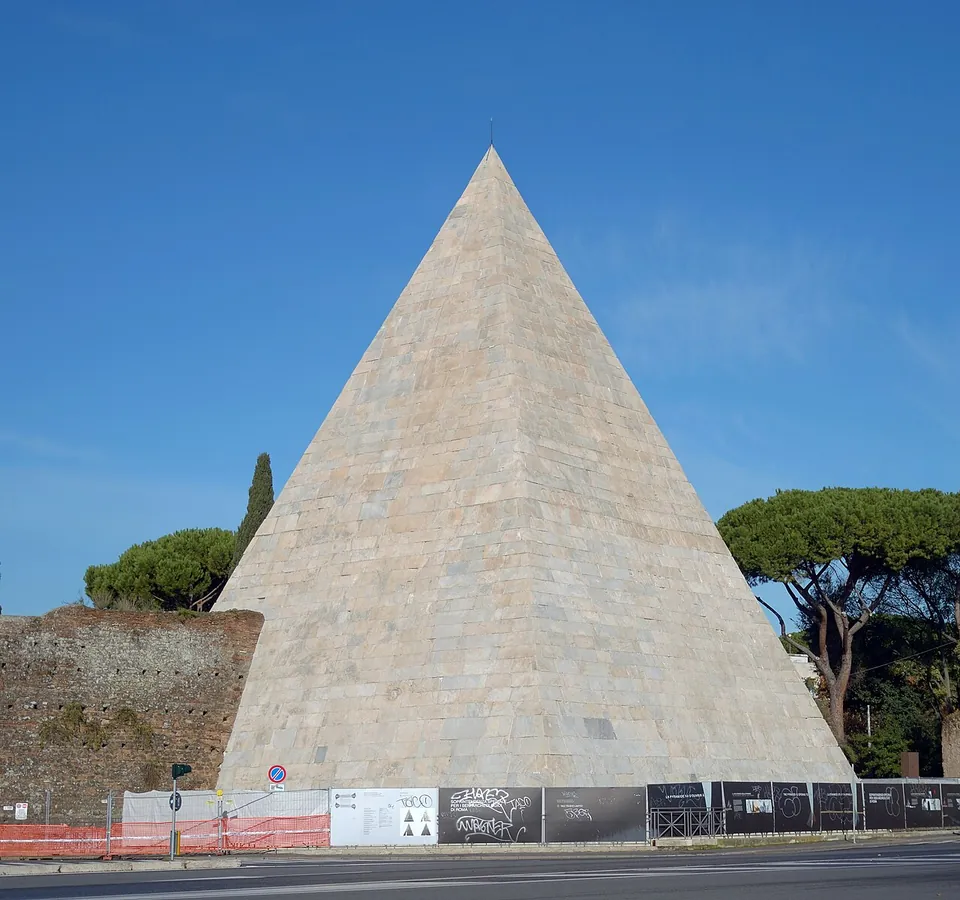
Photo: Livioandronico2013 · CC BY-SA 4.0 · Commons
21 km · tomb · Lazio
Pyramid of Cestius
The pyramid itself, complete: published heights are 36.4 to 37 m on a square base of about 29.5 m a side, of brick-faced concrete clad in white marble (en.wikipedia; it.wikipedia).


Straight-line distances.
Sources
Every fact on this page comes from the records below, each used under the licence noted.