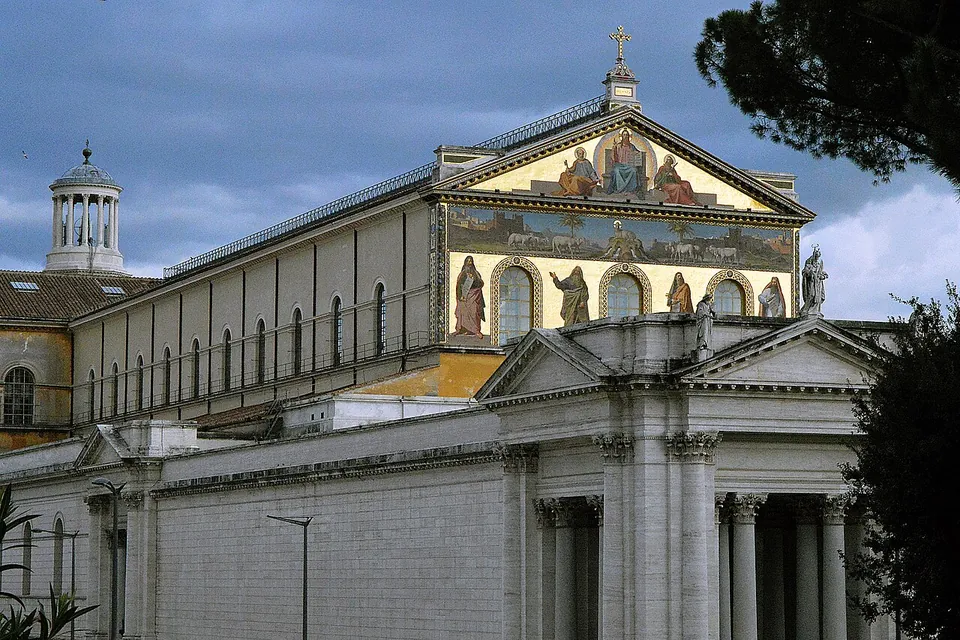
The Basilica of Saint Paul outside the Walls is one of Rome’s four papal basilicas, founded by Constantine over what tradition holds to be the apostle Paul’s grave and replaced in the late 4th century by a much larger five-aisled church (Pleiades; en.wikipedia; it.wikipedia). Be clear about what you will see: a fire in 1823 destroyed almost all of it, and the church standing today was rebuilt in the 19th century (en.wikipedia). It is free, open every day and close to a metro station, so it is easy to fit into a stay in Rome for anyone curious what a late Roman basilica felt like inside.
What is there today
Very little of the late Roman church survived the fire. What did is concentrated at the altar end:
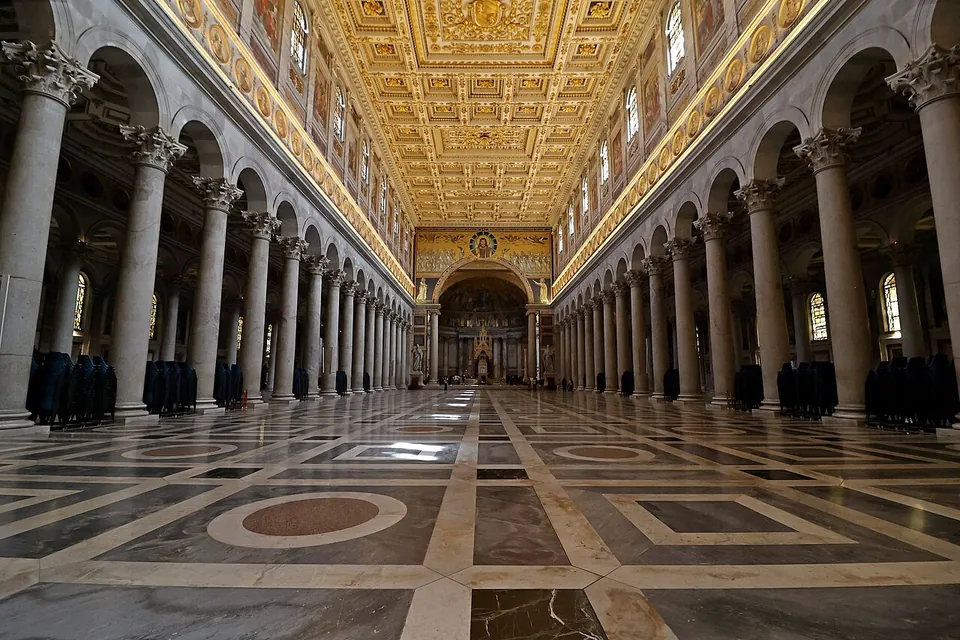
- The triumphal arch mosaic. The great arch between the nave and the transept carries the mosaic made in the time of Pope Leo I (440–461) and paid for by Galla Placidia, as an inscription on it records: Christ in a roundel, the symbols of the four Evangelists, the twenty-four elders of the Apocalypse (it.wikipedia), and Paul and Peter on either side (en.wikipedia; it.wikipedia). It is original but heavily reworked (en.wikipedia): the arch itself was taken down and rebuilt in the 19th century, and the mosaic was detached and restored (it.wikipedia). Another inscription, put back at the top of the arch after the rebuilding, reads in translation “Theodosius began, Honorius completed the hall consecrated to the body of Paul, teacher of the world” (it.wikipedia).
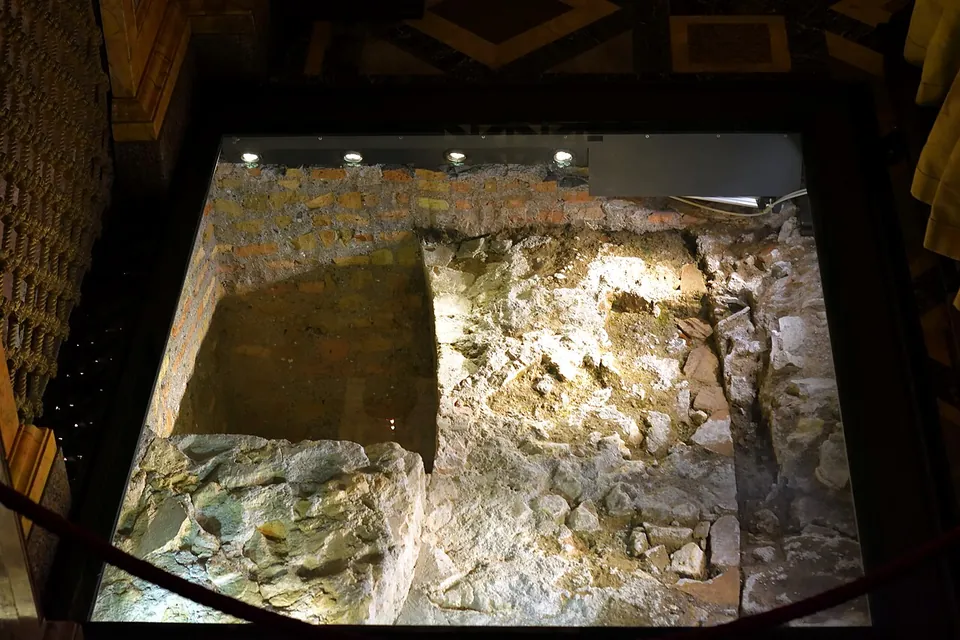
- The first basilica and the tomb. Since works finished in 2006, an opening in front of the papal altar shows part of a marble sarcophagus that tradition holds to contain Paul’s remains, and the curve of the apse of Constantine’s small church, which faced the opposite way from the present one (it.wikipedia). The sarcophagus lies under a late antique inscription, PAULO APOSTOLO MART, “to Paul, apostle and martyr” (de.wikipedia; en.wikipedia). Bone fragments in it were radiocarbon dated to the 1st or 2nd century, which neither proves nor rules out that they are Paul’s (en.wikipedia; de.wikipedia).
- The plan and the size. The rebuilt church keeps the old basilica’s nave and four aisles and its size, 131 m long and 65 m wide, second among Rome’s four papal basilicas only to St Peter’s (en.wikipedia; it.wikipedia). Along the nave, the 80 columns, the wooden ceiling and the mosaic portraits of the popes, a series begun in 1847, are all 19th-century (en.wikipedia; it.wikipedia). How faithfully the rebuilding follows the original is judged differently: one account calls the result a general resemblance only, another the closest of Rome’s four great basilicas to its first form (en.wikipedia; it.wikipedia), and a third says the forest of columns still gives the original’s sense of space (de.wikipedia).
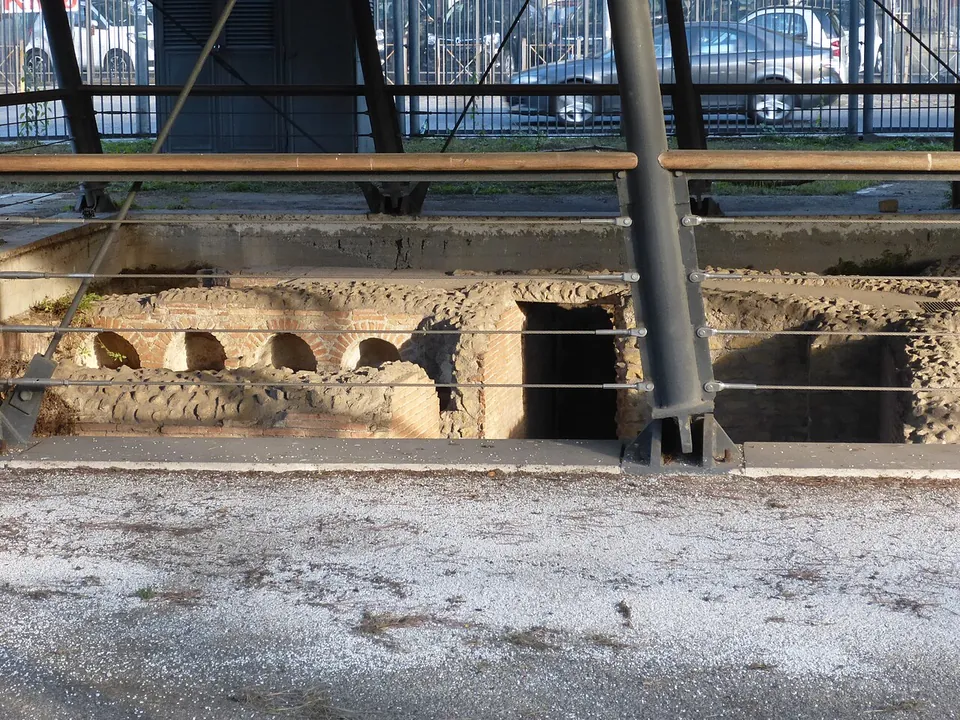
The rest belongs to later centuries: the apse mosaic made under Pope Honorius III (1216–1227), Arnolfo di Cambio’s Gothic canopy over the altar (1285), the 12th-century Easter candlestick, the bronze door commissioned in 1070 and thought to have been cast in Constantinople, and the 13th-century cloister (it.wikipedia; en.wikipedia; de.wikipedia). The cloister also displays fragments of the destroyed basilica and ancient sarcophagi, one carved with the myth of Apollo (en.wikipedia). The archaeological area in the abbey garden, opened in 2013, shows remains the operator dates to the early Middle Ages, among them a monastery of the 5th to 7th centuries and part of the columned portico that led pilgrims from the city gate at Porta San Paolo to the basilica (the operator; it.wikipedia).
Is it worth the trip?
Yes, if you take it for what it is. This is not a Roman ruin: it is a basilica rebuilt to the size and plan of a late Roman one, with a 5th-century mosaic, much restored, on the arch above the altar and the remains of Constantine’s church at your feet, and it costs nothing. If you came to Rome for standing ancient buildings, the Pantheon and the Colosseum come first.
The basilica sits about 2 km outside the Aurelian Walls (it.wikipedia), 2 km beyond the Pyramid of Cestius (the candidate record), so it pairs naturally with that part of the city.
Getting there and what it costs
The basilica is on the Via Ostiense. The metro station Basilica San Paolo, on Line B, is about 300 m away, and the bus stop Ostiense/S. Paolo about 100 m (OpenStreetMap). Free car parks lie about 200 m from the church (OpenStreetMap).
The basilica is open every day from 07.00 to 18.30 and entry is free. The cloister, with the exhibition rooms and the archaeological area, opens daily from 08.00 to 18.00 (last entry 17.30) and costs €4, €3 reduced; groups of more than ten pay €3 each (the operator, read 13 October 2026). It is a working church, with Mass several times a day.
The Roman cemetery outside. Just beyond the north transept, along the Via Ostiense, a small part of the vast cemetery in which the basilica was built can be seen; most of it is still buried, under the basilica and around it (it.wikipedia). The tombs, from the 2nd century BC to the 4th century AD, include early ones built of tufa blocks, brick tombs of the imperial period and a columbarium (Turismo Roma), and they record the shift from cremation to burial in the 2nd and 3rd centuries AD (Pleiades). Entry is by booking only, on Rome’s 060608 line, for groups with their own guide and for individual visitors on set dates (Turismo Roma).
The Catacomb of Commodilla, about 600 m away, holds a small underground basilica of the 6th century with frescoes of the 6th and 7th centuries and a painted 4th-century family vault (it.wikipedia), but it has no regular visiting and is not open to the public (OpenStreetMap).
Visiting details
- Opening hours
- Basilica daily 07.00–18.30. Cloister, with its exhibition rooms and the archaeological area, daily 08.00–18.00, last entry 17.30.
- Tickets
- Basilica free. Cloister €4 (reduced €3); groups of more than ten pay €3 each and their guide goes free. The operator prices the cloister, its exhibition rooms and the archaeological area as one visit.
- Parking
- Free surface car parks about 200 m from the basilica (OSM way/995523292, fee=no).
Before you go
- It is a working church, with Mass several times a day (the operator's timetable).
- The Roman cemetery beside the basilica, the Sepolcreto Ostiense, opens only on booking through Rome's 060608 line.
Hours and prices checked 13 October 2026 on the operator's own site. Confirm before travelling.
History
The basilica stands in what was a large cemetery along the road to Ostia (it.wikipedia), and tradition places Paul’s burial here, in the property of a Christian woman named Lucina, after his execution about 2.6 km away at what is now Tre Fontane (it.wikipedia; en.wikipedia). A memorial, the cella memoriae, was raised over the grave, and Constantine founded a basilica on the site, consecrated by Pope Sylvester in 324 (Pleiades).
That first church was small. In 386 Theodosius I began a much larger one, with a nave, four aisles and a transept, facing the other way so it could grow west towards the Tiber (en.wikipedia). Published dates for its consecration differ, between 390 and about 402, and its mosaics were finished only under Leo I in the mid-5th century (en.wikipedia; it.wikipedia). In the 5th century it was larger than the first St Peter’s (en.wikipedia). Popes kept adapting it: Leo I raised the transept and probably first placed an altar over the tomb, and Gregory the Great (590–604) raised the floor again and set a new altar directly over the sarcophagus (en.wikipedia).
The basilica stood, repaired and enriched, for some 1,400 years. Damaged by an earthquake in 801 and by a Saracen raid in the 9th century, it was then walled into a small fortified town, Johannispolis (en.wikipedia). On 15 July 1823 a fire, officially blamed on a workman repairing the roof gutters (more recent studies question the cause), destroyed most of it (en.wikipedia). Pope Leo XII ordered it rebuilt as it had been; the transept and high altar were reconsecrated in 1840, the whole church in 1854, and the four-sided portico in front was finished only in 1928 (en.wikipedia; it.wikipedia). The basilica belongs to the Holy See and is extraterritorial, though it stands in Italy, and it has been part of a UNESCO World Heritage Site since 1980 (en.wikipedia; it.wikipedia).
More photographs
Nearby
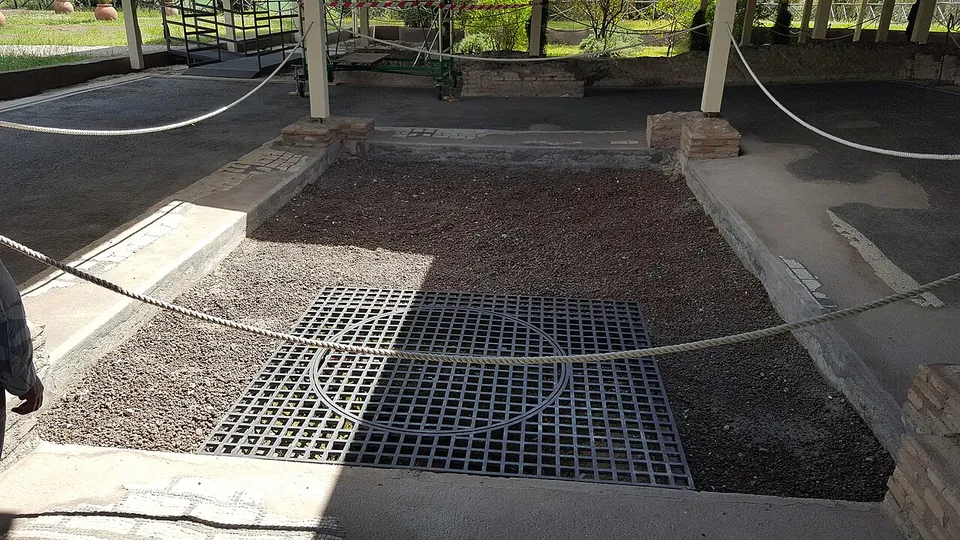
Photo: MumblerJamie · CC BY-SA 2.0 · Commons
16 km · villa · Lazio
Villa of Livia
The operator describes the private wing with the bedrooms of Livia and the emperor, an atrium and a small inner garden, and the large reception rooms that open onto a peristyle; the rooms once had painted walls and floors of mosaic and cut marble (Soprintendenza Speciale di Roma).
20 km · city · Lazio
Ostia
A whole town of brick to walk through: houses, shops, warehouses and apartment blocks, sometimes several storeys high (fr.wikipedia), with floor mosaics still in place in many buildings (de.wikipedia).
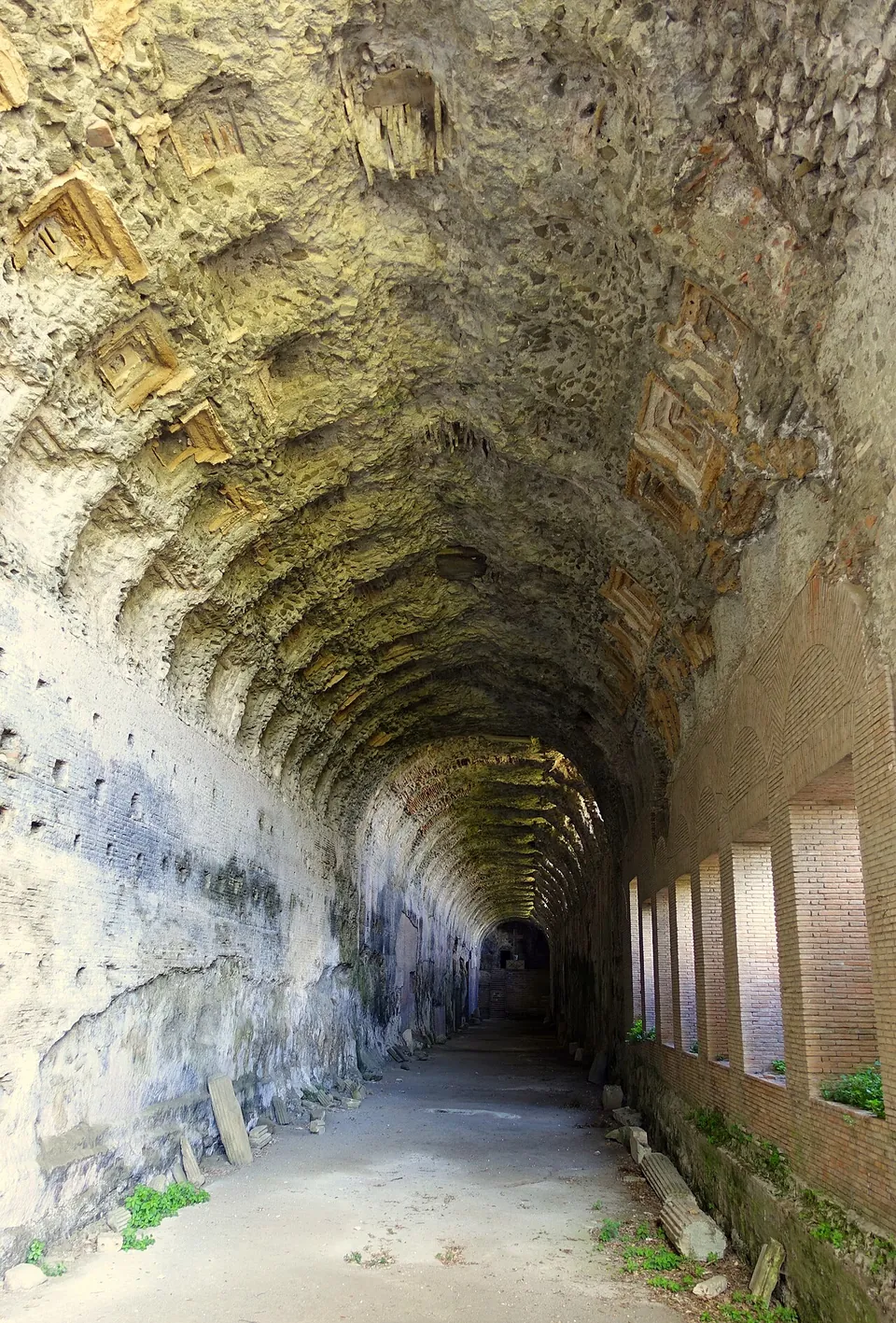
Photo: Daderot · Public domain · Commons
20 km · villa · Lazio
Villa of Domitian
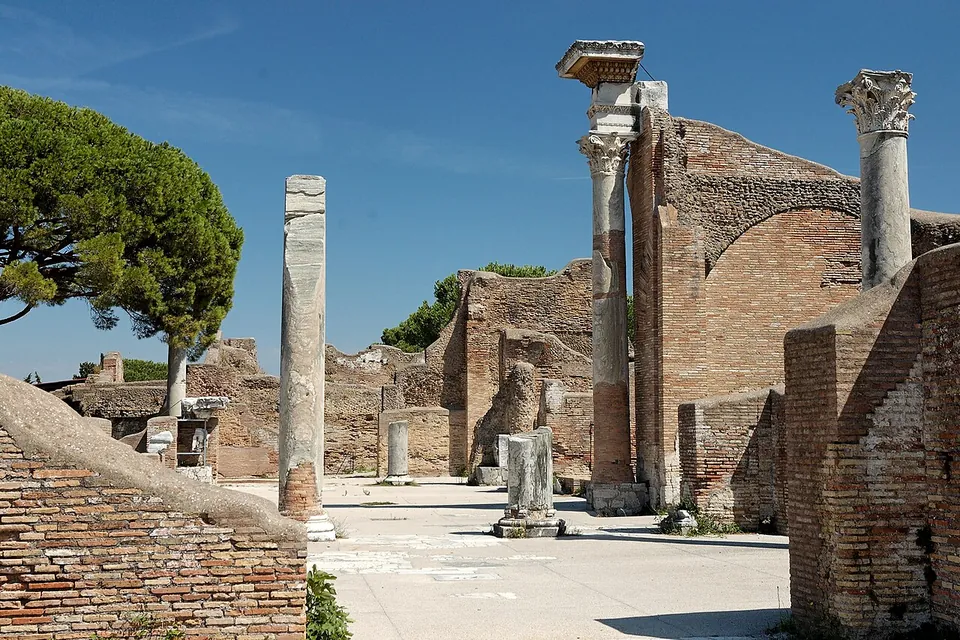
Most of the remains lie inside the Pontifical Villas, an extraterritorial property of the Holy See.


Straight-line distances.
Sources
Every fact on this page comes from the records below, each used under the licence noted.
| Source | Licence |
|---|---|
| Pleiades 423052 | CC BY |
| Wikidata Q231699 | CC0 |
| OpenStreetMap way/23370510 | ODbL |
| Wikipedia (en) — Basilica of Saint Paul Outside the Walls | CC BY-SA 4.0 |
| Wikipedia (it) — Basilica di San Paolo fuori le mura | CC BY-SA 4.0 |
| Wikipedia (de) — Sankt Paul vor den Mauern | CC BY-SA 4.0 |
| Wikipedia (it) — Catacombe di Commodilla | CC BY-SA 4.0 |
| Pleiades — Sepolcreto Ostiense | licence not recorded |
| Basilica Papale di San Paolo fuori le Mura — hours (the operator) | licence not recorded |
| Basilica Papale di San Paolo fuori le Mura — cloister and archaeological area (the operator) | licence not recorded |
| Turismo Roma (Roma Capitale) — Necropoli Ostiense (Sepolcreto Ostiense) | licence not recorded |