

The Ara Pacis is the marble altar the Roman Senate commissioned in 13 BC to honour Augustus’s return from Spain and Gaul (en.wikipedia), dedicated to Pax, the goddess of peace (it.wikipedia), and now reassembled in a glass museum on the Tiber (en.wikipedia). It is a single carved monument in a museum hall, not a ruin to walk through, but its reliefs are among the most important surviving works of Augustan art (it.wikipedia). A ticket is €14, and it is open every day from 09.30 to 19.30 (the operator).
What is there today
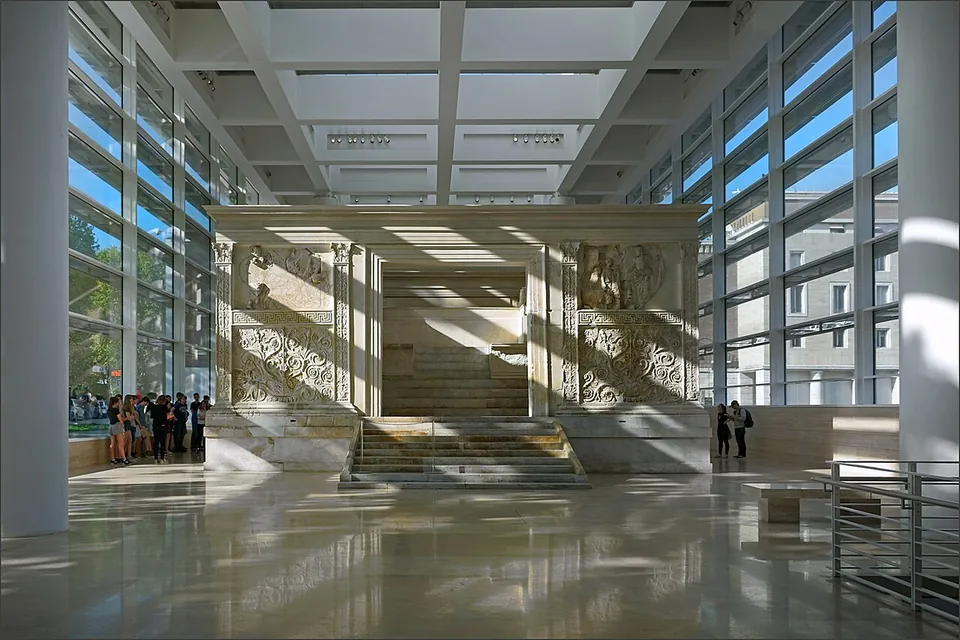
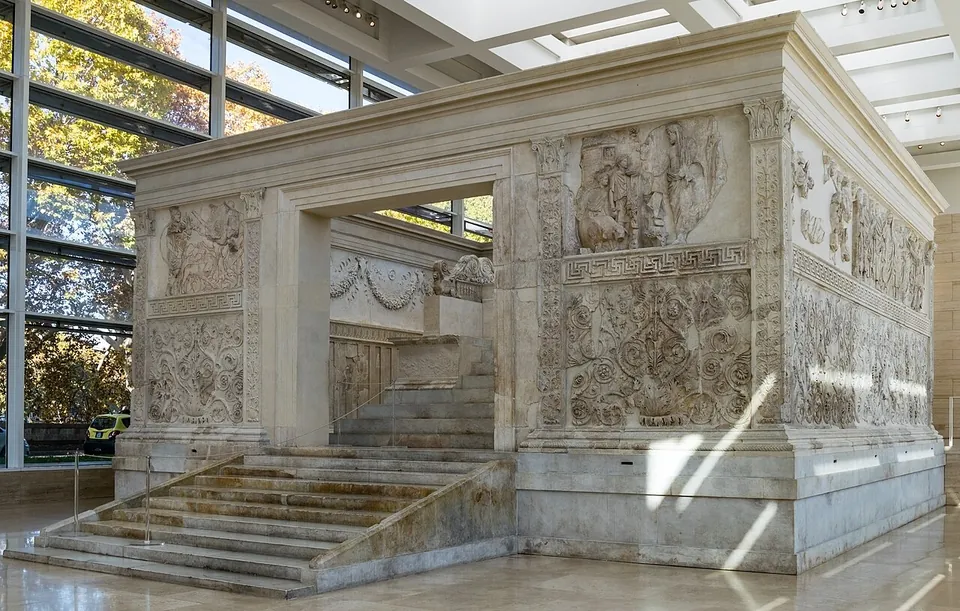
The altar and the walled enclosure round it, standing on a low podium inside a hall of glass. The enclosure is almost square, about 11.6 by 10.6 m and 3.7 m high, with a doorway in each of its two shorter sides; the front one is reached by a flight of nine steps, and the altar itself stands inside, raised on steps of its own (it.wikipedia).
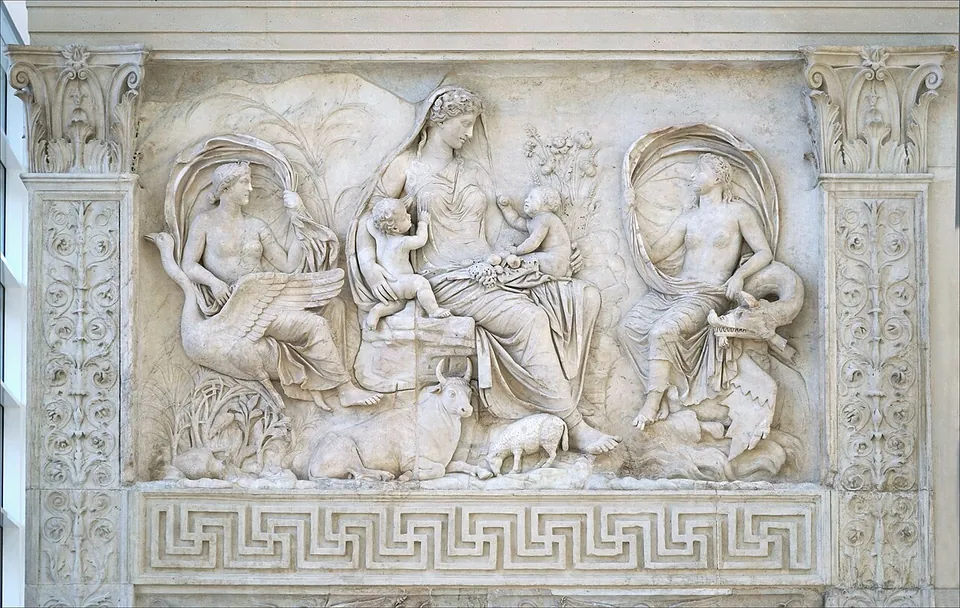
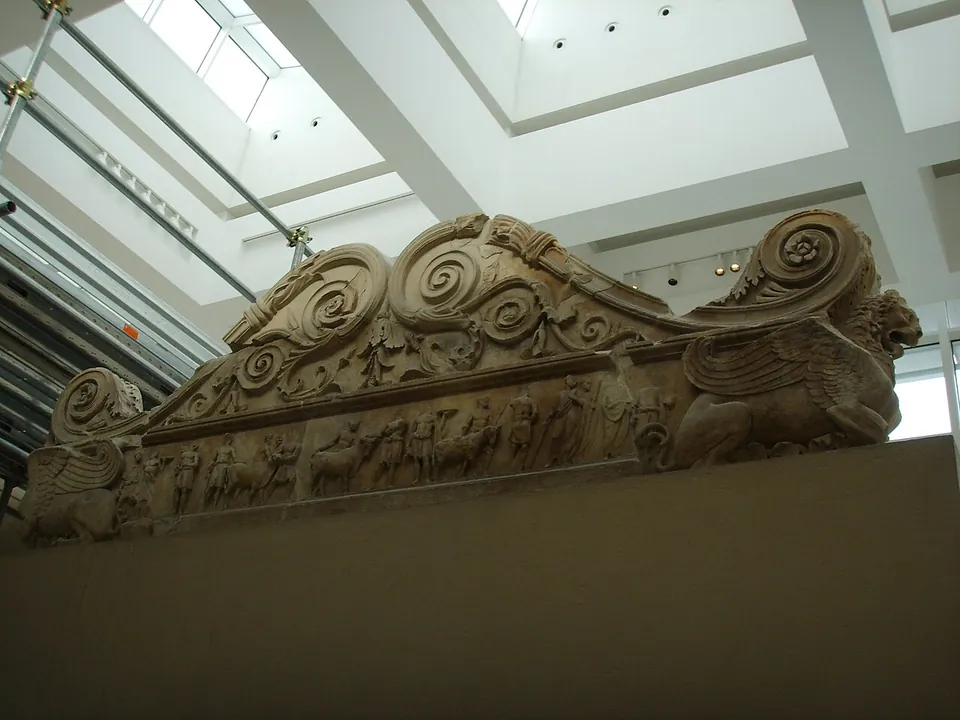
The enclosure is carved inside and out (it.wikipedia). Along the bottom of the outer walls runs a frieze of acanthus scrolls with small animals among them. Above it, the long sides carry a procession: priests, magistrates and members of the imperial household, among them Augustus, Agrippa, Livia, Tiberius and Julia, with women and children prominent in a way earlier Roman public monuments were not. The short sides have panels with scenes of Rome’s origins: a well-preserved one shows a seated woman with two infants, read variously as Tellus, Venus, Pax or Italia, and another a bearded figure making a sacrifice, traditionally Aeneas, though some scholars now argue for Numa, Rome’s second king. Inside, the walls are carved with ox skulls and garlands, and the altar keeps fragments of a small frieze of attendants leading animals to sacrifice (en.wikipedia).
What you see is a reconstruction. The altar was assembled from fragments in 1938, and an artist designed the missing parts (en.wikipedia); the fragments in the Louvre and the Villa Medici could not be recovered, and casts were used in their place (it.wikipedia). It was also set up turned 90° from its original orientation (en.wikipedia). The east wall of the building’s base carries the text of the Res Gestae, Augustus’s account of his own achievements, kept from the earlier pavilion (it.wikipedia).
Around the Ara Pacis
The Mausoleum of Augustus stands across the square, about 80 m away (OpenStreetMap). It has been closed since June 2022. The square reopened in June 2025, but the mausoleum stays closed for its own final restoration works, expected to end in late 2026; no reopening date is published (Sovrintendenza Capitolina).
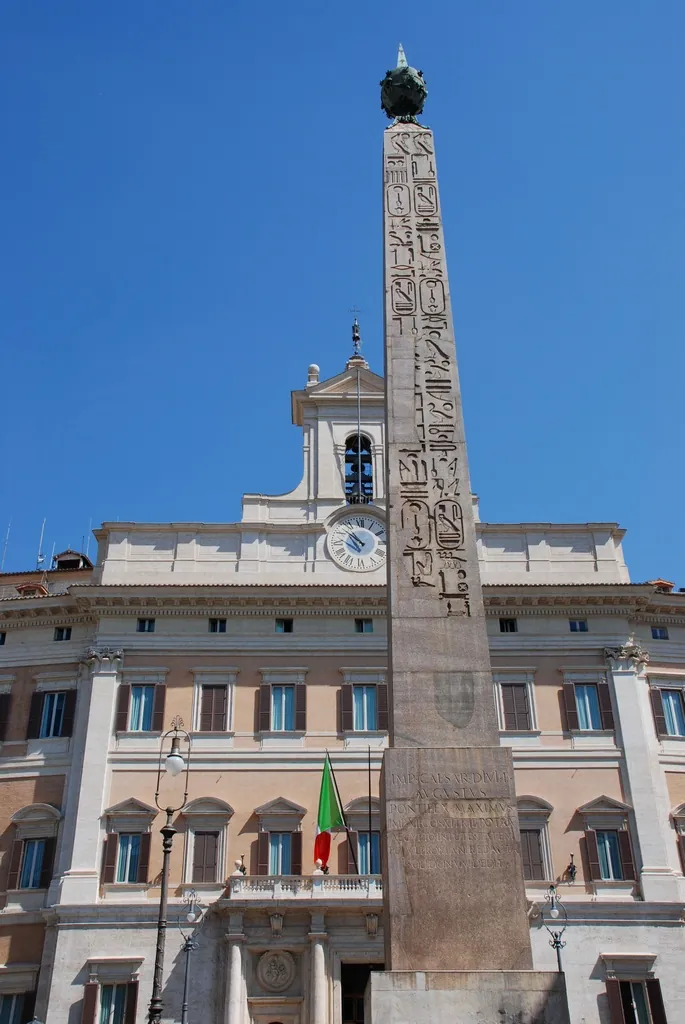
The obelisk of the Solarium Augusti stands about 700 m to the south, in Piazza di Montecitorio, a public square, so it costs nothing to see. In 10 BC Augustus had an Egyptian obelisk, first raised under the pharaoh Psamtik II, set up in the Campus Martius as the shadow-caster of a great solar instrument: long believed to be a giant sundial, it is now more commonly understood as a meridian line tracking the solar year (en.wikipedia). The obelisk is about 30 m high (de.wikipedia); it came from Heliopolis (Pleiades) and was set up in front of Palazzo Montecitorio, the seat of the Chamber of Deputies, in 1789 (Commons file description). The monument itself was destroyed at some point in the Middle Ages (en.wikipedia). A stretch of its meridian line, found by the German Archaeological Institute in 1979, lies under a building in Via di Campo Marzio (fr.wikipedia; Commons file description), and no regular visits to it are published. The Ara Pacis originally stood near the eastern end of the Solarium (Pleiades).
Is it worth the trip?
Yes, if you are interested in what Augustus wanted Rome to see. The procession shows his household at a state ceremony (en.wikipedia), and the whole monument was meant to stand for the peace he had brought after the civil wars (fr.wikipedia). It is also an easy visit: about 900 m from the Pantheon in a straight line, and free on the first Sunday of the month.
If what you want is ruins to explore, this is not that. It is a single monument, reconstructed, in a modern building whose design has drawn criticism since it was built (en.wikipedia). At €14 for what is essentially one monument, it is for people who want to look closely at carving.
Getting there and what it costs
The museum is on Lungotevere in Augusta, at the corner of Via Tomacelli (the operator). The bus stop “Ripetta/Ara Pacis” is about 30 m from it (OpenStreetMap).
It is open every day from 09.30 to 19.30, and from 09.30 to 14.00 on 24 and 31 December, with last entry an hour before closing. It is closed on 1 May and 25 December. A ticket is €14, or €8.50 reduced, among others for visitors aged 6 to 25 who do not live in Rome. Under-sixes go free, and so do residents of Rome and its metropolitan area with an identity card. Everyone gets in free on the first Sunday of the month. Tickets bought ahead for a later day, online or on 060608, cost €1 more and cannot be refunded or changed; tickets for the same day at the desk carry no fee. An audio guide is €4 and a video guide €6 (arapacis.it, read 16 October 2026; check before travelling, since prices move).
On Friday, Saturday and Sunday evenings until 27 December 2026, “L’Ara si rivela” projects a hypothetical reconstruction of the altar’s original colours onto the marble, with narration on headphones in Italian, English, French or Spanish. Shows start at 20.00, 21.00 and 22.00, last about 40 minutes and take up to 40 people, and cost €15, or €13 reduced, on a separate ticket (the operator).
Visiting details
- Opening hours
- Daily 09.30–19.30; 24 and 31 December 09.30–14.00. Last entry one hour before closing. Closed 1 May and 25 December.
- Tickets
- €14; €8.50 reduced, among others for visitors aged 6 to 25 who do not live in Rome. Free under 6, free for residents of Rome and its metropolitan area with an identity card, and free for everyone on the first Sunday of the month. Tickets bought ahead for a later day carry a €1 booking fee. Audio guide €4, video guide €6. "L'Ara si rivela", an evening light-and-sound show projected onto the altar, is a separate ticket at €15 (reduced €13).
Before you go
- Tickets bought in advance, online, by phone on 060608 or at the desk for a later day, cannot be refunded or changed.
- The Mausoleum of Augustus across the square has been closed since 6 June 2022. The square reopened on 6 June 2025, but the mausoleum stays closed for its own final restoration works, expected to end in late 2026, and no reopening date is published.
Hours and prices checked 16 October 2026 on the operator's own site. Confirm before travelling.
History
The Senate commissioned the altar on 4 July 13 BC, when Augustus returned to Rome after three years in Spain and Gaul, and it was consecrated on 30 January 9 BC (en.wikipedia). It stood on the northern edge of the city, on the west side of the Via Flaminia, in a part of the Campus Martius given over to celebrating victories, a Roman mile from the pomerium, the city boundary at which a consul returning from a campaign gave up his military command (en.wikipedia; it.wikipedia). It stood a few hundred metres from the Tiber, and by the 2nd century AD water and damp were already damaging it; a brick wall was built round it to hold back the silt (it.wikipedia), and it was gradually buried under about 4 m of river deposits (en.wikipedia).
Carved fragments were found under Palazzo Peretti, near San Lorenzo in Lucina, in 1568, and were scattered among collections including the Villa Medici, the Vatican, the Uffizi and the Louvre (en.wikipedia; it.wikipedia gives 1536 as an alternative date). More turned up in 1859; Friedrich von Duhn identified the reliefs as the Ara Pacis in 1879–81, and an excavation in 1903 recovered 53 fragments before it was stopped for safety (en.wikipedia).
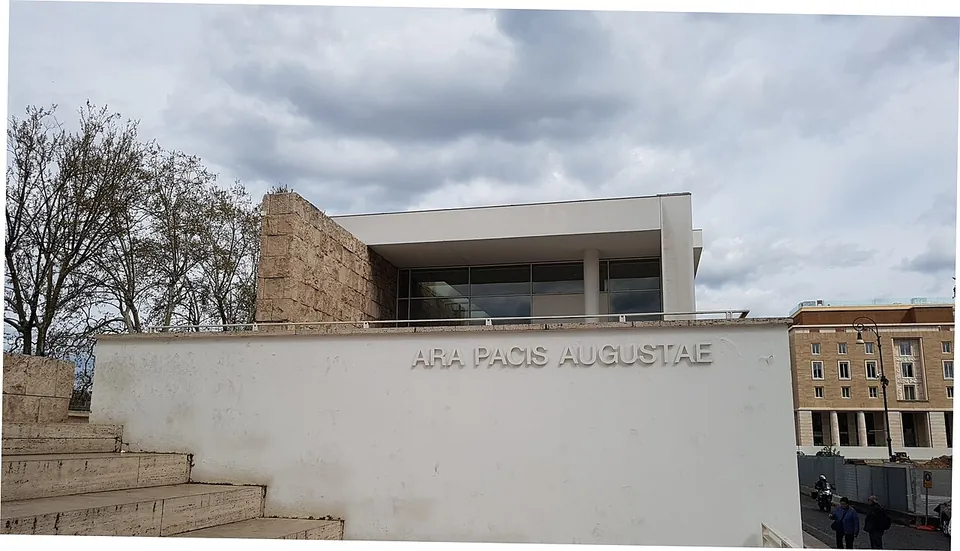
In 1937 the government ordered the altar excavated and rebuilt for the 2,000th anniversary of Augustus’s birth. The engineers froze about 70 m³ of soil under a cinema to extract the remaining pieces, and the altar had to be ready by 23 September 1938 (en.wikipedia). It was set up beside the Mausoleum of Augustus, in a pavilion by the architect Vittorio Ballio Morpurgo, as part of the Fascist regime’s remaking of the area, for which several dozen buildings round the mausoleum were demolished (en.wikipedia). That pavilion was replaced in 2006 by the present museum, designed by Richard Meier (en.wikipedia; it.wikipedia).
More photographs



Nearby
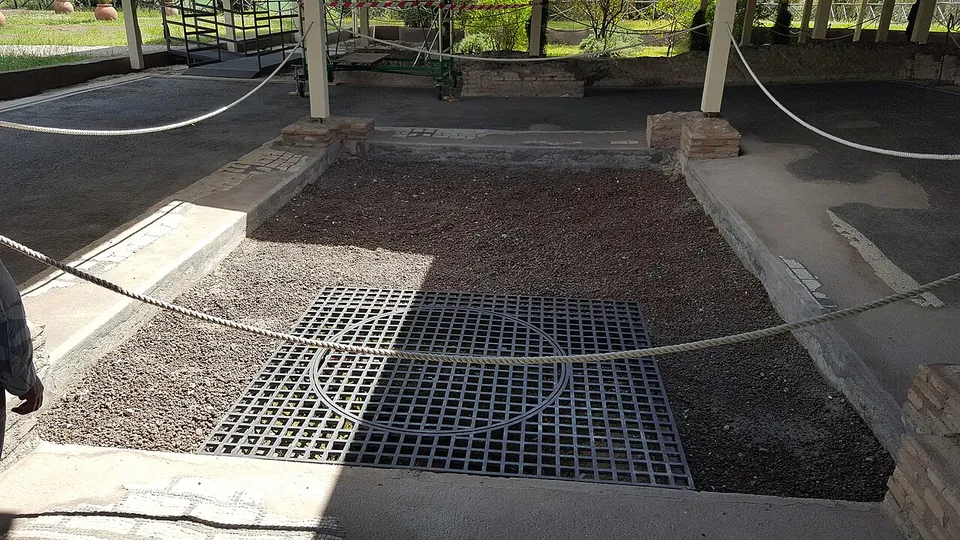
Photo: MumblerJamie · CC BY-SA 2.0 · Commons
11 km · villa · Lazio
Villa of Livia
The operator describes the private wing with the bedrooms of Livia and the emperor, an atrium and a small inner garden, and the large reception rooms that open onto a peristyle; the rooms once had painted walls and floors of mosaic and cut marble (Soprintendenza Speciale di Roma).
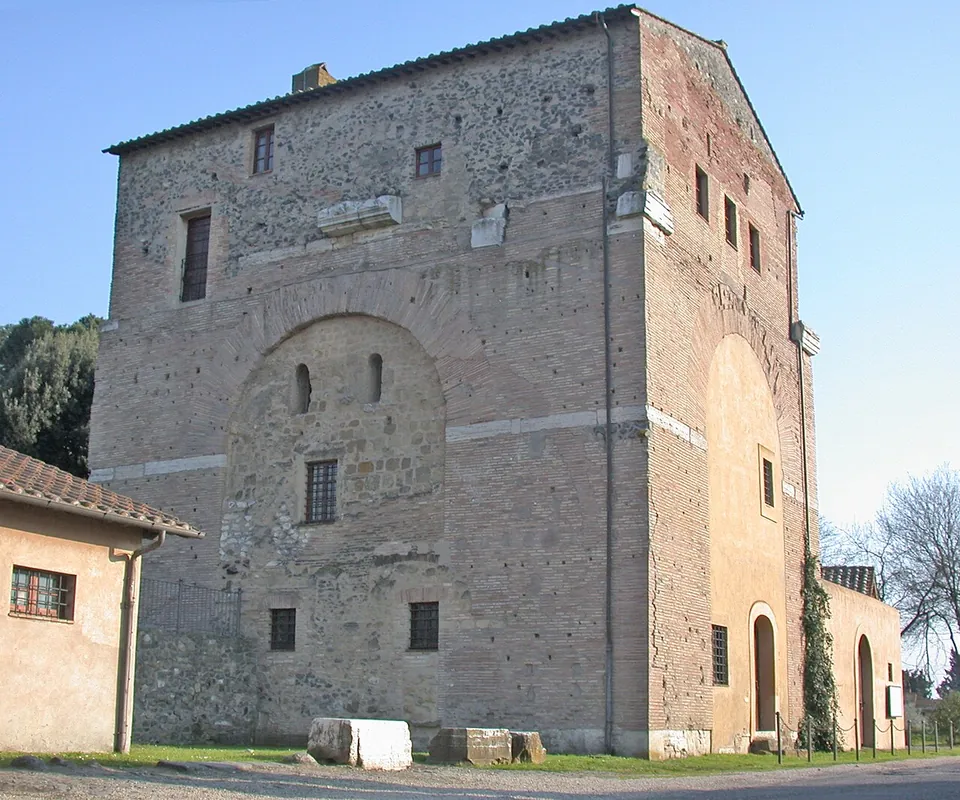
Photo: MM · Public domain · Commons
16 km · arch · Lazio
Arch of Malborghetto
At first sight you see an austere farmhouse rather than an arch (it.wikipedia).
Photo: Carlomorino · CC BY-SA 3.0 · Commons
20 km · city · Lazio
Gabii
The park the state holds covers about 70 hectares on the southern rim of a volcanic crater whose lake was drained in the 19th century (the operator; en.wikipedia).


Straight-line distances.
Sources
Every fact on this page comes from the records below, each used under the licence noted.