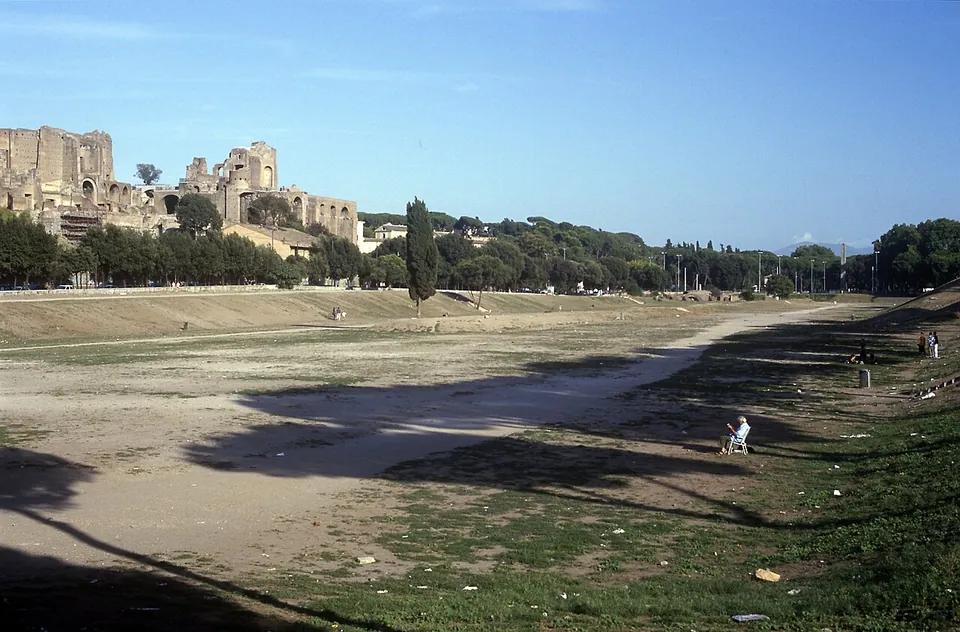
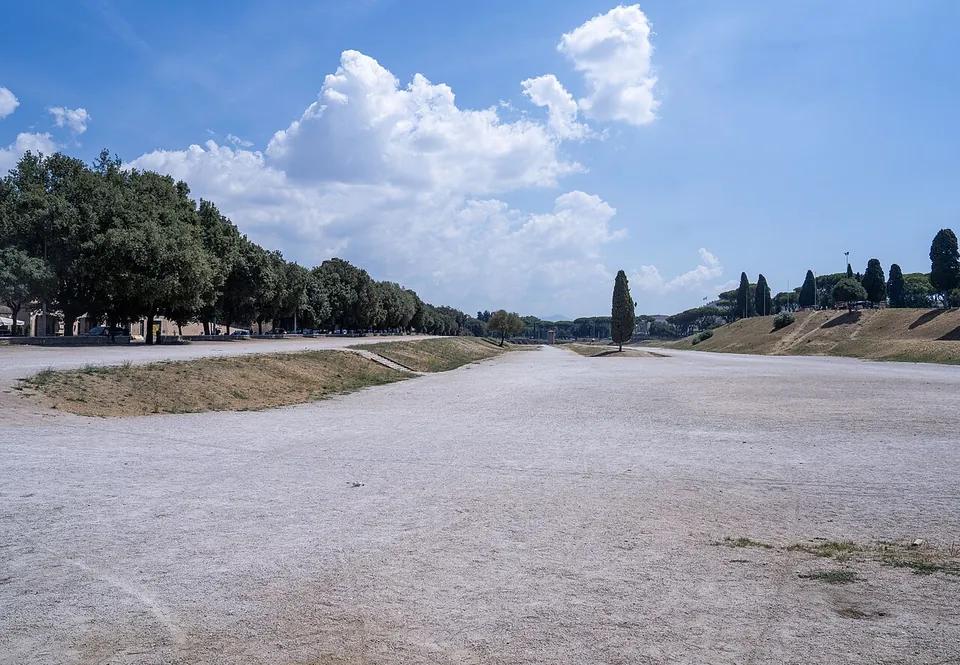


The Circus Maximus was ancient Rome’s chariot-racing stadium, the first and largest in the city, and today it is a public park, a long, open valley of grass and gravel between the Palatine and the Aventine (en.wikipedia). Walking into the park costs nothing. The excavated Roman remains that visitors can walk among are in a ticketed archaeological area at the curved end, €7 for visitors from outside Rome and free for residents (Sovrintendenza Capitolina, the operator).
What is there today
The valley. Published figures put the circus at 600 to 621 m long and 118 to 150 m wide (en.wikipedia; Sovrintendenza Capitolina), and it probably held around 150,000 spectators (en.wikipedia). What you walk on is not the Roman course: the track lies 5 to 6 m below today’s ground, buried by centuries of flood silt and debris (en.wikipedia; Sovrintendenza Capitolina). So the open park is about the scale, a flat floor between grassy banks, with the brick ruins of the imperial palaces standing above it on the Palatine side.
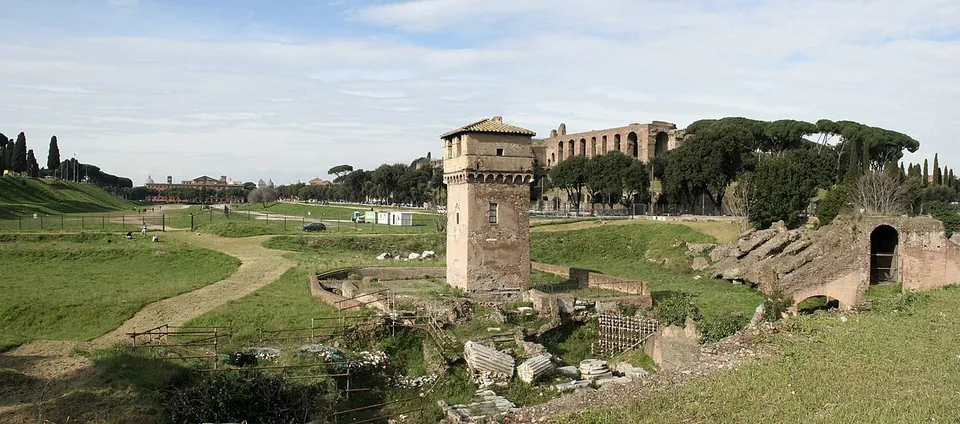
The archaeological area at the curved end. This is where the circus’s own buildings can be seen. Visitors walk through the galleries that led up to the seating, about 100 m of each (the senators sat on the lower level, the common people above), past the remains of ancient latrines, and out along a paved Roman road with a large travertine trough. Rooms off it were shops serving the crowds: inns, food shops, storerooms, laundries, brothels and money-changers’ offices for the betting on the races. In the middle of the curve are the bases of the front columns of the Arch of Titus, with marble fragments from it set out in front of the medieval Torre della Moletta, built in the 12th century, whose internal stair leads up to a viewpoint over the archaeological area that shows the full size of the circus. Most of the Roman structures visible today date from Trajan’s rebuilding (Sovrintendenza Capitolina).
The Circo Maximo Experience. A separately ticketed tour of the area with augmented- and virtual-reality headsets, about 40 minutes long, which reconstructs the circus in its different periods, a chariot race included (circomaximoexperience.it).
Is it worth the trip?
The park, yes, and it costs nothing. It lies between the Palatine and the Aventine, and its interest is its size and its history; its remains are confined to the paid area at one end. Go knowing that it is a grassed and gravelled valley, not a stadium you can sit in.
The paid area is for anyone who wants to see what a Roman circus was built of: it is where the galleries and shops under the stands, the outer road and the arch can be seen, and the tower gives the view that shows how long the course was. With little time in Rome, the free view across the valley is enough. The area is closed on Mondays.
Getting there and what it costs
Circo Massimo station on Metro line B is about 110 m from the archaeological area’s entrance at Piazza di Porta Capena, and bus stops lie within about 100 m of the middle of the valley (OpenStreetMap). Turismo Roma also lists an entrance on Via del Circo Massimo.
The park is free. The archaeological area is open Tuesday to Sunday, 09.30 to 19.00 (last entry 18.00) from the last Sunday of March to late October, and 09.30 to 16.00 (last entry 15.00) through the winter; it is closed on Mondays, 25 December and 1 May. A ticket is €7, reduced €4; residents of Rome and its metropolitan area and MIC card holders go free. Entry is in timed slots, and the operator strongly recommends buying online or through the 060608 call centre (Sovrintendenza Capitolina, read 13 October 2026). The Circo Maximo Experience costs €12, €10 reduced, and does not run in the rain (circomaximoexperience.it).
Visiting details
- Opening hours
- The valley is an open public park. The archaeological area at its curved end is open Tuesday to Sunday, 09.30–19.00 (last entry 18.00) from the last Sunday of March to late October and 09.30–16.00 (last entry 15.00) through the winter; closed Mondays, 25 December and 1 May.
- Tickets
- The park is free. Archaeological area €7, reduced €4 (also for holders of a ticket to a concert held at the Circus that month); free for residents of Rome and its metropolitan area and for MIC card holders. Entry is in timed slots, and the operator strongly recommends buying online or through 060608. The Circo Maximo Experience, a 40-minute augmented- and virtual-reality tour of the area, is a separate ticket at €12 (€10 reduced, and for groups of ten or more).
Before you go
- The archaeological area is closed on Mondays, and the Circo Maximo Experience does not run in the rain.
- The Mithraeum under Piazza della Bocca della Verità opens only by booking through 060608 and is not accessible to wheelchair users.
Hours and prices checked 13 October 2026 on the operator's own site. Confirm before travelling.
Around the circus
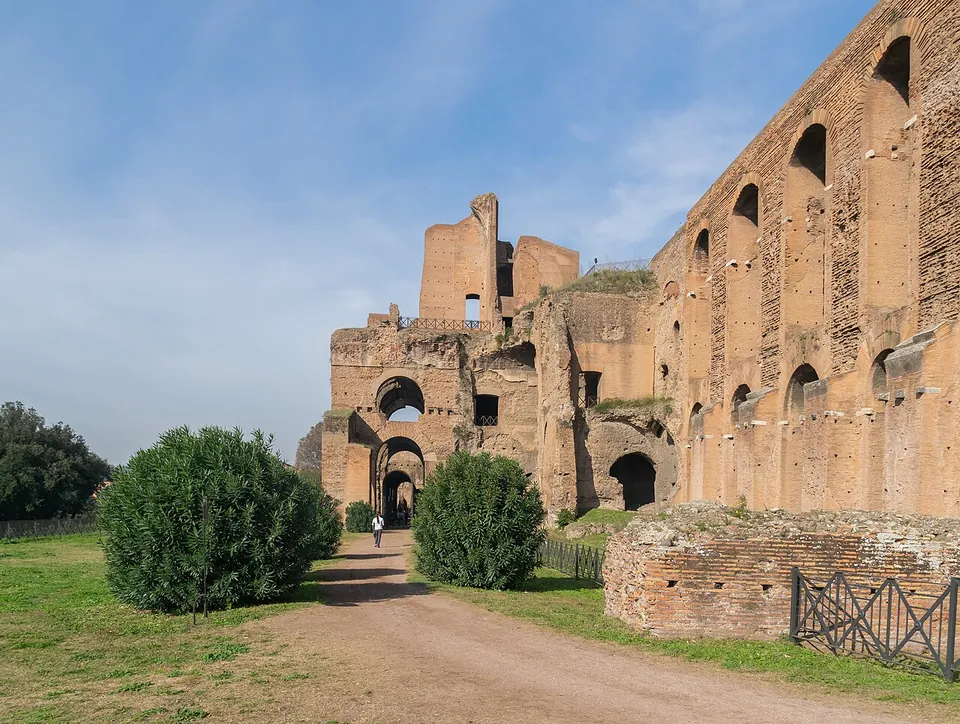
The Palatine slope. The ruins standing above the valley on its Palatine side belong to the emperors’ palaces. The last extension to them, now called the Domus Severiana, survives as imposing brick substructures at the corner of the hill, built to carry a terrace level with Domitian’s palace; they took in a bath complex which may go back to Domitian and was rebuilt by Maxentius (en.wikipedia), and OpenStreetMap maps the ruins beside them as the Baths of Maxentius. At the foot of the slope, on its lowest terrace and aligned with the circus, is the Schola Praeconum, a 3rd-century building named after a black-and-white floor mosaic of eight men carrying a caduceus, a standard and a staff. They have been read as the heralds who announced the circus processions, as public servants or even as charioteers; whichever they are, the building served the circus (Parco archeologico del Colosseo; Pleiades). These buildings are visited as part of the Palatine, on the Colosseum park’s ticket (Parco archeologico del Colosseo; see the Rome page).
The Mithraeum. Facing the starting gates of the circus, at the edge of the Forum Boarium, a series of vaulted rooms on the ground floor of a large ancient building was turned into a sanctuary of Mithras in the 3rd century AD. It was found in 1931, during work for a store of scenery and costumes for the Teatro dell’Opera, and its two carvings of Mithras killing the bull are still in place (Sovrintendenza Capitolina; Pleiades). It lies under a building at Piazza della Bocca della Verità 16/a and opens only by booking through 060608, for groups with their own guide or on set dates for individuals; it is not accessible to wheelchair users (Turismo Roma).
History
The flat valley of the Murcia, between the Palatine and the Aventine, was used for games from the city’s legendary beginnings: tradition set the Rape of the Sabine women here, at races Romulus held in honour of the god Consus (it.wikipedia; Sovrintendenza Capitolina). The first race-course with seating is dated to the age of the Tarquin kings, but only under Julius Caesar, from around 50 BC, was it built as a true masonry circus with seating running almost the whole way round the track (Sovrintendenza Capitolina; en.wikipedia).
Augustus raised Rome’s first obelisk, brought from Heliopolis, on the central barrier. Fire was the constant danger: the wooden stands and the shops beneath them burned in 31 BC and AD 36, and in AD 64, under Nero, a fire that broke out at the circus’s curved end destroyed much of the city. In AD 81 the Senate built a triple arch for Titus at that end, and Trajan then rebuilt the circus in stone, giving it the form it kept from then on (en.wikipedia). Chariot races were its main event, with the teams known by their colours, but the valley also served for triumphs, religious processions, beast hunts and public executions (en.wikipedia; Sovrintendenza Capitolina). The last known races were held by Totila in 549 (en.wikipedia).
Afterwards the valley became farmland and market gardens and its stone was quarried. In 1587 Pope Sixtus V removed two obelisks from the central barrier; they now stand in Piazza del Popolo and at St John Lateran (en.wikipedia; Sovrintendenza Capitolina). A gas works occupied the site from 1852 to 1910 (en.wikipedia). Excavations in the 1930s uncovered much of the curved end and the remains of the Arch of Titus, and after the Second World War the valley went back to grass (Sovrintendenza Capitolina). New excavations and restoration finished in 2016, and the archaeological area opened to the public for the first time on 17 November that year (Sovrintendenza Capitolina). The park is also used for concerts and large public gatherings (en.wikipedia).
More photographs

Nearby
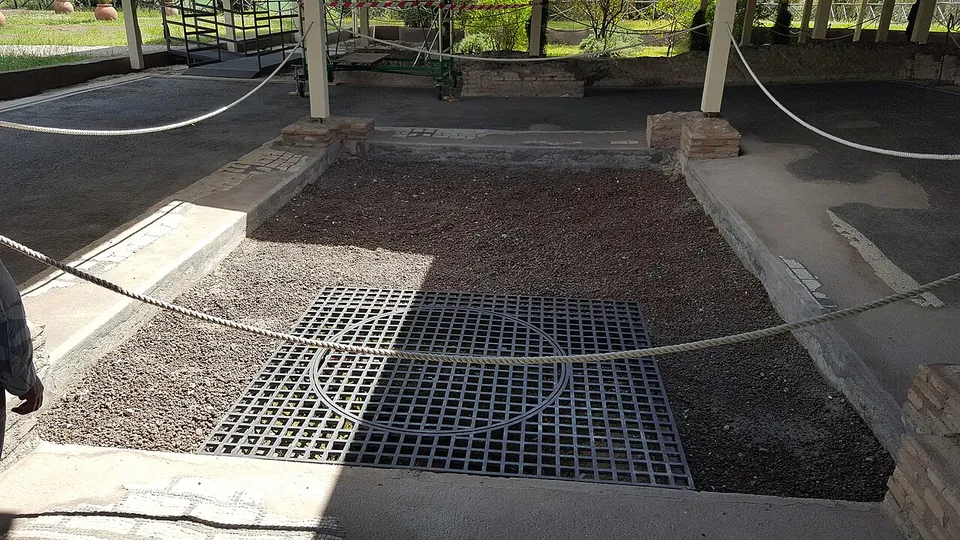
Photo: MumblerJamie · CC BY-SA 2.0 · Commons
13 km · villa · Lazio
Villa of Livia
The operator describes the private wing with the bedrooms of Livia and the emperor, an atrium and a small inner garden, and the large reception rooms that open onto a peristyle; the rooms once had painted walls and floors of mosaic and cut marble (Soprintendenza Speciale di Roma).
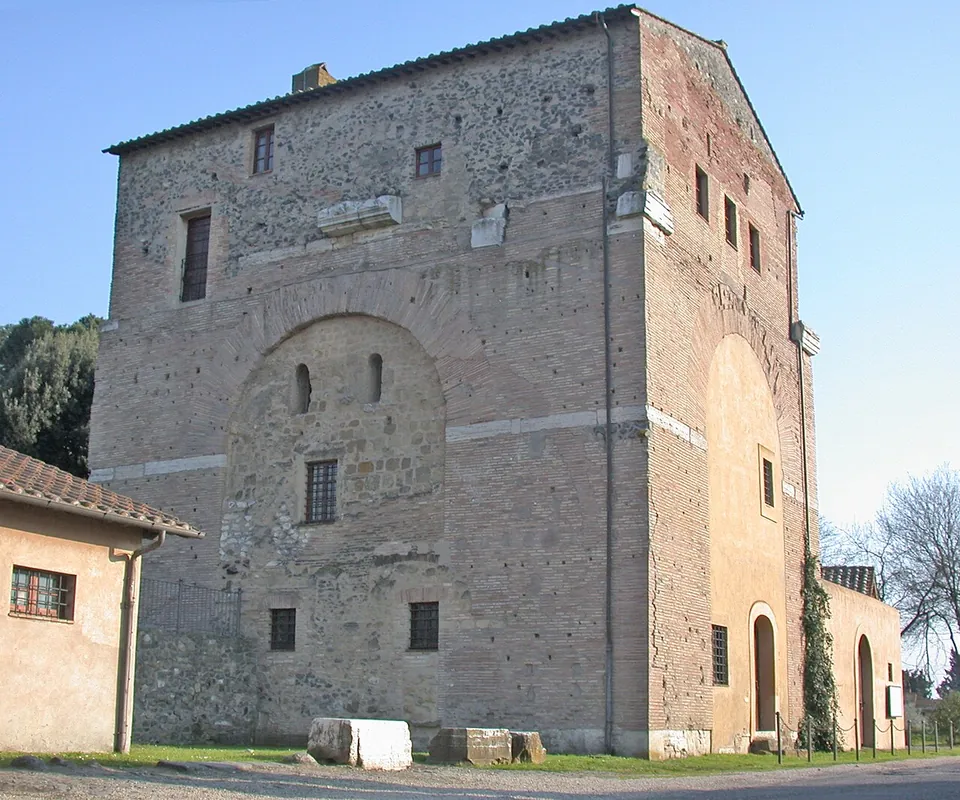
Photo: MM · Public domain · Commons
19 km · arch · Lazio
Arch of Malborghetto
At first sight you see an austere farmhouse rather than an arch (it.wikipedia).
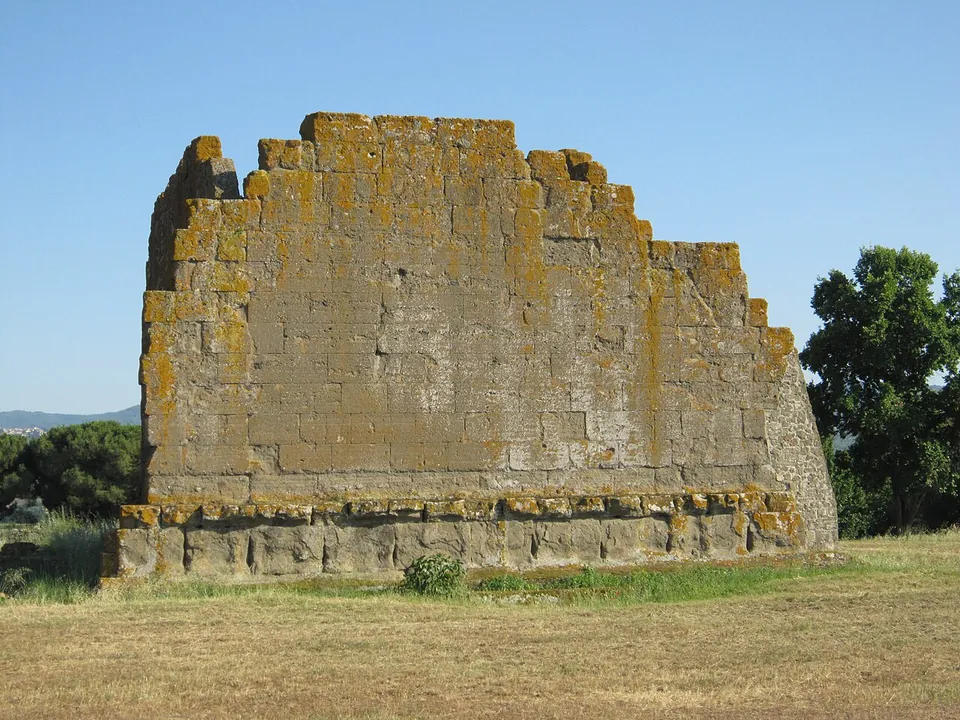
Photo: Carlomorino · CC BY-SA 3.0 · Commons
19 km · city · Lazio
Gabii
The park the state holds covers about 70 hectares on the southern rim of a volcanic crater whose lake was drained in the 19th century (the operator; en.wikipedia).


Straight-line distances.
Sources
Every fact on this page comes from the records below, each used under the licence noted.