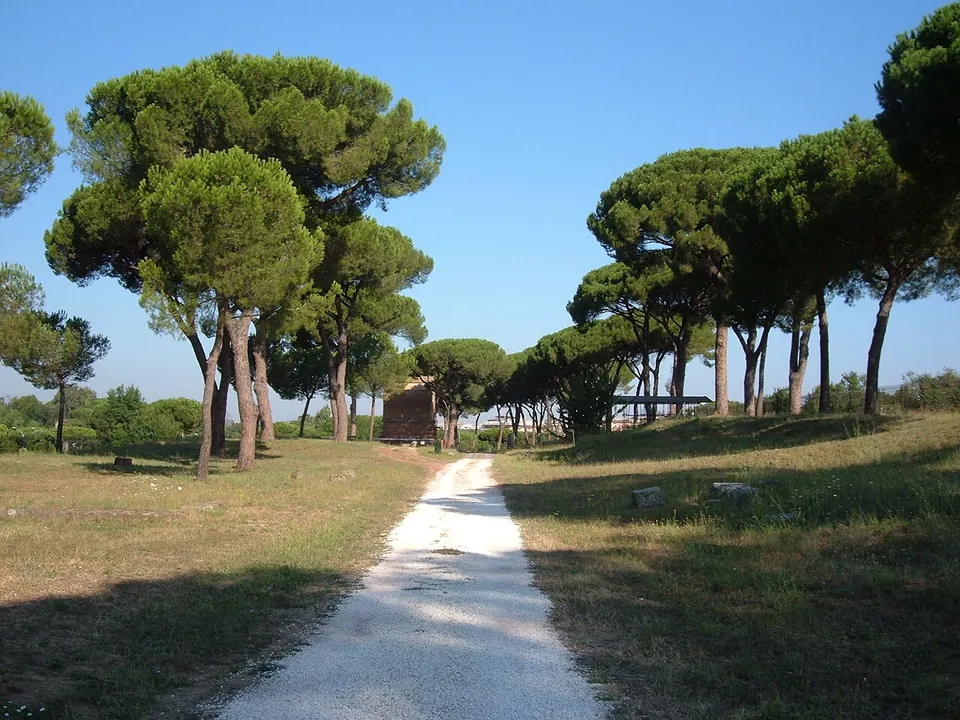
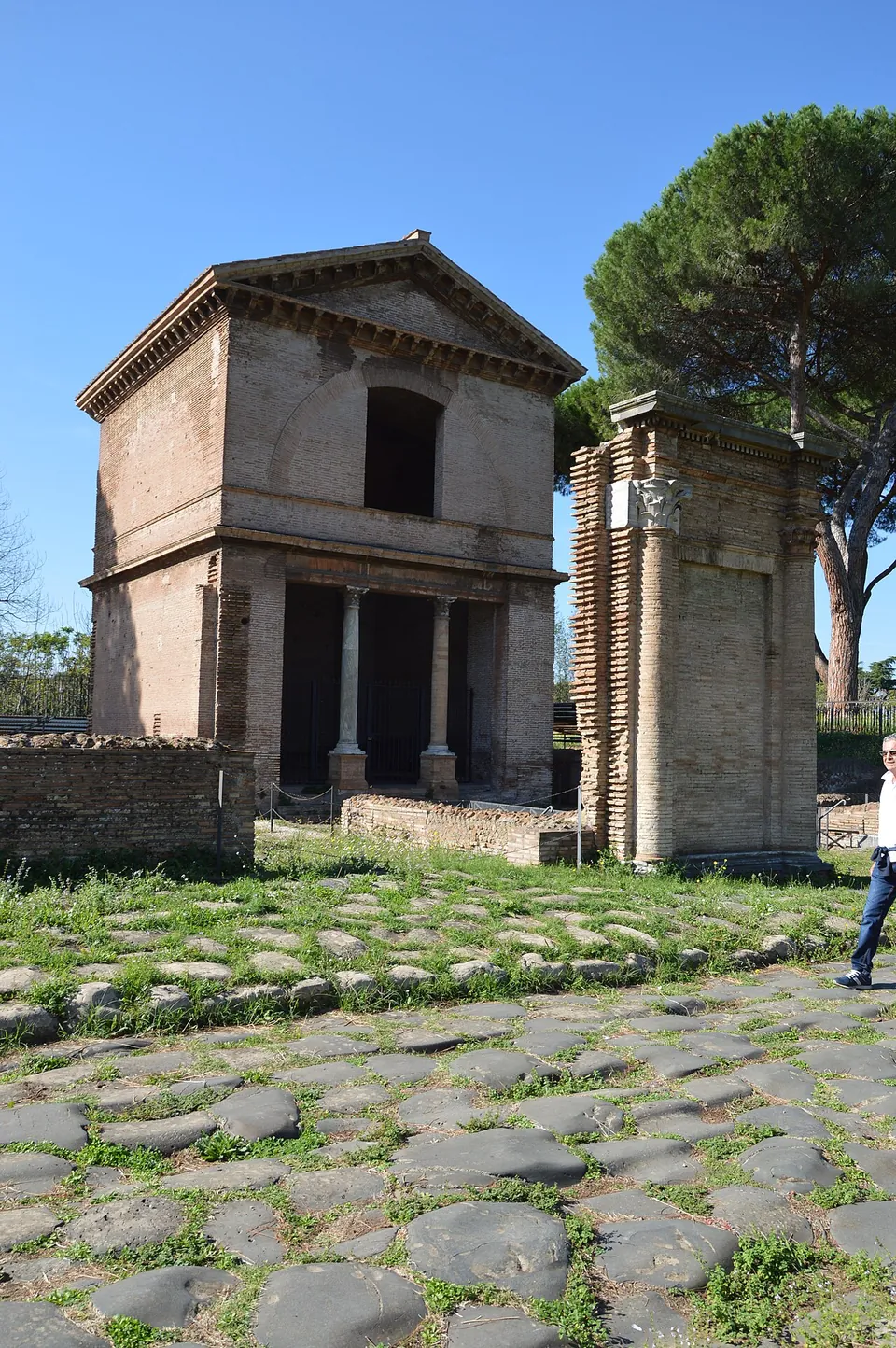
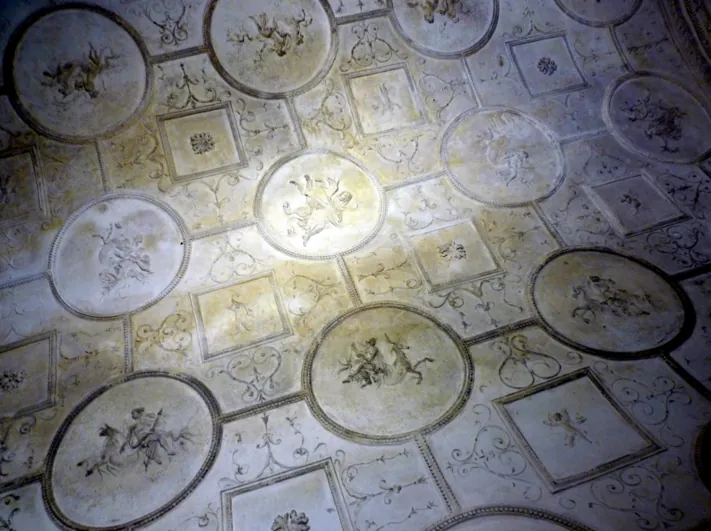


The Tombs of Via Latina are a fenced archaeological park in Rome’s south-eastern suburbs where a stretch of an ancient Roman road still runs between the brick tombs that lined it, several of them with painted and stuccoed burial chambers underground. The site has been closed since 22 June 2026 for restoration, with no reopening date announced.
What is there today
The park stretches about 450 m along the third mile of the Via Latina, the road from Rome to Capua, and a stretch of the road’s original basalt paving can still be walked (en.wikipedia; the operator). Along it stand tombs of the 1st and 2nd centuries AD, and the operator describes the painted plaster, stucco, frescoes and floor mosaics inside them as substantially intact and in their original setting.
Three tombs are the core of a visit:
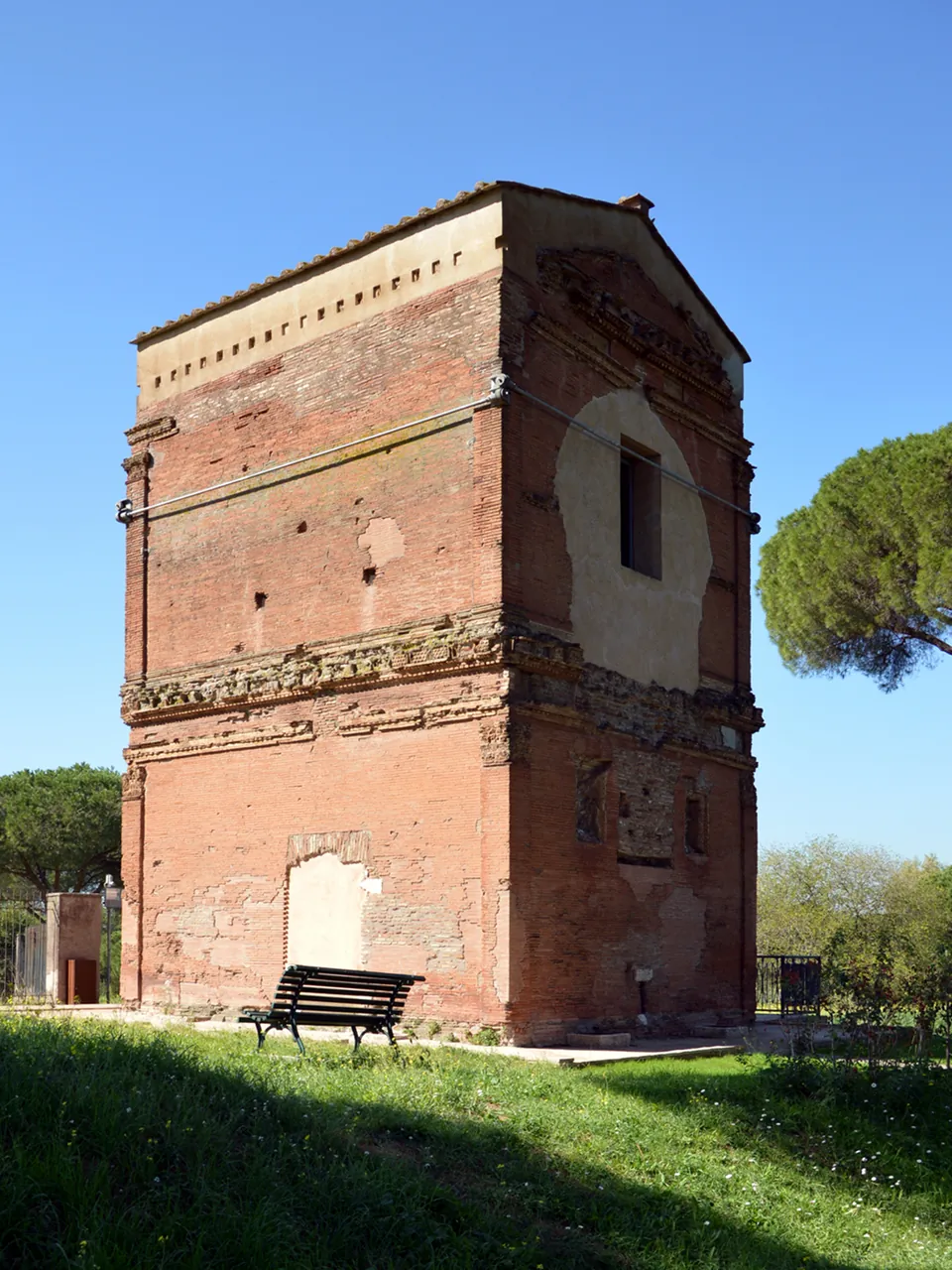
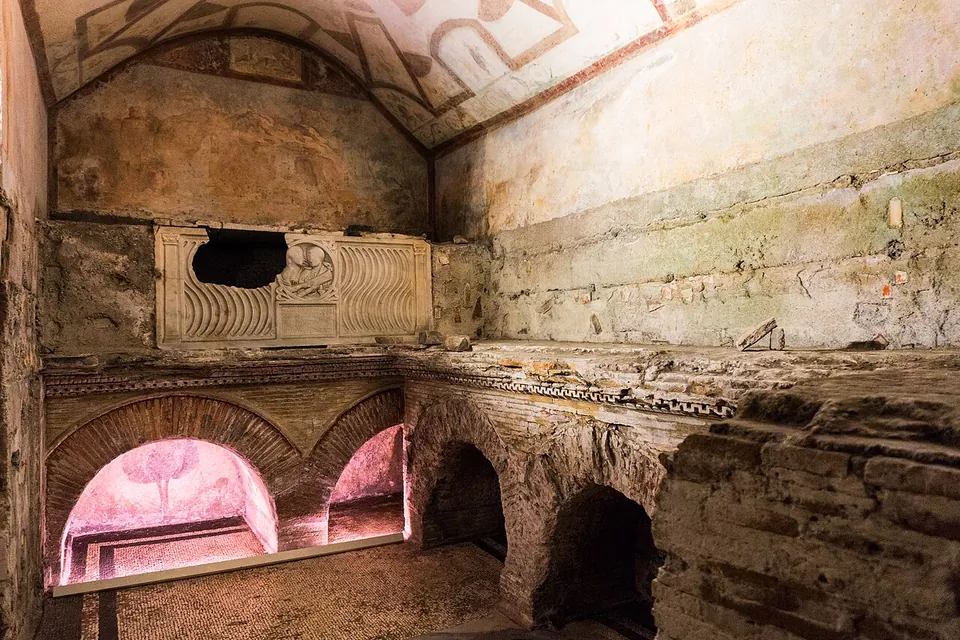
- The Barberini tomb, or tomb of the Cornelii, of the 2nd century AD: two storeys of red and yellow brick above an underground burial chamber (en.wikipedia; the operator). The upper floor has a vault painted with groups of figures, birds and sea creatures on a brick-red ground, with details in stucco, and the chamber below has a black-and-white mosaic floor (the operator; it.wikipedia).
- The Tomb of the Valerii: what you see above ground is a conjectural 19th-century rebuilding, but the two underground chambers of the mid-2nd century are original, their vault and lunettes covered in white stucco medallions with Dionysiac subjects, women and sea creatures, and at the centre a veiled figure carried on the back of a griffin (the operator; it.wikipedia).
- The Tomb of the Pancratii, which the Italian Wikipedia calls one of the most spectacular in the park. A modern building covers walls that survive to about a metre; below, two underground rooms keep frescoes and stucco in bright colour, with scenes such as the Judgement of Paris, and a large marble sarcophagus still in place (the operator; it.wikipedia; en.wikipedia). Its underground rooms are one of the three restoration works under way.
From the road you can also reach the low remains of the 5th-century basilica of Santo Stefano (the operator), built inside a large Roman villa that is now almost entirely buried again. The small underground Tomb of the Calpurni also lies inside the park, and the Mausoleum of Campo Barbarico stands just outside it; all of them are described below. The French Wikipedia notes that the park keeps the look of the 19th-century Roman countryside, and the photographs bear that out: pines, open grass and brick tombs, with the city all round.
Is it worth the trip?
When it is open, yes, for anyone with an interest in how Romans buried their dead: here you walk the original paving of a Roman road between the tombs that lined it, then go down into their decorated chambers. It is less a ruin to look at from outside than a series of small rooms to be shown round, so the guided visit is the point, not an extra.
Right now it cannot be visited at all. The operator closed the whole area on 22 June 2026 and has not given a reopening date, so check the park’s own page before planning around it. The Appia Antica park offers a virtual tour on MUVI Appia (muviappia.it) in the meantime.
Getting there
The entrance is at Via dell’Arco di Travertino 151. Take Metro line A to Arco di Travertino and walk about 400 m, or an ATAC bus to its Arco di Travertino terminus (the operator). A car park is mapped about 290 m from the site (OpenStreetMap).
The grounds are free. Seeing the inside of the tombs means booking an accompanied visit: the site ticket is €6, €2 for EU citizens aged 18–24, and free under 18 and for the other groups the law exempts, and the €12 Appia Antica park ticket covers it together with five other sites of the park over seven days. Tickets are sold on the Musei Italiani site and app, which also list the visiting days and times, or at the entrance totems, which take cards only (parcoarcheologicoappiaantica.it, read 23 October 2026).
Visiting details
- Opening hours
- Closed to the public since 22 June 2026 for restoration works, with no reopening date published. When open, the inside of the tombs is seen only on accompanied visits, on the days and at the times listed on the Musei Italiani ticketing site and app.
- Tickets
- The park grounds are free. A Tombe di via Latina ticket, which books an accompanied visit inside the tombs, is €6; €2 for EU citizens aged 18–24; free under 18. The €12 Appia Antica park ticket covers this site and five others over seven days, booking required. Tickets are sold online at Musei Italiani or at the entrance totems, which take cards only.
- Parking
- A surface car park is mapped about 290 m from the site (OSM way/165355973).
Before you go
- The whole archaeological area has been closed since 22 June 2026 while three restoration works run (a new entrance pavilion, the Tomb Fortunati 25 and the underground rooms of the Tomb of the Pancratii). The reopening date will be announced on the park's own channels; check before going.
- Even when the site is open, the tomb interiors are visited only with a guide and must be booked in advance.
Hours and prices checked 23 October 2026 on the operator's own site. Confirm before travelling.
The basilica, the villa and the lesser tombs
The basilica of Santo Stefano
The operator calls Santo Stefano a rare example of an early Christian plan, built under Pope Leo the Great around the middle of the 5th century, and the Ministry of Culture lists the park and the basilica together as one place. It is reached from the Roman road inside the park, so it shares the park’s opening and its present closure. What is left is low: foundations and a few columns (it.wikipedia), which the Ministry describes as still partly visible. A Rome guide site lists what survives as the apse, the confession beneath the altar where the relics were kept, and the baptistery, a small basin reached by a short flight of steps (info.roma.it).
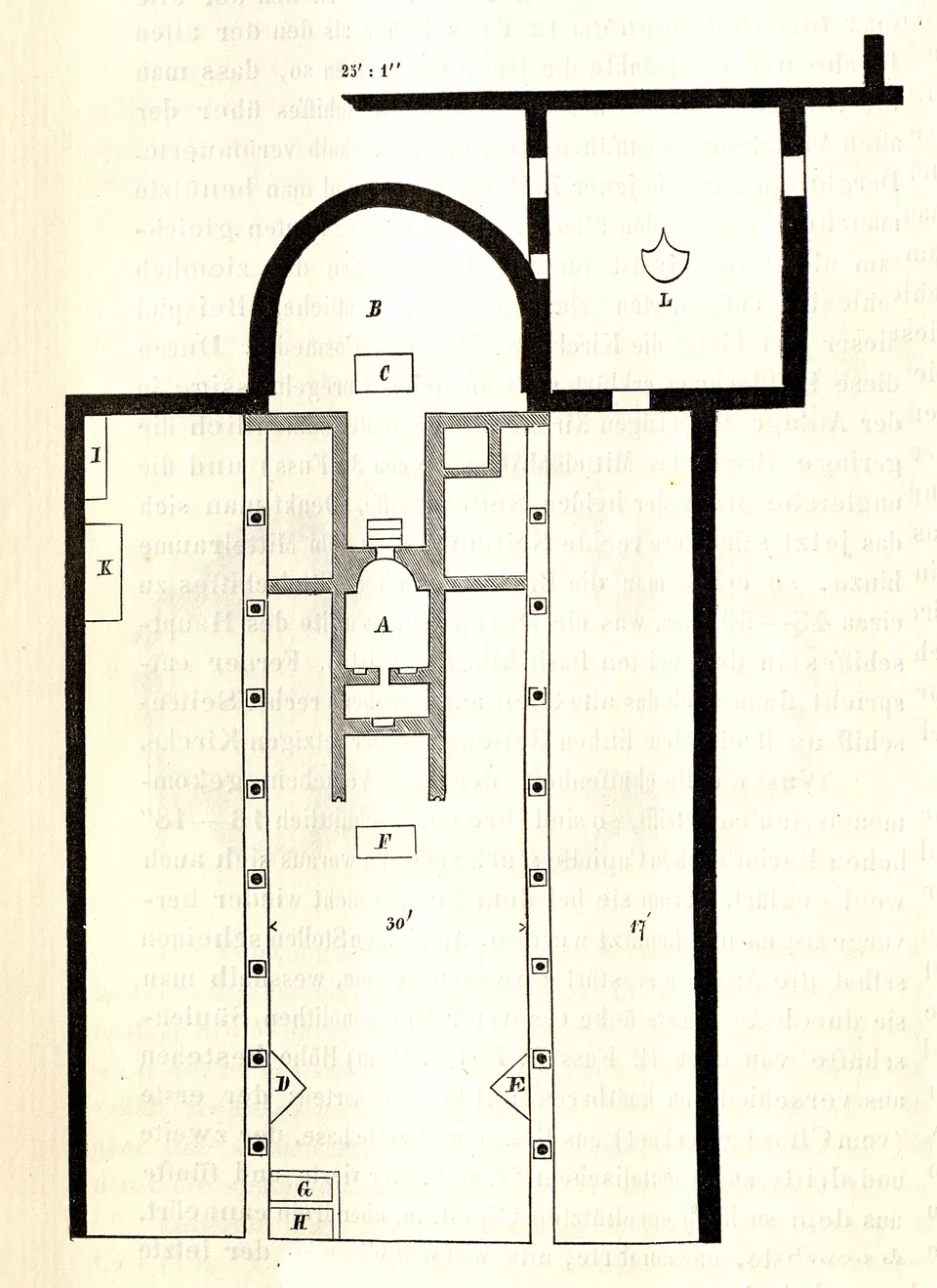
It was a church with a nave and two aisles, about 36 by 21 m, its apse to the west and an entrance porch, the narthex, to the east. Eight columns with Corinthian capitals divided the nave from each aisle, and in the western half of the nave stood an enclosure for the singers, the schola cantorum, with an ambo. Beneath it the excavators found a mausoleum of pre-Christian date, which was used again as a burial chamber in the 5th century (it.wikipedia).
The church was founded by a Demetrias on her own land, according to the Liber Pontificalis, and an inscription found in the 1858 excavation gives her name as Amnia Demetrias. She was probably the daughter of Anicius Hermogenianus Olybrius, consul in 395. When Alaric invaded Italy in 410 she fled to North Africa, became a Christian there and corresponded with Augustine, Pelagius and Jerome. After her death, the inscription says, Pope Leo I began the building as she had wished; a priest named Tigrinus oversaw the work, which was paid for with her money. It was finished around 470 and dedicated to Stephen the first martyr (it.wikipedia). Pope Leo III (795–816) had its roofs renewed and Leo IV (847–855) gave it new vestments and altar hangings. How long it lasted after that is told differently: the article on the church has it abandoned and forgotten, far from the inhabited city, probably by the end of the 9th century (it.wikipedia), while the Ministry of Culture and the Italian article on the park describe it as a goal of pilgrims until the 13th. Lorenzo Fortunati found its ruins in 1857 and later handed the direction of the excavation to the papal commission for sacred archaeology (it.wikipedia).
The villa of Demetrias
The basilica stood in one part of a large villa that occupied the ground behind the Tomb of the Pancratii. The sculpture, mosaics, stucco and inscriptions recovered from it date its building to the late 1st or early 2nd century (it.wikipedia), and the Ministry of Culture says it was lived in until the 5th. Around the middle of the 2nd century it was bought by the senatorial family of the Servilii Silani, and it passed to the imperial estate under Commodus, who is recorded as having had one of the Silani executed. About a century later it came to the Anicii, whose descendant Demetrias built the basilica (it.wikipedia; the Ministry of Culture). The excavation found its two entrances, many small rooms read as storerooms, a portico and a large central courtyard (it.wikipedia).
Almost none of this can be seen. Most of the remains were covered over again after excavation, leaving the basilica as the only visible part, and the plot holding them belongs to the Province of Rome, which laid out sports grounds over them (it.wikipedia); a football pitch built in 1964 partly destroyed the villa, and the walls of a large cistern are among the few remains (info.roma.it). Many finds, statues and pieces of stucco among them, went to the Vatican Museums (info.roma.it). OpenStreetMap maps an information panel for the villa’s bath buildings (“Strutture termali della villa”) close to the basilica, and one version of the operator’s closure notice names “the area of the baths”, with the reception building and the gardens, among the works under way.
The Tomb of the Calpurni
A small tomb beside the line of the Via Latina, inside the park (Pleiades; Wikidata), set within an enclosure: a single underground chamber that keeps traces of its original plaster and stucco, with arched niches (arcosolia) in its walls to take sarcophagi (info.roma.it). Pleiades dates it to the middle of the 1st century AD; vici.org puts it in the 200s. OpenStreetMap maps an information panel beside it. No source says whether it is opened on the accompanied visits: the Ministry’s list of the tombs that can be visited by booking names only the Barberini, Valerii and Pancratii tombs, and neither the Italian nor the English article on the park mentions it.
The Mausoleum of Campo Barbarico
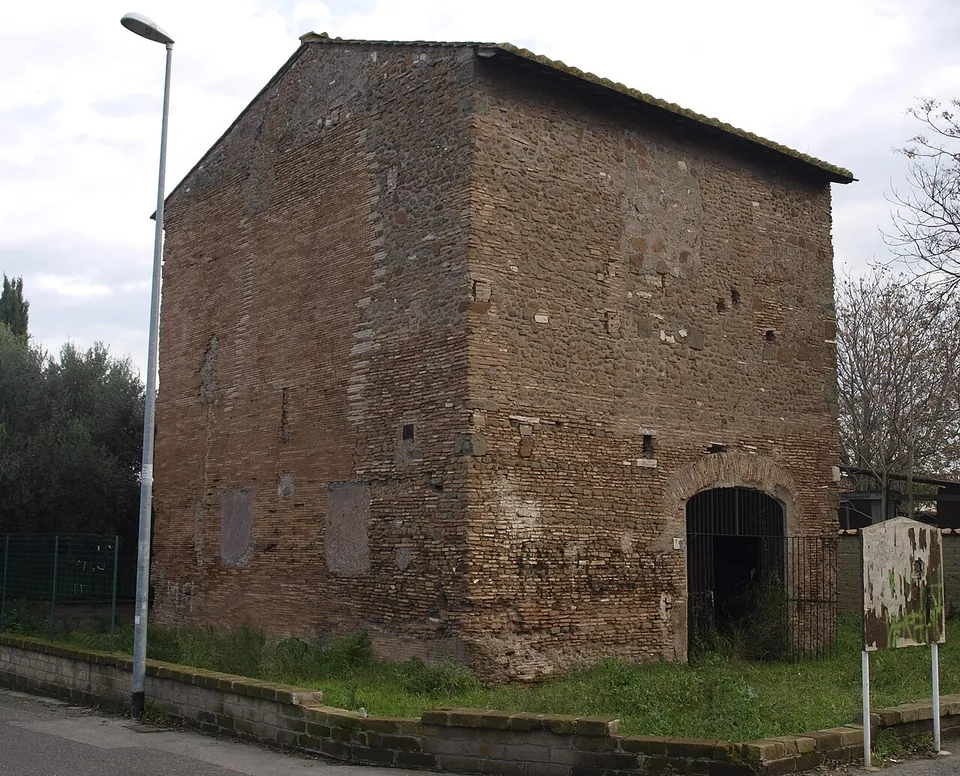
Just south-east of the park, on the fourth mile of the Via Latina where Via Campo Barbarico now follows it, stands a 2nd-century brick tomb of the temple-like type, about 8 by 10 m. Its front was partly rebuilt after collapses, and it served as a hay barn until the end of the 19th century. Inside is a single room whose side walls carry three tiers of niches and arched recesses; of its coffered barrel vault only the springing survives (it.wikipedia). The sources do not say whether the interior can be visited. It takes its name from the Campo Barbarico, where the Goths of Vitiges camped during the siege of Rome in 539.
History
The tombs were found in 1857–58 by Lorenzo Fortunati, a schoolteacher with a passion for archaeology who dug at his own expense with the permission of Pope Pius IX (it.wikipedia; en.wikipedia). He was also digging for profit: the finds were sold and the proceeds split with the landowners, and many tombs were badly damaged to get the large sarcophagi out. His permit was withdrawn in 1859, over his methods and a dispute with the papal commission for sacred archaeology that followed the discovery of the basilica of Santo Stefano (it.wikipedia). Some of the sarcophagi are now in the Vatican Museums, among them the Barberini tomb’s sarcophagus with the myth of Protesilaus and Laodamia (it.wikipedia; en.wikipedia).
The Italian state acquired a large part of the area in 1879, and the park dates from then (the operator; it.wikipedia). Further excavations began in 1900 under Rodolfo Lanciani (en.wikipedia).
The Pancratii take their name from an inscription on the sarcophagus of a married couple in the first underground room, which names a funerary association, the collegium of the Pancratii (the Ministry of Culture). The Ministry dates the tomb to the late 1st or early 2nd century; the English Wikipedia places it under Hadrian (117–138). The name of the Valerii is a traditional attribution that excavation has not confirmed (it.wikipedia). The Barberini tomb owes its first name to the noble family who owned it and its second to a 16th-century drawing by Pirro Ligorio showing an inscription naming Quintus Cornelius on its front (it.wikipedia).
More photographs




Nearby
Photo: Carlomorino · CC BY-SA 3.0 · Commons
16 km · city · Lazio
Gabii
The park the state holds covers about 70 hectares on the southern rim of a volcanic crater whose lake was drained in the 19th century (the operator; en.wikipedia).
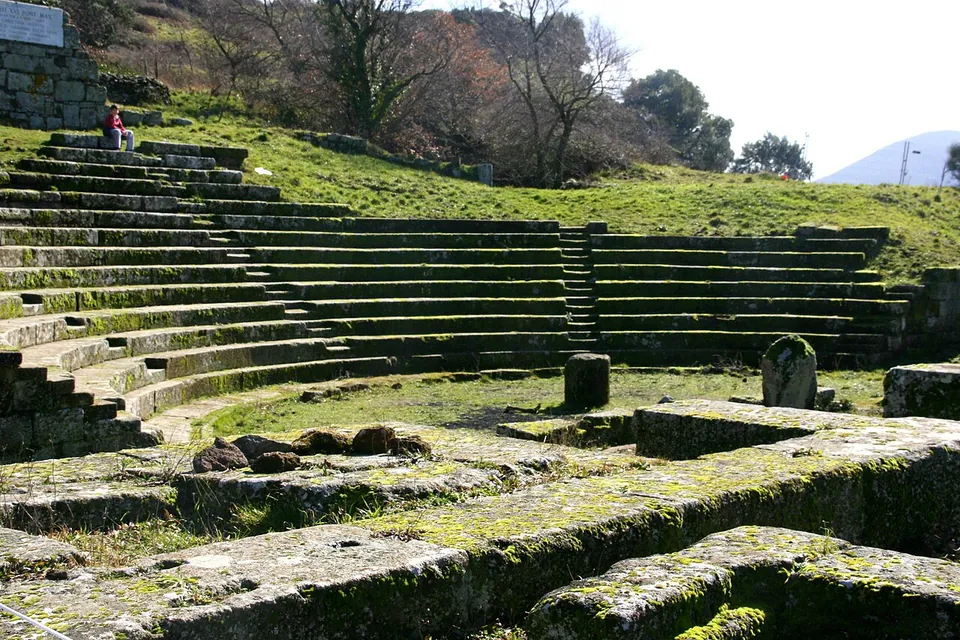
Photo: Luiza Serpa Lopes · Public domain · Commons
16 km · city · Lazio
Tusculum
The visitor route runs mainly through the forum, with the theatre halfway round (the operator).
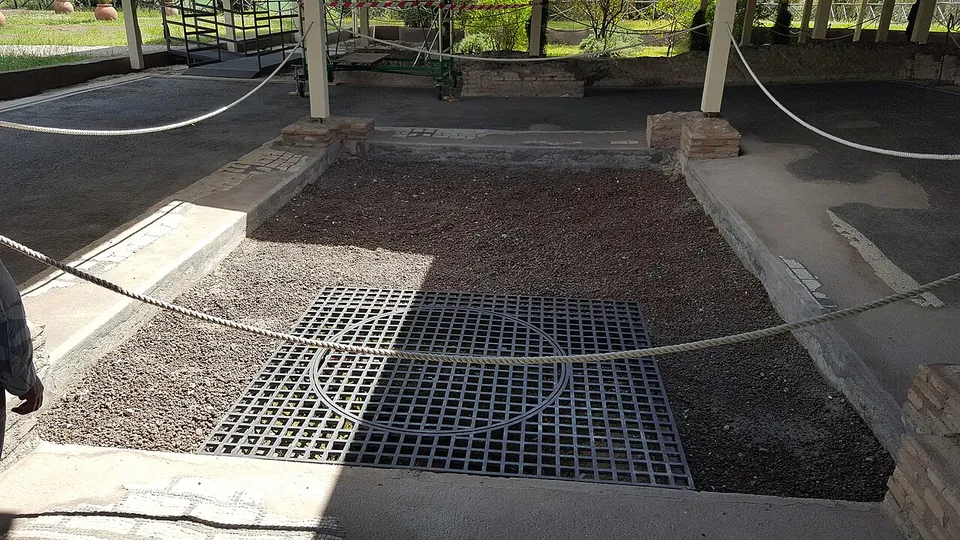
Photo: MumblerJamie · CC BY-SA 2.0 · Commons
16 km · villa · Lazio
Villa of Livia
The operator describes the private wing with the bedrooms of Livia and the emperor, an atrium and a small inner garden, and the large reception rooms that open onto a peristyle; the rooms once had painted walls and floors of mosaic and cut marble (Soprintendenza Speciale di Roma).


Straight-line distances.
Sources
Every fact on this page comes from the records below, each used under the licence noted.