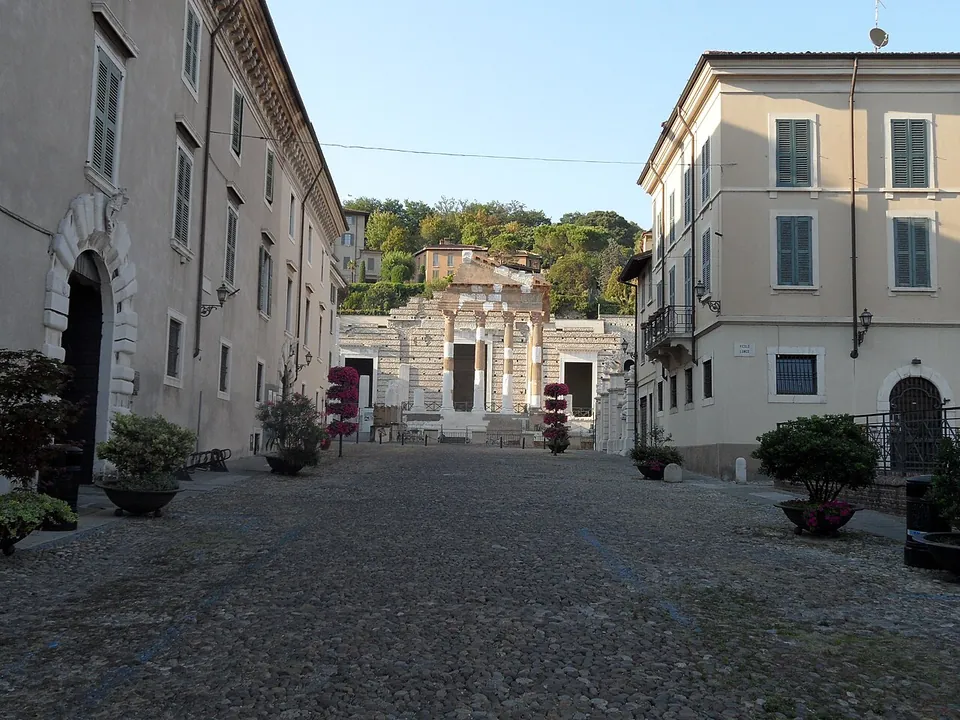


Piazza del Foro is the square in the centre of Brescia that still largely follows the main square of the Roman town of Brixia, and most of what survives of Roman Brescia lies on it: the Capitolium temple Vespasian built in AD 73, the painted halls of an older sanctuary beneath it, the bronze Winged Victory found inside it and, next door, a theatre against the hillside. The square and its one standing forum column are free to see; the temple, the sanctuary and the Victory are an archaeological park on a €19 ticket that also covers the city’s museums. Come for the temple and the sanctuary; the theatre is closed while it is excavated.
What is there today
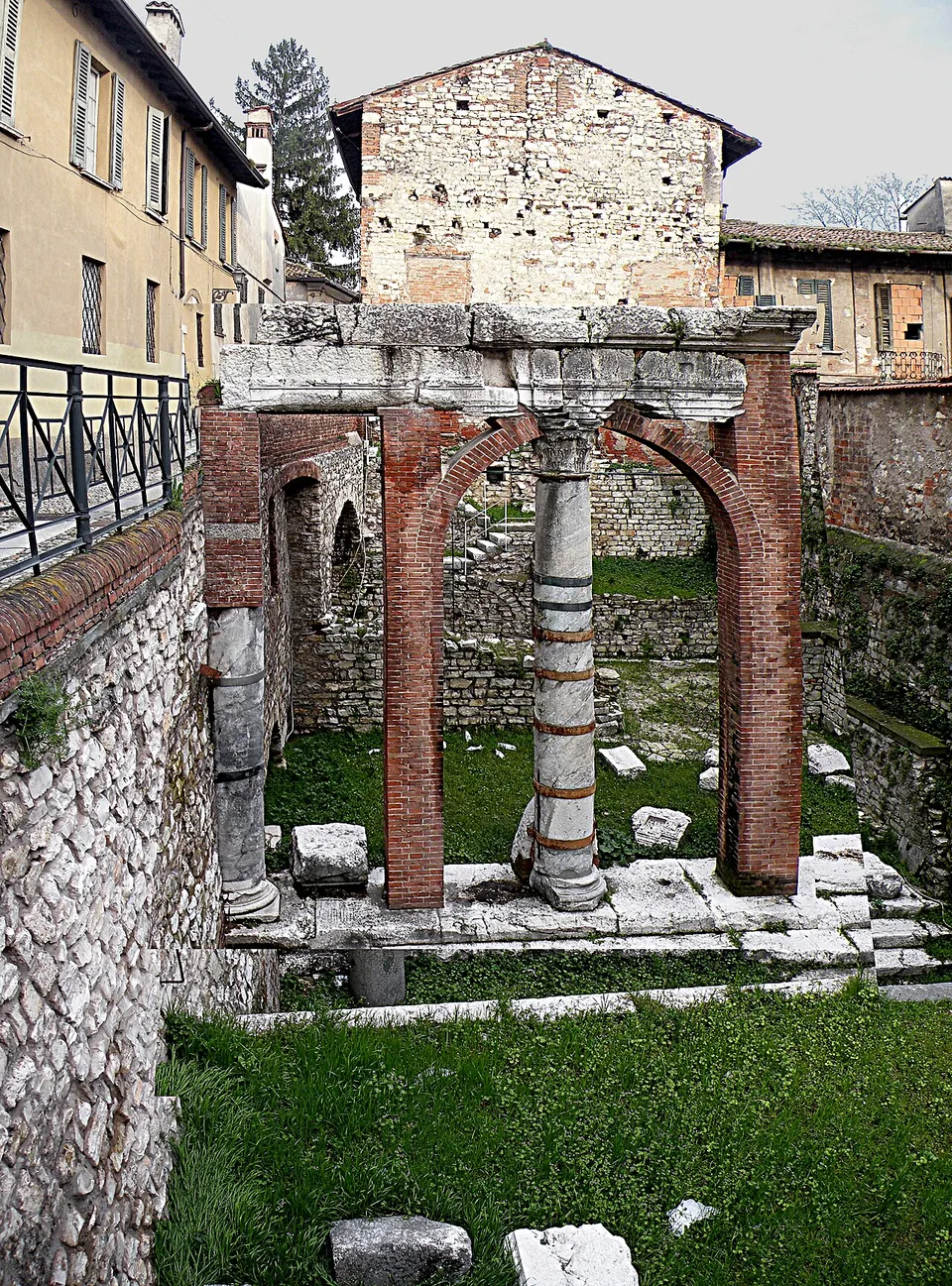
The square. Piazza del Foro is rectangular and slopes markedly to the south from the foot of the Cidneo hill, with Via dei Musei, the Roman main street (decumanus maximus), crossing its north end (it.wikipedia). Its buildings are mostly post-Renaissance, among them the church of San Zeno al Foro of 1745 and Palazzo Martinengo Cesaresco (it.wikipedia), but its outline is still largely the Roman forum’s. In its Flavian form that was a square 40 m wide and 120 m long, with the Capitolium at the north end, porticoes with shops behind them down both long sides, the civil basilica closing the south and baths on the west (it.wikipedia). The Roman level lies 4.5–5 m below today’s paving (it.wikipedia; en.wikipedia). Of the porticoes a single Corinthian column survives, in an excavation open to view from the square; on the paving beneath it is scratched what may be a game board, perhaps a pastime of the merchants who kept shops here (it.wikipedia).
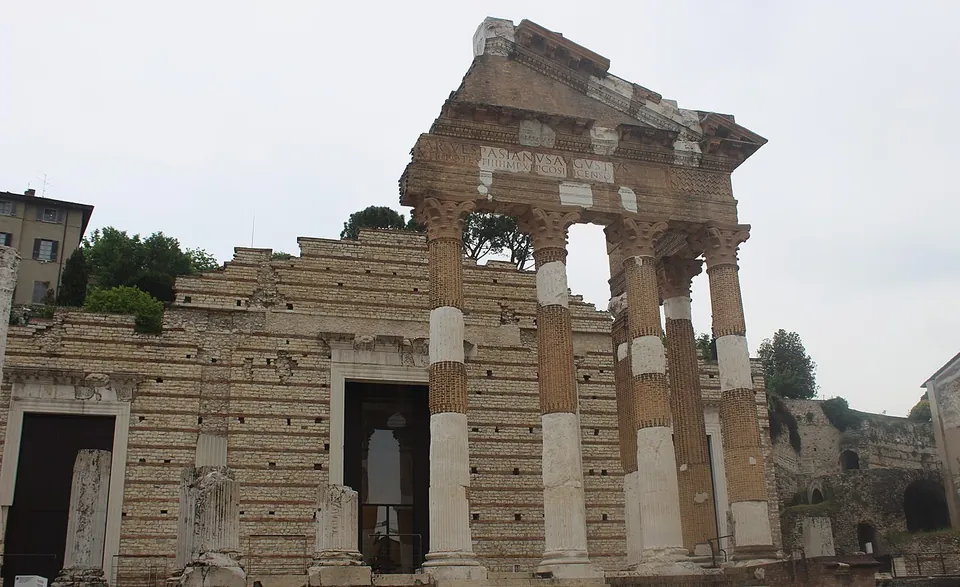
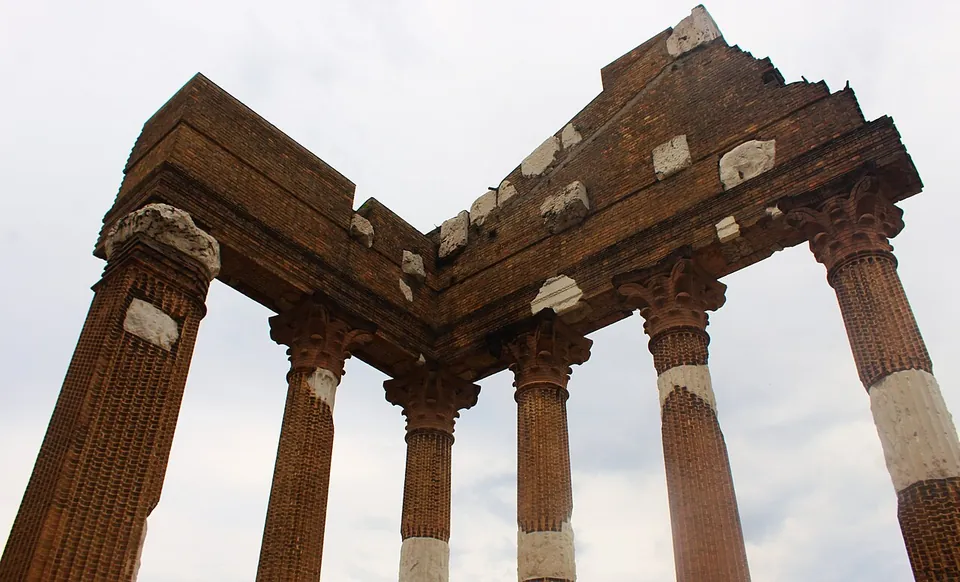
The Capitolium. The temple of Jupiter, Juno and Minerva closes the square to the north, its remains at the level of the Roman street and reached by stairs (it.wikipedia). The dedication to Vespasian is in the inscription on the pediment (it.wikipedia; en.wikipedia). The front has six Corinthian columns, and behind it are three separate cellae, one for each god (it.wikipedia). In 1935–1938 the columns, part of the porch and the three cellae were partly rebuilt in brick; only the first column on the left is whole and original, recognisable because it is entirely white (it.wikipedia). Inside, the 1st-century floors of geometric coloured marble are still in place in two of the cellae (the operator; it.wikipedia), with the altars found in the 19th century, and the walls of the central hall carry the collection of inscriptions assembled in 1830, when the city’s first museum opened in the restored temple (the operator).
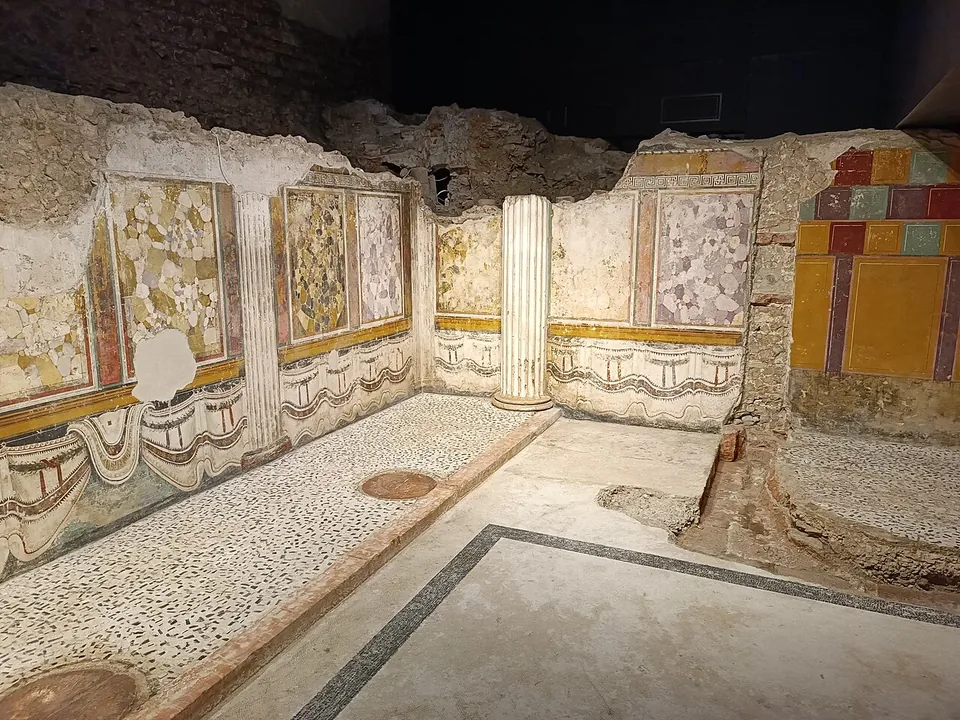
The Republican sanctuary. Under the Capitolium and the neighbouring Casa Pallaveri lie four halls side by side on a common podium, built in the early decades of the 1st century BC and overlooking the decumanus (the operator). Their walls keep painted fluted columns, imitation coloured-marble panels and a painted curtain, which the operator calls unique in northern Italy; one hall opened to the public in 2015, after its frescoes were restored (it.wikipedia).
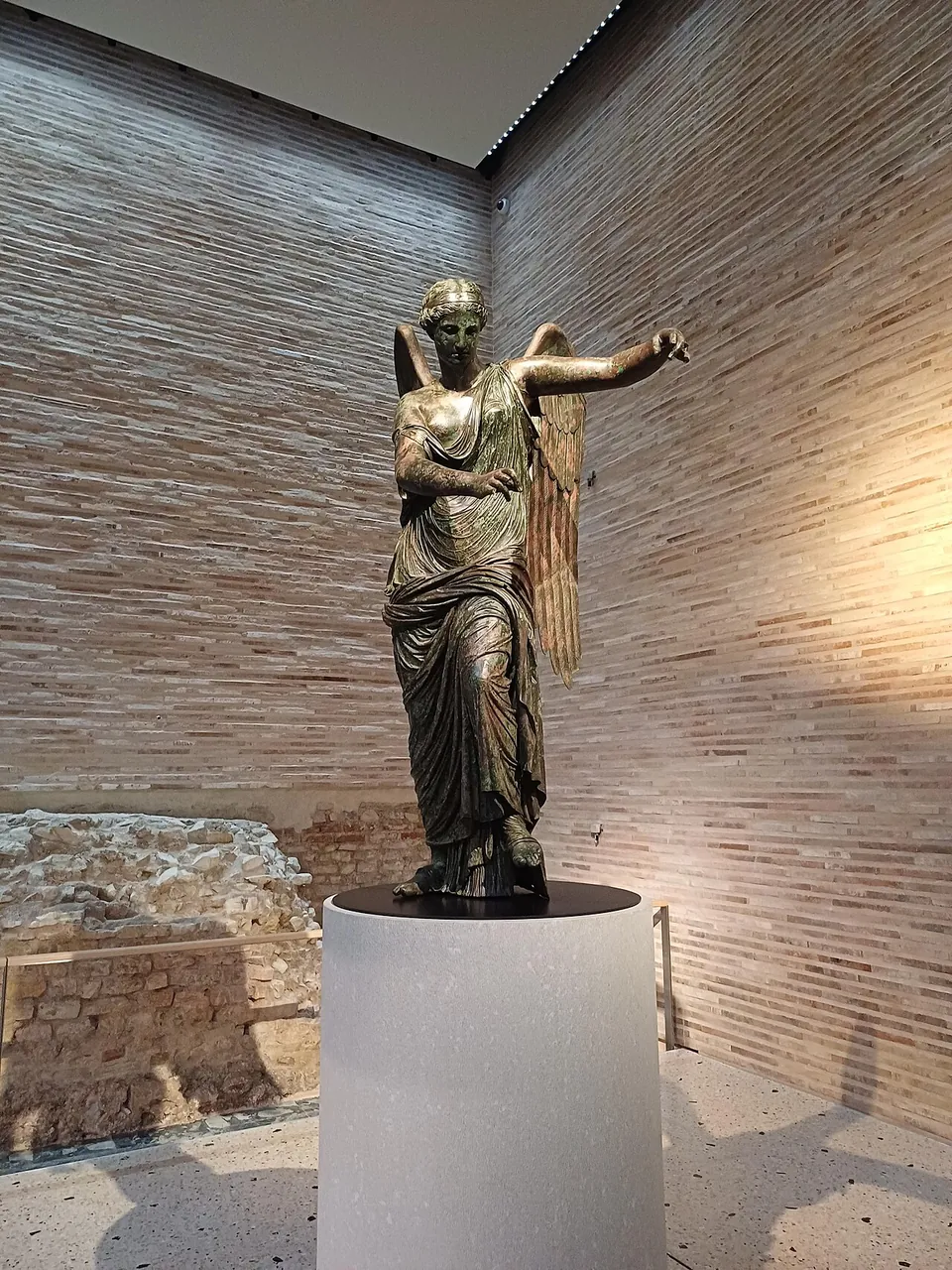
The Winged Victory. The bronze statue was found in 1826 between two walls of the temple, together with bronze imperial portraits and hundreds of other bronze objects (the operator). Restored in 2019–2021 by the Opificio delle Pietre Dure in Florence, it now stands in the temple’s eastern cell, in a setting by the Spanish architect Juan Navarro Baldeweg; the operator dates it to the 1st century AD.
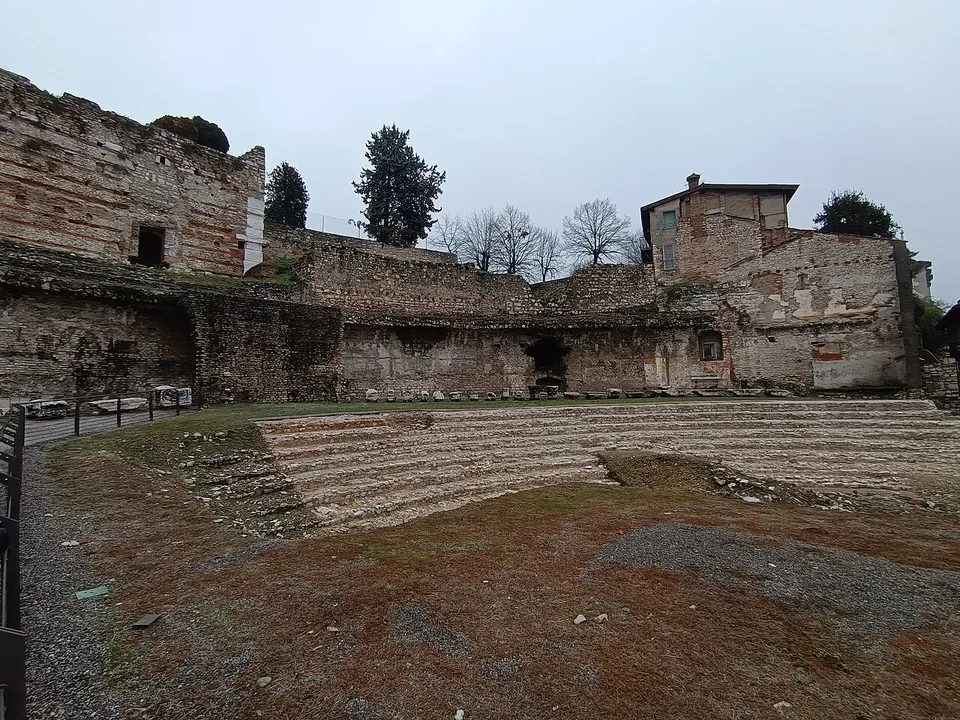
The theatre. East of the temple, the theatre was built partly into the slope of the Cidneo hill. It was about 86 m across with a stage 48 m long, and by some estimates seated about 15,000 (it.wikipedia). Only the lowest tiers of seating, which rested on the ground, survive, together with remains of the stage and of the wall on the street; the Palazzo Maggi Gambara still stands on the western part of the seating (it.wikipedia). It is closed while the Soprintendenza excavates it: the dig was to run until mid-July 2026, after which the site was to be made safe before excavation resumes and the structures are restored (the operator; the Ministry of Culture).
Under Palazzo Martinengo. On the west side of the square, the cellars of Palazzo Martinengo Cesaresco hold an archaeological route with remains from the Iron Age to the late Middle Ages (it.wikipedia); the forum’s Flavian baths, built over an Augustan house, stood on this west side (it.wikipedia). No operator publishes current hours for it. The basilica that closed the south end of the forum is a separate stop of Roman Brixia.
The forum area is part of a UNESCO World Heritage Site inscribed in 2011, but the series is “Longobards in Italy: Places of Power (568–774 AD)”, about the Lombard kingdom rather than Rome (it.wikipedia; the operator).
Is it worth the trip?
Yes. A Roman temple you can walk into, with its marble floors still in place and the painted halls of an earlier sanctuary intact beneath it, and a major ancient bronze shown in the temple where it was found, are reason enough to come to Brescia. The square itself costs nothing and shows how the forum sat below the temple.
Know what you are looking at: the temple front is largely a 1930s reconstruction in brick, and the theatre is closed for excavation. The ticket is good value if you also visit the Santa Giulia museum, linked to the park by the UNESCO Corridor, a free pedestrian route of about a kilometre (the operator), and steep if you only want the temple: the operator sells no ticket for the park alone.
Getting there and what it costs
The park entrance is at Via dei Musei 55. From Brescia railway station it is a 20-minute walk towards Piazza della Vittoria and then along Via dei Musei, or the metro to the Vittoria stop and a 10-minute walk (the operator). Via dei Musei is in the restricted-traffic zone and the park has no parking of its own; the operator points drivers to the car parks Arnaldo, Goito, Fossa Bagni, Castellini and Piazza Vittoria. A lift links the ticket office, the sanctuary and the Capitolium (the operator).
The park opens Tuesday to Sunday, 10.00–18.00 from October to May and 10.00–19.00 from June to September, closed on Mondays that are not public holidays, with last admission 45 minutes before closing. It is sold only on the Integrated Ticket, €19, which also covers Santa Giulia and three other city museums, one entry to each, until 22 August 2027; €16 for over-65s, €12 for under-26s, and free for children up to 5 and with the Brescia Card. A free multimedia guide is available by QR code on your own phone (Fondazione Brescia Musei, page captured 16 September 2026 – check before travelling, since prices move).
Visiting details
- Opening hours
- The Capitolium, the Republican sanctuary and the Winged Victory (Brixia archaeological park) open Tuesday–Sunday 10.00–18.00 from 1 October to 31 May and 10.00–19.00 from 1 June to 30 September; closed on Mondays that are not public holidays; last admission 45 minutes before closing. The square, the forum column and the front of the temple are in public space.
- Tickets
- The park is sold only on the Integrated Ticket, €19, which also covers the Santa Giulia museum and three other city museums, one entry to each, valid until 22 August 2027; €16 over 65 and with listed memberships, €12 under 26 and for disabled visitors (a companion free), €14 in groups; free for children up to 5, residents of Brescia and holders of the Brescia Card or the Abbonamento Musei Lombardia. The square itself is free.
- Parking
- The park is in the restricted-traffic zone (ZTL) on Via dei Musei and has no parking of its own; the operator names the car parks Arnaldo (Piazzale Arnaldo), Goito (Via Spalto San Marco), Fossa Bagni (Via Lombroso), Castellini (Via Castellini) and the one on Piazza Vittoria.
Before you go
- The Roman theatre is closed while the Soprintendenza excavates it; no reopening date is published.
- No operator publishes current hours for the Palazzo Martinengo excavations on the west side of the square.
- The park's rooms are kept at about 20 °C for conservation; the operator suggests bringing an extra layer.
Hours and prices checked 16 September 2026 on the operator's own site. Confirm before travelling.
History
Brixia passed under the control of Republican Rome in 196 BC without much change to the town; the first forum, probably a simple one, was laid out when the town was reorganised under Augustus, with the Republican temple on its north side (it.wikipedia). The sanctuary itself is older: the operator dates it to the years just after Brixia received Latin rights in 89 BC, built by craftsmen from central Italy to show the town’s adherence to the cultural model of Rome.
Under Vespasian the forum took its final form. The old temple was levelled and the Capitolium built over it in AD 73, the basilica rose on the south side, porticoes joined the two, and baths replaced a house on the west (it.wikipedia; Pleiades). Brescia had sent men to fight for Vespasian against Vitellius in the plain between Goito and Cremona, and it.wikipedia reads the temple as his reward. The theatre is dated to the Flavian period by it.wikipedia and Pleiades, and remodelled under Septimius Severus according to it.wikipedia; the operator puts its layout under Augustus, enlarged until the stage was redecorated in the 2nd and 3rd centuries.
The Capitolium was destroyed by fire in the 4th century and never rebuilt, and a landslide from the Cidneo hill later buried it (it.wikipedia). The theatre stayed in use until the late 4th or early 5th century; its stage fell in the 11th or 12th century, probably in an earthquake, and the ruin served as a quarry and, in the 12th century, as a place for public hearings (the operator). The square itself never lost its place in the town plan (it.wikipedia). Excavation began in 1823, paid for by public subscription and led by the Ateneo di Brescia, and uncovered the temple, the theatre and the bronzes (the operator; it.wikipedia). A 1930s plan to clear almost every building from the forum down to the basilica and rebuild its porticoes was never carried out; only the one surviving column was laid bare and restored (it.wikipedia).
More photographs




Nearby
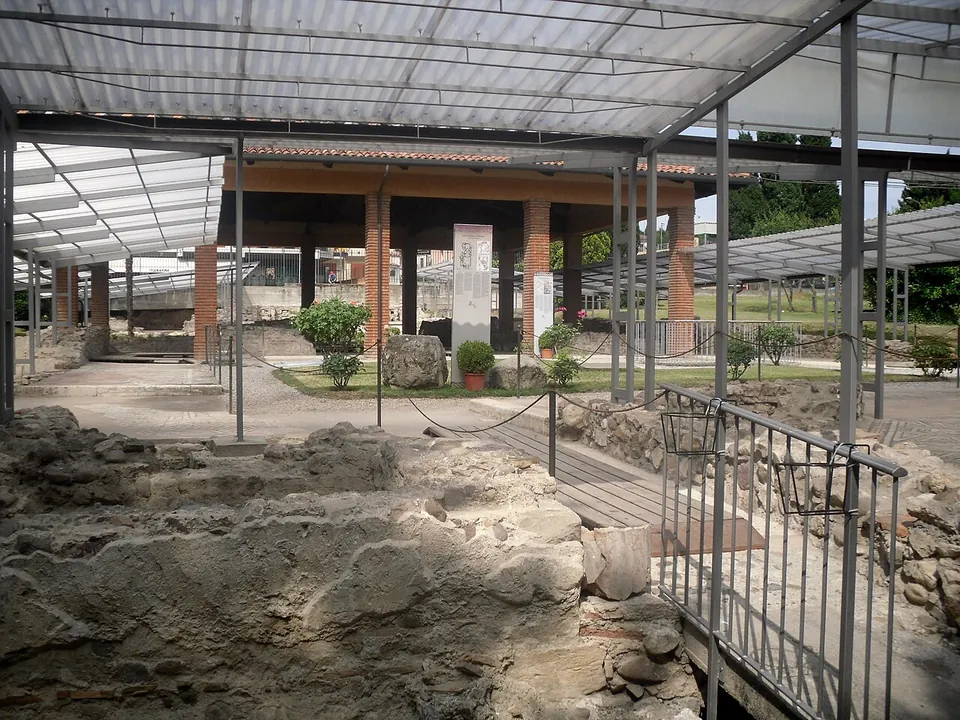
Photo: Imiimane · CC BY-SA 3.0 · Commons
25 km · villa · Lombardy
Roman villa of Desenzano del Garda
The excavated villa covers about one hectare, with residential wings and working quarters side by side (the operator).
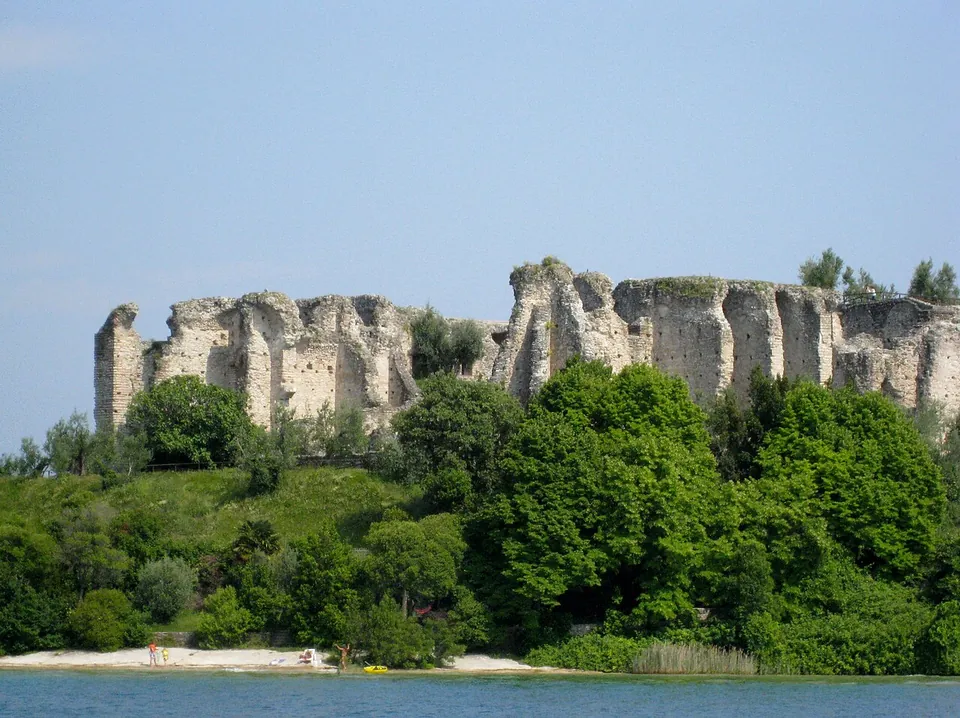
Photo: Agsftw · CC BY-SA 3.0 · Commons
30 km · villa · Lombardy
Grottoes of Catullus
The villa was a rectangle of 167 by 105 m, with a projecting wing at each short end, built on a sloping rock shelf that the builders cut back and propped up with massive substructures on the north side (it.wikipedia).


Straight-line distances.
Sources
Every fact on this page comes from the records below, each used under the licence noted.
| Source | Licence |
|---|---|
| Wikidata Q3902398 | CC0 |
| OpenStreetMap way/201768189 | ODbL |
| Wikipedia (it) — Piazza del Foro | CC BY-SA 4.0 |
| Wikipedia (it) — Foro romano di Brescia | CC BY-SA 4.0 |
| Wikipedia (it) — Capitolium (Brescia) | CC BY-SA 4.0 |
| Wikipedia (en) — Capitolium of Brixia | CC BY-SA 4.0 |
| Wikipedia (it) — Teatro romano di Brescia | CC BY-SA 4.0 |
| Pleiades — Capitolium of Brixia | licence not recorded |
| Pleiades — Roman theater at Brixia | licence not recorded |
| Wikidata — Capitolium (Q3657072) | licence not recorded |
| Wikidata — Roman Theatre of Brescia (Q3982365) | licence not recorded |
| Wikidata — Roman forum of Brescia (Q3748447) | licence not recorded |
| vici.org — Tempio capitolino | licence not recorded |
| Fondazione Brescia Musei — Brixia, Roman archaeological area (hours, tickets, getting there) | licence not recorded |
| Ministero della Cultura — Scavo archeologico del Teatro romano, "Cantiere Aperto" (12 June 2026) | licence not recorded |