

What is there today
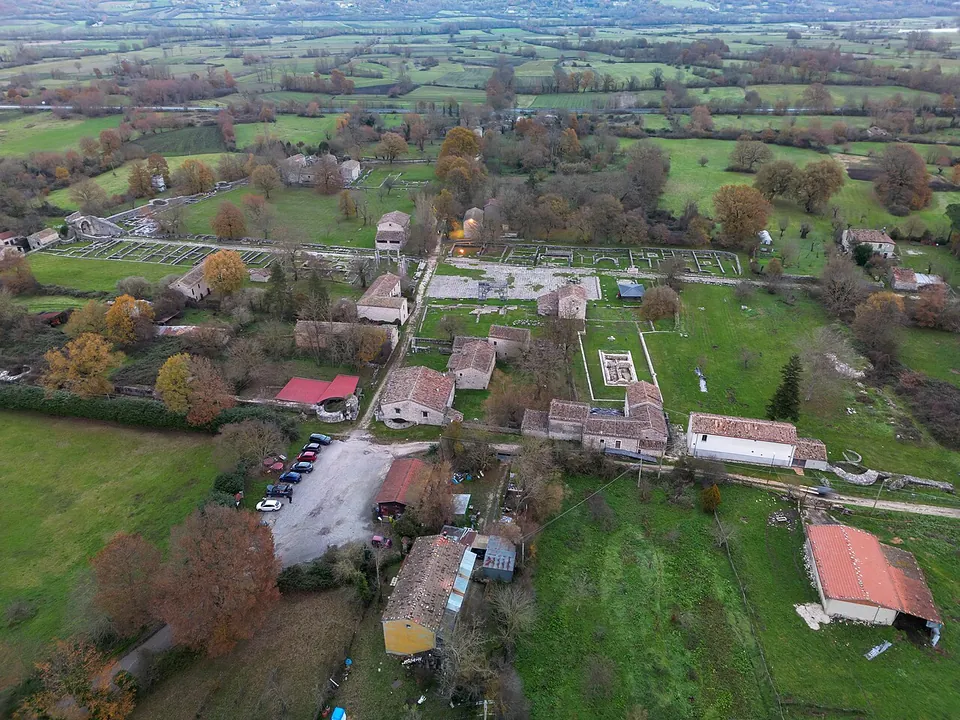
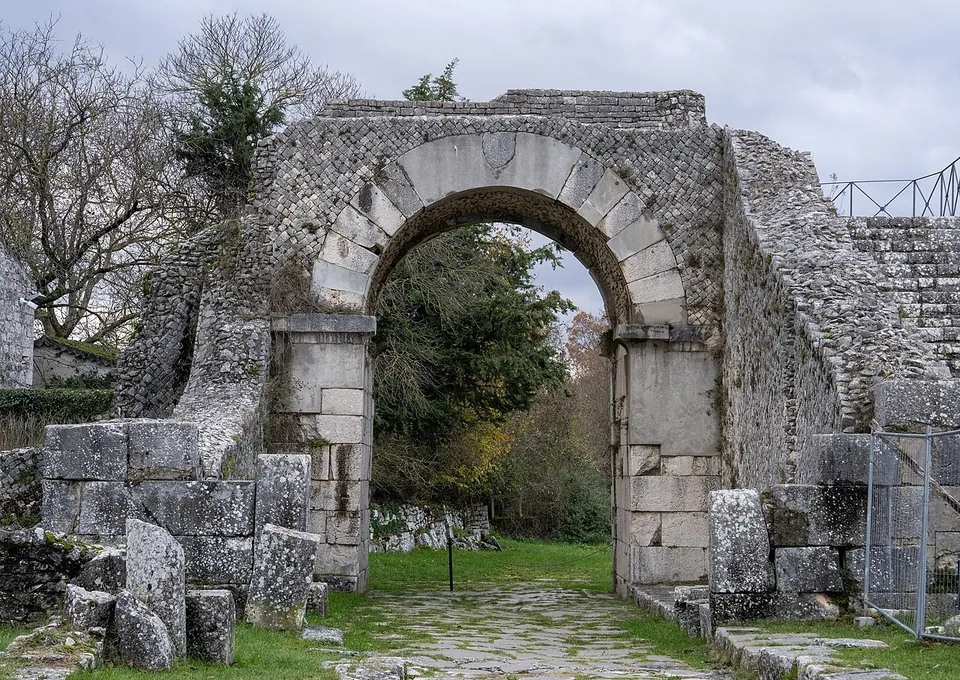
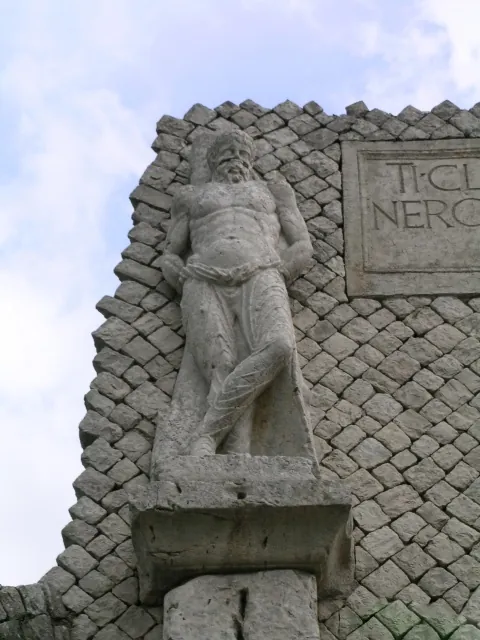
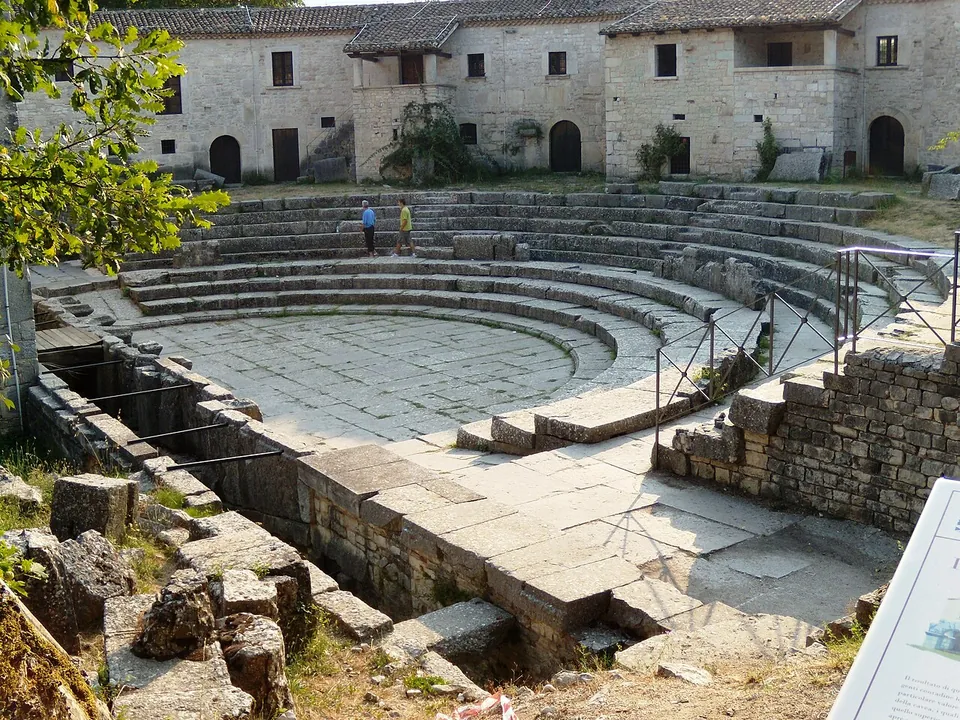
The walls are the first thing you see: a circuit of about 1,270 m in small-stone net-pattern masonry, punctuated by round towers, enclosing about 12 hectares, with a monumental gate at each end of the two main streets (it.wikipedia). Porta Bojano still stands with its arch, its building inscription and the statues of two barbarian prisoners beside it. Inside, the paved main street runs past houses and shops to the forum, a paved square with the columns of the basilica on one side, a market hall and a fountain carved with a griffin. The theatre, the best preserved building in the town, has its lower rows of seats and its orchestra floor, and the farmhouses that were built on top of its upper seating now house a museum (it.wikipedia). “Of all the unearthed cities this is the most romantic”, Guido Piovene wrote in his Viaggio in Italia (1957); the operator quotes the line on its website.
Is it worth the trip?
Yes, if you have a car. Here a Roman town plan — walls, gates, streets and public buildings — lies in fields rather than under a modern town, and Saepinum had about 20,000 visitors in the whole of 2017 (it.wikipedia), so you are unlikely to share it with crowds. Walk the walls, the main street and the forum, and add the tombs outside two of the gates.
Two caveats for 2026. Accessibility works have closed some areas of the site, and the operator does not say which, so you may not see everything. In return, admission is free while the works last. And the site is in open country: the nearest bus stops mapped are about 2.7 km away, towards Sepino.
Getting there
Saepinum is at Altilia, in the municipality of Sepino, about 20 km south of Campobasso on the SS 87 towards Benevento (the operator); the walled town lies about 3 km north of present-day Sepino (it.wikipedia). The operator’s address is Contrada Altilia 1, SP 82, 86017 Sepino.
Since 28 May 2026 the entrance and ticket office at Porta Tammaro, on the side facing the SS 87, have been closed for the works. Go instead to the free car park beside Porta Terravecchia, the south-west gate, pick up a free ticket at the info point there and follow the new path outside the walls to Porta Bojano, where you enter the town directly on the main street; boards along the way explain the walls and towers (the operator).
The archaeological area and the museum are open every day from 08.15 to 19.15. Admission has been free since 1 March 2026; the operator calls this temporary, and the tariff it still lists for normal times is €10, €2 for ages 18–25 and free under 18, with a €20 card for a year’s entry (parcosepino.it, read 17 October 2026; check before travelling, since the works change both the entrance and the price).
Visiting details
- Opening hours
- Daily 08.15–19.15, archaeological area and museum.
- Tickets
- Free since 1 March 2026, as a temporary measure while building works close parts of the site; collect a free ticket at the info point at Porta Terravecchia. The standard tariff the operator still lists is €10, €2 for ages 18–25 and free under 18, with a €20 card for a year's entry.
- Parking
- Free gravel car park beside Porta Terravecchia, the south-west gate (OSM way/193861464, tagged fee=no), which is where the operator currently asks visitors to start. A café is mapped next to it.
Before you go
- Since 28 May 2026 the Porta Tammaro entrance and ticket office (the side facing the SS 87) are closed for works; start at the Porta Terravecchia car park instead.
- Some areas of the site are closed while accessibility works run; the operator does not list which.
- The nearest mapped bus stops are about 2.7 km away, towards Sepino; in practice the site needs a car.
Hours and prices checked 17 October 2026 on the operator's own site. Confirm before travelling.
Around the town
The walls and gates
The walls were built between 2 BC and AD 4, as an inscription repeated over each gate records, paid for by the future emperor Tiberius and his brother Drusus (it.wikipedia). They are about 4.8 m high and faced in opus reticulatum, small limestone blocks set in a net pattern; the round towers are about 7 m across, and the excavation of 2010, which uncovered almost the whole circuit, counted 35 of them. Some towers, mostly on the north-west side, have been partly rebuilt with recovered ancient material (it.wikipedia).
Each gate has a single round arch about 4.8 m high between two round towers, with a walled courtyard behind it for defence (it.wikipedia). At Porta Bojano, on the north-west side, the two towers were rebuilt by 1955, the keystone carries a bearded half-figure usually identified as Hercules, and the building inscription and the two prisoner statues survive on its outer face. Porta Benevento, on the south-east side, was restored in 1972 and keeps five original stones of its outer arch, with a helmeted god, probably Mars, on the keystone. Of Porta Terravecchia and Porta Tammaro little more than stretches of masonry is left (it.wikipedia). An inscription of about AD 168 by Porta Bojano warns the local people not to harm the shepherds driving their flocks along the drove roads (en.wikipedia), which matters here because the town’s main street is the line of one of them, the Pescasseroli–Candela tratturo (it.wikipedia).
The theatre
The theatre stands against the north wall, between Porta Bojano and the north corner of the circuit, and is dated to the early 1st century AD, after the walls: a small gate was cut through them so that spectators from outside the town could walk straight in (it.wikipedia). It measures 61.5 m across. The orchestra keeps its original stone paving, and four rows of the lowest tier of seats and three of the middle tier survive; the whole is thought to have seated about 3,000 (it.wikipedia). In the 18th century farmers built two-storey houses on the upper seating and the stage building from the theatre’s own stones; in the early 1970s they were kept and restored rather than demolished, and they now hold the museum (it.wikipedia).
The forum, basilica and market
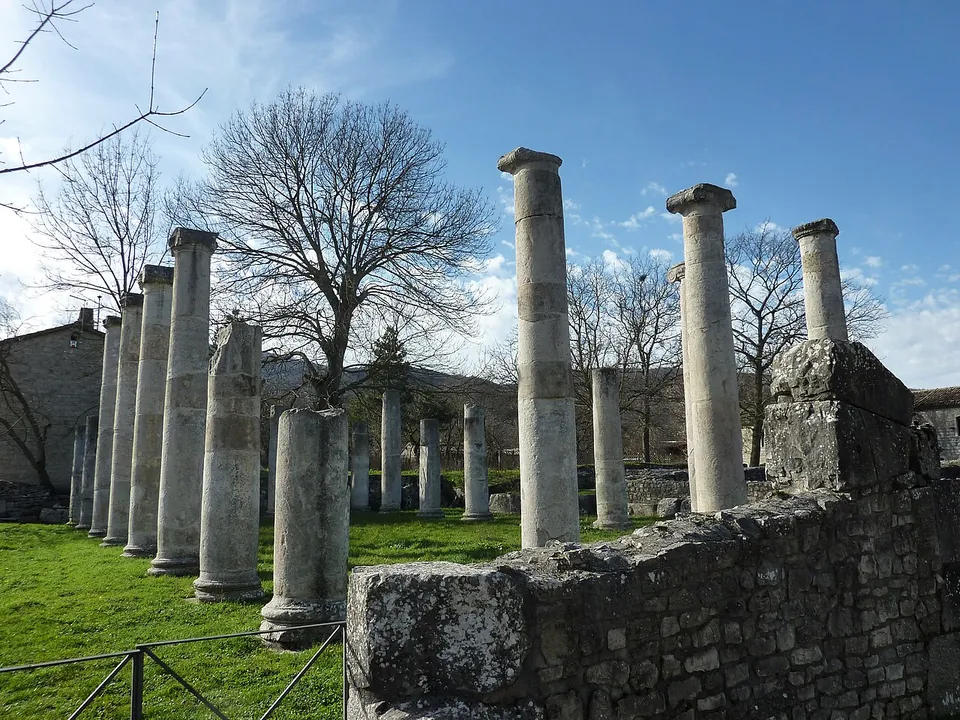
The forum lies where the two main streets cross: a paved square of about 1,412 m², with an inscription laid into the paving that names the magistrates who paid for it, one of them Gaius Papius Faber (it.wikipedia). On its north-west side the basilica, a covered hall for business and the courts, had twenty Ionic columns around its central space; a 1950s restoration put nine of them back to their full height of 6.15 m. It was founded at the end of the 1st century BC by Lucius Naevius Pansa, whose inscription is still in place (it.wikipedia). Next to it is the macellum, a food market around a hexagonal court with shops on four sides, and about ten metres from the square the Fontana del Grifo, a fountain carved with a griffin and paid for by Gaius Ennius Marsus and his son (it.wikipedia).
Along the north-east side of the forum stands a temple podium, possibly of Jupiter, whose cult is attested in the town’s inscriptions (it.wikipedia). Opposite, on the south-west side, a few fragments of a monumental arch have been set back in place with a metal frame, together with its partly damaged inscription naming Lucius Neratius Priscus, consul and governor of Lower Germany and Pannonia, whom it.wikipedia calls one of the most distinguished jurists of his time, a member of the council of the emperors Trajan and Hadrian. Beyond the square, the large building across the main street is identified from two inscriptions as the Baths of Silvanus, the only building in the town whose ancient name is known; it is only partly excavated (it.wikipedia). Since 2023 excavation near Porta Bojano has uncovered a large house with a monumental entrance on the main street and a rare domestic hot-water system built around a lead tank (en.wikipedia, it.wikipedia).
The tombs outside the walls
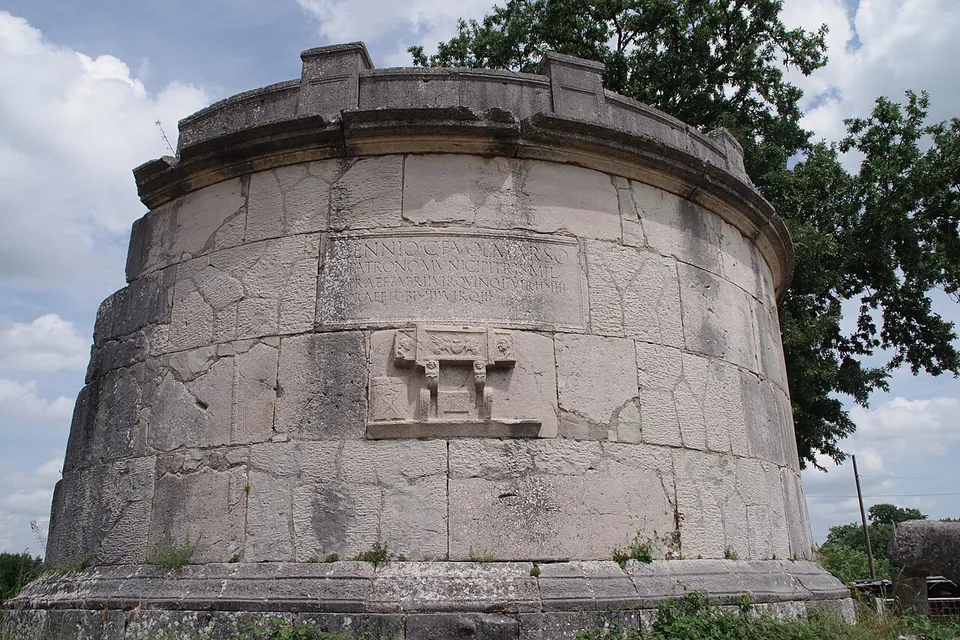
About 75 m outside Porta Benevento, beside the drove road, stands the round mausoleum of Gaius Ennius Marsus, a local magistrate: a drum 8.4 m across on a square base, rebuilt in the 1940s mostly from its own stones, with the epitaph listing his career and, below it, a relief of the folding seat of a magistrate. Two of the stone lions that stood at its corners survive, much worn (it.wikipedia). Outside Porta Bojano is the tomb of Publius Numisius Ligus, a military tribune and patron of the town (Pleiades), an altar-shaped monument of white limestone almost entirely rebuilt from its original blocks and dated to the first half of the 1st century AD (it.wikipedia).
History
The Samnite town, Saipins, stood on the height of Terravecchia at 953 m, above the plain; its walls are still visible there. In 293 BC, during the Third Samnite War, Roman troops under the consul Lucius Papirius Cursor took it, and the survivors were made to move down to the valley, beside the river and the drove route (it.wikipedia). The settlement there became a Roman municipium, a self-governing town, attested in inscriptions from the age of Augustus, when it was walled and a programme of public building began in which leading citizens displayed their wealth. One local family, the Neratii, went on to produce consuls and provincial governors and kept paying for buildings in their home town (it.wikipedia). The town lay on the road between Beneventum and Corfinium (Pleiades).
After the earthquake of 346 Saepinum became the capital of the new province of Samnium, and its governor Fabius Maximus restored many public buildings and the walls between 352 and 357 (it.wikipedia). The Gothic War of 535–553 deepened a decline already under way: much of the walls and the theatre collapsed, the forum lost its role and in the 6th–7th centuries became a cemetery. In 882 Saracen raids drove the remaining people up to a fortified site on the hill, the origin of present-day Sepino (it.wikipedia). Farmers returned to the ruins in the 18th century, building the hamlet of Altilia from Roman stones. Theodor Mommsen, who visited the site, published it in 1845, digging began in 1876, and the excavations of 1950–1955 under Valerio Cianfarani uncovered the forum, the basilica, Porta Bojano and the main street much as they are seen today (it.wikipedia). Since 2021 the site has been run by the Parco Archeologico di Sepino, a park of the Ministry of Culture with its own management (it.wikipedia).
More photographs



Nearby
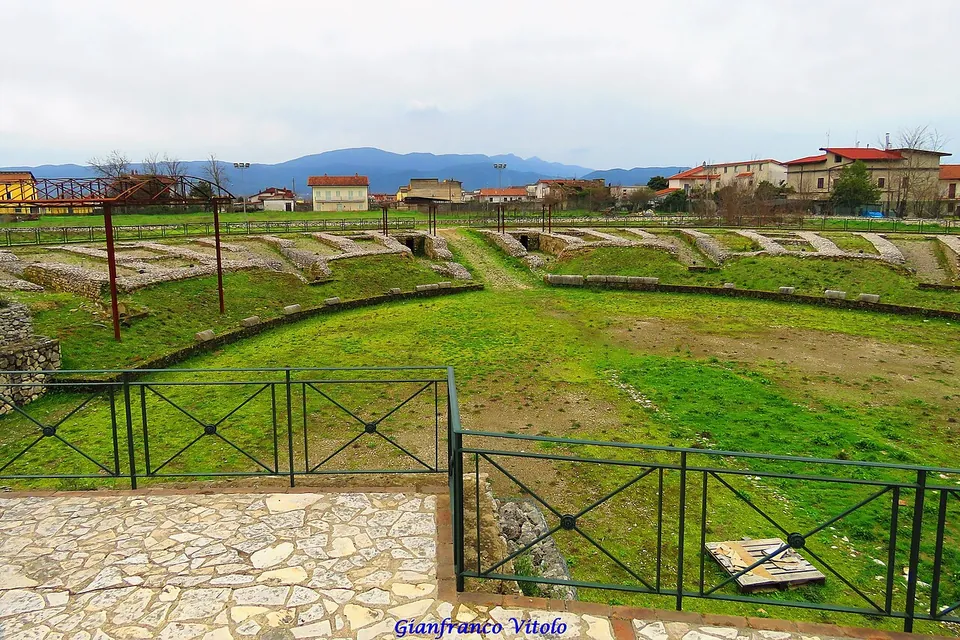
Photo: Gianfranco Vitolo from Sarno (Sa), Italia · CC BY-SA 2.0 · Commons
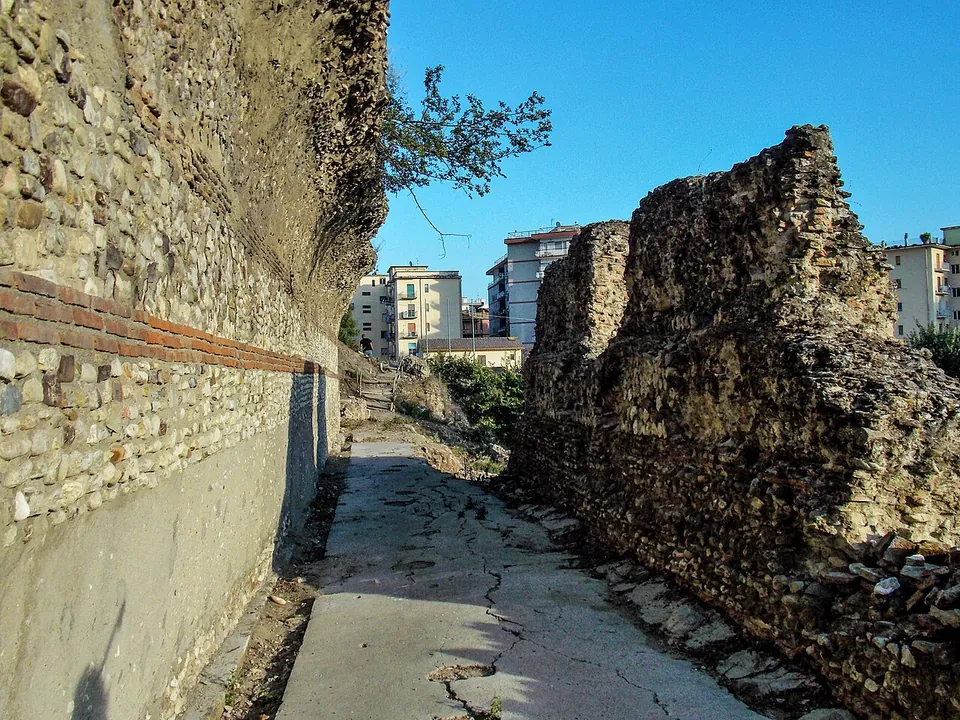
Photo: Decan · CC BY-SA 4.0 · Commons
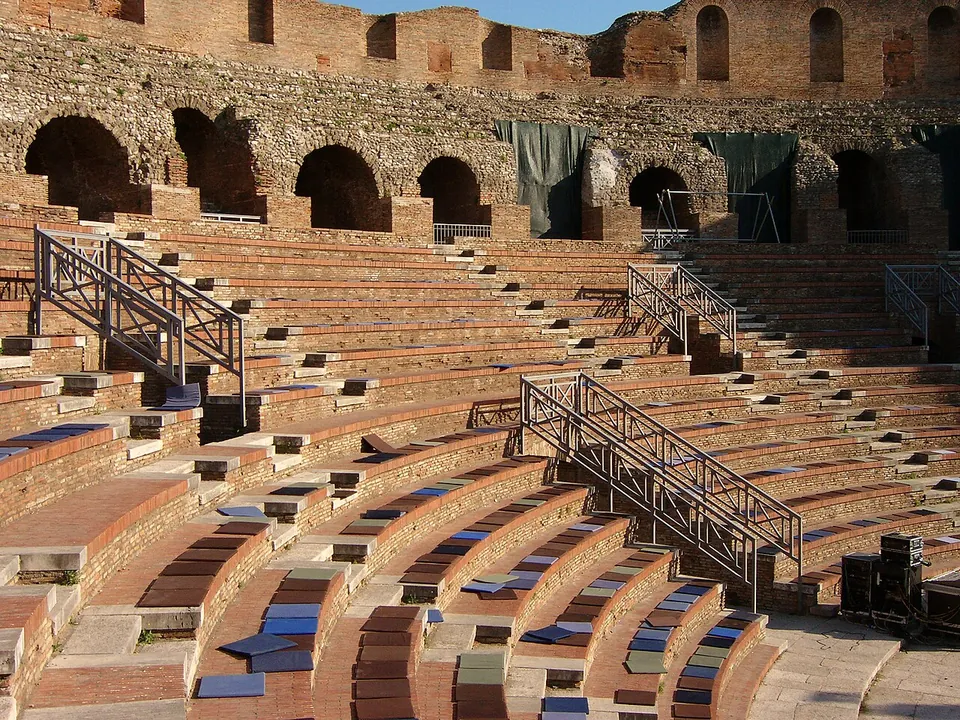
Photo: Simblek at Italian Wikipedia · Public domain · Commons
36 km · theatre · Campania
Roman Theatre of Benevento
The seating is the centrepiece: a semicircle 90–98 m across (published figures differ) around an orchestra of 30 m, built in concrete faced with limestone blocks and brick (the operator; it.wikipedia).


Straight-line distances.
Sources
Every fact on this page comes from the records below, each used under the licence noted.
| Source | Licence |
|---|---|
| Pleiades 433073 | CC BY |
| Wikidata Q1807870 | CC0 |
| Vici.org 1853 | CC BY-SA (text), CC0 (metadata) |
| OpenStreetMap way/193450242 | ODbL |
| Wikipedia (it) — Saepinum | CC BY-SA 4.0 |
| Wikipedia (it) — Teatro romano di Sepino | CC BY-SA 4.0 |
| Wikipedia (en) — Saepinum | CC BY-SA 4.0 |
| Pleiades — Theater at Saepinum | licence not recorded |
| Pleiades — Tomb of P. Numisius Ligus | licence not recorded |
| Parco Archeologico di Sepino — tickets and opening hours (the operator) | licence not recorded |
| Parco Archeologico di Sepino — free admission from March 2026 | licence not recorded |
| Parco Archeologico di Sepino — Porta Tammaro closed, entry from Porta Terravecchia (27 May 2026) | licence not recorded |
| Parco Archeologico di Sepino — new route along the walls (5 June 2026) | licence not recorded |