

What is there today
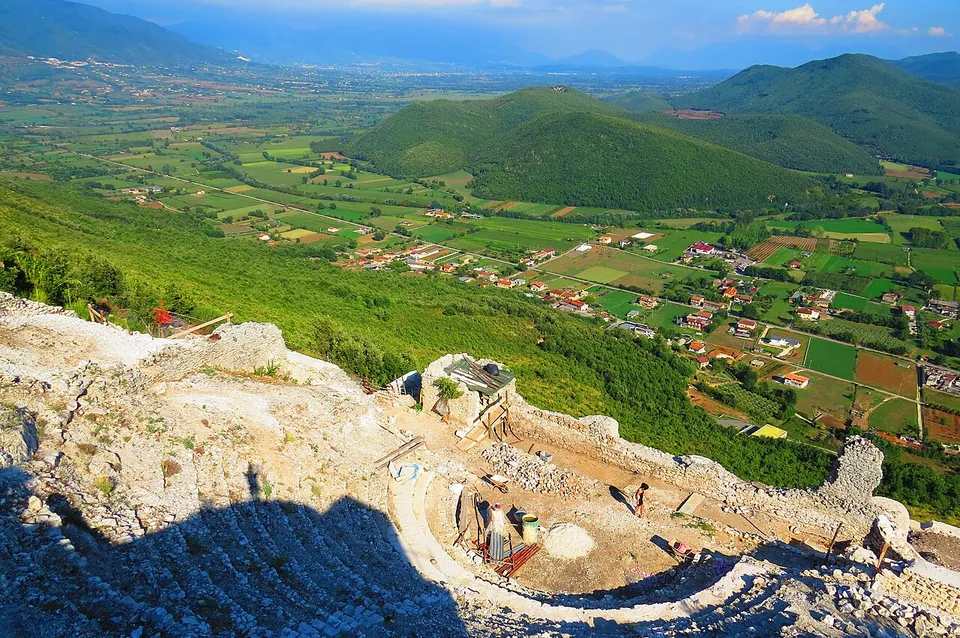
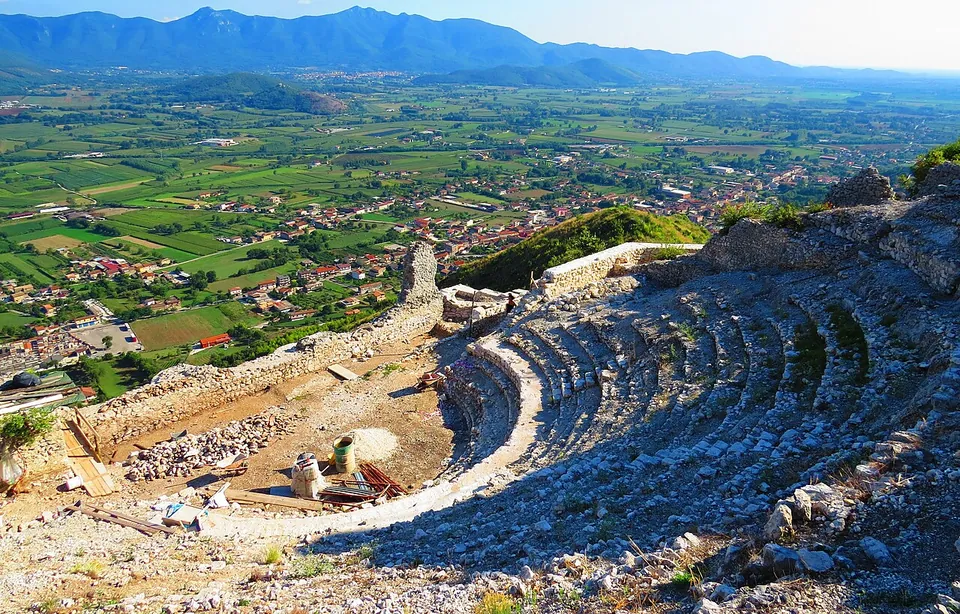
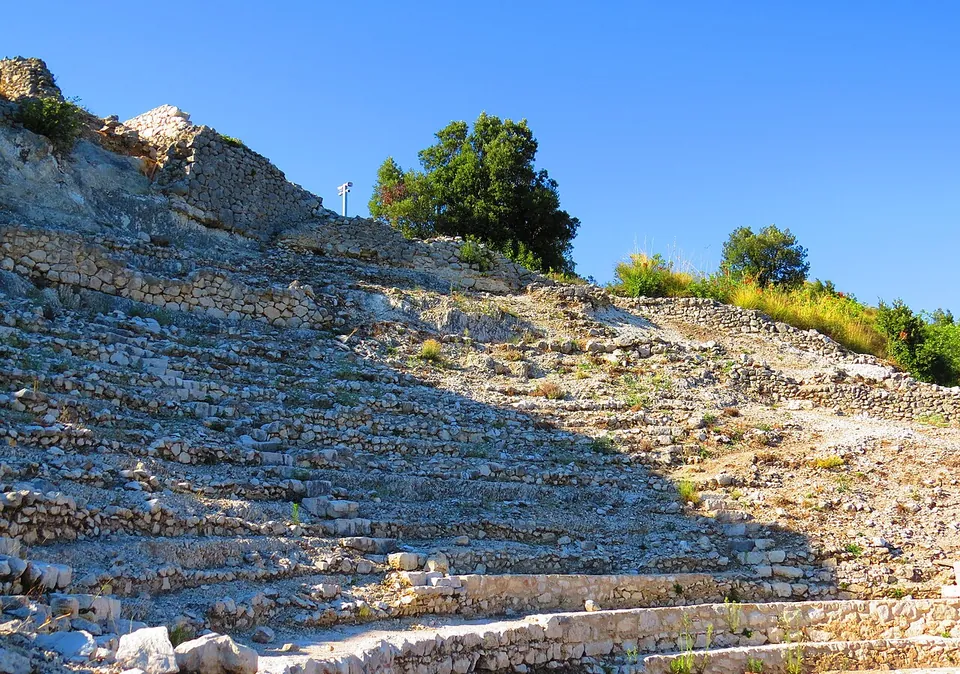
The theatre is what you see. Its semicircular seating, the cavea, is cut into the hillside and built of local limestone rubble set in mortar; excavation since 2002 has uncovered most of it, though in 2013 the orchestra floor still lay about a metre under the earth, and the steps were restored season by season, so much of what you walk on is consolidated or rebuilt (FastiOnline). Of the stage building only the lowest level survives, with one of its side wings still standing to some height (pietravairano-ce.it). Four semicircular towers on the south side buttress the building and gave it a monumental front seen from the valley below (FastiOnline, italia.it).
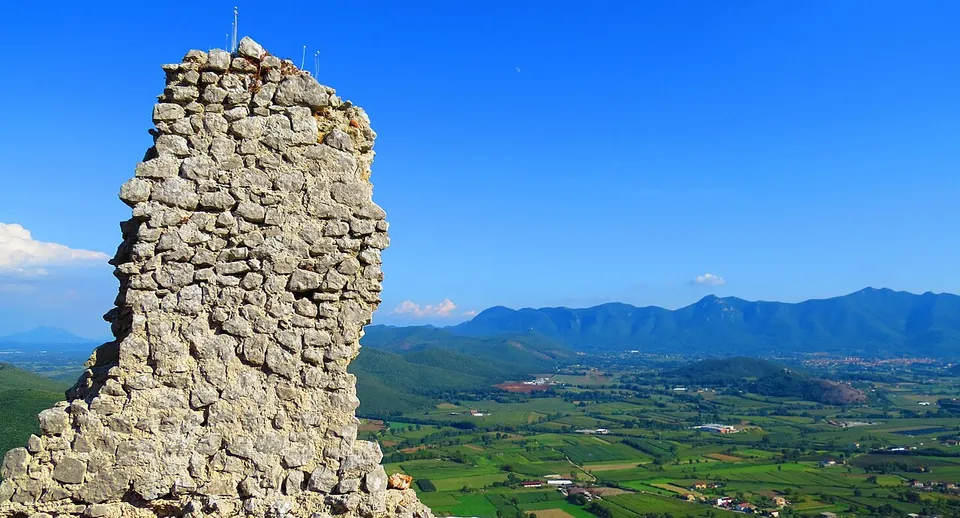
The temple on the terrace above is a plan rather than a building: nothing of its walls stands, but the outline of its interior can still be read on the ground (it.wikipedia, pietravairano-ce.it). It was a Tuscan-style temple with three cellas on a square artificial terrace of about 700 m², held up by retaining walls on every side (FastiOnline). Stretches of an older, pre-Roman fortification wall of polygonal masonry are visible along the slope of the mountain (FastiOnline). The view from the top, over the middle Volturno valley to the Apennines and the Campanian plain, is half the reason to come (italia.it).
Is it worth the trip?
For a curious traveller in the upper Caserta area, yes: a temple and a theatre designed as one building on a mountain spur is a rare arrangement (SiViaggia), and the setting is spectacular. Be clear what you are getting, though. The theatre is small - published estimates put its capacity at about 2,000 - and has been restored heavily enough that the restoration itself was criticised as invasive (SiViaggia); the temple is only a floor plan. Getting there takes a short climb, rough in places. It is a fine half-day combined with the hill village of Pietravairano, not a reason on its own to cross Campania.
Getting there and what it costs
The site is on Monte San Nicola, in the frazione of Sant’Eremo of Pietravairano (SiViaggia); the nearest town of any size is Teano, about 13 km away in a straight line. The walk up takes about 15 minutes, rough in places and in full sun all the way, so avoid the hottest months and carry water (SiViaggia). OpenStreetMap maps car parks in the village below, 700 m to 1.1 km from the site in a straight line.
A monorail has also been built up the hill: the Comune announced in May 2025 that it had passed its acceptance test, and in September 2025 the audience for a concert in the theatre came up both on foot and by monorail (Comune di Pietravairano, via Matese News and Caserta Sera). Whether it runs for ordinary visitors, and when, is not published.
The site is managed by the Comune di Pietravairano, which publishes no opening hours or admission terms. It said in May 2025 that the site would reopen that June after a further round of restoration, and the theatre hosted a concert that September. Before going, ask the Comune whether it is open (no terms published as of 24 October 2026).
Visiting details
- Tickets
- Unknown
- On foot
- About 15 min from the parking
- Best season
- Spring or autumn; the path up is exposed to the sun all the way.
Before you go
- No opening hours or admission terms are published by the Comune di Pietravairano, which runs the site; the Comune's own website could not be reached.
- The Comune announced a reopening after restoration work for June 2025. A monorail up the hill was tested in May 2025 and carried a concert audience that September, but no timetable for ordinary visitors has been published.
History
The hilltop lay inside walls built during the Samnite occupation of the area (Pleiades), which passed under Roman control with the Samnite Wars of 343-290 BC (SiViaggia). The sanctuary itself is late Republican, though published dates range from the later 2nd to the early 1st century BC: roof terracottas found around the temple terrace belong to the second half of the 2nd century BC, while the building technique and pottery point to the first quarter of the 1st century BC (FastiOnline). The temple’s rainwater ran off its roof into a lined basin in the south-east corner and on into a cistern (FastiOnline). Later walls built against and over the temple show that the terrace was reoccupied in the Middle Ages, and a small apsed building nearby may be the chapel of the medieval settlement on the hill (FastiOnline).
Nicolino Lombardi, a local historian, had photographed the ruins before and taken them for a medieval building; flying over the mountain on 4 February 2000 he recognised the symmetry of a temple and a theatre from the air (pietravairano-ce.it, it.wikipedia). Excavation began in 2002 under Gianluca Tagliamonte, with the University of Lecce (the Università del Salento) working alongside the Comune; by its sixth season, in 2013, the cavea had been largely uncovered and its steps restored (FastiOnline).
More photographs

Nearby
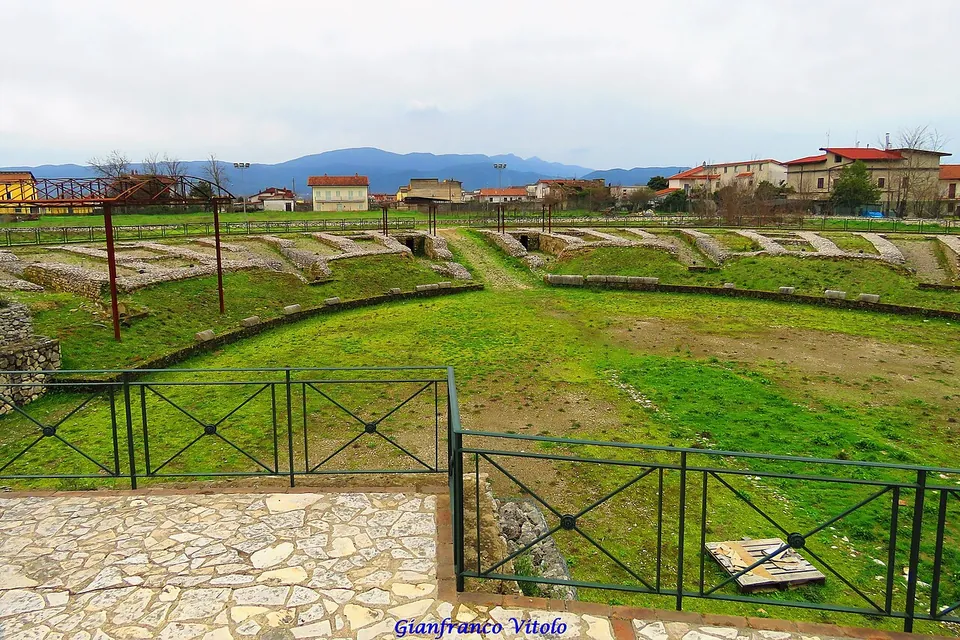
Photo: Gianfranco Vitolo from Sarno (Sa), Italia · CC BY-SA 2.0 · Commons
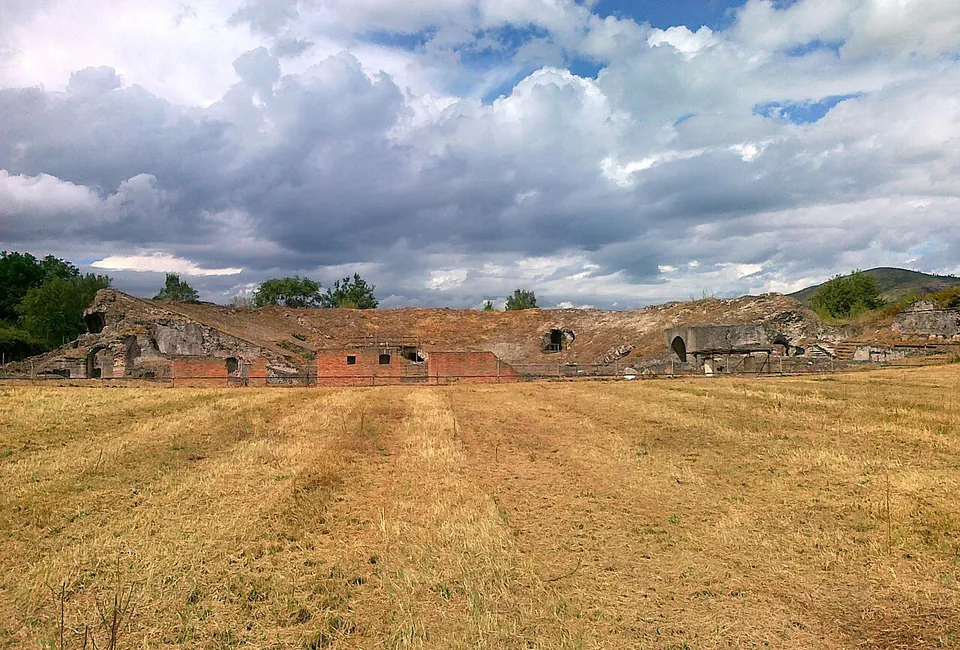
Photo: PietroCifone · CC BY-SA 3.0 · Commons
15 km · city · Campania
Cales
The ancient town survives across its whole extent, though the motorway runs through it, and the Ministry of Culture says plainly that its remains are not easy to read on the ground (cultura.gov.it).
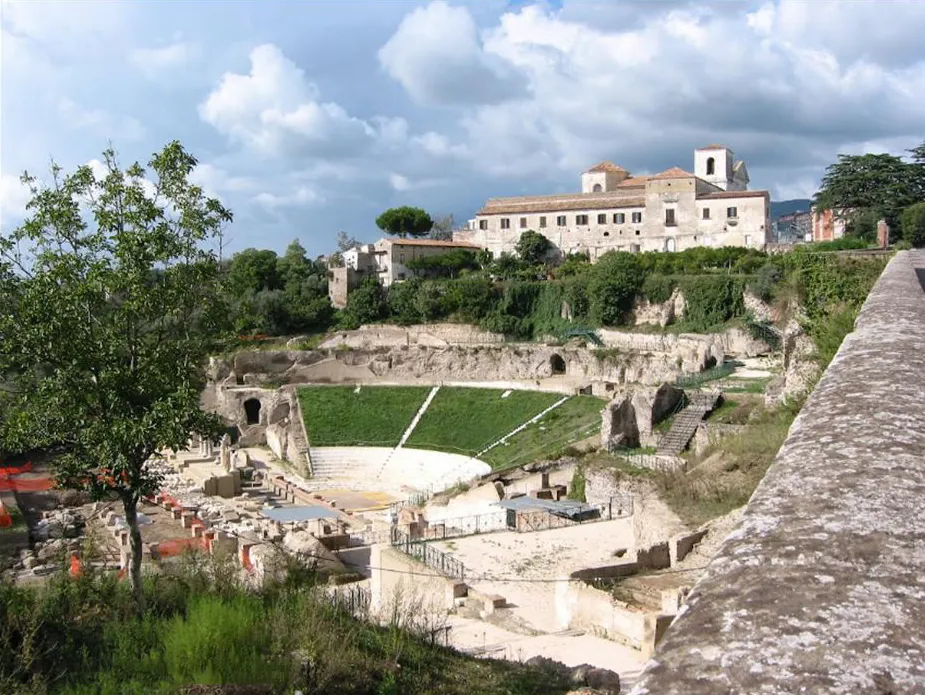
Photo: Gianni Bencivenga · CC BY-SA 3.0 · Commons
23 km · theatre · Campania
Roman Theatre of Sessa Aurunca
The theatre is one of the most imposing Roman public buildings found so far in Campania (the Ministry of Culture); it.wikipedia calls it the second-largest Roman theatre in the region after Naples.


Straight-line distances.
Sources
Every fact on this page comes from the records below, each used under the licence noted.
| Source | Licence |
|---|---|
| Pleiades 251442732 | CC BY |
| Wikidata Q108418823 | CC0 |
| OpenStreetMap way/462104028 | ODbL |
| Wikipedia (it) — Tempio e teatro di San Nicola | CC BY-SA 4.0 |
| FastiOnline — Monte San Nicola, excavation reports 2002–2013 (AIAC_1747) | licence not recorded |
| Italia.it (Ministero del Turismo) — Teatro Tempio di monte San Nicola | licence not recorded |
| pietravairano-ce.it — Tempio e Teatro San Nicola (local history site, with the discoverer's own account) | licence not recorded |
| SiViaggia — Teatro-tempio di Pietravairano, come e quando visitarlo (2023) | licence not recorded |
| Matese News — the Comune's statement on the monorail test and reopening (16 May 2025) | licence not recorded |
| Caserta Sera — the Comune's press release on the September 2025 concert at the theatre | licence not recorded |