

What is there today
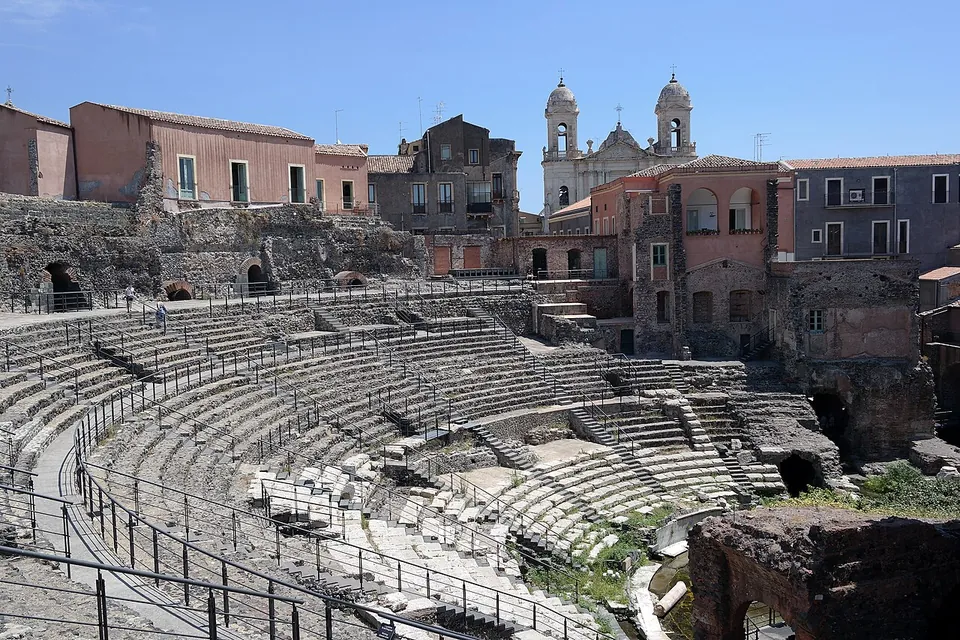
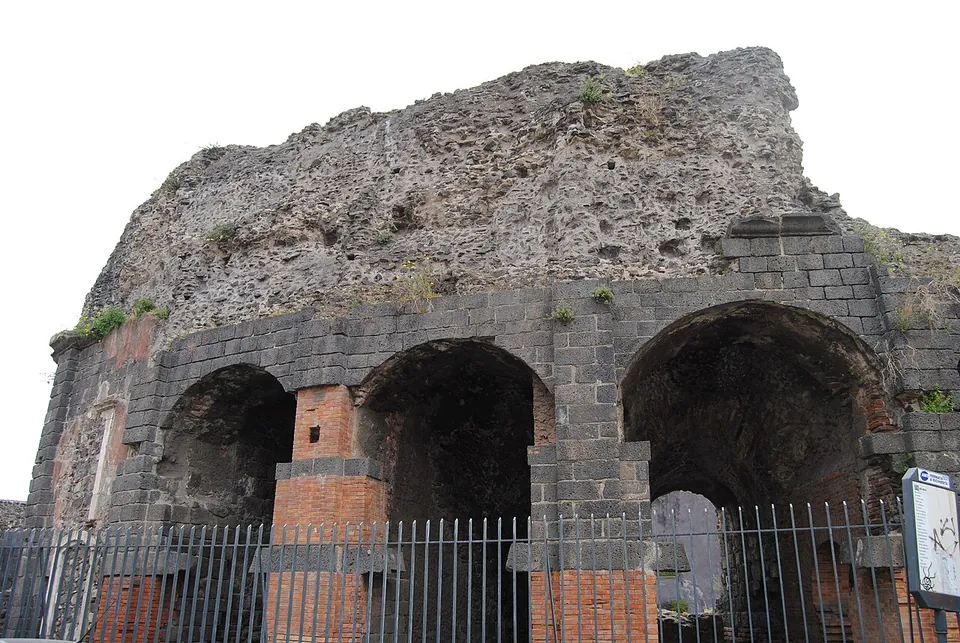
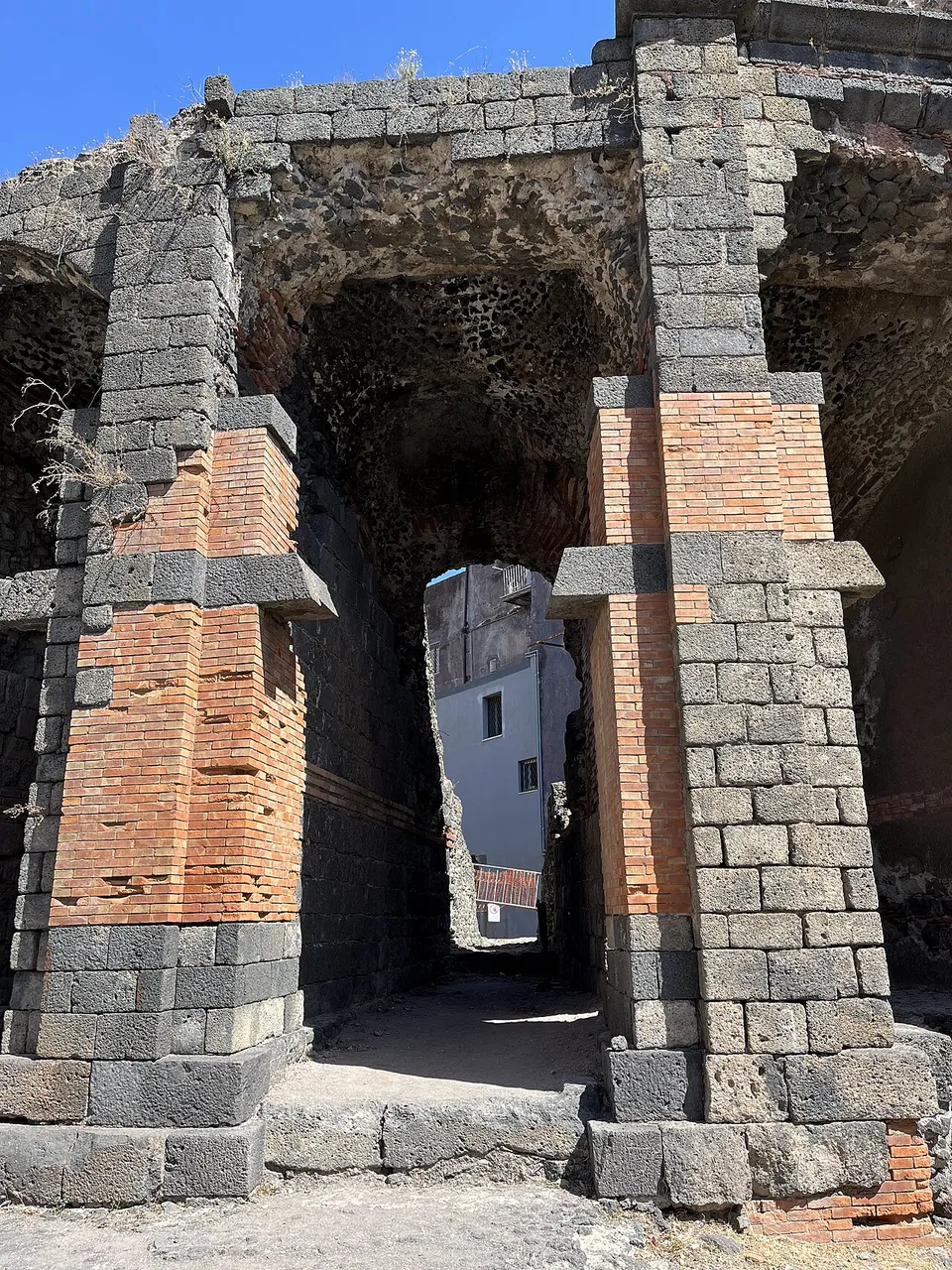
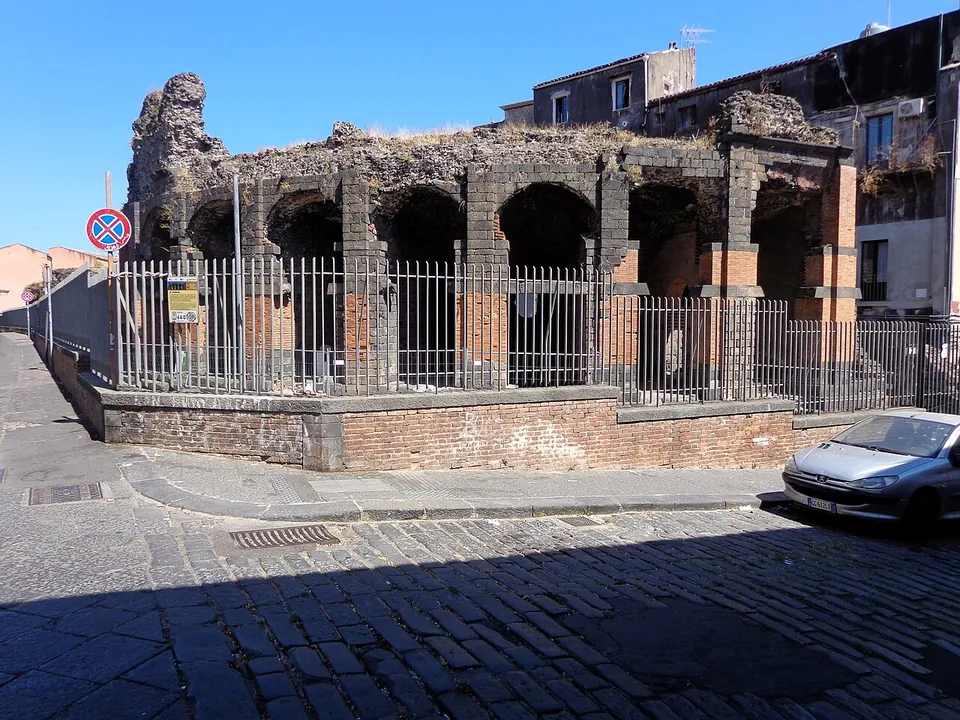
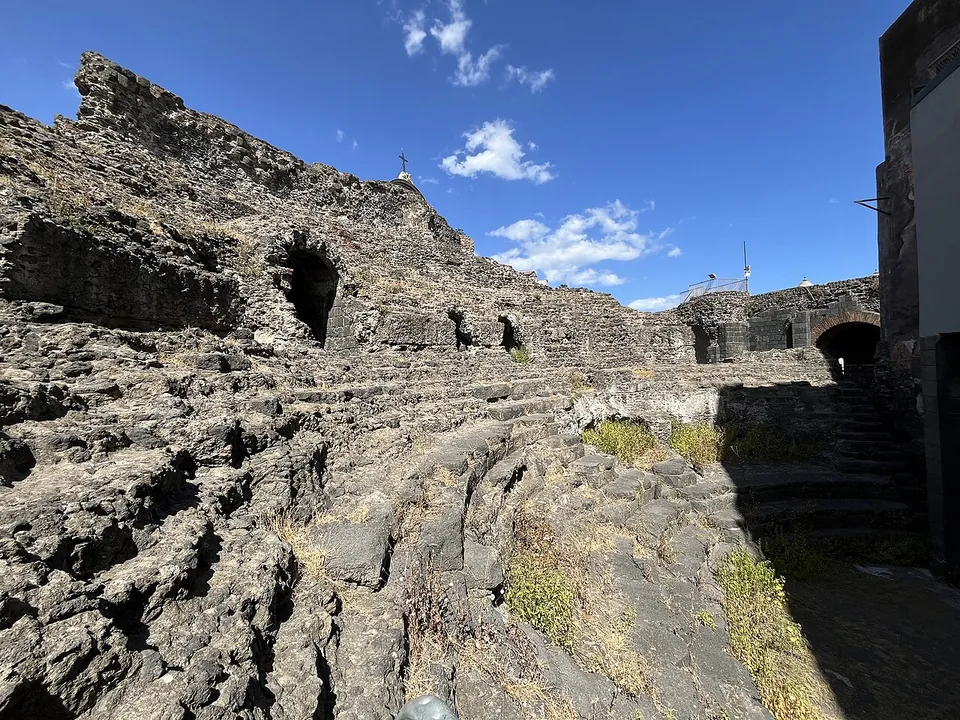
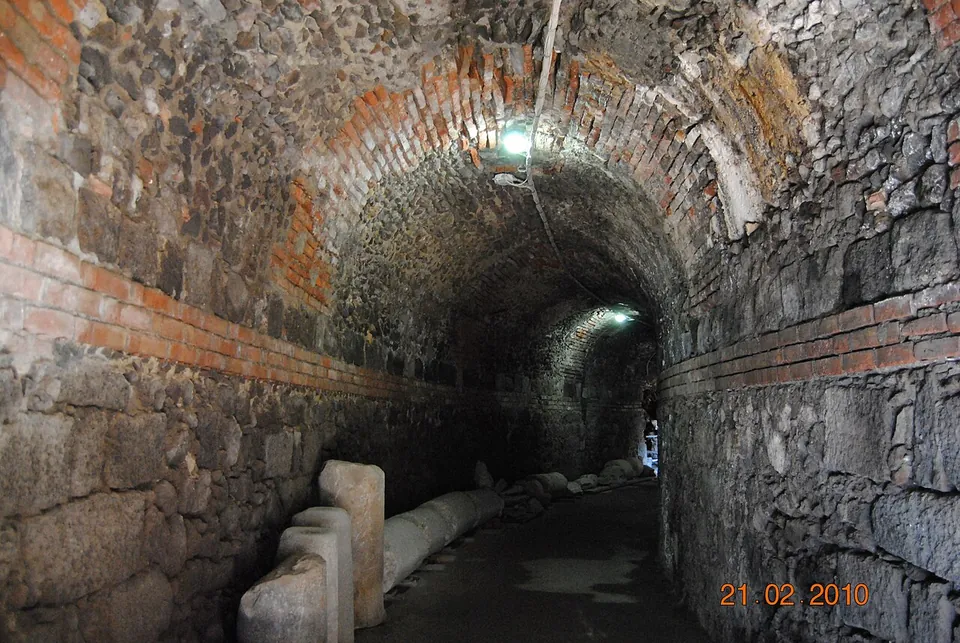
The Odeon is a semicircle of black lava stone, built on 18 walls that form long, narrow wedges with covered rooms inside them: there were 17 rooms, and 16 survive. Its orchestra is paved in marble (it.wikipedia). From the street you see its outer wall opening in tall arches, with brick-faced piers between them. Published figures put its capacity at between 1,300 and 1,500 people (de.wikipedia; it.wikipedia), and it is still used now and then for summer performances (it.wikipedia).
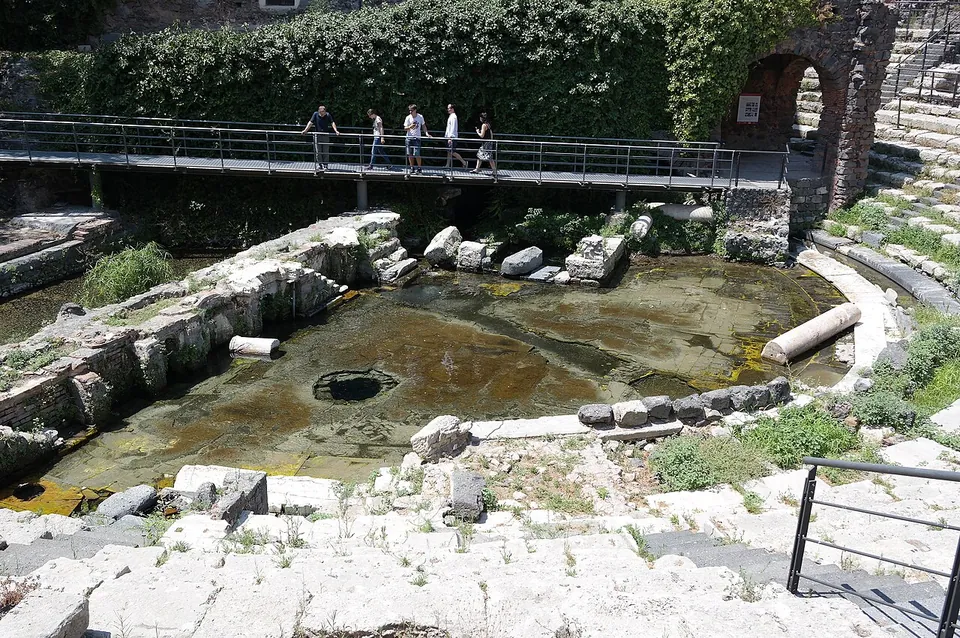
The large theatre next door is the bigger sight. Published figures put its seating at 98 to 100 m across, and its orchestra was about 22 m (en.wikipedia; it.wikipedia; de.wikipedia). Almost all of it is open, with a visitors’ route laid across it, and water from a spring floods the orchestra. Some of the houses built into the ruins after it was abandoned have been kept, among them the 18th-century arches of the old Via Grotte on the orchestra, and the Casa del Terremoto, which has kept intact the household goods abandoned in it on 11 January 1693 (it.wikipedia). Finds from the excavations are on show in Casa Pandolfo and Casa Liberti, two later houses on the site (en.wikipedia). The theatre is hemmed in by houses on every side and cannot be seen from outside (de.wikipedia).
Two smaller remains lie a few minutes’ walk away. In the Cortile San Pantaleone, about 200 m off, a couple of adjoining rooms with arched openings can still be seen, with a wall in opus reticulatum, the Roman net-patterned masonry, from the complex long identified as the forum; a 2008 study suggested it was a set of warehouses instead (it.wikipedia). On Piazza Sant’Antonio, about 300 m off, parts of a bath building probably built in the 1st century and used until the 3rd, absorbed into houses in the mid-19th century, were brought to light again by excavation in 1997 (it.wikipedia). No source says what a passer-by can see of the baths today.
Is it worth the trip?
Yes, if you are in Catania. The large theatre is the city’s main Roman sight, and here you walk among its tiers rather than looking down at a fragment from the street; the Odeon comes on the same ticket. On its own the Odeon is a small building, best taken as part of the theatre visit rather than a goal in itself.
Two things to know. The site is a patchwork of Roman stone and later houses, so it reads less cleanly than a theatre in open country, and that is part of its interest. And the park’s published winter hours name weekdays only, so check before planning a winter weekend around it.
Getting there
The site is in the historic centre, in the block bounded by Via Vittorio Emanuele II, Via Crociferi and Via Teatro Greco (it.wikipedia). The entrance and ticket office are at Via Vittorio Emanuele 266 (the park; de.wikipedia gives the same number). The Vittorio Emanuele II-Tineo bus stop is about 70 m from the Odeon, and a free car park is mapped about 170 m away (OpenStreetMap).
The theatre and Odeon open daily from 09.00 to 19.00 in summer, last entry 18.30, and from Monday to Friday 09.00 to 17.00 in winter, last entry 16.30; the park does not say when the seasons change or whether it opens on winter weekends. A ticket is €8, reduced €4 (the park’s ticket page, as archived in April 2025). A combined ticket that adds the Terme della Rotonda and the Terme dell’Indirizzo is €10, reduced €5 (Regione Siciliana, decree of 22 May 2026), and tickets can also be bought online through the park’s ticketing partner. The park’s website could not be read in October 2026, so check hours and prices on arrival.
Visiting details
- Opening hours
- Theatre and Odeon: summer hours daily 09.00–19.00 (last entry 18.30); winter hours Monday to Friday 09.00–17.00 (last entry 16.30). The park does not say when the seasons change, and gives no winter weekend hours.
- Tickets
- Theatre and Odeon €8, reduced €4, sold at the ticket office at Via Vittorio Emanuele 266. A combined ticket that adds the Terme della Rotonda and the Terme dell'Indirizzo is €10, reduced €5 (regional decree of 22 May 2026). Tickets can also be bought online through the park's ticketing partner.
- Parking
- A free surface car park is mapped about 170 m away (OpenStreetMap node/13753013053); the Vittorio Emanuele II-Tineo bus stop is about 70 m from the Odeon.
Before you go
- The archaeological park's website refused automated reading in October 2026; the hours and the €8 price are its own as archived in April and August 2025. Check them on arrival.
- The supposed forum and the baths of Sant'Antonio, a few minutes' walk away, are not on the park's list of sites, and no operator publishes hours for them.
Hours and prices checked 26 April 2025 on the operator's own site. Confirm before travelling.
History
The hill was settled long before Rome. Sandstone structures reused by the large theatre, some blocks cut with the letters KAT for Katane, may belong to the Greek theatre where Alcibiades addressed the citizens in 415 BC, though excavations since 1998 date them to the 4th century BC rather than the 5th, as had been thought in 1919 (it.wikipedia).
The Roman theatre was restored in the 1st century AD, probably after Augustus made Catania a colony, and given its present grand form in the 2nd, perhaps with money from Hadrian, with a stage richly dressed in marble (it.wikipedia). The Odeon is dated to the 1st to 2nd century and completed in the century after (it.wikipedia); Pleiades puts it most likely in the 2nd century, and de.wikipedia in the 3rd. It served for music and dance and for rehearsals of the shows staged in the theatre (it.wikipedia). A fragment of a head of Marcus Aurelius was found in the theatre’s orchestra (it.wikipedia).
Between the 5th and 7th centuries both buildings were abandoned and taken over for other uses and for housing (it.wikipedia). Many of the theatre’s marble columns, friezes and statues were later taken as building material, some of them for the cathedral (it.wikipedia). The clearance began at the end of the 19th century, after the owner of a palazzo built against the Odeon pulled down its last arch to enlarge his house: the antiquities service, then led by Paolo Orsi, began expropriating the people who lived on the two theatres; the first clearance dealt almost only with the Odeon (it.wikipedia). The large-scale clearance of the theatre came in the 1950s, though some houses still stand on it, and the latest excavations recorded were in 2014–2015 (it.wikipedia).
More photographs




Nearby
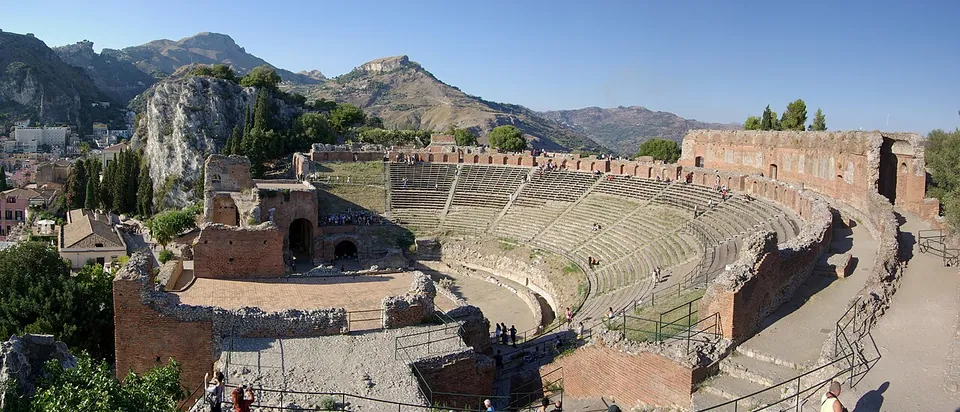
Photo: Berthold Werner · CC BY-SA 3.0 · Commons
43 km · theatre · Sicily
Ancient theatre of Taormina
Despite the name Teatro Greco, what stands is Roman: the operator states that everything visible belongs to the Roman rebuilding, above all the work of the first half of the 2nd century AD.

Straight-line distances.
Sources
Every fact on this page comes from the records below, each used under the licence noted.