Hidden gemHub · 5 stops8th c. BC – 6th c. ADTicketed
Catane – Catania
Katane, Katánē, Catina, Catana, Colonia Iulia Augusta Pietas Catana
city · Sicily, Italy
What it is
Catane – Catania is the ancient city under the baroque centre of modern Catania: founded by Greek colonists as Katane in 729 BC by the ancient reckoning, and Roman from 263 BC, when it became Catina or Catana (it.wikipedia).
What you’ll see
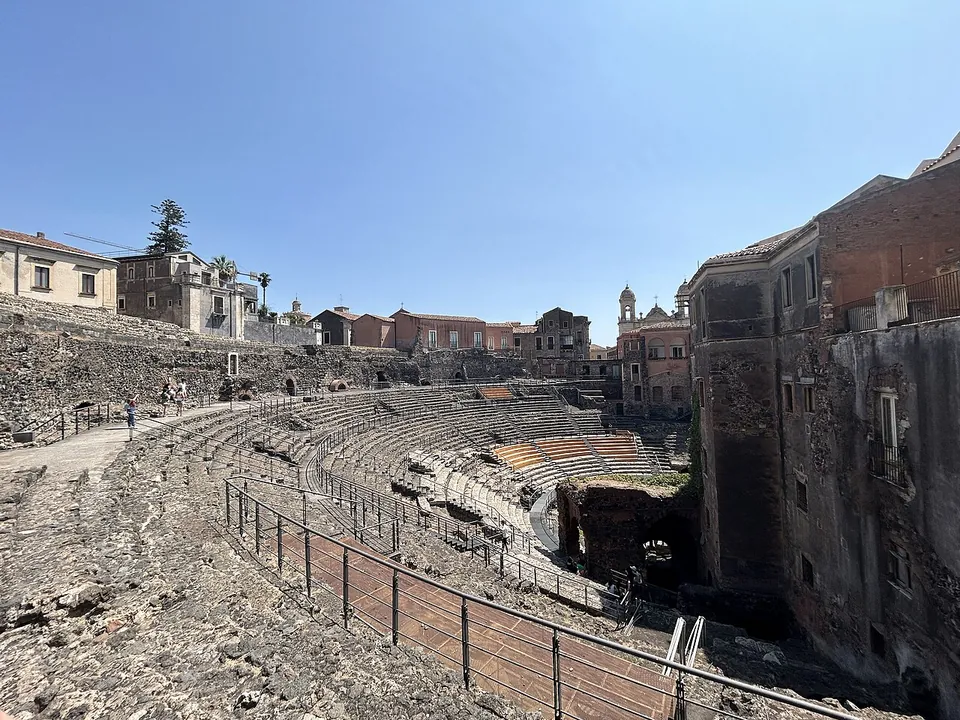
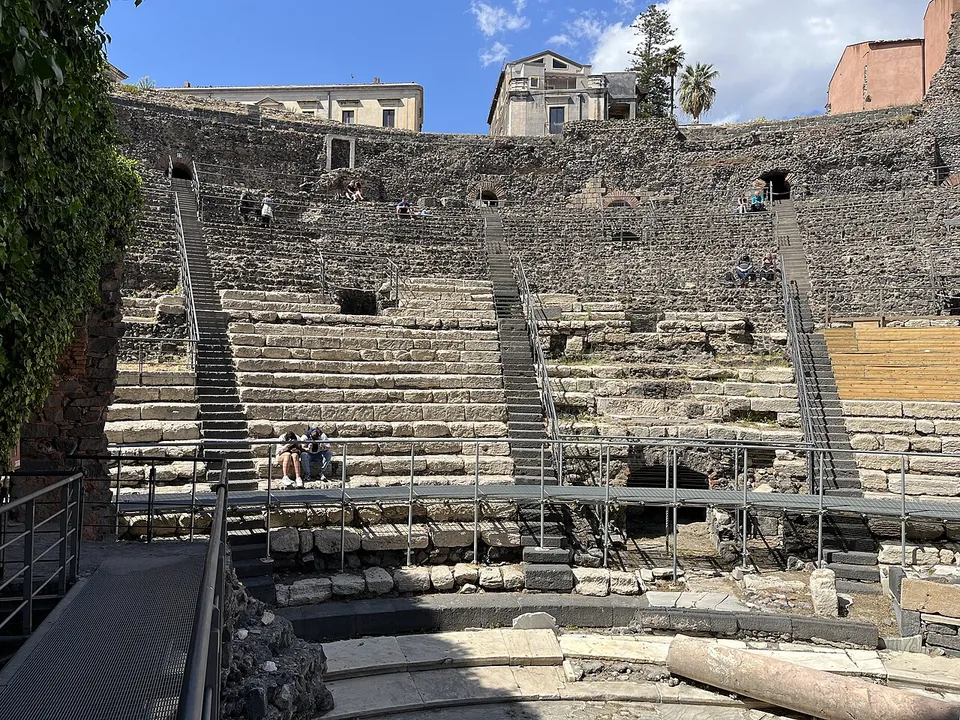
The theatre and the Odeon, side by side off Via Vittorio Emanuele II, are the main sight: a large Roman theatre whose tiers you walk among and a small one beside it, run together by the regional archaeological park (it.wikipedia; the park).
Worth the trip?
If you are in Catania, yes. The theatre is a substantial Roman monument in the middle of the old town, one combined ticket covers it together with two of the bath buildings, and the amphitheatre is half a kilometre away, all within walking distance of each other.
Getting there & cost
Everything is in the historic centre around Piazza del Duomo.Ticketed · The Terme della Rotonda, the Terme dell'Indirizzo, the theatre and Odeon and the amphitheatre have their own pages, with their prices · checked 12 August 2025Hours, tickets and parking
The theatre's seating and the houses of the old town built around it. · Photo: GiovanniPen · CC BY-SA 4.0 · Wikimedia Commons
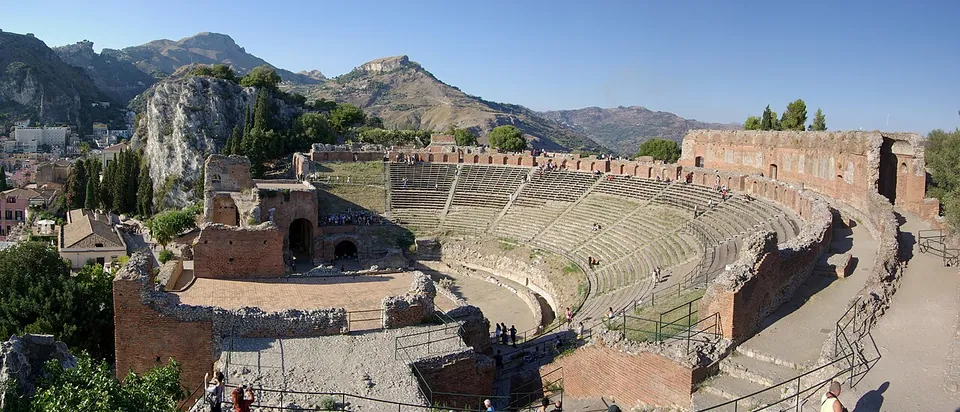
The seating of the Roman theatre, with the visitors' walkways across it. · Photo: Antony-22 · CC BY-SA 4.0 · Wikimedia Commons
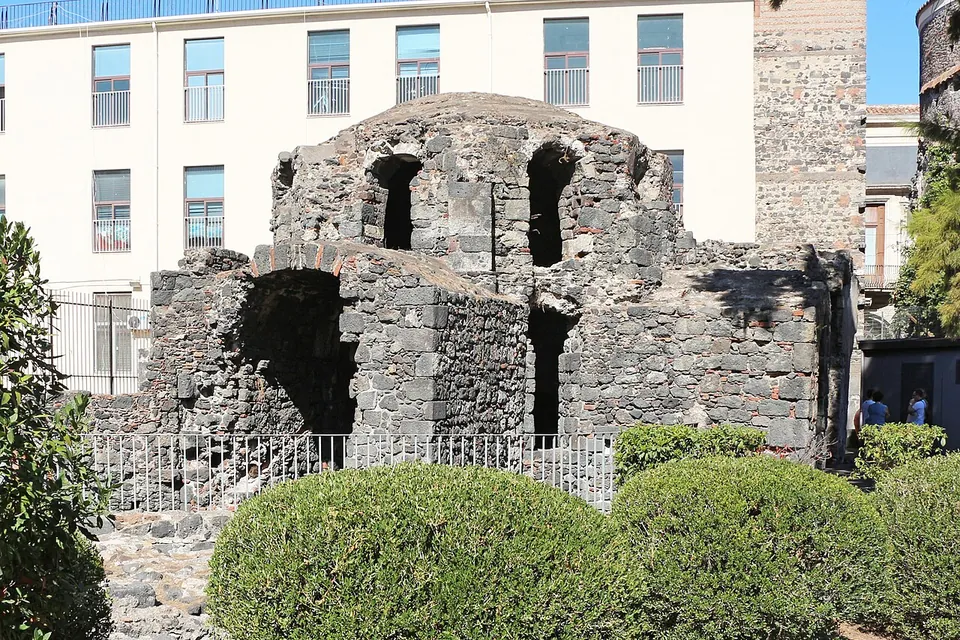
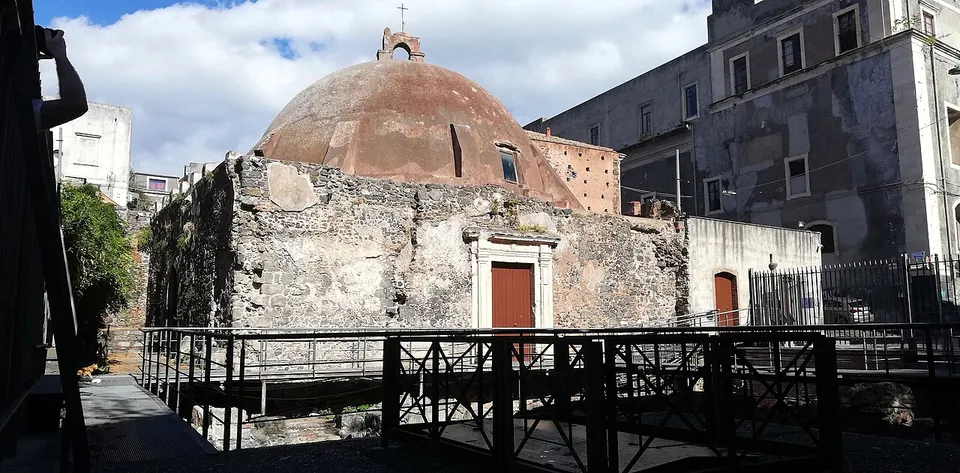
The Terme dell'Indirizzo, with the domed hot room still standing. · Photo: Bernard Gagnon · CC BY 4.0 · Wikimedia Commons
The stops
5 places to see, the best preserved and best known first.
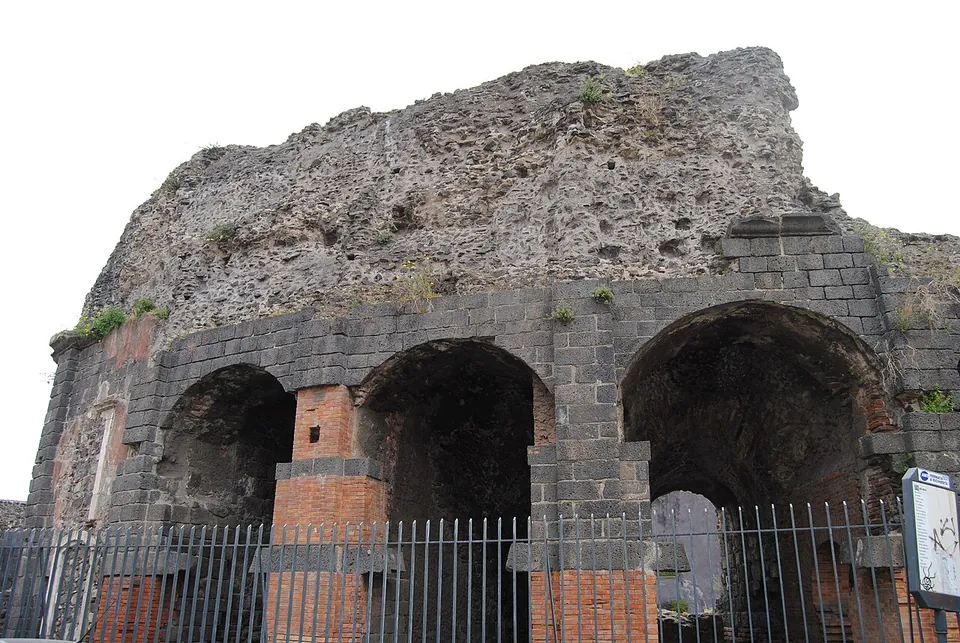
The Odeon is a semicircle of black lava stone, built on 18 walls that form long, narrow wedges with covered rooms inside them: there were 17 rooms, and 16 survive.
The exposed part is the north-western section (the operator): the curving lava-stone structure that carried the seating, and arches whose red brick stands out against the dark stone (it.wikipedia).
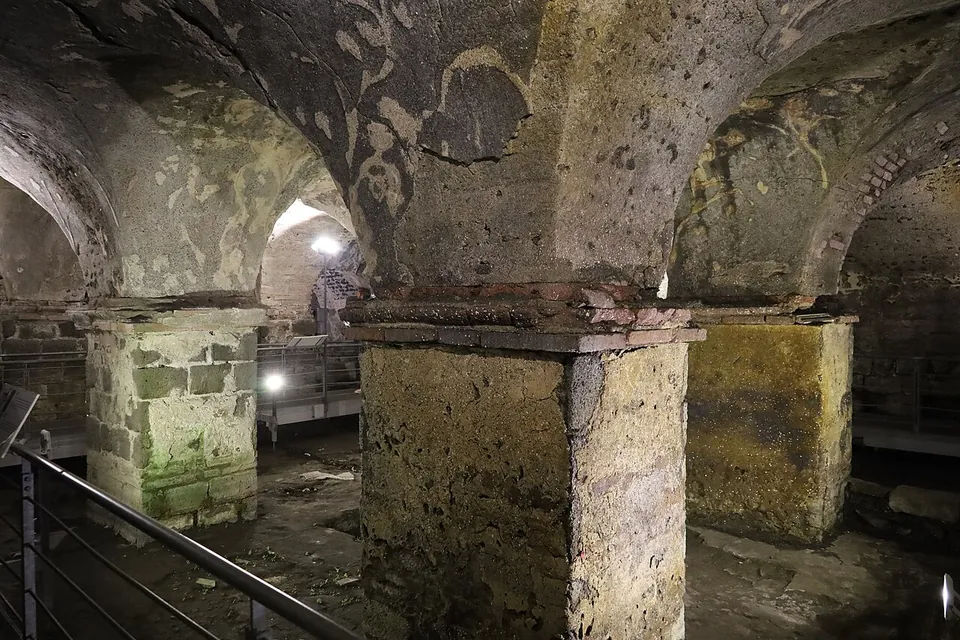
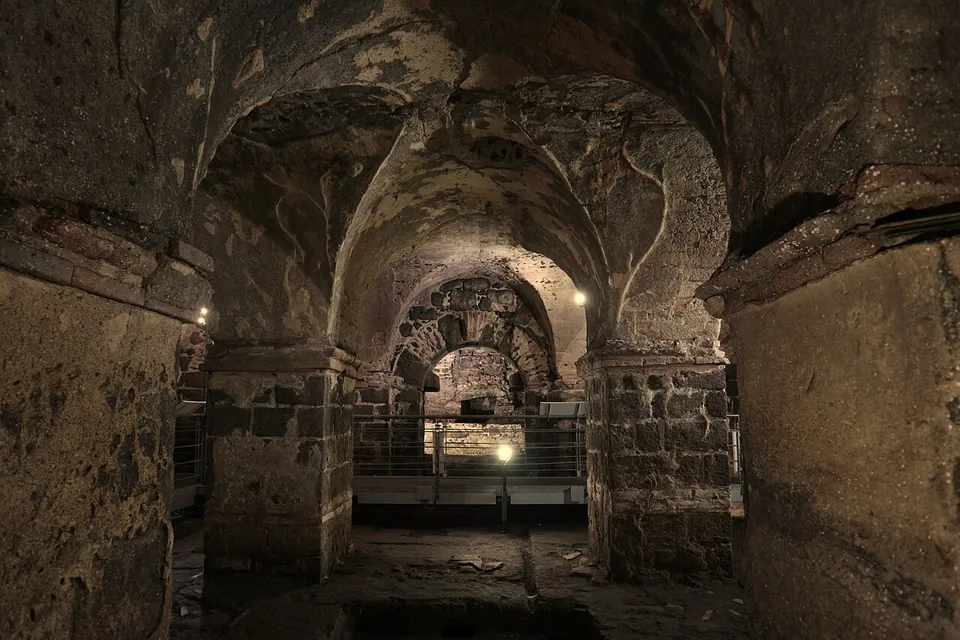
You walk in along a barrel-vaulted corridor, about 18 m long and 2.5 m wide, built in the gap between the cathedral's foundations, to a hall of about 11 by 12 m whose cross vaults rest on four square pillars (it.wikipedia).
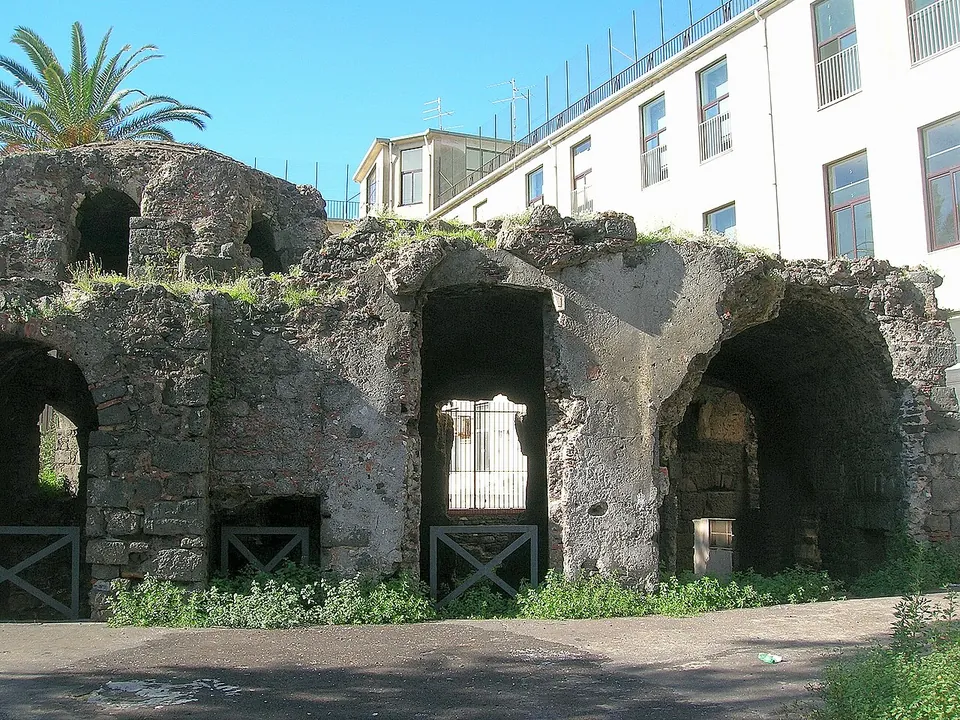
The Roman baths are seen from walkways laid over the excavations.
Ticketed
Catane – Catania is the ancient city under the baroque centre of modern Catania: founded
by Greek colonists as Katane in 729 BC by the ancient reckoning, and Roman from 263 BC,
when it became Catina or Catana (it.wikipedia). What you visit are the pieces that come up through the
streets: a theatre and an odeon side by side, a section of the largest amphitheatre in Sicily,
three bath buildings and a monumental tomb, all a short walk apart.
What is there today
The theatre and the Odeon, side by side off Via Vittorio Emanuele II, are the main sight:
a large Roman theatre whose tiers you walk among and a small one beside it, run together by
the regional archaeological park (it.wikipedia; the park). They have their own page, with
hours and tickets: Theatre and Odeon of Catania.
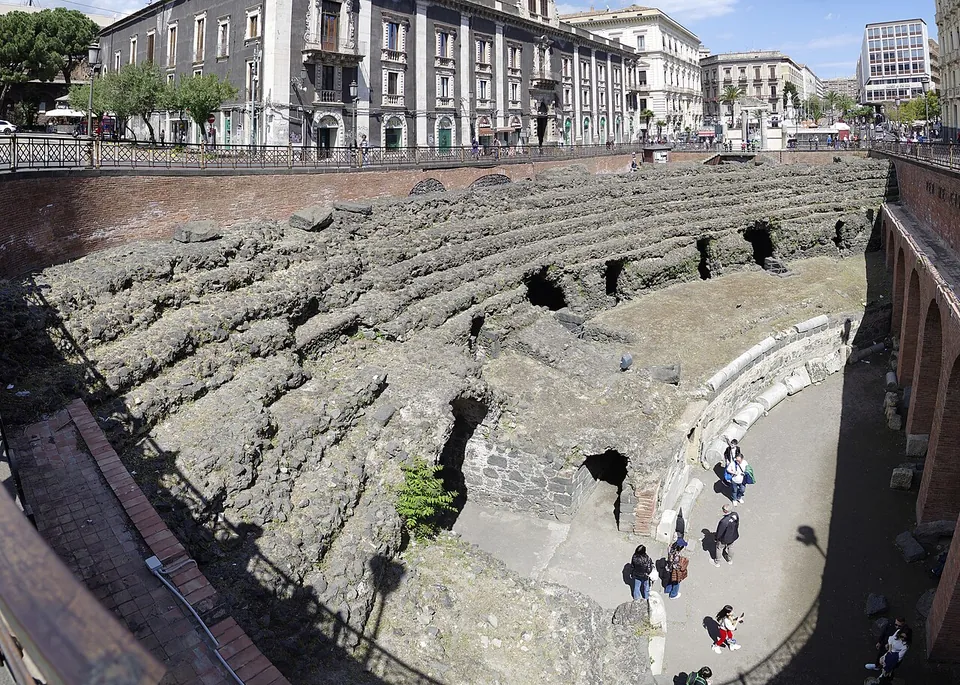
The amphitheatre, on Piazza Stesicoro, was the largest in Sicily; about a tenth of it lies
open in a trench below the square (Pleiades; it.wikipedia). It too has its own page, with
hours and tickets: Roman amphitheatre of Catania.
The Terme dell’Indirizzo, on Piazza Currò near the cathedral, are a small bath building
still standing to its domed hot room, often described as among the best-preserved Roman baths
in Europe (it.wikipedia). They have their own page, with hours and tickets:
Terme dell’Indirizzo. The Terme della Rotonda are 1st- to 2nd-century baths with the
Byzantine church of Santa Maria della Rotonda built over them; the stacks of the heated
floor are still clearly visible (en.wikipedia). They have their own page, with hours and tickets:
Terme della Rotonda. The Terme Achilliane lie under Piazza
del Duomo itself, reached down a ramp to the right of the cathedral’s façade: a small part
of a big late Roman complex, chiefly a hall whose cross vaults rest on four pillars
(it.wikipedia).
The Carmine tomb, a chamber tomb of the later 2nd century AD faced in black lava, is
the largest funerary monument of Roman Catania. It is partly visible in a corner of the
former Carmine convent’s cloister, now an army documentation centre (it.wikipedia). A few
smaller remains near the theatre, the supposed forum and the baths of Sant’Antonio, are
covered on the theatre’s page.
Is it worth the trip?
If you are in Catania, yes. The theatre is a substantial Roman monument in the middle of
the old town, one combined ticket covers it together with two of the bath buildings, and the
amphitheatre is half a kilometre away, all within walking distance of each other.
Set your expectations for the rest. The Roman city has been buried by lava again and again
(en.wikipedia), so this is a walk between fragments, not one archaeological site. Only a
tenth of the amphitheatre is exposed, and the baths keep short hours: closed on Mondays and
open only in the morning on Sundays.
Getting there
Everything is in the historic centre around Piazza del Duomo. Bus stops, Dusmet-Duomo
among them, and a paid car park, Parcheggio Borsellino, are mapped within about 200 m of
the centre point used here, close to the cathedral (OpenStreetMap).
The Terme della Rotonda, the Terme dell’Indirizzo, the
theatre and the amphitheatre have their hours and prices on their own pages; the combined
ticket that covers the Rotonda, the Terme dell’Indirizzo and the theatre and Odeon is given on
the theatre’s page (Regione Siciliana, decree of 22 May 2026). Tickets can also be bought
online.
Visiting details
Opening hours
The Terme della Rotonda, the Terme dell'Indirizzo, the theatre and Odeon and the amphitheatre have their own pages, with their hours.
Tickets
The Terme della Rotonda, the Terme dell'Indirizzo, the theatre and Odeon and the amphitheatre have their own pages, with their prices. A combined ticket covers the Rotonda, the Terme dell'Indirizzo and the theatre and Odeon; its price is on the theatre's page. Tickets can also be bought online through the park's ticketing partner.
Parking
Parcheggio Borsellino, a surface car park with a fee (OpenStreetMap way/533512110), about 200 m from the city-centre point used here; the Dusmet-Duomo and Vittorio Emanuele II-San Placido bus stops are within 150 m.
Before you go
The Terme Achilliane under the cathedral square and the Carmine tomb are not on the archaeological park's list of sites, and no hours or prices for them were found from an operator.
Hours and prices checked 12 August 2025 on the operator's own site. Confirm before travelling.
History
Greek colonists from Chalcis founded Katane in 729 BC, five years after Syracuse by
Thucydides’ reckoning, driving out the Sicels whose settlement stood there
(it.wikipedia); Pleiades puts the foundation sometime after that of Leontini in 730 BC.
It came under Rome more than four centuries later, in 263 BC, taken at the start of the
First Punic War by the consul Valerius Messalla and renamed Catina; a sundial from the city was carried
off to Rome and set up in the Comitium, and Catina paid a tenth of its agricultural income
to Rome as tax (en.wikipedia; it.wikipedia). An eruption of Etna in 122 or 121 BC (published dates
differ) brought down roofs under the weight of ash, and the city was let off its
contributions for ten years (en.wikipedia; it.wikipedia). Cicero called it very rich (it.wikipedia).
The civil war between Octavian and Sextus Pompeius in the 30s BC left Sicily damaged.
Afterwards, in 21 BC, Augustus made Catina a colony and settled veterans there; a forum,
an odeon and an aqueduct followed, and the street plan laid out then can still be partly traced
around Via Vittorio Emanuele II (it.wikipedia). The aqueduct, 24 km long, was the longest
in Roman Sicily (en.wikipedia). Under the Empire the theatre was rebuilt and enlarged, and
the amphitheatre was probably built in the 2nd century (it.wikipedia; en.wikipedia); their
stories are told on their own pages. In the
4th century the poet Ausonius named Catania and Syracuse alone among the cities of Sicily
in his list of famous cities (en.wikipedia).
Tradition places the martyrdom of Saint Agatha, the city’s patron, under Decius in the
mid-3rd century, and Saint Euplius died under Diocletian (it.wikipedia). In about 434 a
governor of Sicily had the Terme Achilliane remodelled to save firewood, on one
scholar’s reading of an inscription now in the Castello Ursino museum (it.wikipedia). According to
Cassiodorus, Theodoric, king of the Ostrogoths, let the citizens take stone from the
long-abandoned amphitheatre (en.wikipedia), and the theatre fell out of use between the 5th
and 7th centuries and filled with houses (it.wikipedia).
More photographs
The pillared hall of the Terme Achilliane under the cathedral square. · Photo: Daniele Napolitano · CC BY-SA 4.0 · Wikimedia Commons
Despite the name Teatro Greco, what stands is Roman: the operator states that everything visible belongs to the Roman rebuilding, above all the work of the first half of the 2nd century AD.
Straight-line distances.
Sources
Every fact on this page comes from the records below, each used under the licence noted.