

What is there today
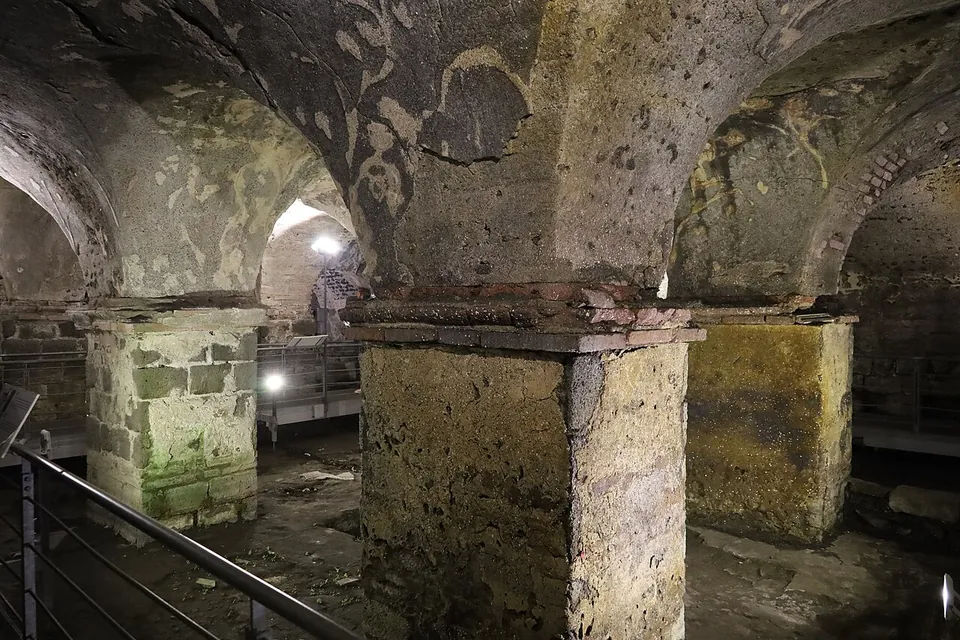
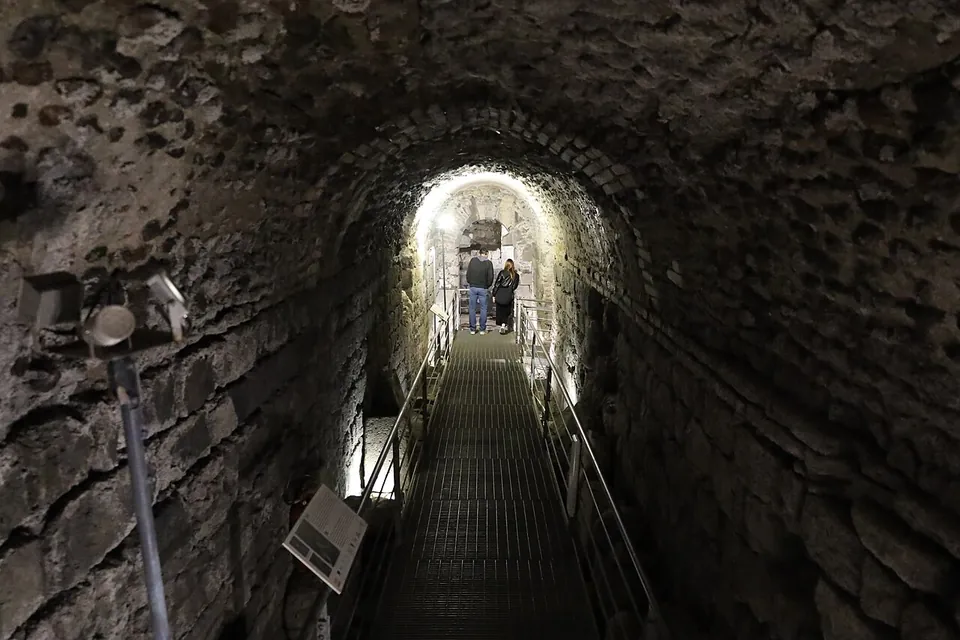
You walk in along a barrel-vaulted corridor, about 18 m long and 2.5 m wide, built in the gap between the cathedral’s foundations, to a hall of about 11 by 12 m whose cross vaults rest on four square pillars (it.wikipedia). A small square basin, once faced with marble, sits in the middle of the floor, and fragments of marble slabs show how the floor was paved (the operator). Three arched openings on the west side give onto a row of parallel tanks that were part of a system for channelling, draining and filtering water; running water, the central pool and the marble facing are the reasons the hall is read as a frigidarium, the cold room of the baths (it.wikipedia). The water of one of the streams of the Amenano river runs through the site (the operator).
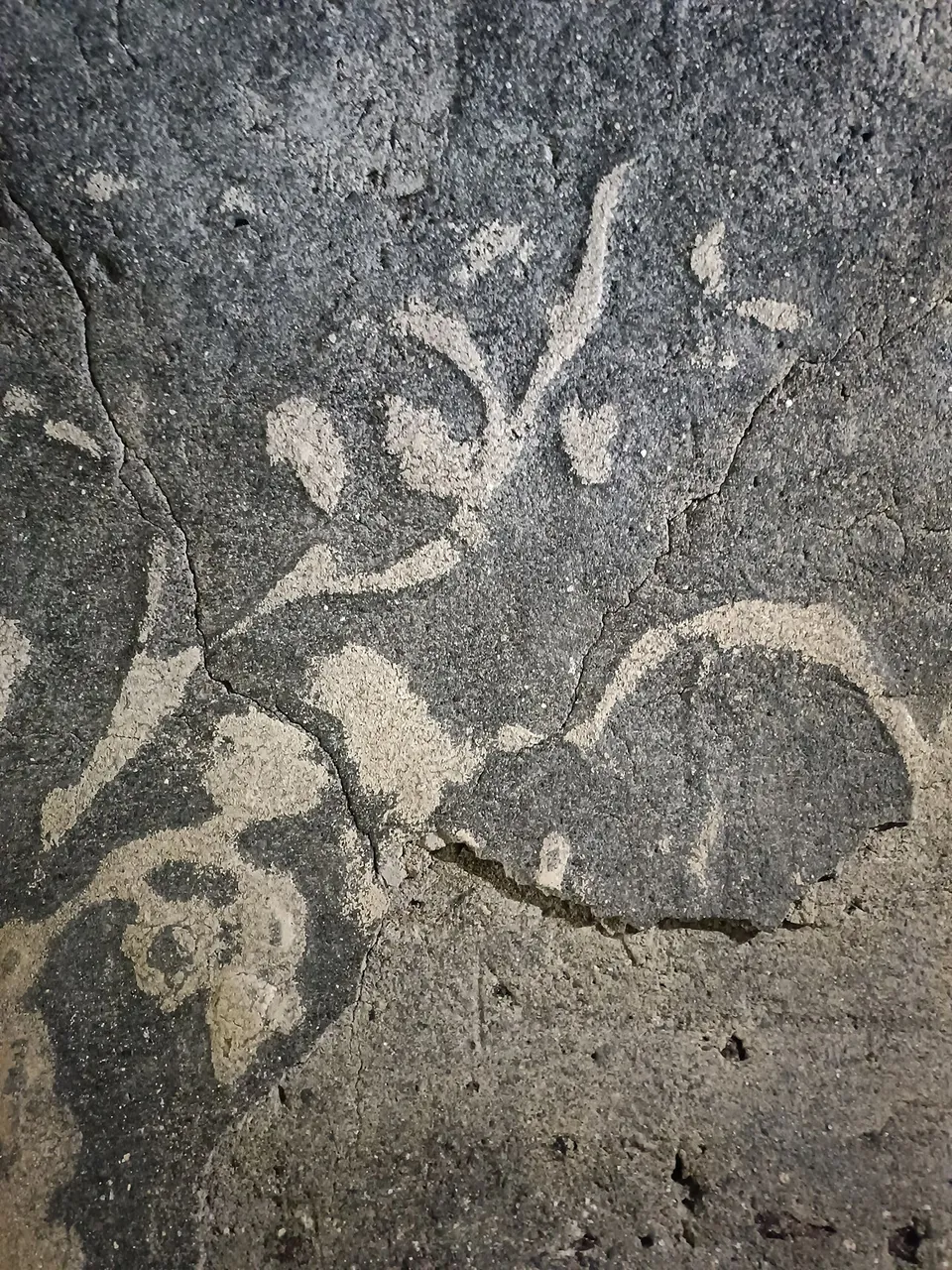
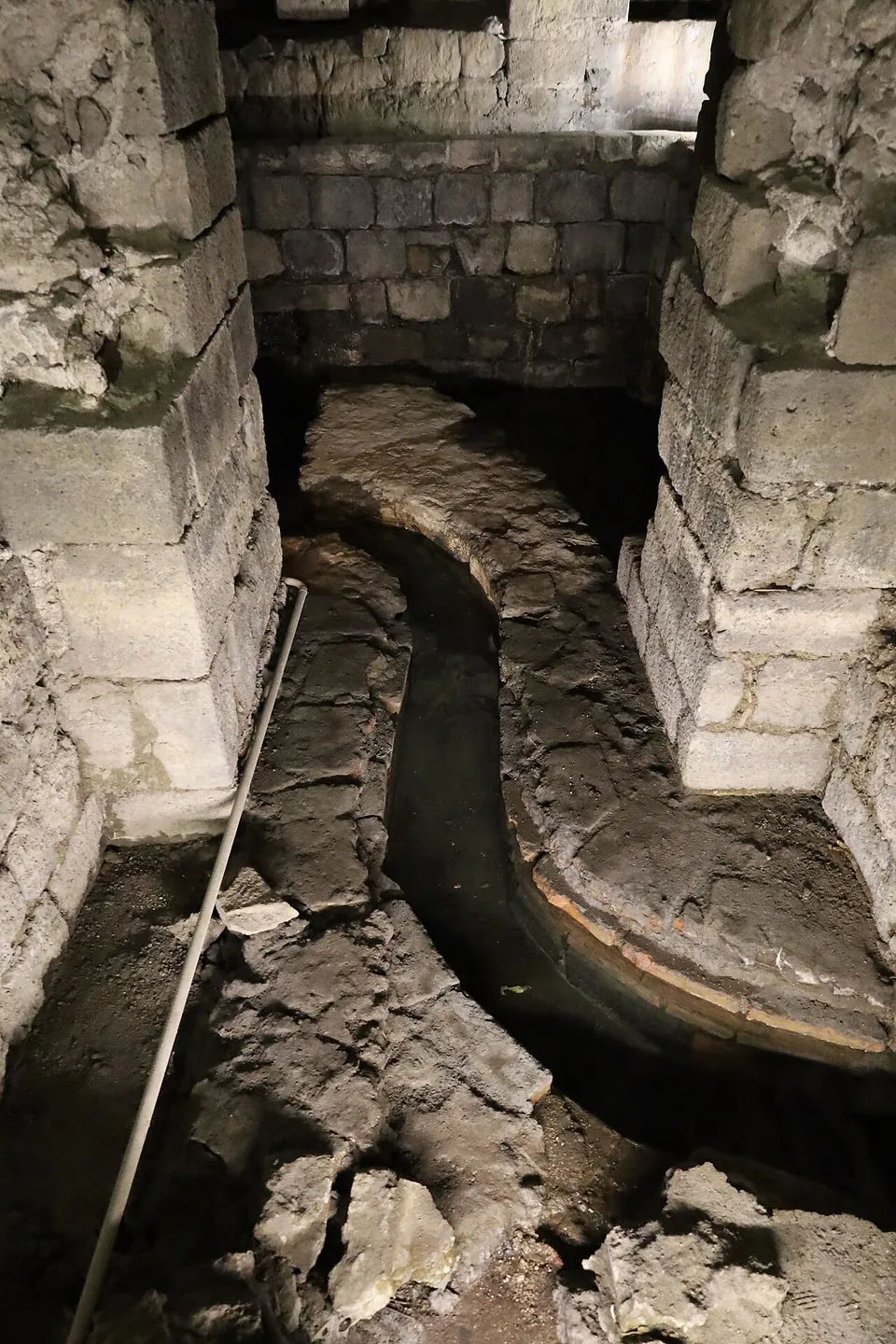
Look up. The walls and vaults were covered in stucco with cupids, vine tendrils and bunches of grapes, clearly legible in the 18th century and now worn and broken in large patches (it.wikipedia). From the left-hand entrance you can also see the remains of the tepidarium, a curved warm room heated by air ducts, and recent deep excavation near the end of the corridor has found an S-shaped channel that probably carried water to the baths’ services (it.wikipedia).
Is it worth the trip?
If you are on the cathedral square anyway, yes. It costs €5, the way in is beside the cathedral’s façade, and you stand inside a Roman room with its original vaults still over your head.
Know what you are getting. This is one hall and a corridor, probably only one of the cold rooms of a complex that once covered a large part of the city centre (it.wikipedia), not a bath building you can walk round. For that, the Terme dell’Indirizzo, about 200 m away, stand above ground to their domed hot room. The hours are short as well: the baths close at 15.00 on most days and open on Sundays only for booked groups of 20 or more, so plan a weekday or Saturday.
Getting there
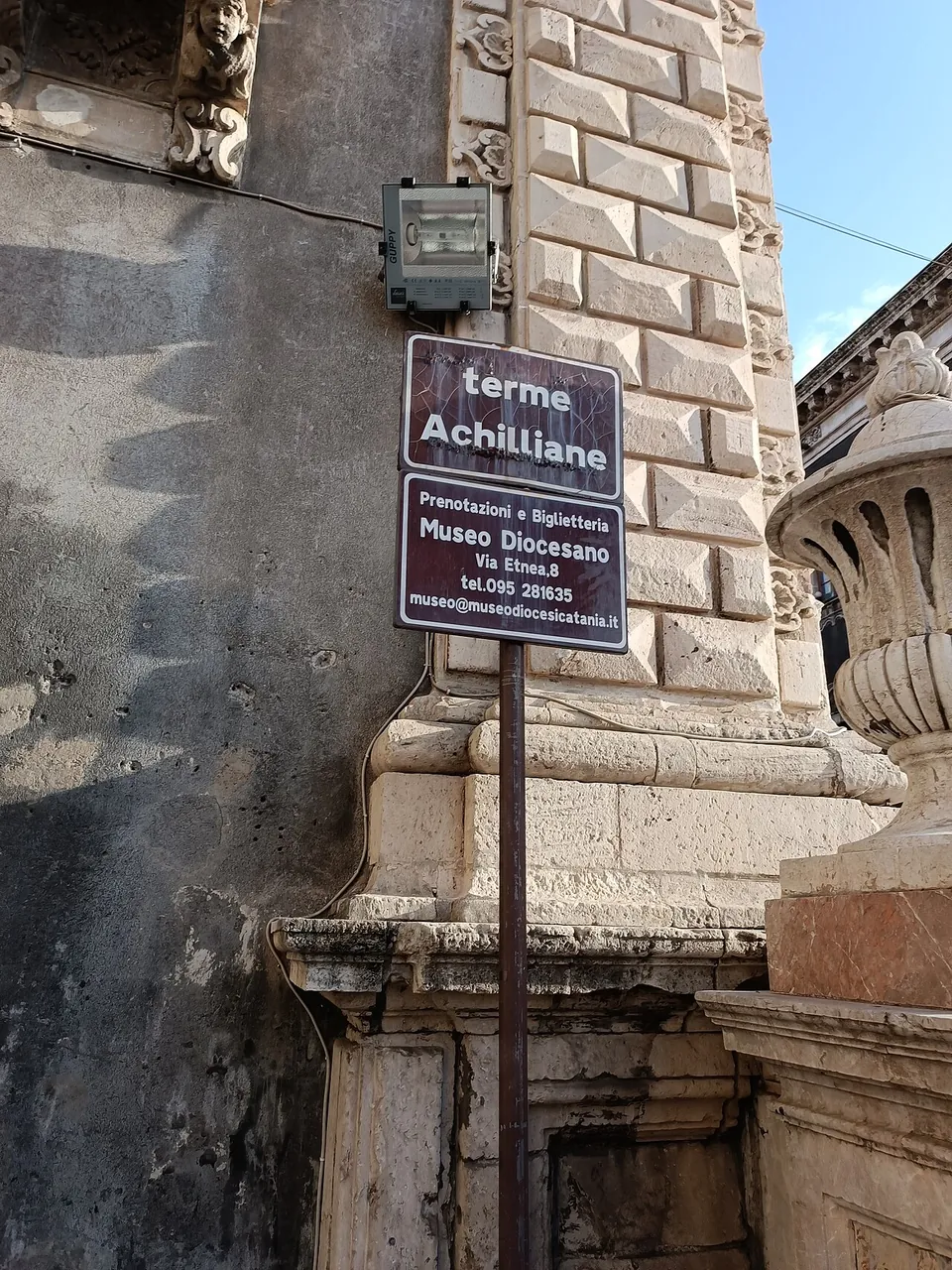
The entrance is on Piazza del Duomo, down a ramp to the right of the cathedral’s façade (it.wikipedia). Tickets are sold at the Museo Diocesano, Via Etnea 8, on the same square, which runs the baths; the baths’ own sign gives the museum for bookings and tickets (the operator). The Dusmet-Duomo bus stop is about 50 m away and Parcheggio Borsellino, a paid car park, about 130 m (OpenStreetMap). The Catane – Catania page links the city’s other Roman sites, all within walking distance.
The museum’s published hours are Monday to Saturday 10.00–15.00, with Tuesday and Thursday afternoons 15.00–20.00 as well, and Sundays and public holidays only by booking for groups of at least 20; last entry is half an hour before closing. The baths alone cost €5, reduced €3 (university students, over-65s, 10- to 18-year-olds and teachers, among others), and children under 10 go free. A combined ticket with the Museo Diocesano is €10, reduced €6, and one that also covers the Benedictine monastery is €15 (museodiocesanocatania.com, read 21 October 2026). The same site also prints a timetable for summer 2025 in which Tuesday and Thursday open only in the afternoon, so check before planning a morning on either day.
Visiting details
- Opening hours
- Monday–Saturday 10.00–15.00, and on Tuesday and Thursday also in the afternoon, 15.00–20.00; Sundays and public holidays by booking only, for groups of at least 20. Last entry half an hour before closing. These are the Museo Diocesano's hours; it publishes none separately for the baths.
- Tickets
- €5, reduced €3 (among others university students, over-65s, 10- to 18-year-olds, teachers); free under 10. With the Museo Diocesano €10, reduced €6; the integrated ticket that adds the Benedictine monastery is €15. Tickets and bookings at the Museo Diocesano, Via Etnea 8, on the cathedral square.
- Parking
- Parcheggio Borsellino, a paid surface car park about 130 m away (OpenStreetMap way/533512110); the Dusmet-Duomo bus stop is about 50 m from the entrance.
Before you go
- The museum's own site also prints a timetable for 3 June to 30 September 2025 in which Tuesday and Thursday open only from 15.00 to 20.00. Check the current hours with the museum before planning a Tuesday or Thursday morning.
- There is no Sunday opening for individual visitors.
Hours and prices checked 21 October 2026 on the operator's own site. Confirm before travelling.
History
When the baths were built is still debated. A group of capitals of Constantine’s time reused in the cathedral may come from them, which would place them in the 4th century; Roger Wilson’s studies would allow the 3rd (it.wikipedia). Pleiades dates them to the 4th and 5th centuries.
The name comes from a Greek inscription on a marble slab from Luni, broken into fragments that together run to almost 4.3 m and are now laid out in the civic museum of the Castello Ursino (it.wikipedia). Its readings differ: Francesco Ferrara read the name as Achillianai, Holm and Kaibel as Achellianai. On Giacomo Manganaro’s reading, the inscription dates to about 434 and records a remodelling, perhaps a reduction in size, meant to save firewood for the hypocausts, begun by the governor Flavio Liberalio and finished by his successor Flavio Felice Eumazio under the emperor Theodosius II (it.wikipedia).
In 1088 Bishop Ansgerio chose the area of the baths for his cathedral, completed in 1094, and its monastery; the earthquakes of 1169 and 1693 buried the remains (it.wikipedia). In the 18th century the Prince of Biscari cleared the hall of the debris of 1693 and traced the complex under the cathedral, the seminary that now houses the Museo Diocesano and the town hall. Jean Houel, who took the hall for a colossal temple of Bacchus, painted its stuccoes in gouaches now in the Hermitage in St Petersburg (the operator). Remains attributed to the baths, with traces of a heated floor, were found under the seminary in 1856 (it.wikipedia).
The baths were closed as unsafe from 1974 to 1994, reopened after the city restored them in 1997 and closed again by flooding. The repaving of Piazza del Duomo in 2004–2006 covered them with a heavy steel slab to carry the square, and they then reopened to visitors and for events (it.wikipedia).
More photographs


Nearby
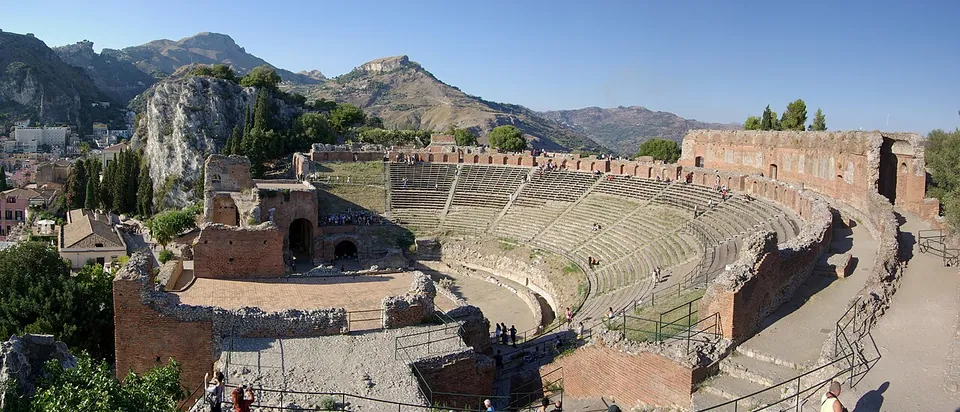
Photo: Berthold Werner · CC BY-SA 3.0 · Commons
43 km · theatre · Sicily
Ancient theatre of Taormina
Despite the name Teatro Greco, what stands is Roman: the operator states that everything visible belongs to the Roman rebuilding, above all the work of the first half of the 2nd century AD.

Straight-line distances.
Sources
Every fact on this page comes from the records below, each used under the licence noted.
| Source | Licence |
|---|---|
| Pleiades 991638694 | CC BY |
| Wikidata Q3984379 | CC0 |
| Vici.org 58377 | CC BY-SA (text), CC0 (metadata) |
| OpenStreetMap node/1178588235 | ODbL |
| Wikipedia (it) — Terme Achilliane | CC BY-SA 4.0 |
| Museo Diocesano di Catania — Le Terme Achilliane (the operator) | licence not recorded |
| Museo Diocesano di Catania — Biglietteria, hours and tickets (the operator) | licence not recorded |
| Museo Diocesano di Catania — Terme Achilliane school visit | licence not recorded |