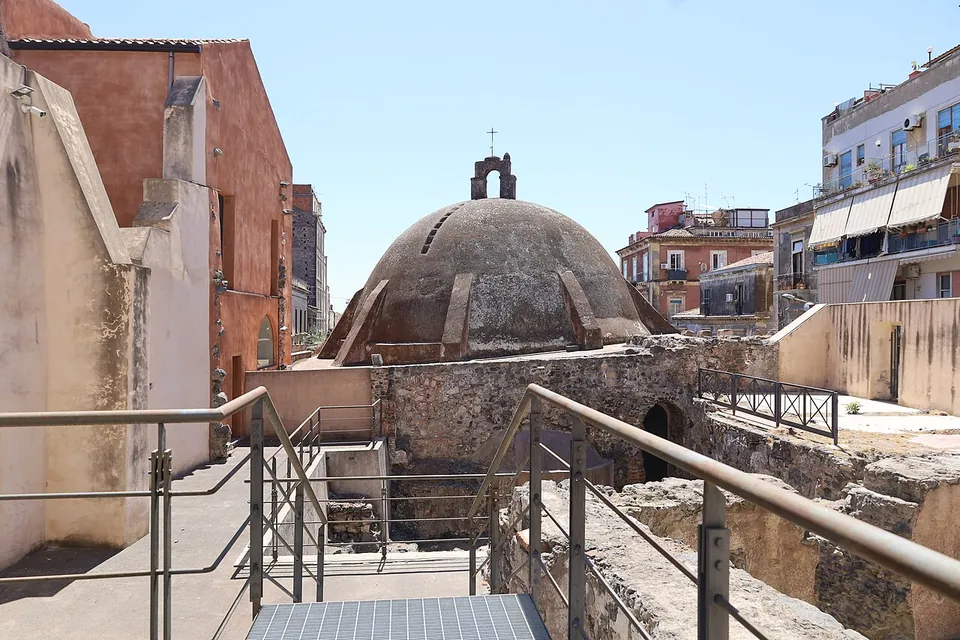
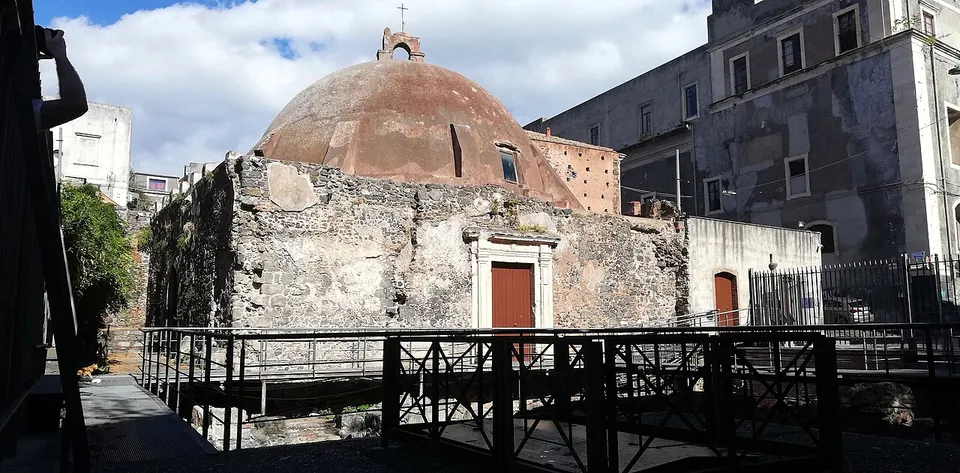


The Terme della Rotonda are a Roman public bath complex of the 1st to 2nd century AD in Catania, a short walk from the Roman theatre and Odeon, with the domed church of Santa Maria della Rotonda built on top of them towards the end of the 6th century (it.wikipedia). One visit gives you both: excavated bath rooms around and under a Byzantine church that still stands.
What is there today
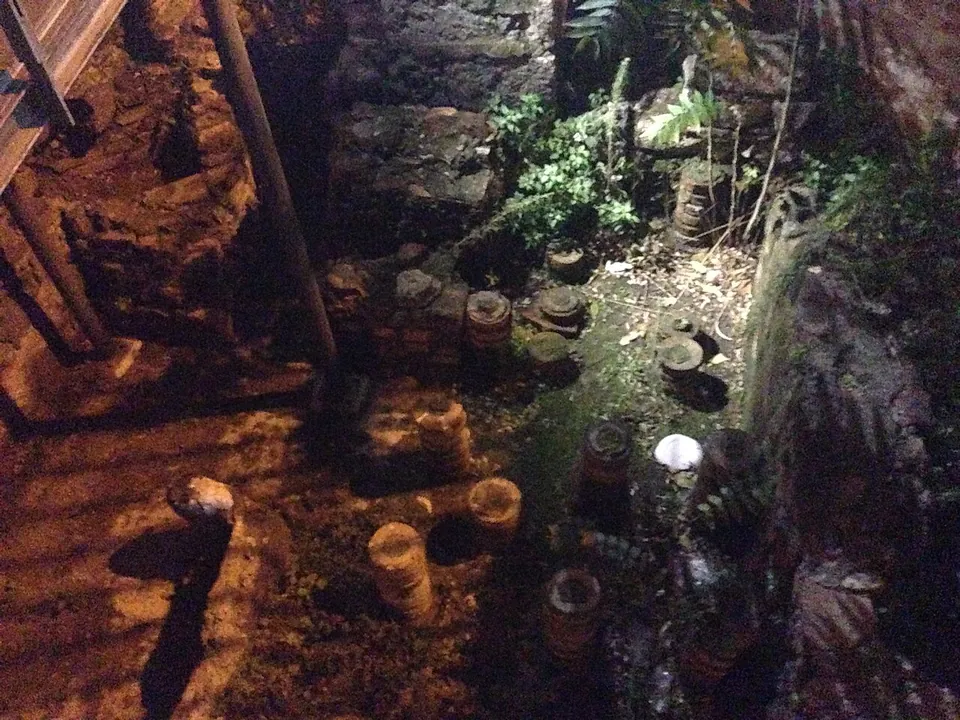
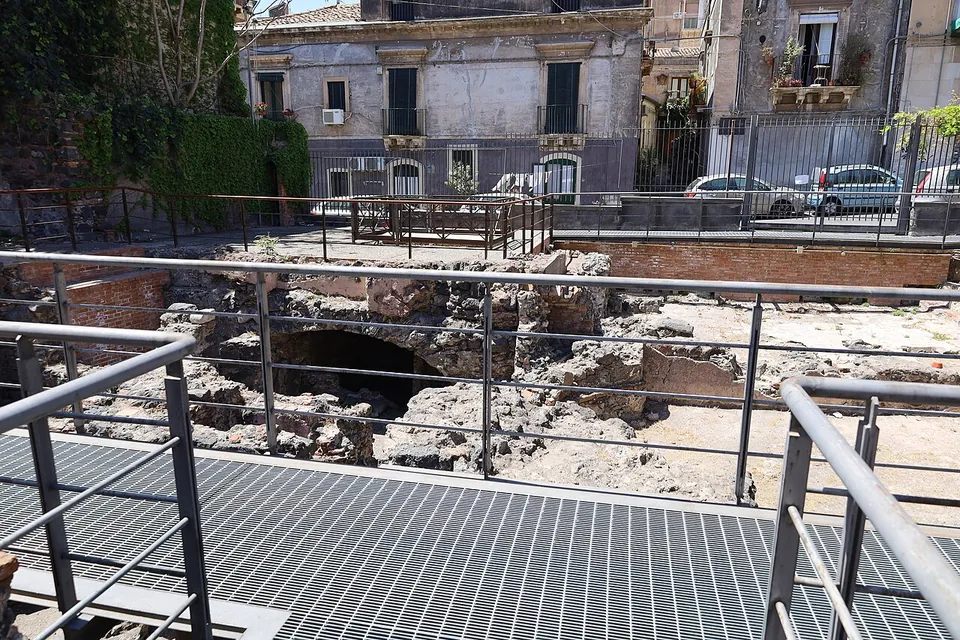
The Roman baths are seen from walkways laid over the excavations. The main room, an apsed hall running north–south from the first phase of the baths, was probably the cold room (frigidarium). East of it lies a large heated room, identified as the hot room (calidarium), where the stacks that once carried its floor over the hot air beneath are still clearly visible (en.wikipedia). West of the hall is a large room paved with big marble slabs, where several medieval tombs were found, some cut through the floor. To the south are rooms of the 2nd and 3rd centuries: two small round rooms with heated floors, perhaps saunas, and a probable warm room (tepidarium) (it.wikipedia). Excavations from 2004 to 2008 identified nine rooms of the baths with certainty; others are thought to lie under Via Rotonda and Via della Mecca (it.wikipedia).
North of the church, uncovered in the excavations that began in 2015, are a large water tank (castellum aquae) connected to a branch of Roman Catania’s aqueduct and a four-sided courtyard ringed with exedras, which was the Roman entrance to the baths (it.wikipedia); both can be seen beside the church (en.wikipedia).
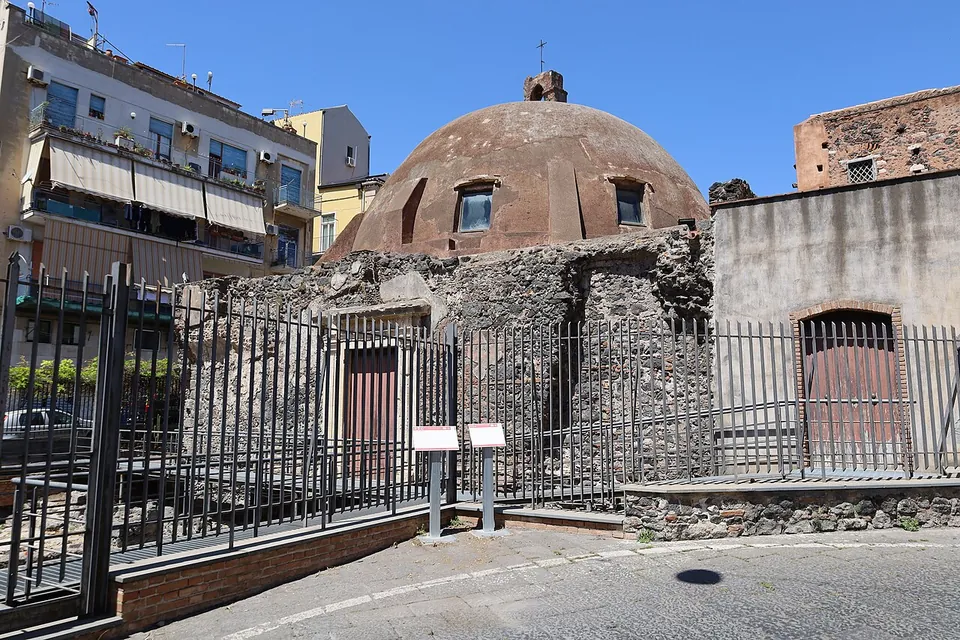
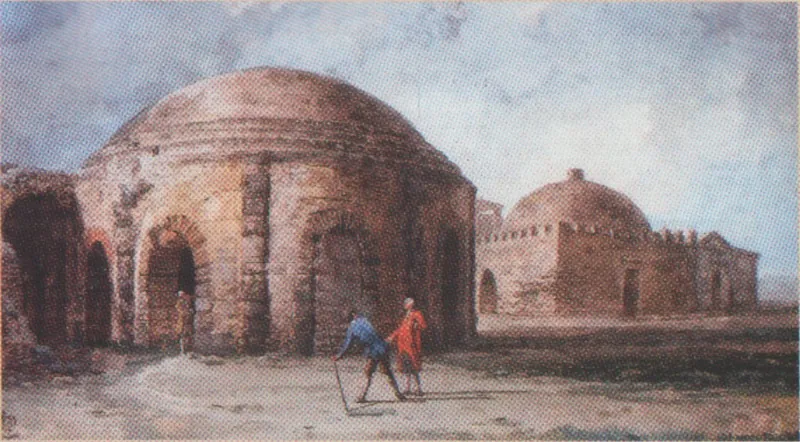
The church is the building you see from the street: square outside, with a round hall 11 m across inside under a hemispherical dome. That round hall is Byzantine, not Roman, though it was long taken for Roman work (it.wikipedia). Much of the painting inside was destroyed in the works of the 1940s and 1950s, but the chancel keeps medieval frescoes: a saint, probably Nicholas, of the 12th century, and Saint Leo of Catania of the 13th, named in Greek letters, with traces of a 13th-century Annunciation; 18th-century saints and evangelists are painted in the pendentives below the dome, under a long Latin inscription running round its base (it.wikipedia).
Is it worth the trip?
If you are in Catania for the theatre, yes: it is about 150 m away (OpenStreetMap), and €2 buys a site where Roman baths, a Byzantine church and a medieval graveyard sit on top of each other. A combined ticket covers it together with the theatre and the Terme dell’Indirizzo.
Know what you are getting. The Roman part is mostly floors, walls a little above them and heating stacks, seen from above rather than walked through, and the dome that dominates the site belongs to the church. For a bath building still standing to its domed hot room, the Terme dell’Indirizzo, part of the same combined ticket, are the better sight. The hours are short, too: closed on Mondays, shut over lunch, and open only in the morning on Sundays.
Getting there
The site lies beside Via Rotonda (OpenStreetMap), about 150 m from the theatre and Odeon; the park’s announcement of June 2026 gives its address as Via della Mecca. The other stops of Roman Catania are on the Catane – Catania page. A stop named Clementi-Minoritelli is mapped about 100 m away, and a free surface car park about 260 m away (OpenStreetMap).
It is open Tuesday to Saturday 09.00–13.00 and 14.30–18.30, and on Sunday 09.00–13.00, with last entry at 12.30; it is closed on Mondays (the park’s hours page, as archived in August 2025; the park announced the same hours for June 2026). Entry has been charged since 1 June 2026: €2, reduced €1 (Regione Siciliana, decree of 22 May 2026). The combined ticket that adds the theatre and Odeon and the Terme dell’Indirizzo is priced on the theatre’s page. Tickets can also be bought online through the park’s ticketing partner. The park’s website could not be read in October 2026, so check hours on arrival.
Visiting details
- Opening hours
- Tuesday–Saturday 09.00–13.00 and 14.30–18.30; Sunday 09.00–13.00 (last entry 12.30); closed on Mondays.
- Tickets
- €2, reduced €1 (regional decree of 22 May 2026, in force from 1 June 2026). A combined ticket also covers the Terme dell'Indirizzo and the theatre and Odeon; its price is on the theatre's page. Tickets can also be bought online through the park's ticketing partner.
- Parking
- A free surface car park is mapped about 260 m away (OpenStreetMap node/13753013053); the Clementi-Minoritelli public-transport stop is about 100 m away (node/10062529650).
Before you go
- The archaeological park's website refused automated reading in October 2026; the hours above are its own as archived on 12 August 2025, and the park announced the same hours again for June 2026 (as reported by La Sicilia). Check them on arrival.
- Short hours. Closed all day on Mondays and from 13.00 to 14.30 on other days, and open on Sunday mornings only.
Hours and prices checked 12 August 2025 on the operator's own site. Confirm before travelling.
History
The baths were built in the 1st or 2nd century AD on ground that had already been used in the early Copper Age, and were enlarged in the 3rd century, a time when the city grew notably richer. They were then abandoned, and towards the end of the 6th century, in the Byzantine period, they were turned into a church; the water tank north of it was converted at the same time into a building serving the church. With the Bonajuto Chapel, the Rotonda is one of the very few traces of Byzantine Catania (it.wikipedia).
From the 9th century to the 16th, the ground around the church and among the ruins of the baths was a busy graveyard. After the earthquake of 1169 damaged the Byzantine chancel, the church was turned to face east and given a pointed doorway, and in the 16th century a new Renaissance entrance turned it back to its north–south orientation (it.wikipedia).
For centuries the building was believed to be Catania’s oldest church, consecrated to the Virgin as early as AD 44, and many early modern historians took it for a pagan pantheon whose dome had served as the model for the one in Rome. That belief lasted until the 18th century, when the Prince of Biscari first identified it as a Roman bath building and took it to be part of a very large complex that also included the baths at Piazza Dante (it.wikipedia).
The air raids of 1943 devastated the nearby church of Santa Maria della Cava and damaged the Rotonda. The consolidation that followed in the 1940s and 1950s, directed by Guido Libertini, removed church structures and frescoes to expose the Roman remains. New excavations between 2004 and 2008 found many tombs, identified the nine bath rooms and uncovered a 13th-century apse and frescoes hidden under plaster; in 2015 the whole block north of the church was expropriated and excavated, bringing the water tank and the entrance courtyard to light and opening a view of the dome from Via dei Gesuiti (it.wikipedia).
More photographs



Nearby
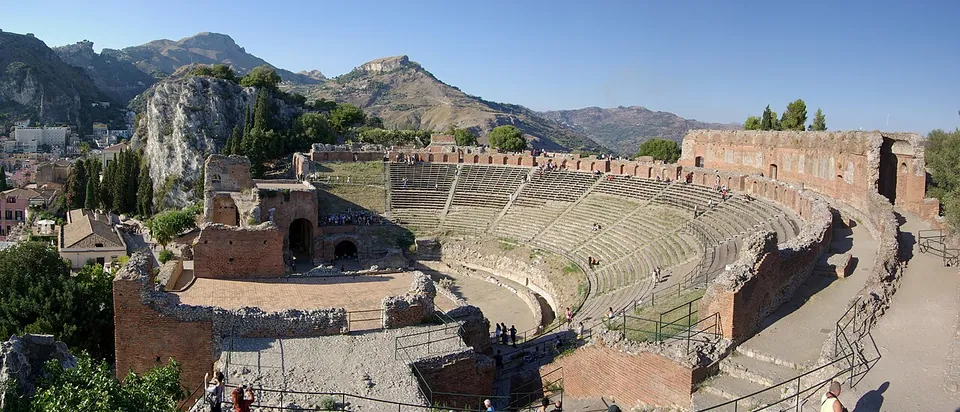
Photo: Berthold Werner · CC BY-SA 3.0 · Commons
43 km · theatre · Sicily
Ancient theatre of Taormina
Despite the name Teatro Greco, what stands is Roman: the operator states that everything visible belongs to the Roman rebuilding, above all the work of the first half of the 2nd century AD.

Straight-line distances.
Sources
Every fact on this page comes from the records below, each used under the licence noted.
| Source | Licence |
|---|---|
| Wikidata Q3984392 | CC0 |
| Vici.org 58376 | CC BY-SA (text), CC0 (metadata) |
| OpenStreetMap way/25418602 | ODbL |
| Wikipedia (it) — Terme della Rotonda | CC BY-SA 4.0 |
| Wikipedia (en) — Terme della Rotonda (Catania) | CC BY-SA 4.0 |
| Parco archeologico e paesaggistico di Catania e della Valle dell'Aci — opening hours (the operator; archived copy of 12 August 2025) | licence not recorded |
| Regione Siciliana — D.A. n. 23 of 22 May 2026, new entrance tickets for the Terme della Rotonda, Terme dell'Indirizzo and Portico dell'Atleta | licence not recorded |
| Online tickets for the park's sites, Terme della Rotonda (the park's ticketing partner) | licence not recorded |
| La Sicilia, 30 May 2026 — the park's announcement of paid entry and hours from 1 June 2026 | licence not recorded |