

What is there today
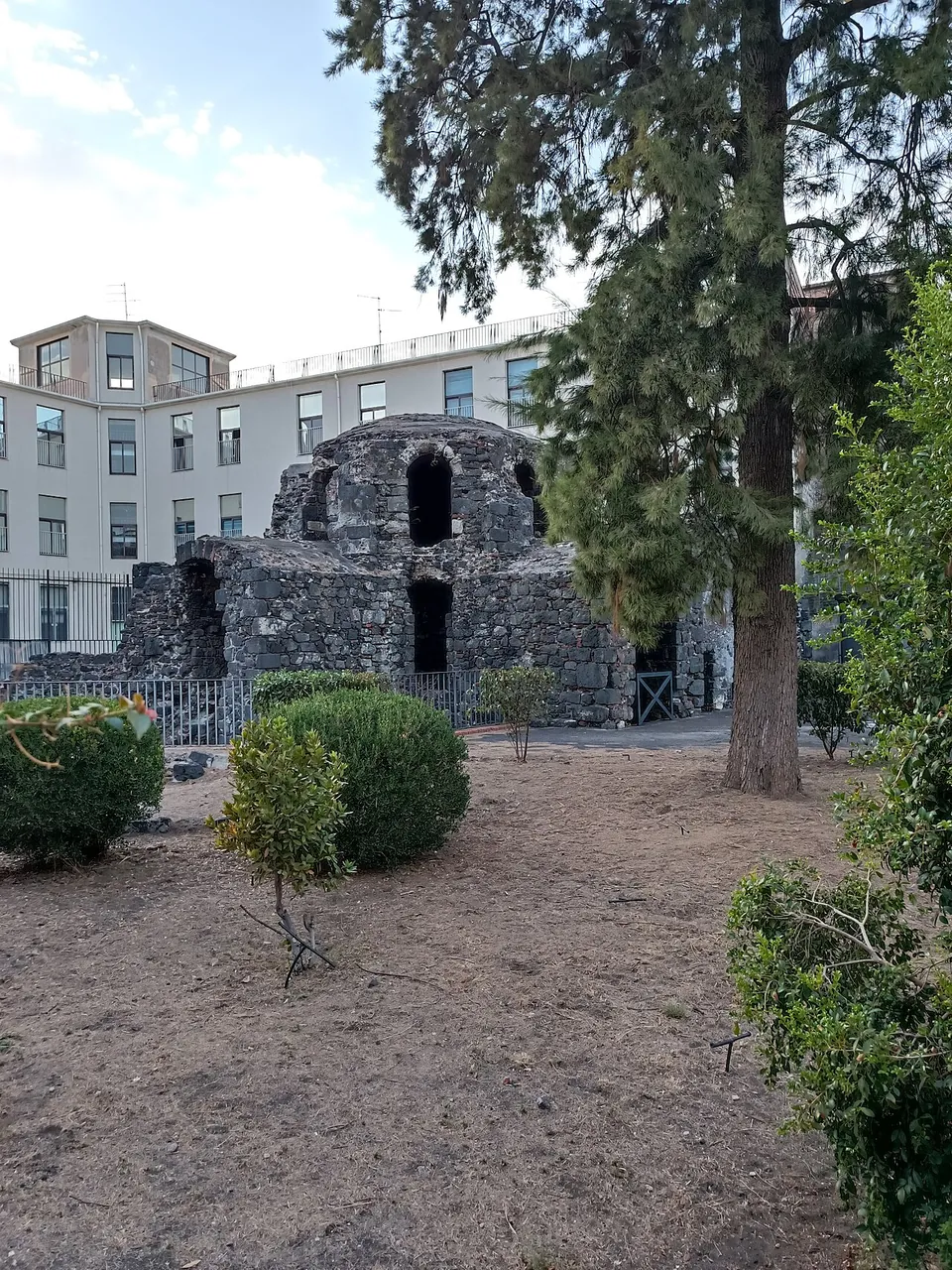
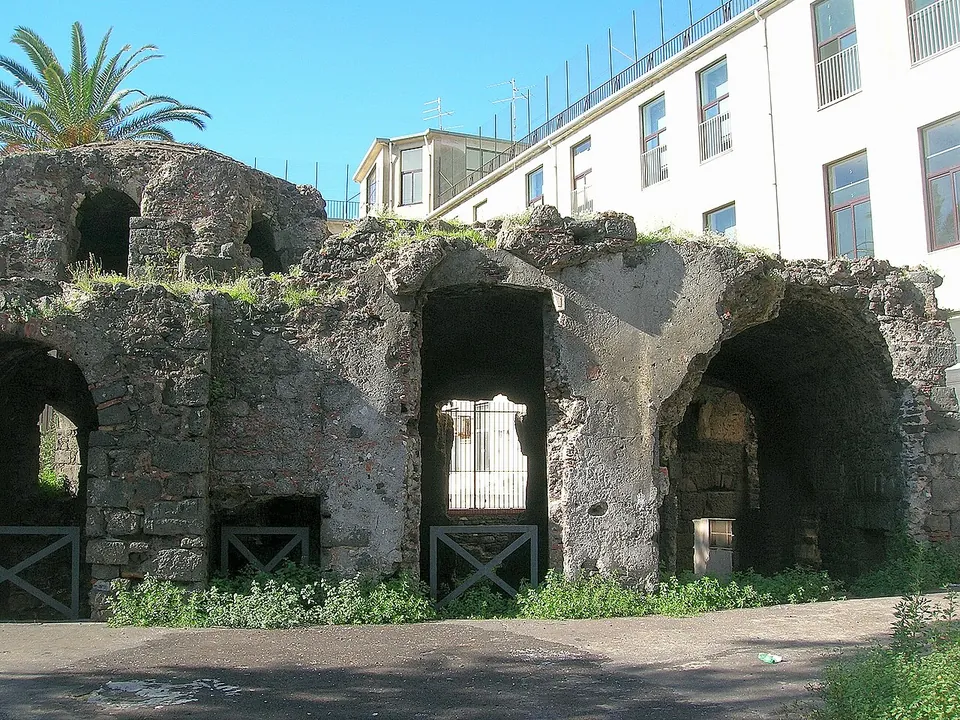
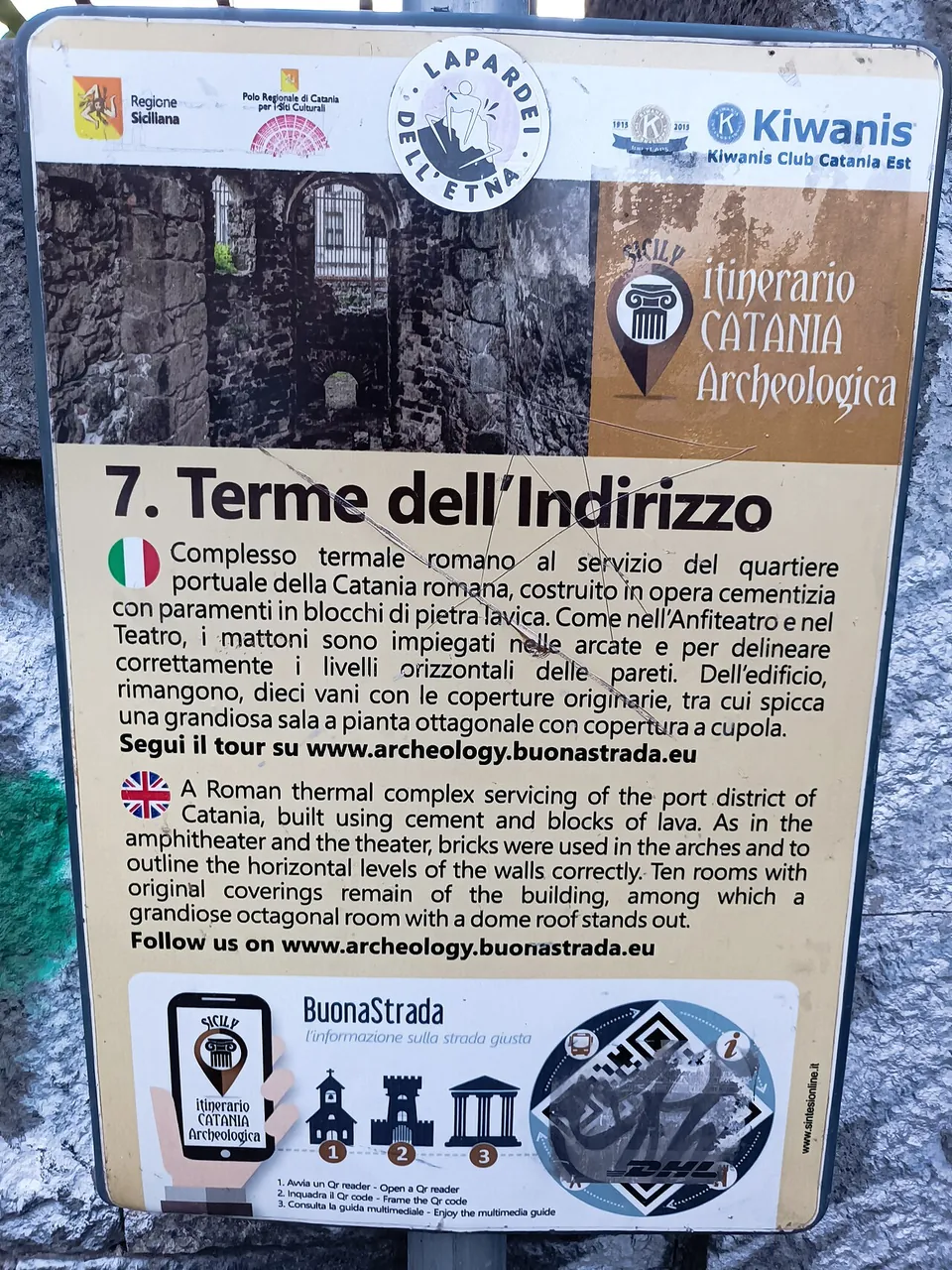
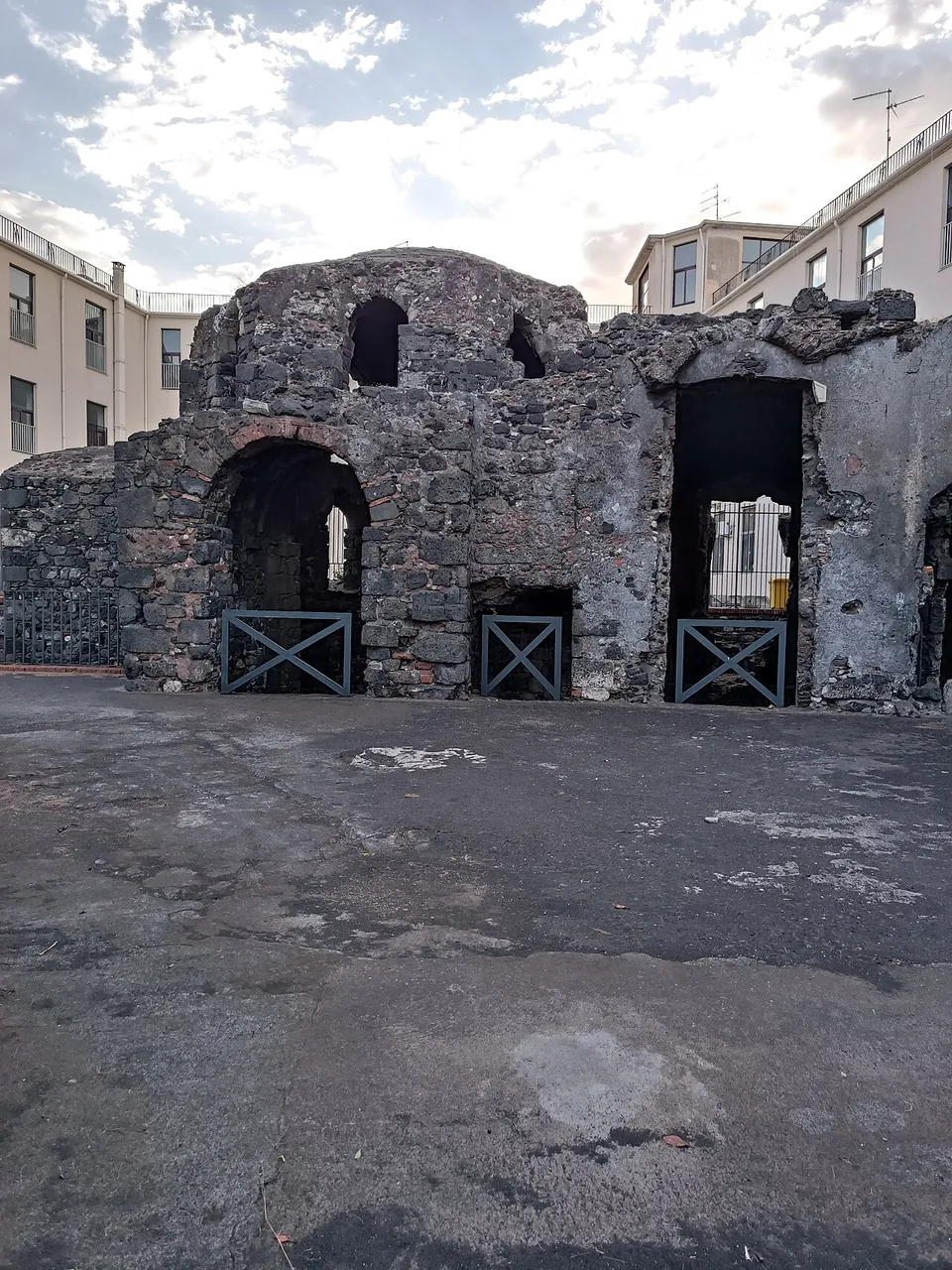
This is a building, not a ground plan. Its walls of dark lava stone still stand with roofs over several rooms, and the main room, the octagonal hot room (calidarium), is covered by a dome almost 10 m high (it.wikipedia). Published counts of what stands differ: five rooms and several secondary ones (it.wikipedia), or ten rooms that keep their original roofs (the bilingual information board at the site, part of the “Itinerario Catania Archeologica”).
The entrance is through a rectangular room usually identified as the changing room, with a small niche in its north wall that probably served as a urinal; an opening in its west wall leads to a second rectangular room, probably the cold room, and both are crossed by a drain. Two rooms, one rectangular and one trapezoidal, served as warm rooms (tepidaria), and from the rectangular one a doorway leads into the calidarium, which had openings for light in two tiers but none on its north sides. Three rectangular pools open off it, and in one of them the suspensurae, the supports that held up the floor, can still be seen. A small sweating room (laconicum) lies between the western pool and the trapezoidal warm room (it.wikipedia). The two doorways out of the changing room carry single lintels of limestone; similar blocks found in the neighbouring Via Zappalà Gemelli probably belonged to the city walls (it.wikipedia). The board describes the construction as Roman concrete faced with blocks of lava, with brick used in the arches and to keep the courses level, as in the city’s amphitheatre and theatre.
The building stands among clipped shrubs in a garden, behind a low railing, and in the photographs the arched openings at ground level are closed by metal gates; no source read says how much of the interior a visitor walks through.
Is it worth the trip?
If you are in Catania, yes: for €2 you see a Roman bath building still standing to its dome, one counted among the best preserved in Europe, a few minutes’ walk from the cathedral. It is a single small building, though, so it is a stop on a walk round the Roman city rather than an outing in itself, and it fits best together with the Terme della Rotonda and the theatre, which a combined ticket covers. Mind the hours: closed on Mondays, open only in the morning on Sundays, and closed over lunch on other days.
Getting there
The baths are on Piazza Currò, near the cathedral and the Castello Ursino (it.wikipedia). The Garibaldi-Mazzini bus stop is about 120 m away, and Parcheggio Borsellino, a paid car park, about 250 m (OpenStreetMap).
They open Tuesday to Saturday 09.00–13.00 and 14.30–18.30, and on Sunday 09.00–13.00 (last entry 12.30); they are closed on Mondays (the park’s hours page, as archived in August 2025; the park’s announcement of May 2026, as reported by La Sicilia, gives the same). Entry has been paid since 1 June 2026: €2, reduced €1 (Regione Siciliana, decree of 22 May 2026). A combined ticket also covers the Terme della Rotonda and the theatre and Odeon, whose page gives its price. Tickets are sold online through the park’s ticketing partner; the only ticket office the park’s announcement names is the theatre’s, about 300 m away on Via Vittorio Emanuele, and no source says whether there is a desk at the baths. The park’s website could not be read in October 2026, so check hours and prices on arrival.
Visiting details
- Opening hours
- Tuesday–Saturday 09.00–13.00 and 14.30–18.30; Sunday 09.00–13.00 (last entry 12.30); closed on Mondays.
- Tickets
- €2, reduced €1 (regional decree of 22 May 2026; paid since 1 June 2026). A combined ticket also covers the Terme della Rotonda and the theatre and Odeon; its price is on the theatre's page. Tickets are sold online through the park's ticketing partner.
- Parking
- Parcheggio Borsellino, a car park about 250 m away (OpenStreetMap way/533512110); the Garibaldi-Mazzini bus stop is about 120 m from the baths.
Before you go
- The archaeological park's website refused automated reading in October 2026; the hours above are its own as archived on 12 August 2025, and a press report of the park's announcement of 30 May 2026 gives the same. Check them on arrival.
- The only ticket office the park's announcement names is the theatre's, on Via Vittorio Emanuele, about 300 m away. No source says whether tickets are also sold at the baths.
Hours and prices checked 12 August 2025 on the operator's own site. Confirm before travelling.
History
Archaeologists date the baths to the late imperial period, between the 3rd and the 5th centuries. They stood close to the port, in a district given over to trade, and in the Middle Ages the building may have served as a workshop (it.wikipedia).
At the start of the 17th century the ground was entrusted to the Reformed (Discalced) Carmelites; the ruins were absorbed into their monastery and used at first as a storehouse, and documents of the time mistook them for an ecclesia or “Palazzo di Città”, a public place for meetings and councils. The name comes from the nearby church of Santa Maria dell’Indirizzo and its convent, now a school, and through them from a legend: in 1610 Pedro Téllez-Girón, Duke of Osuna and Viceroy of Sicily, was said to have escaped a terrible storm when a light appeared and guided him to a safe landing (it.wikipedia).
In the 1770s Ignazio Paternò Castello, Prince of Biscari, studied the ruins and identified them correctly as baths, writing about them in his Viaggio per tutte le antichità di Sicilia. The baths became fully visible again only in the 1930s, were first restored in the 1980s, and were studied and restored further between 2011 and 2013 (it.wikipedia).
More photographs

Nearby
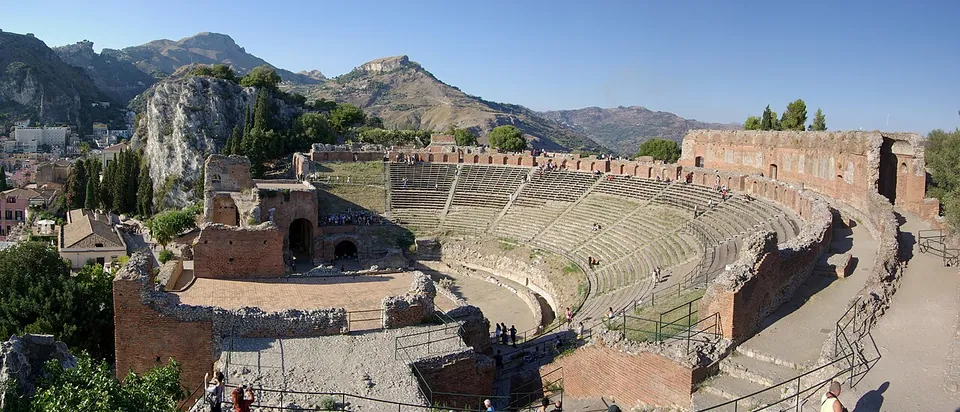
Photo: Berthold Werner · CC BY-SA 3.0 · Commons
43 km · theatre · Sicily
Ancient theatre of Taormina
Despite the name Teatro Greco, what stands is Roman: the operator states that everything visible belongs to the Roman rebuilding, above all the work of the first half of the 2nd century AD.

Straight-line distances.
Sources
Every fact on this page comes from the records below, each used under the licence noted.
| Source | Licence |
|---|---|
| Wikidata Q3984389 | CC0 |
| Vici.org 58378 | CC BY-SA (text), CC0 (metadata) |
| OpenStreetMap way/30886806 | ODbL |
| Wikipedia (it) — Terme dell'Indirizzo | CC BY-SA 4.0 |
| Parco archeologico e paesaggistico di Catania e della Valle dell'Aci — opening hours (the operator; archived copy of 12 August 2025) | licence not recorded |
| Regione Siciliana — D.A. n. 23 of 22 May 2026, new entrance tickets for the Terme della Rotonda, Terme dell'Indirizzo and Portico dell'Atleta | licence not recorded |
| La Sicilia (30 May 2026) — the park's announcement of paid entry, tariffs and hours | licence not recorded |
| Online tickets for the park's sites (the ticket office the park's pages link to) | licence not recorded |