What is there today
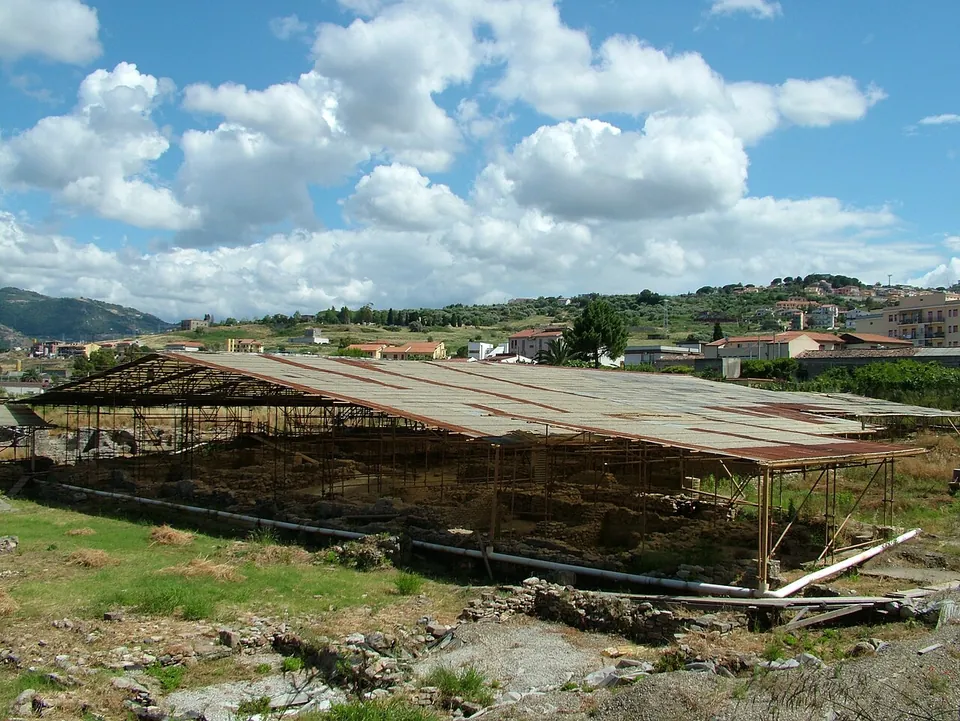
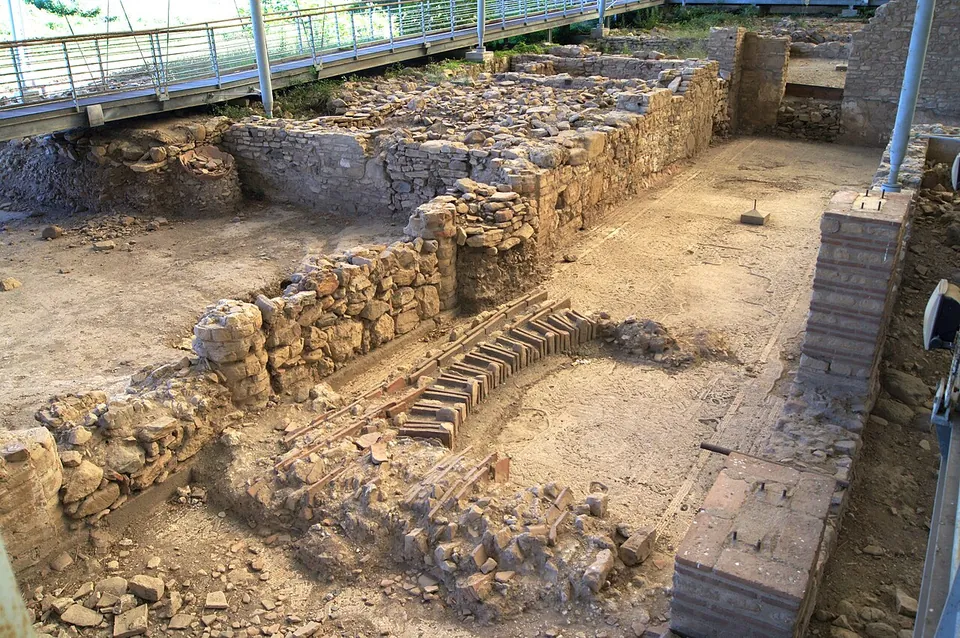
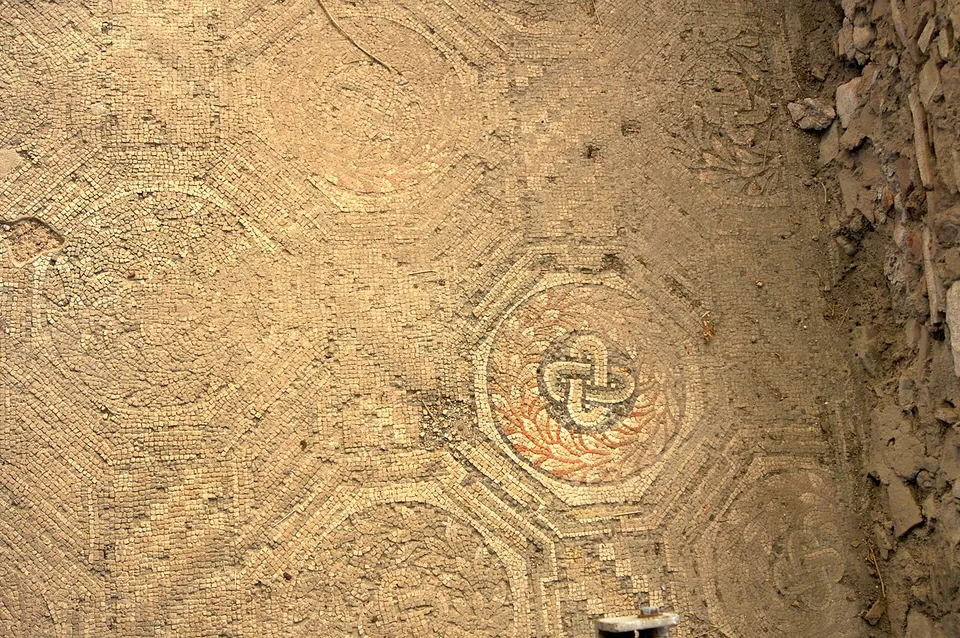
The explored part is the centre of the house: a courtyard surrounded by a portico (the peristyle), with the living rooms around it (it.wikipedia). Two rooms stand out. On the west side is a large hall ending in an apse, and on the south a room with three apses that looked from the peristyle towards the sea (it.wikipedia, the operator). The apse hall has lost its mosaic, but the peristyle and the three-apsed room keep theirs: a grid of square panels in a laurel-wreath border in the peristyle, and circular medallions and curved-sided octagons holding animal heads in the three-apsed room (it.wikipedia). Published descriptions differ on how well these floors are preserved. it.wikipedia also lists a room with a Medusa mosaic and a tablinum with a mosaic of Bacchus, and in the north-east lie the baths (it.wikipedia, en.wikipedia), with raised floors, a furnace, ducts and tubs (the operator).
What you see is low walls and floors rather than standing rooms, under a protective roof (en.wikipedia), and excavation is still going on: many rooms have not yet been dug down to floor level (it.wikipedia). From test excavations the whole villa is estimated at about 2 hectares (de.wikipedia). A small antiquarium on the site holds the finds, from pottery, lamps and coins to carved marble from the villa’s decoration (it.wikipedia), but it is closed for renovation at present.
Is it worth the trip?
As an add-on to Tindari, yes. The two belong to the same archaeological park, lie about 6 km apart (it.wikipedia) and share a combined ticket valid for three days, and the villa is a short visit: one peristyle, a few showpiece rooms and their floors. Expect a working excavation under a roof and a motorway overhead rather than a polished site. The mosaics are mostly geometric (de.wikipedia) and, in design and colour, of no very high standard, which suggests a Sicilian rather than a North African workshop (it.wikipedia). With the museum closed and restoration work on one mosaic under way since February 2026, there is less to see than usual; on its own it is a stop for people already on this stretch of coast, not a destination to cross the island for.
Getting there
The villa is at Via Giovanni XXIII 2 in Patti Marina, Patti (the operator), about 1.3 km from the centre of Patti. The railway station Patti-San Piero Patti is about 400 m away in a straight line (OpenStreetMap). For drivers, no car park of the site’s own is mapped; the nearest mapped car parks, 120–140 m away, are marked for customers only.
From 1 to 15 October it is open Tuesday to Sunday 09.00–17.30, and from 16 to 31 October 09.00–17.00; it is closed on Mondays. The park posts its hours a season at a time, so check the timetable page for other months. A ticket is €6, with a reduced fare for EU citizens aged 18–25 (published figures range from €3 to €4); under-18s go free, and so does everyone on the first Sunday of the month. The combined ticket with Tindari is €11.20 (reduced €5). Tickets are sold online through Aditus Culture, the park’s ticket office, and free tickets only at the site (the Parco archeologico di Tindari and Aditus Culture, read 22 October 2026: check before travelling).
Visiting details
- Opening hours
- Tuesday to Sunday, 09.00–17.30 from 1 to 15 October and 09.00–17.00 from 16 to 31 October; closed on Mondays. The park posts its hours a season at a time, and no hours for the other months were posted when this was read.
- Tickets
- €6; reduced (EU citizens aged 18–25) €3–4, published figures differ; free under 18, and free for everyone on the first Sunday of the month, with free tickets issued only at the site. A combined ticket with the Tindari archaeological area is €11.20 (reduced €5) and is valid for three days from the first entry. Tickets are sold online through Aditus Culture, the park's ticket office.
- Parking
- OpenStreetMap maps no car park of the site's own. The nearest mapped car parks, 120–140 m away, are marked for customers only; Piazza Giovanni Falcone e Paolo Borsellino is about 175 m away.
Before you go
- The antiquarium, the small museum of finds on the site, is closed to the public for renovation (notice on the official ticket office's page, read 2026-10-22).
- Restoration of the Dionysus mosaic floor began on 16 February 2026.
- Closed on Mondays.
Hours and prices checked 22 October 2026 on the operator's own site. Confirm before travelling.
History
The villa stood beside the Roman road along Sicily’s north coast, the Via Valeria (Pleiades, it.wikipedia), and may have been the centre of a large agricultural estate (Pleiades). Its dating is still being worked out (it.wikipedia). Parts of the excavated walls are mapped as structures of the 1st century BC to the 2nd century AD and of the 2nd and 3rd centuries AD (OpenStreetMap), and the house now visible was built in the early 4th century over an earlier residence (the operator; en.wikipedia dates that first villa to the 2nd–3rd centuries). The apse hall is aligned east–west, unlike the rest of the house, which has led to the suggestion that it was a church added after the owner became a Christian (en.wikipedia).
Published accounts differ on how the villa ended, but they place it in the later 4th century or around 400: it.wikipedia has it destroyed by an earthquake, linking it to the earthquake of 365 and elsewhere putting it around 400; de.wikipedia has an earthquake at the end of the century; en.wikipedia says the house had already been abandoned before 365. In the 6th and 7th centuries the ruins were partly reoccupied and rebuilt, with graves cut among them, including burials in the bath area, and people were still living there at least until the 10th century (it.wikipedia).
The site was found in 1973 during construction of the motorway, when two of its piers destroyed part of the villa’s north side (it.wikipedia).
Nearby
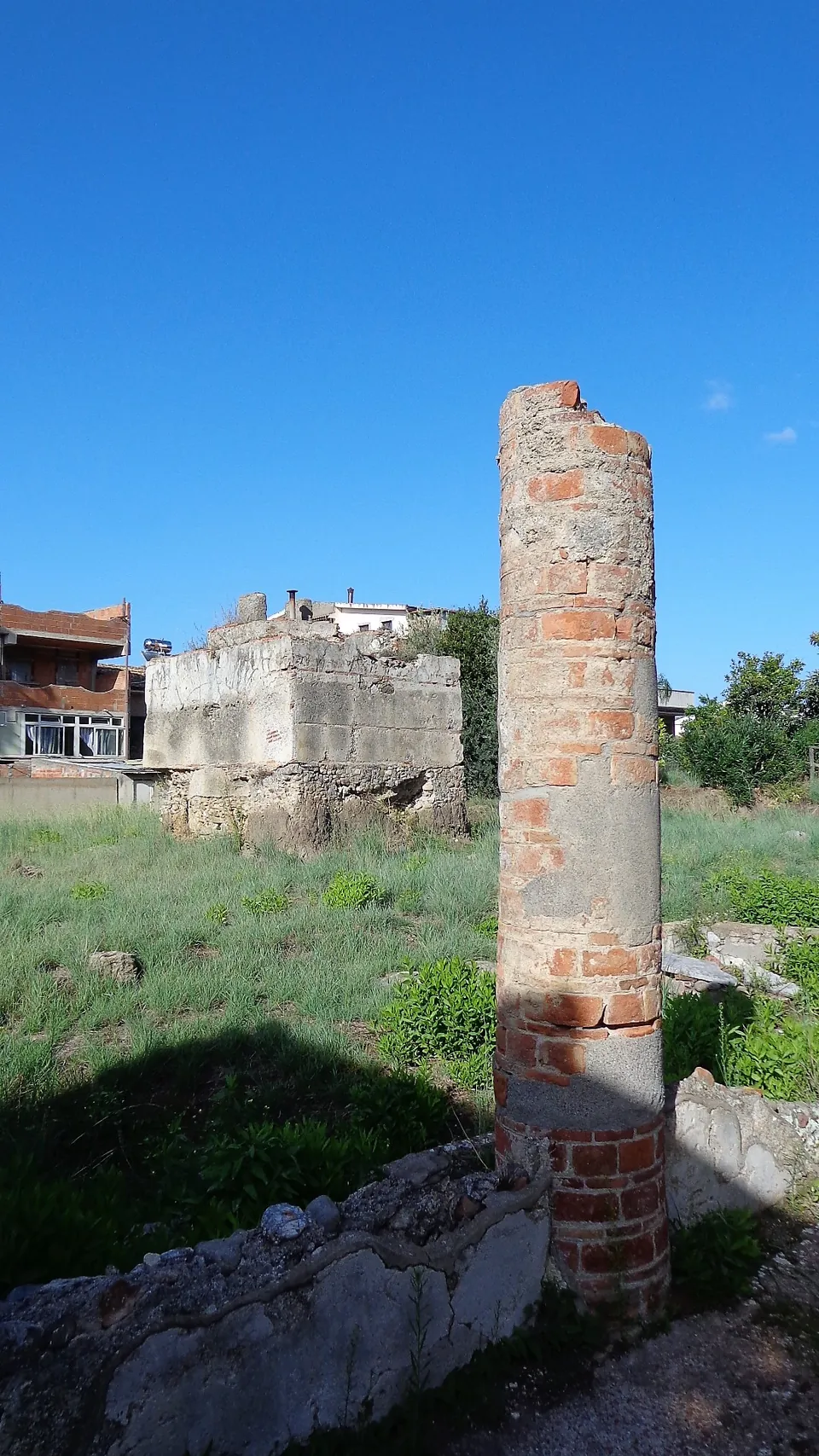
Photo: Effems · CC BY-SA 4.0 · Commons
15 km · villa · Sicily
Roman villa of San Biagio
The house was laid out on a square plan around a courtyard with a portico of eight columns a side, the peristyle (it.wikipedia, de.wikipedia).
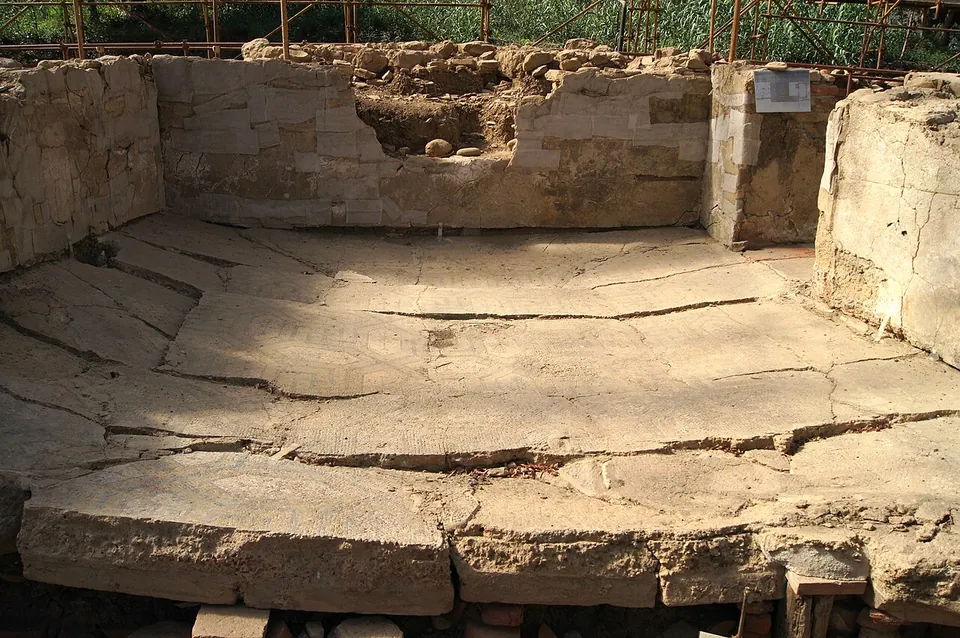
Photo: Rjdeadly · CC BY-SA 4.0 · Commons
18 km · bath · Sicily
Baths of Bagnoli
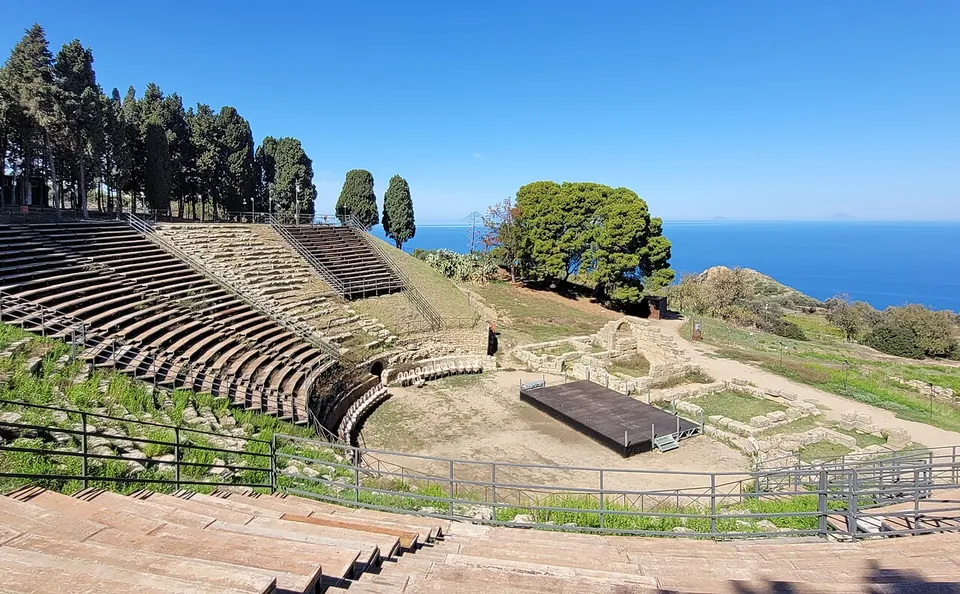
A fenced strip of excavation about 32 m long and 7 m wide (de.wikipedia), holding a row of six rooms (the operator): a cold-bath suite of three rooms, a warm room (tepidarium) and the two rooms of the hot bath (caldarium).


Straight-line distances.
Sources
Every fact on this page comes from the records below, each used under the licence noted.
| Source | Licence |
|---|---|
| Pleiades 462414 | CC BY |
| Wikidata Q2236915 | CC0 |
| OpenStreetMap relation/5857627 | ODbL |
| Parco archeologico di Tindari — Villa Romana di Patti Marina (the operator) | licence not recorded |
| Parco archeologico di Tindari — tickets, Villa Romana di Patti Marina (the operator) | licence not recorded |
| Parco archeologico di Tindari — timetables (the operator) | licence not recorded |
| Parco archeologico di Tindari — free and reduced admission rules (the operator) | licence not recorded |
| Aditus Culture — Villa Romana di Patti (official ticket office, linked from the operator's ticket page) | licence not recorded |
| Wikipedia (it) — Villa di Patti | CC BY-SA 4.0 |
| Wikipedia (en) — Villa Romana di Patti | CC BY-SA 4.0 |
| Wikipedia (de) — Villa Romana di Patti | CC BY-SA 4.0 |