

What is there today
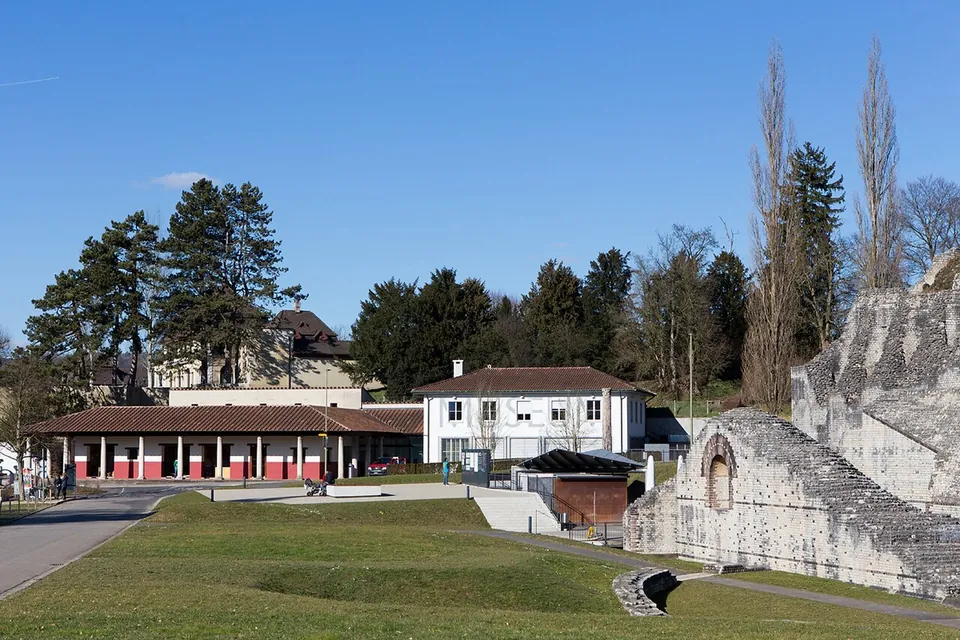
The operator lists the open-air site, its protected monuments and an animal park as free, and the open-air site as open around the clock; fr.wikipedia puts the open-air sights at more than twenty. A museum and a Roman House, which charge, stand next to the theatre.
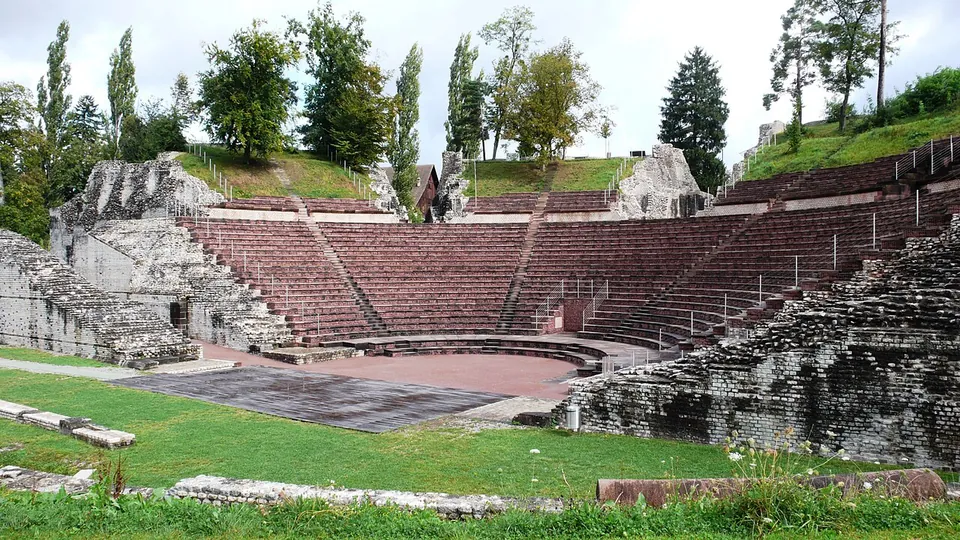
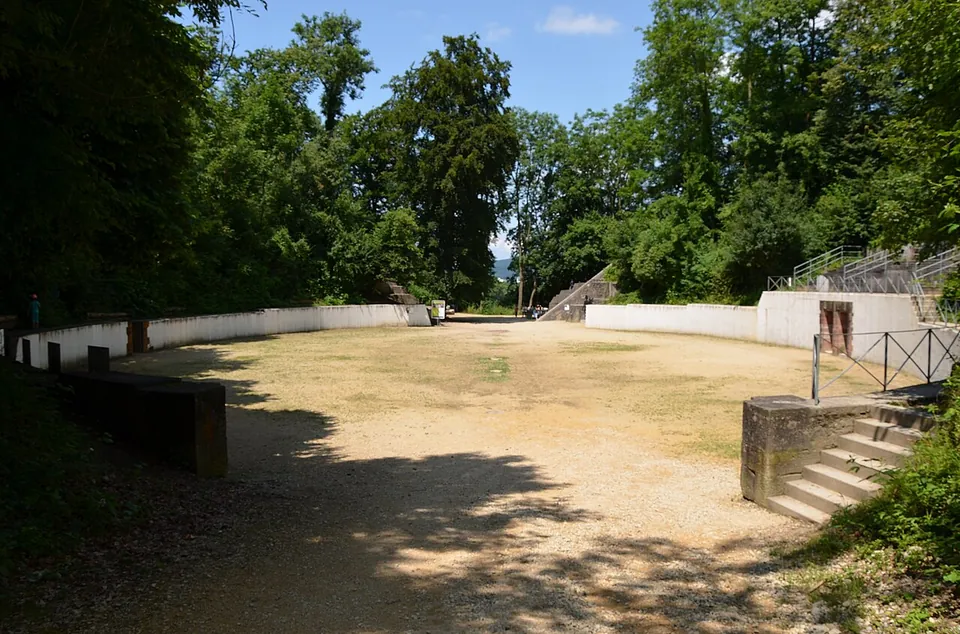
The theatre is the centrepiece: a semicircle of stone seating rising in tiers, framed by heavy masonry. Pleiades calls it one of the best preserved Roman theatres north of the Alps, and fr.wikipedia the largest. The forum with its temple and the basilica are mapped just east of it (OpenStreetMap). The amphitheatre lies in the woods to the south: built around AD 170, it held about 13,000 spectators (Pleiades).
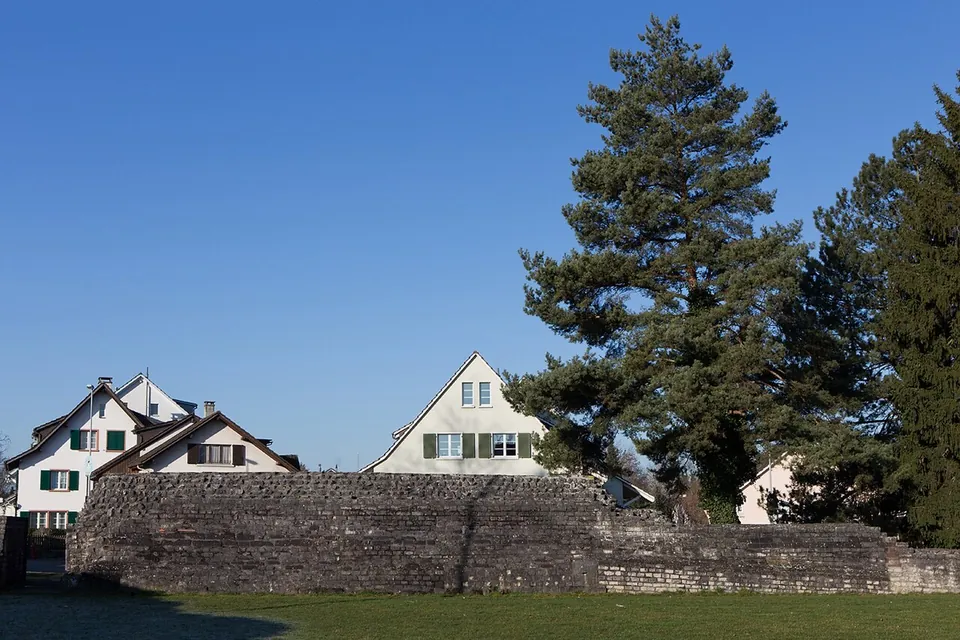
The Castrum Rauracense, the late Roman fort, is on the Rhine about 700 m north, in the village of Kaiseraugst. Built around 300 to guard the river crossing, it counts among the most impressive fortifications of its stretch of the late Roman frontier (de.wikipedia), and a long section of its wall stands in the village centre. A bridge, now gone, and a bridge-head on the far bank belonged to it; the bridge-head, in Grenzach-Wyhlen in Germany, is the only part of the crossing still visible (de.wikipedia).
The museum’s most important exhibit is the treasure of silver plate and coins found in Kaiseraugst in 1962 (fr.wikipedia).
Is it worth the trip?
Yes. The theatre alone repays the stop, the outdoor monuments cost nothing and never close, and the S1 from Basel stops at Kaiseraugst, a walk away. Only the museum and the Roman House need opening hours and a ticket.
Getting there
By train, take the S1 from Basel SBB to Kaiseraugst (not “Salina Raurica”); from there it is a 15-minute walk to the museum and the central sights, or a short ride on bus 72 or 83. Bus 81 runs from Aeschenplatz in Basel to Augst BL Stundeglas, a 15-minute walk away. In summer, boats run from Basel and Rheinfelden to Augst and Kaiseraugst, 20 minutes’ walk from the museum. By car, leave the motorway at Augst or Rheinfelden and follow the brown signs; the car parks P2, P3 and P4 charge a fee (the operator).
The open-air site is open around the clock, all year, and is free. The museum and Roman House open daily 10.00–17.00 from March to October and Tuesday to Sunday 10.00–15.00 from November to February, and close on 24–26 and 31 December and 1 January; from 26 to 31 October 2026 the museum’s galleries are shut for refurbishment, though the Roman House stays open. Entry is CHF 8 (about €8.55), or CHF 6 for ages 6 to 17, students up to 26, pensioners and groups of ten or more; under-sixes go free (augustaraurica.ch, read 7 October 2026 — check before travelling).
Visiting details
- Opening hours
- Open-air site and monuments: open around the clock, all year. Museum and Roman House: daily 10.00–17.00 from March to October; Tuesday–Sunday 10.00–15.00 from November to February; closed 24–26 and 31 December and 1 January. The museum's exhibition galleries close for refurbishment from 26 to 31 October 2026, while the Roman House stays open.
- Tickets
- Open-air site, monuments and animal park free. Museum and Roman House CHF 8 (about €8.55); CHF 6 (about €6.40) for ages 6–17, students up to 26, pensioners and groups of ten or more; free under 6.
- Parking
- Paid car parks P2, P3 and P4 (P1 closed); motorway exit Augst or Rheinfelden, then the brown signs (the operator).
Before you go
- From Basel by train, get off at Kaiseraugst, not "Salina Raurica" (the operator).
Hours and prices checked 7 October 2026 on the operator's own site. Confirm before travelling.
History
Augusta Raurica was officially founded in 44 BC and grew into the largest town of the region, with about 15,000 people around AD 200 (de.wikipedia). It belonged first to the province of Germania Superior and from 297 to Maxima Sequanorum (rm.wikipedia). The civilian town lasted until about 280; after a brief retreat into a much smaller enclosed area, the Castrum Rauracense was built on the Rhine around 300 and housed Roman troops for about a hundred years, at least in the first half of the 4th century the Legio I Martia (de.wikipedia). In the 7th century the place lost its importance to the new regional centre, Basel (de.wikipedia).
More photographs

Nearby
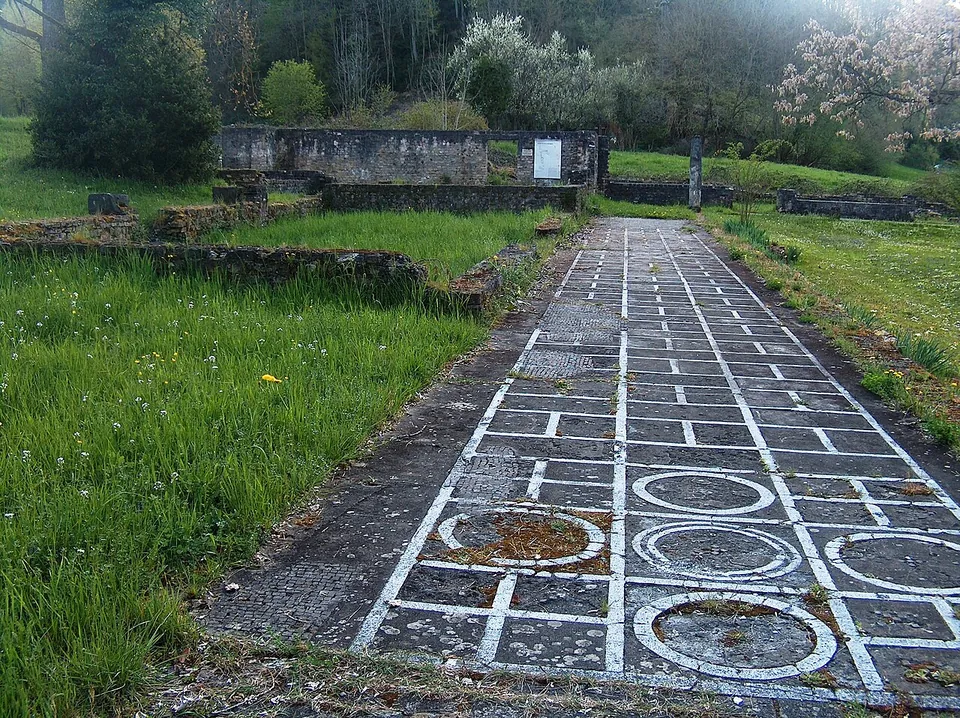
Photo: Umschattiger · CC BY-SA 3.0 · Commons
5 km · villa · Liestal District, Basel-Landschaft
Roman villa of Munzach
The estate measured about 160 by 320 m.
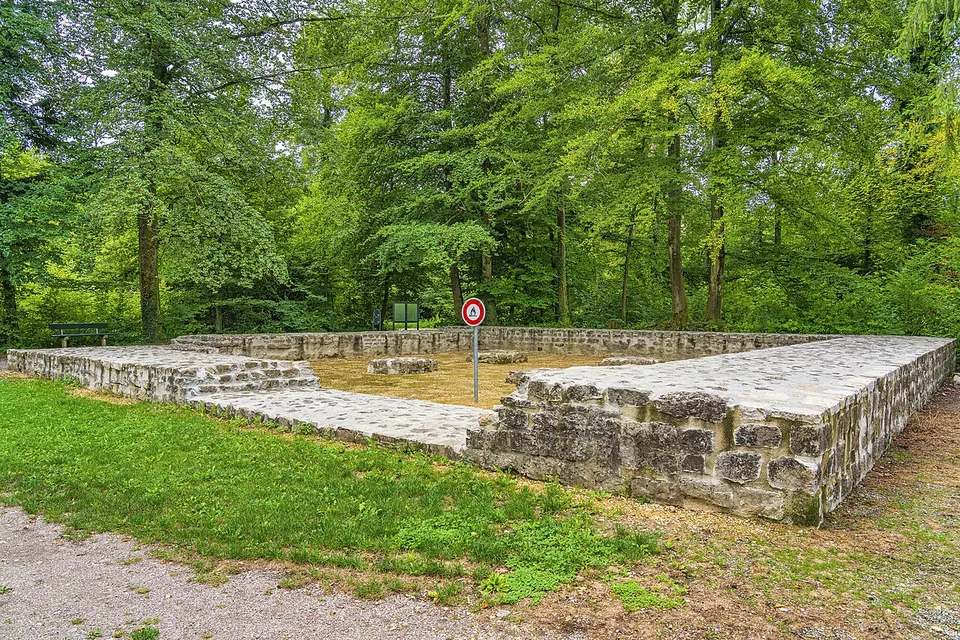
Photo: PantaRhei · CC BY-SA 4.0 · Commons
15 km · fort · Rheinfelden District, Aargau
Burgus of Wallbach-Stelli
Of the three Roman watchtowers known at Wallbach, only the burgus at Stelli has been fully excavated, conserved and partly reconstructed (de.wikipedia).
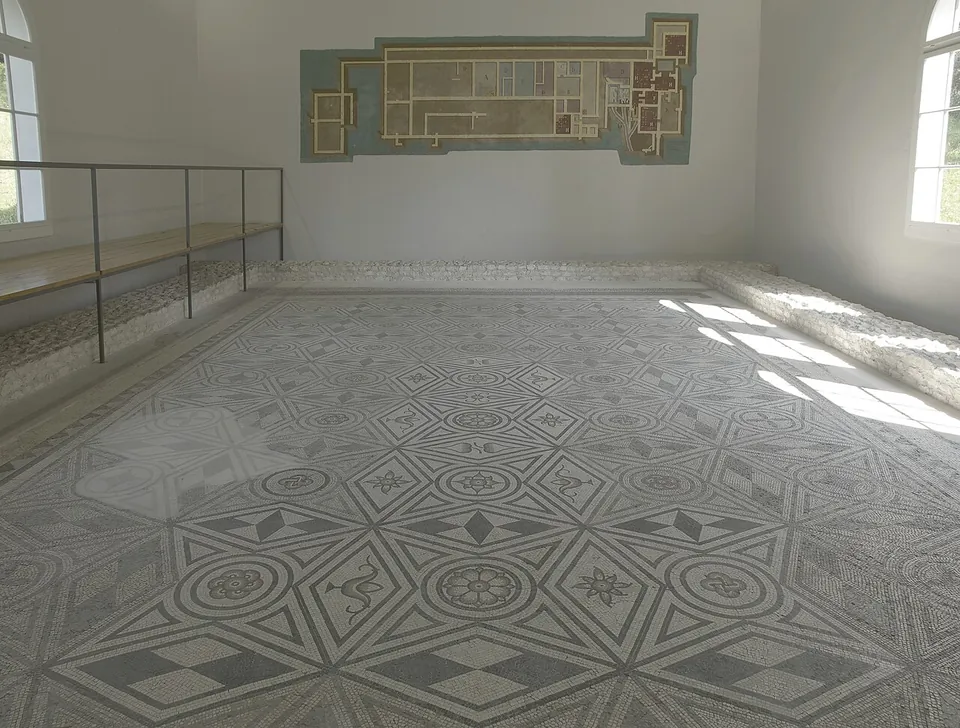
Photo: Minnou · CC BY-SA 3.0 · Commons
33 km · villa · Zofingen District, Aargau
Roman villa of Zofingen
Three well-preserved mosaic floors, with chequerboard, lozenge and trapezoid patterns and floral motifs, are kept visible in two matching classical shelters (Canton of Aargau Denkmalpflege).


Straight-line distances.
Sources
Every fact on this page comes from the records below, each used under the licence noted.
| Source | Licence |
|---|---|
| Pleiades 177494 | CC BY |
| Wikidata Q610371 | CC0 |
| Vici.org 2793 | CC BY-SA (text), CC0 (metadata) |
| OpenStreetMap way/40103774 | ODbL |
| Pleiades — Roman theater at Col. Augusta Raurica | licence not recorded |
| Pleiades — Roman amphitheater at Augusta Raurica | licence not recorded |
| Pleiades — Forum of Col. Augusta Raurica | licence not recorded |
| Pleiades — Castrum Rauracense | licence not recorded |
| Wikipedia (de) — Augusta Raurica | CC BY-SA 4.0 |
| Wikipedia (en) — Augusta Raurica | CC BY-SA 4.0 |
| Wikipedia (fr) — Augusta Raurica | CC BY-SA 4.0 |
| Wikipedia (rm) — Augusta Raurica | CC BY-SA 4.0 |
| Wikipedia (de) — Castrum Rauracense | CC BY-SA 4.0 |
| Wikipedia (de) — Rheinbrücken Augusta Raurica | CC BY-SA 4.0 |
| KGS inventory 1391 — Augusta Raurica, römische Koloniestadt (BABS) | licence not recorded |
| Augusta Raurica — opening hours and admission (the operator) | licence not recorded |
| Augusta Raurica — getting here and parking (the operator) | licence not recorded |