

What is there today
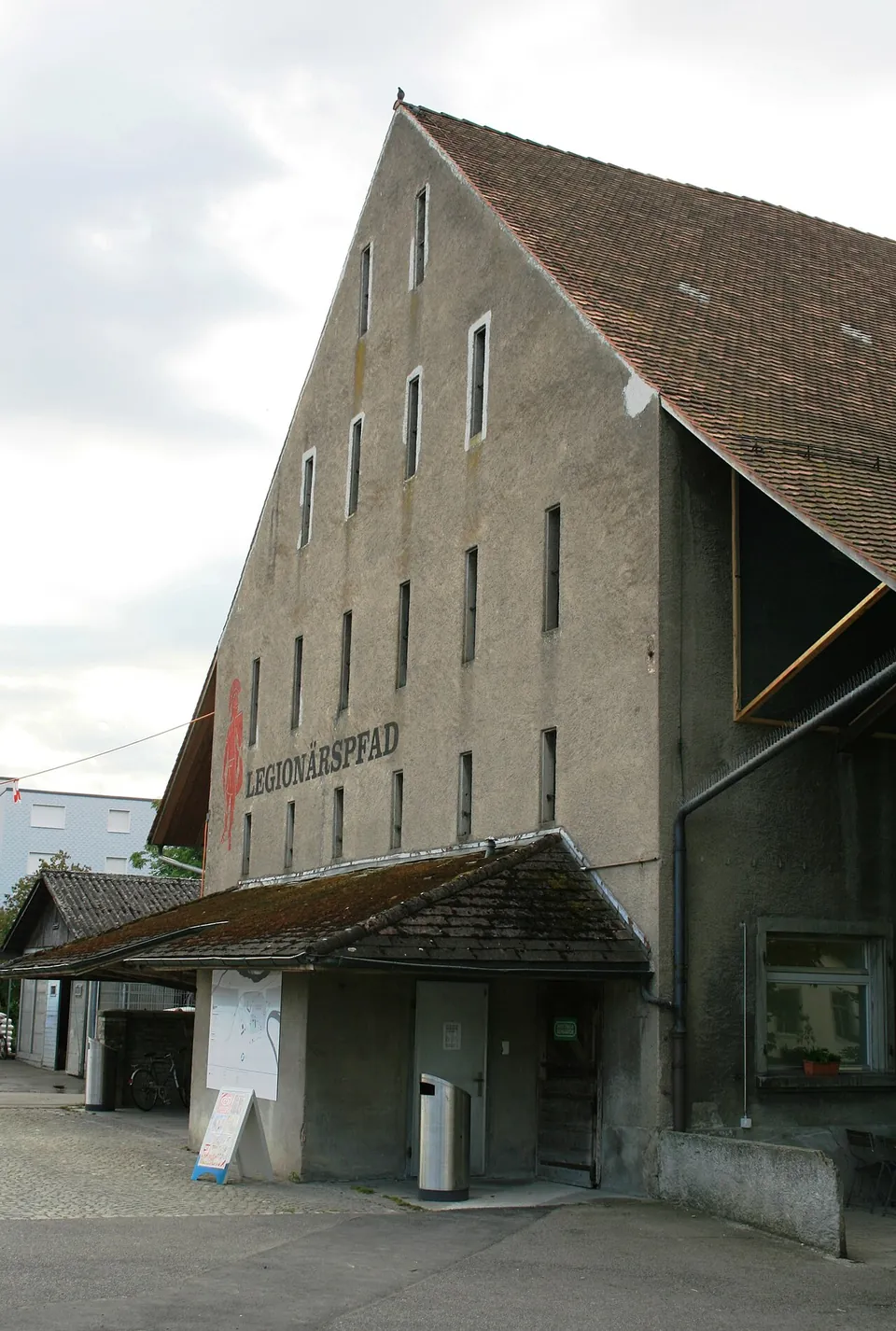
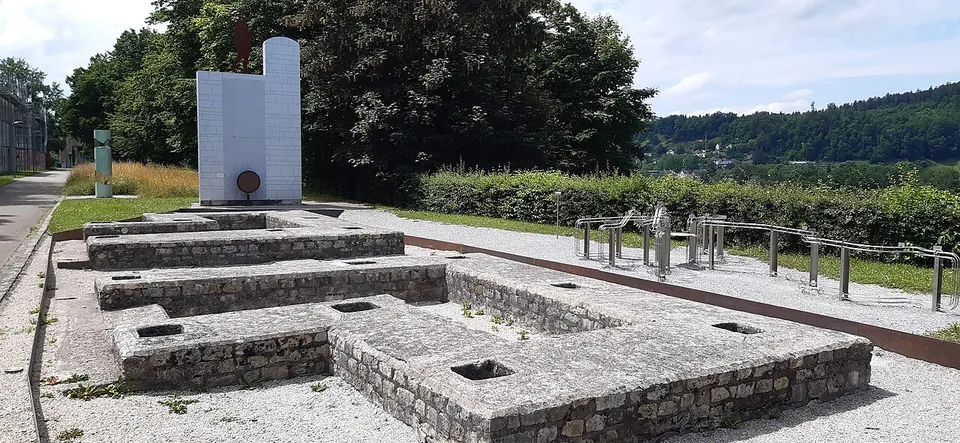
The Legionärspfad, run by Museum Aargau, is the way into the camp: eleven stations through its excavated sites, among them the amphitheatre, reconstructed legionaries’ barracks, a gate, the baths and a Roman garden of 450 m² planted with some 40 species documented by archaeology (the operator). The trail opened in the summer of 2009 (Wikidata). Along it the foundations of the camp’s north gate are laid out on the ground.
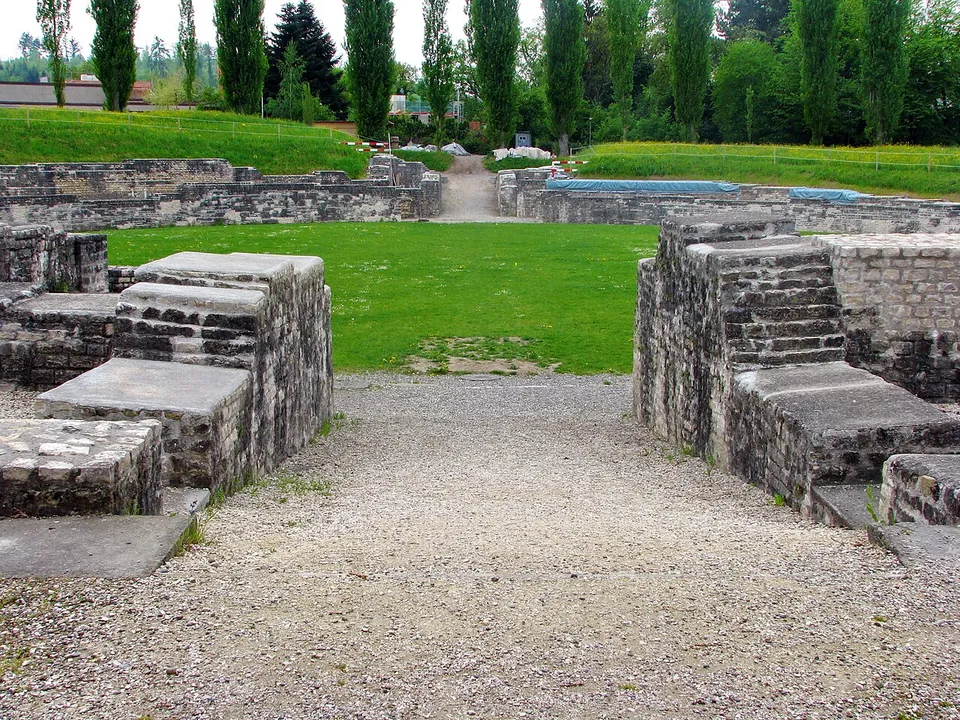
The amphitheatre, about 700 m south-west of the camp’s mapped point (Wikidata coordinates), can be visited without a ticket (the operator). It is the oldest in Switzerland and the largest: the 13th legion built it first in wood, and after a fire the 21st legion replaced it with the stone structure that stands today. Its seating held some 11,000 spectators around an arena of 64 by 52 m (the operator); over all it measures 111 by 99 m (de.wikipedia). A camel’s foot bone found at Vindonissa is taken as a sign that exotic animals appeared in the shows (the operator). It is used for opera and other events today (Wikidata).
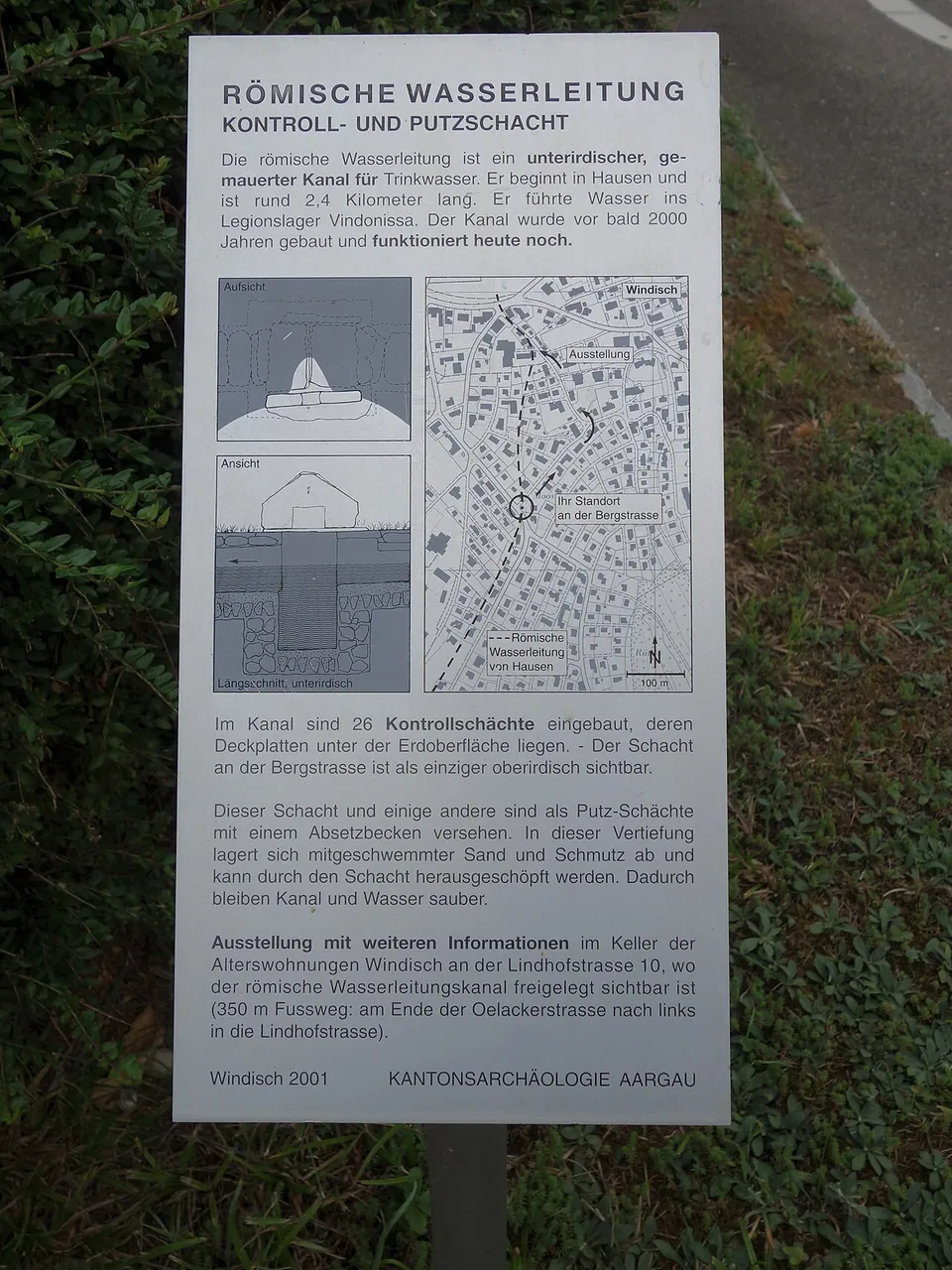
The aqueduct that fed the camp still works. The Kantonsarchäologie’s information board at Bergstrasse in Windisch describes an underground masonry channel for drinking water, about 2.4 km long from Hausen, built almost 2,000 years ago; of its 26 inspection shafts only this one is visible above ground, and the channel itself can be seen exposed in the cellar of the old people’s flats at Lindhofstrasse 10, about 350 m on foot (board of 2001, photographed 2022). The national register lists it as a water-carrying Roman and medieval aqueduct (KGS 282).
The finds are in the Vindonissa Museum in Brugg, which holds original objects from more than a century of excavation and, the operator says, the largest collection of Roman writing tablets.
Is it worth the trip?
Yes. Vindonissa was the only Roman legionary camp on what is now Swiss soil (the operator), and the Legionärspfad, with its reconstructions, makes a camp you would otherwise have to imagine readable on the ground. The amphitheatre is worth the short walk on its own and costs nothing, which makes it a good stop out of season, when the trail is closed.
Getting there
From Brugg station, buses 364 and 366 (to the Windisch Gemeindehaus stop) or 361, 362 and 363 run to the Legionärspfad’s visitor centre in two or three minutes, or it is about 15 minutes on foot. By car, leave the A3 at Brugg; paid parking is in the Campus car park on Bahnhofstrasse, about ten minutes’ walk away (the operator).
The Legionärspfad is open from 1 April to 1 November 2026, Tuesday to Friday 09.00–17.00 and on weekends and public holidays 10.00–18.00, and closed on Mondays except Easter Monday and Whit Monday. Entry is CHF 14 (about €15), CHF 10 for apprentices and students up to 26 and CHF 8 for ages 6 to 16; a family ticket is CHF 35 with two adults or CHF 25 with one, and a combined ticket with the Vindonissa Museum costs CHF 18. The museum in Brugg (Museumstrasse 1) opens all year, Tuesday to Friday and Sunday 13.00–17.00, for CHF 10, CHF 7 for students and CHF 4 for children (museumaargau.ch, read 7 October 2026 — check before travelling).
Visiting details
- Opening hours
- Legionärspfad (the legionary trail): 1 April to 1 November 2026, Tuesday–Friday 09.00–17.00, Saturday, Sunday and public holidays 10.00–18.00, closed on Mondays except Easter Monday and Whit Monday. The amphitheatre can be visited without a ticket. Vindonissa Museum in Brugg: all year, Tuesday–Friday and Sunday 13.00–17.00, closed Monday and Saturday.
- Tickets
- Legionärspfad: CHF 14 (about €15); CHF 10 (about €10.70) for apprentices and students up to 26; CHF 8 (about €8.55) for ages 6–16; family tickets CHF 35 or 25. With the Vindonissa Museum: CHF 18 adults. Vindonissa Museum alone: CHF 10 (about €10.70), students CHF 7, children CHF 4. Amphitheatre free.
- Parking
- Paid parking in the Campus multi-storey car park on Bahnhofstrasse, about ten minutes' walk from the Legionärspfad (the operator).
Hours and prices checked 7 October 2026 on the operator's own site. Confirm before travelling.
History
The camp was laid out early in the 1st century AD beside a former Celtic oppidum, at a crossing of the Aare waterway and roads to Aventicum, Augusta Raurica, Zurich and Raetia (de.wikipedia). Three legions were stationed there in turn between AD 14 and 101: the 13th, the 21st and the 11th (de.wikipedia). The 13th stayed until 44 or 45; the 21st rebuilt the camp’s defences in stone, and after it plundered the surrounding countryside in 69 it was replaced by the 11th, which left around 101, when Vindonissa became a civilian settlement (fr.wikipedia). From the end of the 1st century it lay in the province of Germania Superior (de.wikipedia).
After an Alamannic invasion was beaten back in the late 3rd century, the Castrum Vindonissense again had a garrison, from about 300 into the 5th century, behind the chain of forts on the Rhine frontier; two kilometres west of the old camp, at Brugg-Altenburg, the ruins of a small late Roman fort survive (de.wikipedia). Vindonissa later became a bishop’s seat (en.wikipedia), and in 1308 the widow of the murdered King Albert I of Habsburg founded the convent of Königsfelden in the middle of the camp’s remains; its church is now a museum (fr.wikipedia). Many Latin inscriptions have been found at Windisch, above all soldiers’ epitaphs, and the camp’s rubbish dump has yielded inscribed wooden tablets that record daily life there (fr.wikipedia).
More photographs

Nearby
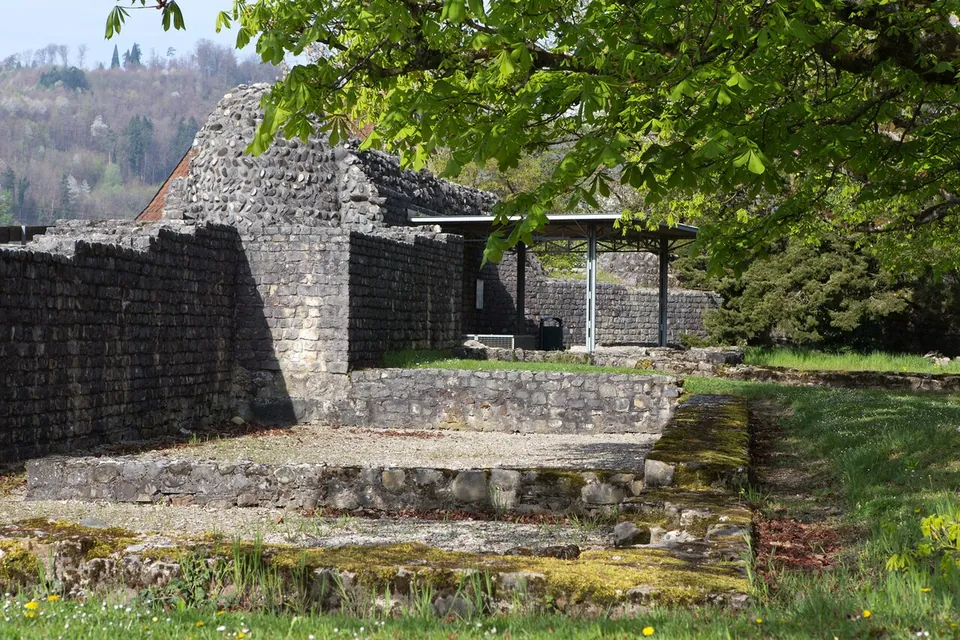
Photo: Roland Zumbuehl · CC BY-SA 3.0 · Commons
13 km · fort · Zurzach District, Aargau
Kirchlibuck fort, Bad Zurzach
On the Kirchlibuck a section of the fort's south wall has been rebuilt or restored and made freely accessible to visitors, and the foundations of the west tower survive; smaller pieces of Roman wall have also been made visible again on the buildings along the Burghaldenweg (de.wikipedia).
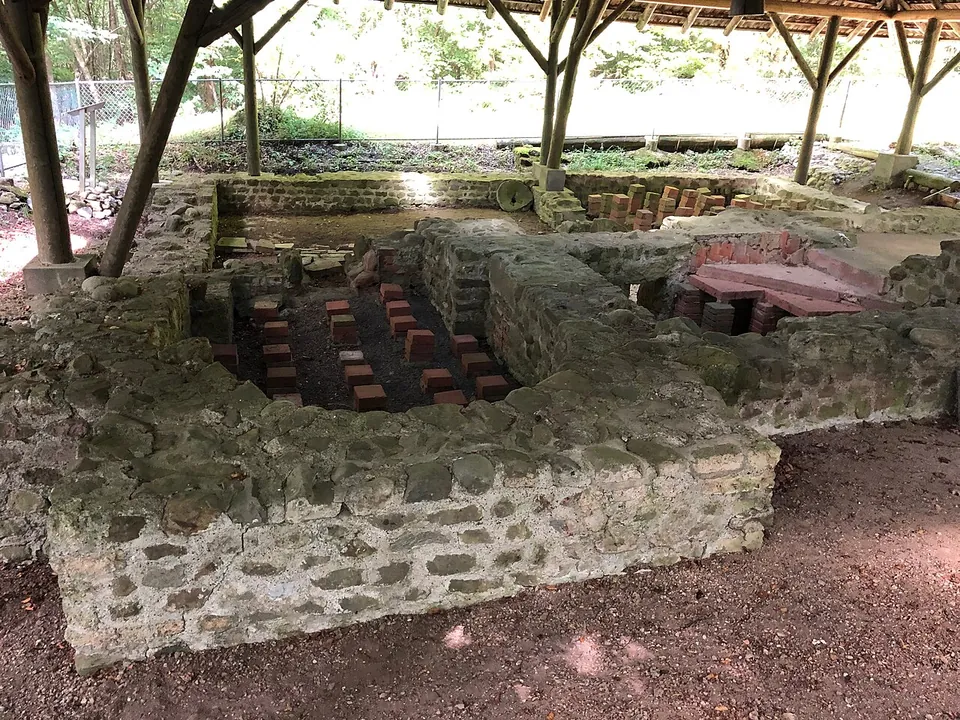
Photo: Adrian Michael · CC BY 3.0 · Commons
20 km · villa · Bremgarten District, Aargau
Roman villa of Sarmenstorf
Only the bath wing is still visible: after the excavations every other wall was covered over again, and the baths are protected by a shelter (Municipality of Sarmenstorf).
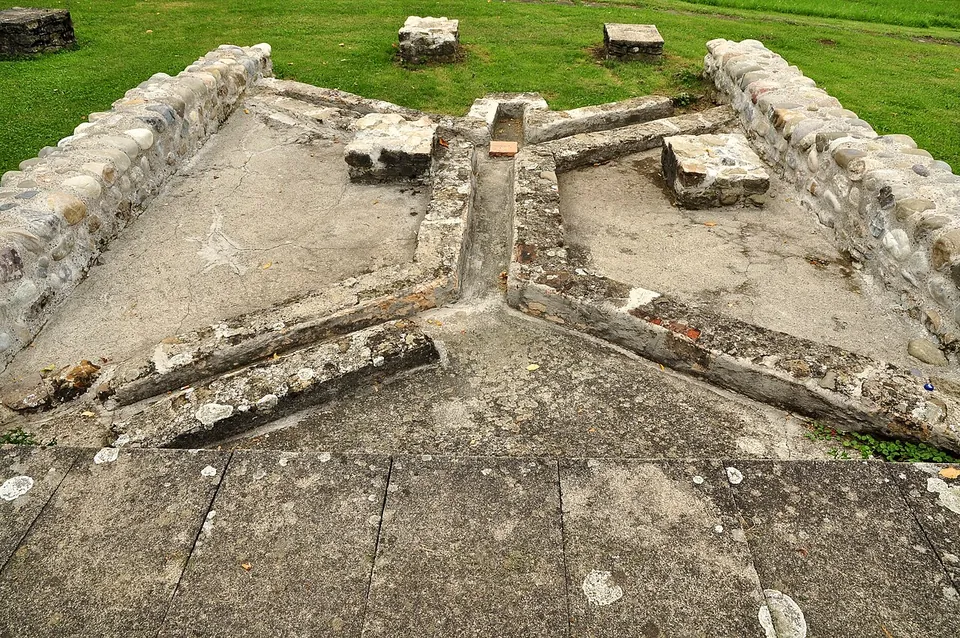
Photo: Roland zh · CC BY-SA 3.0 · Commons
24 km · villa · Bülach District, Zurich
Roman estate of Seeb
The ruins were excavated between 1958 and 1969 and partly conserved (the welcome board; it.wikipedia has systematic excavation from 1963 to 1970).


Straight-line distances.
Sources
Every fact on this page comes from the records below, each used under the licence noted.